We will be travelling through the following countries on this trip: Germany, Denmark, Czechia, Poland, Hungary, Italy, Monaco, France, Belgium and the United Kingdom.
Saturday 28 June 2025
We’ve officially begun our journey. Today was only a short hop from Canberra to Sydney, where we’re spending the night at the Rydges Sydney International. We took the Murray’s bus up, and while Maree happily settled in with her book—as she always does—I can’t say I enjoyed the ride. A few passengers were on video calls with their phone volumes cranked up, so we were treated to a running commentary from people we couldn’t see. Then the two kids behind us spent most of the trip being… enthusiastic, let’s say, while their mum didn’t seem too fussed about keeping them quiet. By the time we stepped off the bus three hours later, I was more than ready to be done.
From now on, I think I’ll fly for all Canberra connections. I still prefer the train in theory, but with the constant railworks and the inevitable crawl into Goulburn, the trip drags out to more than four hours. At least on the train you can stretch your legs.
So after settling in we went down to Smithies’ Bar at the hotel and had a bite to eat and a nice glass of Pinot Grigio. It was nice to just relax. This is why we always get to Sydney the day before we fly overseas, so we can just relax before the hectic day that comes next.
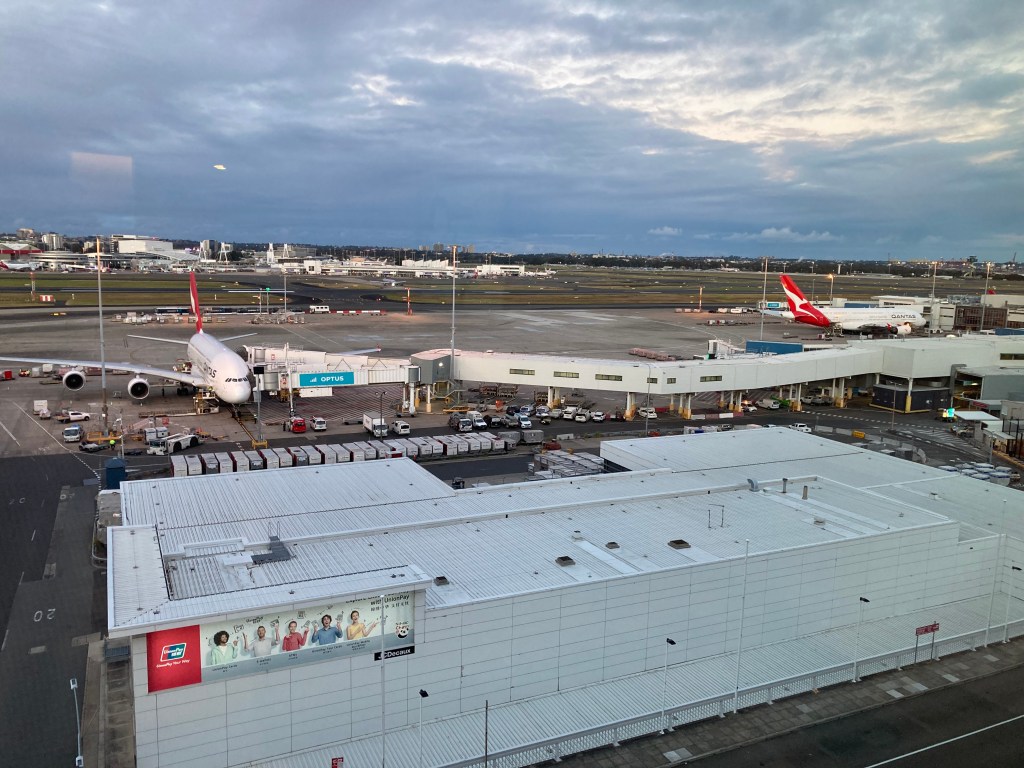
The only pic I have today is our view of the airport runways, with two of the QF A380s in the foreground.
Sunday 29 June 2025
This morning we made our way over to the international terminal to check in for our flight to Singapore. In reality, all we needed to do was drop our bags, since we’d already completed online check‑in yesterday.
Qantas uses a self‑service kiosk system at Sydney International, and it works remarkably well. You simply follow the prompts, print your baggage tags, and—if you want—your boarding passes too. Then it’s just a matter of attaching the tags and placing your bags on the conveyor belt to be scanned and whisked away to the loading area beneath the terminal. The only mildly fiddly part is getting the labels on neatly.
From there we joined the security queue, which was heaving with early‑morning departures. Even so, the process was well organised and took about 30 minutes. Immigration was next, and the E‑Gates made it quick and painless—just a short wait in the line and we were through.
Once airside, we went in search of breakfast and found a great spot: The Bistro, not far from Gate 10. Excellent food, fast service—highly recommended.
I’m not sure if I mentioned it earlier, but we decided to use Qantas frequent flyer points for the Sydney–Singapore–Sydney legs and travel in Economy. Normally we fly Business on international trips, but with Qantas fares sitting around $20,000 for two to Europe, we opted for a different approach: Economy to Singapore, then Business to Munich with Etihad. Etihad had a fantastic deal—Singapore–Munich–Singapore in Business Class for two for $8,000—so that sealed the decision. Using QF points for the Economy sectors only cost an extra $780 in taxes, so overall it worked out very well.
After breakfast we headed to Gate 10 for boarding. Qantas is using the A380 on this route. We were originally booked on the service operated by the Finnair aircraft Qantas has wet‑leased, but a few weeks ago we were moved to QF81. The crew explained that this weekend marks the end of the Singapore school holidays, so passengers from both flights were combined. The result: a completely full aircraft, not a spare seat anywhere.
The flight itself was smooth from start to finish. Because I had originally booked extra‑legroom seats on the Finnair A330, Qantas allocated us exit‑row seats on the A380. They were excellent—plenty of space to stretch out. Maree wasn’t thrilled about having nowhere to store her bits and pieces (everything has to go in the overhead lockers in those rows), but really, you don’t need much. She had her book, plus the screen and tray table for everything else. For Economy, I thought the upgrade of aircraft was excellent.
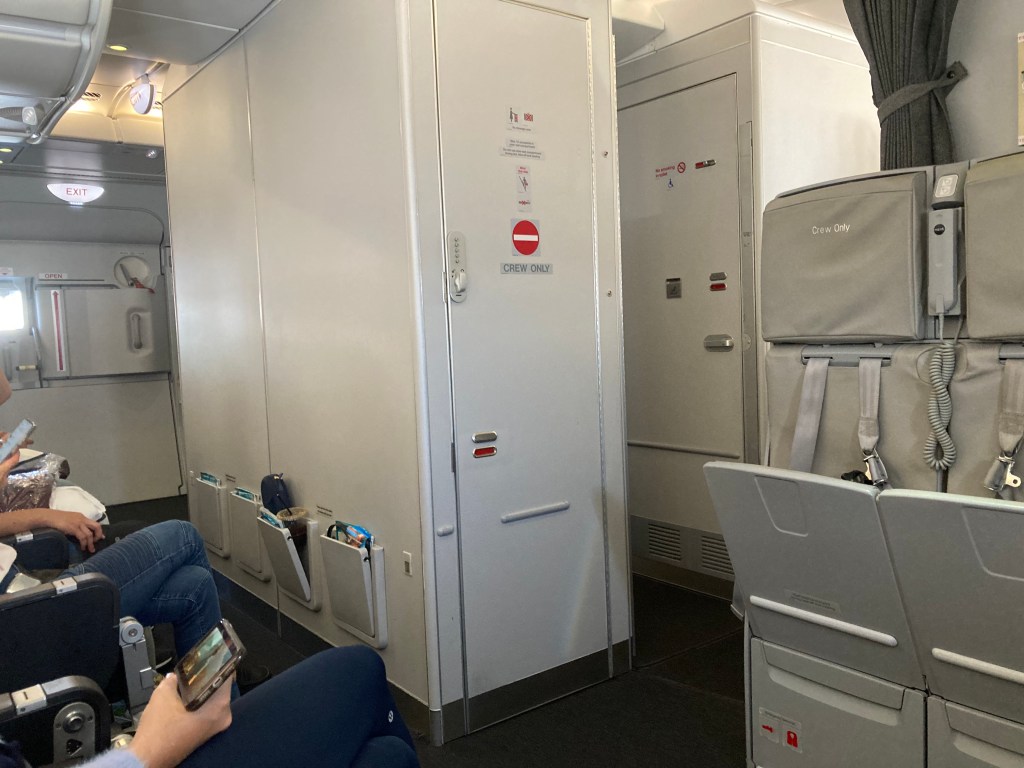
The pod you can see is the stairwell leading down to the lower deck of the aircraft—the baggage‑storage level, which also houses the crew rest areas used during breaks. Economy occupies the entire lower level, with First Class at the front of the main deck and Business and Premium Economy located above us on the upper deck.
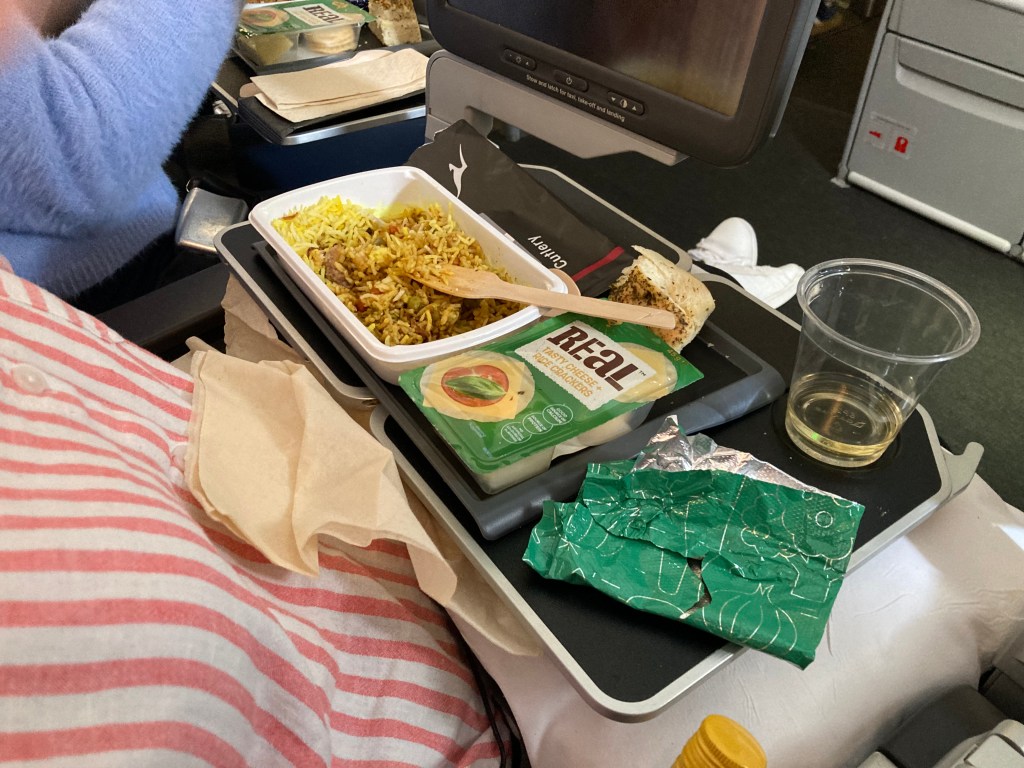
Lunch was served about two hours into the flight, and by the time the trolley reached our row the meat and chicken options had already disappeared. We ended up with the vegetable biryani. It was fine, just not what we would have chosen. The cabin crew were very apologetic, repeatedly explaining that they’d run out of the other meals.
What really stood out, though, was how well the crew looked after us. They checked in on us regularly, made sure we had first choice for the second meal service, and kept asking whether we needed anything. I’m not sure if it was because we’ve held QFF status for so many years or simply their natural hospitality, but it was genuinely appreciated.
We arrived in Singapore safe and sound—as you’d expect with a solid Qantas crew. Immigration took only a couple of minutes thanks to the E‑Gates, and then we waited for our bags. With an Apple AirTag tucked inside, there was no need to hover anxiously by the carousel; the moment the bag hit the belt, my phone let me know. Those tags really are brilliant.
A quick taxi ride took us to the Hotel Plaza on Scotts Road. Later, we wandered over to PS Café on Orchard Road for dinner. We both had a delicious laksa, paired with a Pinot Grigio for Maree and a local craft beer for me. Afterwards, it was straight back to the hotel for an early night.
Even though the flight to Singapore was pleasant enough, I did miss the comfort of Business Class. Still, the best part of the trip is just ahead—we leave Singapore on Tuesday evening for Munich.
Night all.
Monday, 30 June 2025
Today we decided to take things slowly and enjoy a gentle walk along Orchard Road, one of Singapore’s main shopping streets. Since we’ll be returning at the end of our Europe trip, we’ve saved the sightseeing for later. We’ve visited Singapore many times and have already ticked off most of the major attractions.
We spent a relaxed few hours wandering in and out of the shops. I told Maree to keep an eye out for anything she liked and we could pick it up on our return. So far, the bank balance remains untouched.
We began the morning with breakfast at Starbucks—there’s one just a minute from the hotel, and their breakfast options and coffee are reliably good. From there, we set off, heading down several escalators to cross the busy intersections. Our hotel is only about three minutes from the Orchard/Scotts Road junction, and the traffic there is constant.
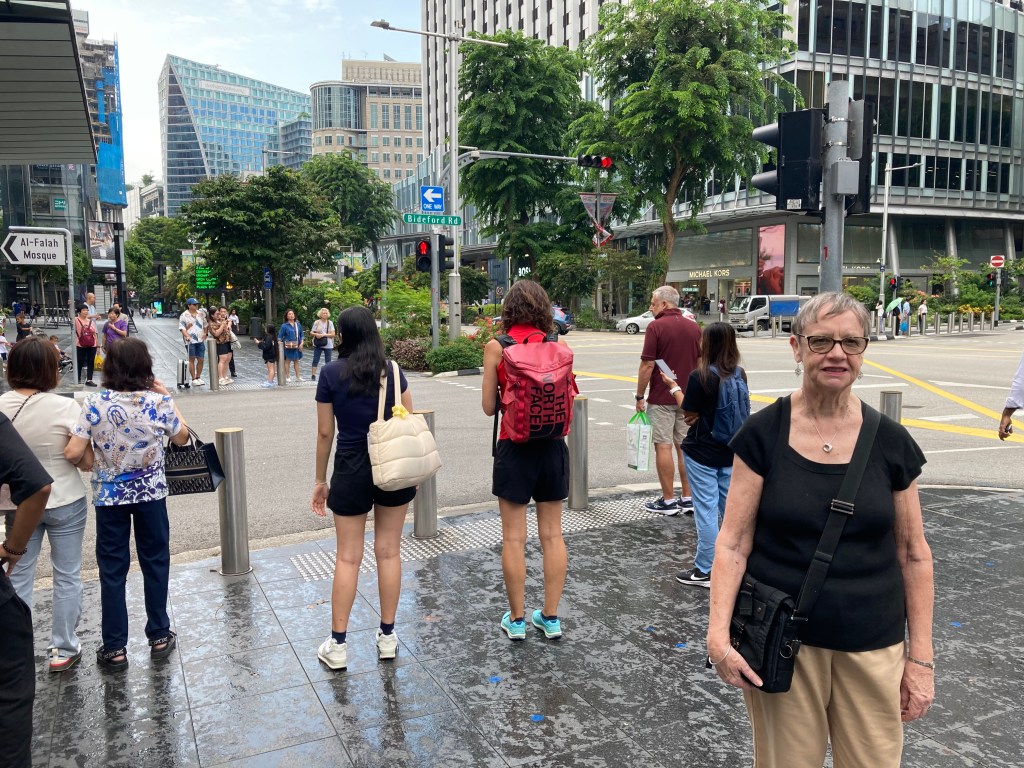
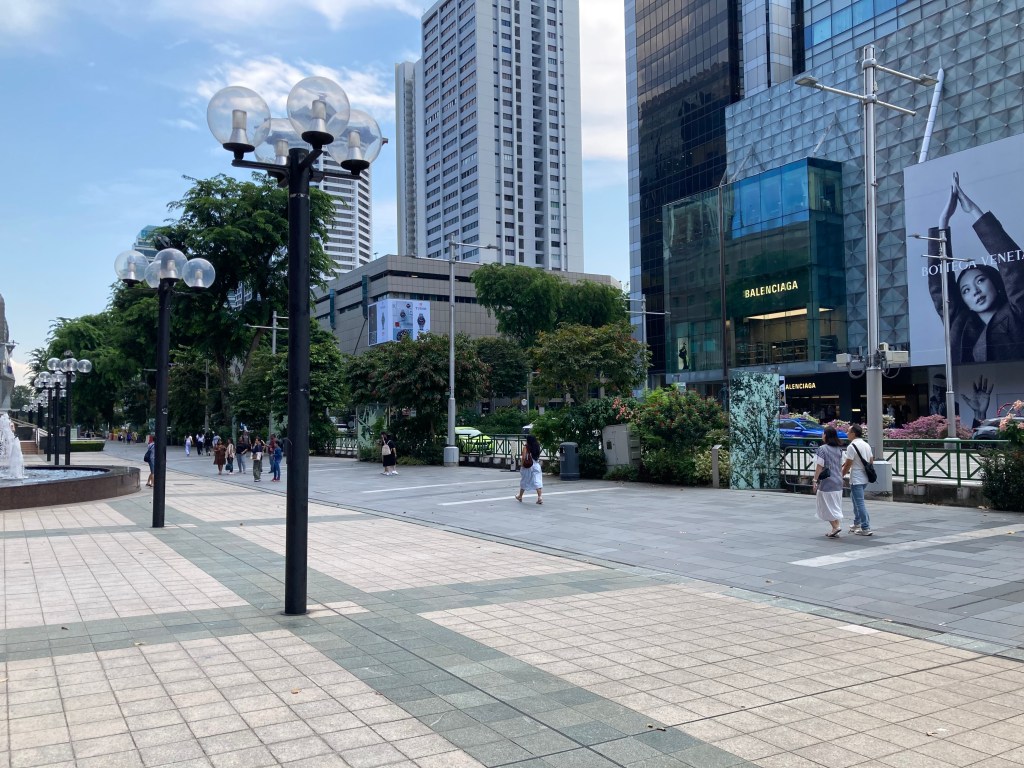
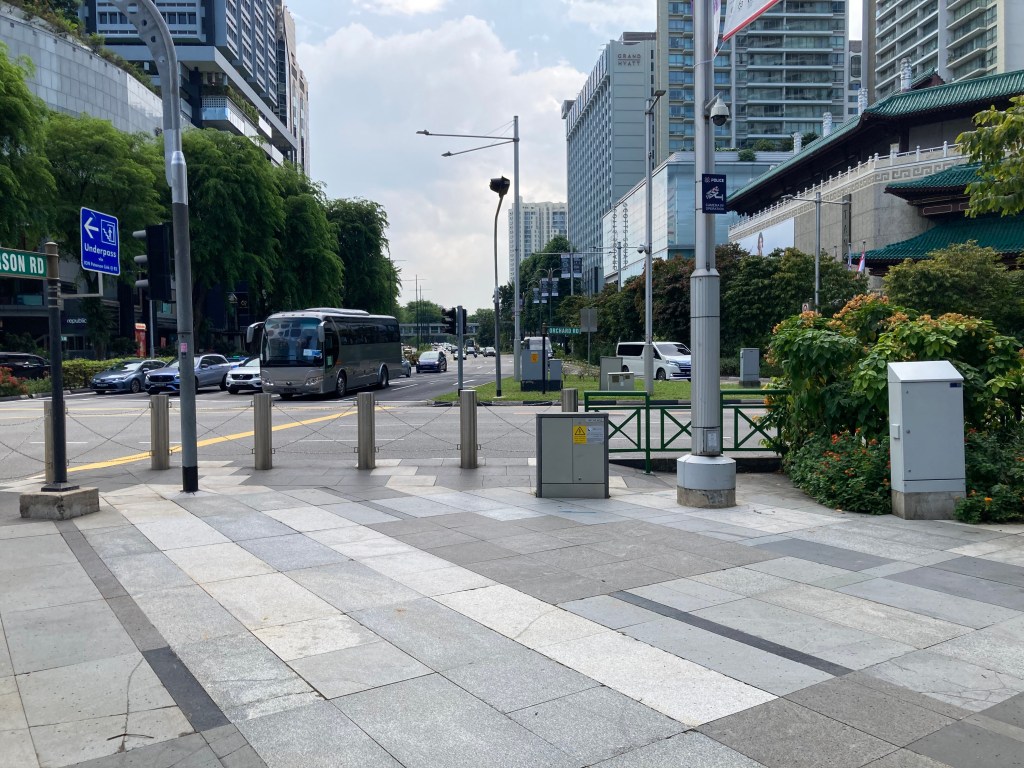
After a while we stumbled upon another Starbucks and decided it was the perfect place to stop for lunch and cool down. The temperature was around 30 degrees, which isn’t too bad, but the humidity was high enough to make walking a bit sticky. After lunch, we took a few photos of the ebb and flow of Orchard Road’s pedestrian traffic—some areas bustling, others surprisingly calm.
We then came across these statues as we were returning to the hotel.
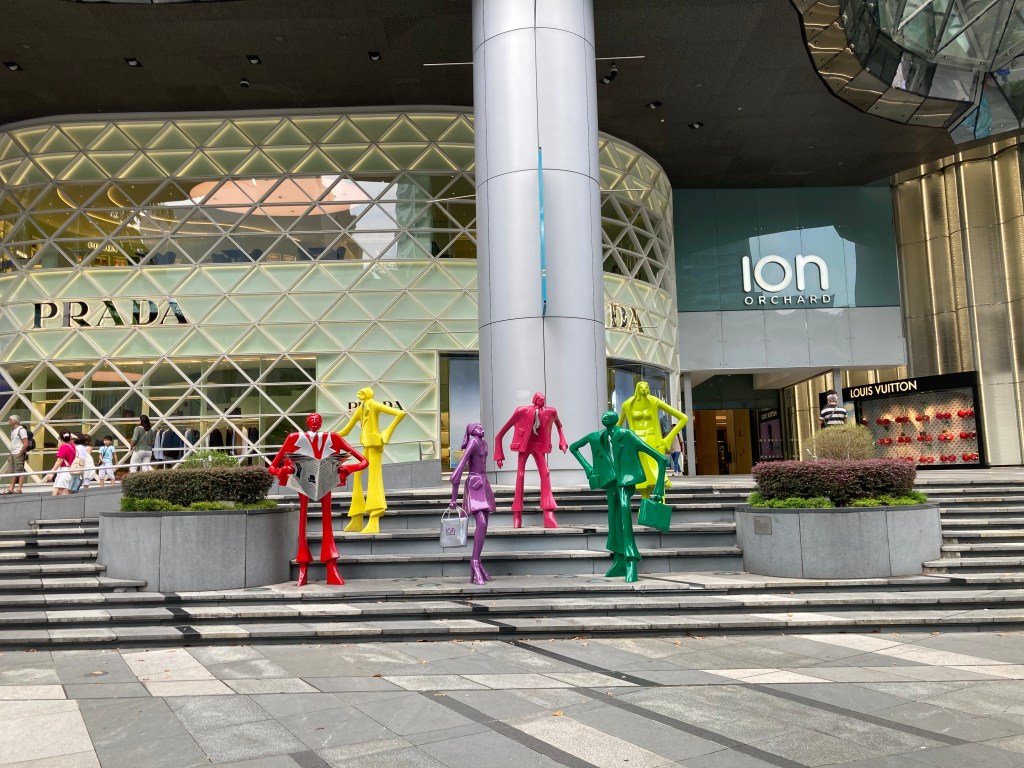
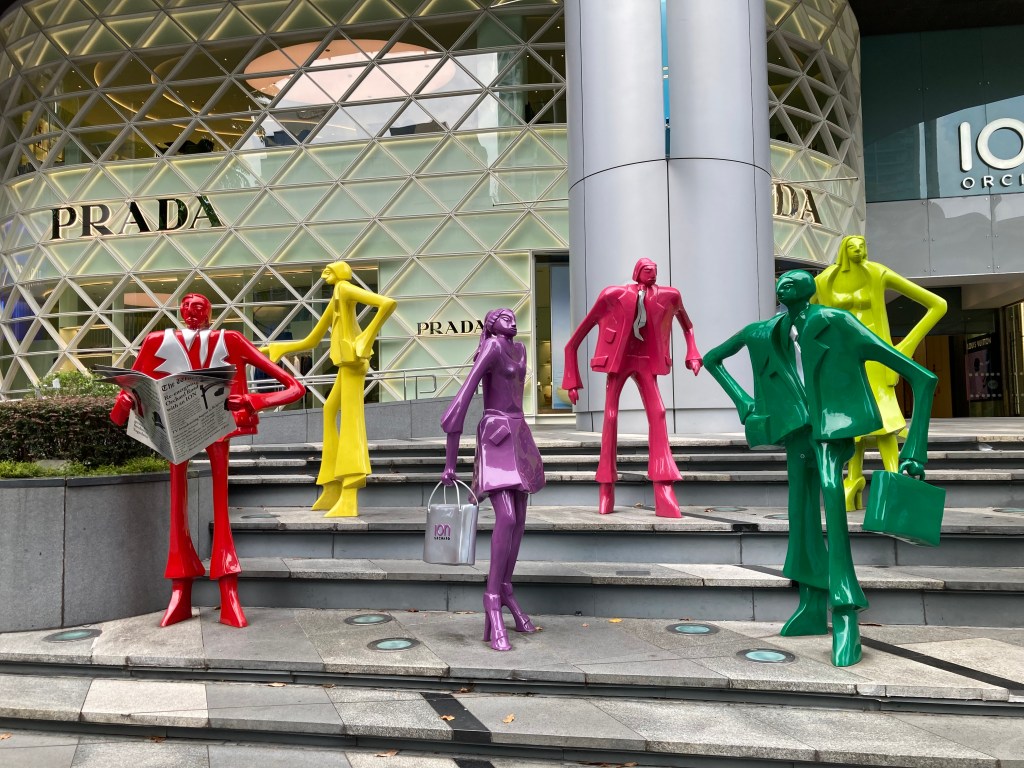
These statues were created by Kurt Laurenz Metzler and are titled Urban People. The installation features six aluminium figures representing everyday urban life in Singapore, and they stand just outside the Prada store.
We headed back to the hotel for a relaxed afternoon before returning to PS Café for dinner. Last night’s meal was excellent, so we decided to go again—and it didn’t disappoint. The servings were generous, the flavours bold, and it was a lovely way to spend our final evening in Singapore. We enjoyed a couple of wines and soaked up the atmosphere before our return visit on 11 September.
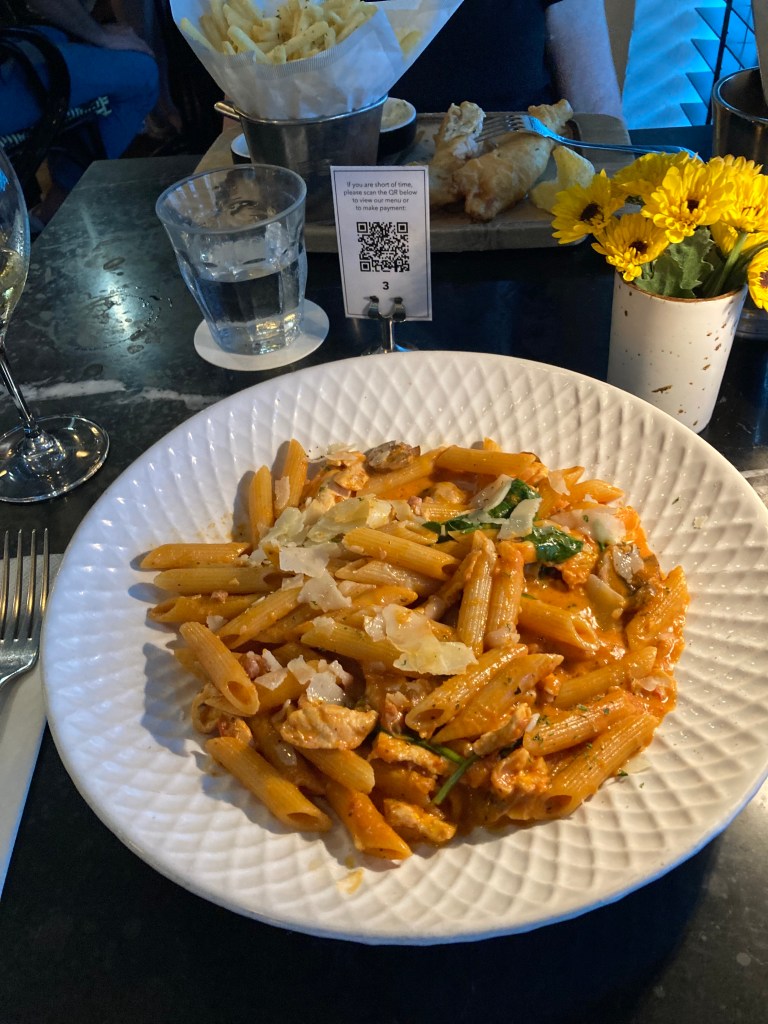
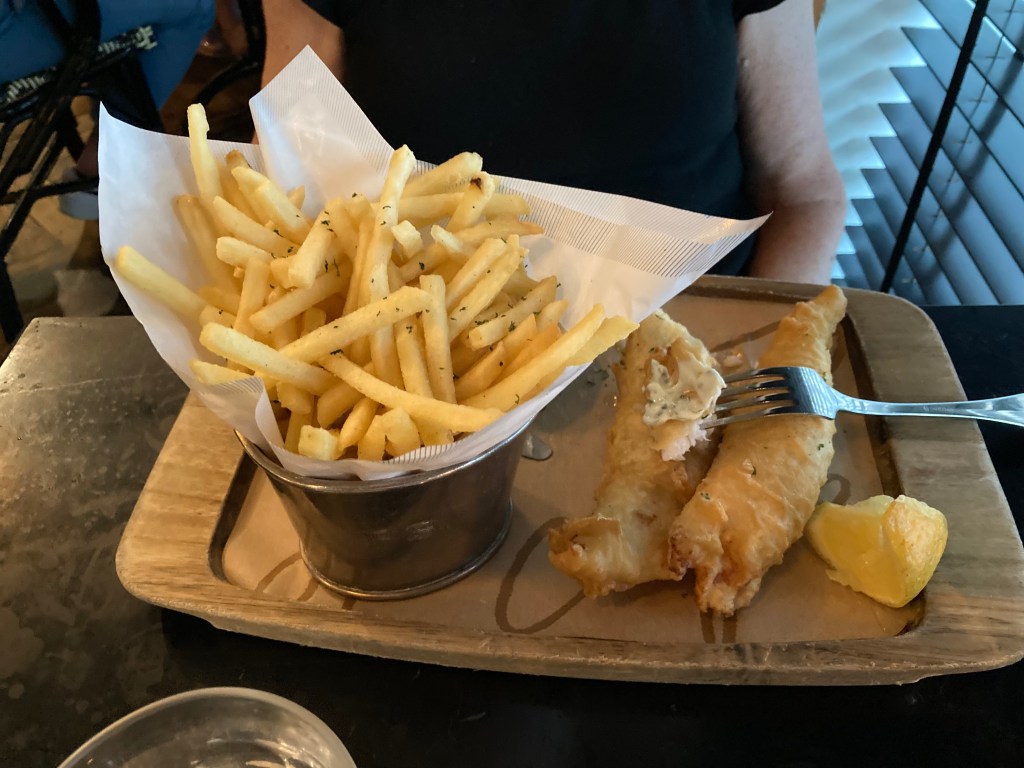
Following are images taken in the PS Cafe.
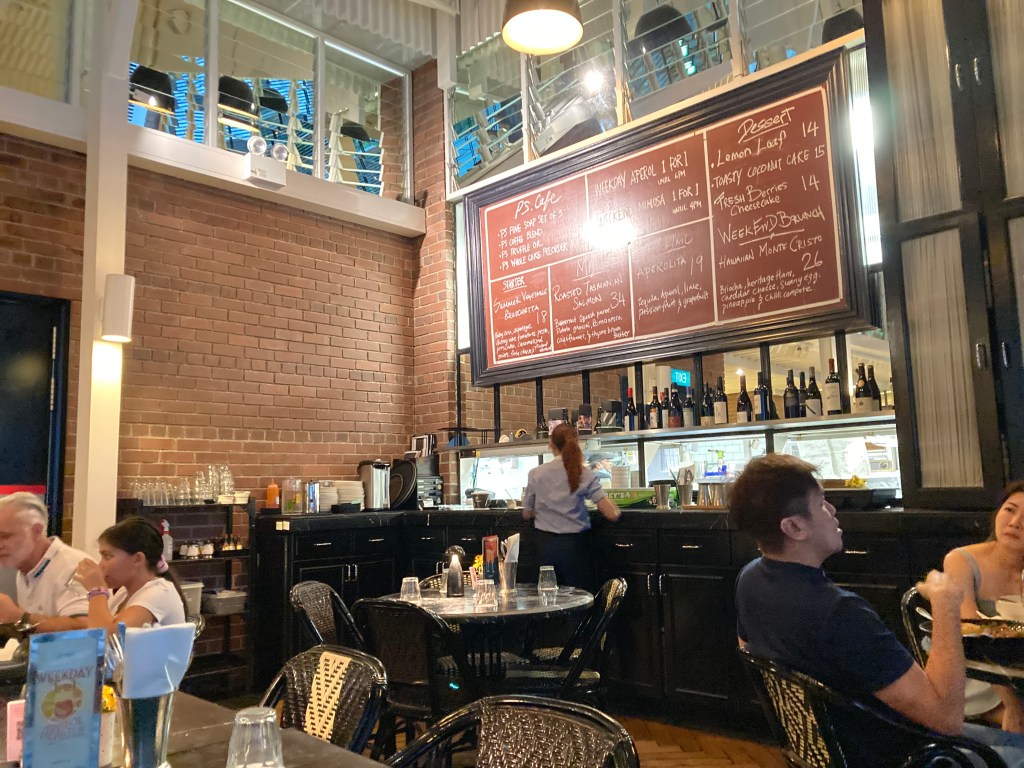
My pasta dish.
Maree’s fish and chips
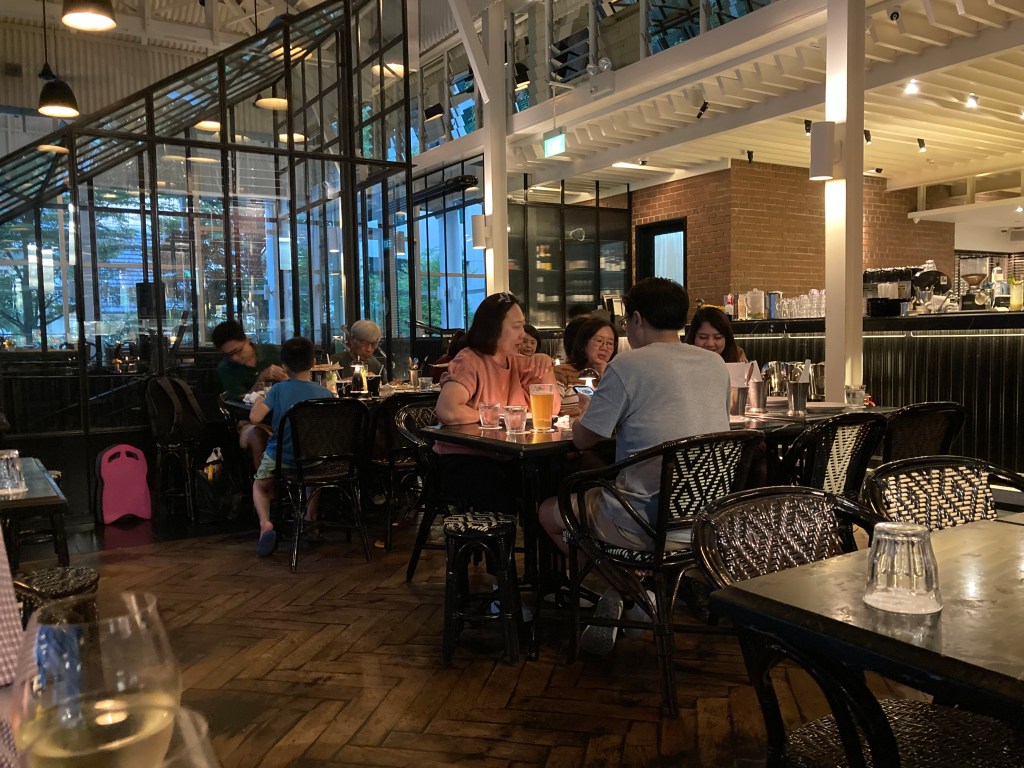
Eating out in Singapore isn’t cheap, but the atmosphere—people everywhere, the energy of the city—makes it worth it. Our bill came to $222 for two courses and wine, with the wine, unsurprisingly, being the priciest part of the meal.
Tomorrow we have a late checkout, as our flight to Munich doesn’t depart until 21:00.
Tuesday, 1 July 2025
We started the morning with breakfast at Starbucks again. The hotel restaurant is perfectly fine, but neither Maree nor I feel like a big breakfast to kick off the day. After eating, we wandered out to pick up a few snacks for the long flight to Europe. The onboard meals will be fine, but it’s always nice to have a few extras within reach.
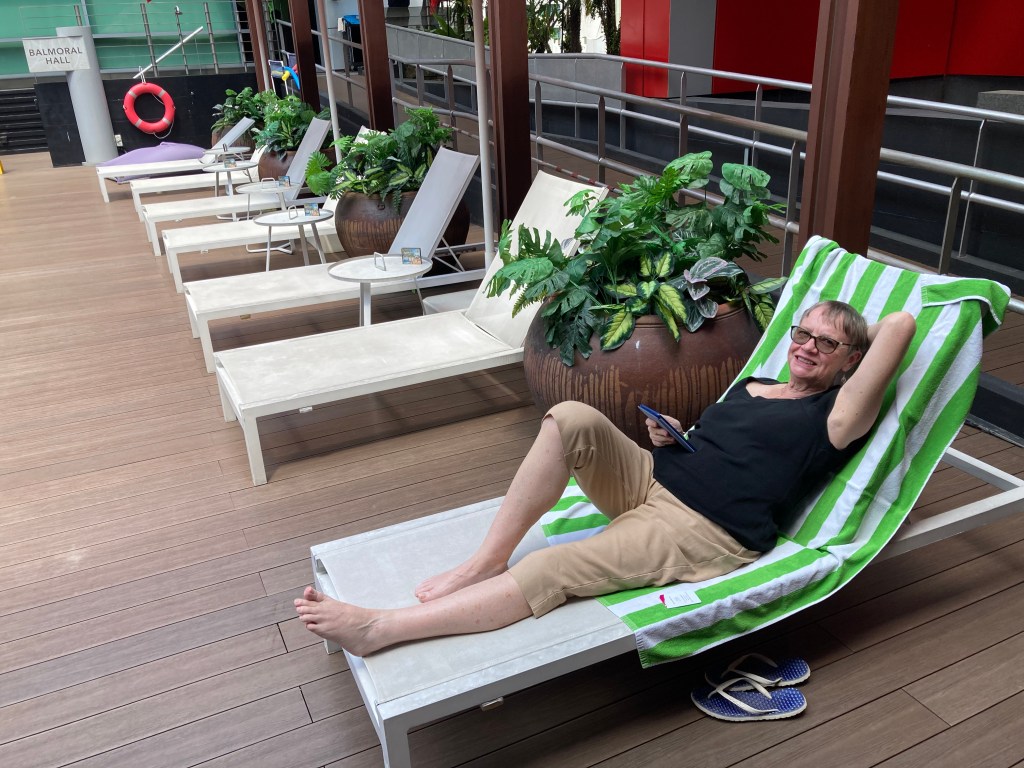
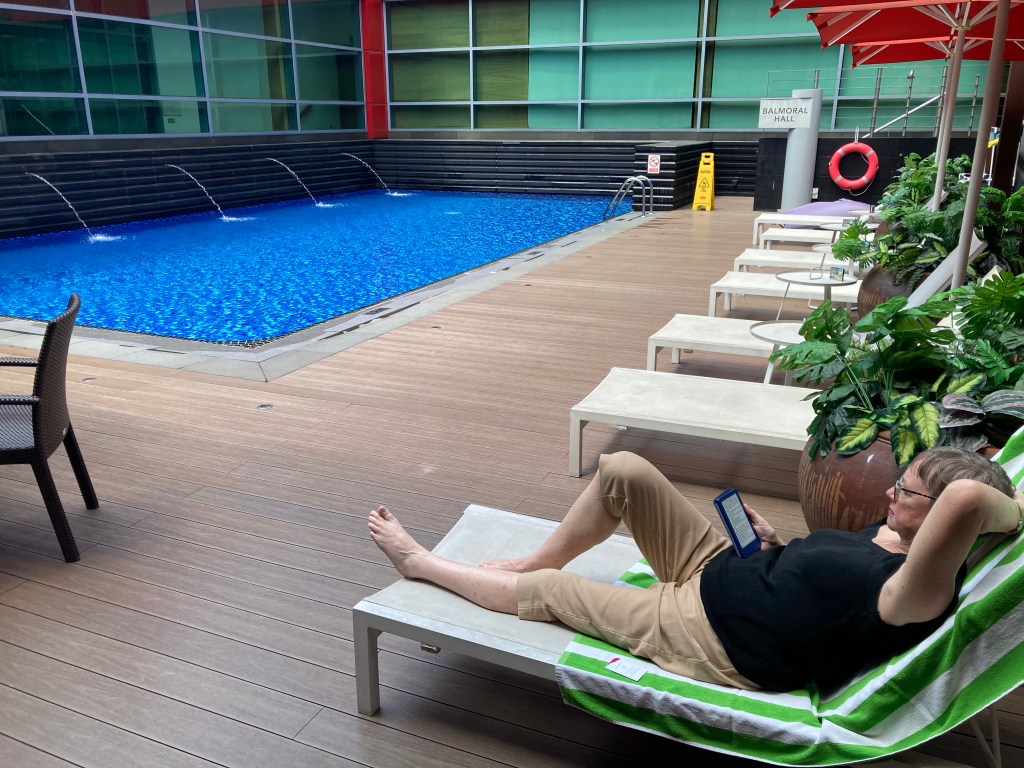
Maree spent the afternoon relaxing by the pool, making the most of the warm weather before our long journey ahead.
We checked in for our Etihad flight yesterday afternoon, ahead of tonight’s 21:00 departure. When I looked over the details, I noticed there had been an aircraft change: Etihad has downgraded the service from the A380 to the 777LR. It’s probably due to the end of the Singapore school holidays and a drop in demand for the larger aircraft. The only downside is that the 777LR has fewer Business Class seats, and for some reason our seat assignments were changed. Even though the same seat numbers exist on the 777LR, the system seems to have reassigned us automatically. We were originally seated together, but now Maree is in 8A and I’m in 12K—both window lie‑flat seats, just four rows apart. We’ll see if we can sort that out at the airport when we collect our boarding passes.
It’s not a major issue, as it’s only a 6½‑hour sector to Abu Dhabi, and from Abu Dhabi to Munich we’re seated together on the 789. Still, it would be nice to sit together all the way.
We’re scheduled to arrive in Munich at 06:40 local time (14:40 AEST) on Wednesday and will head straight to the hotel. I managed to get a good deal by booking the room for the night before our arrival, which means we can go straight in and rest if we’re tired. The hotel even invited us to have breakfast if we arrive before 10:00am, and I’m sure we will.
So, probably nothing more to add until we reach Germany.
I checked FlightRadar24 to see whether our aircraft had arrived in Singapore at its scheduled 09:40 time. To my surprise, it had only just departed Abu Dhabi at 12:00 Singapore time. Fortunately, Etihad is only showing a 30‑minute delay to our departure, which still gives them a standard two‑hour turnaround. Hopefully that remains the case.
Wednesday, 2 July 2025
The flight went according to plan. We left Singapore for Abu Dhabi about 30 minutes late but still arrived on time. The captain clearly made up the difference en route, though it came at the cost of a smooth ride. We had light turbulence for most of the journey, and because the pilots were trying to claw back time, they didn’t slow down through it. The result was a fairly bumpy flight at times.
It didn’t worry me—I slept for five of the seven hours. And when you look at the Business Suite, it’s easy to see why.
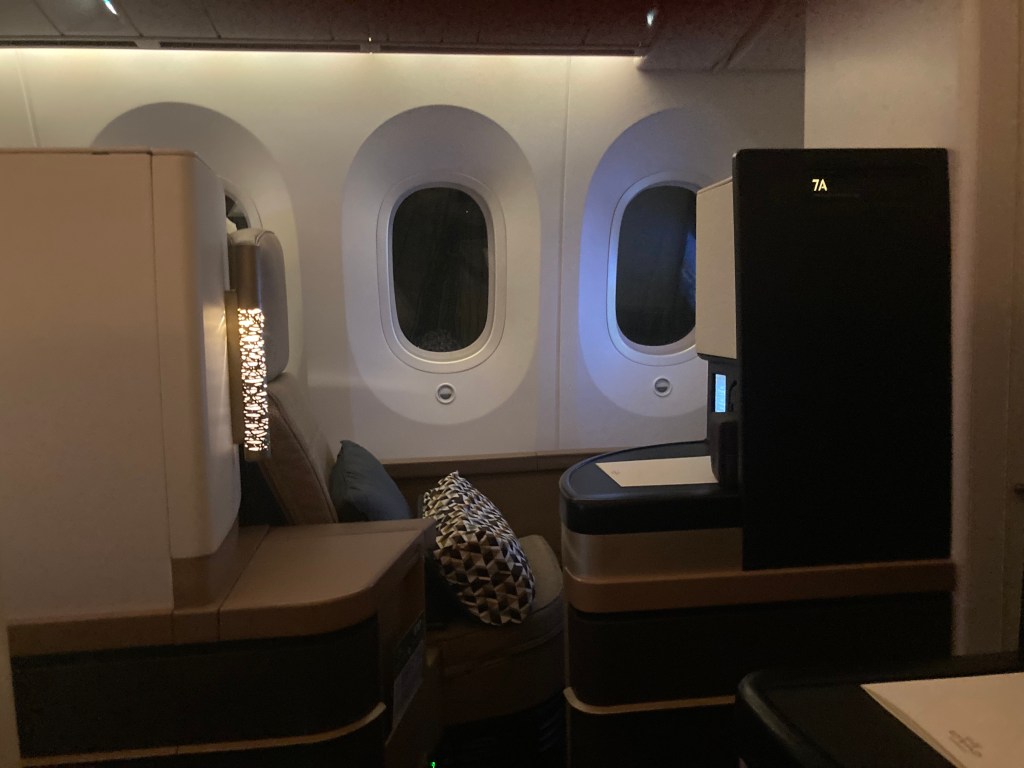
After a brief stop in the Etihad Business Lounge in Abu Dhabi, we made our way to the Munich flight. It was a short six‑hour sector, and I managed to squeeze in another couple of hours’ sleep before we touched down in Munich at 06:20 this morning.
Once we cleared immigration, we headed straight for the S‑Bahn into Munich’s Central Station. From there it was only a short walk to our hotel for the next six nights.
The Jedermann Hotel is a family‑run property, and I chose it because it was reasonably priced and close to the main station. It’s a pleasant hotel overall, but our room did come with a few surprises. The air‑conditioning, for instance, isn’t quite delivering the coolness I was hoping for. We’ve set it to 18 degrees—because you know me, it has to be cool—but despite running all day, the room is sitting closer to 22. Then there’s the lack of a refrigerator. They do have a small communal fridge downstairs where guests can store items, provided everything is labelled. It feels a bit like using the camp kitchen when we’re out with the caravan. And finally, the bathroom is missing the usual basics—shampoo, conditioner, soap—but a quick trip to a local shop sorted that out, along with bottled water and a bottle of wine for later.
After our errands, we returned to the hotel for a rest before heading out to Marienplatz.
Marienplatz, the city’s central square, has been the heart of Munich since its earliest days. Although it’s now named after the Marian Column in its centre, it was originally known as Schrannenplatz—Grain Market Square—because it served as the main marketplace in medieval times. We spent some time exploring the area and taking in the sights.
One of the highlights is the Mariensäule, or Column of St Mary, erected in 1638 to celebrate the end of the Swedish occupation. The column is crowned with a golden statue of the Virgin Mary and surrounded by four cherubs, each representing Munich’s triumph over war, plague, heresy, and famine.
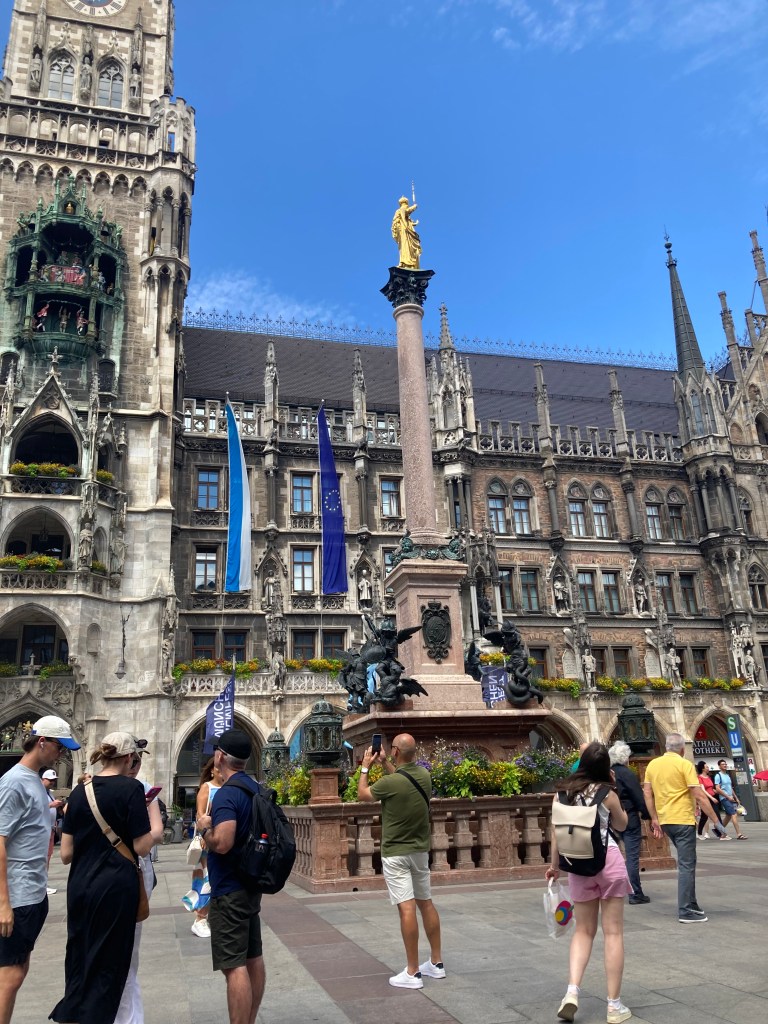
Neues Rathaus, or the New Town Hall, is an impressive Neo‑Gothic landmark that has housed Munich’s city government since it opened in 1874. Its façade is adorned with grotesque gargoyles, a dragon climbing one of the turrets, and—most famously—the glockenspiel. Each day at 11:00 and 12:00, its 43 bells and 32 figures spring to life, reenacting a historic jousting tournament followed by the Schäfflertanz, the traditional coopers’ dance.
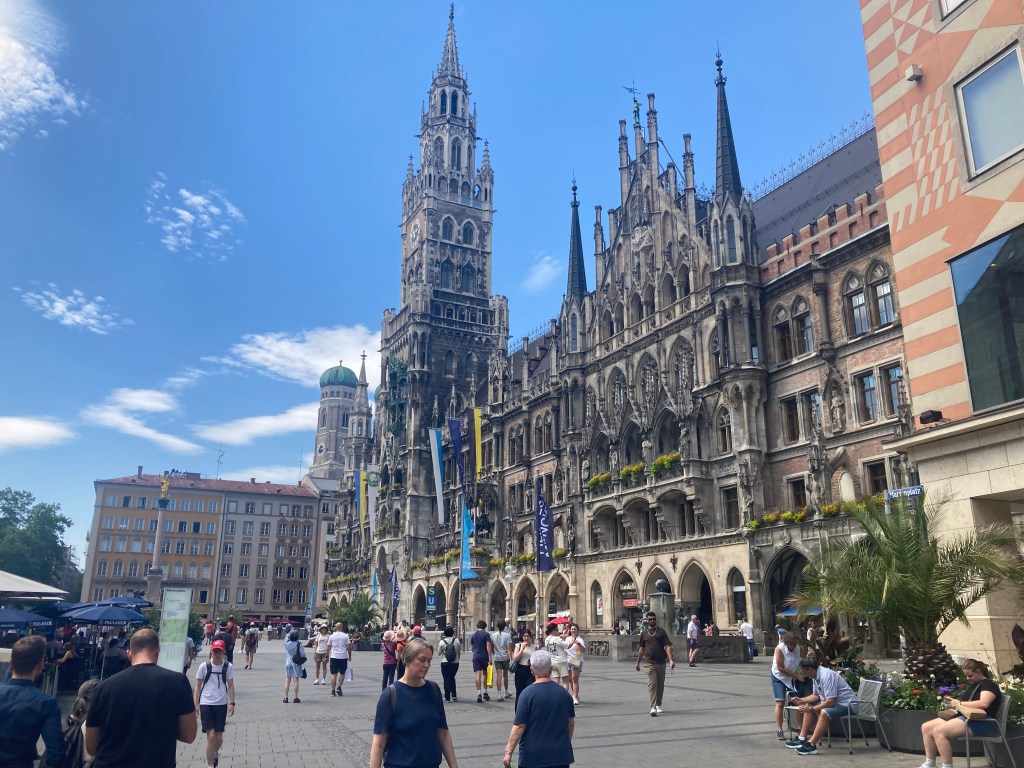
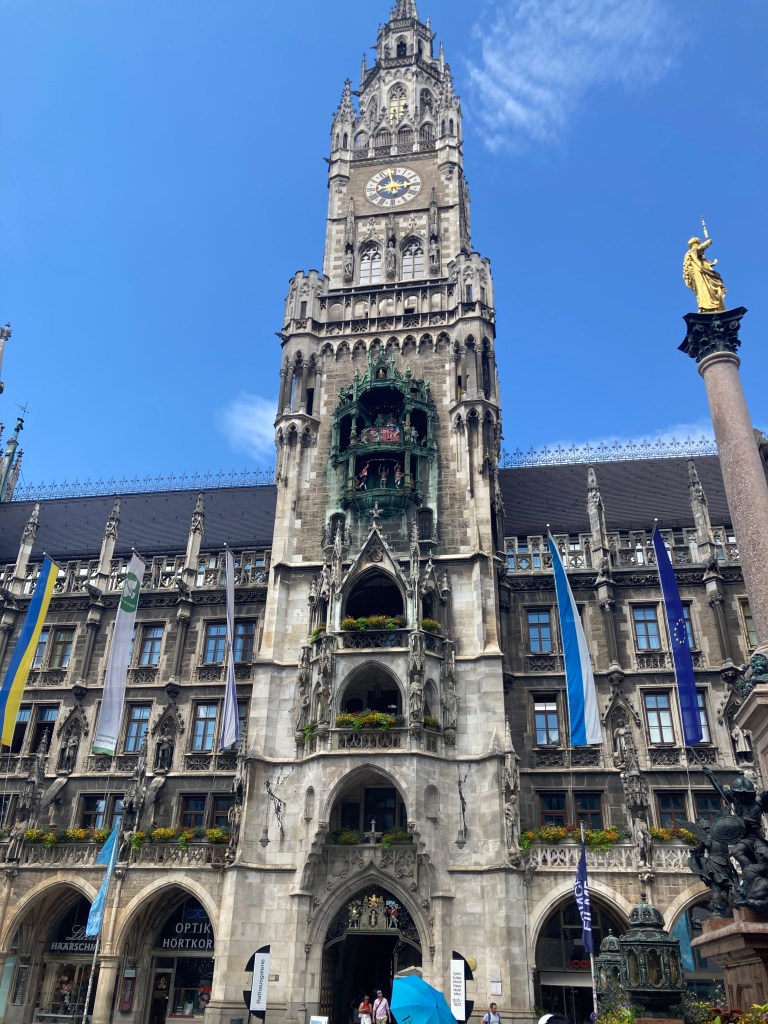
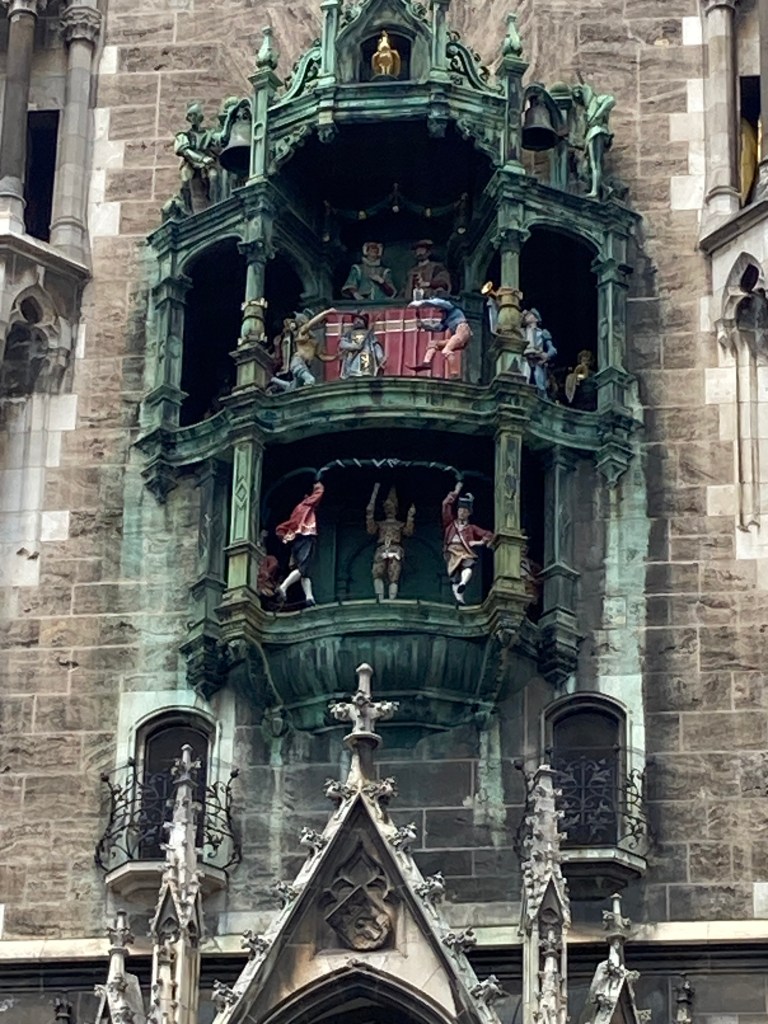
As the temperature hovered around 30 degrees, we decided it was the perfect moment to sit down and enjoy something cold. We ordered two small beers—after all, when you’re in Germany, sampling the local brews feels almost mandatory.
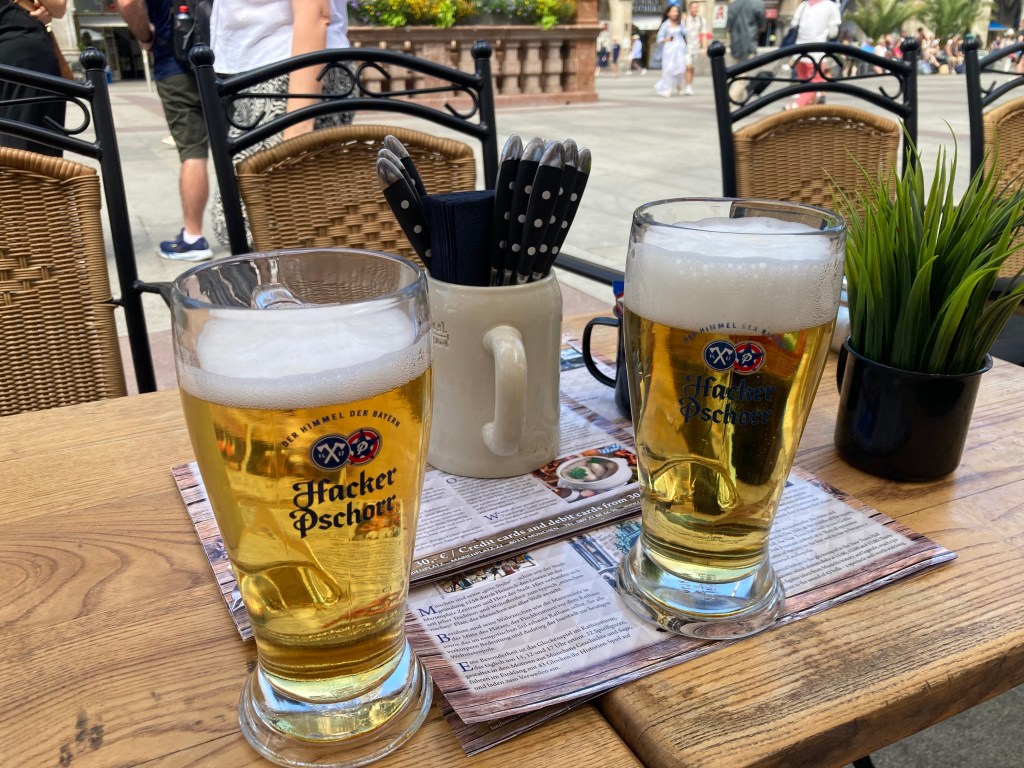
The smallest size is half a litre. Nice and refreshing and a great taste.
After a couple of hours of wandering, we returned to the hotel for another short break—understandable, given we’d just travelled 15 hours from Singapore to Munich and the jet lag was beginning to catch up with us.
Around 7pm we headed out again, this time to an Italian restaurant just two doors down from the hotel. As we stepped outside, a loud crack of thunder rolled overhead. There wasn’t much rain, but the thunder rumbled on for a good ten minutes.
Once inside, we settled in and ordered a lovely bottle of Italian Pinot Grigio—complete with a proper cork—before choosing our mains.
And yes, Maree was happily enjoying her wine, as always.
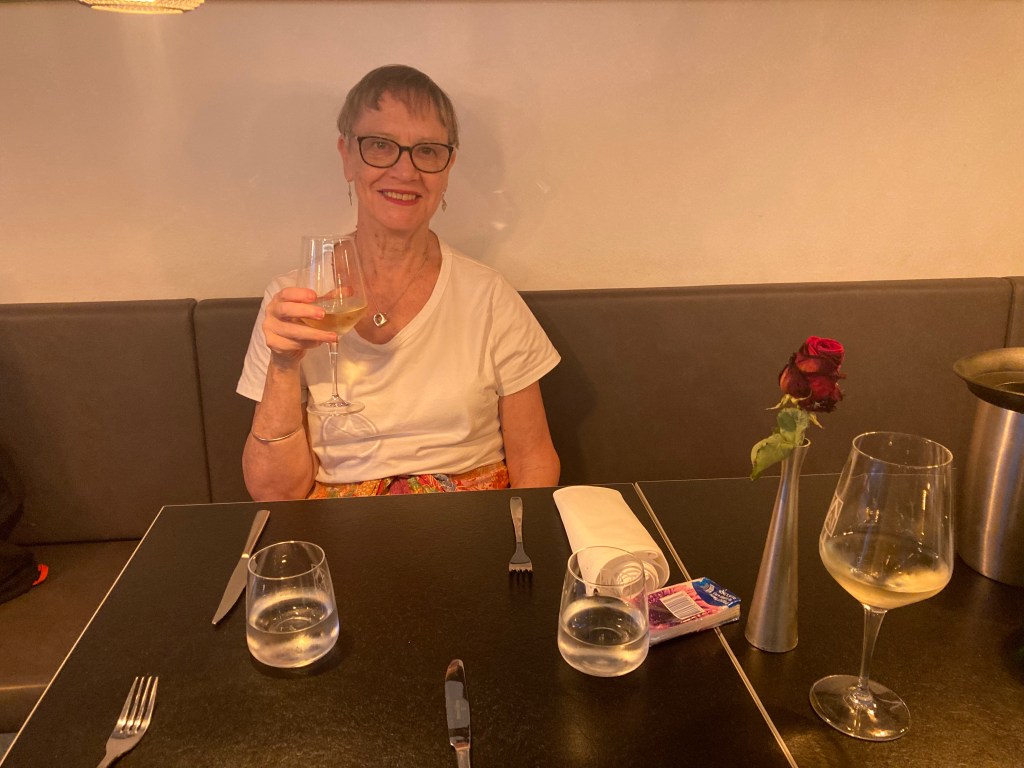
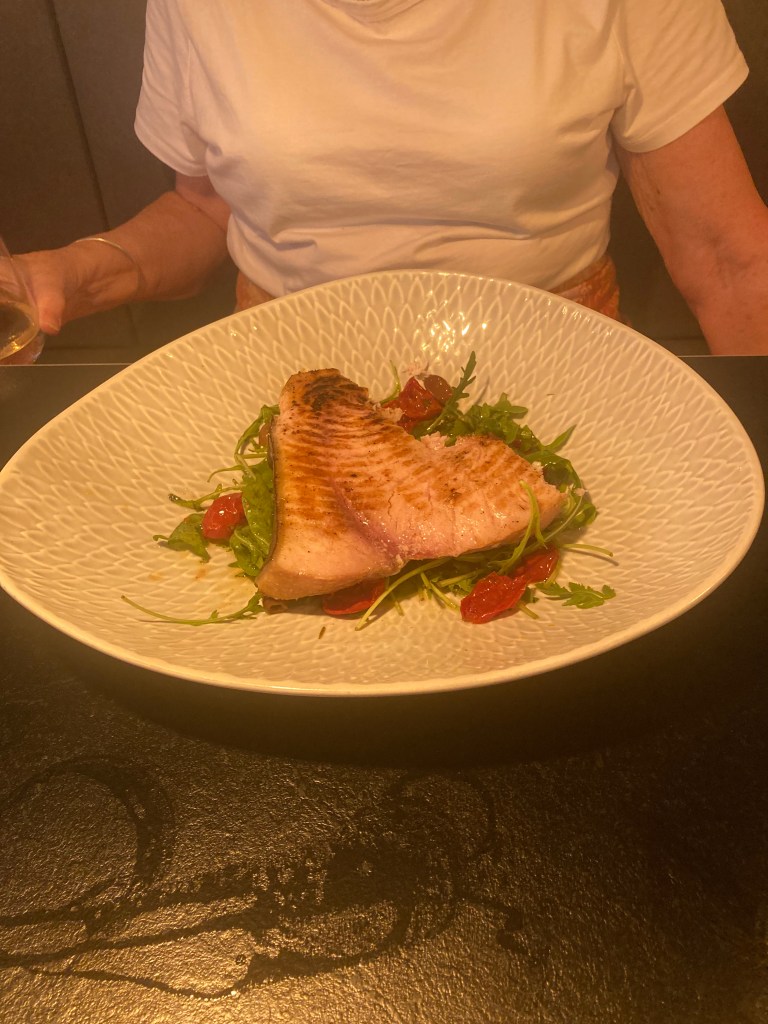
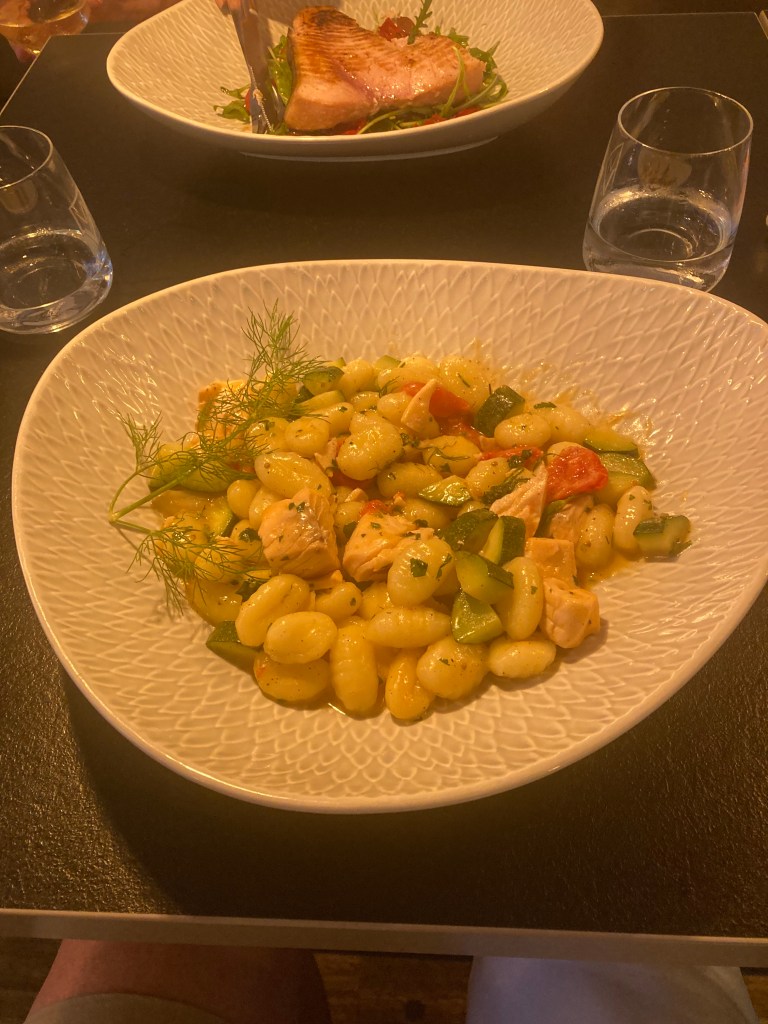
Maree chose the grilled swordfish, while I couldn’t resist the homemade salmon gnocchi. The restaurant is run by Italians, and it shows—the dishes were authentic, beautifully prepared, and absolutely first‑rate.
Maree’s swordfish
My gnocchi.
After a lovely evening, it was time to call it a night. Maree was already well on her way to dreamland—she never sleeps particularly well on planes, even with lie‑flat beds, so tonight she’ll make up for it.
Thursday, 3 July 2025
This morning we headed back to Marienplatz in the old town to watch the Rathaus‑Glockenspiel as it reenacts scenes from Munich’s history. The first tableau tells the story of the 1568 marriage of Duke Wilhelm V to Renata of Lorraine, followed by the Schäfflertanz—the traditional coopers’ dance.
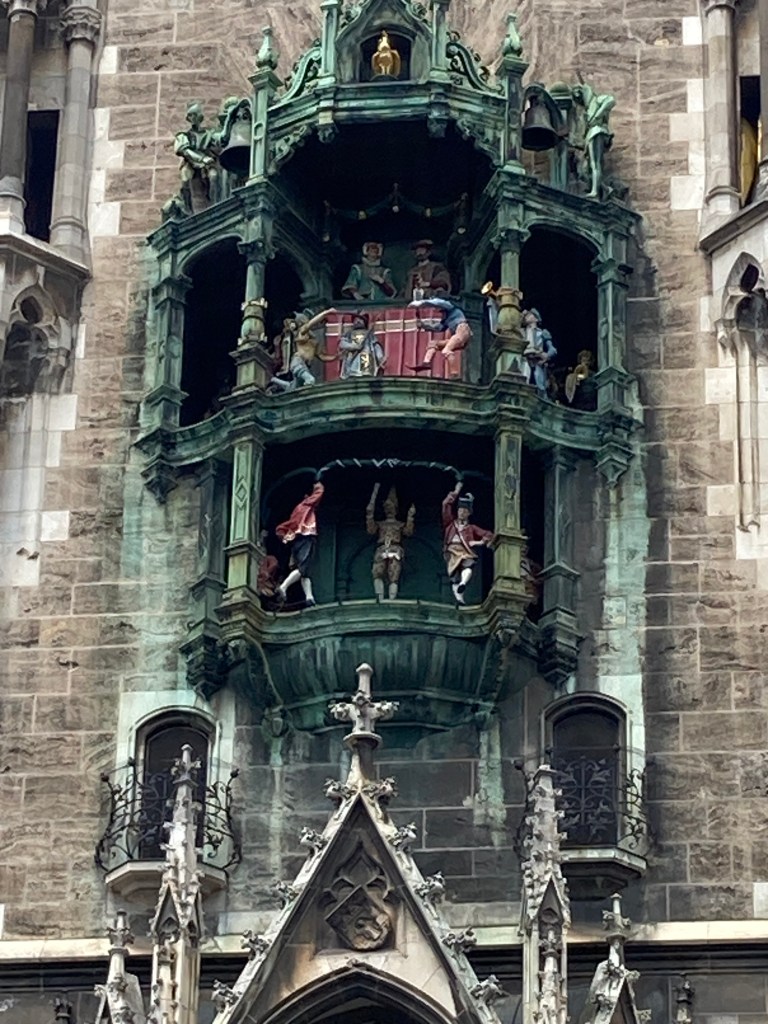
After watching the glockenspiel performance, we wandered around the square and came across a group of musicians playing classical pieces. They had a small ensemble of string instruments, accompanied by a flutist and a pianist. While we were there, they performed Palladio by Karl Jenkins and then the Game of Thrones theme—both beautifully done. I recorded the reenactment and the musicians and will upload the videos later this evening. I need to recreate them in YouTube before adding them to the blog.
After leaving Marienplatz, we returned to the hotel for a short break before heading out again for a bit of shopping. All in all, a very leisurely day.
Tomorrow we’re off to the village of Hohenschwangau, home to Neuschwanstein Castle. More on that adventure tomorrow.
Thursday, 4 July 2025
We left the hotel around 09:15 to catch the regional train departing Munich Hauptbahnhof at 09:41 for the town of Füssen. The two‑hour journey took us through the Bavarian countryside, and from Füssen we hopped on a local bus to Hohenschwangau—a quick ten‑minute ride. We arrived in the village just after midday. Our tour of Neuschwanstein Castle is booked for 13:30, giving us plenty of time to explore before heading up.
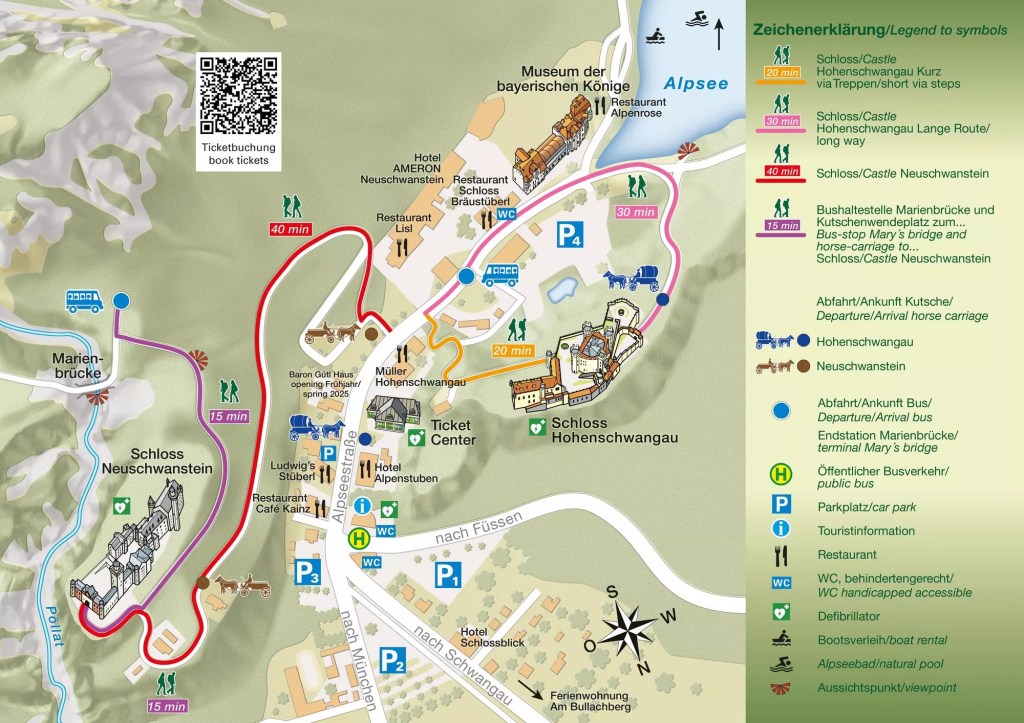
The walk to the castle is quite steep, which is why they offer transport for those who prefer not to tackle the climb. We opted not to walk—it’s a solid 40‑minute uphill trek and definitely requires a good level of fitness.
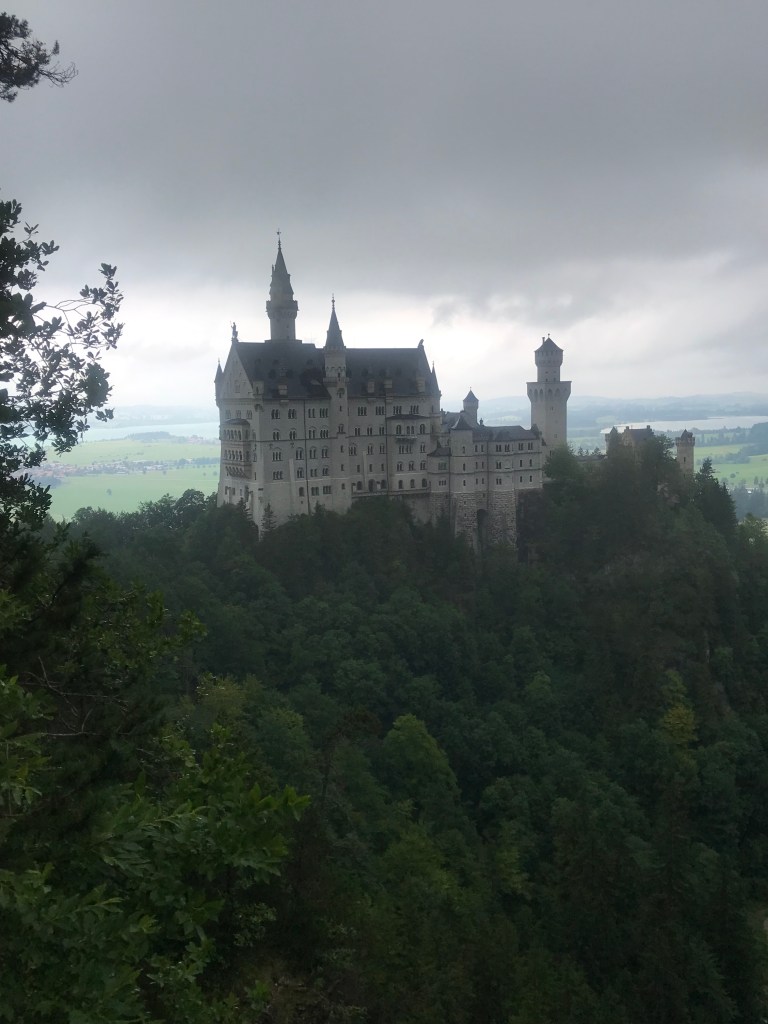
Schloss Neuschwanstein
Neuschwanstein was commissioned by King Ludwig II of Bavaria (1845–1886). Construction began in 1868, though the castle was never fully completed. Ludwig envisioned it as a tribute to the medieval ideals of kingship and culture that he so deeply admired. Although designed and furnished in a romanticised medieval style, it was fitted with the most modern technology of its time, making it one of the world’s most iconic examples of historicist architecture.
The castle sits dramatically on a rugged hill in the foothills of the Alps, in Germany’s far south near the Austrian border. It belongs to the municipality of Schwangau and overlooks the village of Hohenschwangau, home to the castle of the same name. Neuschwanstein rises above the narrow Pöllat Gorge, with the Alpsee and Schwansee lakes lying just to the west—an extraordinary setting for an extraordinary building.
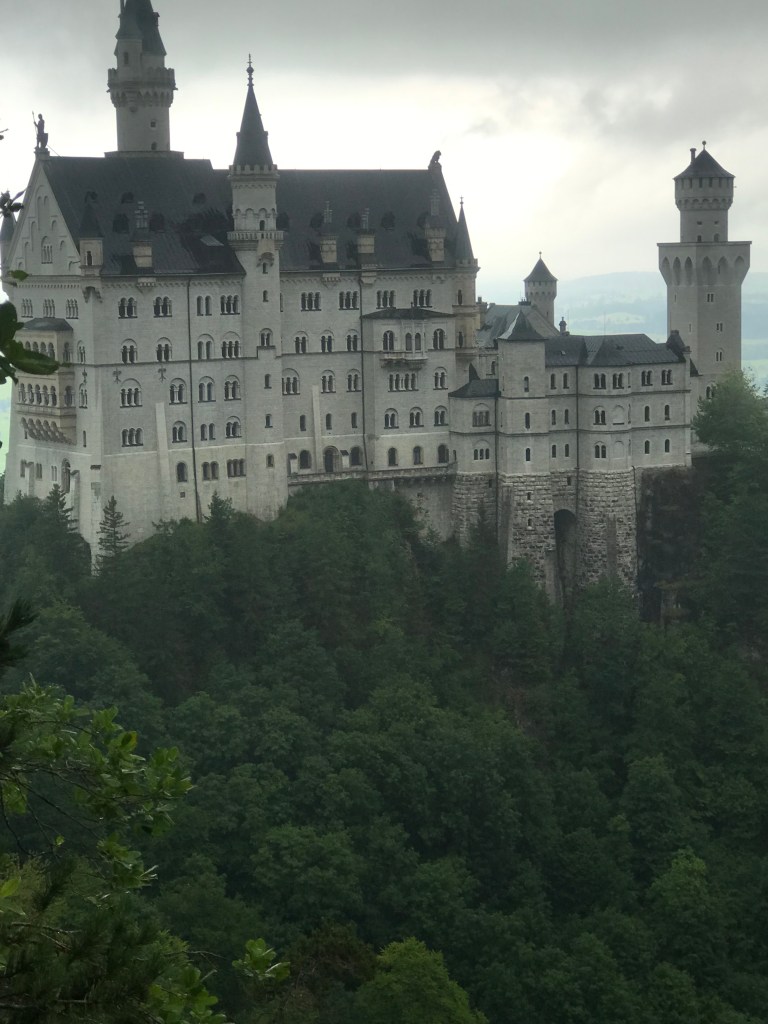
Although the Munich Residenz—then the primary residence of the Bavarian monarchs—was one of the largest palace complexes in the world, King Ludwig II felt increasingly constrained by life in the capital. Seeking both solitude and creative inspiration, he commissioned Neuschwanstein Castle on the remote northern edge of the Alps. It was conceived not only as a personal retreat but also as a tribute to the composer Richard Wagner, whom Ludwig deeply admired.
Ludwig funded the project from his own private fortune and through extensive borrowing, choosing not to use Bavarian state funds. Construction began in 1869 but was never fully completed. The castle was intended to serve as the king’s private residence, but Ludwig died in 1886 before he could live there. Shortly after his death, Neuschwanstein was opened to the public.
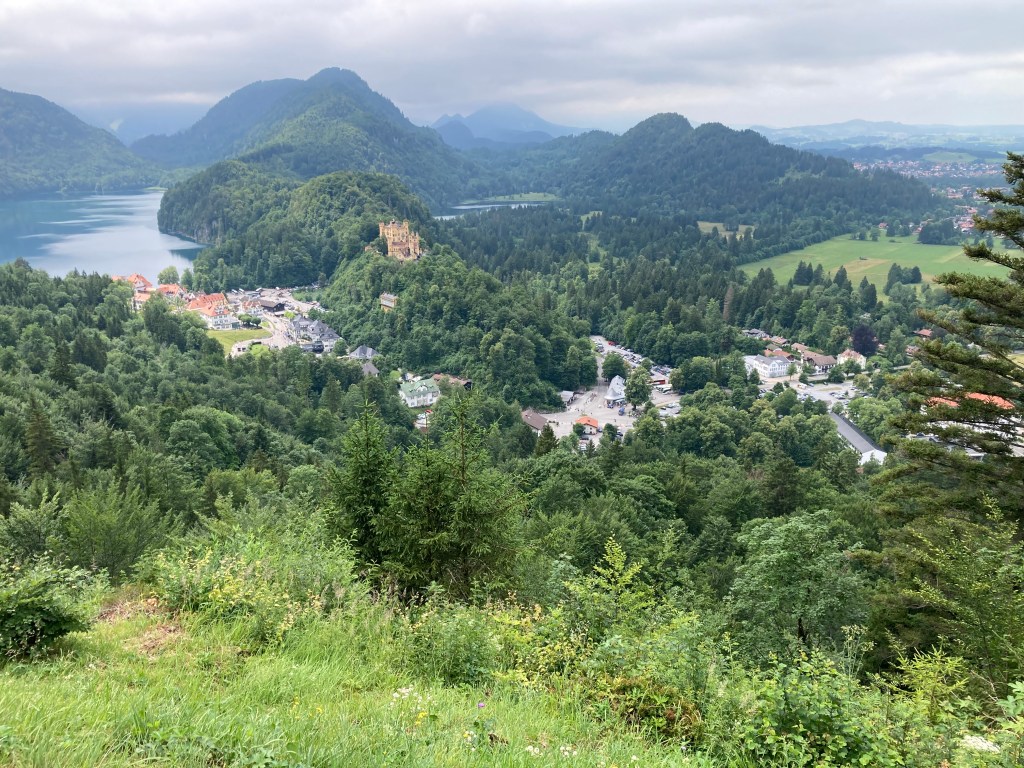
The municipality of Schwangau sits on the southwestern edge of Bavaria, where the landscape shifts from the Alpine foothills near the Austrian border to gentler rolling hills further north. In the Middle Ages, three castles once stood watch over the surrounding villages, including one known as Schwanstein Castle.
In 1832, King Maximilian II of Bavaria—Ludwig’s father—purchased the ruins of Schwanstein and replaced them with the neo‑Gothic palace now known as Hohenschwangau Castle. Completed in 1837, it became the royal family’s summer residence, and Ludwig, born in 1845, spent much of his childhood within its walls.
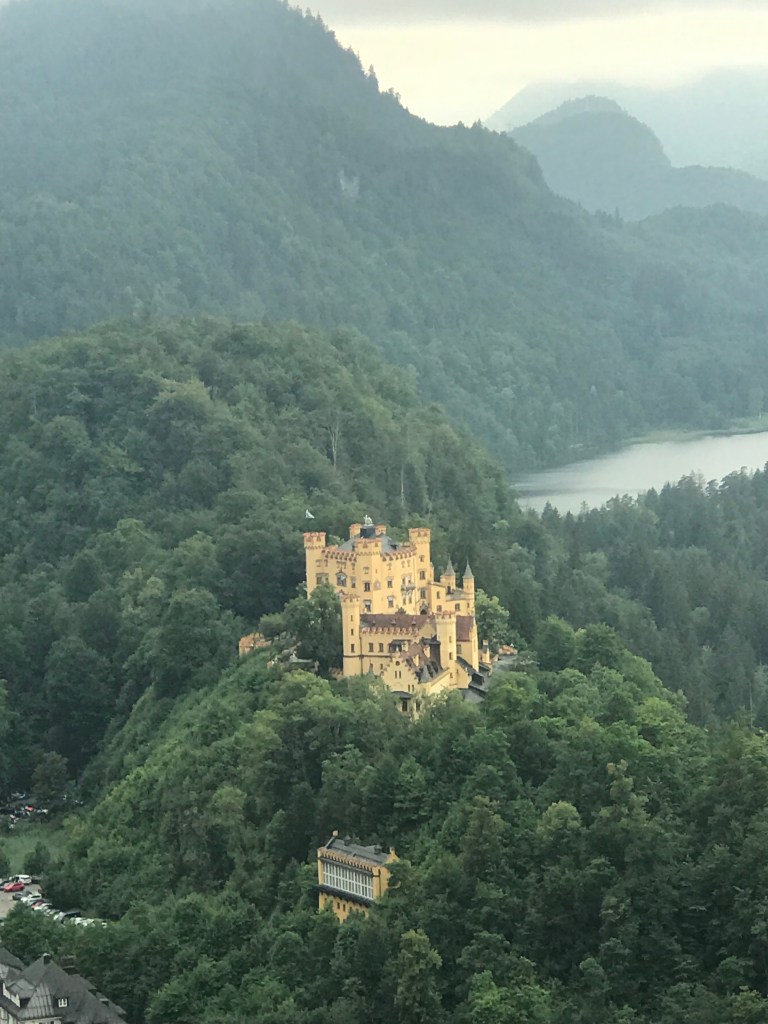
Vorderhohenschwangau Castle and Hinterhohenschwangau Castle once stood on a rugged hill overlooking Schwanstein Castle and the two nearby lakes. Separated only by a moat, the twin fortresses together comprised a hall, a keep, and a fortified tower house. By the 19th century, however, only ruins remained.
The young crown prince was familiar with these ruins from his childhood excursions, even sketching one of them in his diary in 1859. When he became King Ludwig II in 1864, he chose this very site for the first of his ambitious palace‑building projects. He named the new palace New Hohenschwangau Castle, which led to some confusion: Hohenschwangau Castle (the family’s summer residence) had been built on the former site of Schwanstein Castle, while Ludwig’s new palace replaced the ruins of the two Hohenschwangau Castles. Only after Ludwig’s death was the new palace renamed Neuschwanstein.
At the time of Ludwig’s death, the palace was still far from complete. The Gatehouse and the Palas were largely finished, but the Rectangular Tower remained covered in scaffolding. Construction on the Bower had not yet begun; it was eventually completed in a simplified form in 1892, without the planned statues of female saints. The Knights’ House was also reduced from Ludwig’s original vision—he had imagined its gallery columns as stylised tree trunks topped with crown‑shaped capitals.
The most ambitious element of all—a 90‑metre keep rising above a three‑nave chapel in the upper courtyard—never progressed beyond the foundations. A connecting wing between the Gatehouse and the Bower was also abandoned, as were plans for a terraced garden with a fountain west of the Palas. All of these grand ideas were set aside after the king’s death.
Marienbrücke” (Mary’s bridge), situated above Pöllat gorge
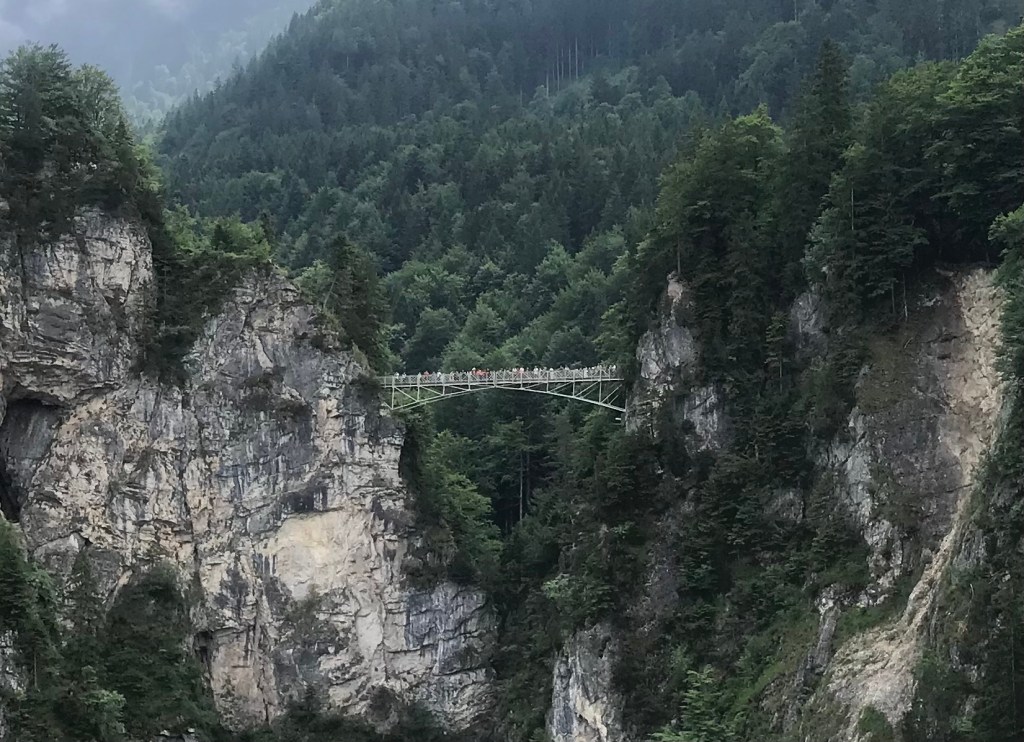
High above the Pöllat Gorge, the “Marienbrücke” stretches out with a spectacular view of Neuschwanstein Castle—a remarkable feat of engineering and a fitting symbol of King Ludwig II’s romantic vision. Yet the bridge’s story actually begins long before the fairytale castle existed.
Its origins trace back to the 1840s, when King Maximilian II, Ludwig’s father, commissioned a simple wooden bridge across the gorge. It offered his guests a dramatic vantage point over the surrounding landscape and also served as a practical crossing for hikers and hunters navigating the alpine terrain.
When Neuschwanstein Castle began rising between 1868 and 1886, the bridge took on new importance. Ludwig II immediately recognised it as the ideal lookout from which to admire his dream castle. In 1866, the original wooden structure was replaced with a sturdier iron bridge, which he named in honour of his mother, Queen Marie of Bavaria.
The bridge was remarkably advanced for its time. Its slender iron framework was anchored high above the gorge using cutting‑edge construction methods of the era, giving it an impressive load‑bearing strength despite its delicate appearance. More than 150 years later, it has endured wind, weather, and countless visitors.
Today, the Marienbrücke remains one of Bavaria’s most breathtaking viewpoints. Once a secluded spot where Ludwig II admired his dream castle in private, it now draws visitors from around the world who come to enjoy the same fairytale panorama.
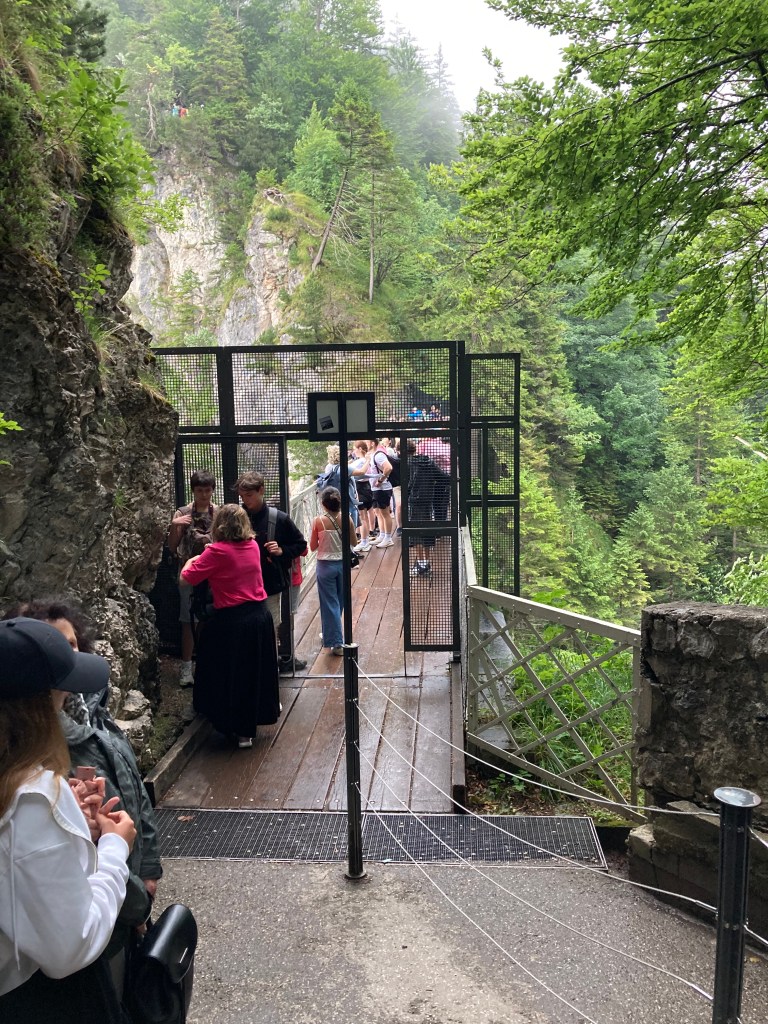
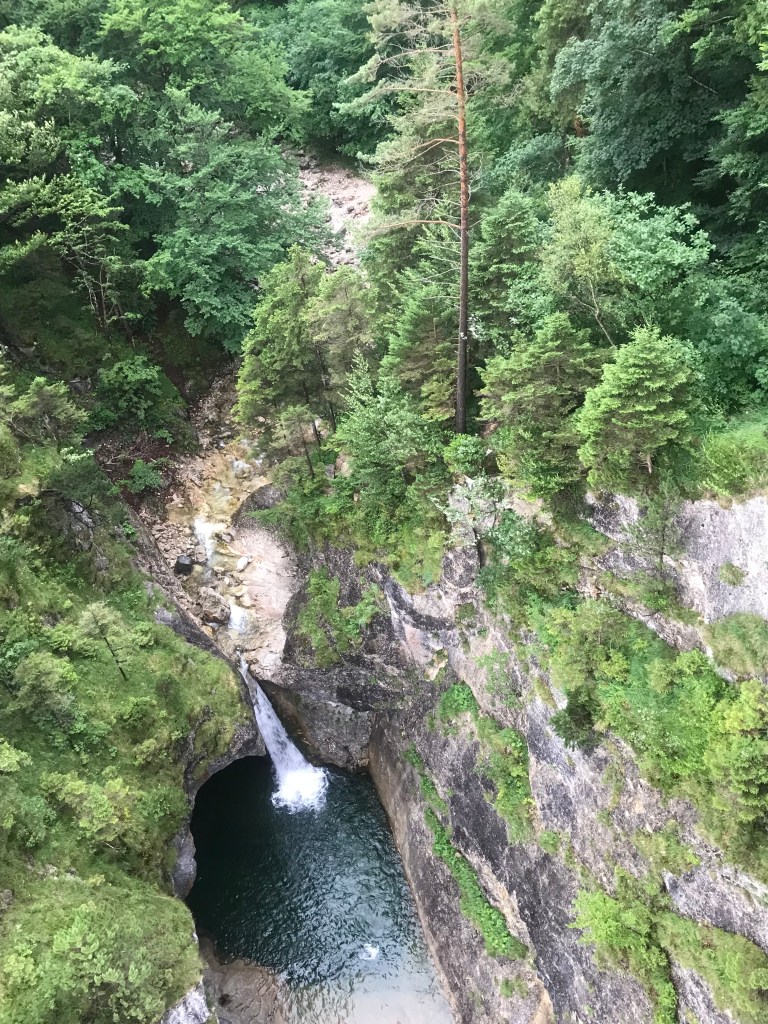
The following images were taken from Mary’s Bridge.
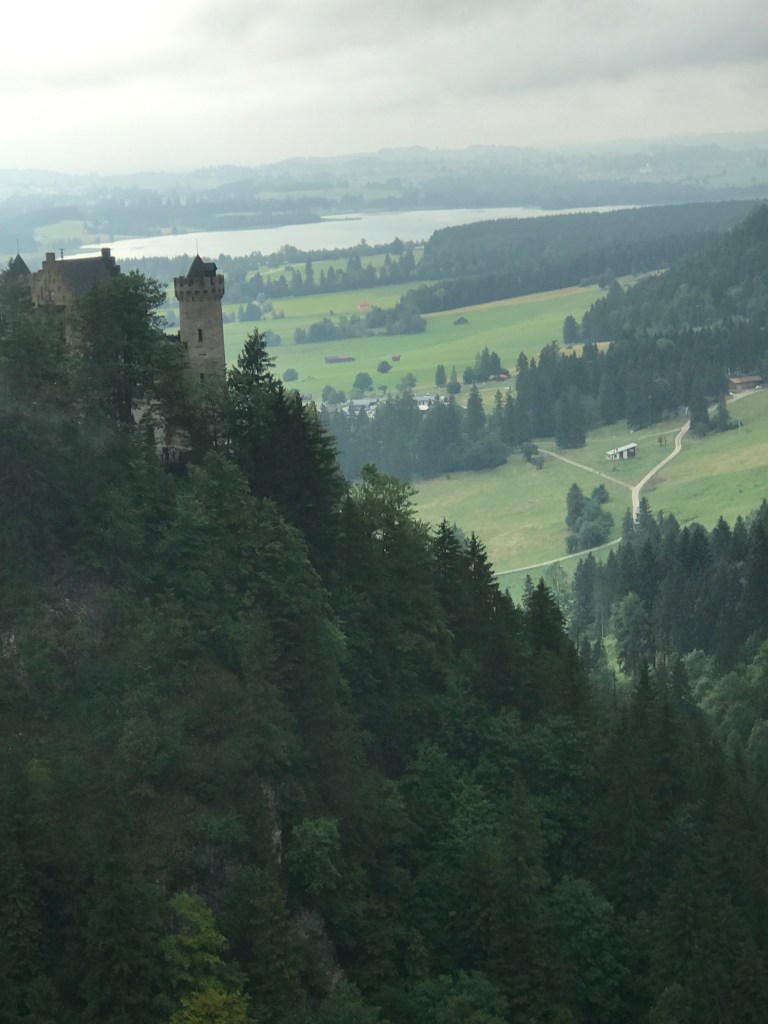
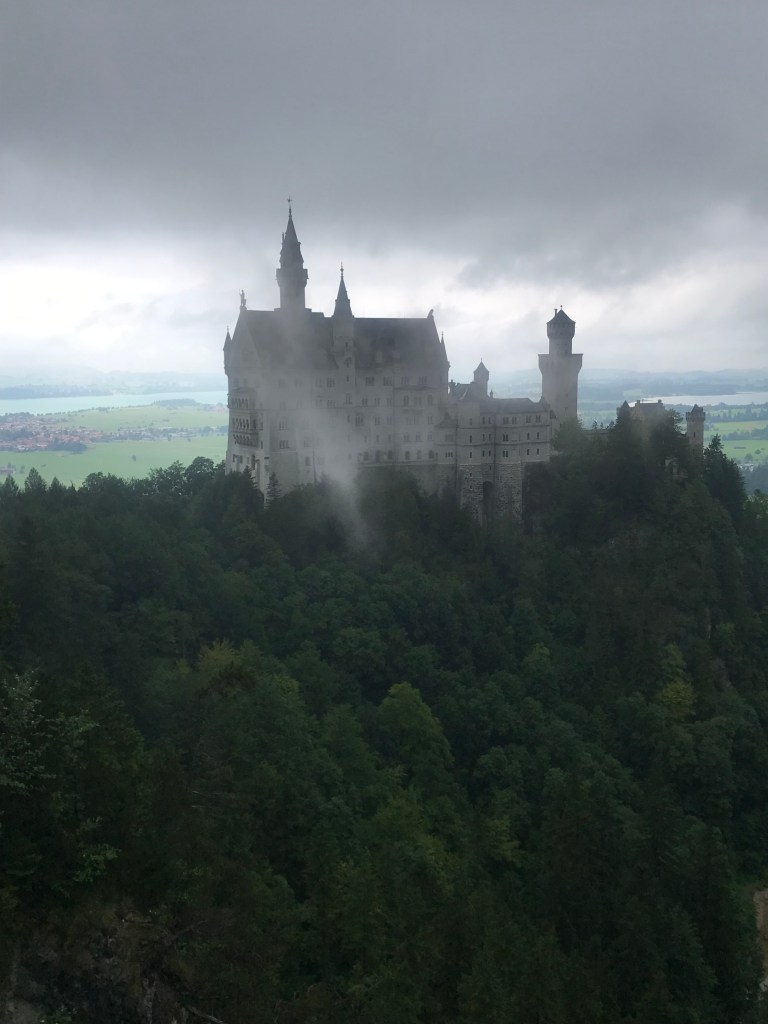
Neuschwanstein Castle also became a major source of inspiration for the Disney castles—most notably Disneyland’s Sleeping Beauty Castle and Disney World’s Cinderella Castle. Walt Disney visited Neuschwanstein himself and was captivated by its fairytale architecture, which he later echoed in his own iconic designs. Even the silhouette of Neuschwanstein helped shape the famous Disney logo.
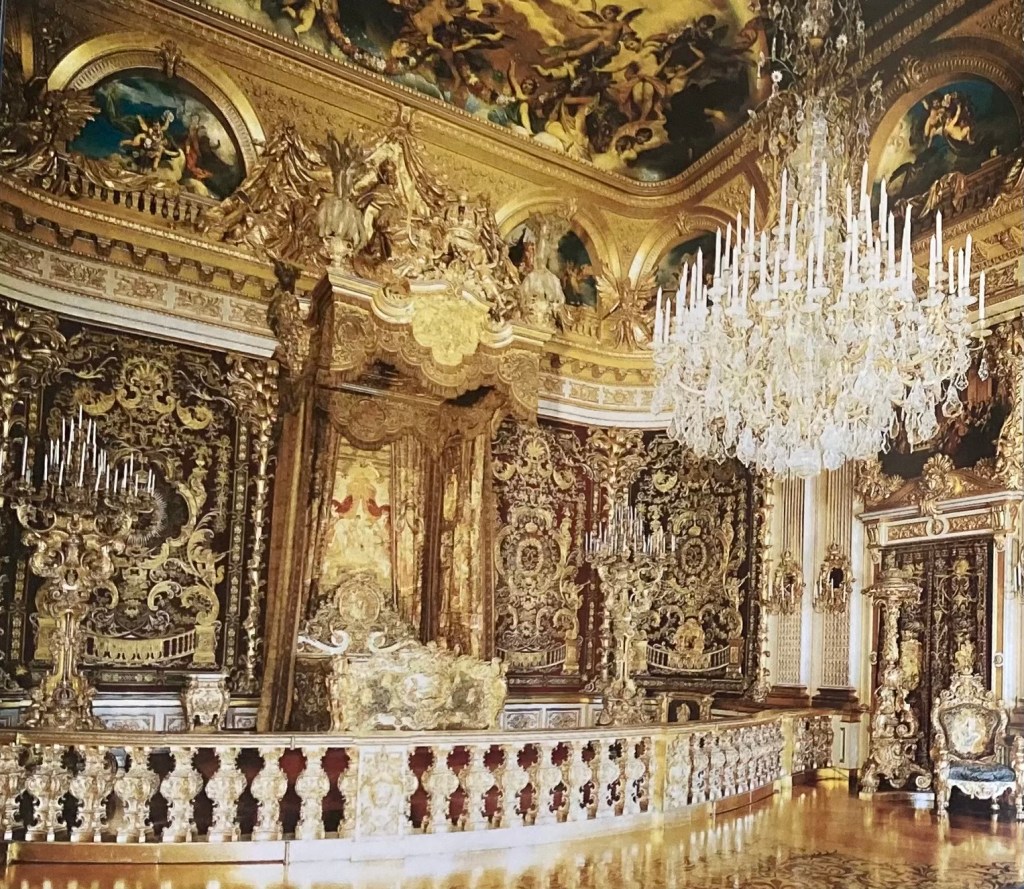
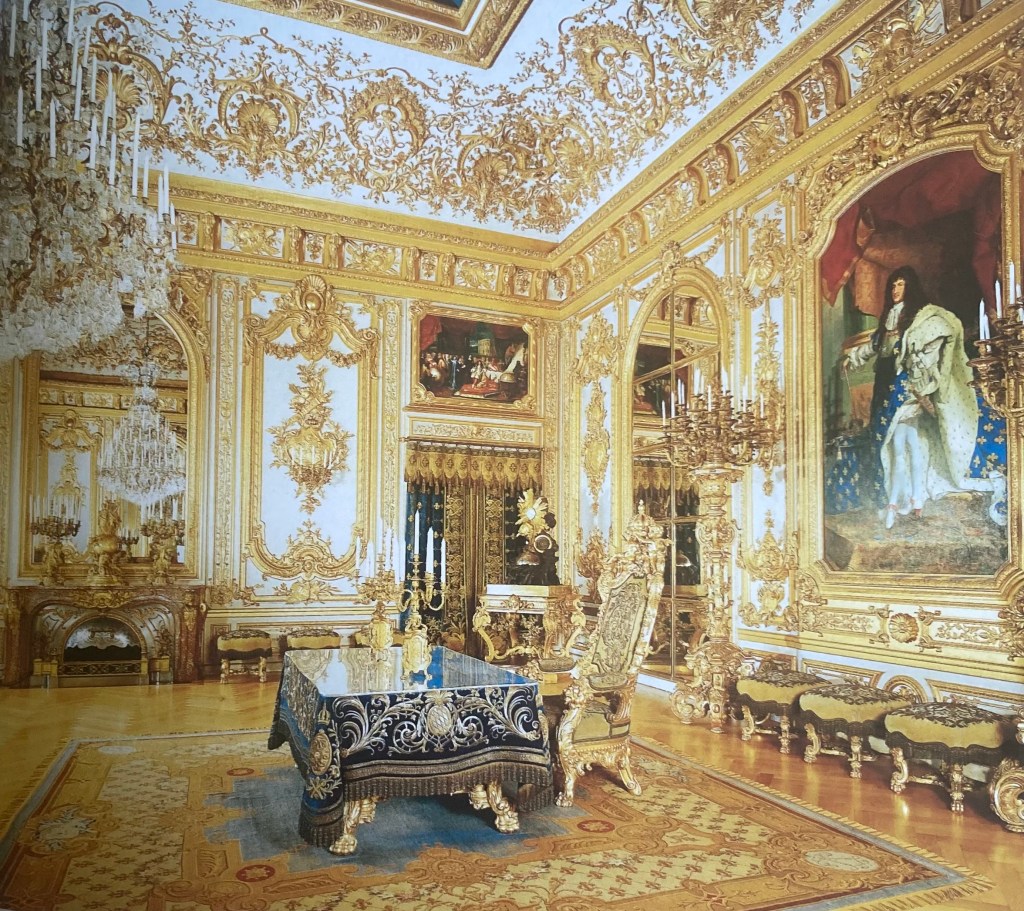
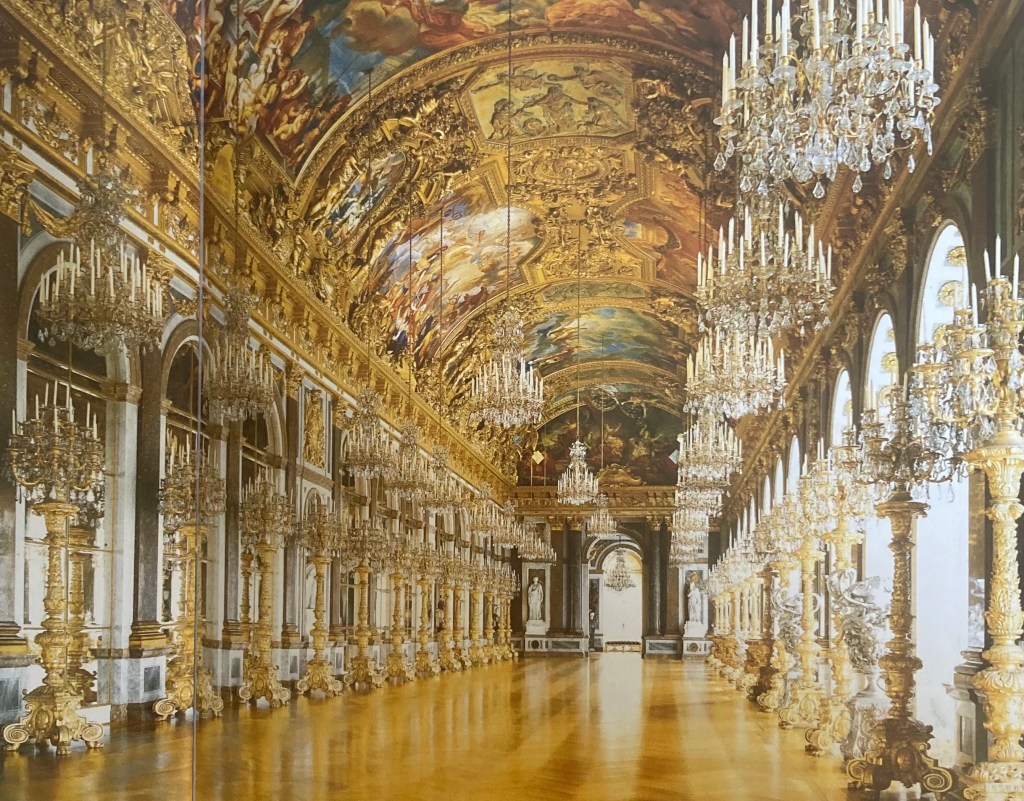
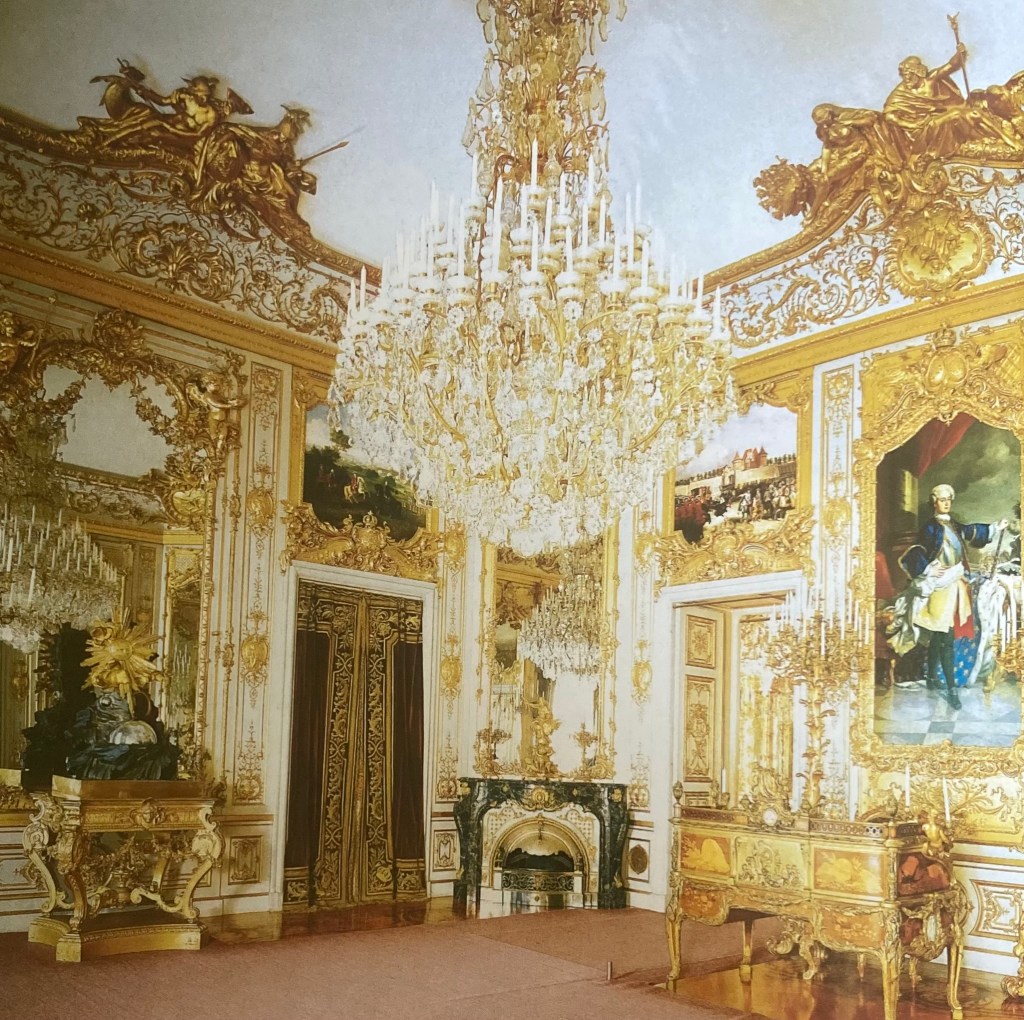
Because photography isn’t permitted inside the castle during the tour, the images that follow are taken from the guidebook we purchased.
As you’ll see, gold leaf was used extensively throughout the interiors, especially in the royal apartments. It created an atmosphere of extraordinary opulence, perfectly in line with King Ludwig II’s famously extravagant tastes. In fact, the sheer amount of gold leaf was considered excessive even in his own era, underscoring his desire for a uniquely lavish retreat. Beyond the gold, the castle’s rooms were adorned with other luxurious details—ivory candelabras, ostrich‑plume carpets, and amethyst tables among them.
This is the State Bedroom
This is the Conference Hall
This is the Great Gallery of Mirrors.
This is the study.
Today was quite exhausting, with steep hills to climb and a long series of stairs inside the turret just to reach the start of the tour. In total, there are around 350 steps, and unfortunately the effort took a toll on Maree’s knee, which has swollen to nearly twice its normal size. We took our time walking back to the bus for the ride to Füssen, then caught the train back to Munich.
Tomorrow we plan to rest and take things slowly so Maree’s knee can recover before our tour of Hitler’s Eagle’s Nest in Berchtesgaden on Sunday—another full day of sightseeing ahead.
Saturday, 5 July 2025
As mentioned in yesterday’s entry, we’re taking the day off so Maree can recuperate. The next update will be on Sunday evening.
Sunday, 6 July 2025
This morning we took the 08:00 train toward Salzburg, though we only travelled as far as Freilassing. There we changed trains for the short journey to Berchtesgaden, arriving around 10:30.
Photos taken around Berchtesgaden
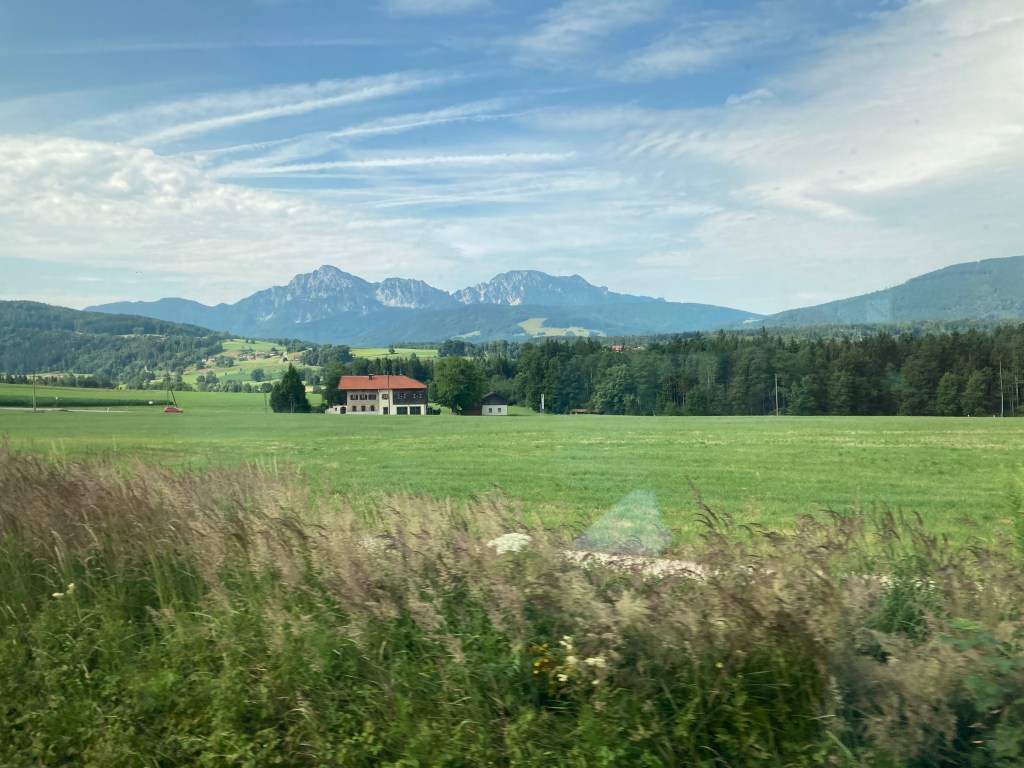
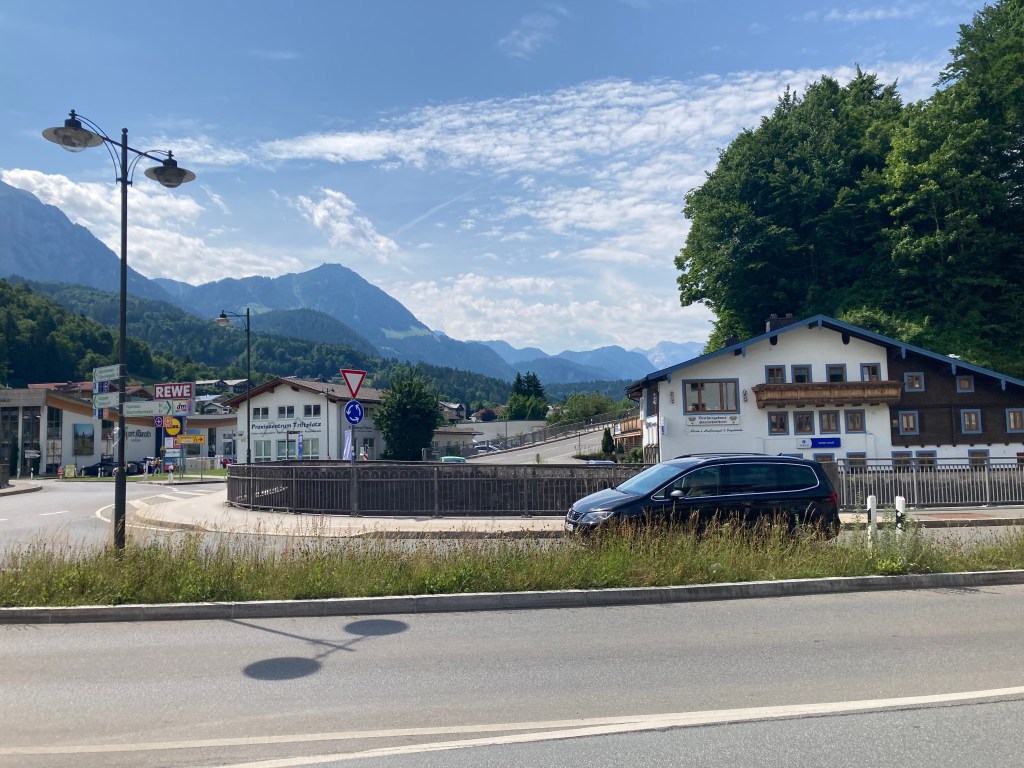
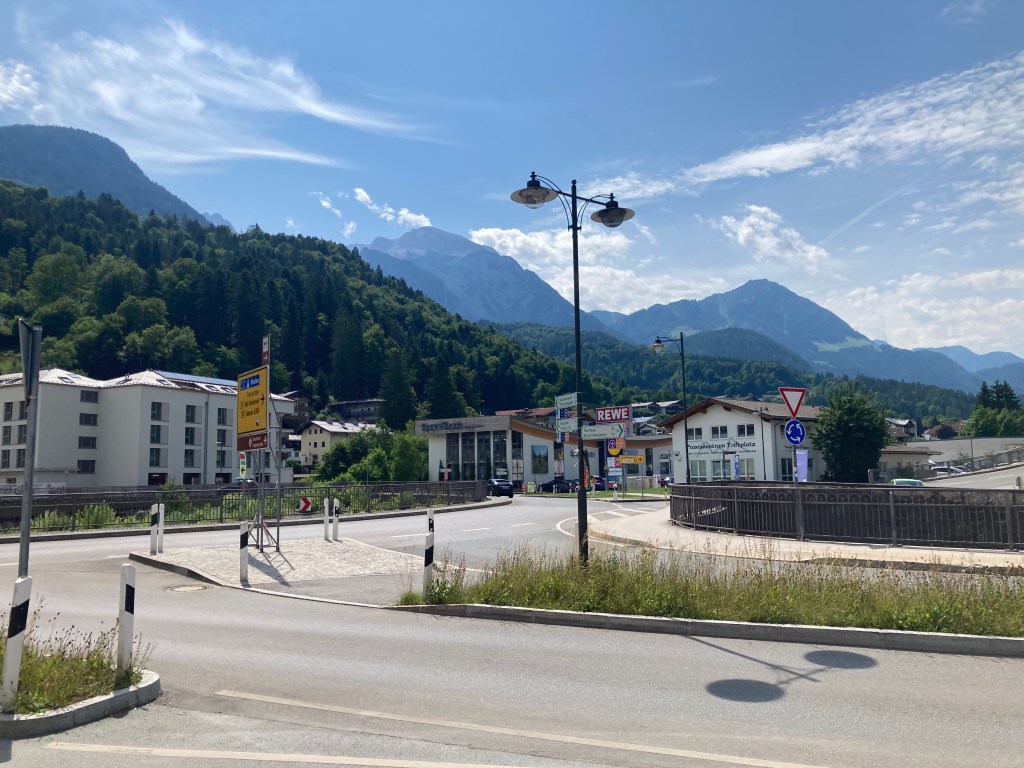
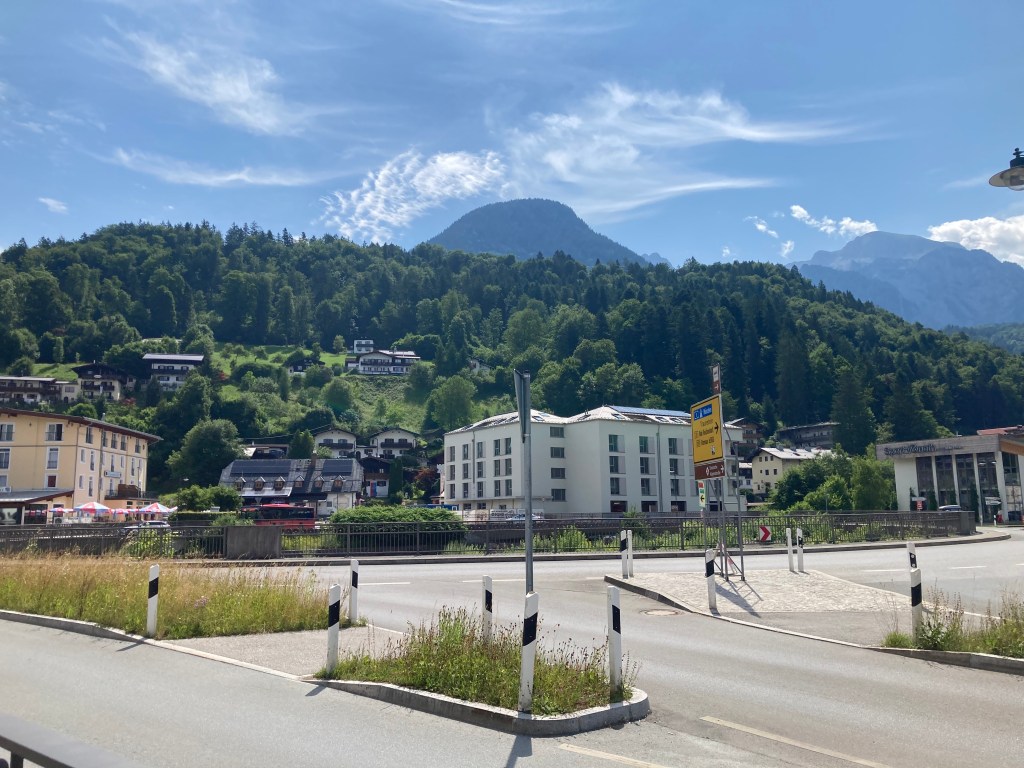
After stopping for a coffee, we caught the bus up to Dokumentation Obersalzberg, where our tour of the area begins before continuing on to Kehlsteinhaus—the Eagle’s Nest.
The Dokumentation Obersalzberg Centre serves as a place of learning and reflection on the Nazi era, located within what was once the Führer’s Restricted Area (Führersperrgebiet) in Berchtesgaden. It links the local history of Obersalzberg with the broader story of National Socialism.
The Documentation Centre with Mountain Range in the back ground.
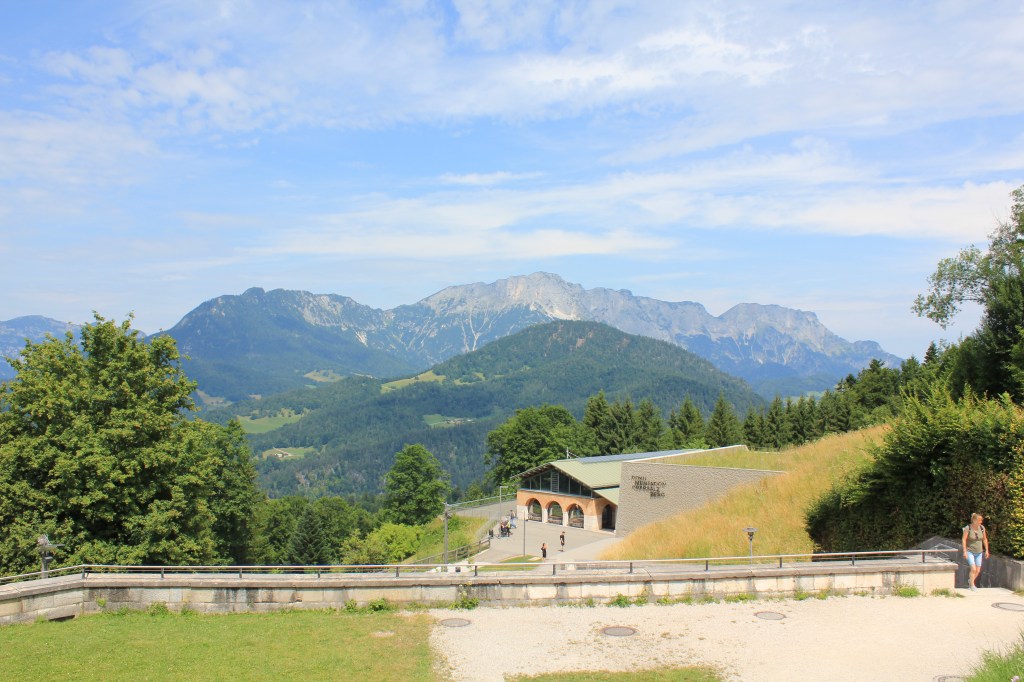
More photographs of the area of Obersalzburg.
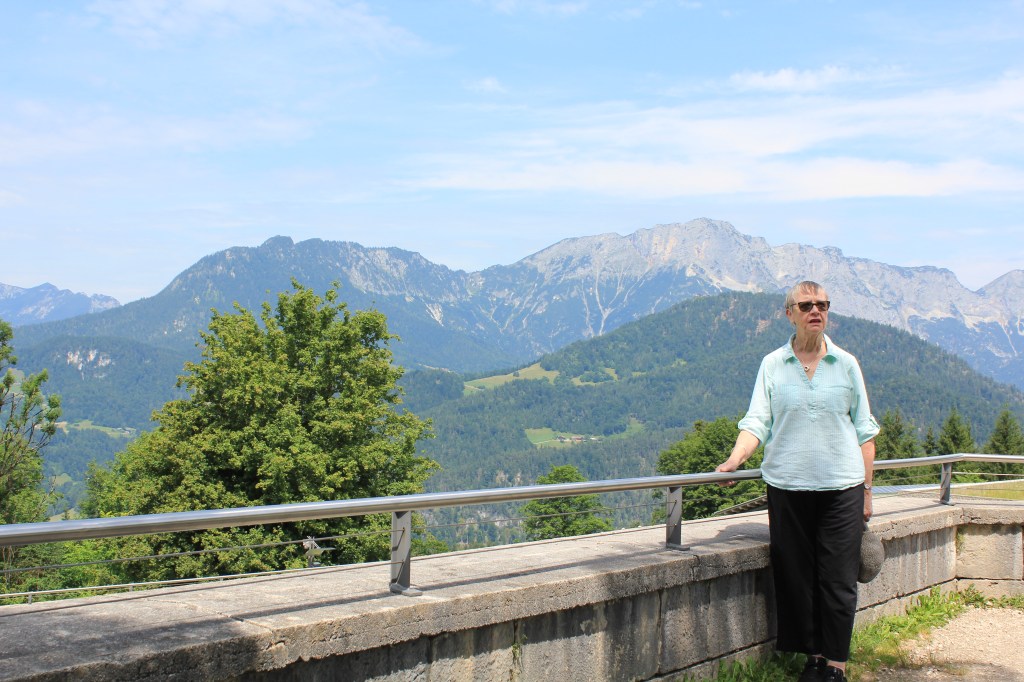
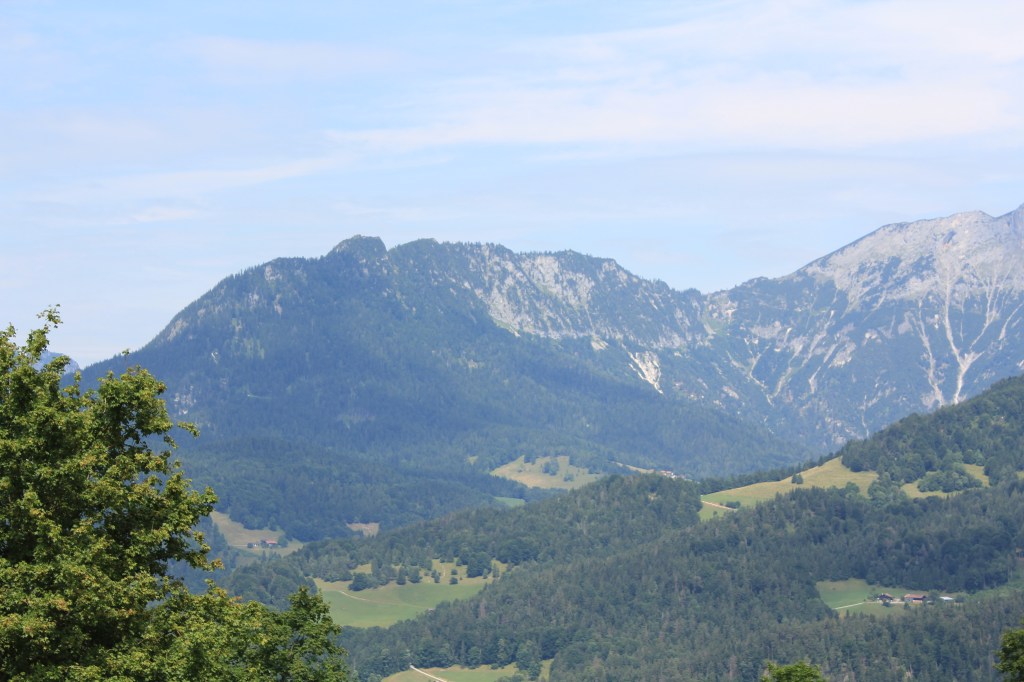
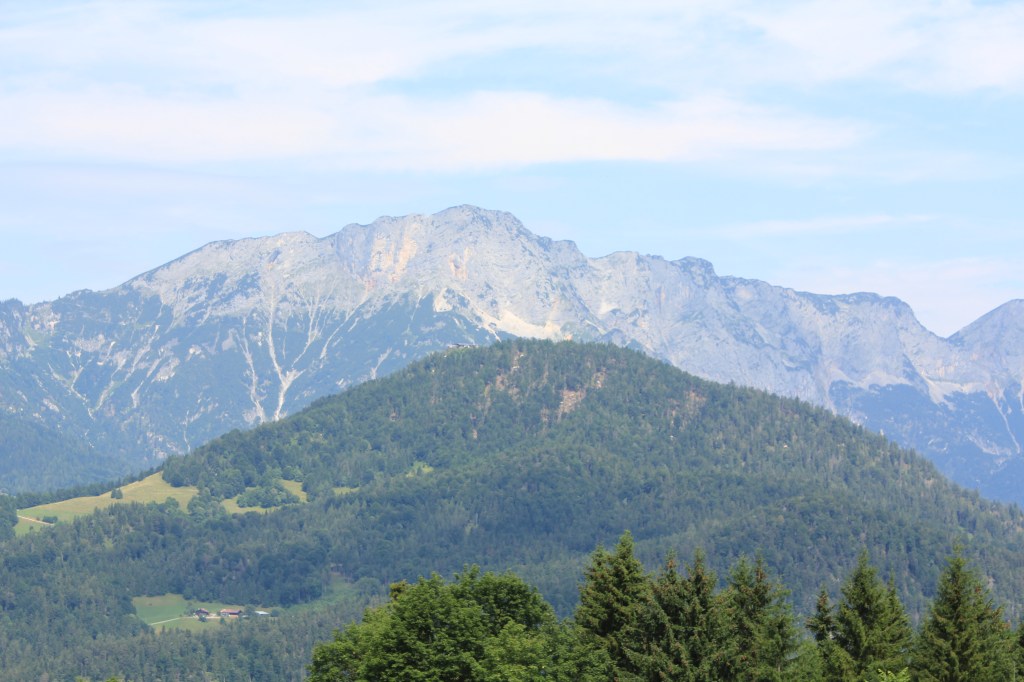
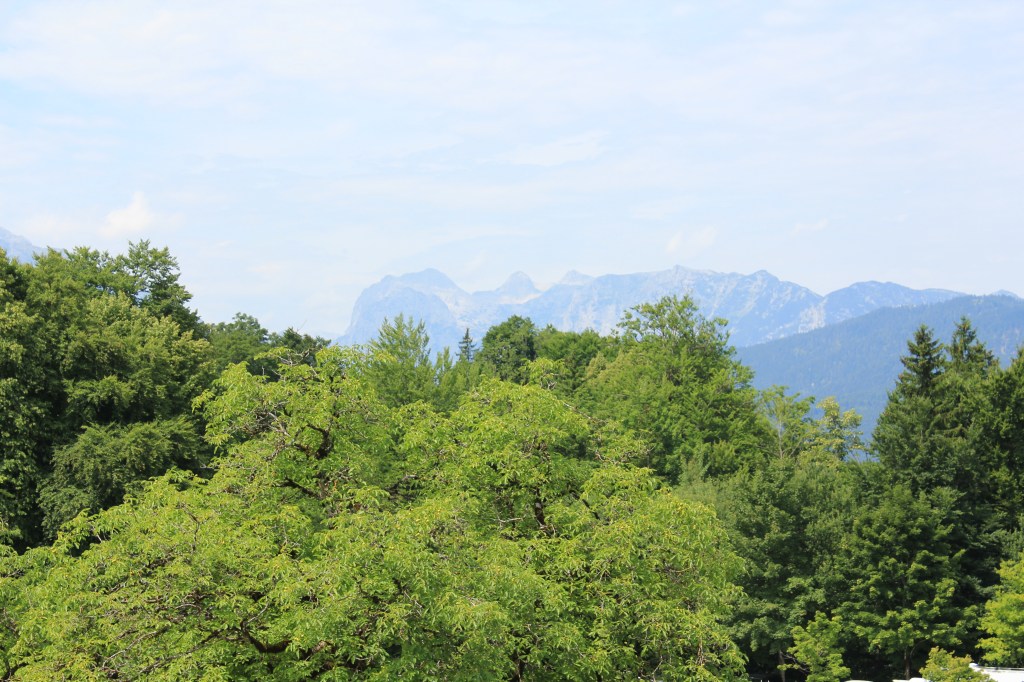
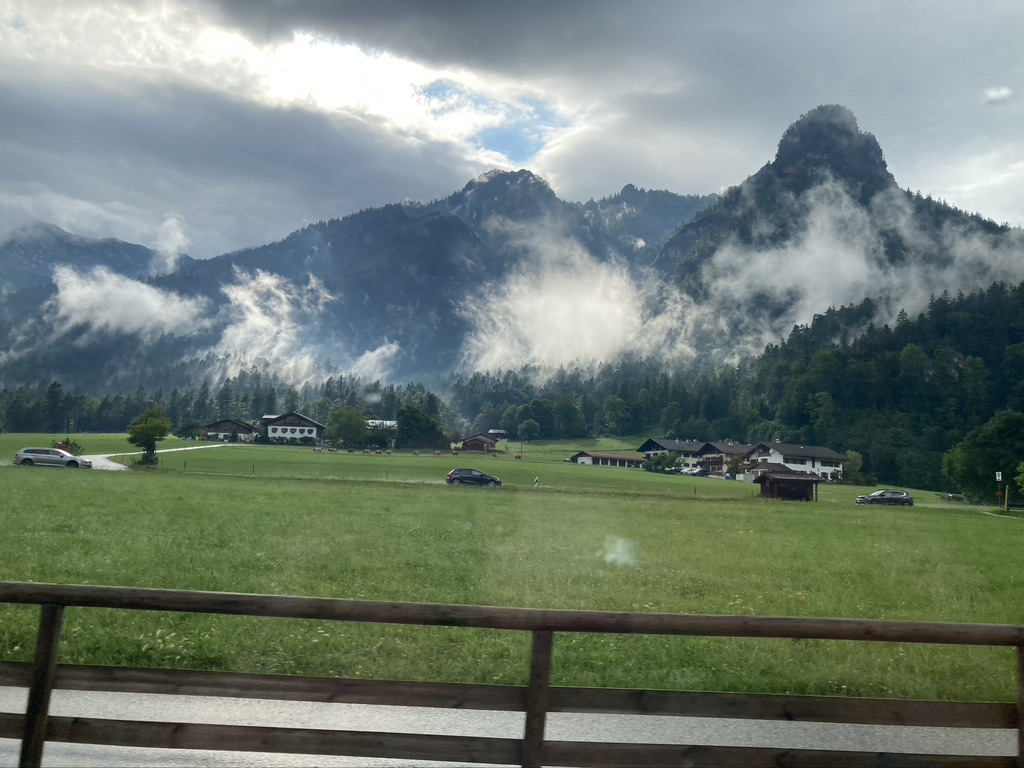
We began the tour at 13:00 with an in‑depth briefing about the surrounding area and how it was transformed when Hitler appropriated it for his personal use and for the Nazi Party. After the introduction, we were driven to the Berghof, Hitler’s former summer residence in Obersalzberg. Our guide carried large A2‑sized photographs showing the property as it looked during Hitler’s time, which made it much easier to visualise the site as it once was.
The summary below is only a brief overview of what we learned during the tour. I’ll include links at the end of today’s blog for anyone interested in exploring the history in more detail.
The Berghof began as a modest chalet called Haus Wachenfeld, built in 1916 (or 1917) by businessman Otto Winter from Buxtehude. It stood near the Platterhof, formerly Pension Moritz, where Hitler had stayed in 1922–23. By 1926, the pension’s original operators had left, and Hitler disliked the new owner. He moved first to the Marineheim and later to the Deutsches Haus hotel in Berchtesgaden, where he dictated the second volume of Mein Kampf during the summer of 1926. It was during another visit that autumn that he met his then‑girlfriend, Maria Reiter, who worked in a shop on the hotel’s ground floor. In 1928, Winter’s widow rented Haus Wachenfeld to Hitler, and his half‑sister Angela briefly served as housekeeper.
By 1933, Hitler had purchased Haus Wachenfeld using proceeds from the sale of Mein Kampf. Between 1935 and 1936, architect Alois Degano—under the supervision of Martin Bormann—transformed the small chalet into a much larger residence, renamed the Berghof, or “Mountain Court.”
The expanded home featured a large terrace with colourful resort‑style umbrellas, an entrance hall decorated with cactus plants in majolica pots, and a dining room lined with expensive cembra pine. Hitler’s study included its own telephone switchboard room, and the library held books on history, art, architecture, and music. The great hall was furnished with heavy Teutonic furniture, a large globe, and a striking red marble fireplace. Hidden behind one wall was a projection booth used for evening film screenings—often Hollywood movies, including Mickey Mouse cartoons.
One of the Berghof’s most famous features was its enormous picture window, which could be lowered into the wall to reveal an unobstructed panorama of the snow‑covered mountains of Hitler’s native Austria. The property was run almost like a small resort, staffed by housekeepers, gardeners, cooks, and other domestic workers.
On 25 April 1945, the Obersalzberg complex was heavily bombed by British RAF Lancaster bombers, including aircraft from No. 617 Squadron (the “Dambusters”). Several bombs struck the Berghof, causing extensive damage. Retreating SS troops later set the villa on fire on 4 May 1945.
We spent time walking through the ruins of the Berghof as our guide used the large historical photographs to help us imagine moving from room to room. When I upload the photos, you’ll be able to compare the view from the famous picture window with the same view today—they are virtually identical.
From the Berghof, we continued our journey up to Kehlsteinhaus, the Eagle’s Nest.
This is a map of the route to the Eagles Nest
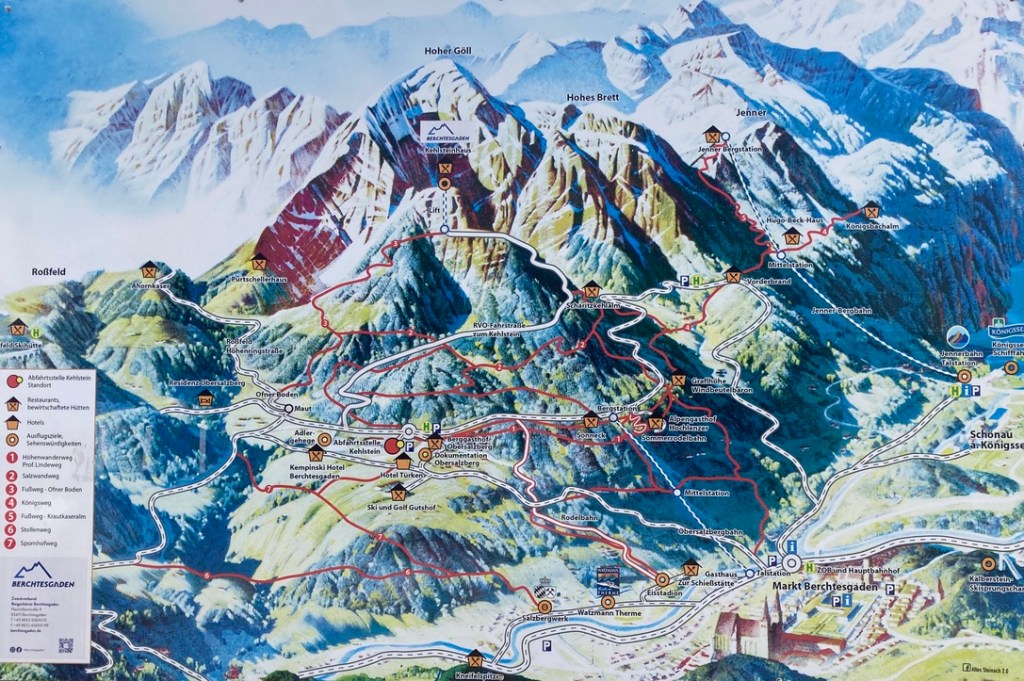
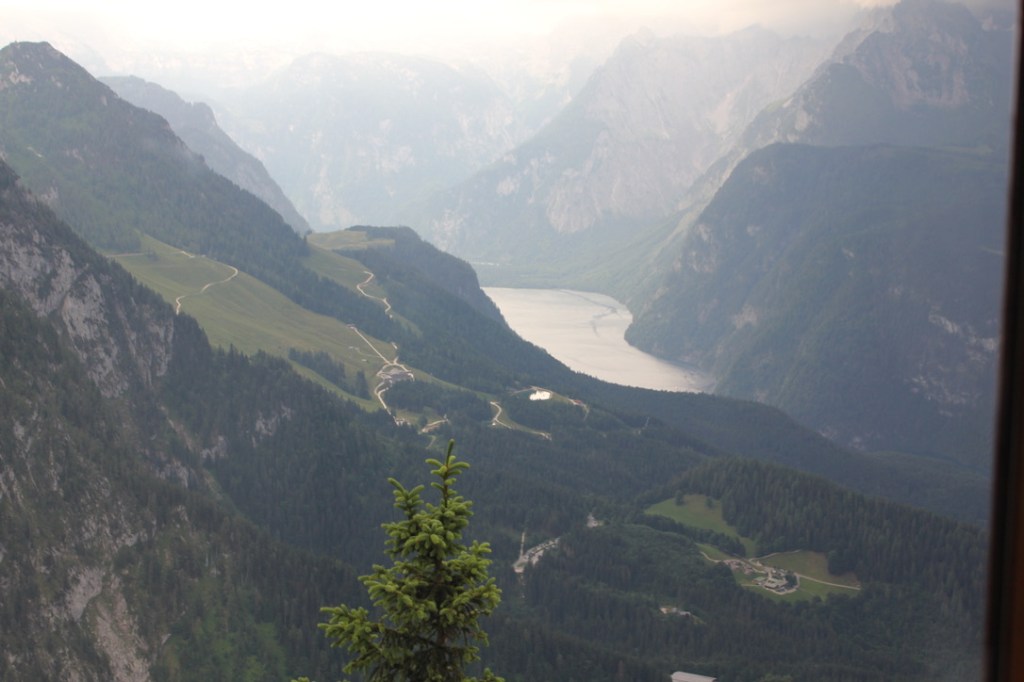
The Kehlsteinhaus—better known in English as the Eagle’s Nest—stands on a ridge atop the Kehlstein, an 1,834‑metre subpeak of the Hoher Göll overlooking Berchtesgaden. Commissioned by Martin Bormann in the summer of 1937 and funded by the Nazi Party, it was completed in an astonishing 13 months. The building served exclusively as a venue for Nazi Party government and social functions and was visited by Adolf Hitler on just 14 documented occasions.
Photos taken as we drove up to the Eagles Nest.
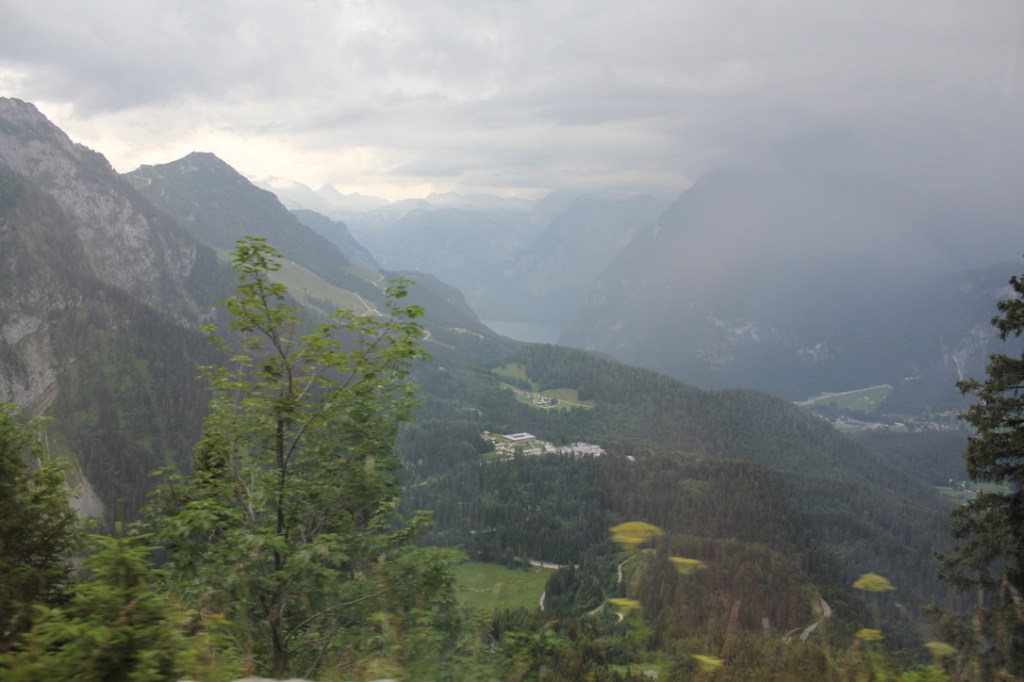
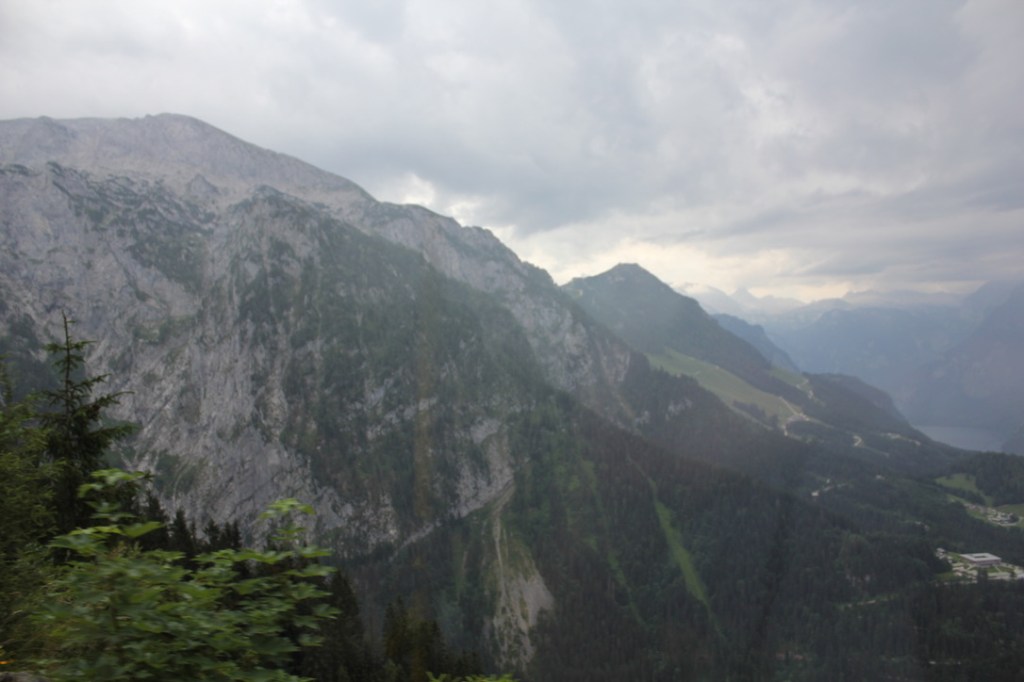
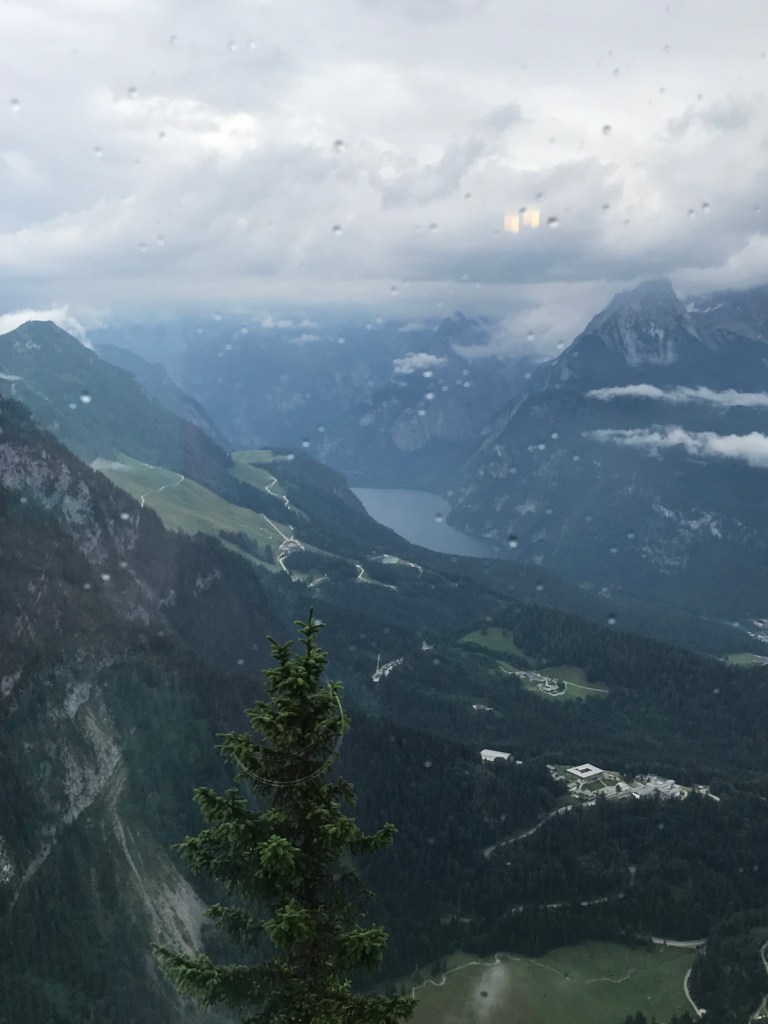
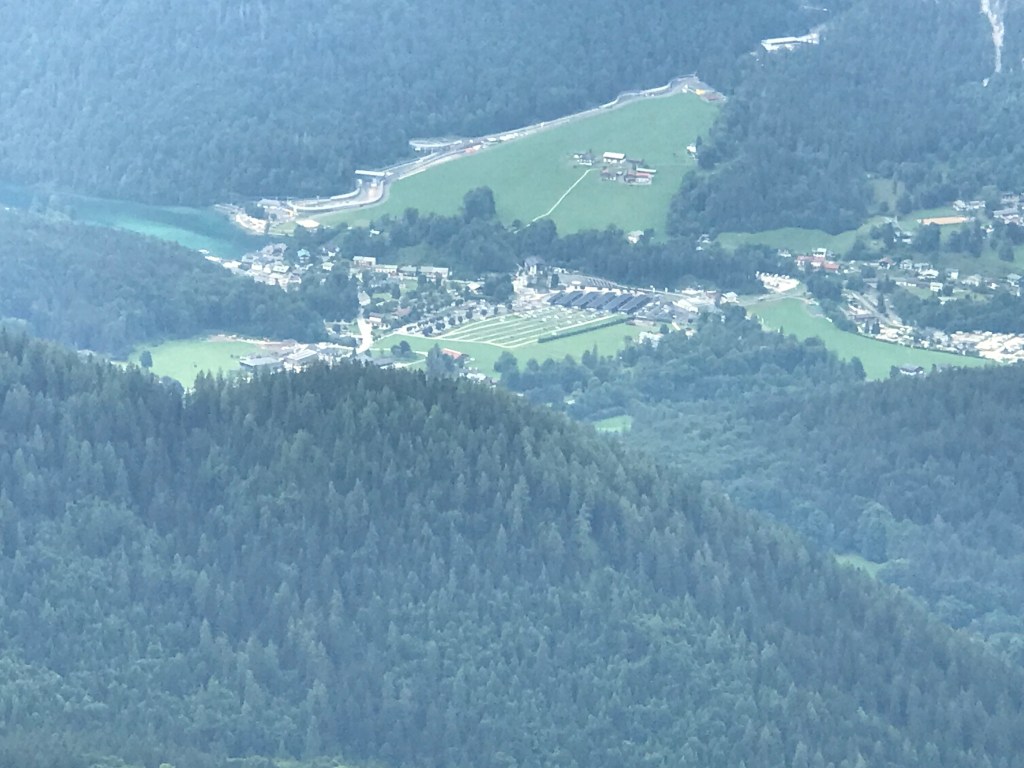
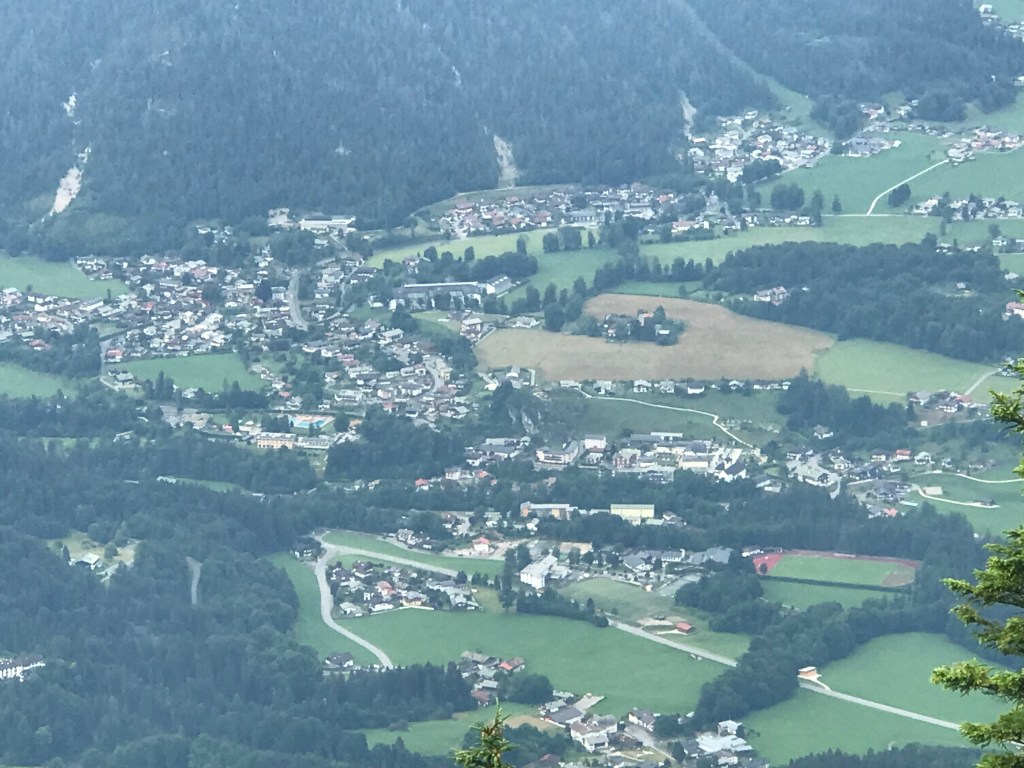
The Kehlsteinhaus sits atop the Kehlstein, offering sweeping views across the Alps from an elevation of 1,834 metres—about 6,017 feet—above sea level.
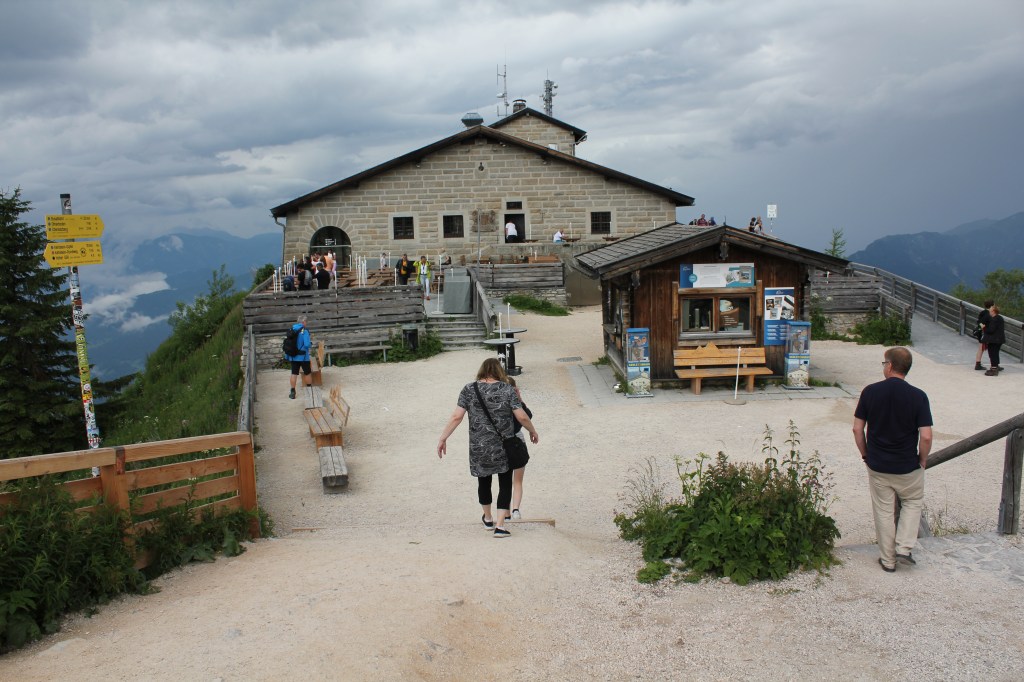
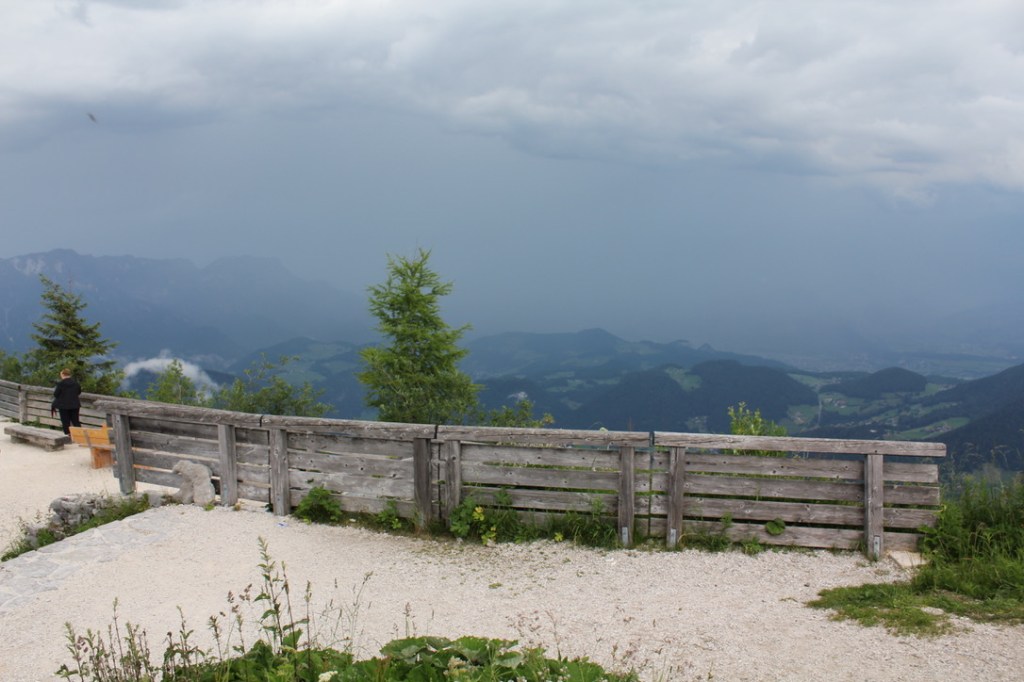
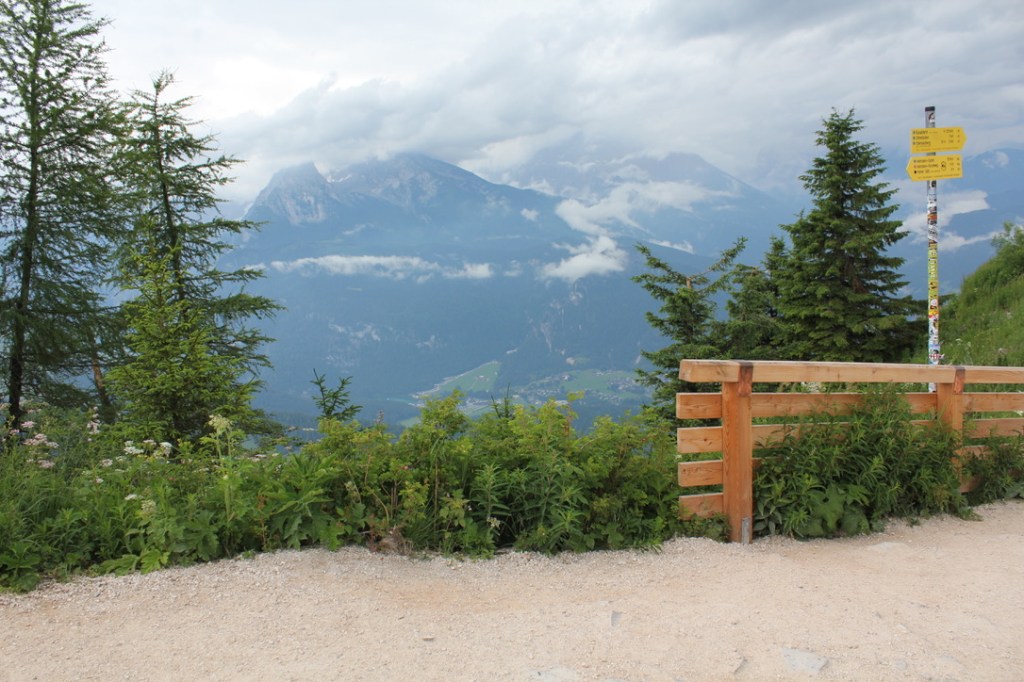
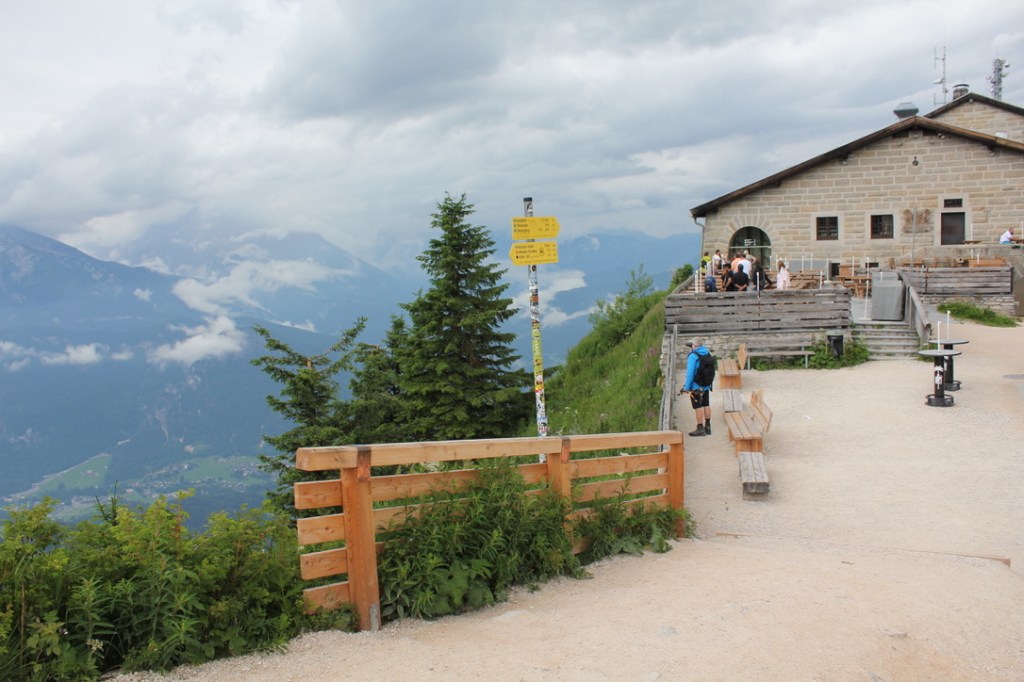
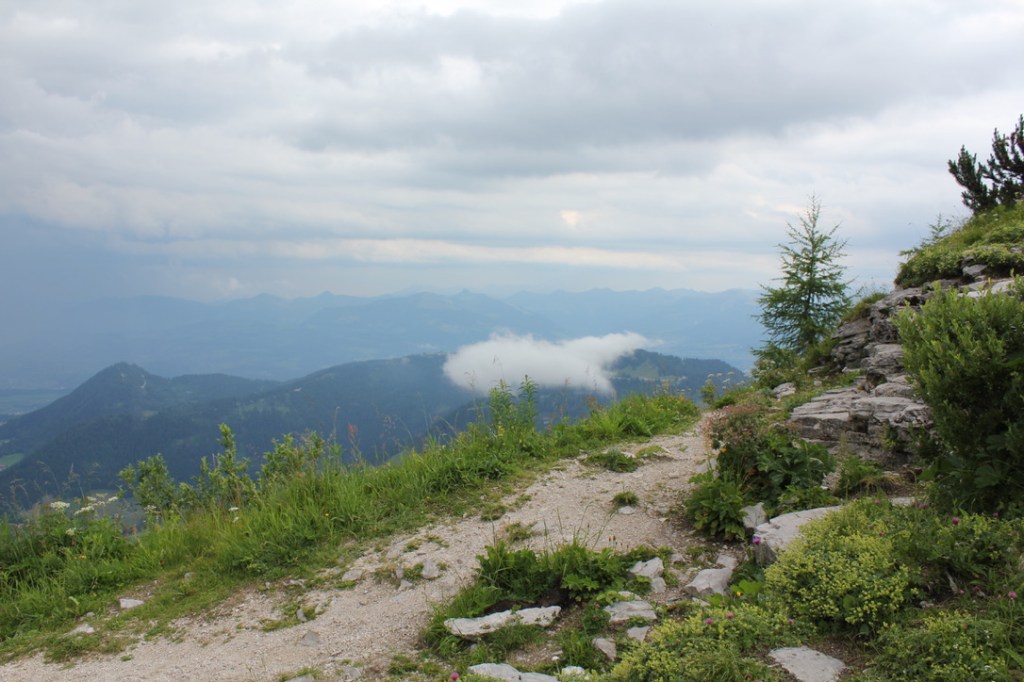
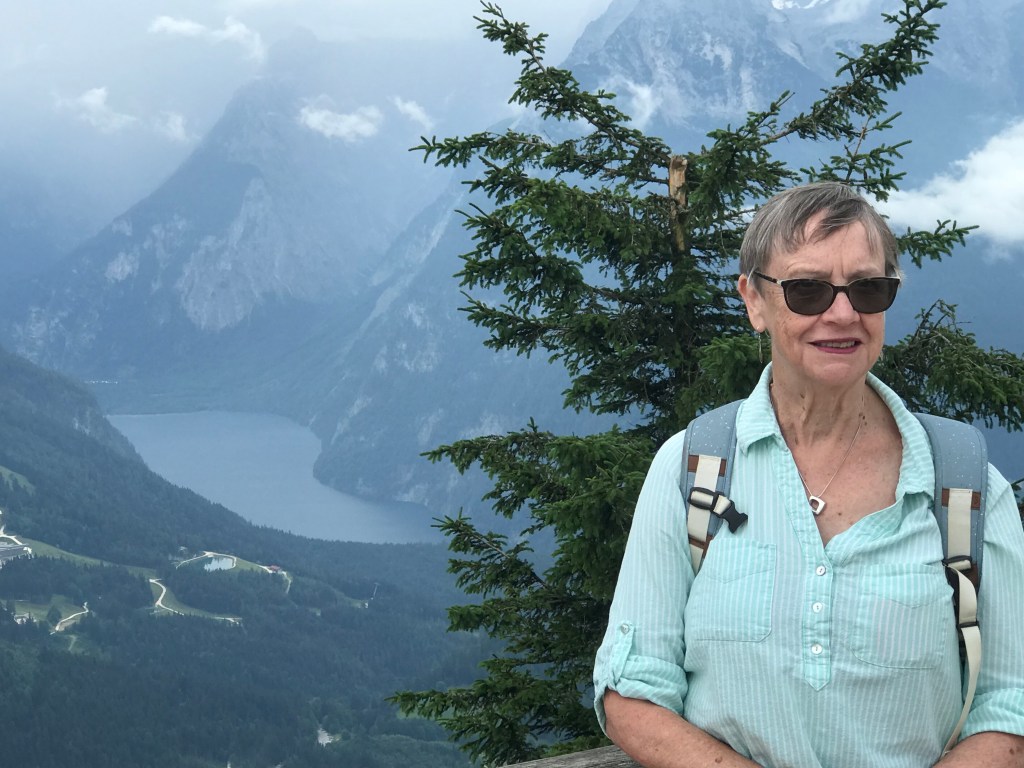
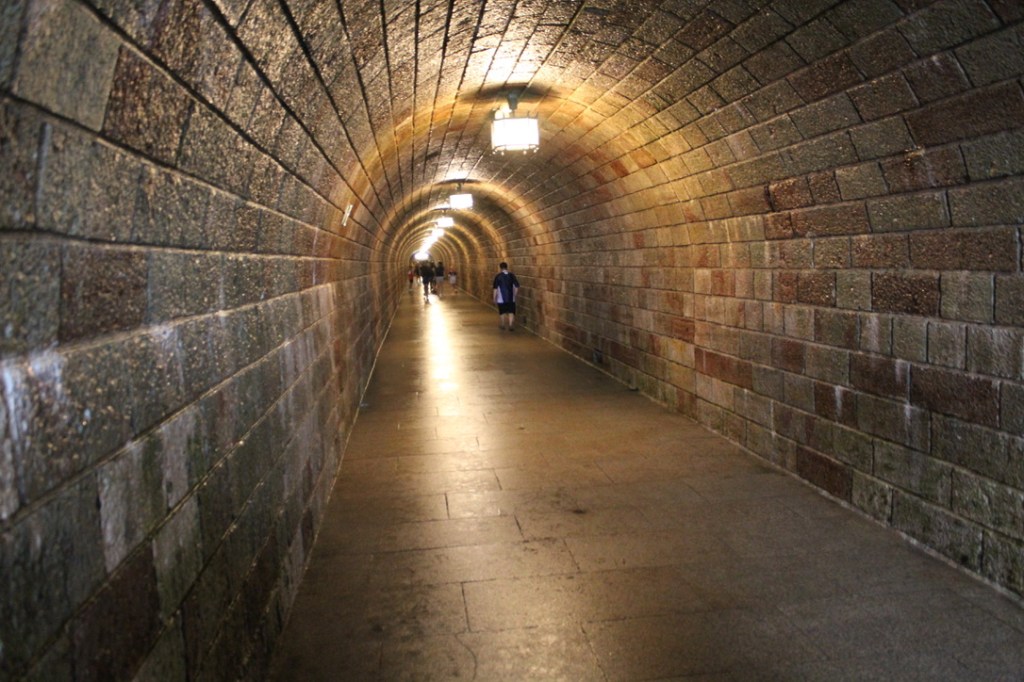
From the car park, a 124‑metre entry tunnel leads to an ornate elevator that carries visitors the final 124 metres up to the building. The tunnel, lined with marble, was originally warmed by air circulated from an adjacent service passage. In its day, high‑ranking officials were often driven directly through the tunnel to the elevator—after dropping them off, the driver had no choice but to reverse the entire length of the tunnel, as there was no room to turn around.
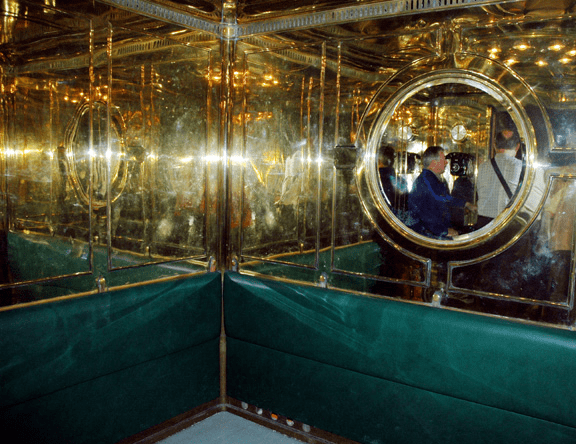
The inside of the large elevator is surfaced with polished brass, Venetian mirrors, and green leather.
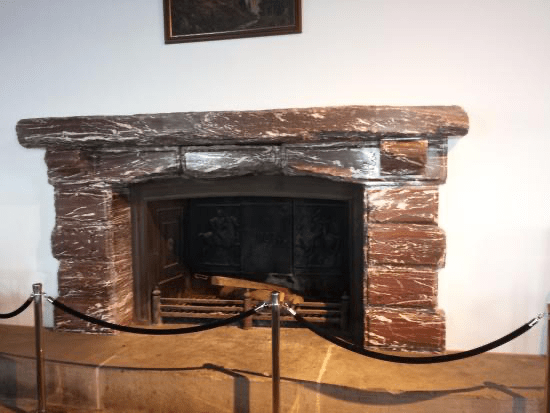
The main reception room is anchored by a striking fireplace made of red Italian marble, a gift from Benito Mussolini. After the war, Allied soldiers chipped away pieces of it to take home as souvenirs, leaving visible damage that remains today.
The Kehlsteinhaus sits several hundred metres above the Berghof, Hitler’s former summer residence. In one of his few diplomatic meetings held there, Hitler received the departing French ambassador André François‑Poncet on 18 October 1938. It was François‑Poncet who later referred to the building as the “Eagle’s Nest,” a name that has since become widely used.
The Kehlsteinhaus was targeted during the RAF bombing of Obersalzberg on 25 April 1945, carried out by No. 1, No. 5, and No. 8 Groups, along with No. 617 Squadron. Despite the scale of the raid—359 Avro Lancasters and 16 de Havilland Mosquitoes—the small mountaintop structure proved difficult to hit, and the bombs instead caused severe damage to the Berghof and surrounding area.
Which Allied unit first reached the Kehlsteinhaus remains uncertain. Members of the U.S. 7th Infantry Regiment reportedly made it as far as the elevator, with at least one soldier claiming he continued to the top. At the same time, troops from the French 2e Division Blindée—including Laurent Touyeras, Georges Buis, and Paul Répiton‑Préneuf—were present during the nights of 4 and 5 May. They collected several of Hitler’s personal belongings and took photographs before the arrival of American forces, eventually departing on 10 May at the request of U.S. Command. Their presence is supported by numerous accounts from accompanying Spanish soldiers.
Although untouched by the bombing, the Kehlsteinhaus was taken over by Allied forces and used as a military command post until 1960, when it was returned to the State of Bavaria.
After exploring the site, we finished our visit with a beer in the dining hall.
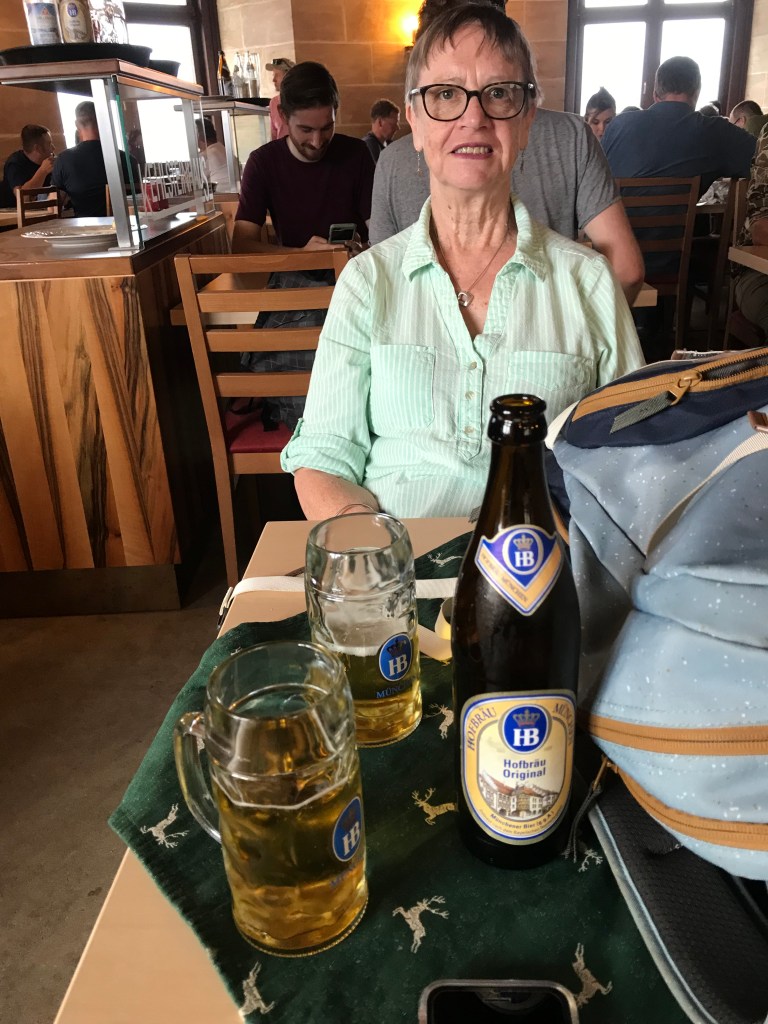
For a full history of Hitler, the Kehlsteinhaus and the Dokumentation Obersalzberg, refer to the following websites:
https://en.wikipedia.org/wiki/Adolf_Hitler
https://en.wikipedia.org/wiki/Kehlsteinhaus
https://de.wikipedia.org/wiki/Dokumentation_Obersalzberg
Monday 7 July 2025
Today is another rest day. We leave for Heidelberg tomorrow morning. With nothing scheduled, we’ll probably just wander the city and see what we find. I’ll do a bit of research to see what’s worth exploring. Until tomorrow.
Tuesday 8 July 2025
We’re currently on the train to Heidelberg, and Maree has just come back after enjoying a coffee.
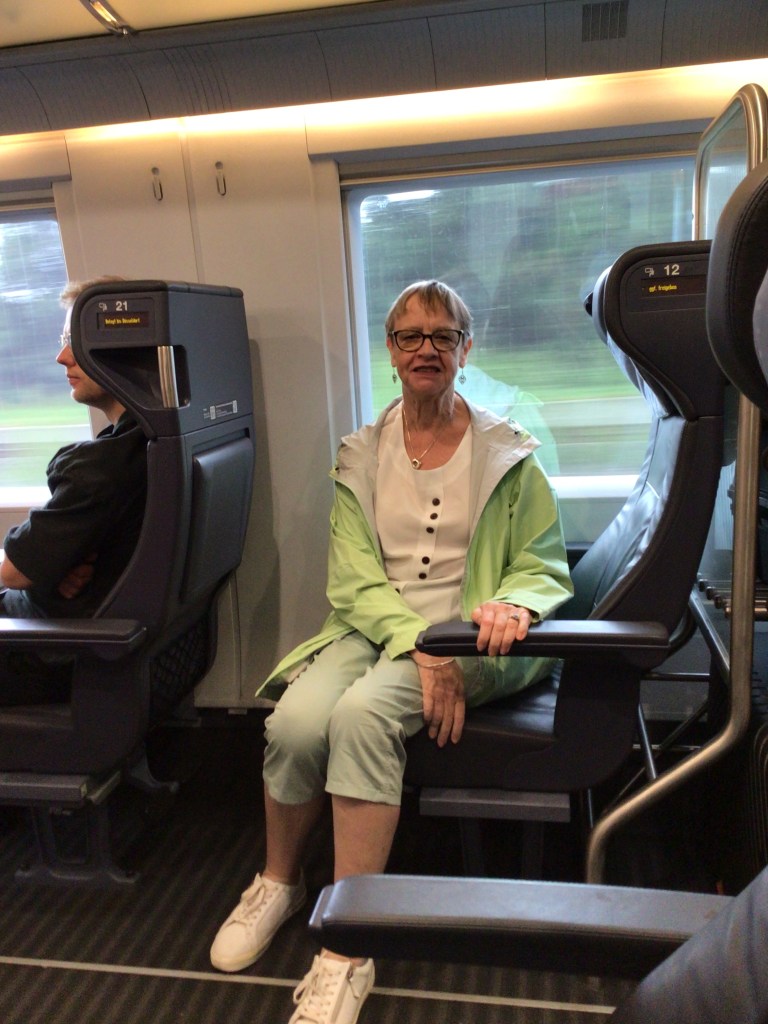
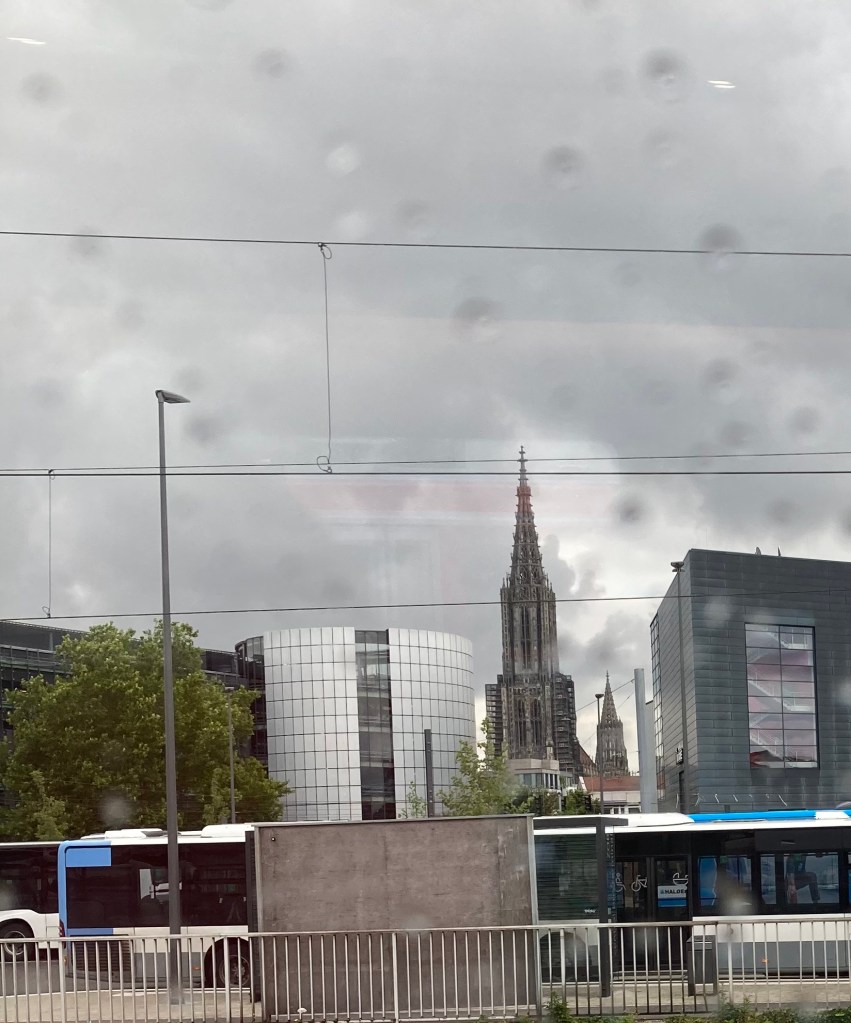
The photo below, taken as we arrived at Ulm Station, shows the towering steeple of Ulm Minster — the tallest church in Europe and, in fact, the tallest church in the world. Although I couldn’t capture the entire building, the steeple alone gives a sense of its immense scale, rising to 161.53 metres.
Ulm Minster (Ulmer Münster) is a masterpiece of Gothic architecture. Construction began in 1377 and wasn’t fully completed until 1890, more than five centuries later. Originally built as a Catholic church, it became Lutheran during the Reformation, though its design and dedication to the Virgin Mary reflect its Catholic origins.
A few remarkable details about the church:
It held the title of the world’s tallest church tower from 1890 and still does today, with its spire reaching 161.53 metres.
Visitors can climb 768 steps to a viewing platform at 143 metres, offering sweeping views over Ulm and, on clear days, even the Alps.
Despite Ulm suffering heavy bombing in World War II, the Minster survived with minimal damage, a stroke of luck given its prominence.
The church can hold up to 20,000 people, making it one of the largest Protestant churches in Germany by capacity.
Even from a partial glimpse, the scale of the steeple is astonishing — a dramatic landmark that dominates the skyline and hints at the extraordinary craftsmanship behind it.
We arrived in Mannheim and transferred to the S‑Bahn for the short 15‑minute ride to Heidelberg.
Our hotel is just 230 metres from the Hauptbahnhof—a modern place with very comfortable rooms. After settling in, I walked over to the tourist information office to pick up a city map, then stopped by the Deutsche Post/DHL outlet. With the weather warmer than expected, I decided to send my extra shirts, trousers, and jacket back home. It also frees up a bit more space in my suitcase for Maree’s growing collection of purchases.
With the map in hand and my clothes on their way to Australia, I returned to the hotel, collected Maree, and we went for a wander around the neighbourhood. We were mainly scouting for dinner options. It’s quite different from Munich, where restaurants were plentiful right outside the door. After exploring a bit, we found a lovely place called uuuhmami and booked a table there for Thursday evening.
For tonight, we reluctantly settled on Moe’s Grill, an American‑style burger spot.
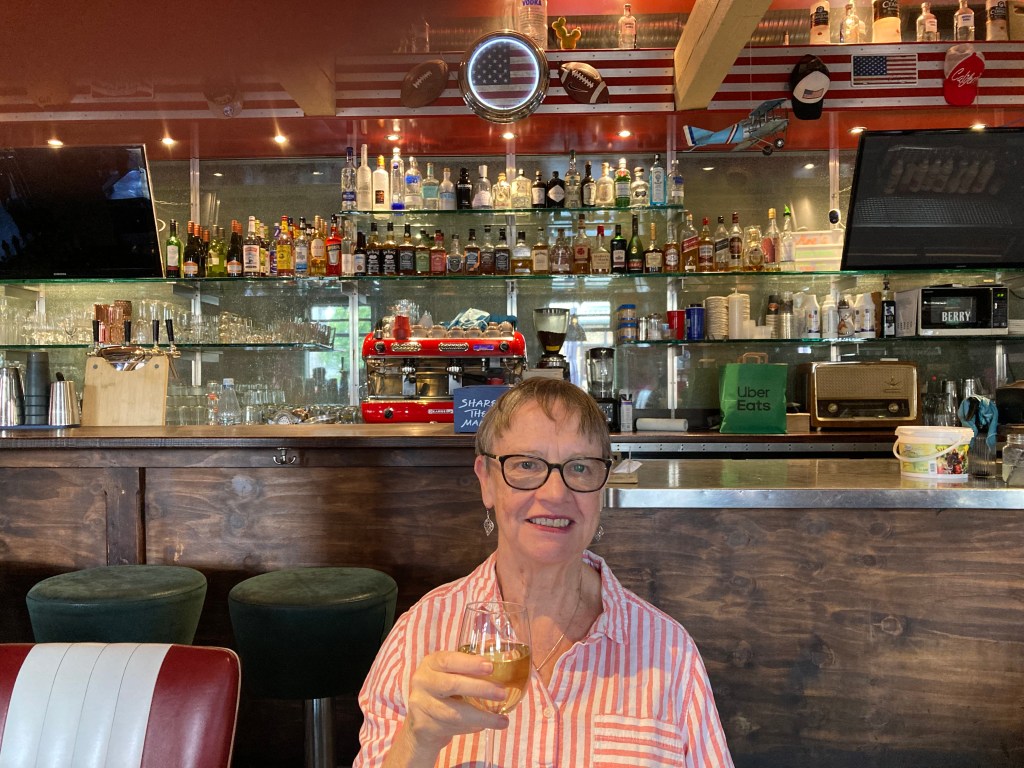
It looked quite nice inside, as you’ll see from the photos, but the food didn’t quite live up to the setting—well, at least not my meal. Maree’s Caesar salad was very good, but my burger was on the greasy side, and the generous amount of tomato sauce turned the bun soggy. So this place gets no stars from me.
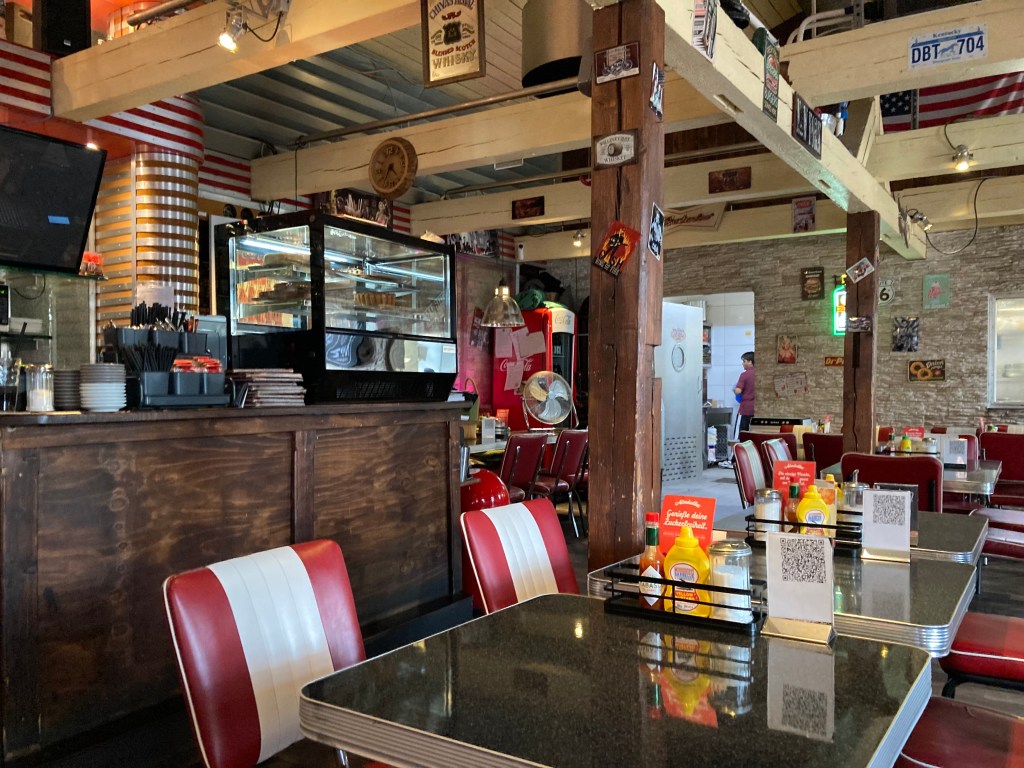
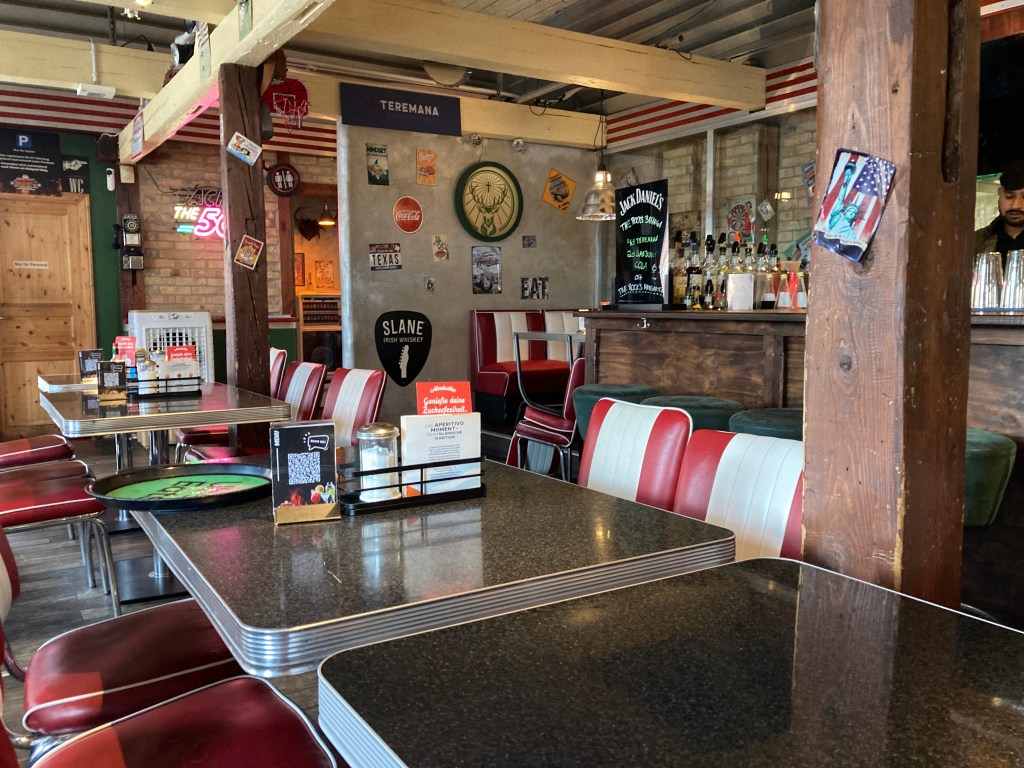
So after dinner—such as it was—we wandered around for a little while before making our way back to the hotel, where we settled in for the evening with a lovely bottle of Italian Pinot Grigio.
Wednesday, 9 July 2025
We enjoyed a leisurely breakfast this morning before heading out toward the Old Bridge. Instead of taking the direct route, we chose to stroll along the banks of the Neckar River. The walk was peaceful, and the riverside scenery is genuinely beautiful.
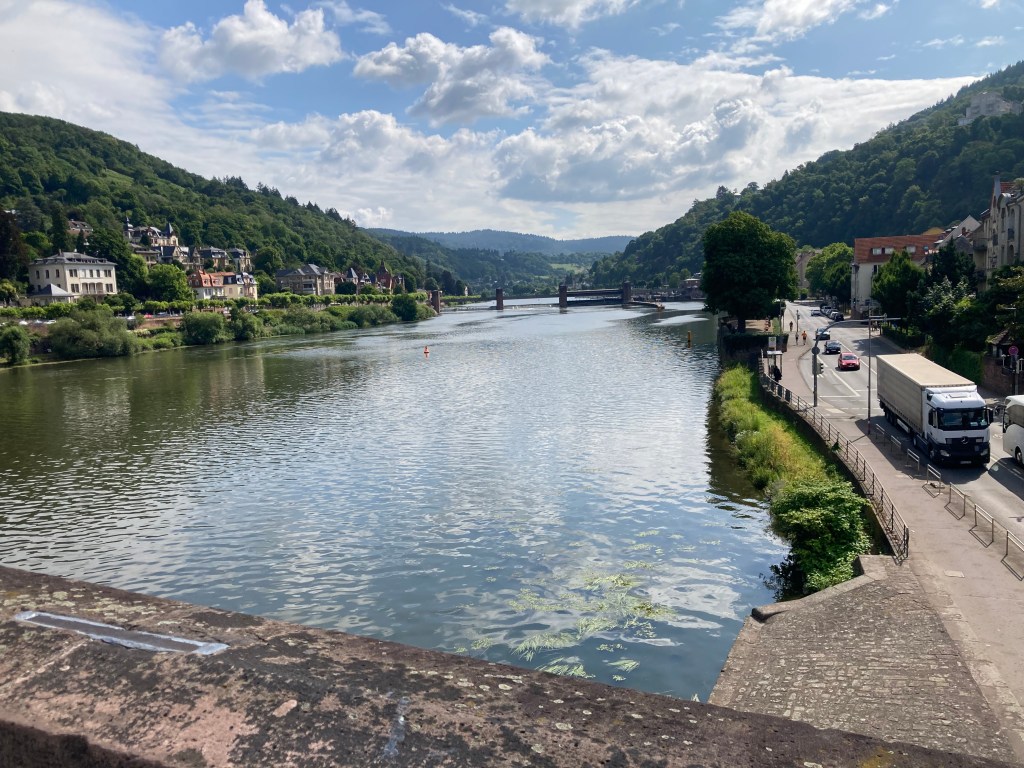
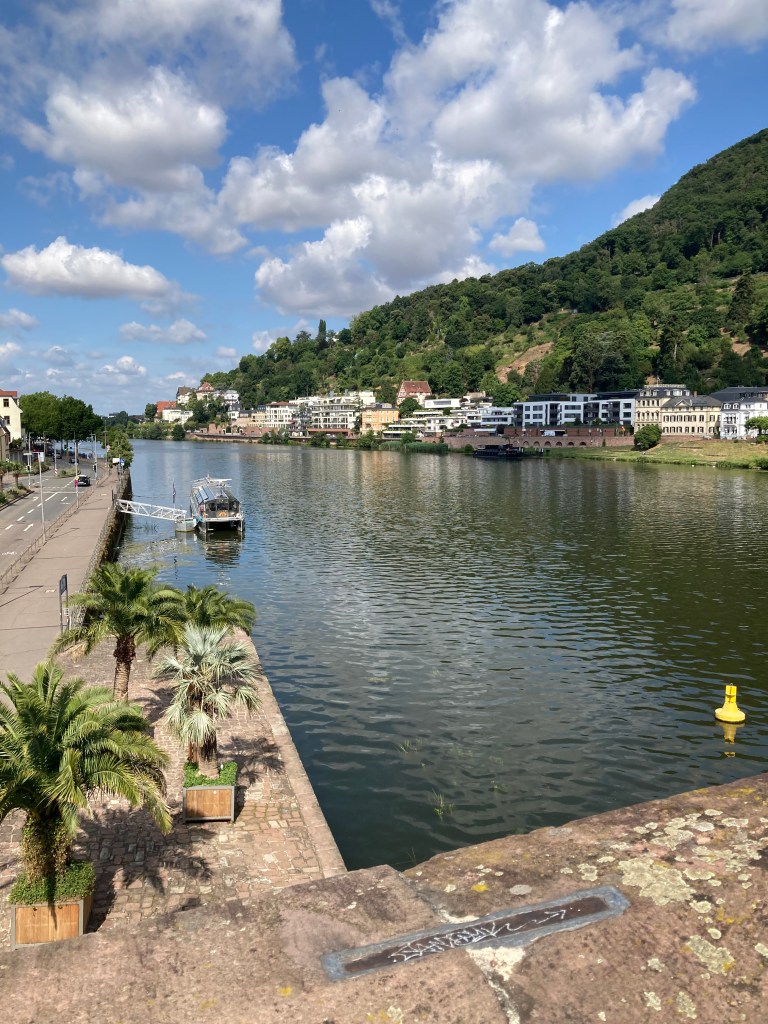
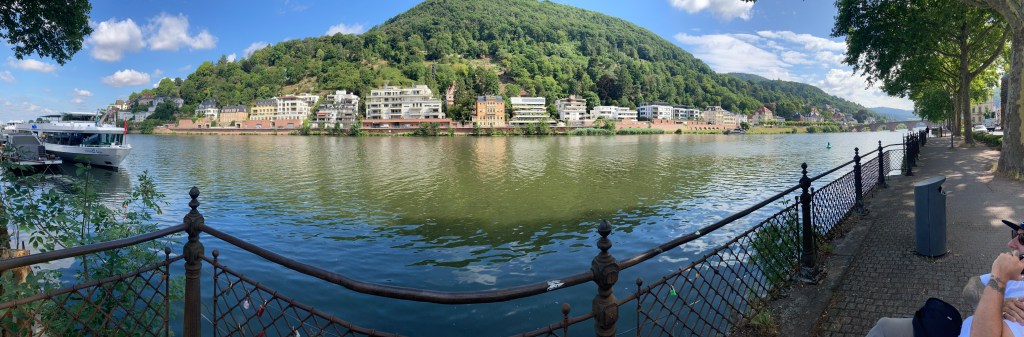
The Karl Theodor Bridge—better known as the Old Bridge or Alte Brücke—is one of Heidelberg’s most iconic landmarks. Spanning the Neckar River, it links the Old City with the eastern side of the Neuenheim district on the opposite bank.
The bridge you see today, built from warm Neckar sandstone, is actually the ninth structure to stand on this site. Earlier wooden bridges were repeatedly destroyed by floods and ice, prompting Elector Charles Theodore to commission a more durable stone bridge in 1788. His decision proved wise: the Old Bridge has become one of Heidelberg’s most recognisable symbols and a favourite destination for visitors.
It’s a beautiful piece of history to walk across, with the city, river, and castle all unfolding around you.
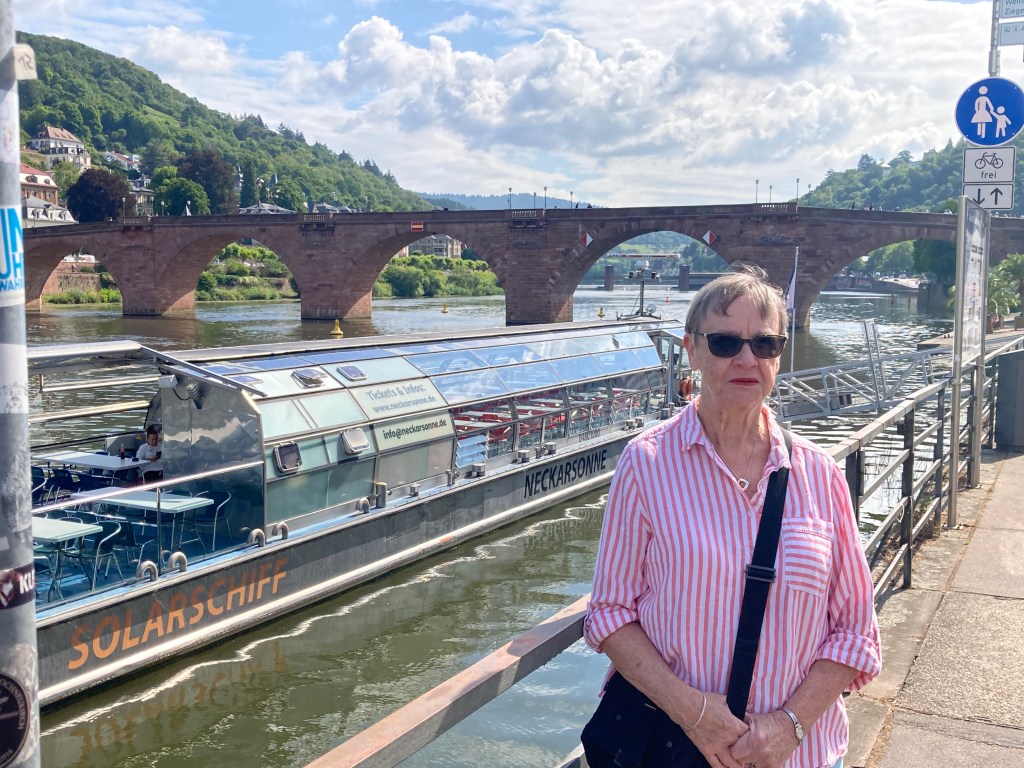
We made our way in this direction because we’re taking a three‑hour river cruise on the Neckar this afternoon and wanted to confirm exactly where it departs. Since we were already nearby, we took the chance to wander through the old town for a while.
Although the Karl Theodor Bridge was completed almost 250 years ago, it’s still relatively young compared with the long history of Heidelberg itself. Its nickname, the “Old Bridge,” only came into use after the construction of the Theodor Heuss Bridge in 1877 (originally called the Friedrichs Bridge). Since the thirteenth century, eight different bridges have stood on this same site, and the current stone bridge rests on their medieval foundations. The bridge gate (Brückentor) at the southern end also dates back to the Middle Ages, adding even more character to this historic crossing.
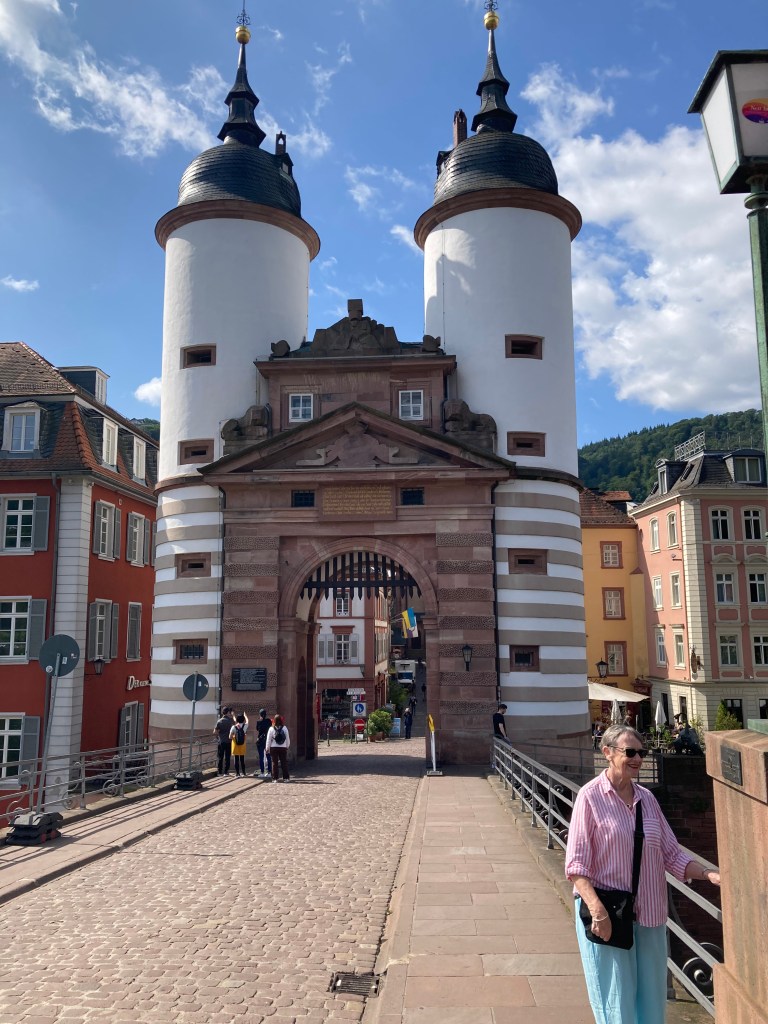
On 29 March 1945, as Allied forces approached Heidelberg, German troops destroyed three of the Old Bridge’s arches and two of its supporting pillars in an effort to slow the advance. The explosion left the bridge badly damaged and severed the historic link between the Old City and Neuenheim. After the war, the people of Heidelberg undertook a careful reconstruction, restoring the bridge to its original 18th‑century appearance. Today, it stands not only as a landmark but also as a symbol of the city’s resilience and determination to preserve its heritage.
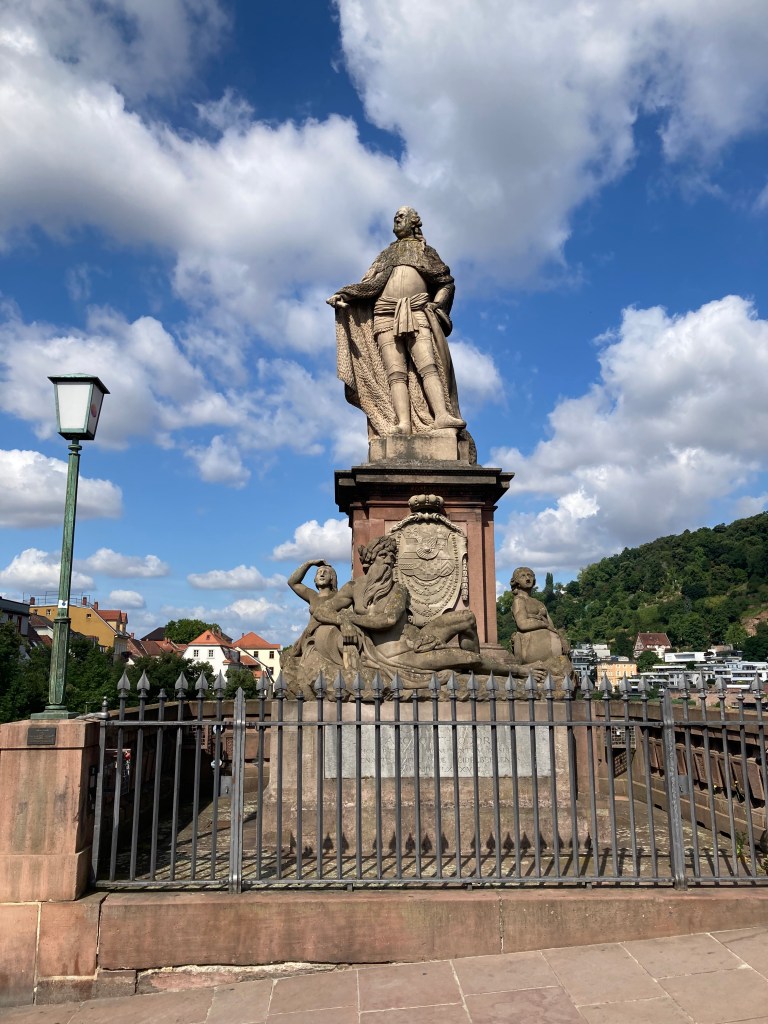
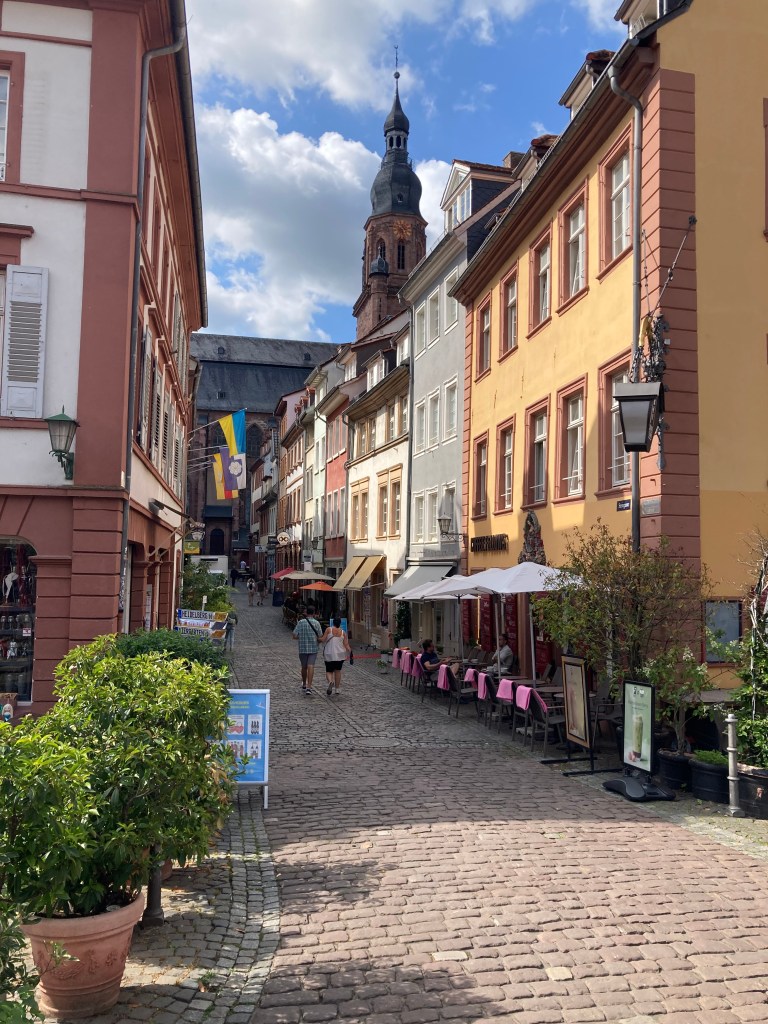
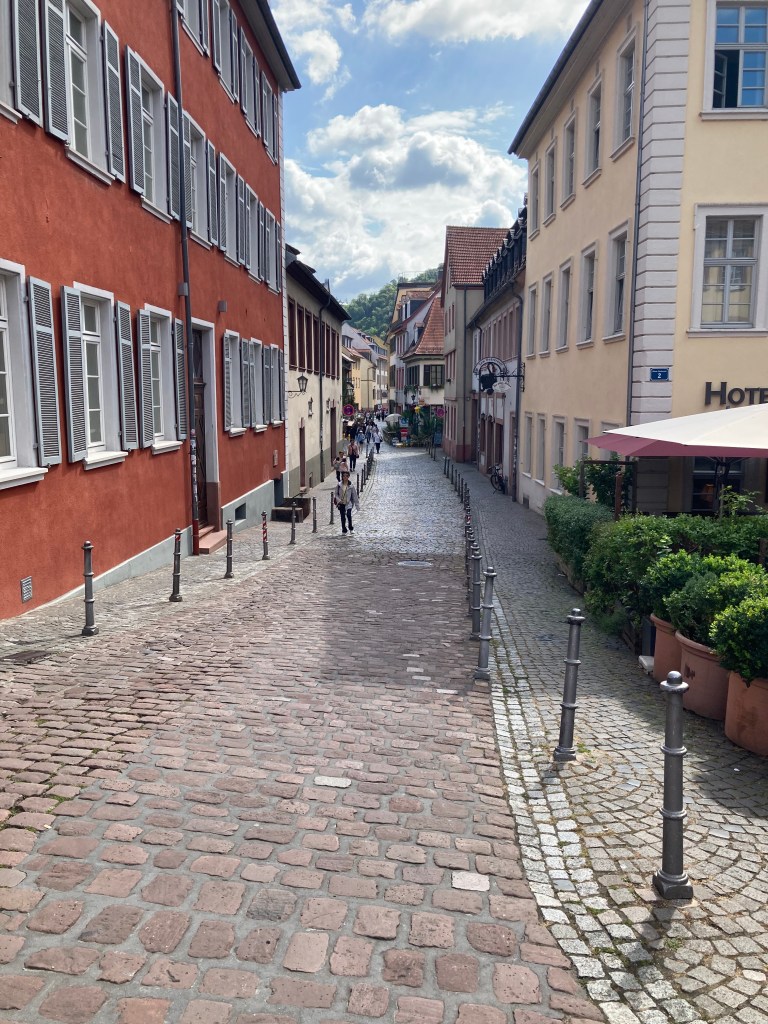
Photos of the old town streets.
At the Old Bridge stands the famous Bridge Monkey, a figure whose origins reach back to the 15th century. The original statue was made of stone and positioned in the bridge tower on the Neuenheim side, opposite the Old Town. The tower itself was meant to project authority and remind visitors of the city’s power, while the monkey—cheekily holding up a mirror—symbolised mockery and a reminder not to think too highly of oneself.
The medieval statue was destroyed along with the bridge tower during the Nine Years’ War, but the modern bronze version, installed in 1979, continues the tradition. Today’s Bridge Monkey invites visitors to interact with it: touching the mirror is said to bring good fortune, touching the outstretched fingers promises a return to Heidelberg, and touching the nearby bronze mice is believed to bring fertility. It’s a playful piece of folklore woven into the city’s long history, and one of the most photographed spots on the bridge.
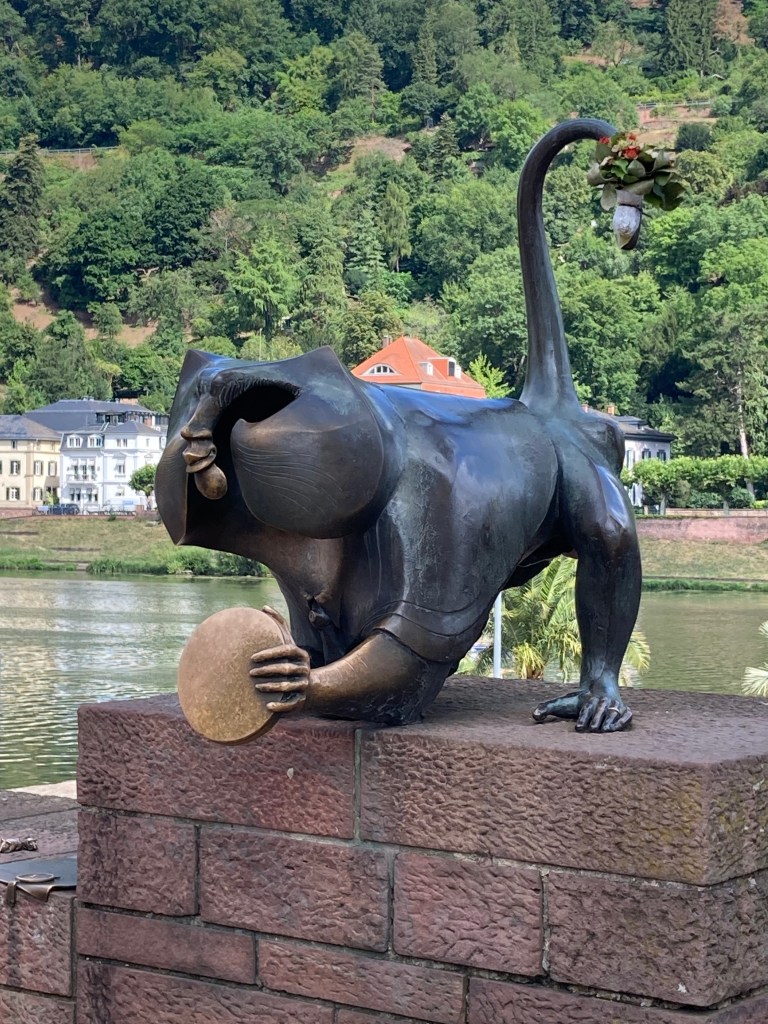
Touching its bare backside, the original Bridge Monkey offered a rather cheeky greeting to anyone crossing the bridge. Its rear end faced toward Mainz on the opposite bank, a deliberate gesture aimed at the Bishops of Mainz. The people of Heidelberg wanted to make it clear that the bishops held no authority over the Electors of the Palatinate. The mirror in the monkey’s hand served a different purpose: a reminder for passers‑by to reflect on themselves before judging others.
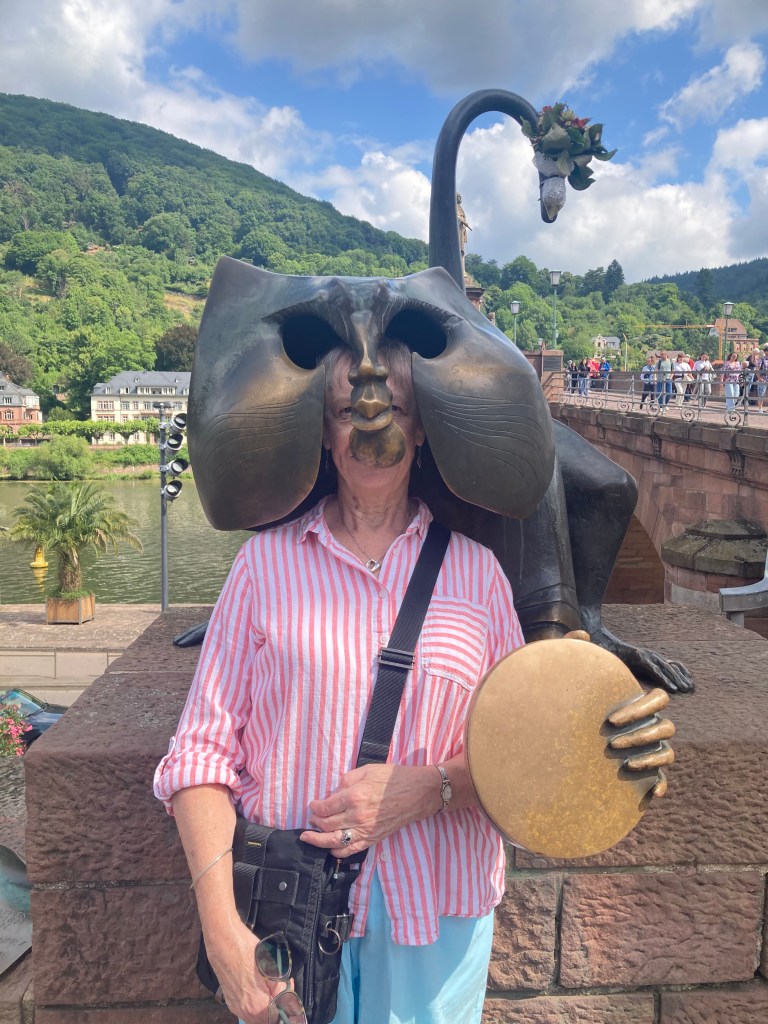
Centuries later, at the request of the Alt‑Heidelberg association, artist Gernot Rumpf created a new bronze version of the monkey in 1977. Installed beside the bridge tower in 1979, this modern sculpture differs from its predecessors. Instead of grabbing its backside, the monkey now forms the “sign of the horns,” a gesture meant to ward off the evil eye.
Visitors also like to stick their heads inside the hollow bronze head for good luck. Just imagine how many tourists have had their heads in there before you, Maree.
From here we headed back to the hotel for a short break before setting out again for our three‑hour cruise.
We reached the departure point at 14:30 and boarded the vessel for our journey along the Neckar River. The cruise began by heading upstream, gliding beneath the Old Bridge before entering a lock that regulates the river’s water levels at different sections.
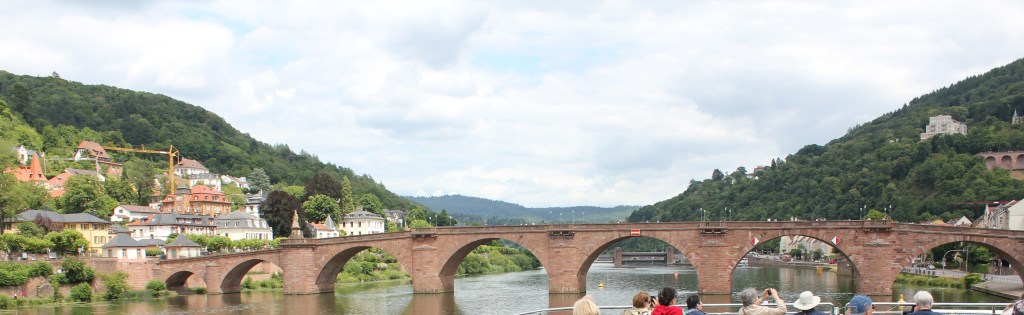
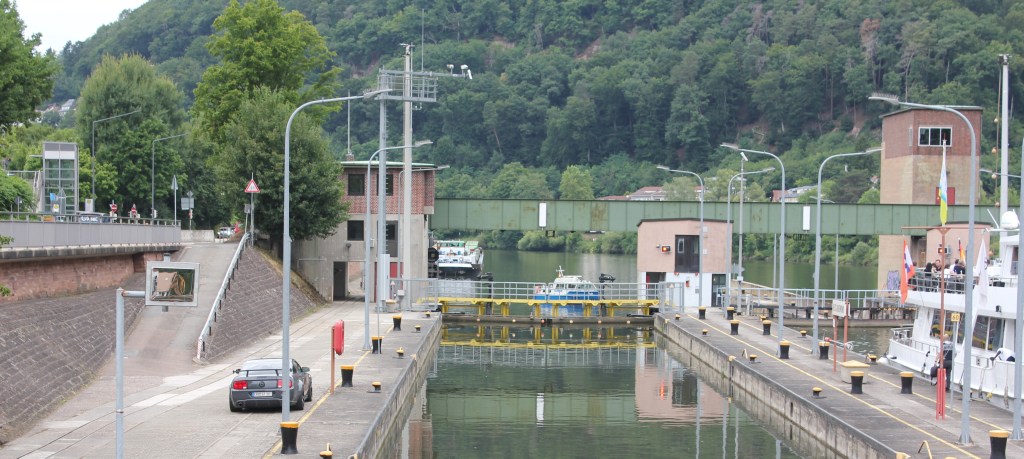
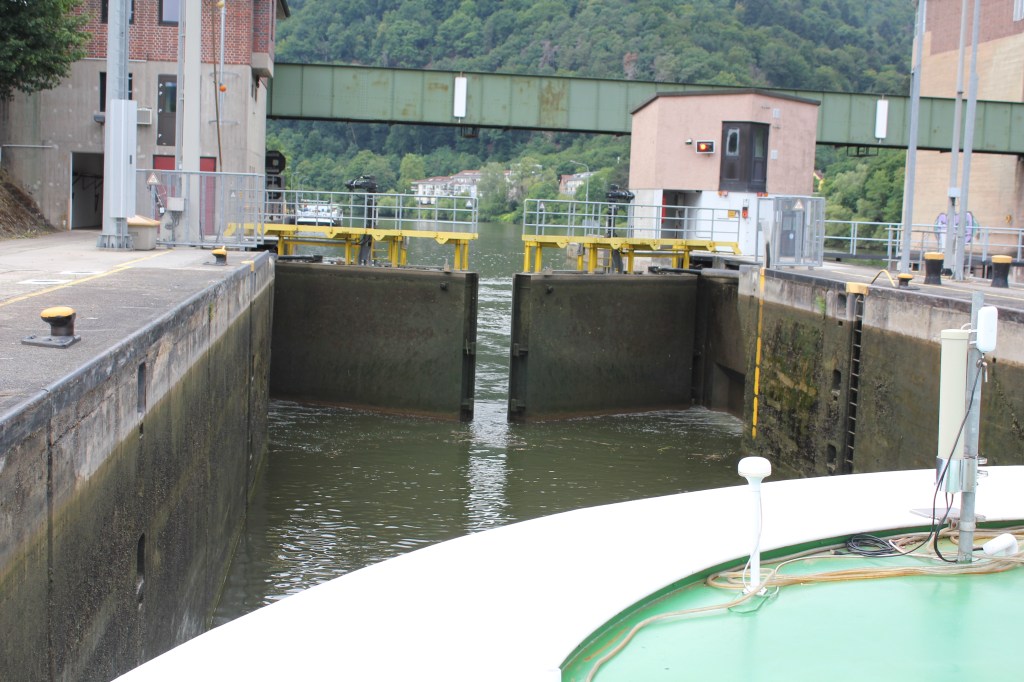
After we cleared the lock, a running commentary played about the sights along the Neckar, though the audio was a bit hard to make out. Rather than guess at what we missed, I’ll simply share some of the photos we took as we cruised along. It really was a very pleasant and relaxing three‑hour journey.
Before the photos, a little background on the Neckar itself:
The Neckar stretches for 362 kilometres, flowing mainly through Baden‑Württemberg with a short section passing through Hesse. It’s one of the Rhine’s major right‑bank tributaries. The river rises at 706 metres above sea level in the Schwenninger Moos conservation area near Schwenningen, then winds its way through towns such as Rottweil, Tübingen, Esslingen, Stuttgart, Heilbronn and finally Heidelberg, before joining the Rhine at Mannheim at just 95 metres above sea level. On average, it contributes around 145 cubic metres of water per second to the Rhine. Since 1968, about 200 kilometres of the river—from Mannheim to Plochingen—have been navigable for cargo ships, thanks to a system of 27 locks.
The Neckar valley also acts as a natural cold‑air basin. On clear nights, cold air from the surrounding hills sinks into the valley and settles there, often creating fog even when the higher plateaus are bathed in sunshine. This unique geography also contributes to the region’s reputation for wine cultivation, supporting grape varieties such as Trollinger, Lemberger, Kerner and Müller‑Thurgau.
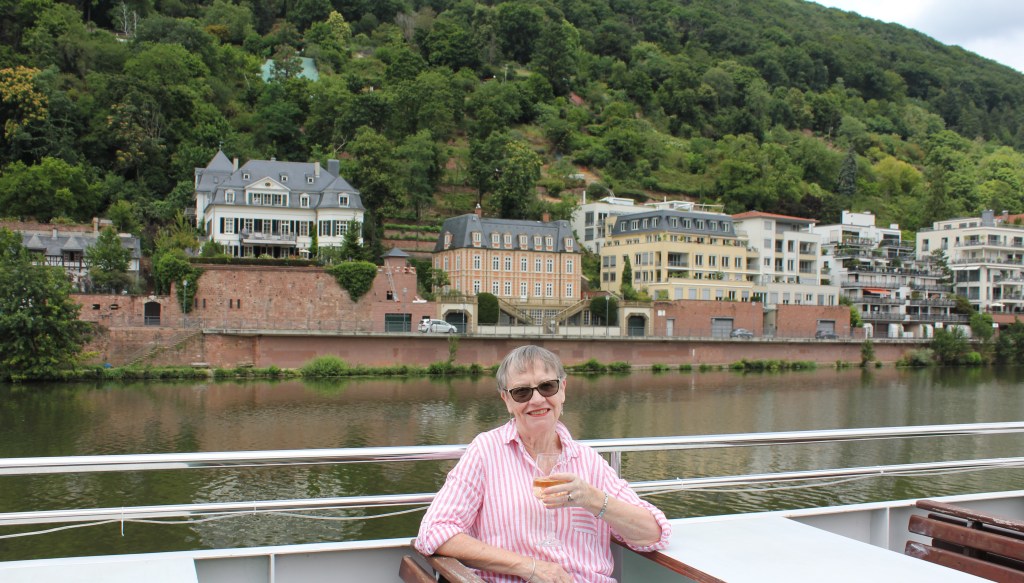
And of course, no cruise can begin without the traditional photo of Maree, glass of wine in hand, settling in to enjoy the scenery.
Heidelberg Castle
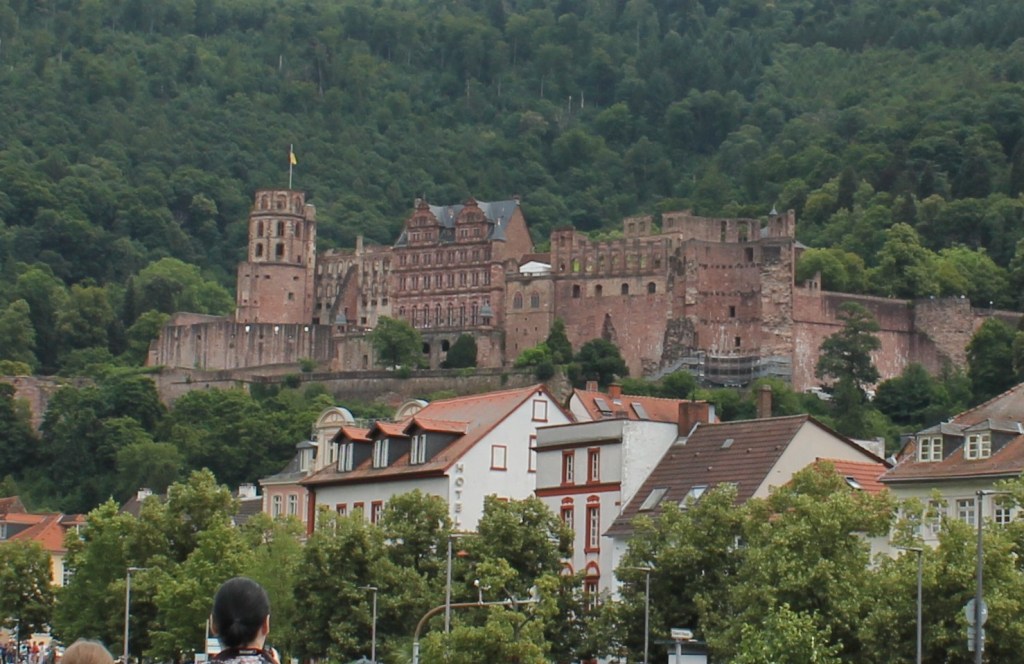
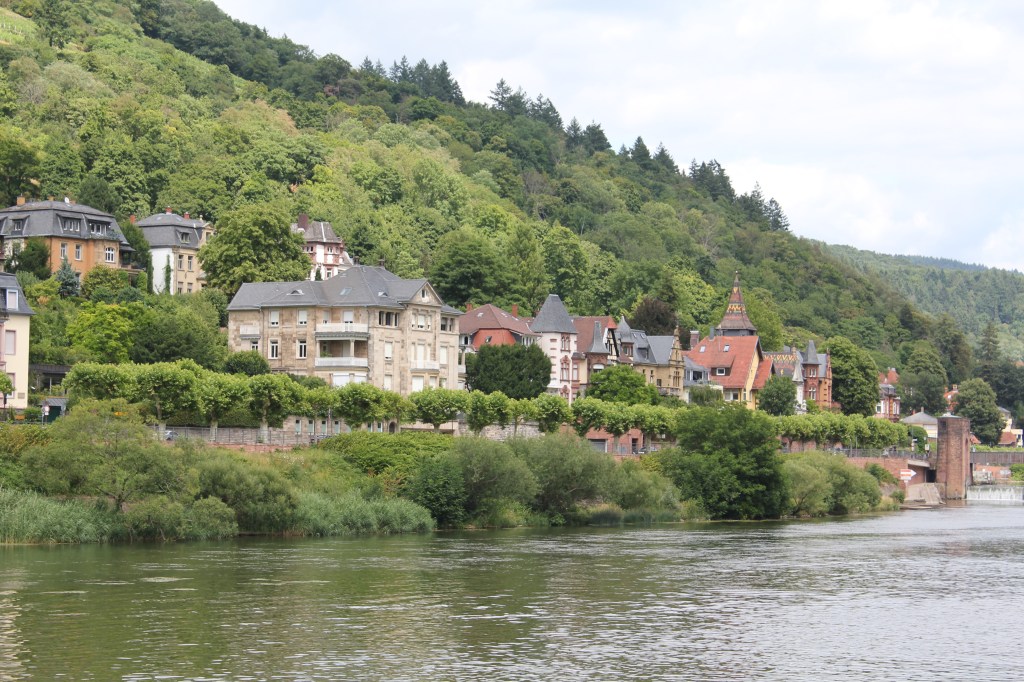
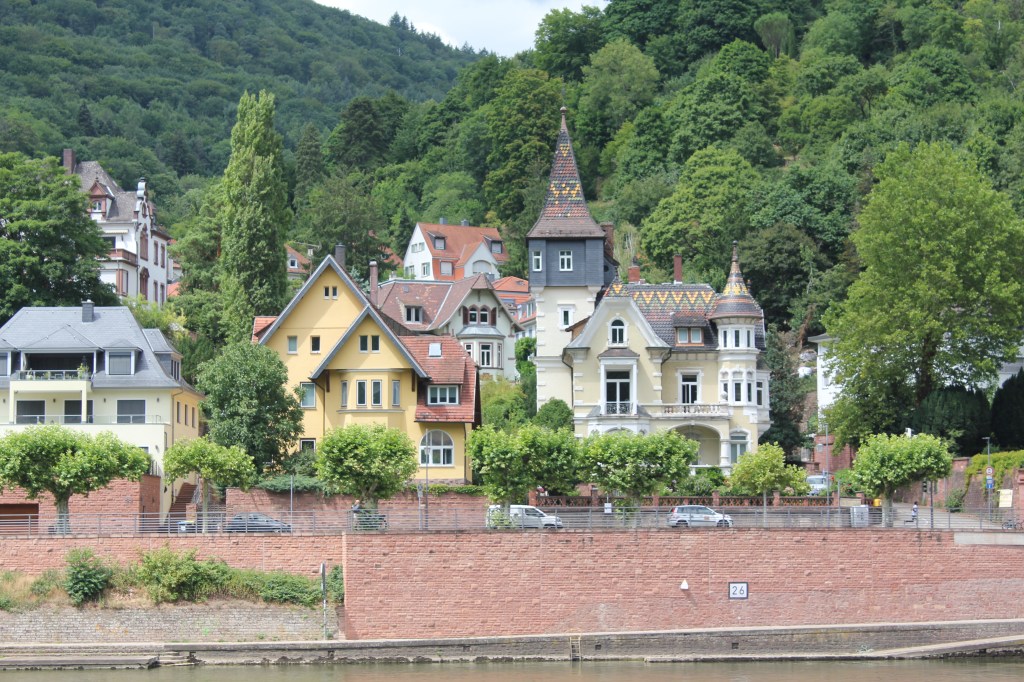
The many houses that line the river.
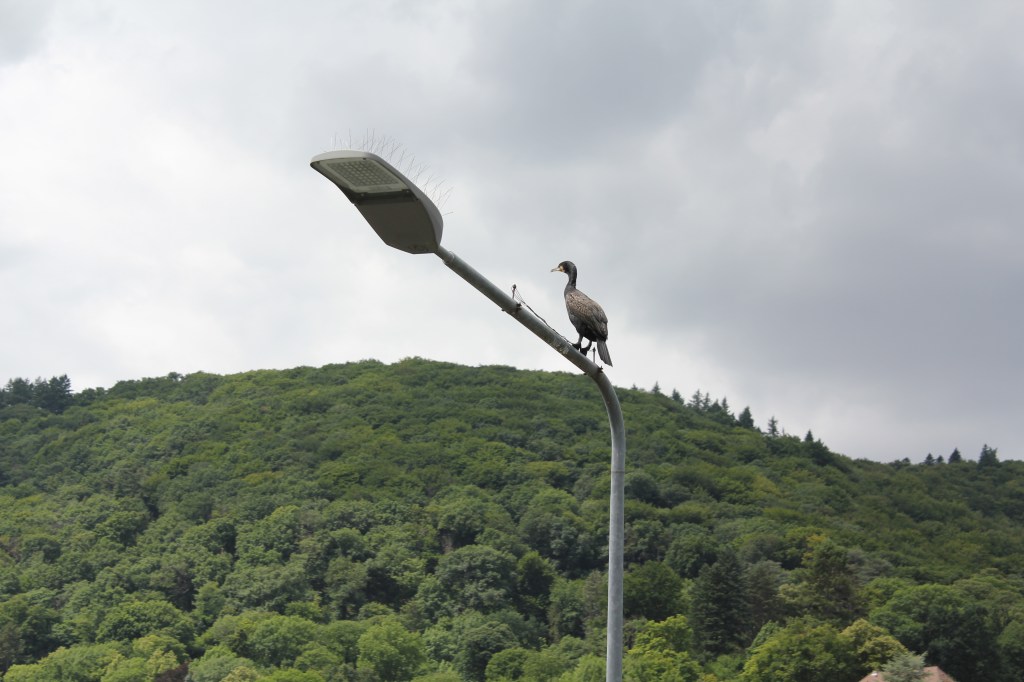
A cormorant perched on the light pole, and if you look closely, you can see the spikes fitted along the top of the light cover—an attempt to keep birds from leaving their mess all over the fixture.
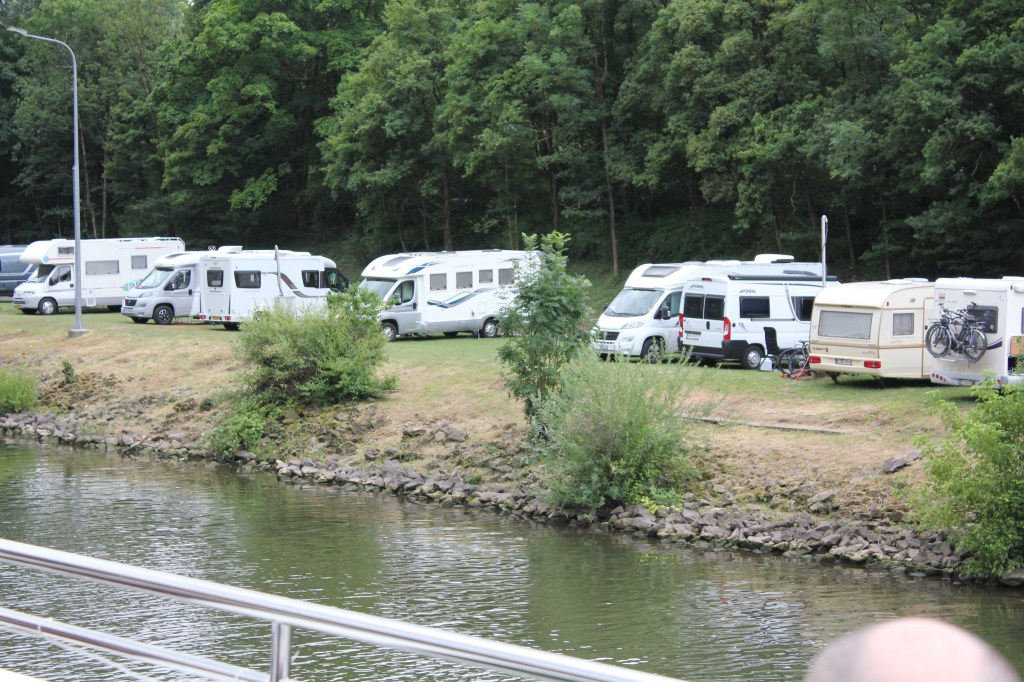
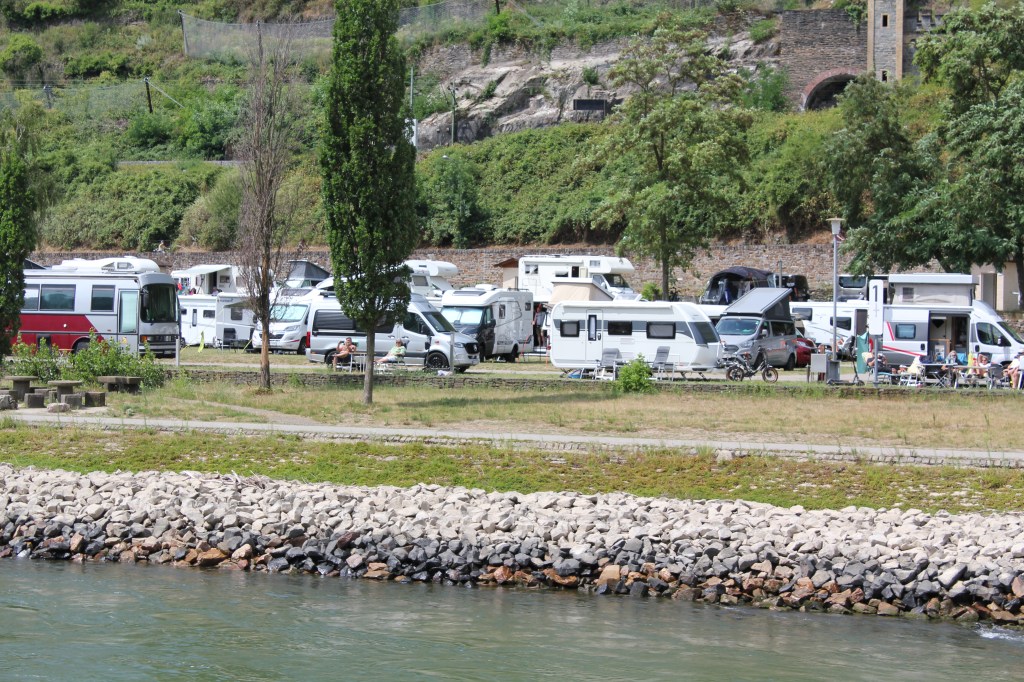
A caravan and motorhome park sits right along the riverbank, with most of the spaces taken up by motorhomes. They were packed in quite tightly in several areas—nothing like the spacious layouts we’re used to in our van parks back home.
Old castles and castle ruins
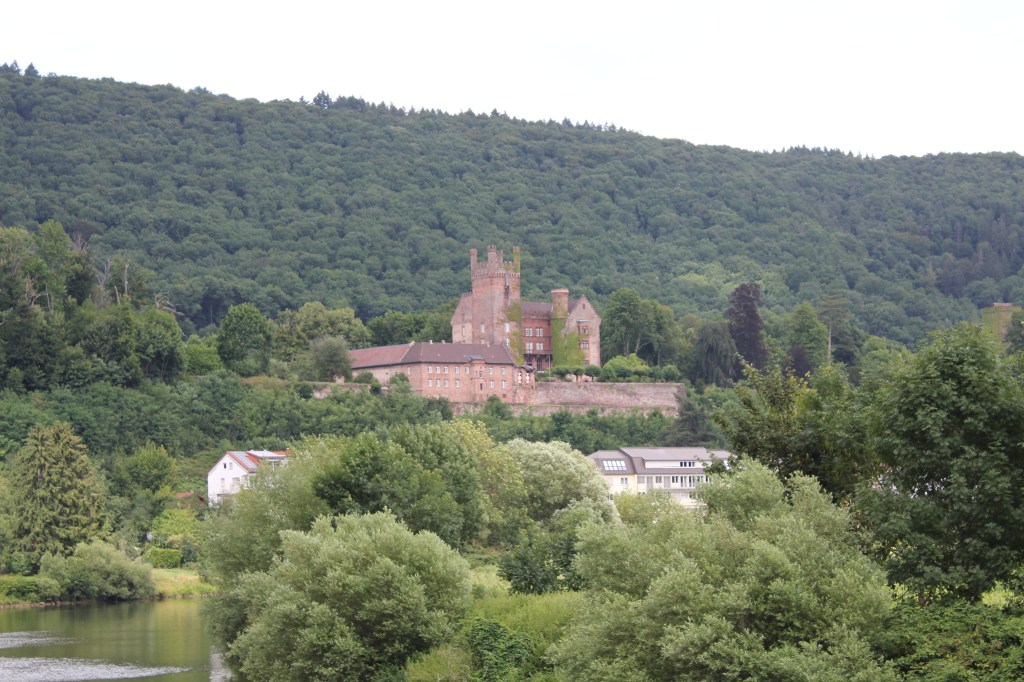
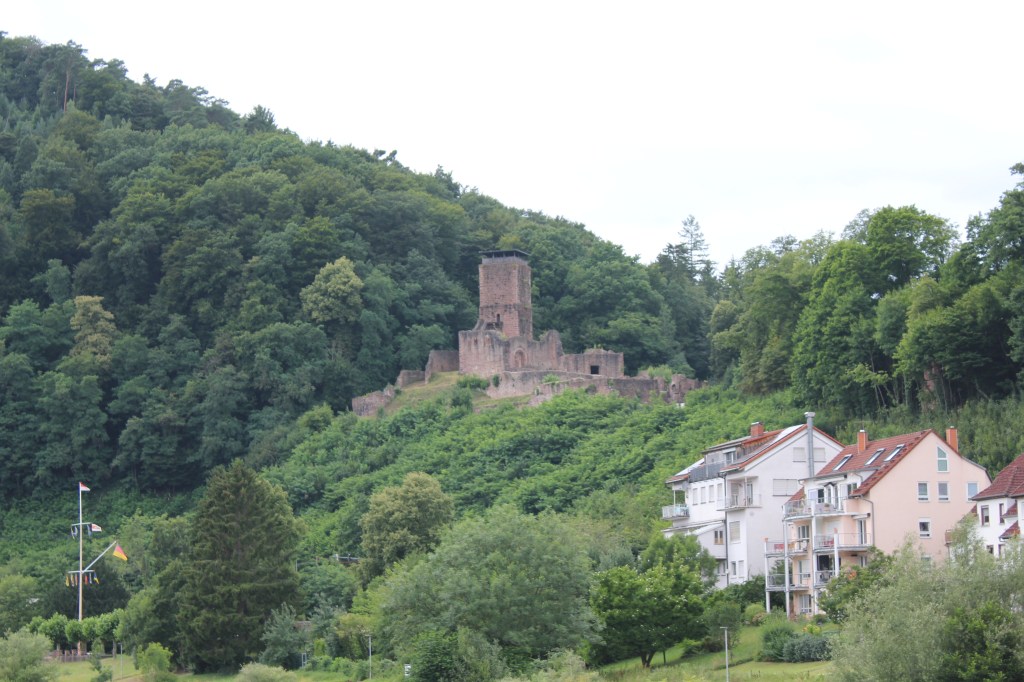
Well that is all for today.
Thursday 10 July 2025
This morning we headed off to the Heidelberg Castle and the old town area.
Heidelberg Castle
Heidelberg Castle, perched 80 metres up the northern slope of the Königstuhl, dominates the view over the old town and remains one of Germany’s most striking historic landmarks. Although now a ruin, it is considered one of the most significant Renaissance structures north of the Alps.
The castle’s history stretches back to at least the early 13th century, when it began as a fortified residence of the Palatinate electors. Over the centuries it expanded into an impressive complex of courtyards, towers, and grand halls. Its fortunes changed dramatically in the 17th and 18th centuries, when it suffered repeated destruction—first during the Thirty Years’ War, then in the War of the Palatine Succession, and finally from a lightning strike that set parts of it ablaze. Only sections were ever rebuilt, leaving the dramatic mix of ruins and restored buildings seen today.
Despite its turbulent past, Heidelberg Castle remains a powerful symbol of the city’s heritage, drawing visitors from around the world to admire its architecture, its gardens, and the sweeping views over the Neckar and the old town below.
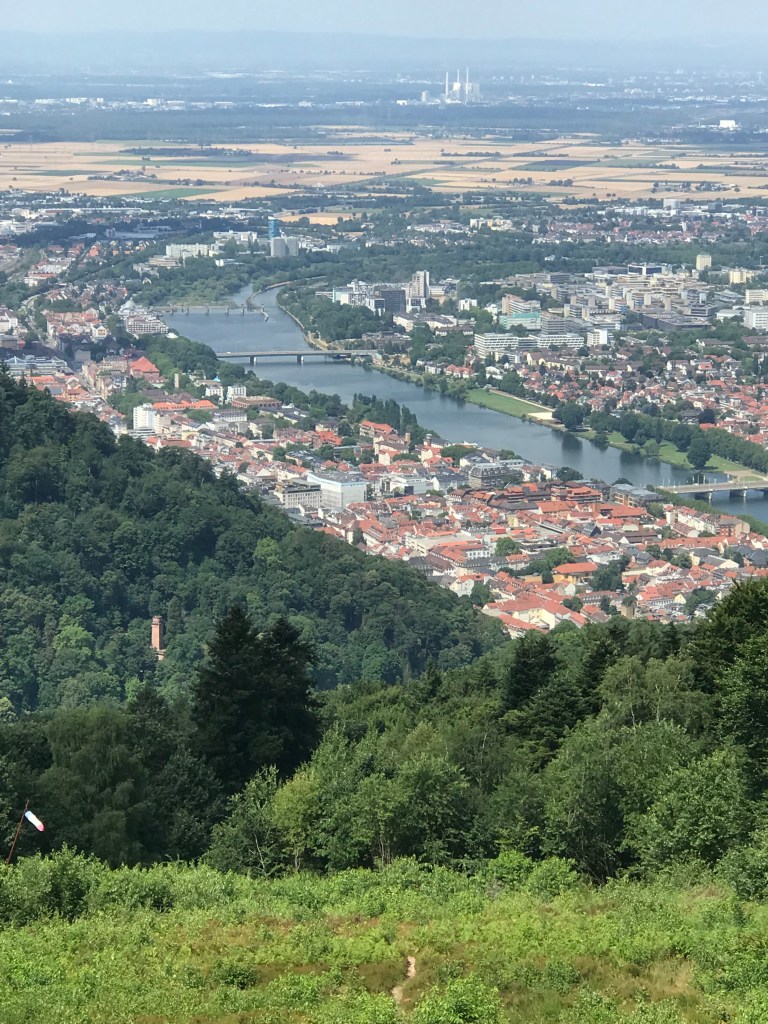
A funicular railway runs up the hillside, offering an easy alternative to the 315 steps you’d otherwise need to climb if you chose to walk to the castle.
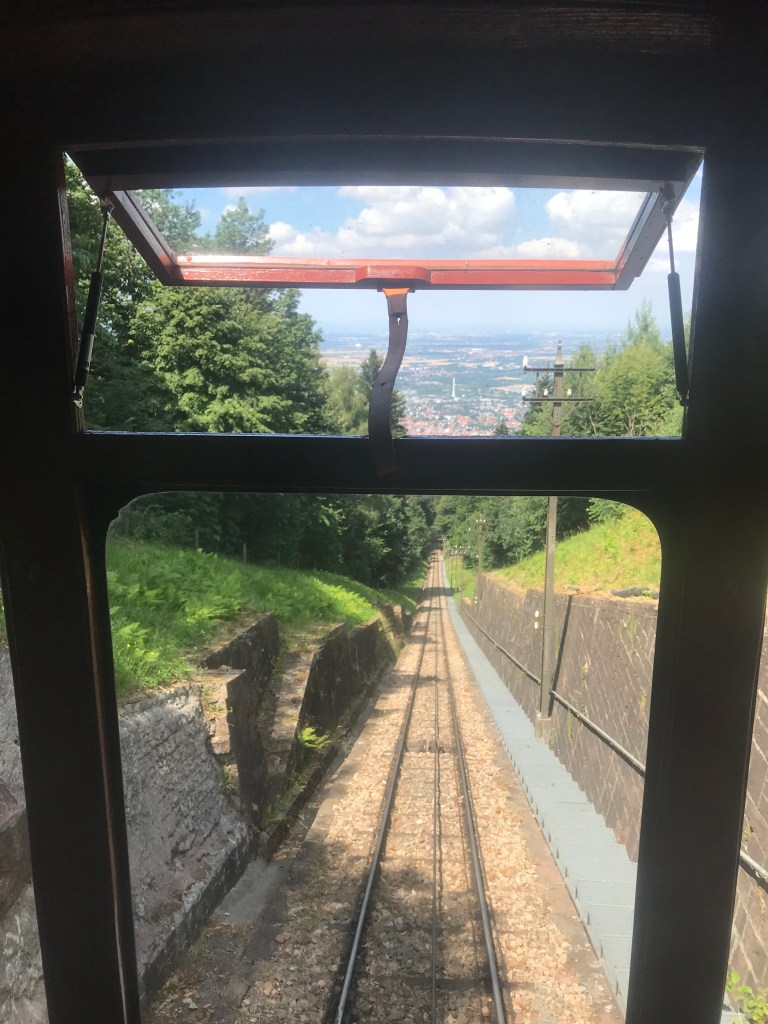
More detail about the castle. The earliest parts of the castle were built before 1214, and by around 1294 the complex had grown into two separate castles. Disaster struck in 1537 when a lightning bolt destroyed the upper castle. The remaining structures continued to evolve and expand, reaching their greatest extent by about 1650, only to suffer further devastation during subsequent wars and fires. Another lightning strike in 1764 ignited a blaze that destroyed several of the rebuilt sections.
By the time Mark Twain visited in 1880, he described Heidelberg Castle as a romantic ruin—an impression that still defines its charm today.
Images of the castle ruins.
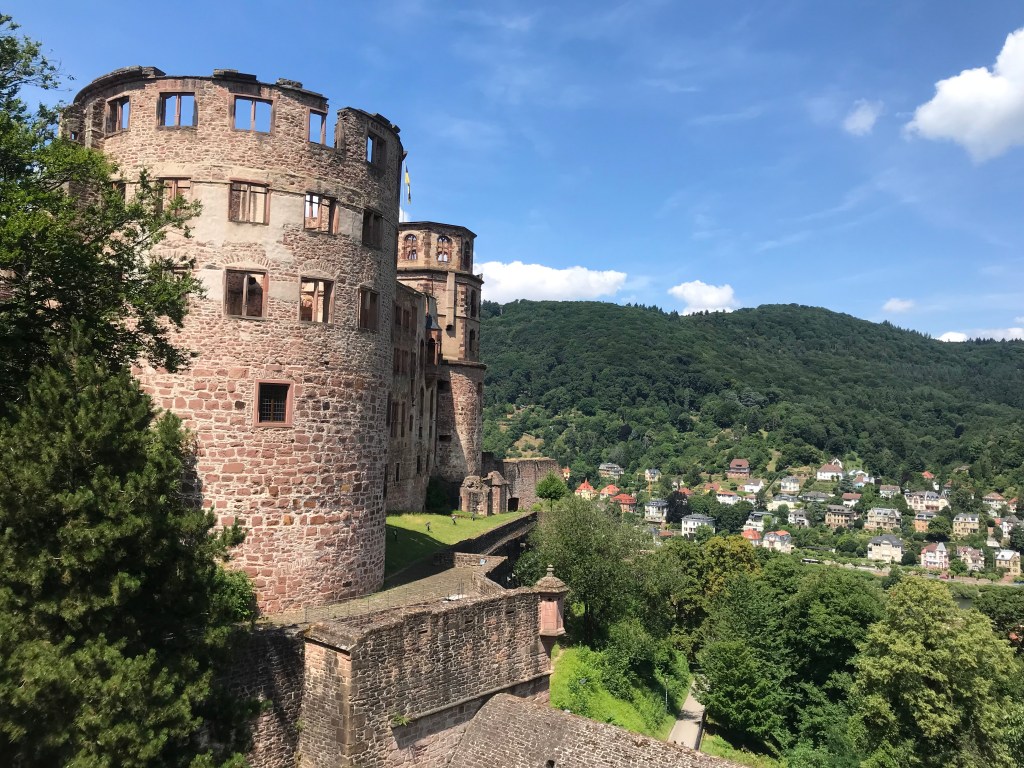
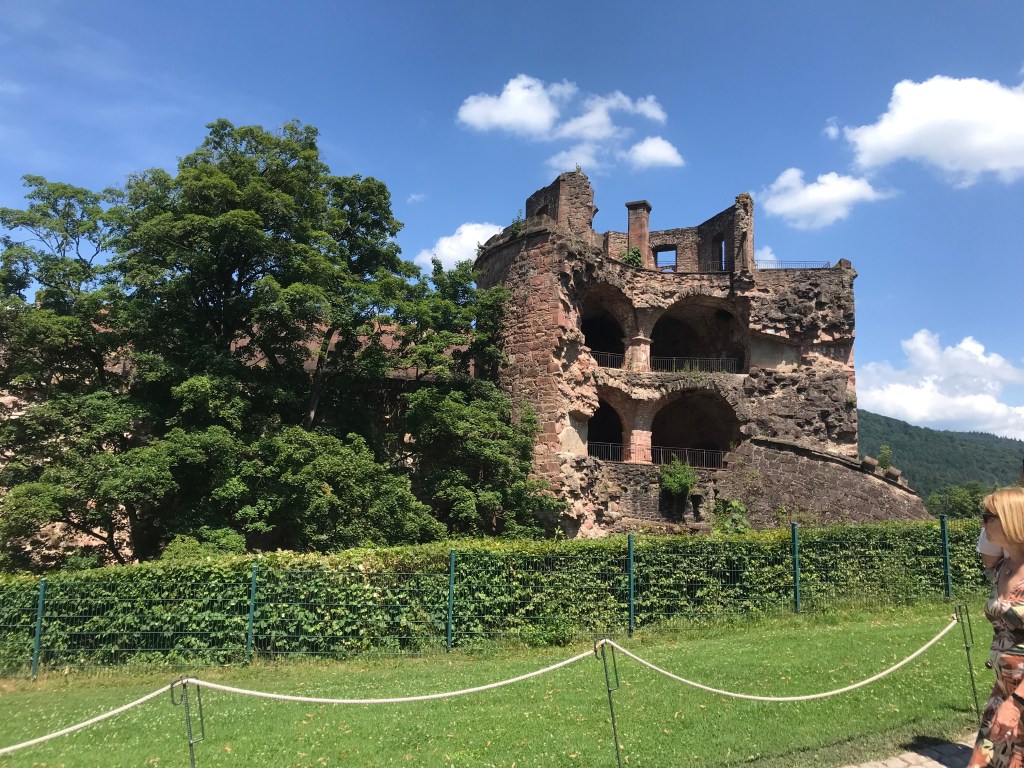
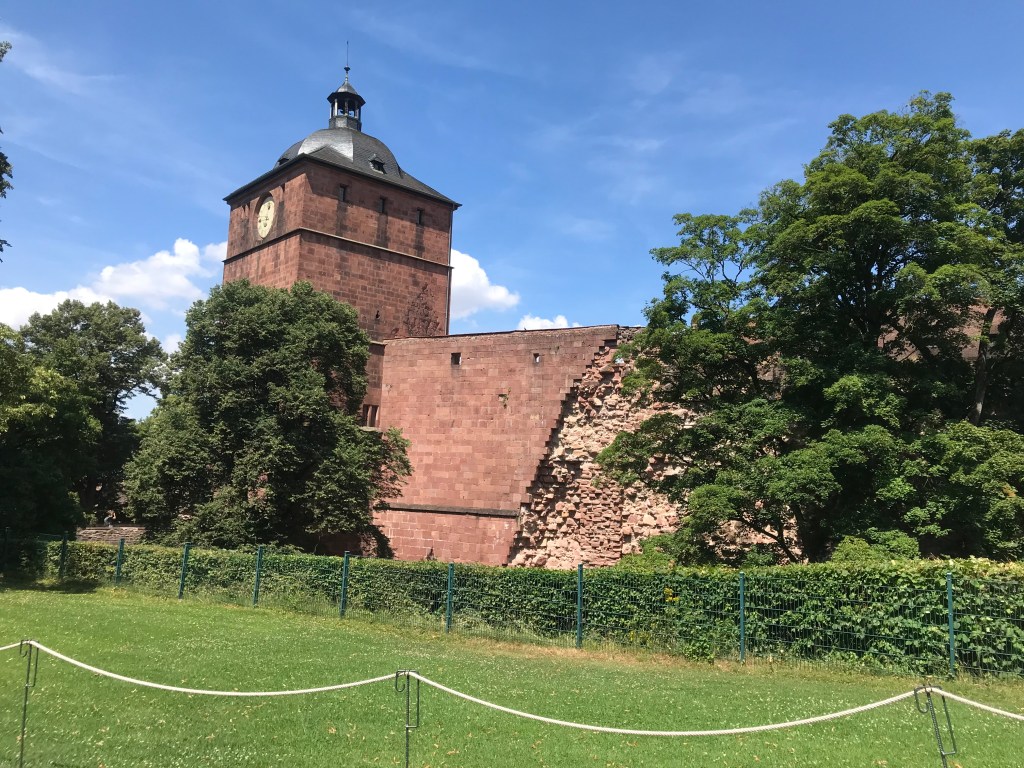
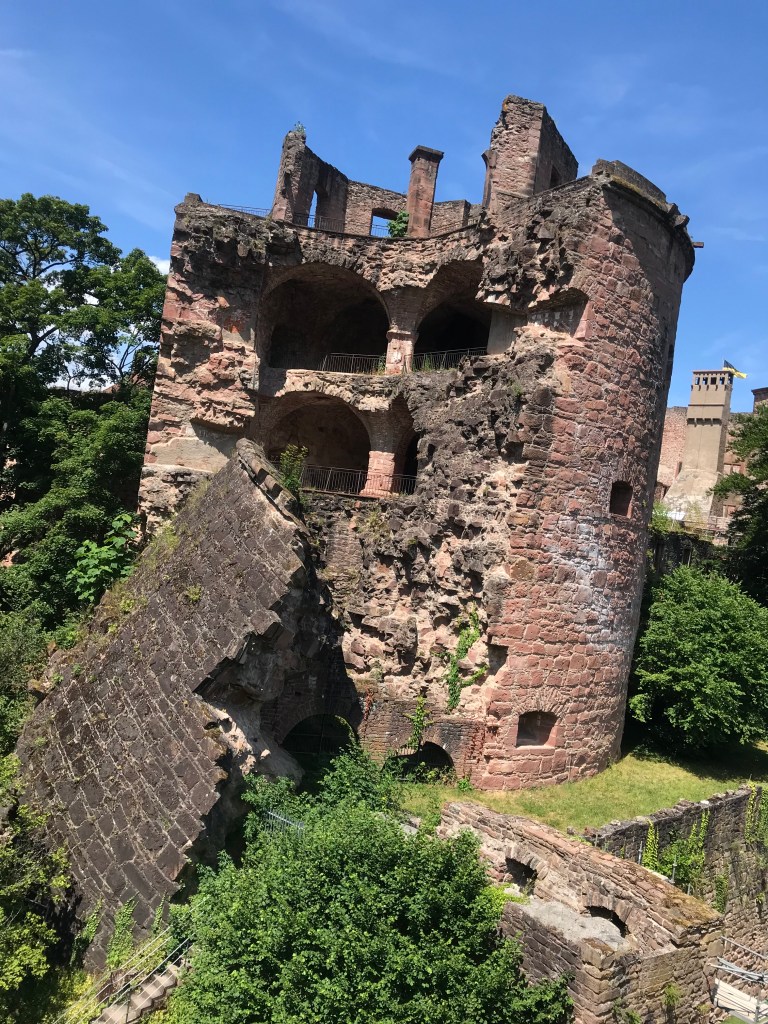
From here we left the castle and headed to the old town of Heidelberg.
Old Town
The Marktplatz is the oldest square in Heidelberg and has been the heart of the city’s marketplace since its earliest days. Hauptstrasse borders it to the south, while Heiliggeiststrasse frames the northern side, creating a lively crossroads between two of the Old Town’s most historic streets. At the eastern end of the square stands the Rathaus (Town Hall), a focal point of civic life for centuries.
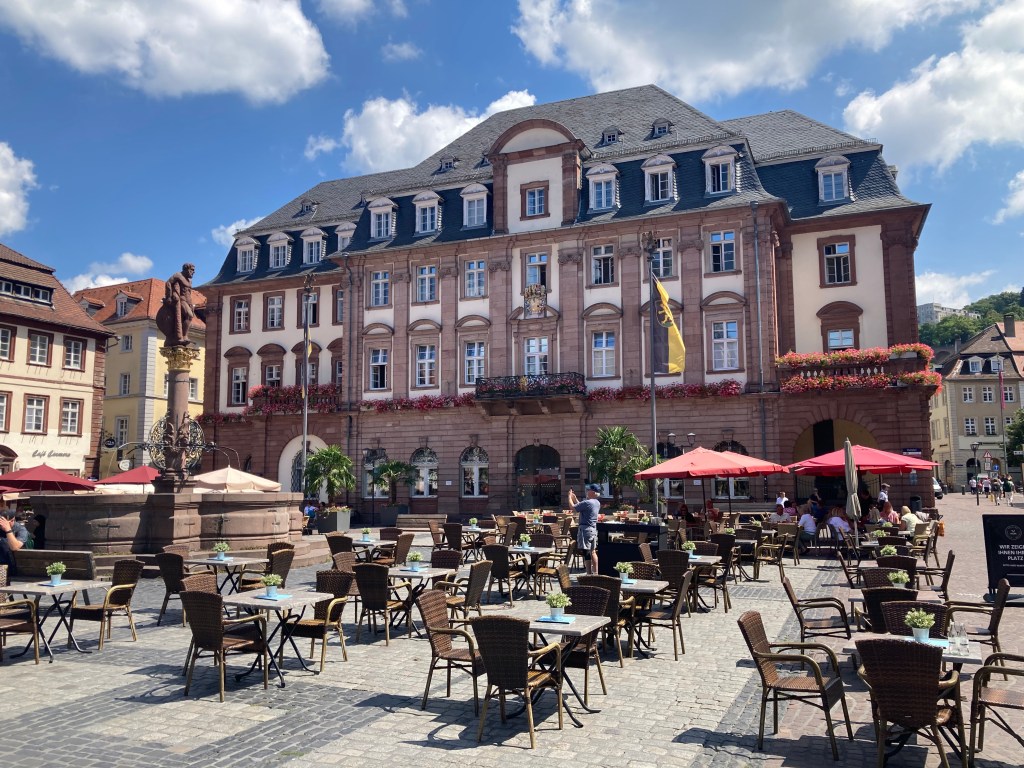
The Church of the Holy Spirit dominates the western part of the square.
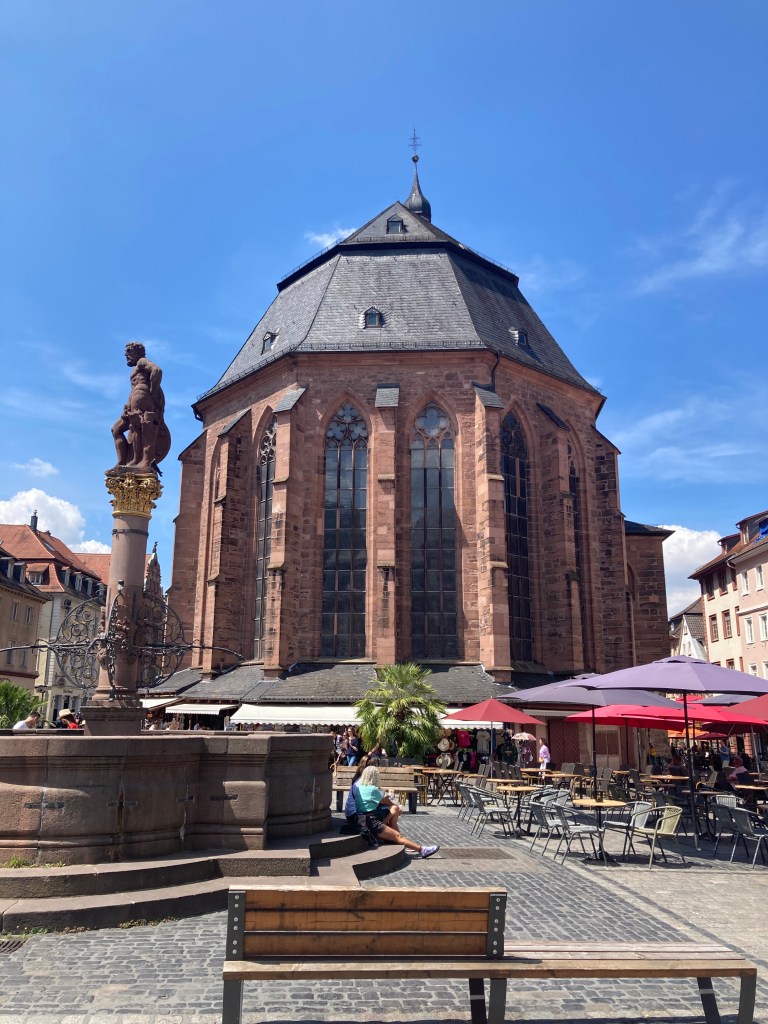
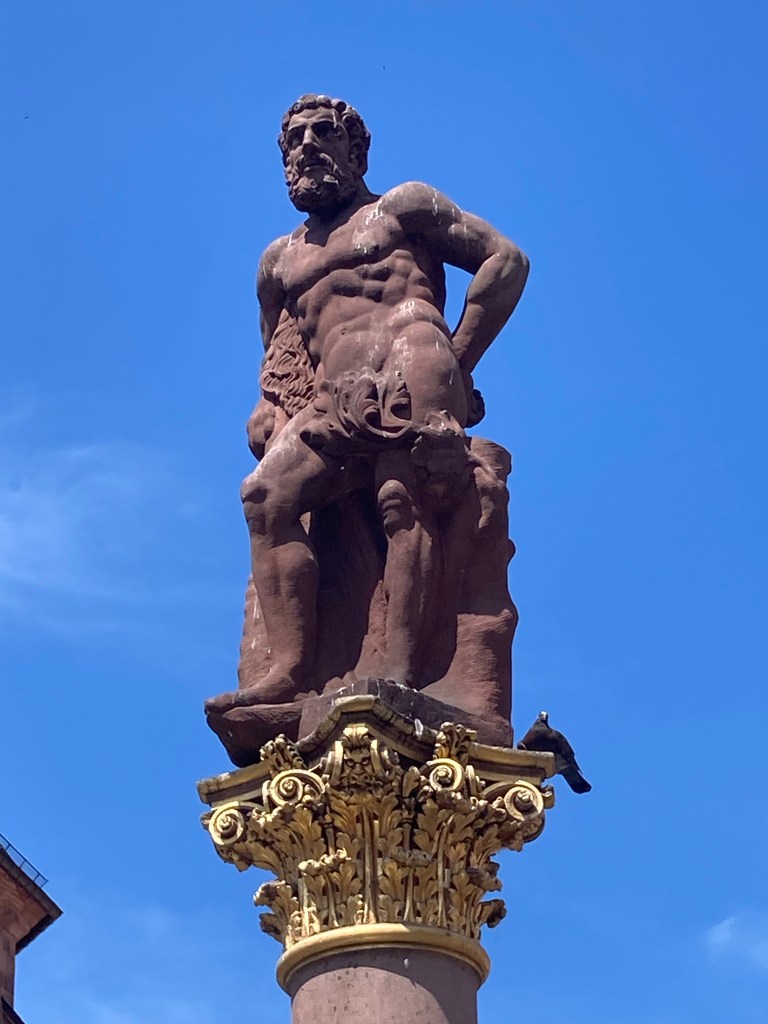
The Hercules Fountain, standing proudly at the centre of the Marktplatz, honours the immense effort required to rebuild Heidelberg after its devastation in the War of the Palatine Succession. Installed in the early 18th century, the statue depicts Hercules as a symbol of strength and resilience—an apt tribute to a city that had to rise from near‑total destruction. For centuries, the fountain has served not only as a reminder of Heidelberg’s turbulent past but also as a celebration of its determination to rebuild and flourish.
We stopped for a lunch break before taking a walk around the old town.
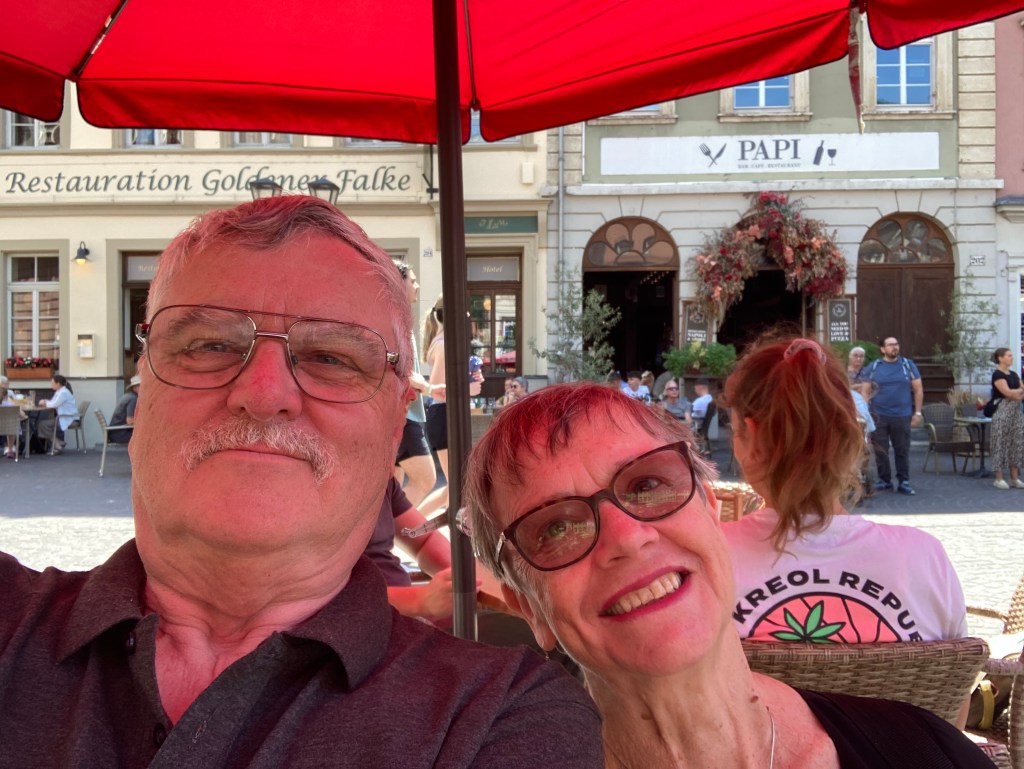
We each enjoyed a beer, which certainly helped us unwind as we wandered around in the warm weather (though it definitely felt hot to me). The delicious pizza we shared did a great job of settling those hunger pangs too.
The following photos are from the walk around the old town.
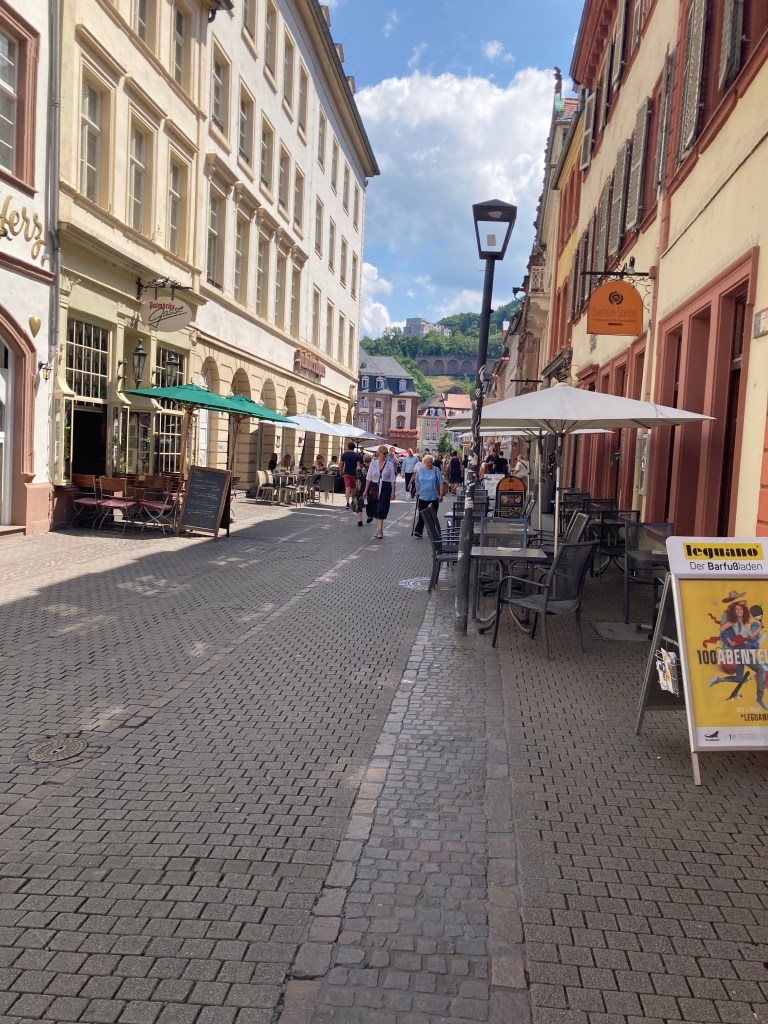
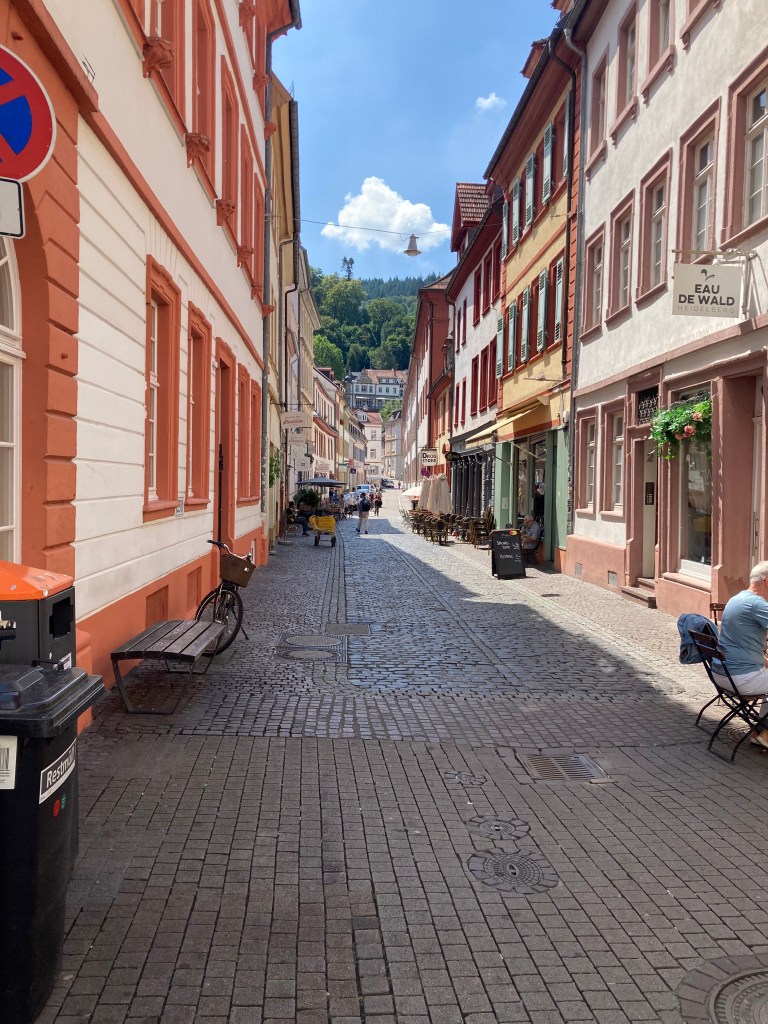
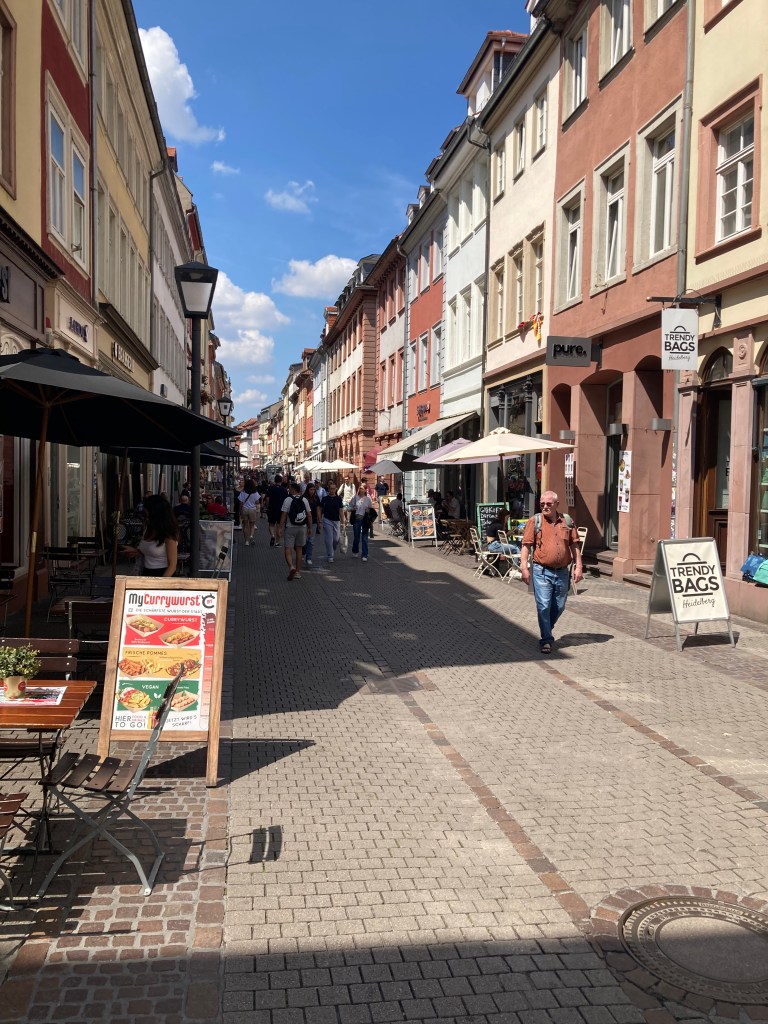
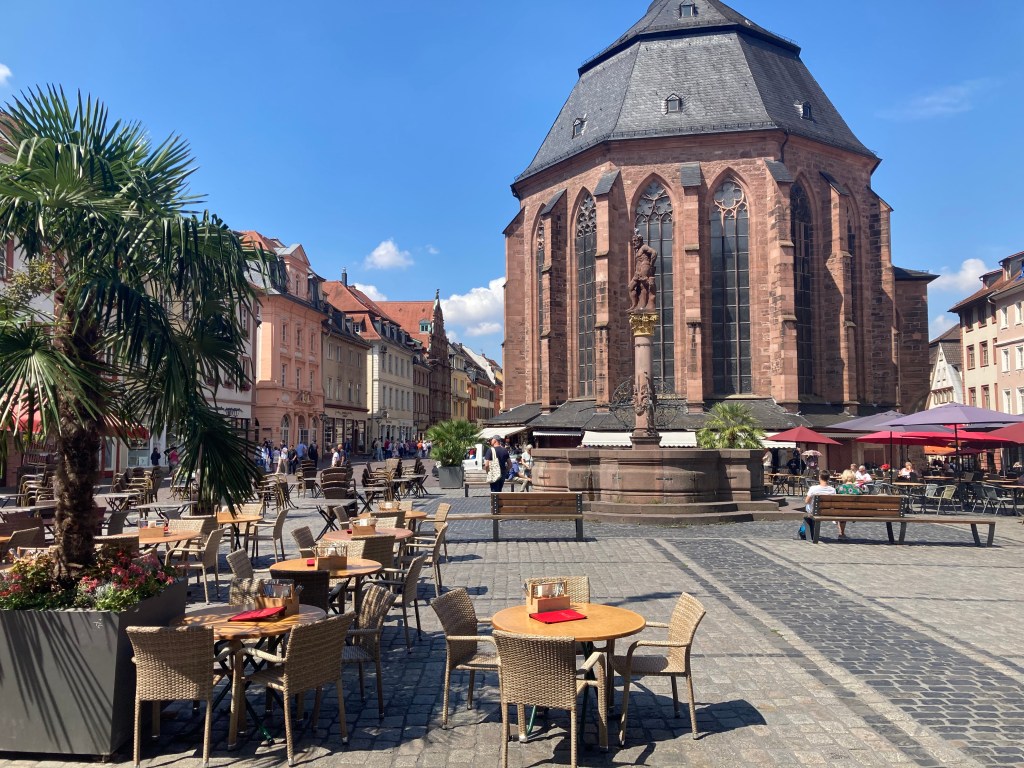
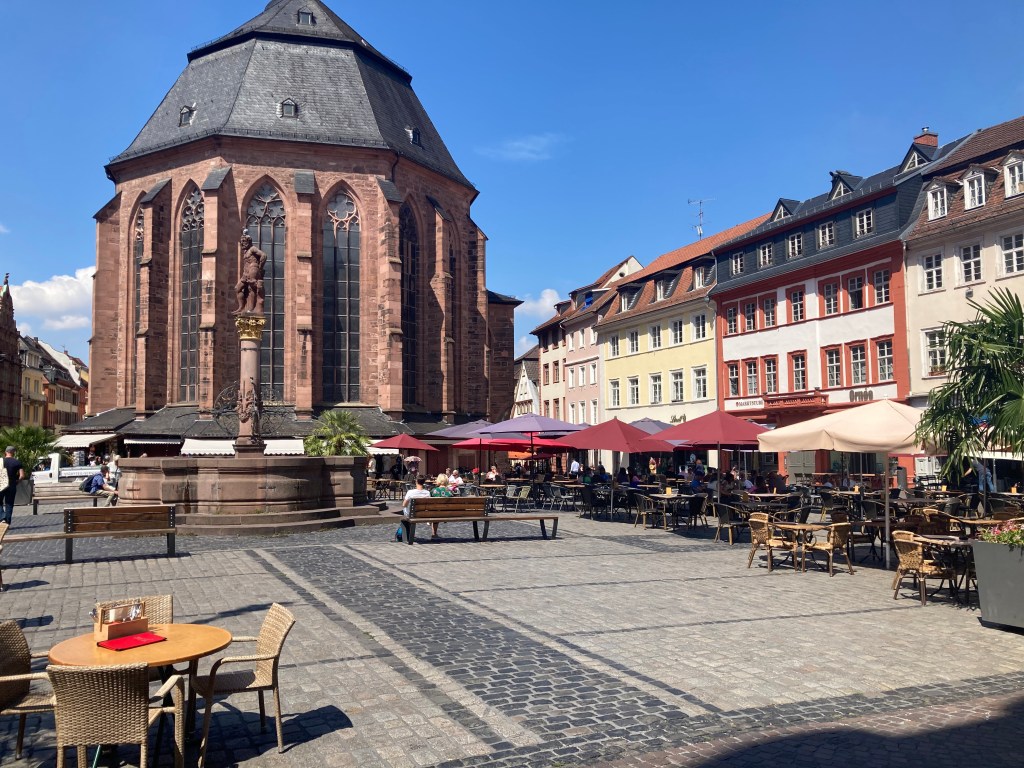
After more than five hours of exploring today, we headed back to the hotel for a well‑earned rest before making our way out again for dinner at uuuhmami.
Information about the restaurant is surprisingly scarce, but I did find this: uuuhmami was created by Heidelberg restaurateurs Suna, Marco, Leander and Ellis. Their original plan was to open a straightforward pizzeria offering Roman and Neapolitan classics. But once they saw the space—with its soaring ceilings and elegant pillars—they realised it deserved to be more than “just” a pizzeria. One of the founders regularly travels between Heidelberg and Rome, inspired by the city’s tradition of selling pizza by the slice on almost every corner.
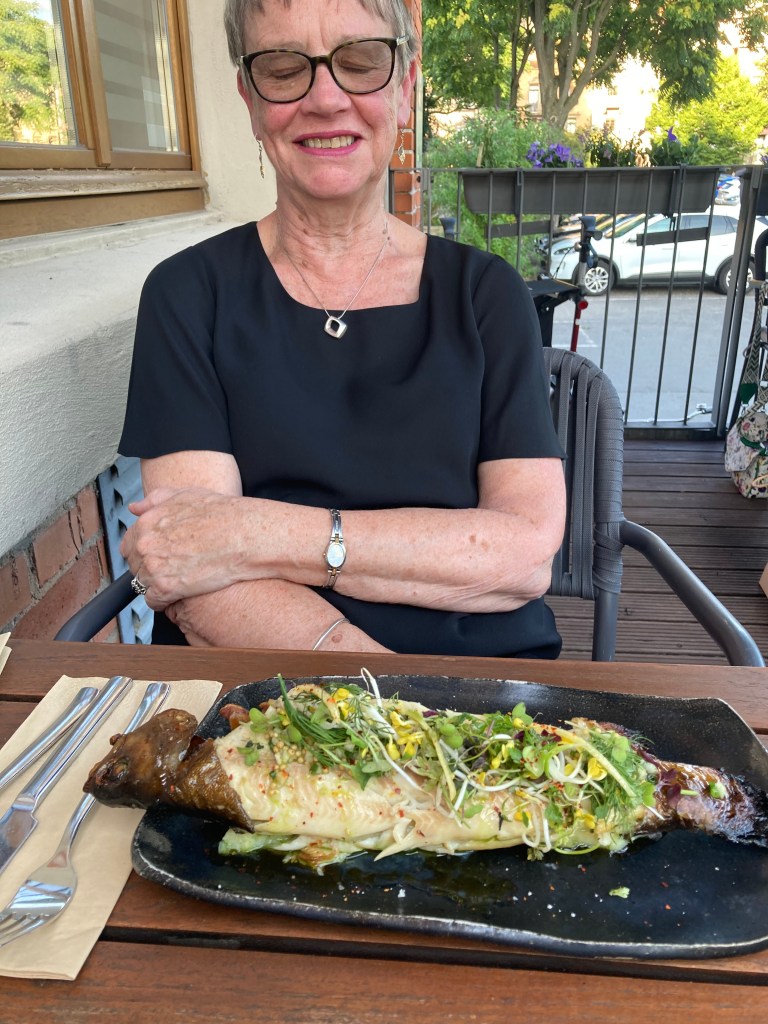
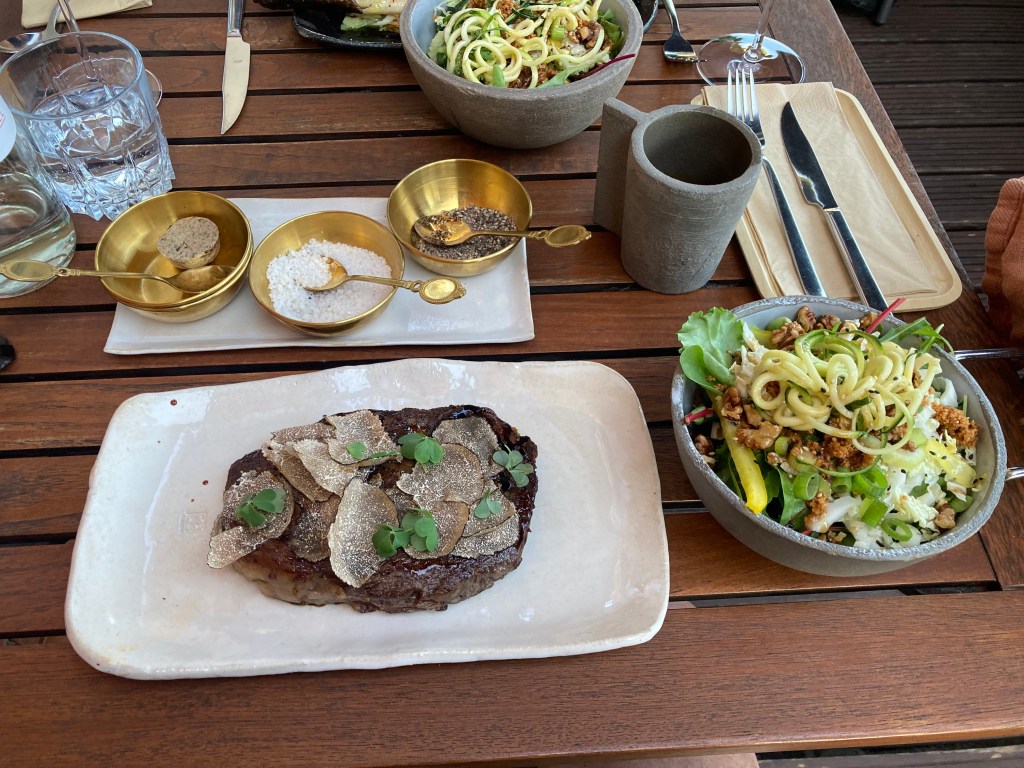
Our evening there was wonderful. The food was beautifully prepared and full of flavour. Maree chose the trout, while I went for the Wagyu beef, and we both added a side of Asian raw salad.
Maree’s trout looked so good that she closed her eyes for a moment, as if letting her mind linger on the promise of that first bite’ savouring the aroma, the colours on the plate, and the anticipation of just how delicious it was going to be.
My 330‑gram Wagyu beef arrived after the waitress thoughtfully brought the cut out beforehand to make sure I was happy with the selection. Naturally, I gave it the nod—as long as it came out medium‑rare. It might not have been the most photogenic dish at first glance, but once the thinly shaved truffle and the rich jus from the little mug were poured over the top, it turned into an exceptional steak. I paired it with the same side salad as Maree.
Well with dinner over it is time to head home. Tomorrow we leave Heidelberg for Koblenz.
Friday 11 July2025
The day got off to a rough start—and somehow managed to get worse before it got better.
Over breakfast, I checked the status of our 10:39 train from Heidelberg to Koblenz, only to discover it wasn’t just delayed… it had been cancelled. And so had the next one. So I settled in and began sorting through every possible train option to Koblenz. The next viable departure was at 12:25, so I jumped onto Interrail and booked two new seat reservations. We already had reservations for the earlier train, and I’ll look into a refund later, but honestly, the cost of seat reservations with Eurail passes is so small that it’s hardly worth stressing over.
With that sorted, we pushed our hotel checkout to midday, then headed to the station. Thankfully, the 12:25 train arrived only a few minutes behind schedule.
The journey itself was lovely—especially the final 40 minutes, which followed the Rhine River. That stretch alone almost made up for the morning’s chaos.
We arrived in Koblenz two hours later and walked over to the Hotel Continental, where we were booked for three nights. But when we reached the door, we were met with a shock: the hotel was closed, boarded up, and clearly undergoing major renovations. A few locals confirmed it had been shut for quite some time and pointed us toward another hotel near the Hauptbahnhof.
Feeling frustrated—and admittedly a bit let down by booking.com, though this is the first issue we’ve had with them in nine years—we made our way to the Hotel Hohenstaufen. Inside, we were greeted by a warm, smiling manager. We explained our situation and asked if she had any rooms available for three nights. She checked… and told us she had exactly one room left. Talk about luck turning around.
So this is home for the next three nights. The room is a good size, the restaurant is excellent, the staff are incredibly helpful, and despite the hotel being full, it’s surprisingly quiet. The only downside is the lack of air‑conditioning, though the fan in the room does take the edge off. Today was warm, and the next couple of days are forecast to be even warmer.
Later, the manager told us that quite a few travellers have turned up with bookings for the closed hotel. One couple even arrived late at night to find every room in Koblenz booked out—they had to catch another train to a different city just to find a bed.
So, what began as a frustrating day ended with us securing perfectly decent accommodation for the next three nights. By the time everything was sorted, it was already 15:30, so the rest of the day was a write‑off.
Steve, enjoying a very well‑earned drink after a taxing day.
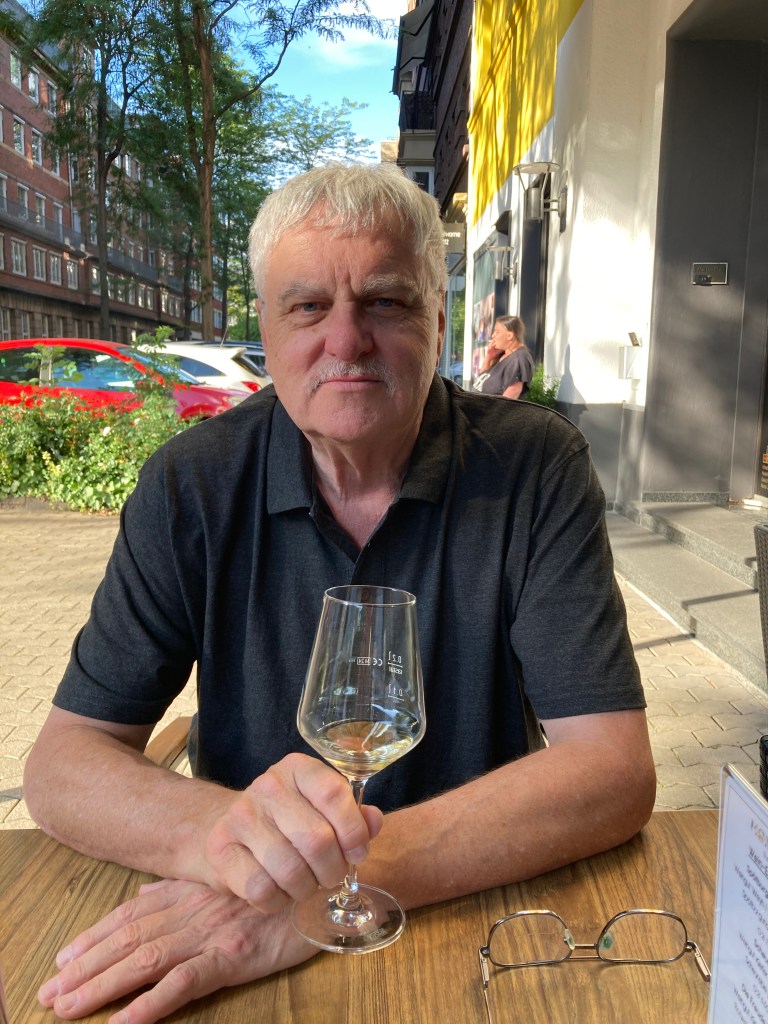
Tomorrow we are going on a six hour cruise up the Rhine from Koblenz to Rudesheim.
Saturday 12 July 2025
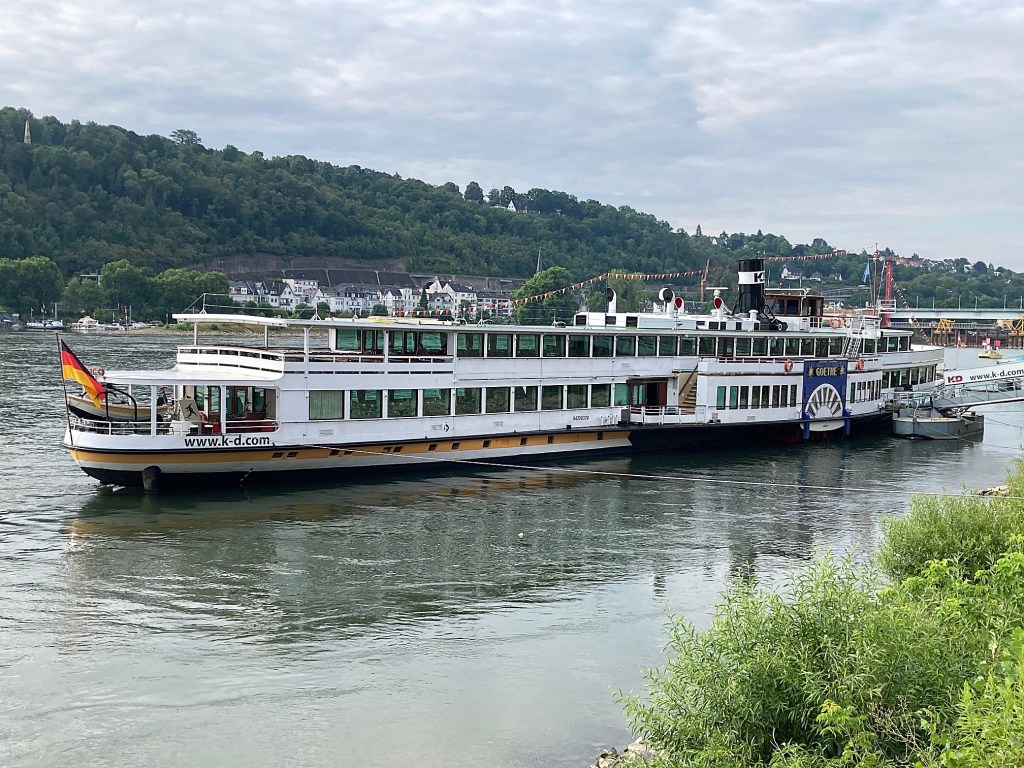
Today was dedicated entirely to our Rhine River cruise from Koblenz to Rüdesheim—a six‑hour journey upstream aboard a 100‑year‑old paddle steamer. Before diving into the photos, a little context about this remarkable river sets the scene.
The Rhine is one of Europe’s great waterways. It begins high in the Swiss canton of Graubünden in the southeastern Alps, then winds its way along a series of borders: first between Switzerland and Liechtenstein, then Switzerland and Austria, and later Switzerland and Germany. From Lake Constance onward, it marks much of the Franco‑German frontier before turning north through the German Rhineland. Eventually, it bends westward into the Netherlands, where it finally empties into the North Sea. Its vast catchment area covers around 185,000 square kilometres.
At roughly 1,230 kilometres long, the Rhine is the second‑longest river in Central and Western Europe after the Danube, carrying an average of about 2,900 cubic metres of water per second. It’s also home to Europe’s most powerful waterfall, the Rhine Falls. Depth varies dramatically along its course—from shallow stretches under two metres to deep channels exceeding ten.
Historically, the Rhine and the Danube formed much of the northern boundary of the Roman Empire, and ever since, the Rhine has remained a vital artery for trade and transport. The castles and fortifications that line its banks are reminders of its strategic importance throughout the Holy Roman Empire. Today, major cities such as Cologne, Rotterdam, Düsseldorf, Duisburg, Strasbourg, Arnhem and Basel all owe part of their prominence to this river.
Our vessel for the day was the Goethe—the last remaining paddle steamer on the Rhine and the largest side‑paddle steamer in the world. This year marks its 100th anniversary, making the journey feel all the more special.
We were looked after by Brian, our waiter for the cruise—a friendly Filipino gentleman who has spent his career on various ships before joining the Goethe. He was endlessly cheerful, always ready with a smile or a quick chat when he wasn’t serving other passengers. His knowledge of this stretch of the Rhine added so much to the experience, and he made the day feel warm and personal from start to finish.
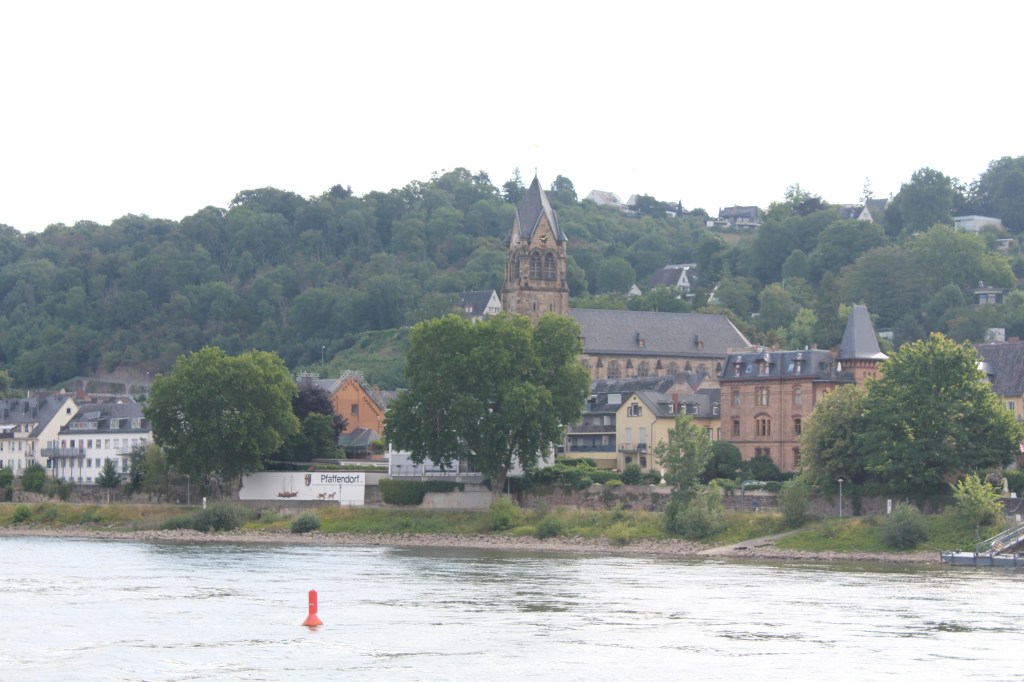
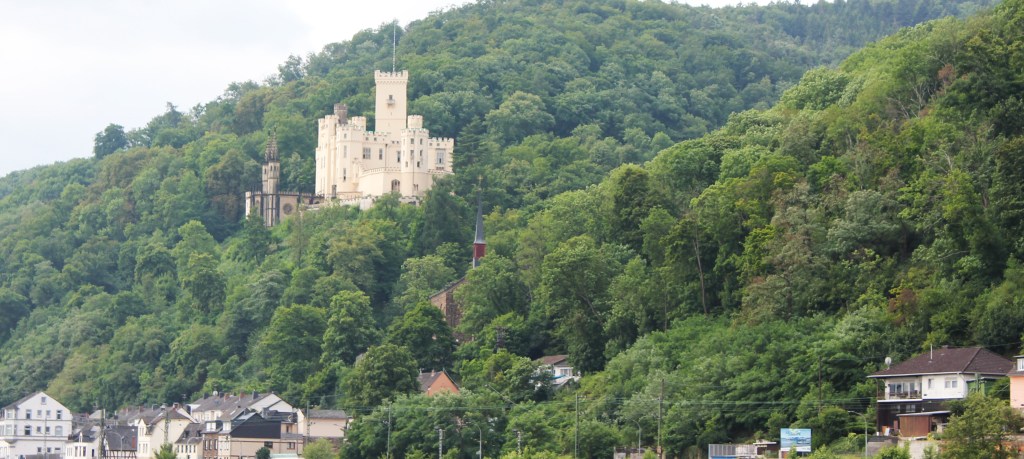
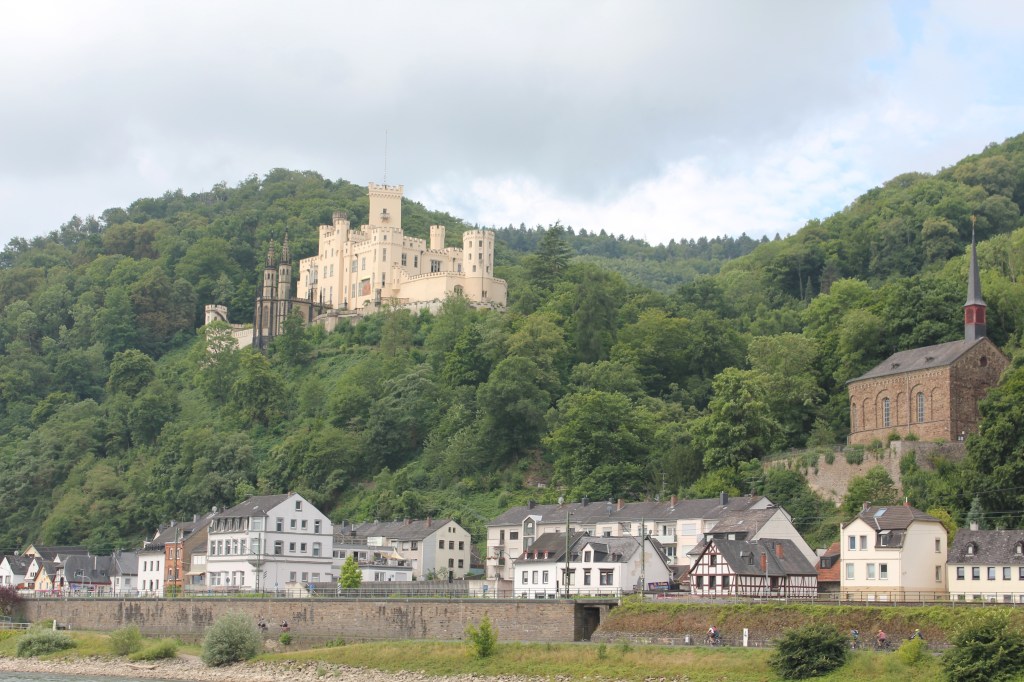
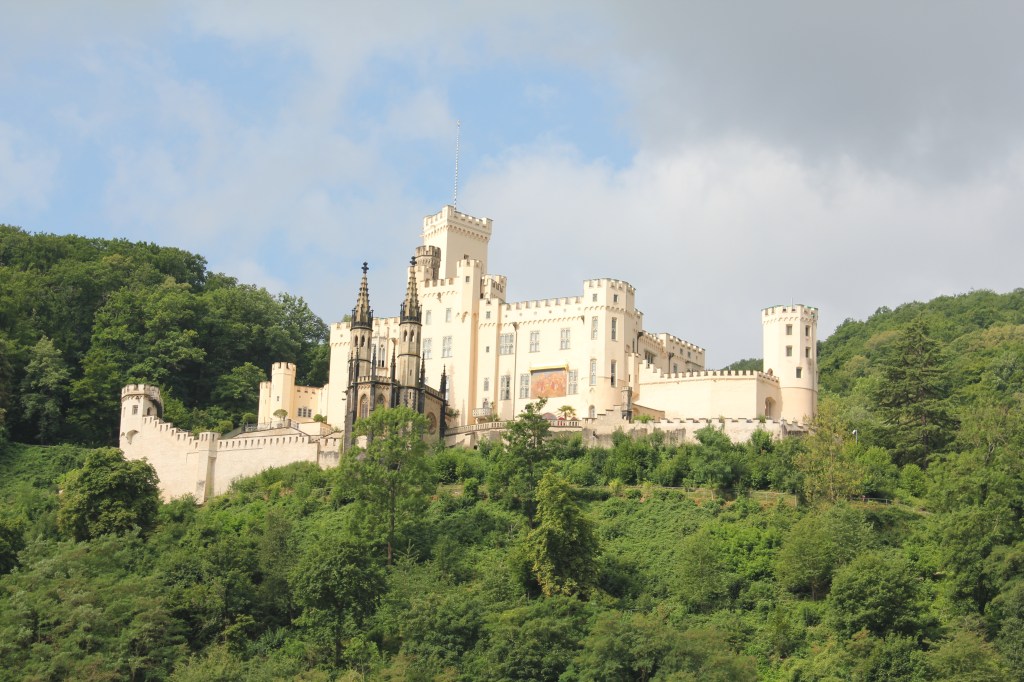
Originally built as a medieval fortress in the 13th century, Stolzenfels was destroyed during the Thirty Years’ War and left in ruins for centuries. Its transformation began in the 19th century, when Crown Prince Frederick William of Prussia commissioned a complete reconstruction in the romantic Gothic Revival style. The result is the fairy‑tale castle seen today; complete with towers, battlements, and sweeping terraces overlooking the Rhine.
Now part of the UNESCO‑listed Upper Middle Rhine Valley, Stolzenfels Castle stands as a symbol of the region’s romanticism and its long, layered history.
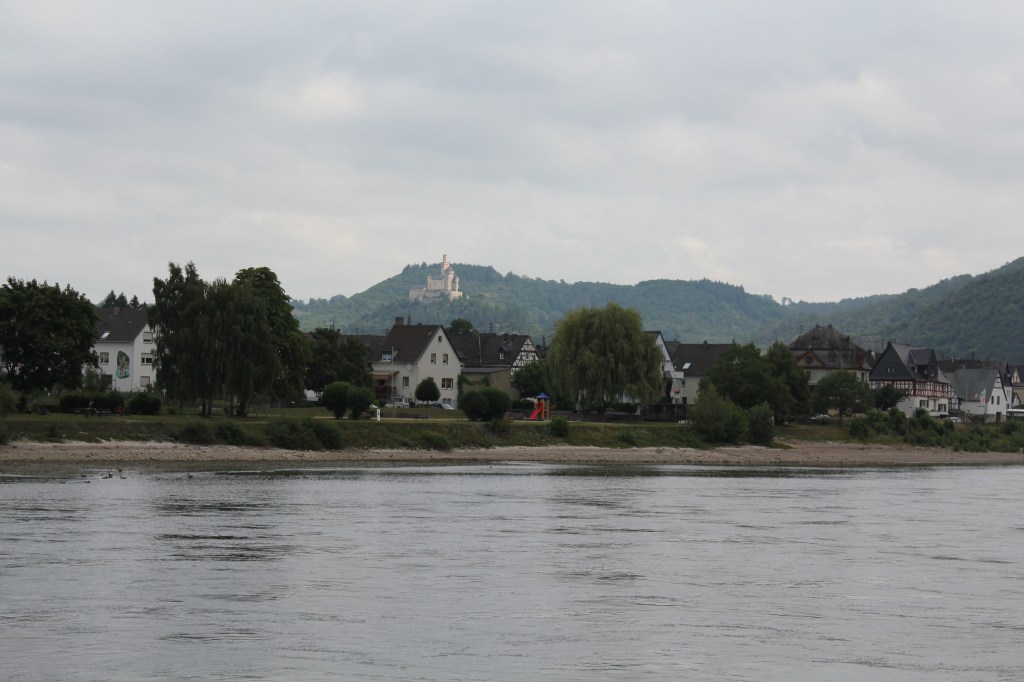
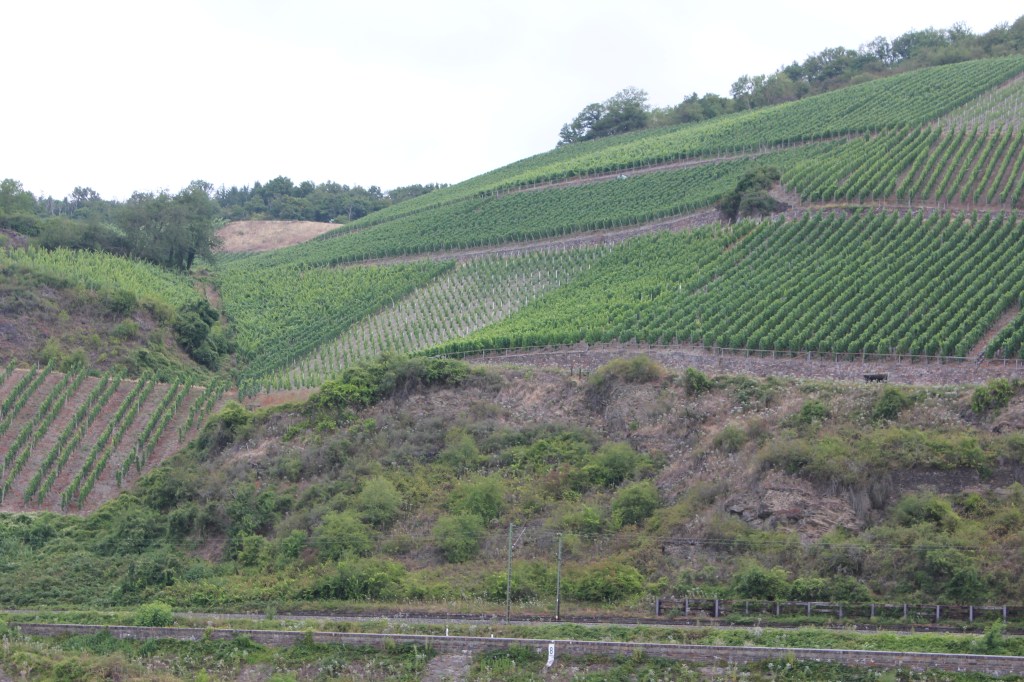
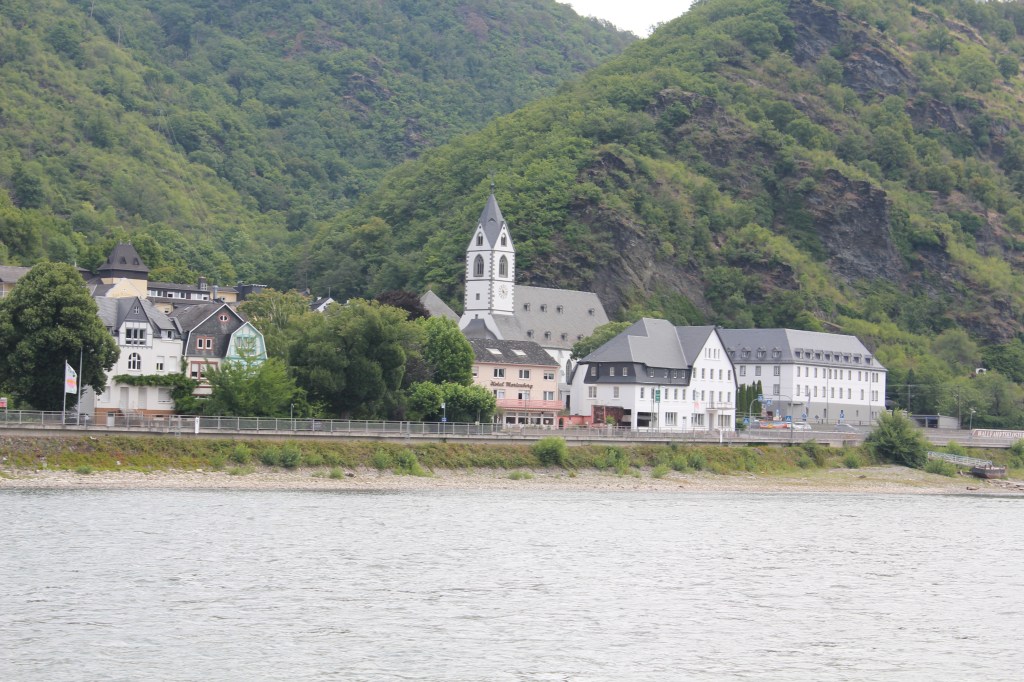
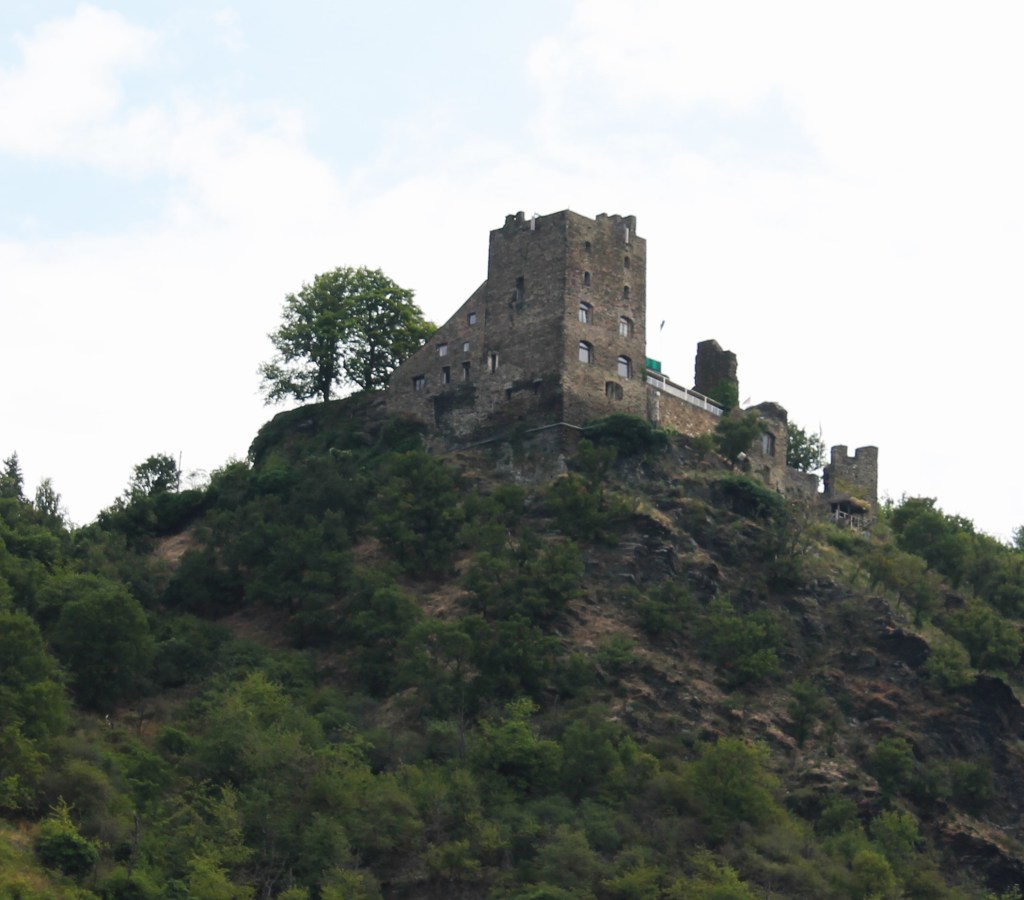
Over the centuries, Liebenstein changed hands multiple times and gradually fell into ruin, like many Rhine castles after the age of fortifications passed. Today, it stands as a romantic reminder of medieval power struggles and the long history of settlement along the Rhine, offering sweeping views over one of Germany’s most picturesque landscapes.
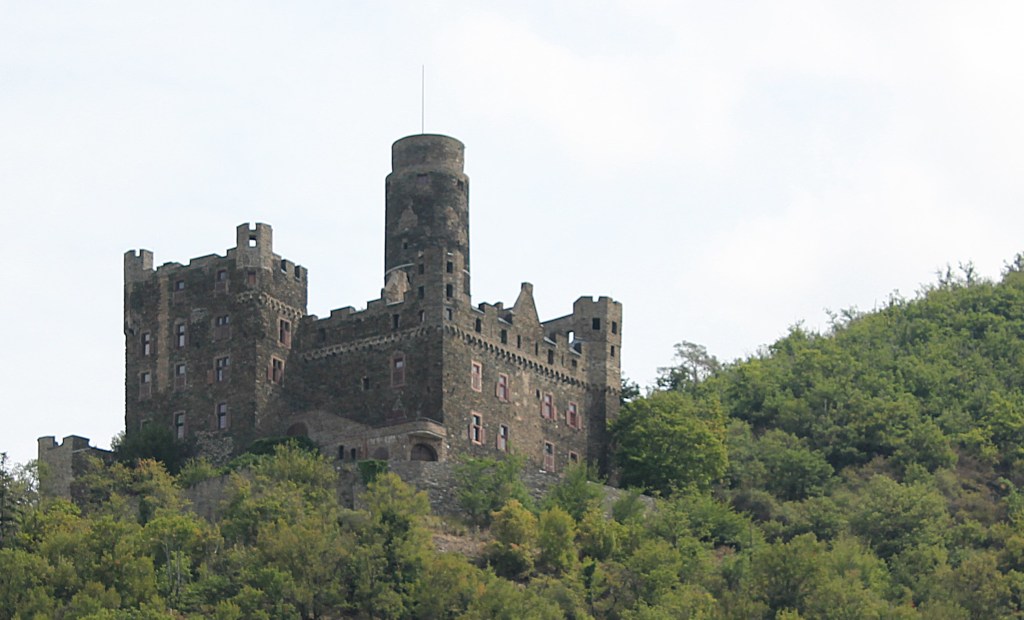
Despite the teasing name, Maus Castle was a formidable stronghold. It survived numerous regional conflicts and, unlike many Rhine castles, was never destroyed in war. Carefully restored in the 20th century, it remains one of the best‑preserved fortifications in the valley, offering a vivid glimpse into the power struggles and river trade that shaped the Middle Rhine for centuries.
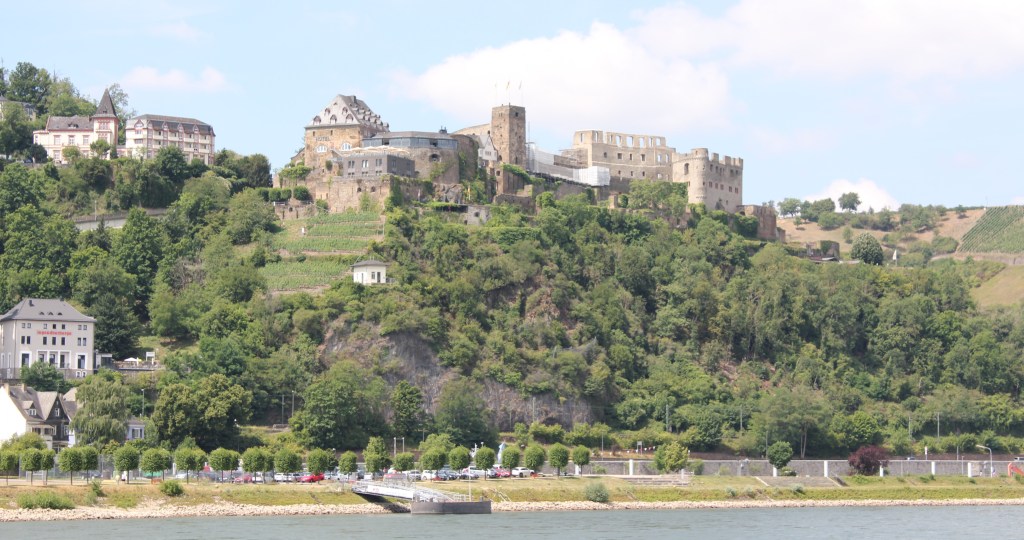
Over the centuries, Rheinfels expanded into a vast complex of walls, tunnels, and defensive works, serving as both a military stronghold and an administrative centre. It survived numerous conflicts until the late 18th century, when French Revolutionary troops destroyed much of it.
Today, the remaining structures—towering walls, vaulted cellars, and sprawling ramparts—offer a vivid glimpse into its former might. Overlooking one of the most scenic stretches of the Rhine, Rheinfels Castle stands as a powerful reminder of the region’s turbulent medieval history.
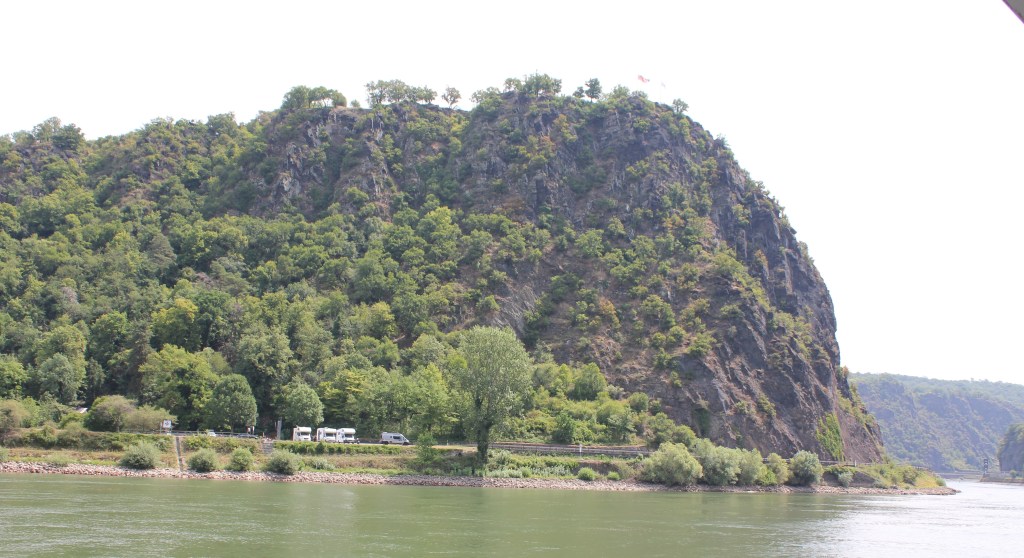
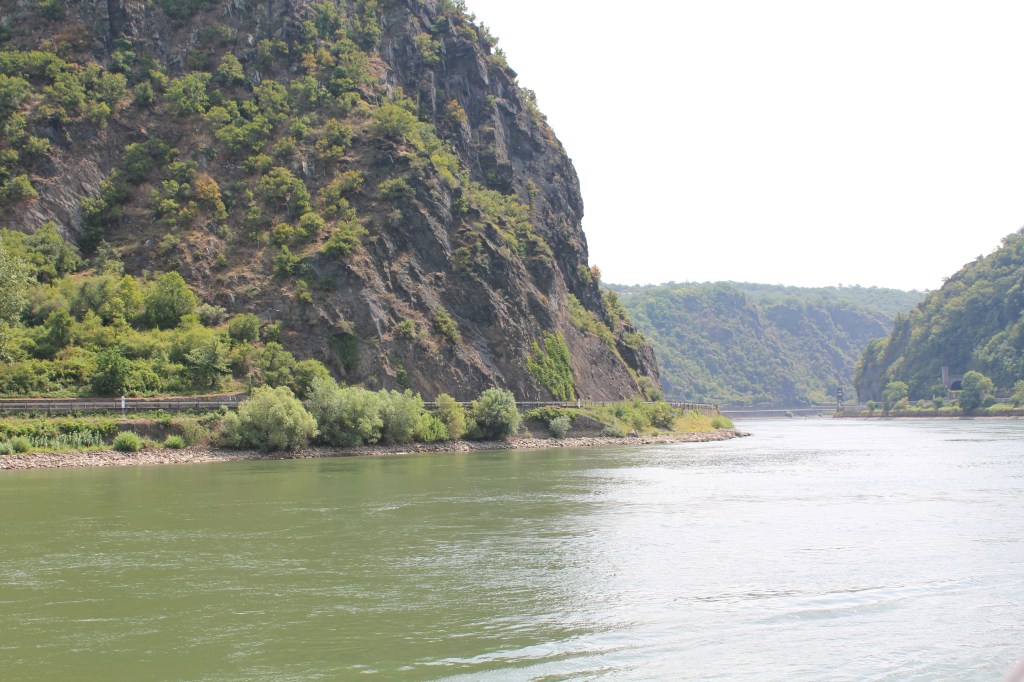
Loreley Rock has long been wrapped in legend. According to folklore, a siren named Loreley sat atop the cliff, singing so beautifully that sailors became entranced and steered their boats into the treacherous currents below. While the tale is myth, the danger was real—the narrow, winding passage at this point in the Rhine was notoriously difficult to navigate for centuries.
Today, Loreley remains one of the most iconic sights along the river, blending geological drama, romantic legend, and the enduring heritage of the Rhine Valley.
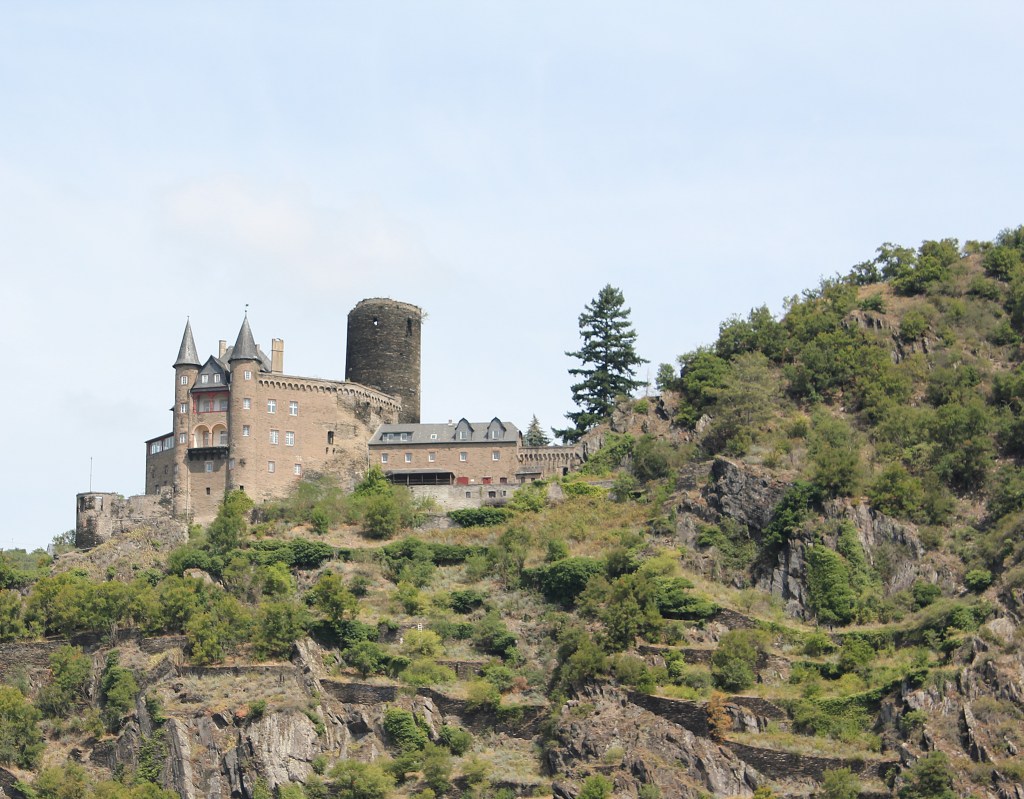
Its name, “Katz,” was actually a later nickname—originally the castle was called Burg Neukatzenelnbogen. The playful moniker emerged in contrast to nearby Maus Castle (Burg Maus), its smaller neighbour on the opposite side of the valley. Local lore turned the two into a legendary pair, with Katz imagined as the powerful “cat” and Maus as the vulnerable “mouse,” though in reality both fortresses were part of the same network of regional power.
Over the centuries, Katz Castle endured wars, destruction, and rebuilding. It was heavily damaged by French forces in the 17th century, then reconstructed in the 19th century in the romantic style that defines its appearance today. Now privately owned and not open to the public, it remains an iconic sight—its towers rising dramatically above the Rhine, paired with Maus Castle across the water, together telling the story of medieval rivalry, river trade, and the long history of fortifications in the Rhine Valley.
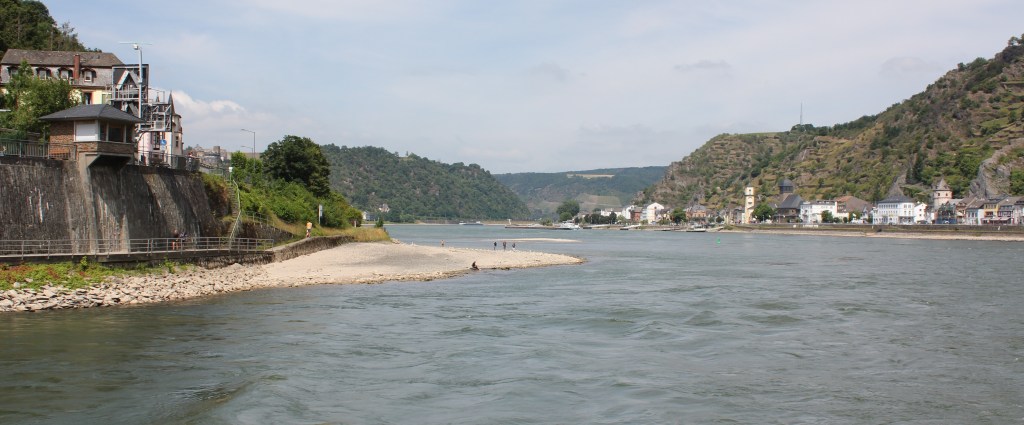
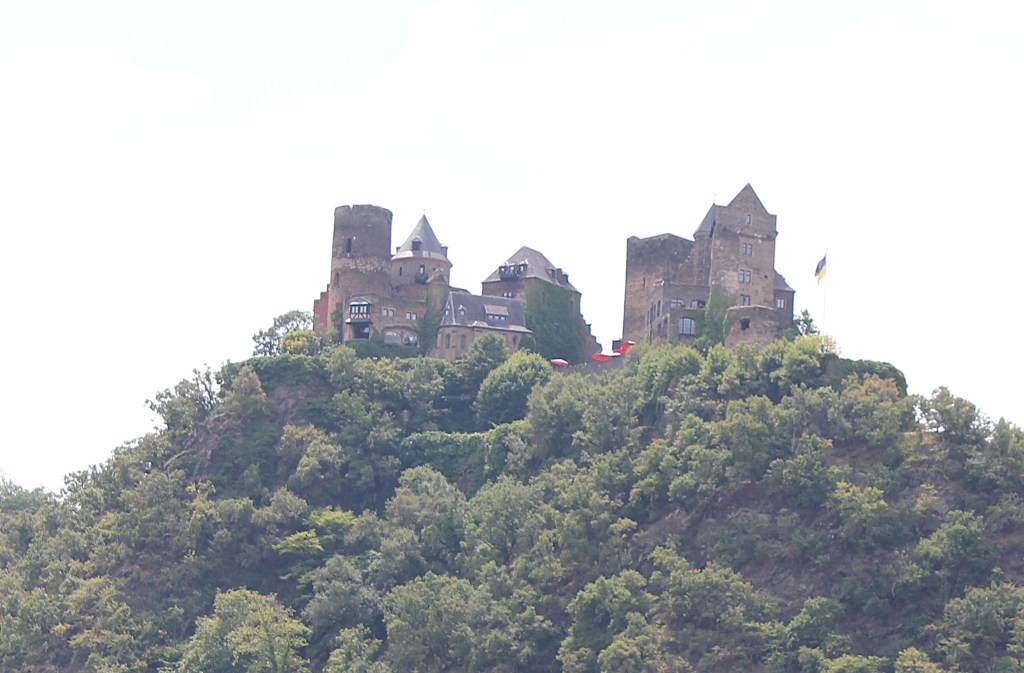
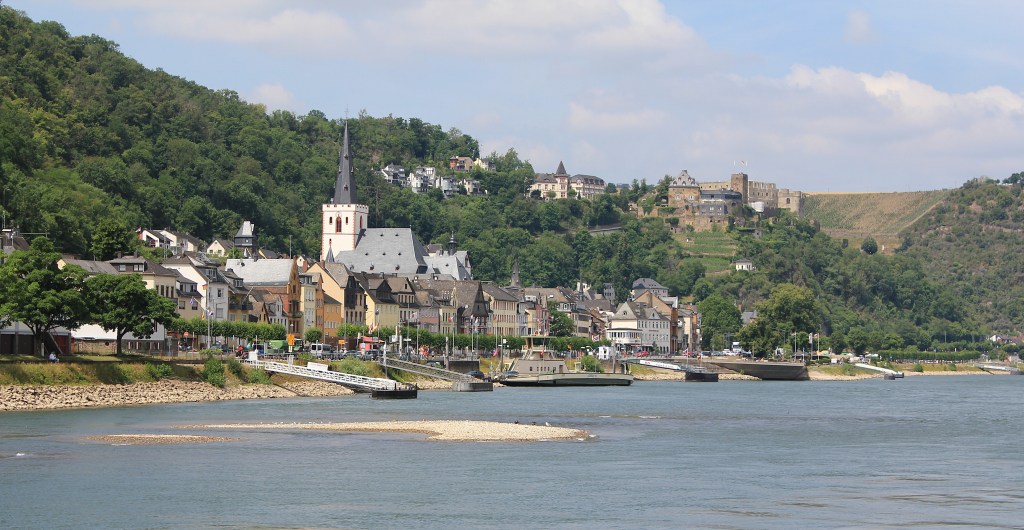
Like many Rhine castles, Schönburg suffered destruction during the late 17th century when French troops devastated much of the region. It remained a ruin for nearly 200 years until the late 19th century, when it was carefully restored and brought back to life. Today, the castle stands as a beautifully preserved reminder of Oberwesel’s medieval past, offering sweeping views over one of the most scenic stretches of the Rhine.
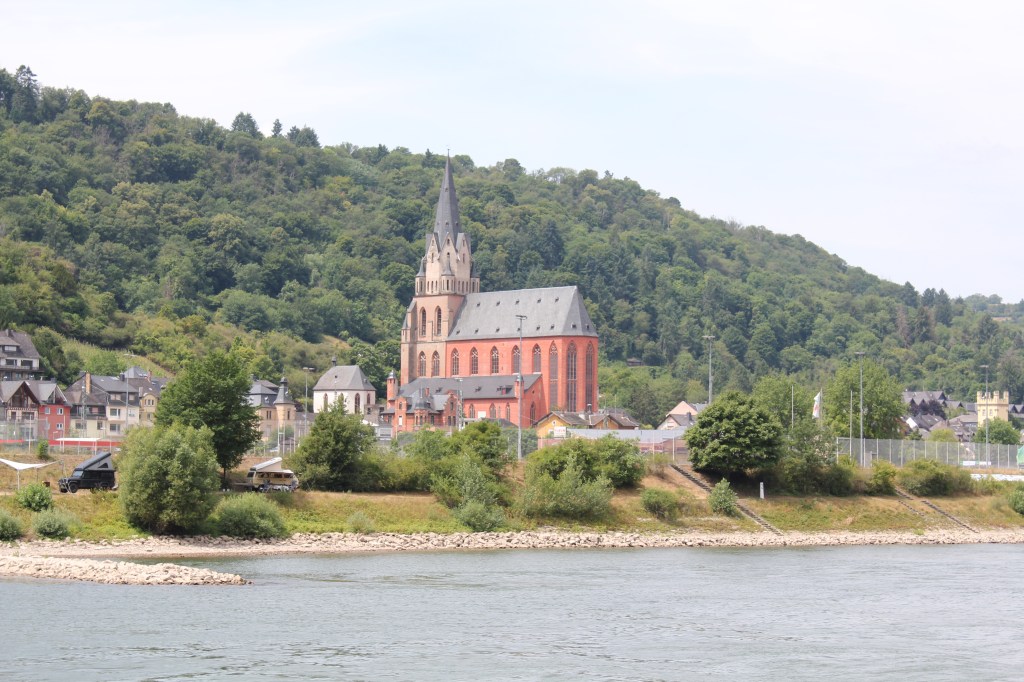
The church is renowned for its soaring interior, elegant tracery windows, and beautifully preserved medieval art. Its striking red‑sandstone exterior has become a defining feature of Oberwesel’s skyline, visible from far along the river. Over the centuries, Liebfrauenkirche has served not only as a place of worship but also as a symbol of the town’s resilience and cultural heritage, standing as one of the architectural jewels of the Middle Rhine.
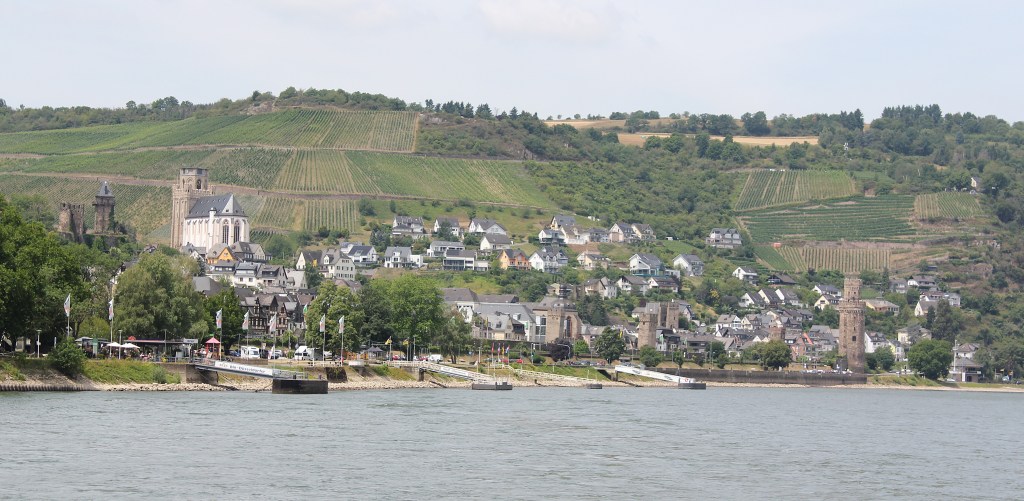
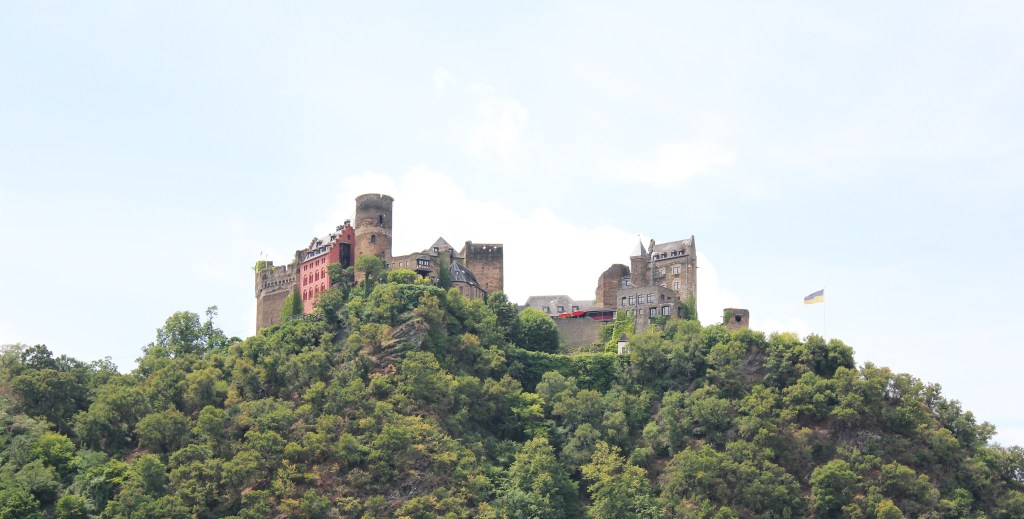
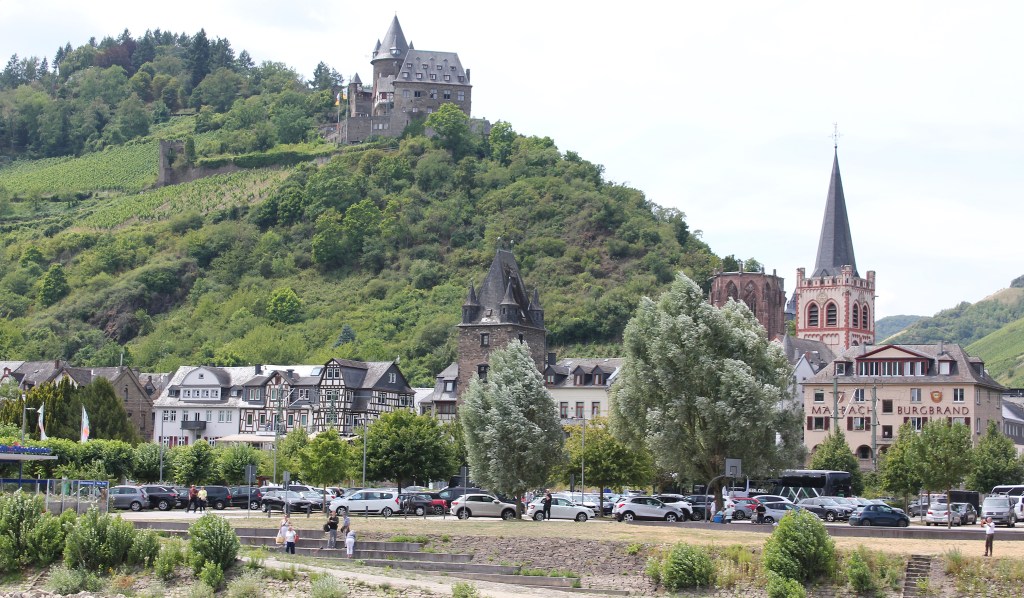
Over the centuries, the castle witnessed political intrigue, shifting alliances, and repeated conflicts. It was heavily damaged during the Thirty Years’ War and later destroyed by French troops in the late 17th century, leaving it in ruins for more than two hundred years.
In the early 20th century, Burg Stahleck was reconstructed, transforming the once‑ruined fortress into a youth hostel while preserving its medieval character. Today, it stands as one of the most atmospheric castles in the Rhine Valley—its towers and battlements overlooking vineyards, river bends, and the historic town of Bacharach below.
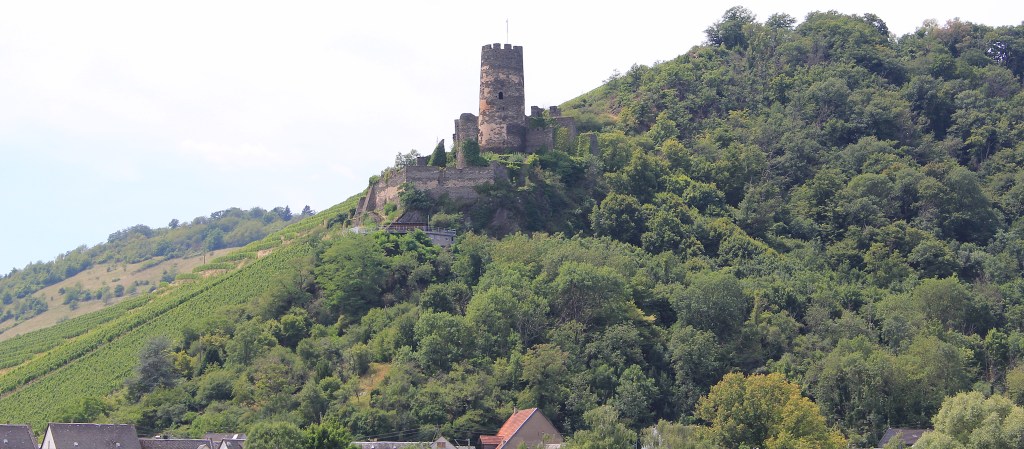
Fürstenberg played a significant role in the network of Rhine fortifications, but like many castles along the river, it suffered heavily during the wars of the 17th century. French troops destroyed much of it in 1689, leaving only fragments of its walls and towers standing.
Today, the ruins still command impressive views over the Rhine Valley, offering a glimpse into the turbulent history of medieval power struggles and the once‑formidable chain of castles that shaped life along the river.
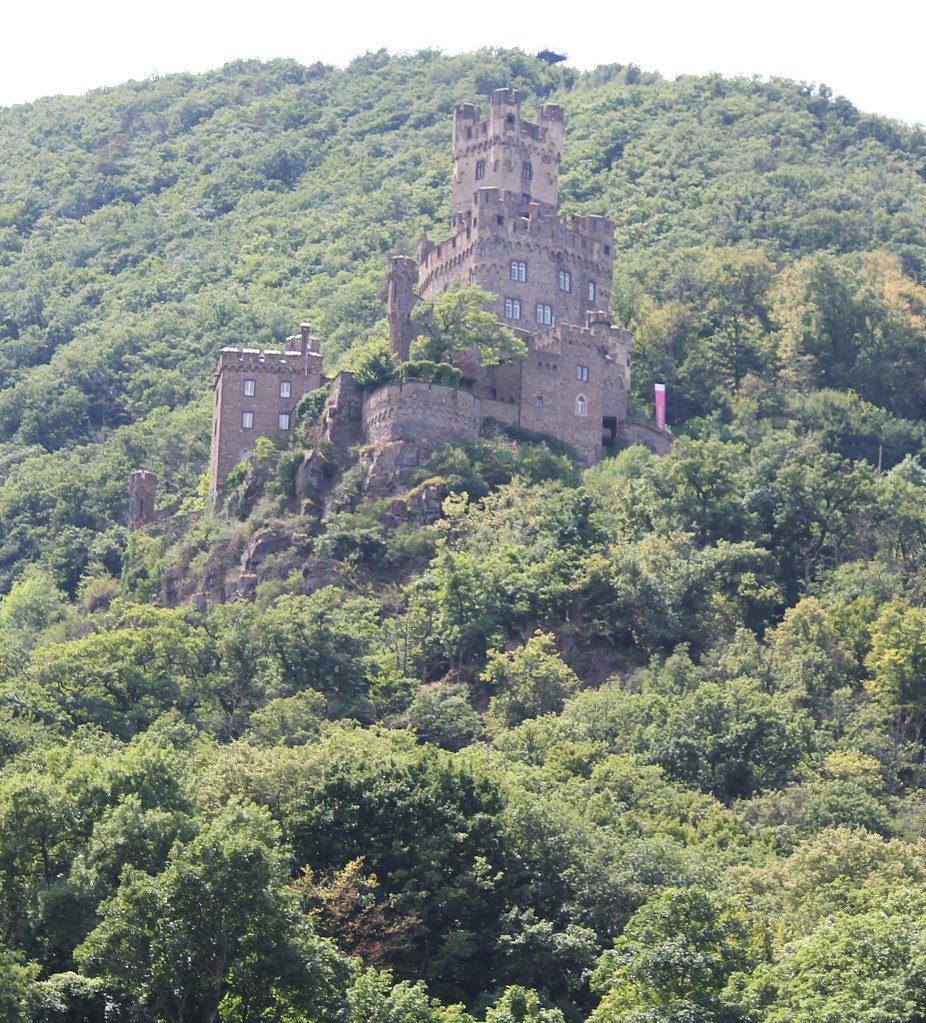
In the 14th and 15th centuries, some minor noble families in the Rhine region struggled financially as political power shifted and traditional feudal income declined. A number of them resorted to attacking merchant ships, demanding illegal tolls, or raiding nearby settlements. These nobles became known as Raubritter—“robber knights.”
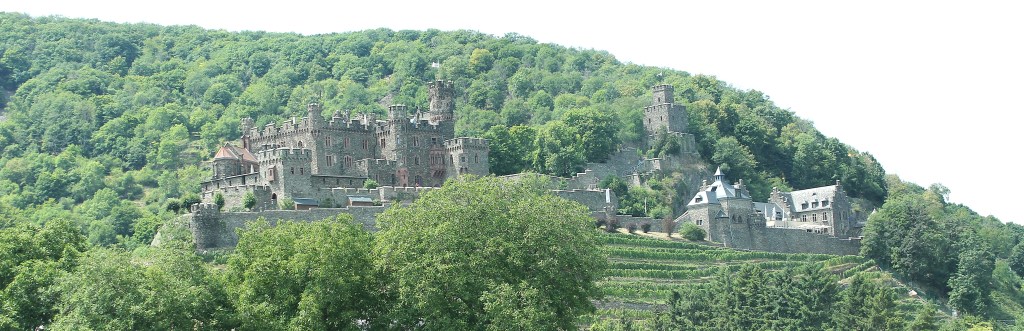
For nearly two centuries the castle lay in ruins, until the mid‑19th century, when it was rebuilt in the romantic style under the patronage of the Prussian royal family. Today, Sooneck Castle stands restored and commanding, offering a glimpse into both its medieval origins and the 19th‑century fascination with Rhine romanticism that helped preserve so many of the valley’s historic landmarks.
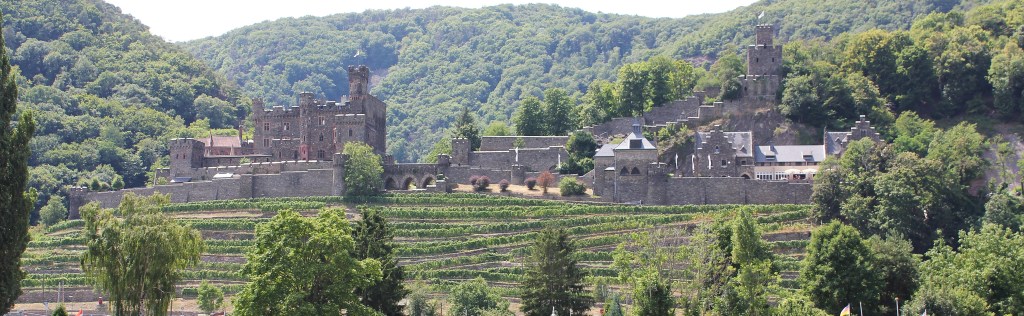
Because of this lawlessness, imperial forces destroyed Reichenstein in the 13th century, though it was later rebuilt and continued to evolve over the centuries. In the 19th century, during the Romantic movement that revived interest in Rhine history and architecture, the castle underwent extensive restoration, giving it much of the dramatic appearance it has today.
Now a museum and hotel, Reichenstein Castle stands as a layered testament to medieval power struggles, Rhine trade, and the 19th‑century fascination with restoring the valley’s ancient fortresses.
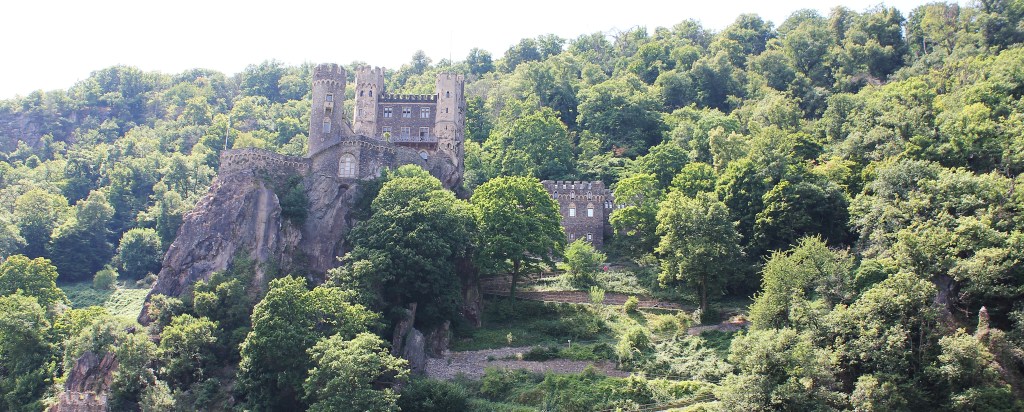
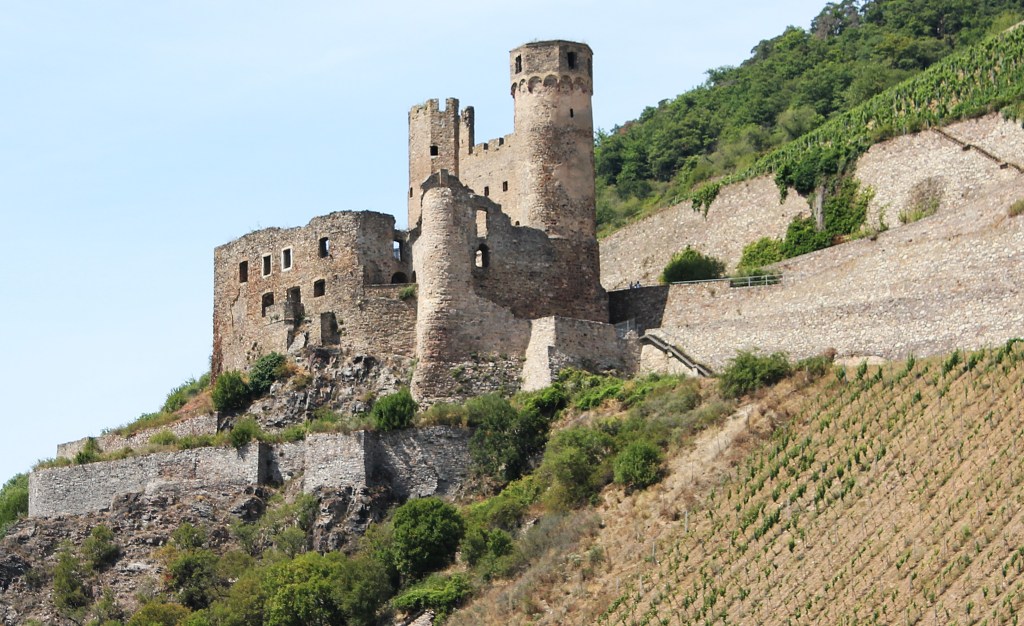
For centuries, Ehrenfels played a key role in controlling this vital trade route. Its thick walls and commanding views made it a formidable defensive site, but like many Rhine castles, it met its downfall during the late 17th century when French troops destroyed it in the course of regional conflicts.
Today, only its rugged towers and curtain walls remain, rising dramatically above the vineyards. Even in ruin, Ehrenfels Castle captures the romantic spirit of the UNESCO‑listed Middle Rhine Valley, offering a glimpse into the medieval power struggles that once shaped life along the river.
We enjoyed magnificent views all the way along the Rhine as we travelled from Koblenz to Rüdesheim. Although the ticket included a return cruise, we chose instead to take the regional train back—four hours downstream on the boat felt a little long after such a full day. The train, covered by our Eurail Pass, took only an hour and twenty minutes and followed the river the entire way, so we didn’t miss a moment of the scenery.
It was a wonderful outing from start to finish, and the KD “Nostalgic Route” proved to be a fantastic way to experience this iconic stretch of the Rhine.
Sunday 13 July 2025
This morning, Maree headed out for a walk to the Deutsches Eck before taking the cable car across the Rhine to visit Ehrenbreitstein Fortress. I stayed behind to rest—after a hot, air‑conditioner‑less night with very little sleep, it felt wiser to recharge than push myself.
The Deutsches Eck
After the death of Emperor Wilhelm I, plans quickly emerged to honour the ruler who had overseen the unification of Germany following three major wars. In 1891, his grandson, Kaiser Wilhelm II, selected the Deutsches Eck in Koblenz as the site for a grand monument. To create the space, an old harbour basin at the confluence of the Moselle and Rhine was filled in, giving the headland the shape we recognise today.
On 31 August 1897, the monumental copper statue was formally unveiled—an event attended by Kaiser Wilhelm II, commemorating his grandfather and marking the completion of one of Germany’s most symbolic memorials.
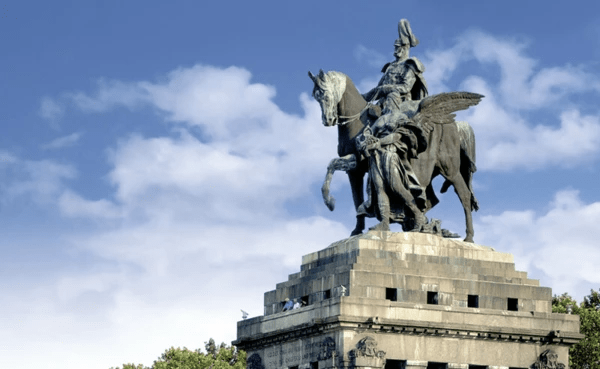
From here, Maree continued down to the cable car, which glides across the Rhine on its way up to Ehrenbreitstein Fortress. This impressive system can move up to 7,600 people per hour, giving it the highest transport capacity of any cable car in Germany. Originally constructed for the 2011 Federal Horticultural Show, it has been operating since June 2010, linking the Rhine Promenade near St. Castor Basilica with the fortress plateau above. The ride offers sweeping views over Koblenz and the confluence of the Rhine and Moselle—an experience that’s as practical as it is spectacular.
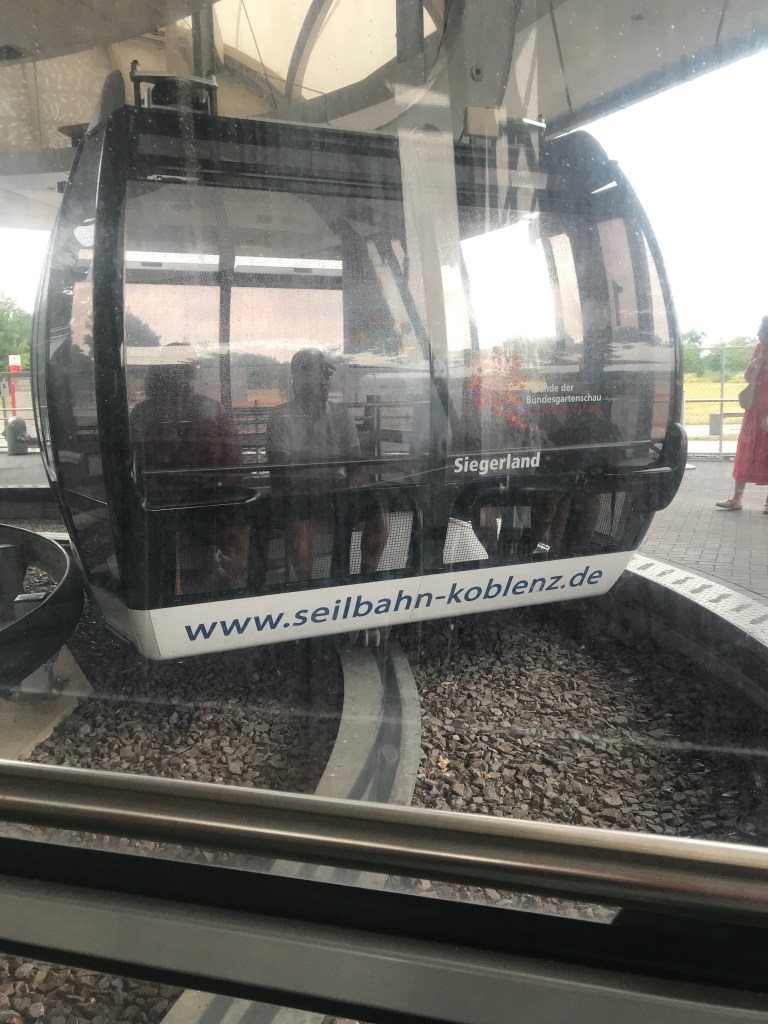
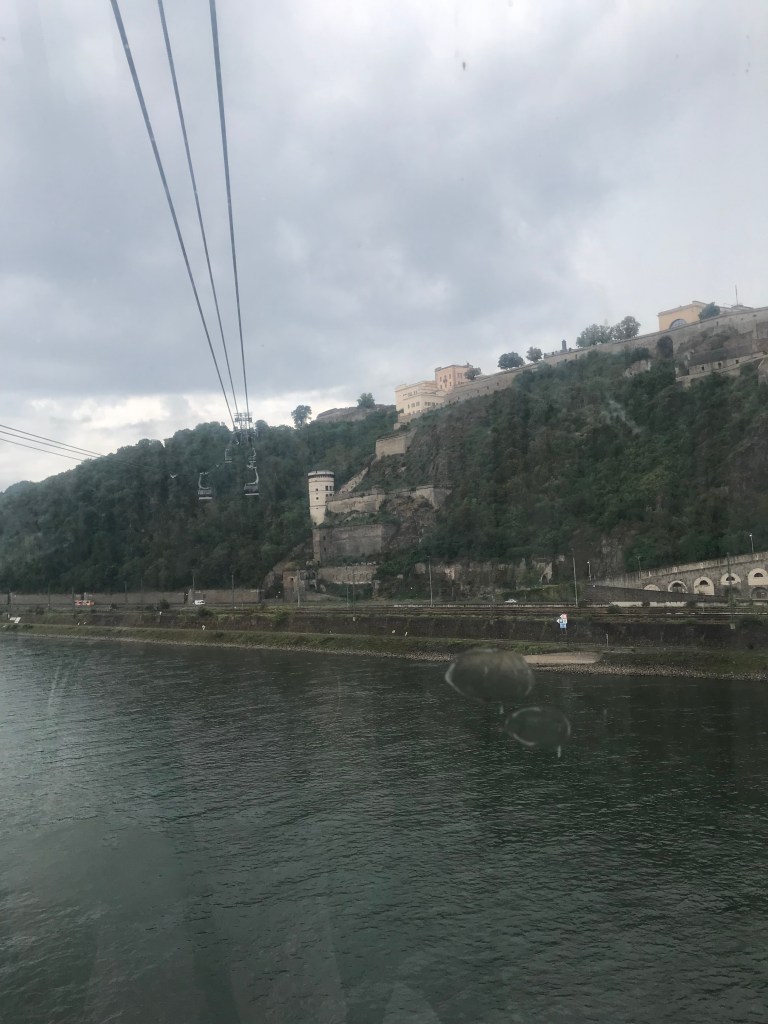
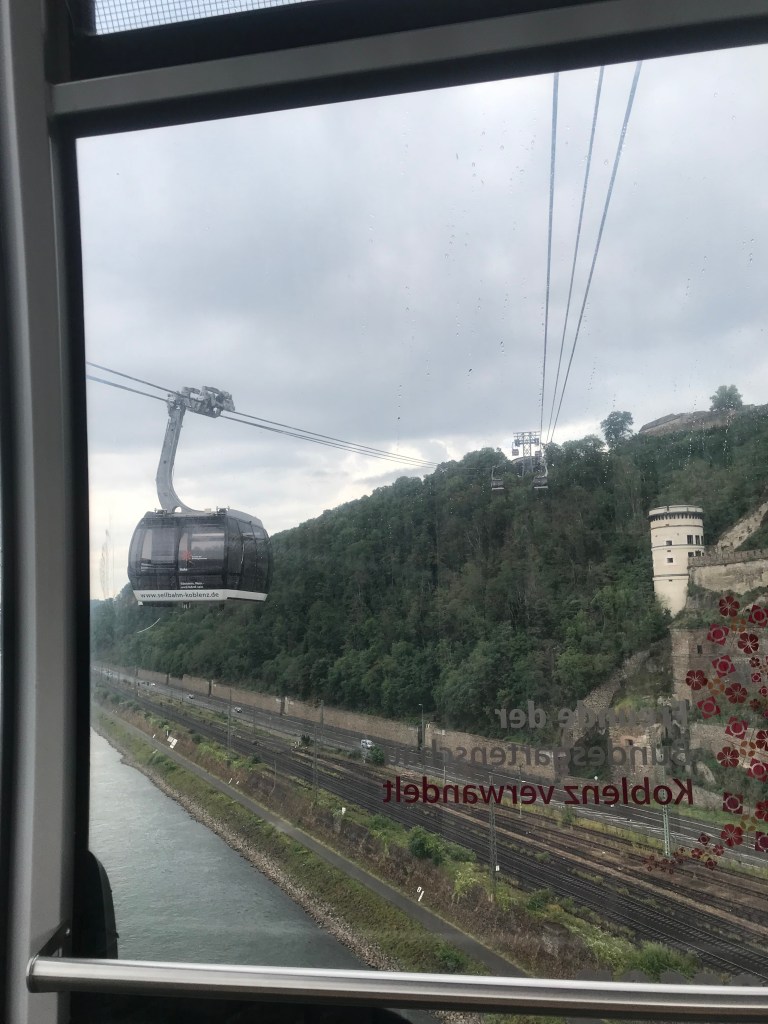
Maree took the cable car up to Ehrenbreitstein Fortress.
Ehrenbreitstein Fortress History
Ehrenbreitstein, the hill that now carries the great fortress overlooking Koblenz, has been a strategic site for thousands of years. Human settlement here dates back to the 4th millennium BC, and by the 10th–9th centuries BC early fortifications were already in place. The Romans later recognised its value, establishing a defensive post between the 3rd and 5th centuries AD. More permanent settlement followed in the Carolingian era of the 8th and 9th centuries.
Around the year 1000, a nobleman named Ehrenbert (or Erembert) built a castle on the hill—originally called Burg Ehrenbertstein, later evolving into Burg Ehrenbreitstein. The first written record of the castle appears in 1139, identifying it as property of the Archbishop of Trier. Over the next centuries, successive archbishops expanded and strengthened the complex, adding outworks such as Burg Helferstein to the south and enlarging the main castle in stages through the 12th, 13th, and 15th centuries.
By the 16th century, the rise of gunpowder warfare prompted a major transformation. The medieval castle began its evolution into a true fortress, equipped with heavy artillery—including the massive nine‑ton Greif cannon. At the base of the hill, Philipp Christoph von Sötern constructed the Phillipsburg Palace (1625–1629), protected by the fortress above. Control of Ehrenbreitstein shifted during the Thirty Years’ War, but it remained a vital stronghold, even safeguarding the revered Holy Tunic of Trier from 1657 to 1794.
Its strategic importance made it a bargaining chip between European powers. In 1688, the fortress successfully resisted a siege by Louis XIV’s forces. Additional fortifications were added around 1730, but the French briefly captured it in 1759. During the French Revolutionary Wars, Koblenz fell in 1794, and although Ehrenbreitstein withstood several sieges, a year‑long blockade beginning in 1798 starved the defenders into surrender. When the French withdrew under the Treaty of Lunéville, they destroyed the fortress in 1801 to prevent its reuse.
After the Congress of Vienna in 1815, the Rhineland passed to Prussia, and Koblenz became a key defensive point on the French frontier. The Prussians rebuilt and expanded the fortifications between 1815 and 1834, creating the vast Festung Koblenz—one of the largest fortress systems in Europe, second only to Gibraltar. As part of this network, the new Ehrenbreitstein Fortress could house up to 1,200 soldiers and once again dominated the confluence of the Rhine and Moselle.
Today, the fortress stands as a monumental reminder of the region’s long military history, layered with centuries of conflict, engineering, and strategic importance.
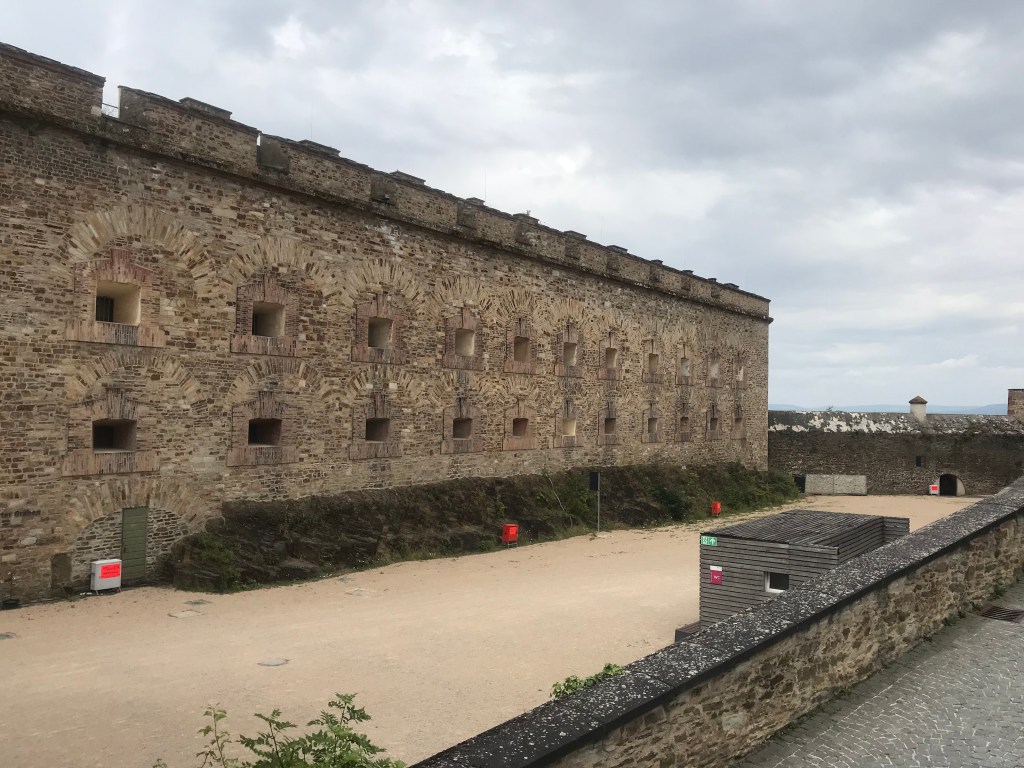
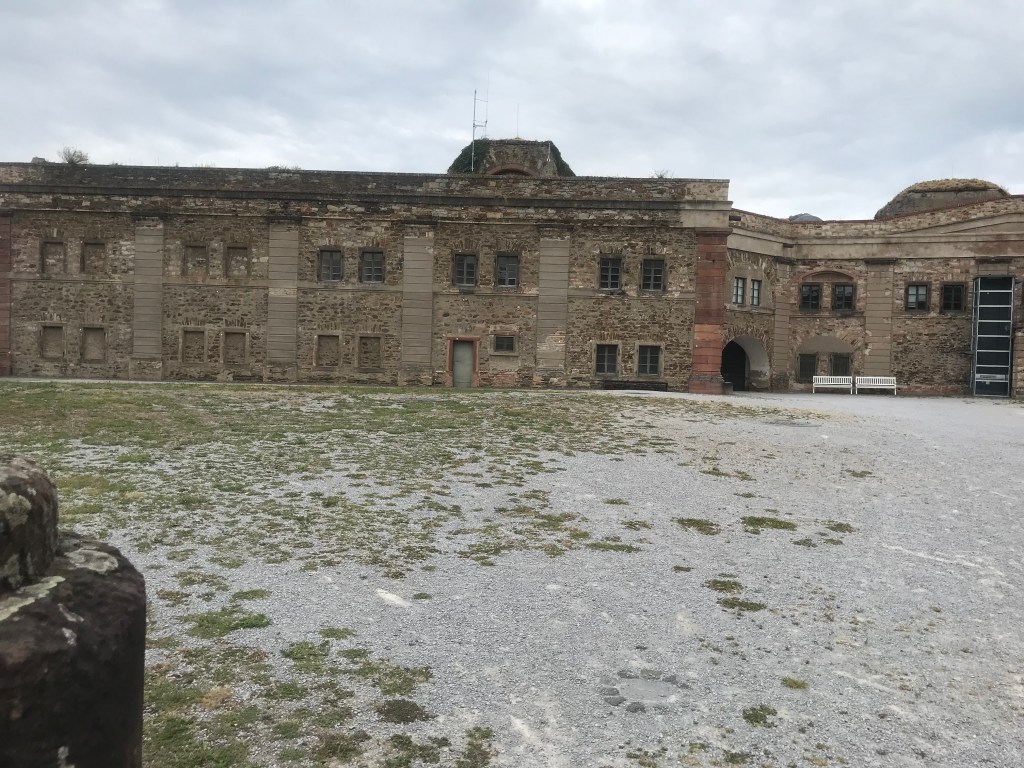
Maree took the following photos from the Fortress.
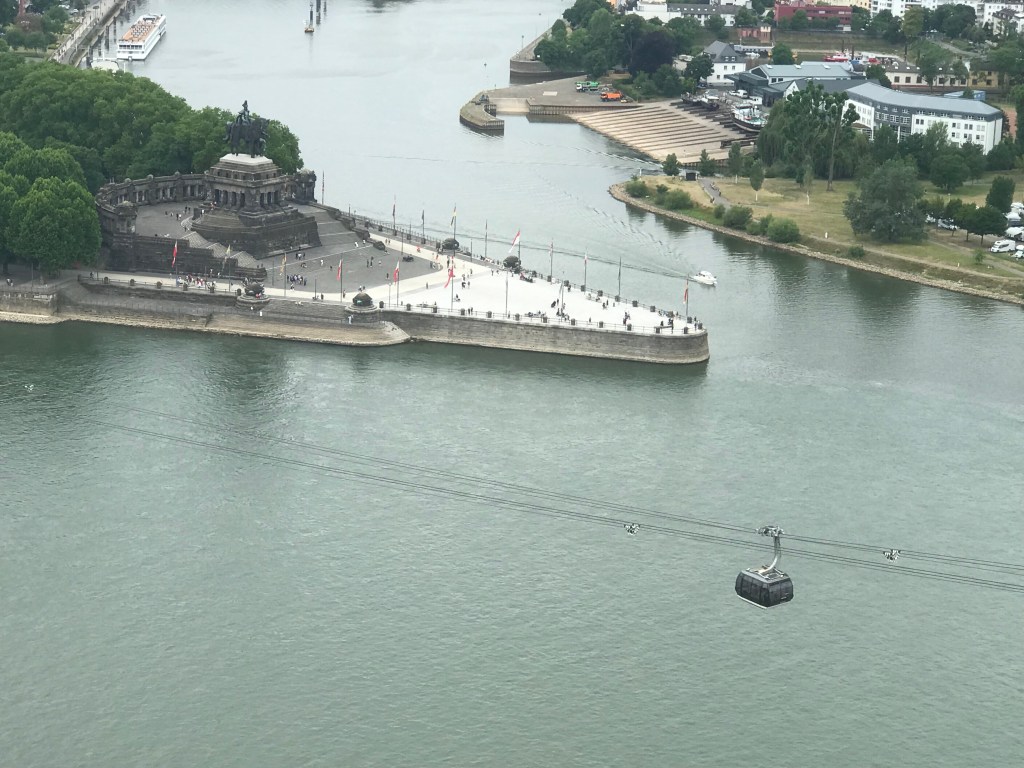
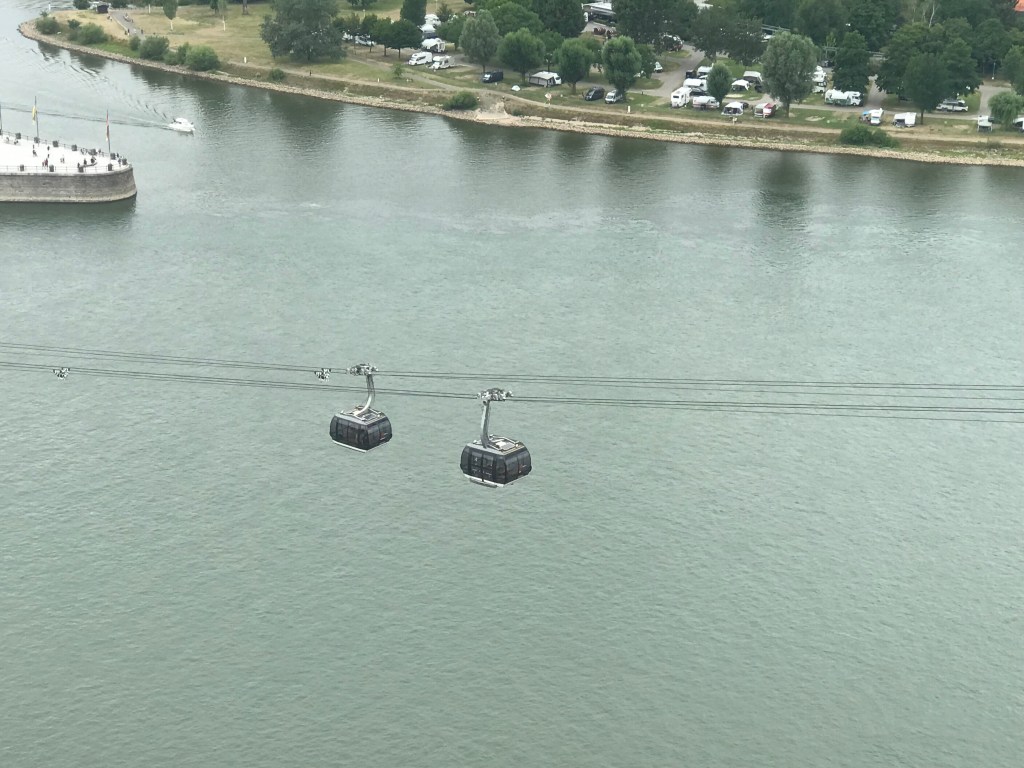
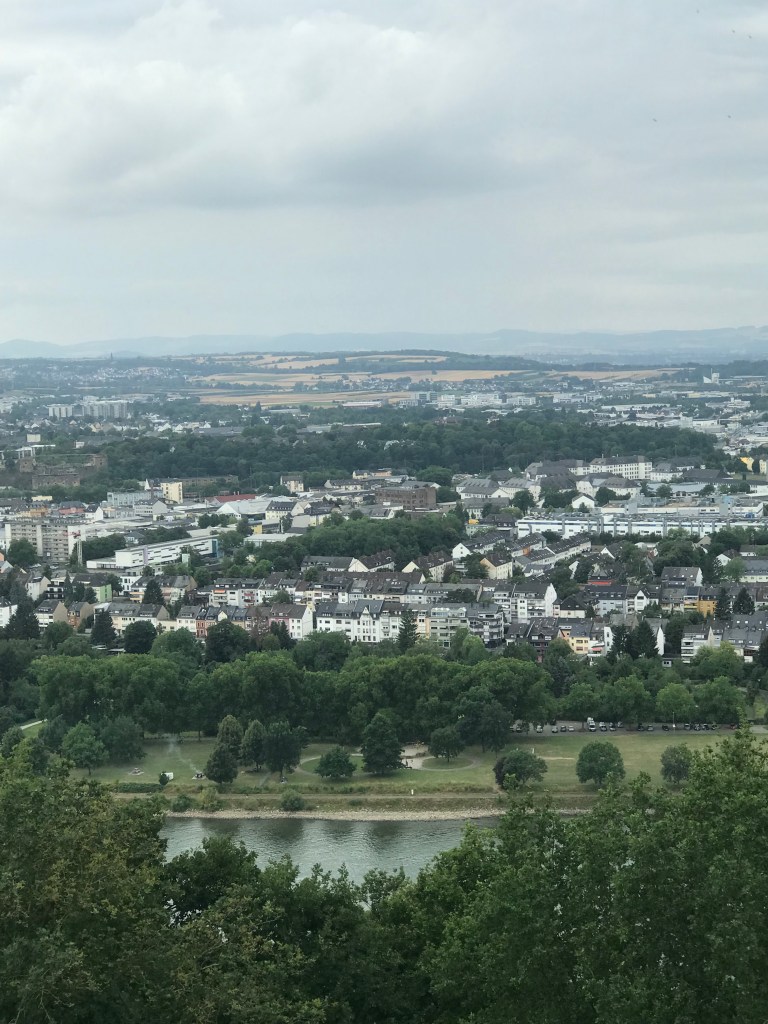
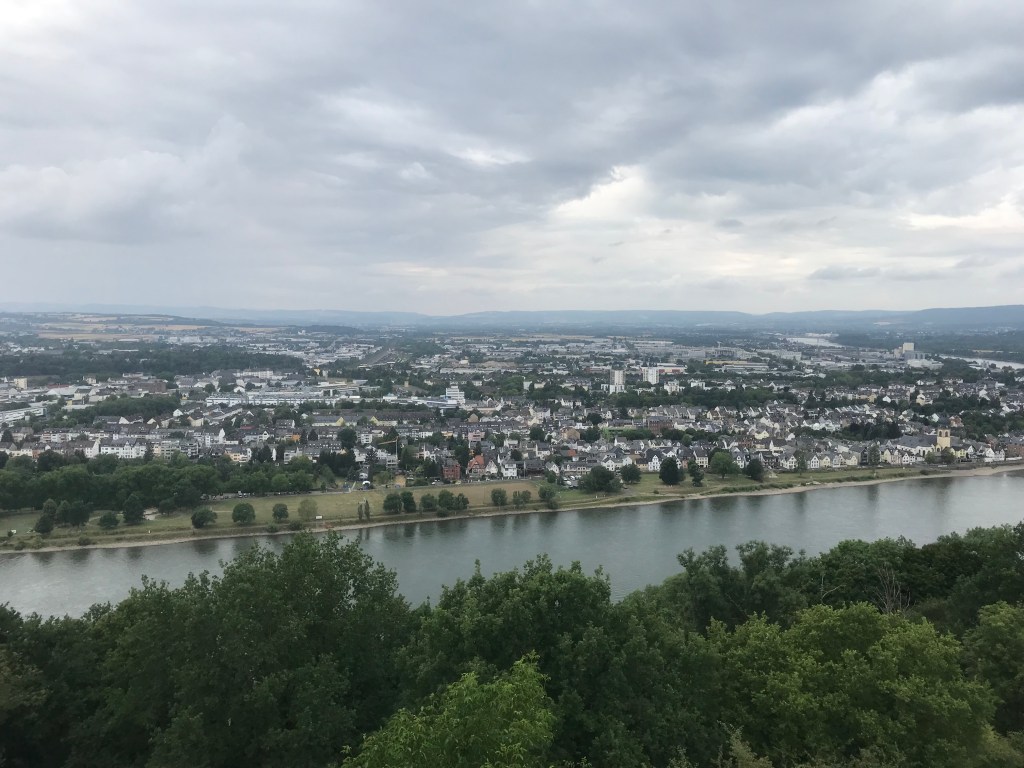
Tomorrow we leave Koblenz for Cologne.
Monday 14 July 2025
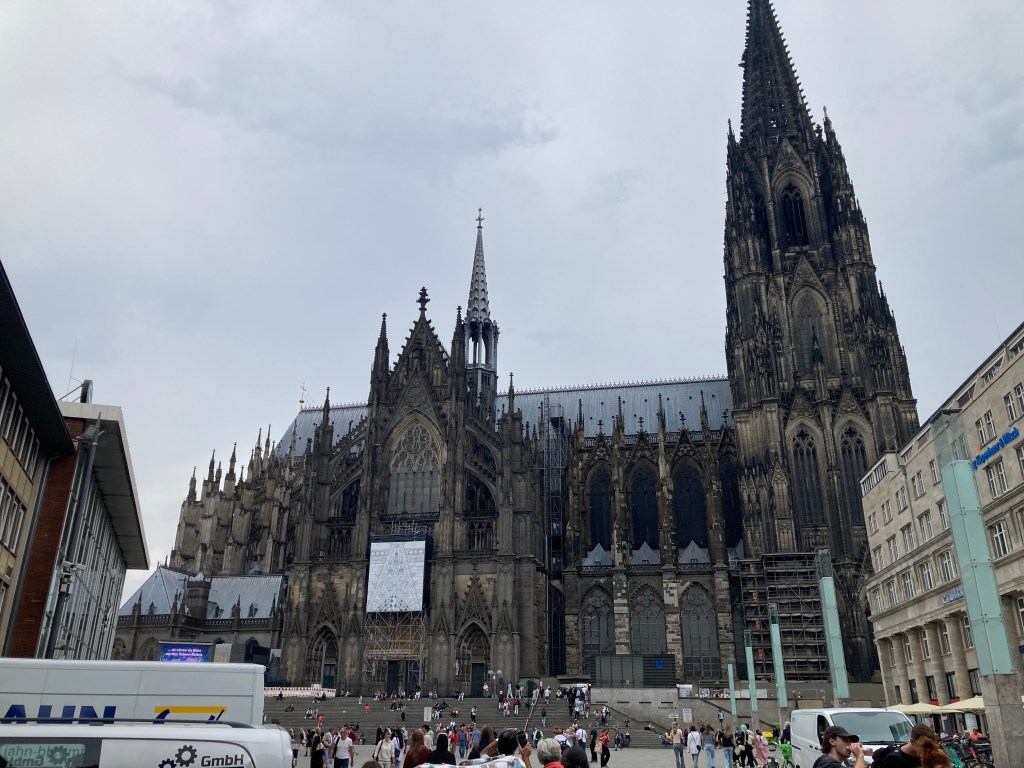
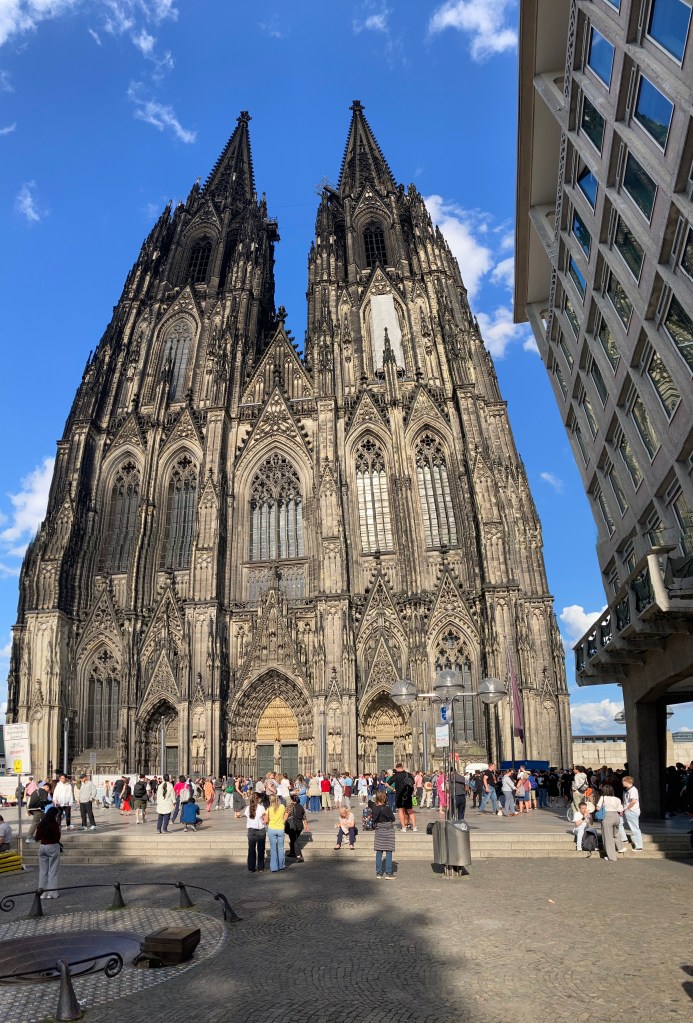
Today we travelled up to Cologne, where we’ll be staying for the next two nights. We’ve booked a river cruise for tomorrow afternoon, but otherwise the plan is simply to unwind and wander through the city at our own pace. Our hotel is right beside the Cologne Hauptbahnhof, and from our window we have a perfect view of the magnificent Cologne Cathedral.
Cologne Cathedral (Kölner Dom) is one of Europe’s great Gothic masterpieces. Construction began in 1248, inspired by the soaring cathedrals of France, but the project stretched across centuries—work halted in the 16th century and the building stood unfinished for more than 300 years. It wasn’t until the 19th century, during a wave of renewed interest in medieval architecture, that construction resumed. The cathedral was finally completed in 1880, following the original medieval plans.
Today, its twin spires dominate the skyline and make it the most visited landmark in Germany. Despite heavy bombing during World War II, the cathedral survived and remains a symbol of resilience, faith, and the long, layered history of Cologne.
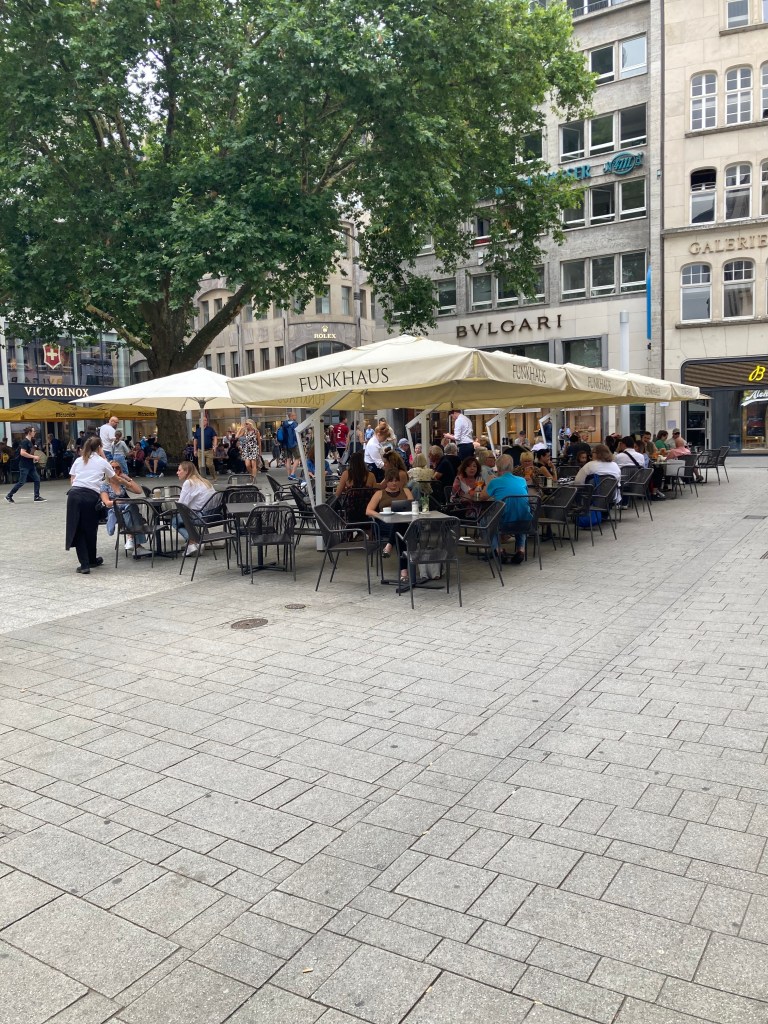
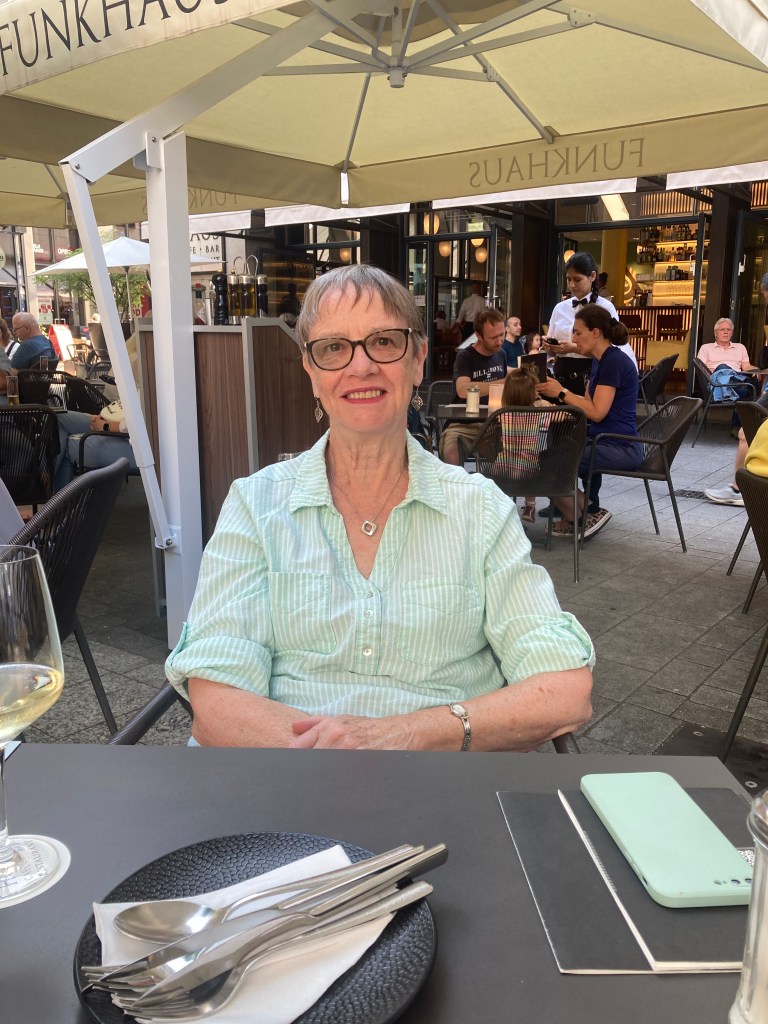
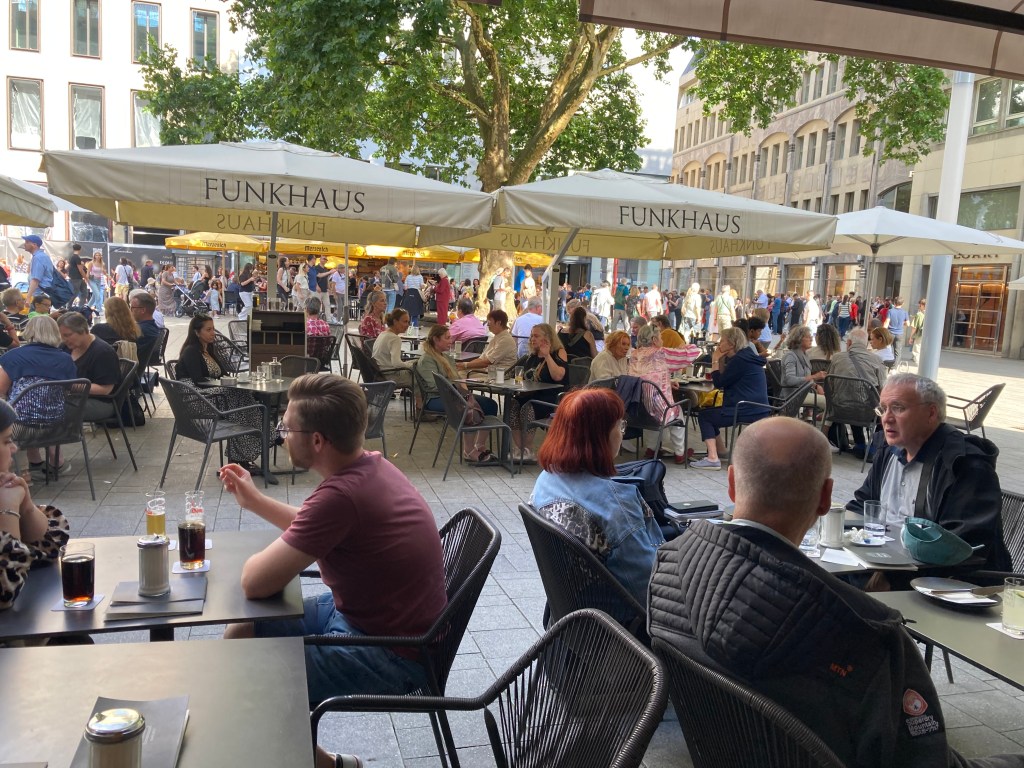
We found a lovely outdoor spot for a light lunch at Funkhaus, a café with a bit of history behind it. The building once housed part of Cologne’s former broadcasting centre, and its name—literally “radio house”—reflects that past. Today, the space has been transformed into a relaxed café‑restaurant, blending its mid‑20th‑century media heritage with a modern, easygoing atmosphere. It made for a pleasant and fitting place to pause and enjoy the afternoon.
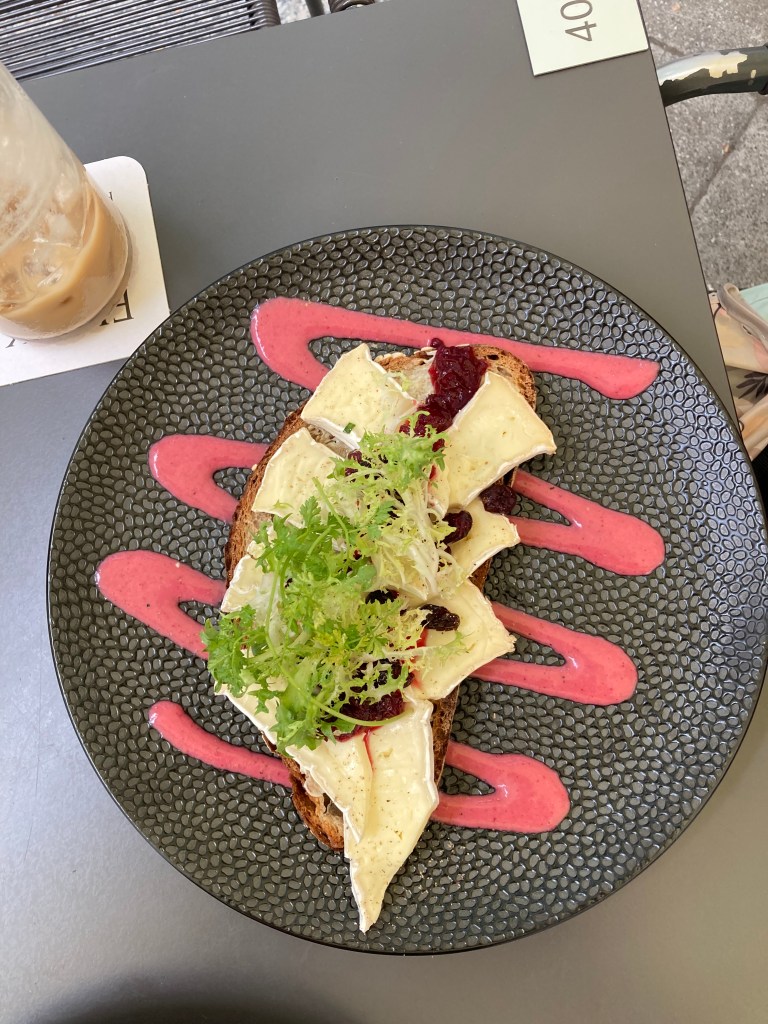
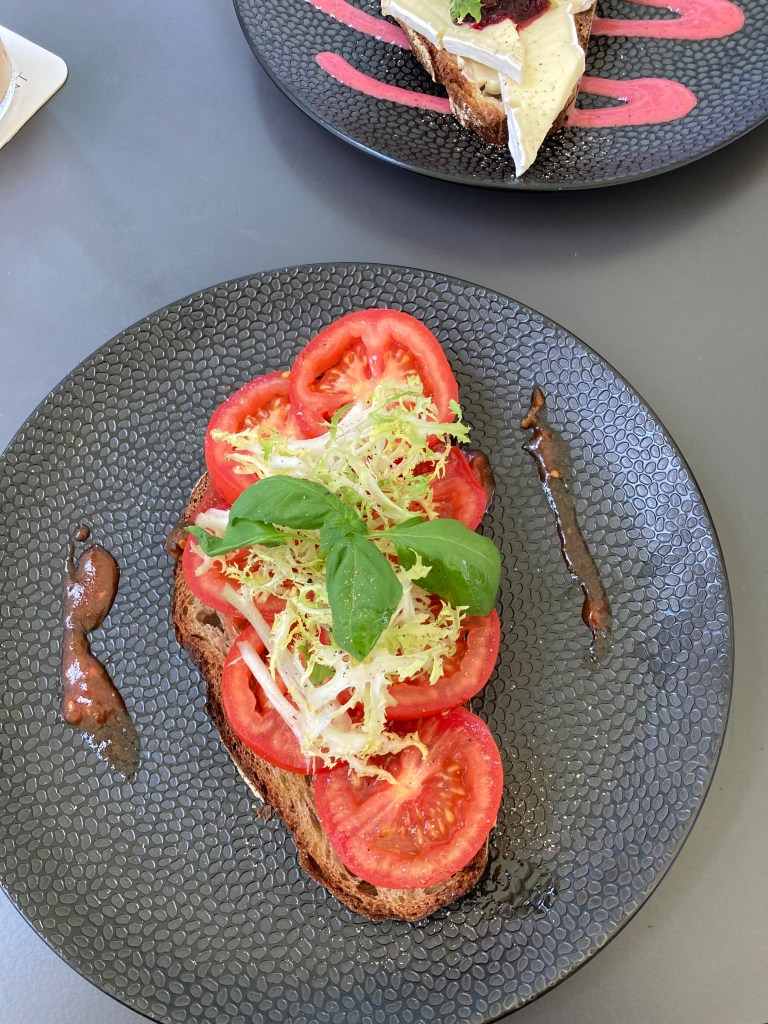
From here it was back to the hotel where we worked on making some sight seeing bookings for our stay in copenhagen. One of the tours is to Kronburg Castle (better know as Hamlet’s Castle).
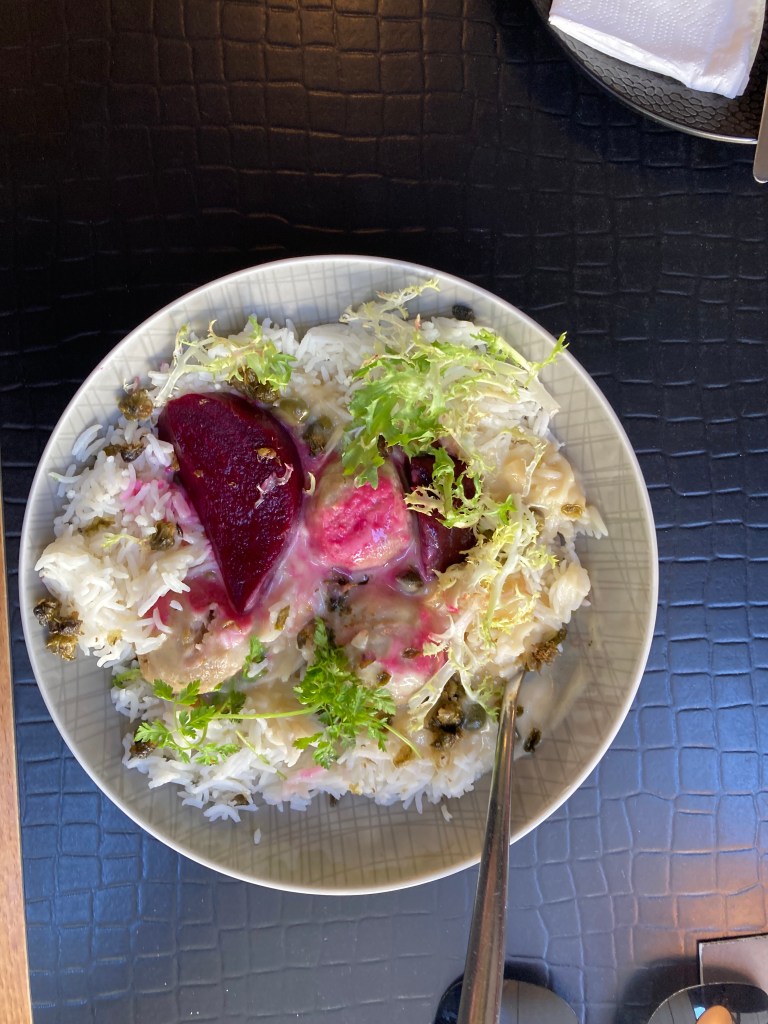
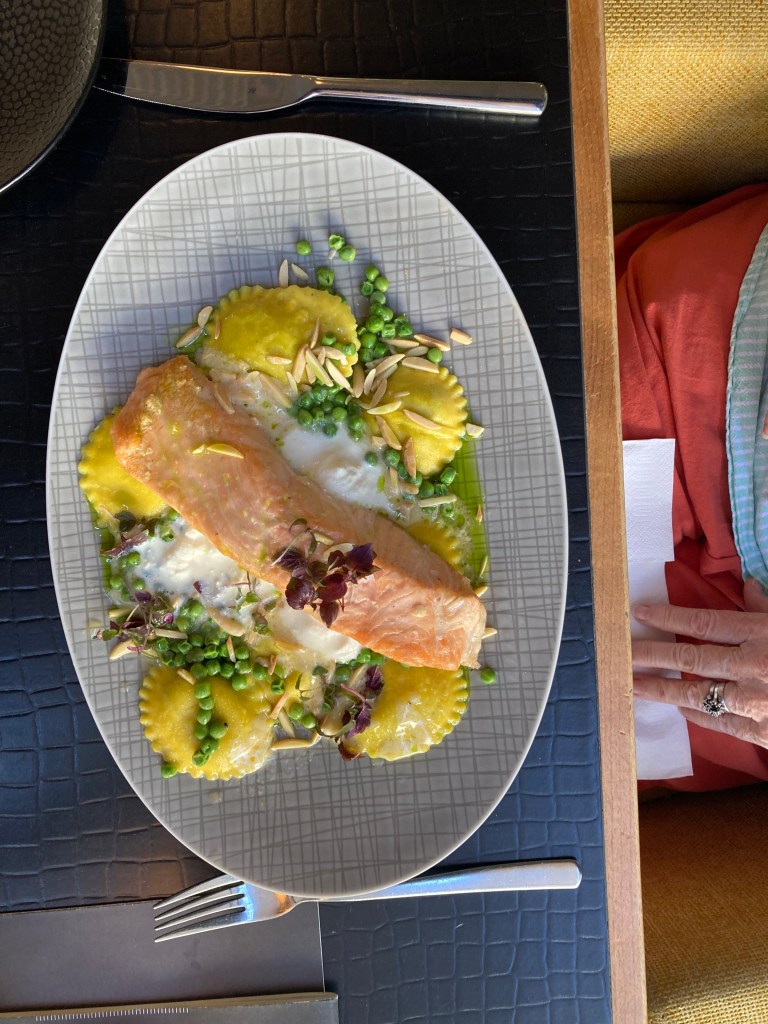
After finishing our research it was off to get some dinner. As the place we had lunch was so good we decided to have dinner there.
Tuesday 16 July 2025
Nothing much to report today. We spent the day wandering around town, ticking off a few essential bits of shopping and simply enjoying the pace of things. For both lunch and dinner we went back to the same restaurant we discovered on our first day—when you find a good thing, there’s no reason to stray.
Wednesday 17 July 2025
We left Cologne for Copenhagen at 06:15 this morning.
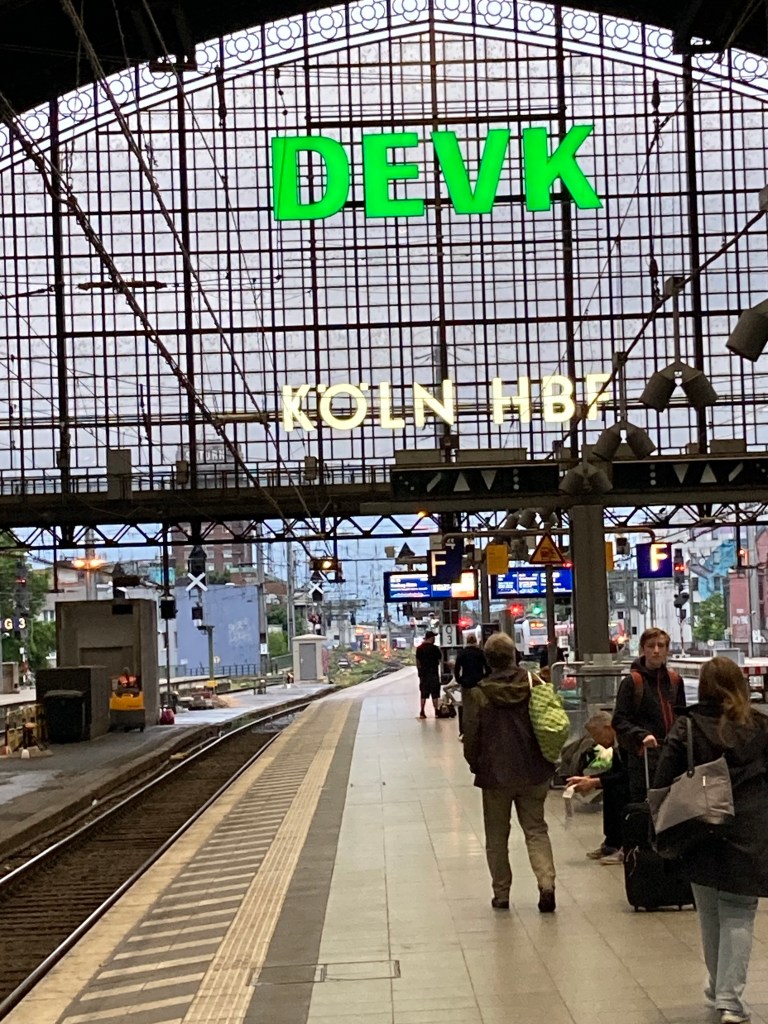
The trip to Hamburg passed quietly, and we dozed through most of the three‑and‑a‑half‑hour journey. After a 40‑minute transfer, we made our way to the platform for our train to Nyborg, waiting at the designated boarding point for the first‑class carriage. Unfortunately, the train arrived in reverse formation—first class wasn’t at the front at all, but at the very last of seven carriages. What followed was a brisk, slightly chaotic dash along a crowded platform to reach the other end before the doors closed.
Once aboard, things didn’t improve much. The carriage had that unmistakable 1980s European layout: a narrow side aisle and two sets of three seats facing each other, all feeling a bit cramped and dated. The exterior of the train was grimy, and to top it off, there was no bistro or restaurant car. With a four‑hour journey ahead of us, we settled in for the long ride to Nyborg—hungry, slightly amused, and very ready to arrive.
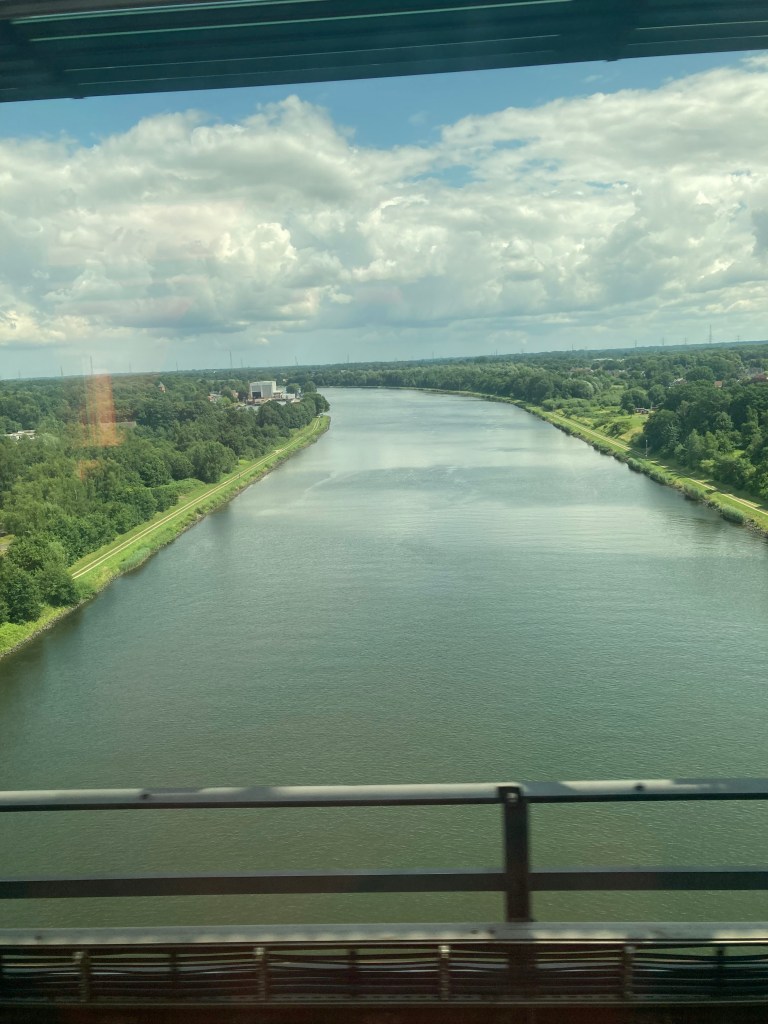
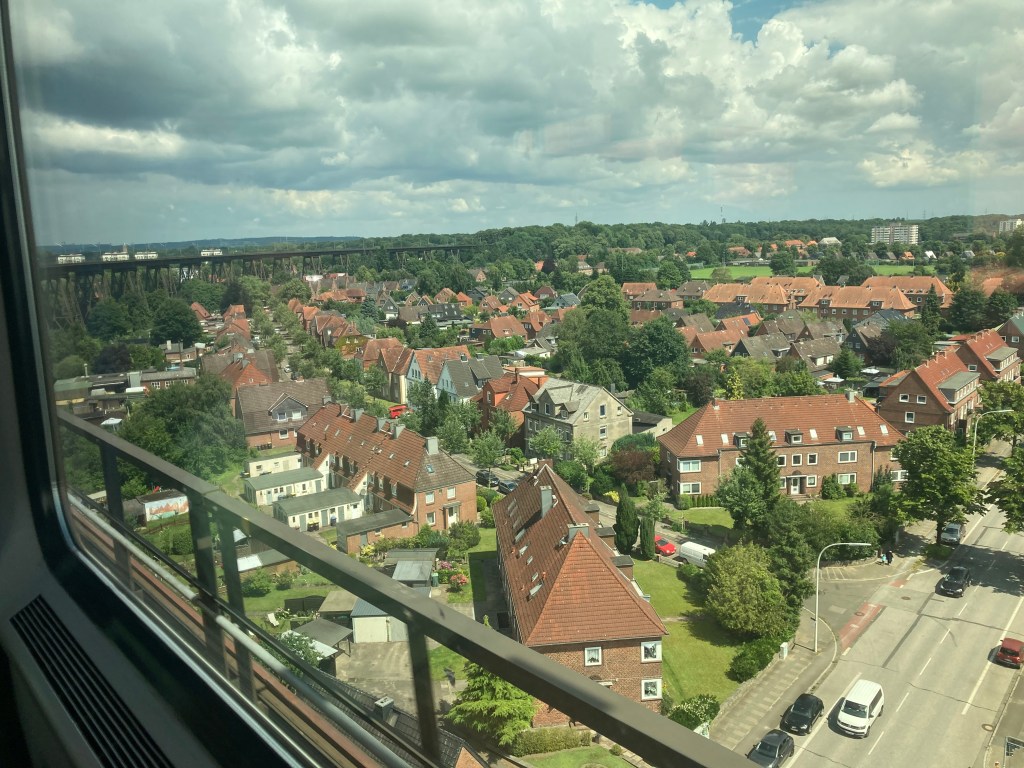
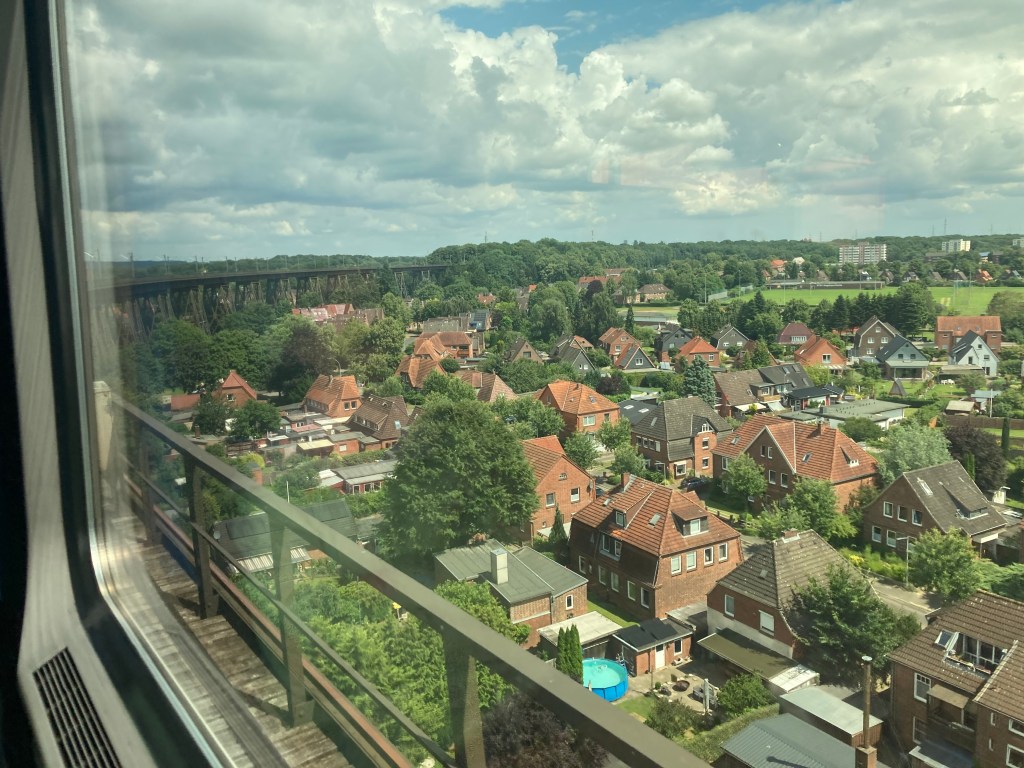
The Rendsburg High Bridge, completed in 1913, rises 68 metres above the canal and provides 42 metres of clearance for passing ships. What makes it truly extraordinary is the ingenious railway loop built to bring trains up to the required height: a full spiral that winds around the town before the line crosses the canal and then passes back underneath itself. Watching the train curve around the loop and then glide under the very bridge we had just crossed was a fascinating experience.
A pity Maree missed the whole spectacle—but she was fast asleep.
Why Nyborg, you might ask? Under normal circumstances, the train runs directly from Hamburg to Copenhagen without any fuss. But at the moment, major track work is underway on the section between Nyborg and Slagelse. Engineers are inspecting and upgrading the rail line that dives beneath the Great Belt Strait via the Great Belt Tunnel—part of the enormous Great Belt Fixed Link, which combines both the tunnel and the iconic suspension bridge. Because that tunnel section is temporarily closed, every passenger has to disembark at Nyborg and continue the journey by bus.
And that’s where the chaos began.
Several hundred people poured off the train and sprinted toward the waiting buses, hurling luggage into the cargo holds and scrambling aboard for the 40‑minute ride to Slagelse. Once there, everyone had to dash again to catch the connecting train we already had reservations for.
It was, without exaggeration, the most disorganised transfer I’ve ever seen. No staff directing the crowds, no system, no order—just a crush of people pushing up and down stairways. Nyborg station didn’t even have escalators operating, so I ended up carrying both suitcases down fifteen steep flights while people jostled past, pushing me forward in the process. At one point they nearly succeeded in knocking me over.
The one silver lining came during the bus ride itself. The road crosses the Great Belt Bridge—the very strait the train normally passes under through the tunnel. So, in the middle of all the mayhem, we did get an unexpected bonus: a rare chance to see the Great Belt from above, sweeping across one of Denmark’s most impressive engineering landmarks.
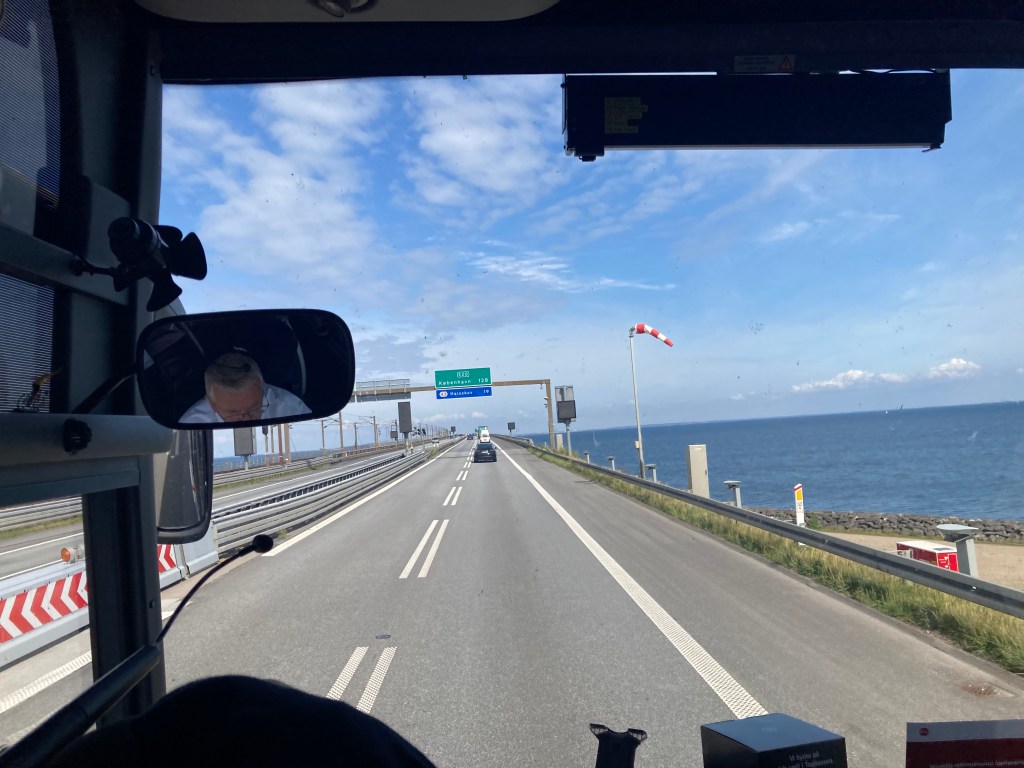
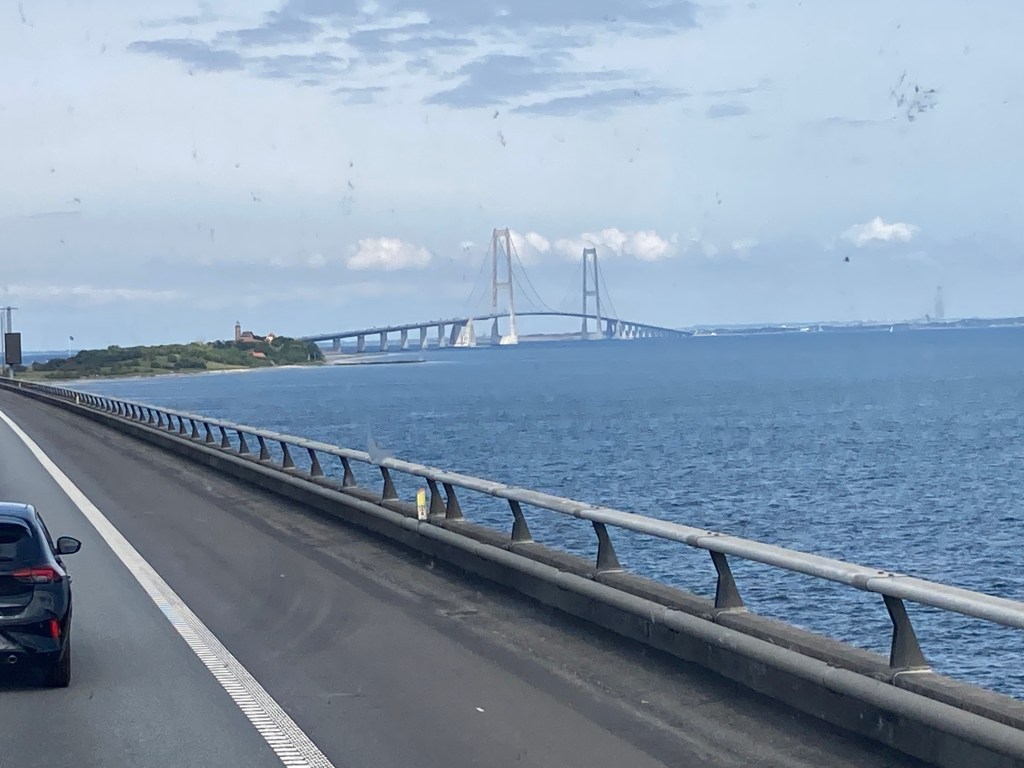
The Great Belt Bridge is part of Denmark’s impressive Great Belt Fixed Link, a combination of bridges and tunnels that connects the islands of Zealand and Funen. From an engineering perspective, it’s an extraordinary structure. The East Bridge—the most recognisable section—is one of the world’s longest suspension bridges, with a main span stretching 1,624 metres. Its two pylons rise 254 metres above sea level, anchored deep into the seabed to withstand fierce winds and the strong currents of the strait.
The West Bridge, which carries both road and rail, uses a series of concrete box‑girder spans designed to handle heavy loads and constant marine exposure. Together with the undersea rail tunnel, the entire link forms a critical piece of Denmark’s infrastructure, reducing travel times and standing as a landmark achievement in modern bridge engineering.
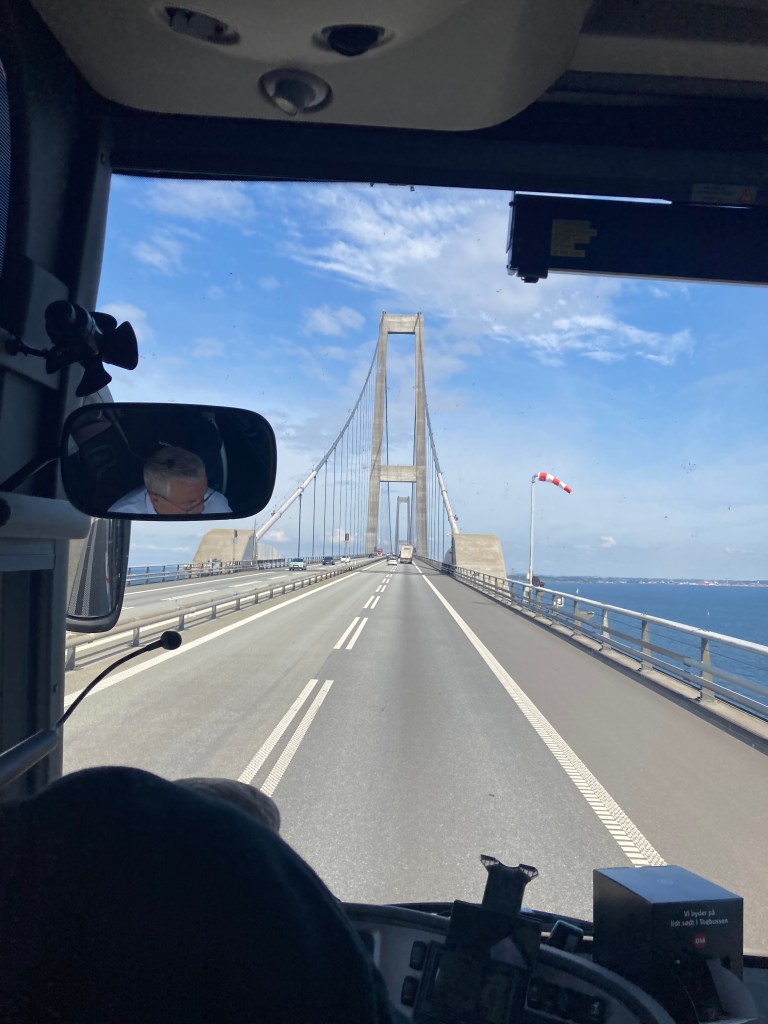
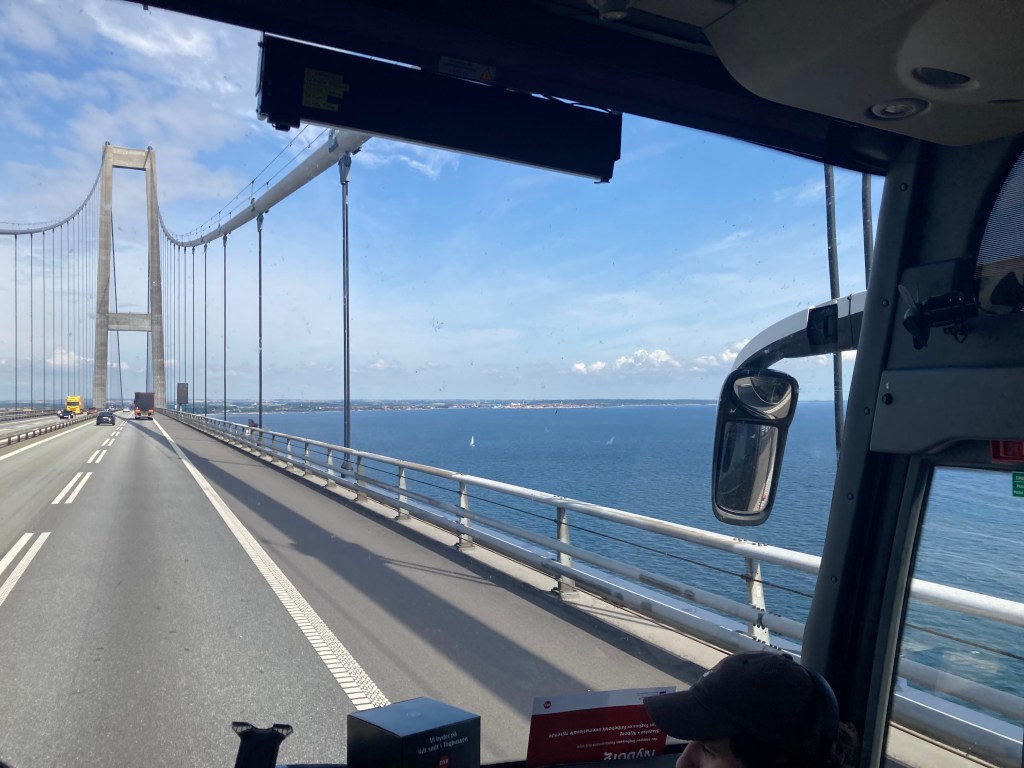
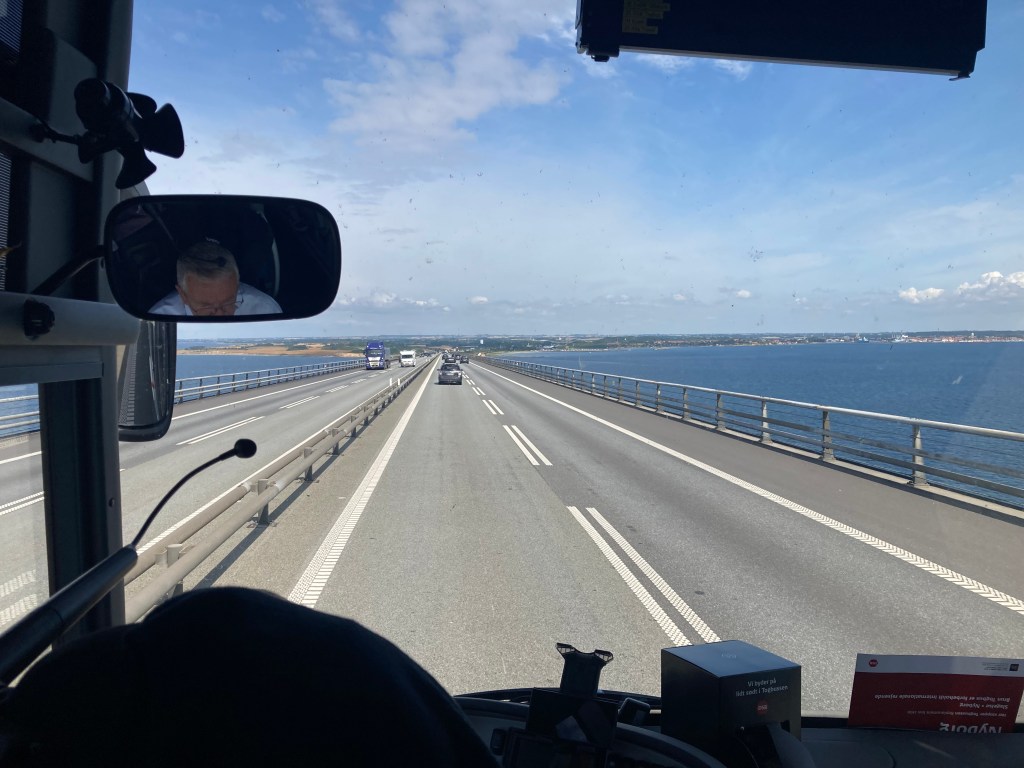
Eventually, we rolled into Copenhagen at 17:20—11 hours and five minutes after leaving Cologne—tumbled into a taxi, and made our way to the Island Hotel, where we’ll be based for the next six nights. Now we’re finally settled in and unwinding for the evening after what can only be described as a thoroughly chaotic day.
Thursday 17 July 2025
Today we travelled from Copenhagen up to Helsingør, a beautiful trip in itself, but really just the prelude to our main purpose: spending the day at Kronborg Castle. Standing at the tip of Zealand, right where Denmark narrows to just four kilometres from Sweden, the castle immediately makes sense of its own existence. You can feel why this spot mattered. For centuries, whoever controlled this point controlled access to the Baltic Sea—and the wealth that passed through it.
As we walked through the grounds, it was easy to imagine the layers of history beneath our feet. Kronborg began life in the 1420s as a fortified stronghold called Krogen, built by King Eric VII to enforce the lucrative Sound Dues on passing ships. Across the water, the Swedes had their own tower fortress, Kärnan, and together the two created a choke point that shaped regional politics for generations.
The Renaissance splendour we see today came later, when King Frederick II transformed the medieval fortress between 1574 and 1585 into a grand palace worthy of a European court. Shakespeare never visited, but that didn’t stop him from immortalising the place as Elsinore in Hamlet, and wandering the courtyards you can almost understand why he chose it—there’s a brooding theatricality to the place, especially with the sea wind sweeping in from the Øresund.
Not all of Kronborg’s story is glamorous. A devastating fire in 1629 destroyed much of the castle, though the church miraculously survived untouched and still stands in its original medieval form. King Christian IV rebuilt the rest, only for the Swedes to besiege and capture it in 1658, stripping it of many of its treasures. By 1785 it had ceased to be a royal residence altogether and was converted into army barracks, a role it held until 1923.
Today, after extensive restoration, it’s a place where all those eras coexist. We joined one of the guided tours, which brought the castle’s long, complicated history to life, and then spent the rest of the day wandering through the courtyards, ramparts, and echoing halls at our own pace.
The notes below are followed by the photos we took as we explored—little glimpses of a place that has been a fortress, a palace, a barracks, a literary icon, and now a beautifully preserved piece of world heritage.
Why Kronborg Castle is also known as Hamlet’s Castle
Kronborg’s fame extends far beyond Denmark’s borders thanks to its role as the setting for Shakespeare’s Hamlet. Although Shakespeare never set foot here, he clearly knew of the castle—likely through travelling actors or sailors who passed through Helsingør—and transformed it into “Elsinore,” the brooding backdrop for his most famous tragedy. Standing in the courtyards today, with the wind coming in off the Øresund, it’s surprisingly easy to imagine the play unfolding around you.
The connection isn’t just literary. Hamlet has been performed at Kronborg many times, beginning in 1816 when soldiers from the castle garrison staged the play in the telegraph tower to mark the 200th anniversary of Shakespeare’s death. Since then, the castle has hosted a remarkable line-up of actors who have taken on the role of the Danish prince within its walls. Laurence Olivier, John Gielgud, Christopher Plummer, Derek Jacobi, David Tennant, and, in 2009, Jude Law have all performed Hamlet here, turning Kronborg into a kind of pilgrimage site for Shakespearean theatre.
It adds a wonderful extra layer to the visit—walking through the same spaces where centuries of history, legend, and performance have all converged.
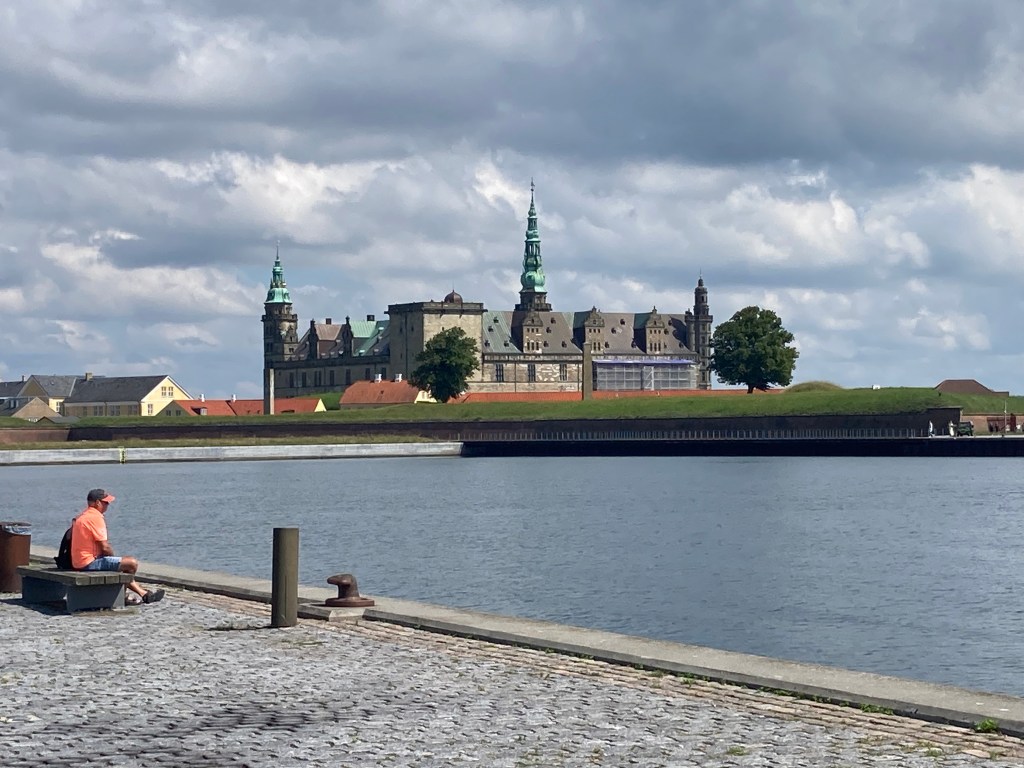
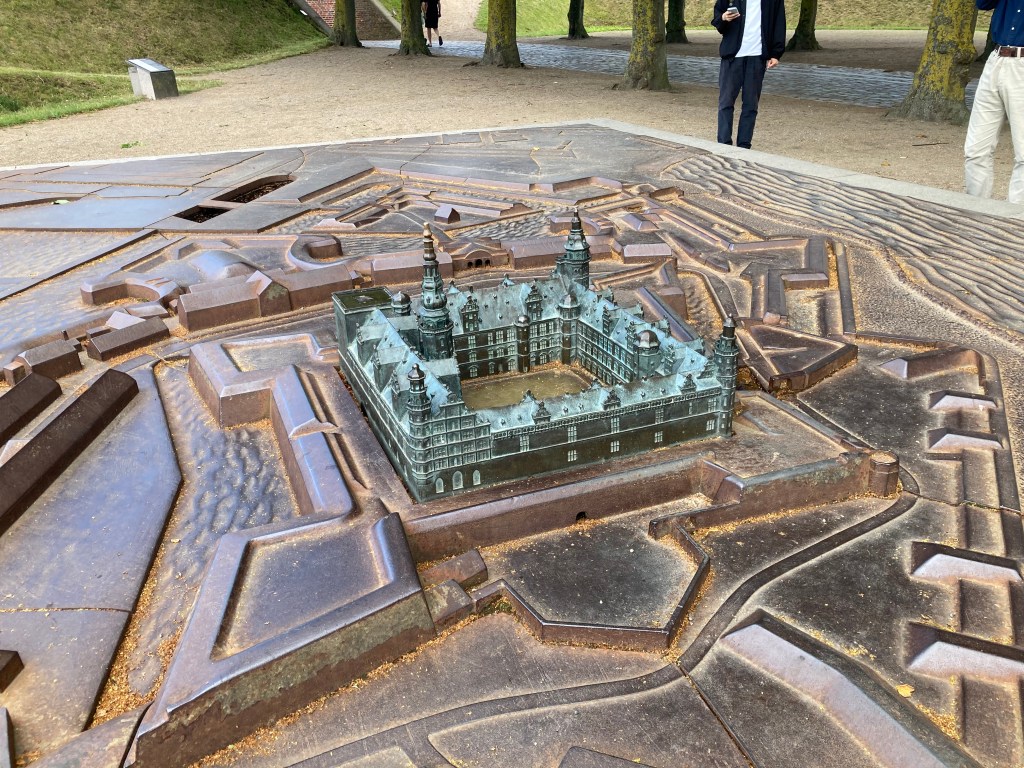
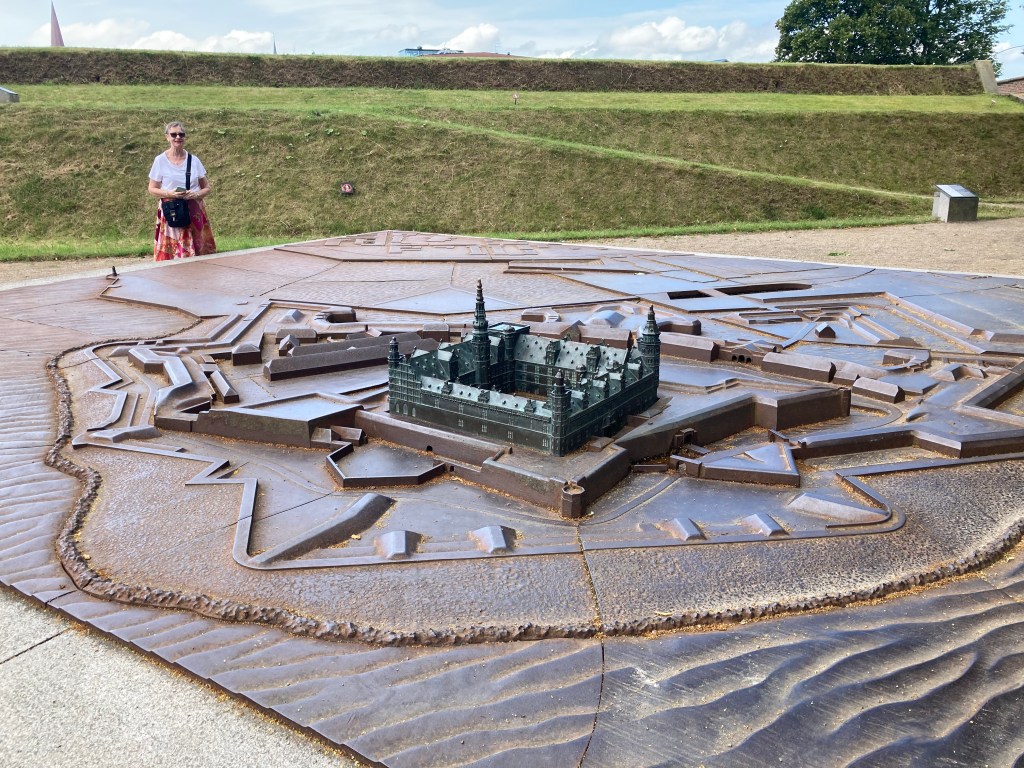
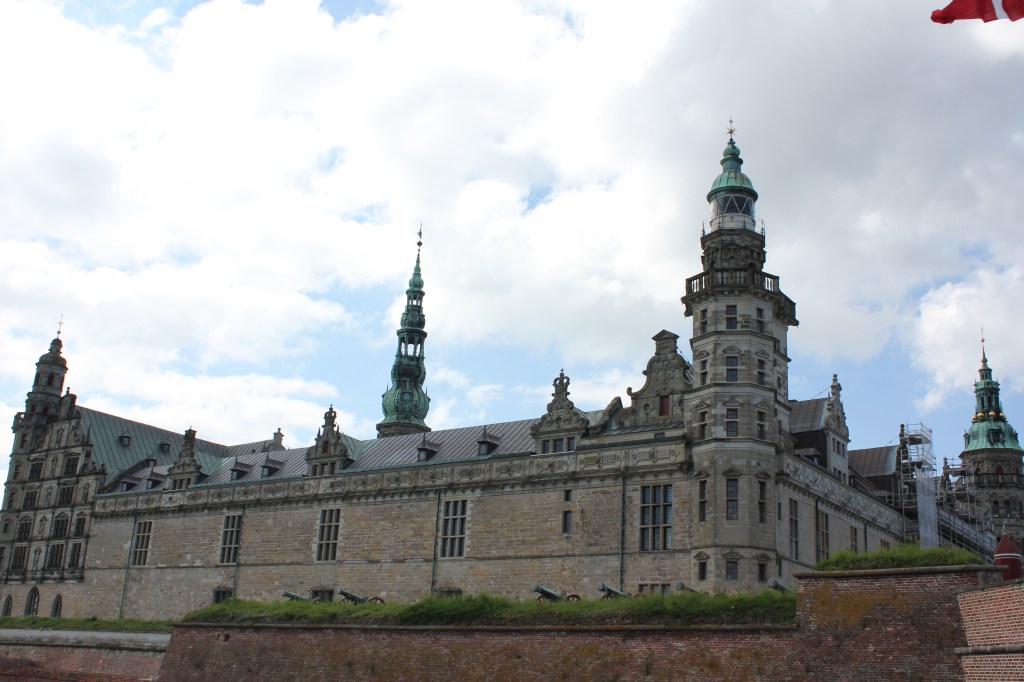
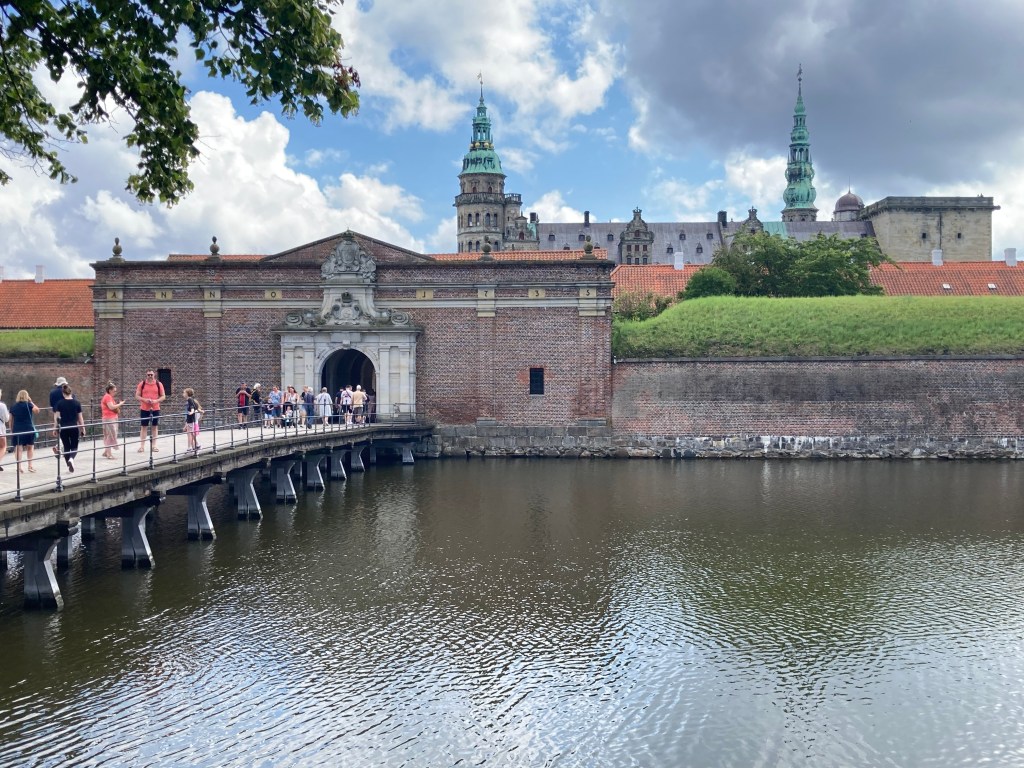
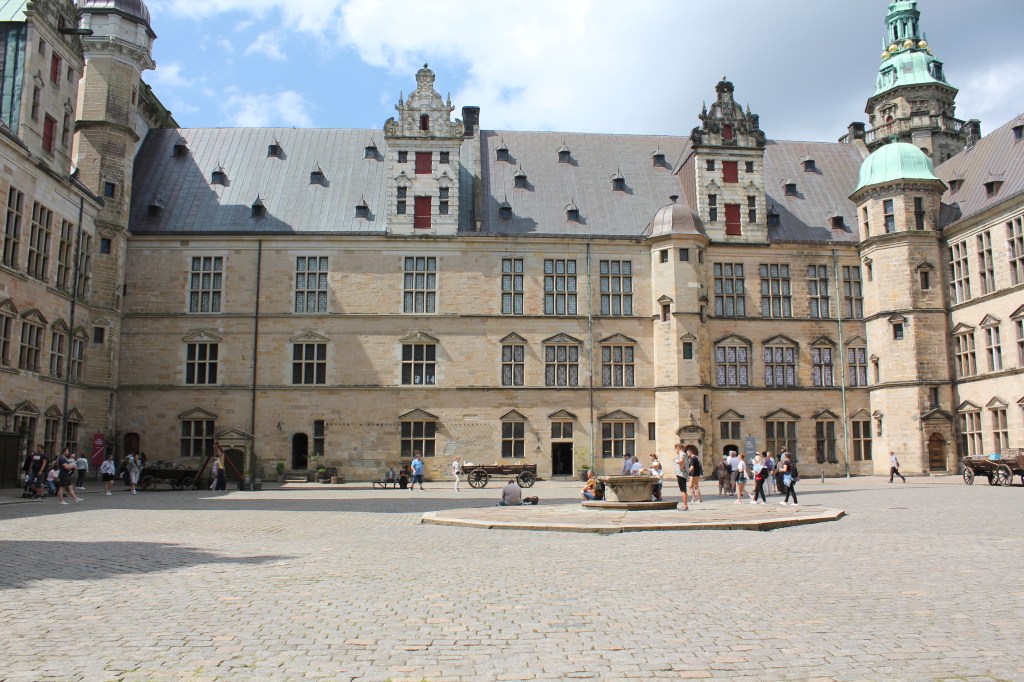
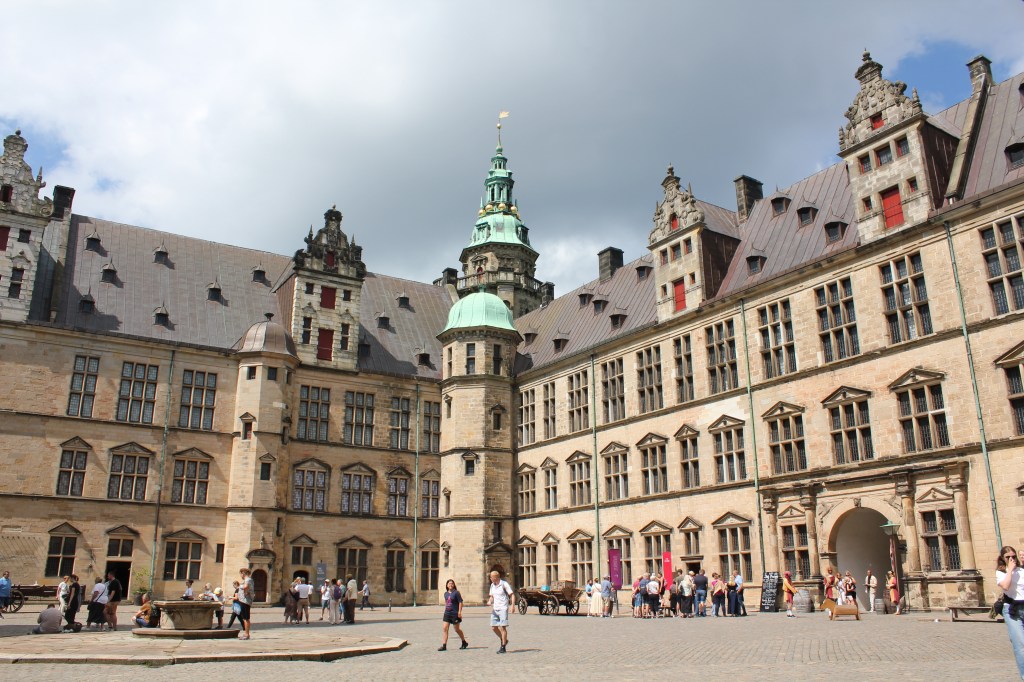
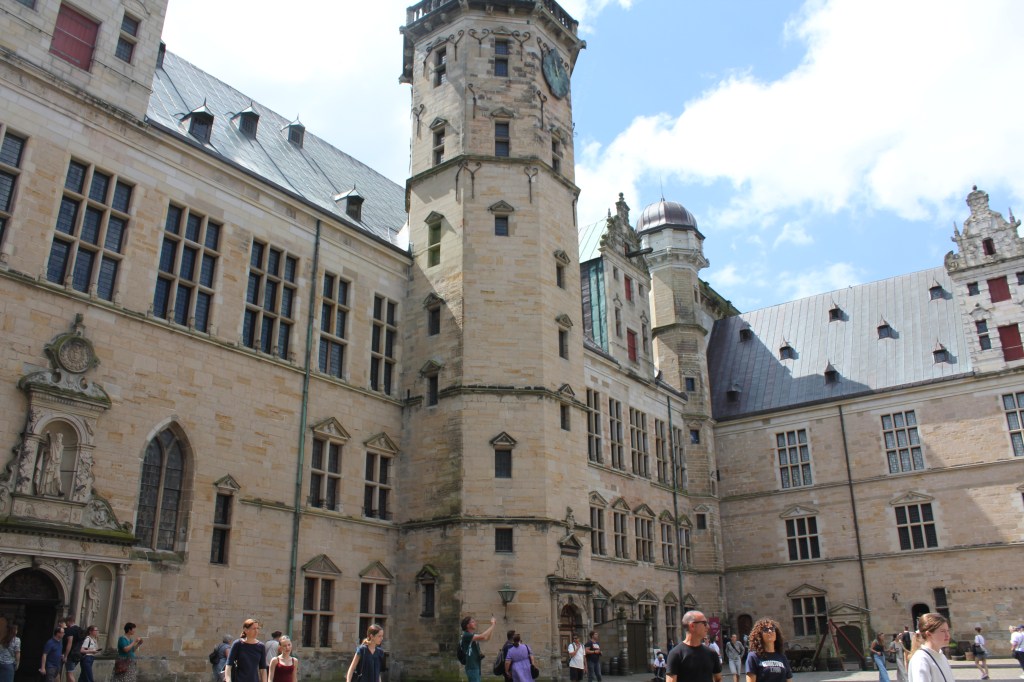
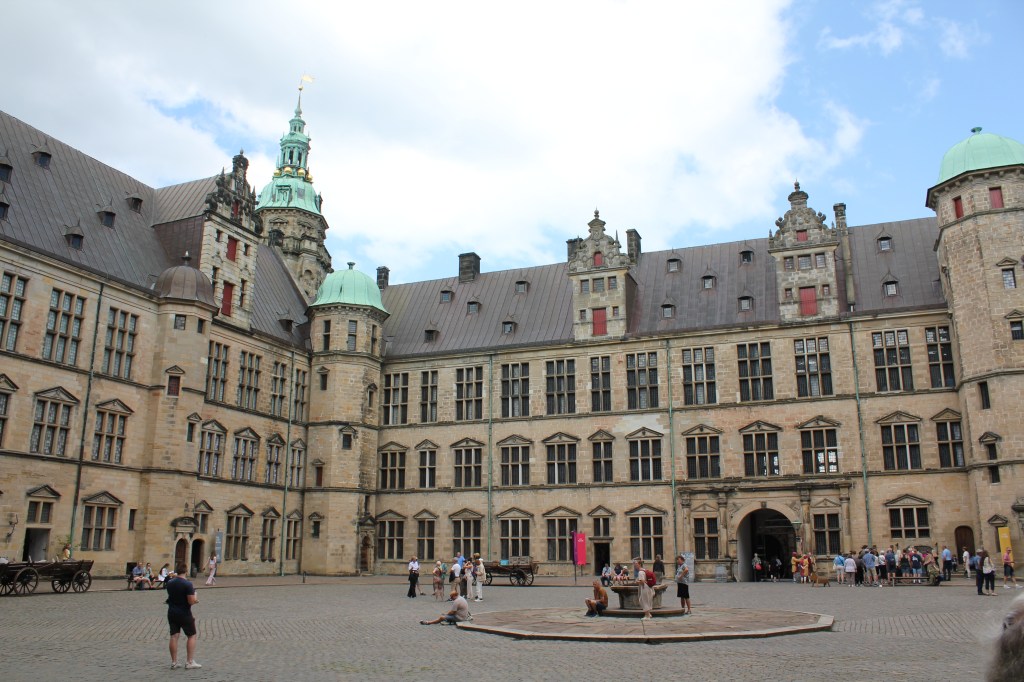
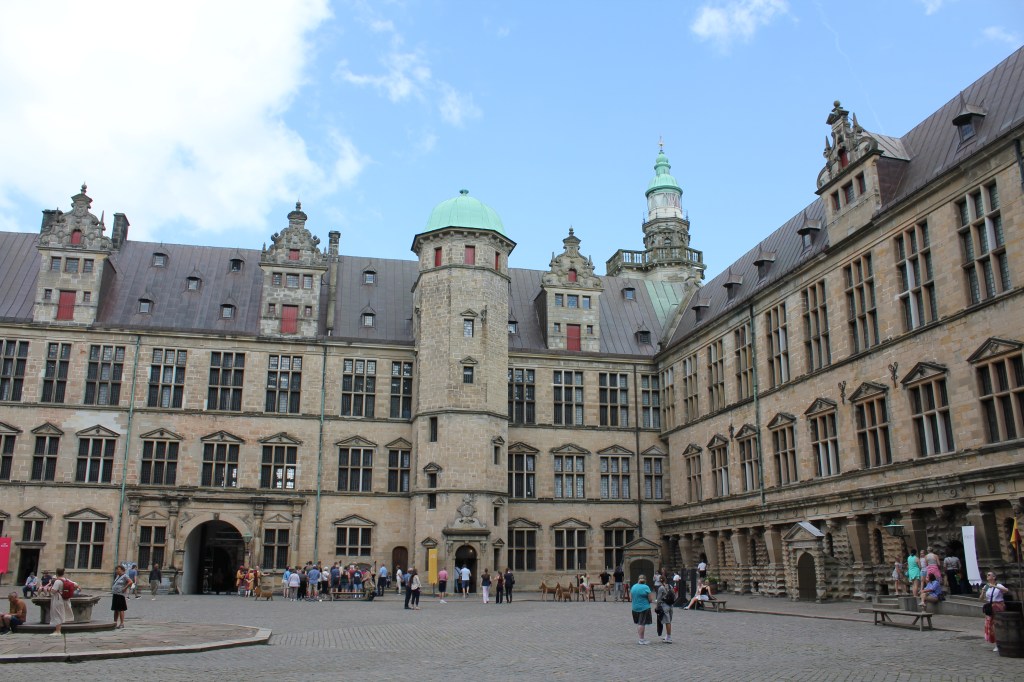
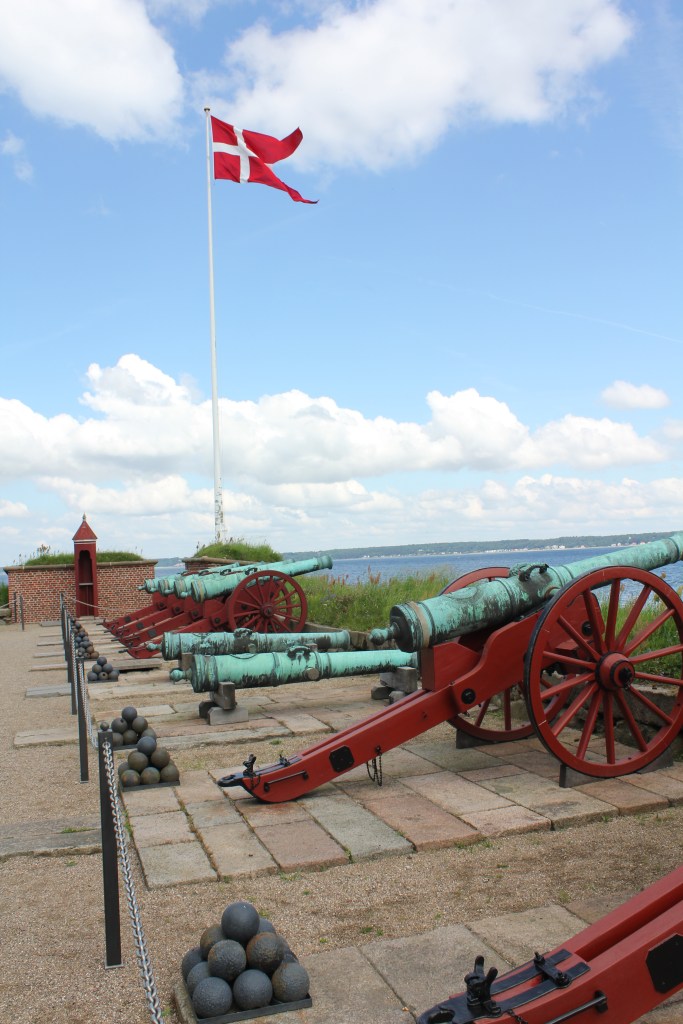
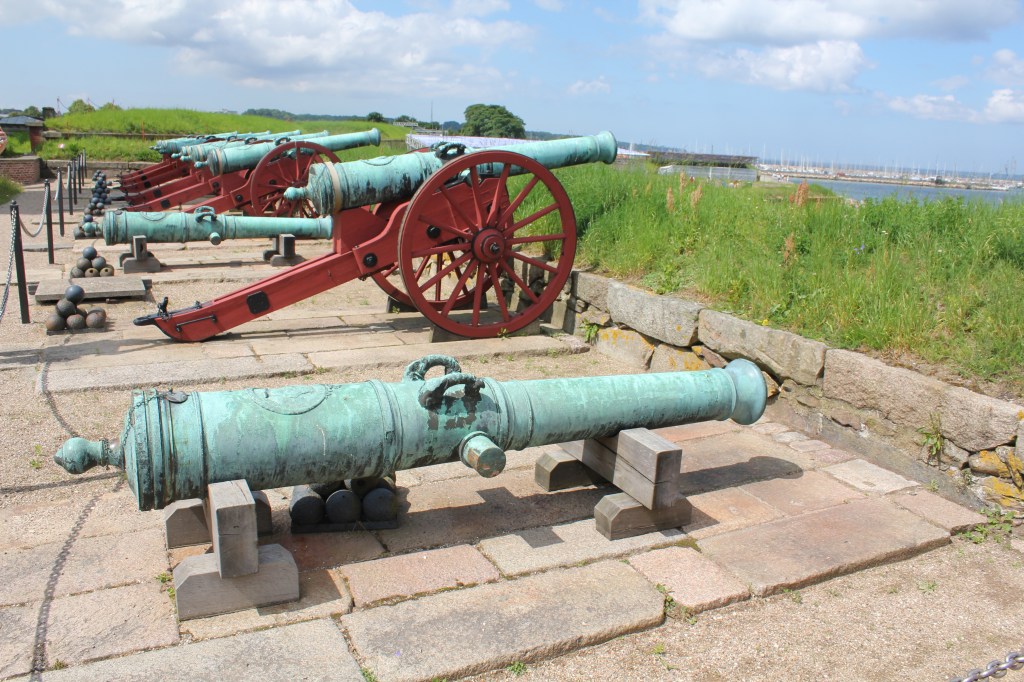
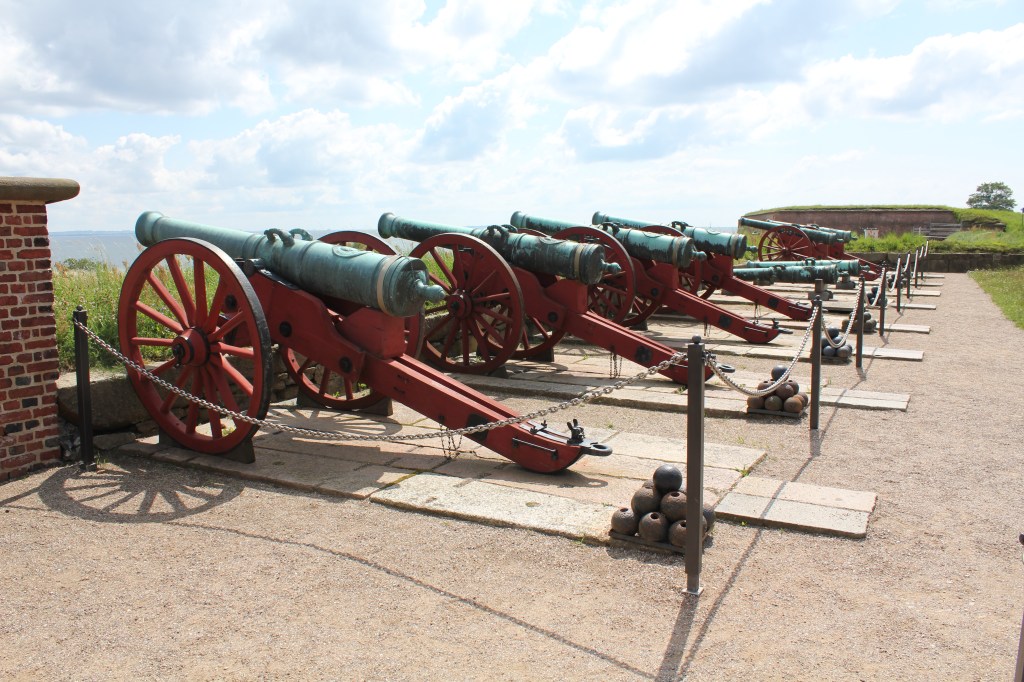
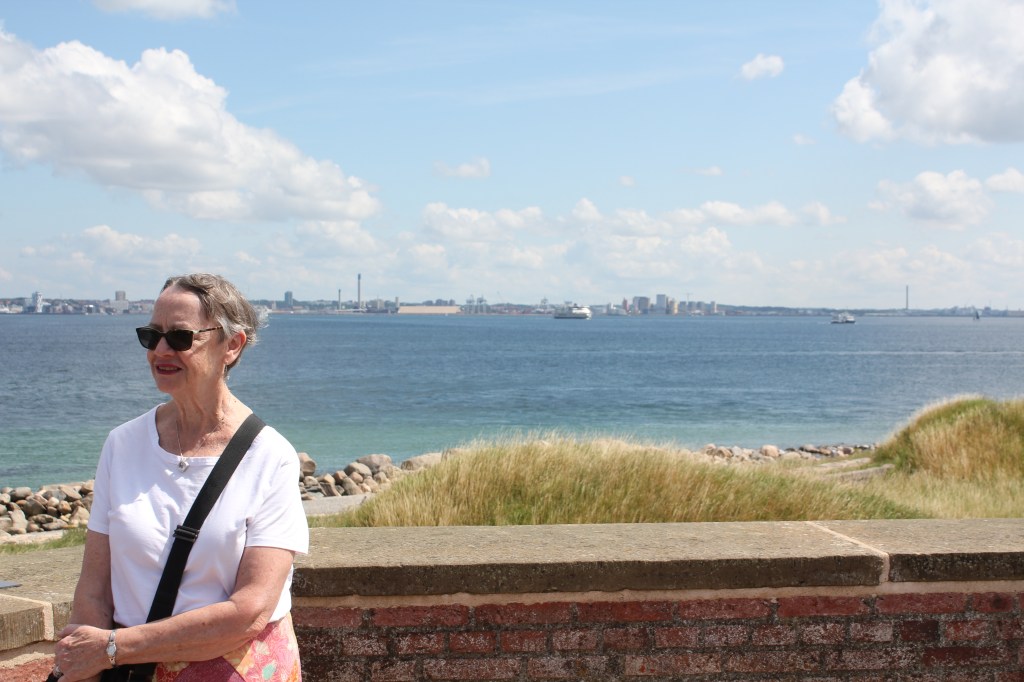
After a full day exploring this remarkable landmark—and absorbing more history than our legs were prepared for—we made our way back to the railway station and caught the next train for the 50‑minute ride to Copenhagen.
For dinner we chose J’taime, a cosy Italian restaurant just a short walk from the hotel. It’s known for its warm, intimate atmosphere and a menu built around classic Italian comfort dishes made with high‑quality ingredients. The food was excellent—beautifully prepared and full of flavour—though, in true Danish fashion, the bill reminded us once again that dining out here rarely comes cheap. Still, it was a lovely way to end the day.
Friday 18 July 2025
This morning we made our way to Århusgade Nord, a neighbourhood that feels a little like Copenhagen’s version of a quiet, modern suburb—nothing overly dramatic to see, but home to one very compelling destination. Our sole purpose for coming here was to visit a small but legendary spot: Juno the Bakery.
Juno has become something of a phenomenon in Copenhagen. Founded by Emil Glaser, a former Noma chef, it’s known for its meticulous craftsmanship, slow-fermented doughs, and pastries that manage to be both rustic and impossibly refined. Everything is baked on-site in small batches, and the locals treat it almost like a pilgrimage. The result is a constant, slow-moving line that spills out onto the footpath from the moment the doors open. People wait patiently—happily, even—because they know what’s coming is worth every minute.
For Maree and me, there was an extra layer of meaning to this visit. For Christmas 2024, Maree received a gift certificate from her nephew James and his fiancée Nina, who had clearly gone to great lengths to organise it from Australia. They knew we were planning this European trip and wanted her to experience something truly special in Denmark. It was such a thoughtful gesture, and there was no way we were going to let the opportunity pass us by.
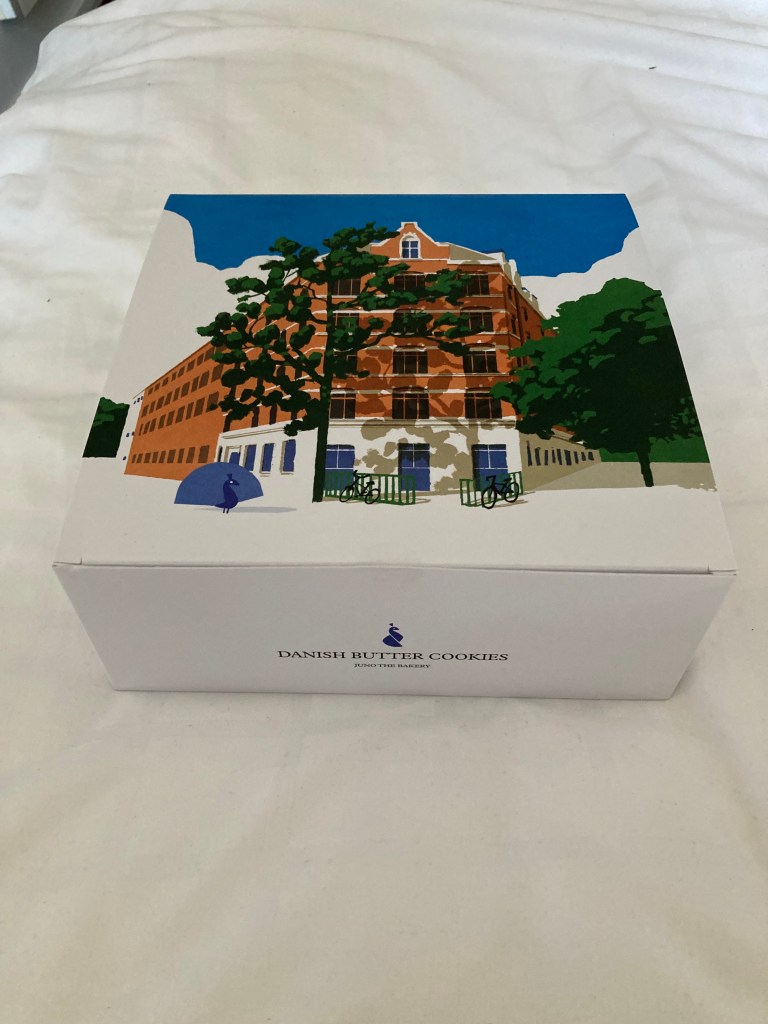
And truly, we were not disappointed. We selected around six pastries—each one different—and added a tin of their Danish butter cookies, along with coffee and a juice. The pastries were exquisite: flaky, delicate, deeply flavourful, and made with the kind of care you can taste. The butter cookie tin will also make a perfect souvenir once we’ve inevitably eaten every last crumb.
The photos that follow were taken at the bakery, capturing a little of the charm, the anticipation, and the quiet joy of finally experiencing Juno for ourselves.
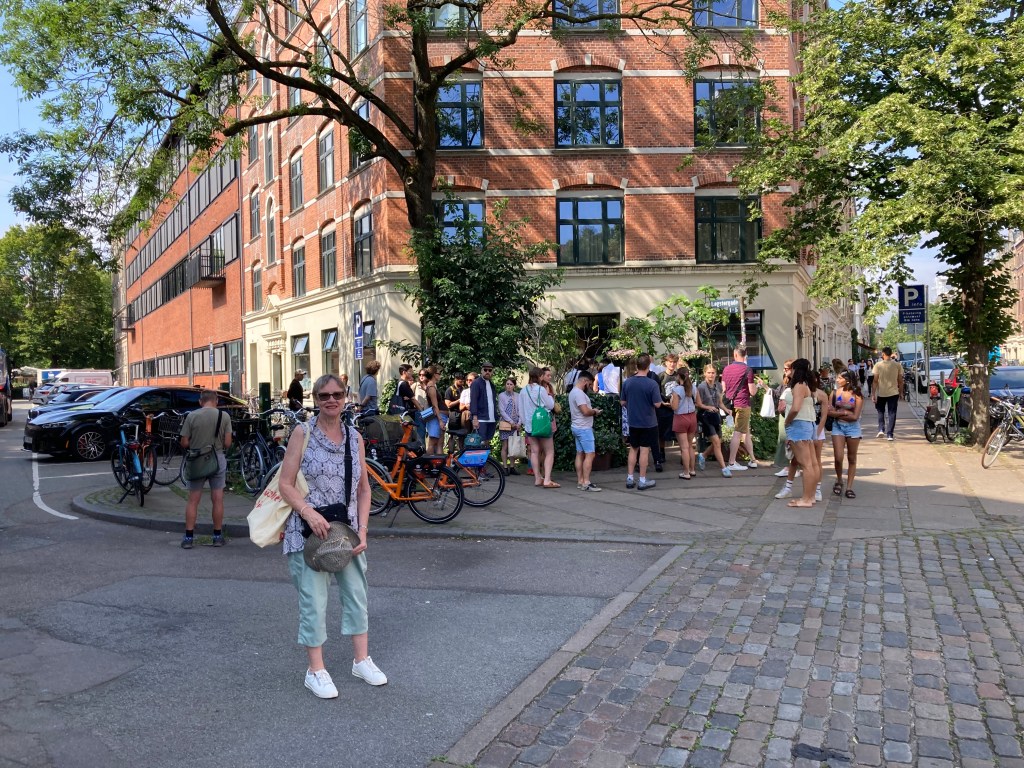
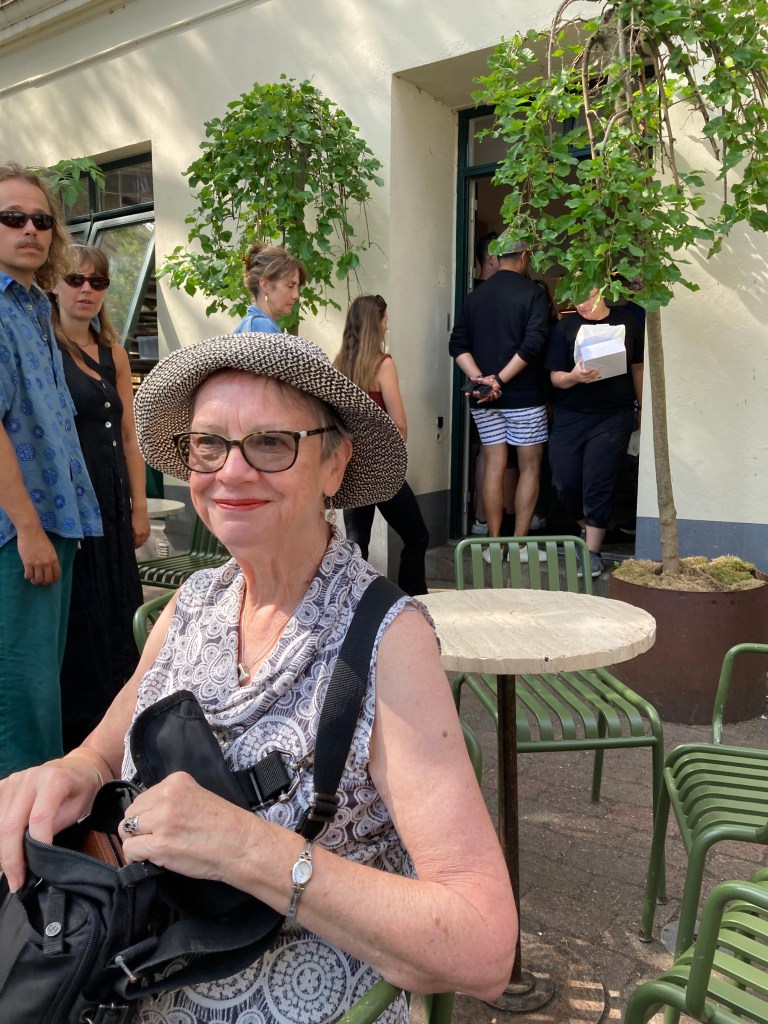
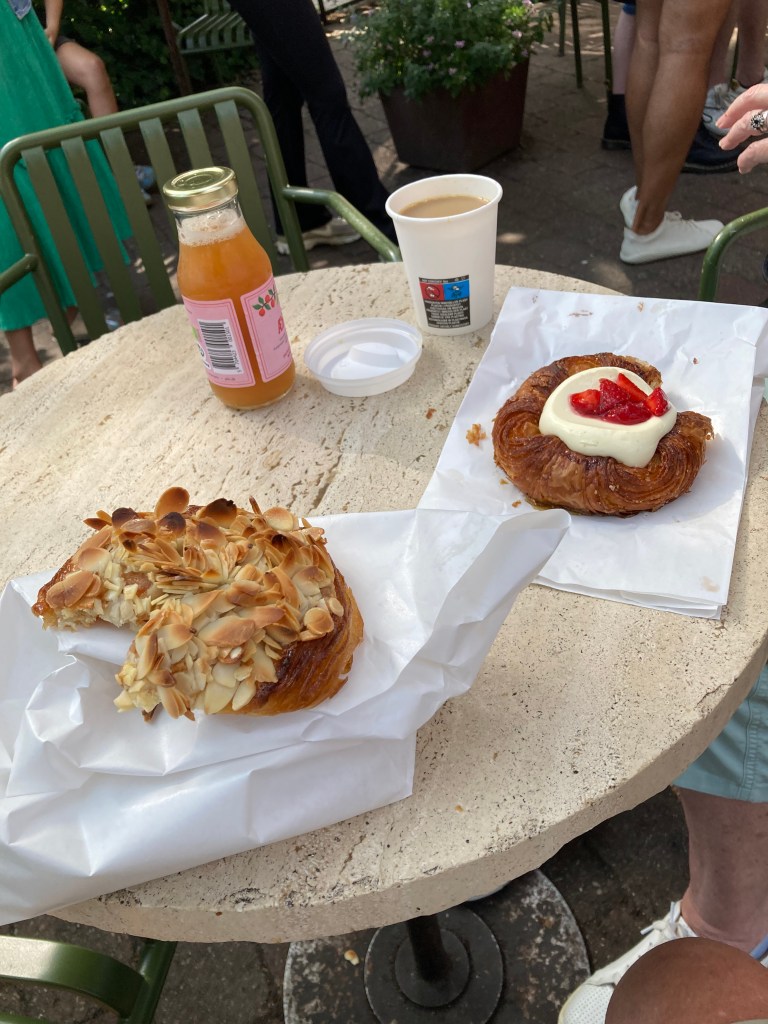
After devouring the pastries, it was time to move on to our next stop: the Little Mermaid. The walk from the bakery took about 30 minutes—just long enough to feel virtuous after all that buttery indulgence. When we arrived, we were genuinely taken aback by the sheer number of tourists clustered around the statue, cameras raised like it was a celebrity making a rare public appearance.
The contrast to my last visit in the 1980s was almost comical. Back then, I remember wandering up to the statue completely alone, no crowds, no selfie sticks, no tour buses idling nearby. Just me, the mermaid, and a very quiet Copenhagen morning. How times have changed.
A bit of background for context. The Little Mermaid is a bronze sculpture created by Danish artist Edvard Eriksen and unveiled in 1913. It was commissioned by Carl Jacobsen—the son of the founder of Carlsberg Brewery—after he became enchanted by a ballet based on Hans Christian Andersen’s 1837 fairy tale. The statue depicts the mermaid in the moment of transformation, caught between sea and land, perched on a rock along the Langelinie promenade. She’s famously small, deliberately understated, and yet somehow she has become one of the most recognisable symbols of Copenhagen.
Over the years she’s survived everything from vandalism to political protests, and still she sits there, gazing wistfully out to sea while thousands of visitors jostle for the perfect photo. Watching the scene today, it was hard not to smile. The poor mermaid hasn’t had a quiet moment in decades.
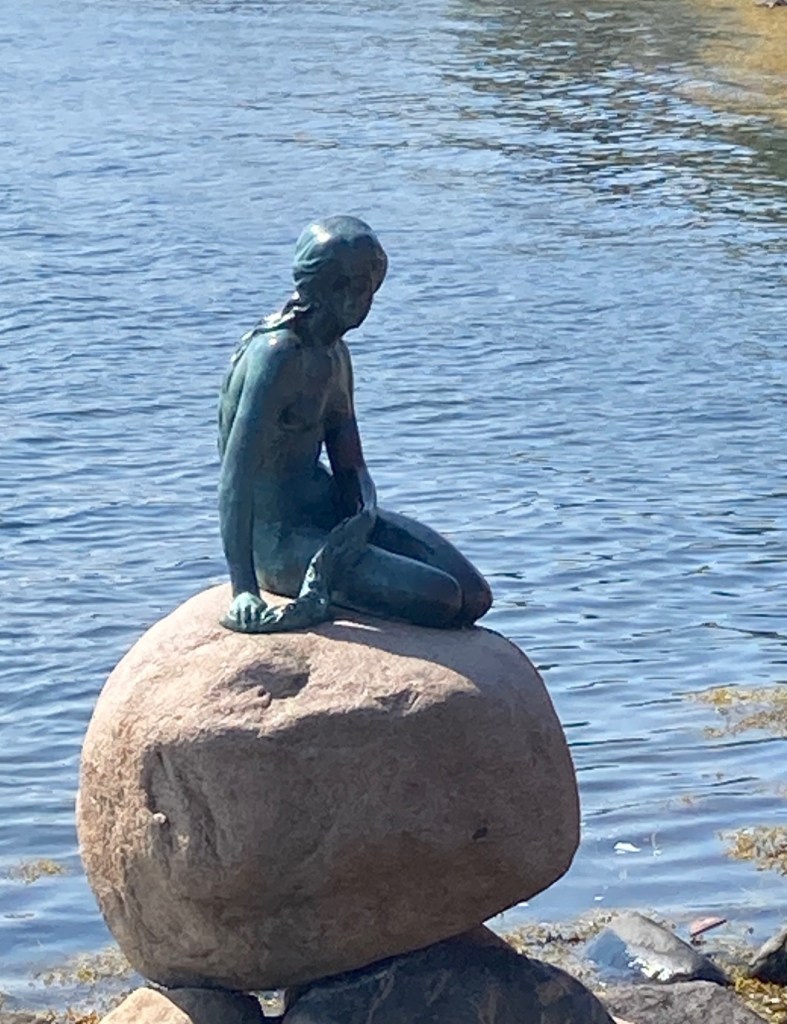
Saturday 19 July 2025
Today we headed off to Malmö in Sweden. Since it’s only about 45 kilometres from Copenhagen—roughly a 40‑minute train ride—it felt too close not to visit. Malmö has a handful of interesting sights, but we had one very particular destination in mind: the Disgusting Food Museum.
Once we arrived, we made our way straight there. The museum is exactly what the name promises, and yet far more fascinating than you’d expect. It showcases around 80 “disgusting” foods from around the world—everything from roasted guinea pig from Peru to Casu Marzu, the infamous Sardinian cheese containing live insect larvae, and of course Sweden’s own Surströmming. For the uninitiated, Surströmming is herring that has been fermented just enough to avoid rotting, resulting in a smell so potent that opening a can is considered an extreme sport. Naturally, the museum lets you experience that aroma firsthand. Lucky us.
What makes the museum genuinely interesting, though, is why it exists. It was created to challenge our assumptions about what is considered “normal” or “disgusting” when it comes to food. The founder, Dr. Samuel West, wanted to highlight how deeply cultural conditioning shapes our tastes. What one country sees as a delicacy, another sees as a dare. The museum’s goal is to spark curiosity, encourage open‑mindedness, and remind visitors that disgust is often just unfamiliarity wearing a dramatic costume.
Walking through the exhibits, you can’t help but laugh at your own reactions—one moment recoiling, the next thinking, “Well… maybe I’d try that.” It’s equal parts educational, entertaining, and mildly traumatic, but in the best possible way.
Following are some photos I took of the more “memorable” items—interesting, yes, but also undeniably disgusting. Consider this your warning and your invitation.
Habushu (also known as habu sake or habushu awamori)
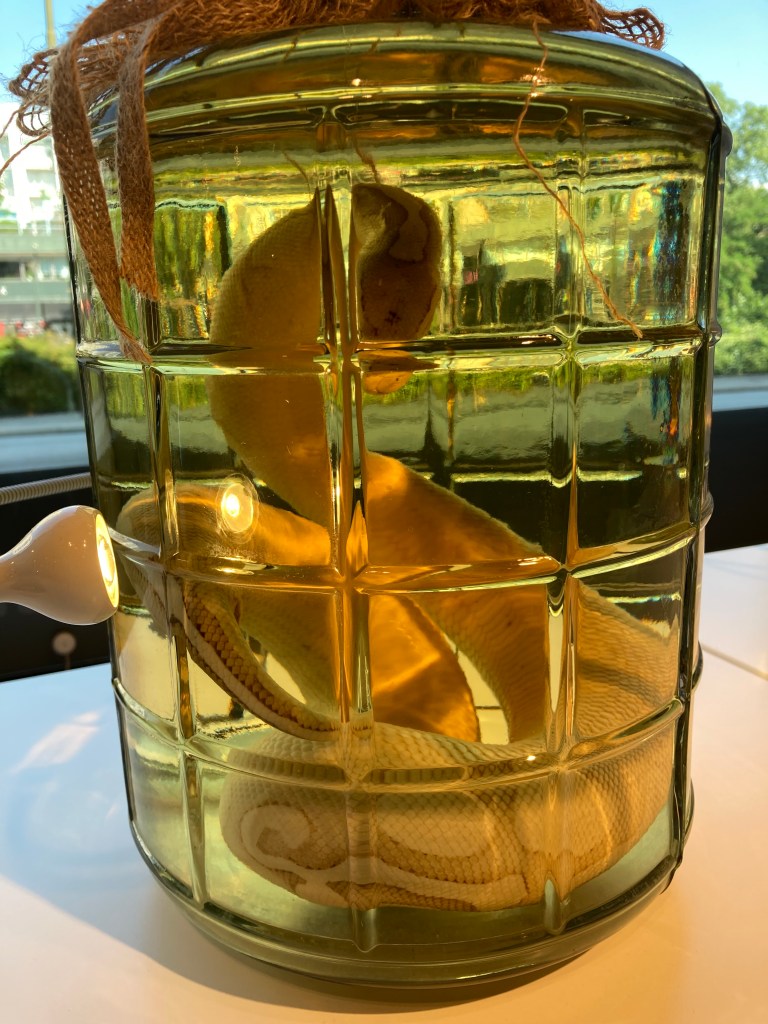
From there, the process becomes a kind of boozy preservation ritual. The snake is submerged in pure ethanol for about a month, which both sanitises and firms the body. After that, it’s transferred into a 59% alcohol mixture for another 40 days, and finally into a 35% awamori base, where it rests until it’s ready for consumption. Removing the intestines beforehand is thought to reduce the drink’s notoriously unpleasant smell, though “reduce” is a generous word.
This concoction is known as Habu sake (or habushu), a traditional Okinawan spirit. It’s believed to have aphrodisiac qualities and is often marketed as a health tonic, though its real appeal seems to lie in the shock factor and the centuries‑old belief that consuming the snake’s essence brings strength and vitality. Whether that’s true is debatable—but its reputation for being one of the world’s most visually confronting drinks is well‑earned.
KOPI LUWAK
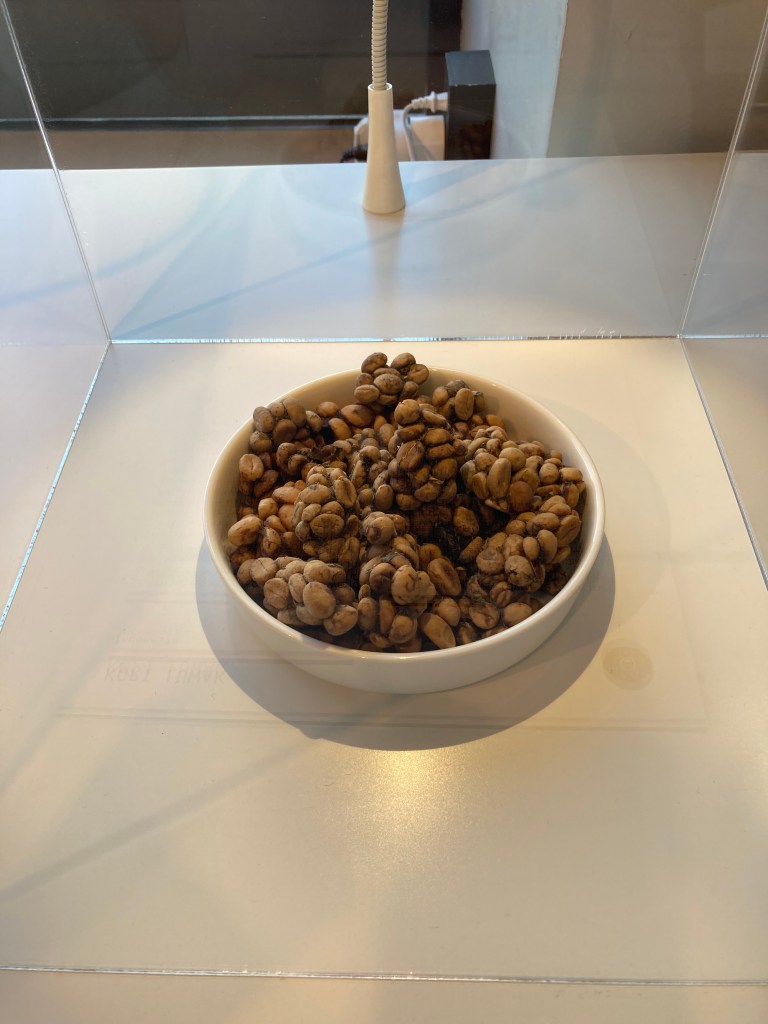
The origins of Kopi Luwak go back to the 19th‑century Dutch colonial period in Indonesia. Local farmers were forbidden from harvesting coffee for their own use, but they noticed that civets would sneak into plantations, eat the ripest cherries, and leave the beans behind. The farmers collected these discarded beans, cleaned them, roasted them, and discovered that the resulting coffee was surprisingly good—far smoother than the standard plantation brew. What began as an act of necessity eventually became a luxury.
Today, Kopi Luwak is often described as the rarest and most expensive coffee in the world, sometimes fetching up to EUR 3,000 per kilogram. Its scarcity, the labour involved, and the novelty factor all contribute to its price. It’s also become a subject of debate, as ethical concerns have been raised about the treatment of civets in some commercial operations. Authentic, ethically sourced Kopi Luwak—where the beans are collected from wild civets rather than caged ones—is extremely rare.
Whether you consider it a gourmet treasure or simply one of the world’s strangest beverages, there’s no denying that Kopi Luwak has one of the most memorable production stories of any food or drink on the planet.
HAKARL
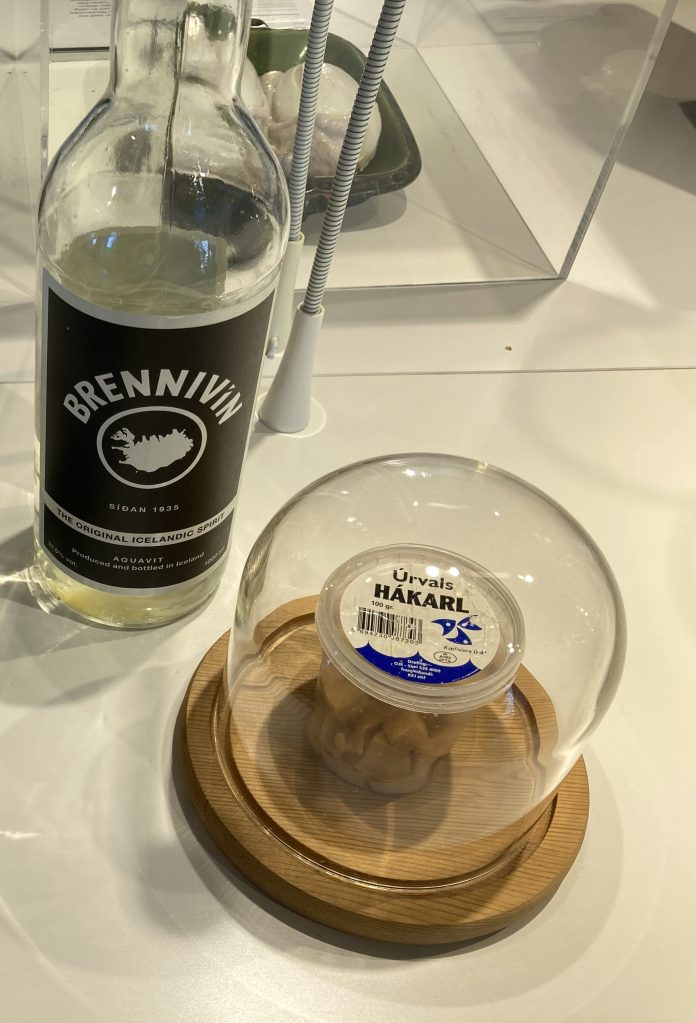
The shark is then covered with sand and stones and left to cure for anywhere from six to twelve weeks, depending on the season and temperature. During this time, the natural toxins break down through fermentation. Once the curing period is complete, the shark is dug up, cut into long strips, and hung in open-air drying sheds for several months. The cold Icelandic wind does the rest, slowly drying and further mellowing the flesh until it becomes the infamous delicacy known as hákarl.
Only after this long process is the shark finally cut into small cubes and served. The smell—an eye-watering mix of ammonia and decay—is often considered far worse than the taste itself. One writer famously described eating hákarl as “chewing a urine‑infested mattress,” which, while colourful, gives you a fair idea of the experience.
Despite its reputation, hákarl has deep cultural roots in Iceland. For centuries it was a vital source of protein in a harsh climate where little else was available. Today it’s more of a culinary curiosity—something brave visitors try once, photograph, and then politely decline a second helping.
Maree and I were actually served this fermented shark—along with a shot of Brennivín, Iceland’s famously potent schnapps—when we were travelling around Iceland in 2017. It was part of a traditional tasting menu at a local restaurant, the kind where the staff present each dish with great pride and a perfectly straight face, even when the plate contains something that smells like industrial-strength ammonia.
We both very politely declined to eat it, but we did lean in for a cautious sniff. That alone was enough. The aroma was so aggressively unpleasant that it felt like a physical event—sharp, sour, and instantly nauseating. The Brennivín, often called “Black Death,” is traditionally served to help wash the shark down, but in our case it would have been needed just to recover from the smell.
It was one of those travel moments you never forget: the kind where you’re grateful for the cultural insight, impressed by the bravery of anyone who eats it willingly, and absolutely certain that once in a lifetime is more than enough.
KIVIAK
The sealed bundle is then buried under a mound of rocks, with a heavy stone placed on top to keep the air out and ensure the fermentation process begins properly. Over the next three to six months, depending on the season, the birds slowly ferment inside the seal. This method was developed by Inuit communities as a way to preserve food through the long, brutal Arctic winter, when hunting could be impossible and fresh food scarce.
When the kiviak is finally ready, the seal is opened and the birds are removed. Traditionally, they’re eaten by biting off the head and sucking out the rich, fermented juices, which are considered the most flavourful part. The rest of the bird—now softened by months of fermentation—can be eaten whole, bones and all. The flavour is said to be intensely strong, somewhere between ripe cheese and game meat, with a smell that can be… challenging for the uninitiated.
It’s a dish deeply rooted in survival, tradition, and the resourcefulness of Arctic communities. And while it may not be for everyone, it remains an important part of Greenlandic cultural heritage.
The museum also keeps a running tally on a blackboard titled “Days Since Last Vomit.” It proudly displayed a 1 when we walked in… and had been reset to 0 by the time we left. I’m fairly certain I heard someone in the background losing their breakfast, which felt like the museum’s version of a five‑star review.
Despite its name, the museum is absolutely a “must‑do” if you ever find yourself in Malmö. It’s clever, funny, educational, and just the right amount of traumatising. At AUD 28 per person, it felt well worth the price—especially for the stories (and stomach‑turning memories) we walked away with.
From there, we headed to Dirty Taco for lunch, which we enjoyed immensely—surprisingly so, considering we’d just spent the morning sniffing some of the world’s most revolting foods. Dirty Taco is known for its playful, street‑food‑inspired menu, mixing bold flavours with a bit of attitude. It was exactly the palate reset we needed.
After lunch, we made our way to see the Non‑Violence sculpture, also known as The Knotted Gun. Created by Swedish artist Carl Fredrik Reuterswärd, the sculpture was made in response to the murder of John Lennon and has since become an international symbol of peace and non‑violence.
On the walk there, we stumbled across another striking artwork: the Optimistorkestern (The Optimist Orchestra). This whimsical bronze sculpture depicts a cheerful marching band of musicians, instruments in hand, striding forward with infectious enthusiasm. It’s one of Malmö’s most beloved public artworks—playful, full of character, and impossible not to smile at as you pass by.
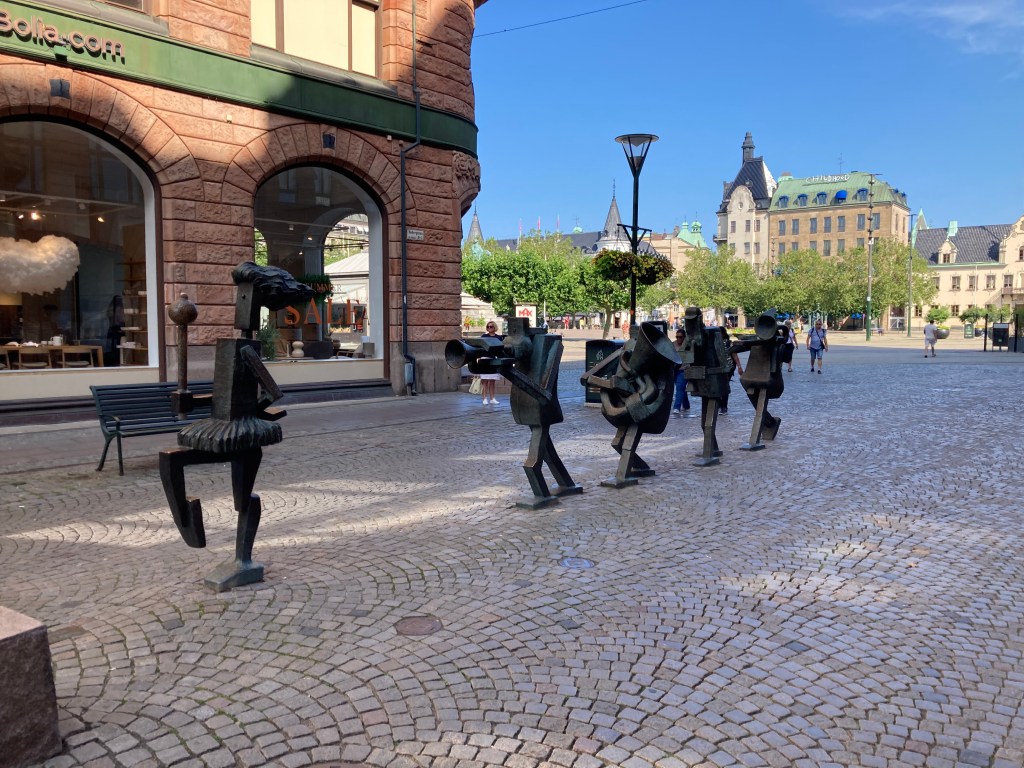
The Optimistorkestern is a wonderfully vibrant sculpture located along Södergatan, one of Malmö’s busiest pedestrian streets. Created in 1985 by the Swedish sculptor Yngve Lundell, it depicts a delightfully enthusiastic marching band—four musicians and their spirited conductor—striding forward with infectious energy. Lundell designed the piece as a celebration of optimism and forward momentum, and the result is a whimsical ensemble that feels almost like it has stepped straight out of a storybook.
The sculpture was installed to mark the pedestrianisation of Södergatan, symbolising the lively, people‑centred atmosphere the city hoped to create. Over the years, the Optimistorkestern has become one of Malmö’s most beloved public artworks, admired by locals and visitors alike for its humour, charm, and unmistakably upbeat spirit. It’s hard not to smile as you pass by—it captures the city’s creative personality perfectly.
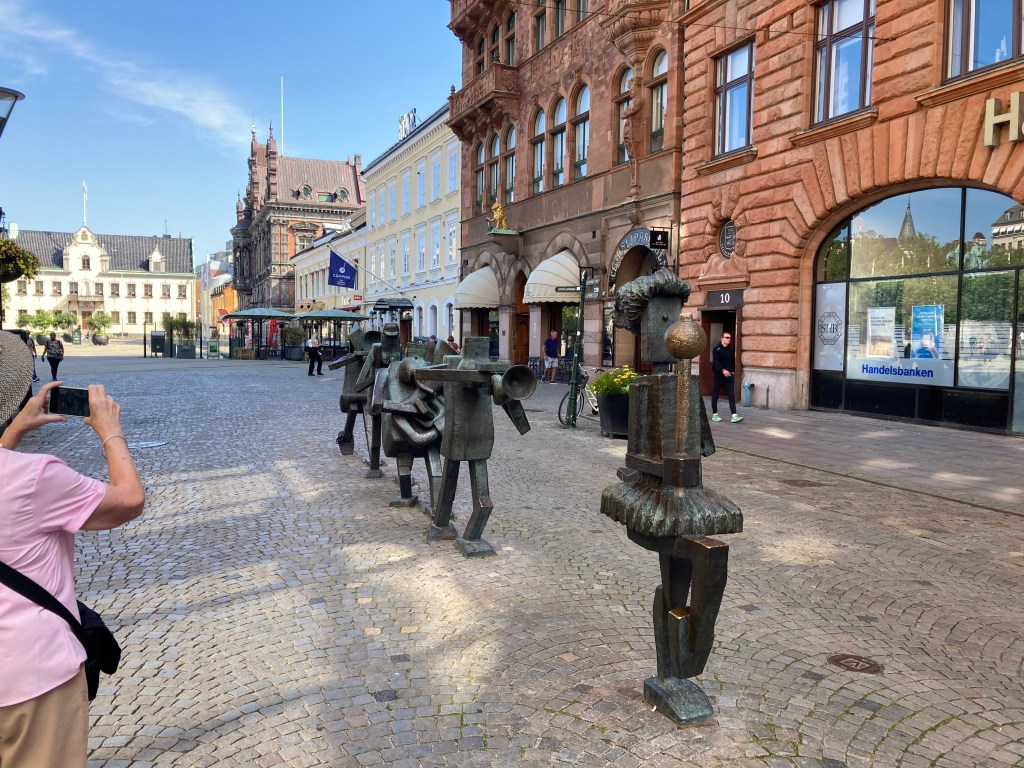
We then came across this statue of Charles X Gustav.
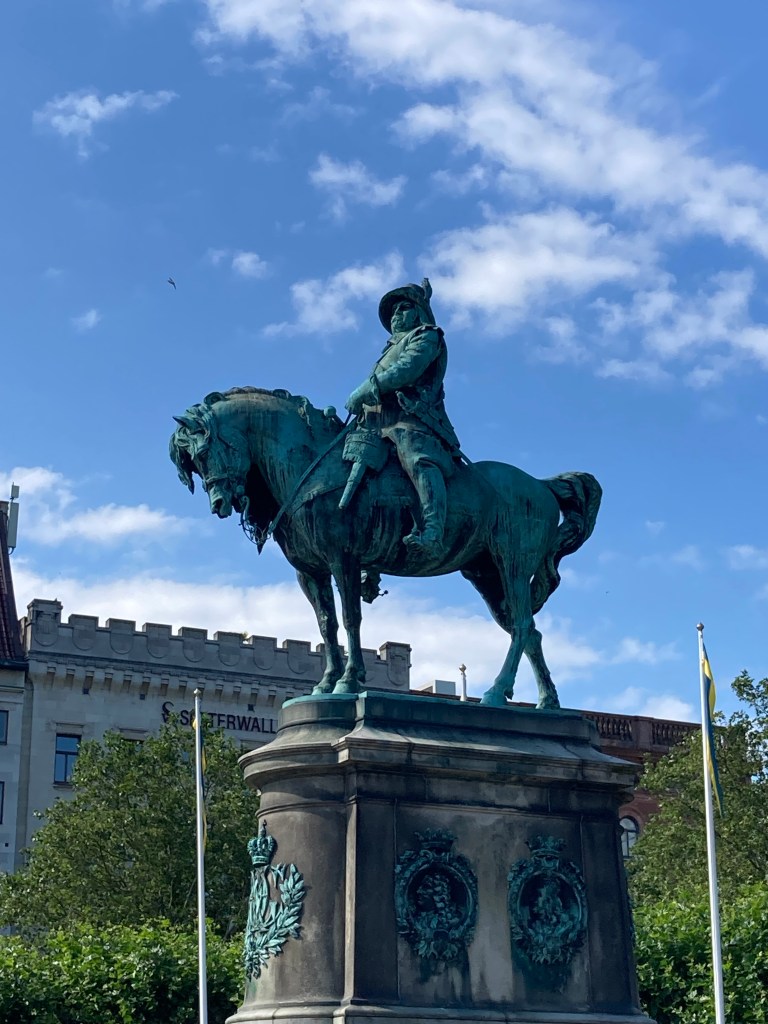
The horse’s unusually long mane is another symbolic detail, traditionally associated with nobility and distinction. The statue reflects a shift in artistic style during the late 19th and early 20th centuries, when sculptors began favouring more naturalistic, less militaristic portrayals of historical figures. Rather than glorifying conquest, this monument presents Charles X Gustav as a composed, almost contemplative leader.
It’s a fascinating contrast to the king’s actual legacy, which was anything but quiet—his reign was marked by ambitious military campaigns and territorial expansion. Yet here, in bronze, he appears serene, offering a gentler interpretation of a ruler better known for his forceful politics.
After a leisurely walk through the city, we eventually arrived at the Non‑Violence sculpture.
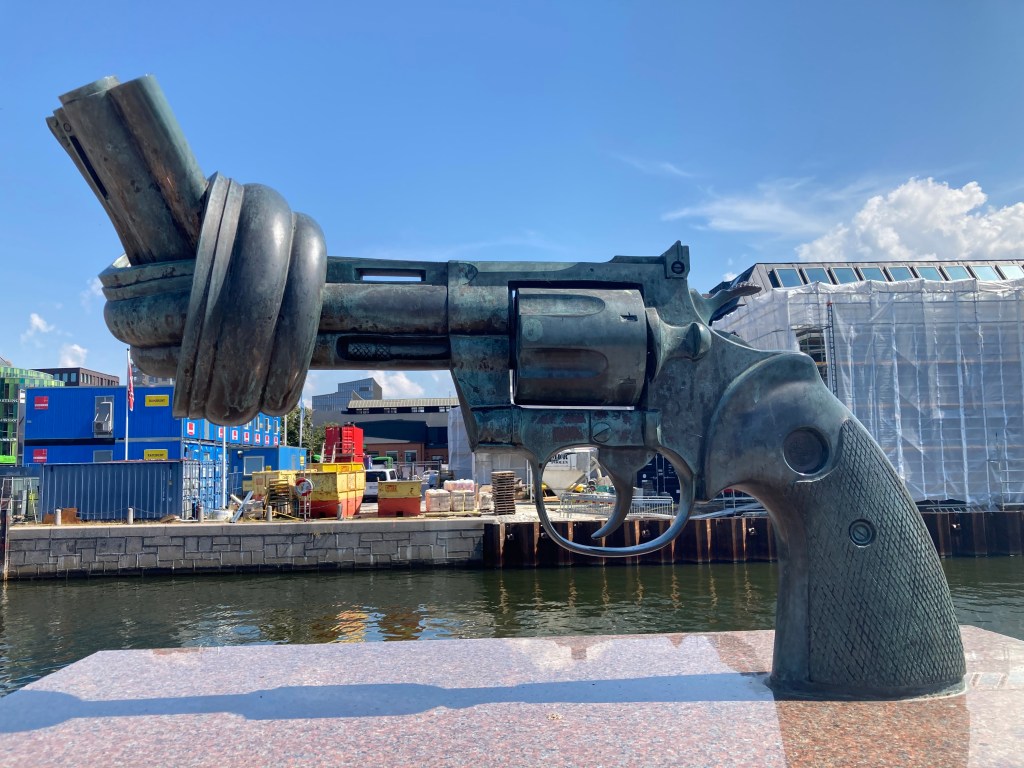
The first sculpture was placed outside the United Nations headquarters in New York, where it quickly became a global emblem of non‑violence and conflict resolution. Its message resonated so strongly that more than 30 replicas have since been installed around the world, each one reinforcing the same call for peace.
Malmö’s version stands near the central station, making it one of the city’s most visible public artworks. Set against the backdrop of daily commuters and travellers, it serves as a quiet but persistent reminder of the human cost of violence—and the hope that societies can choose a different path.
From there, it was only a short stroll to the railway station, where we boarded the next train for the quick journey back across the water to Copenhagen.
For dinner, Maree said she just wanted to wander around and see what we stumbled across. So that’s exactly what we did, and before long we found ourselves outside a pub with a rather quirky approach to dining. Their menu featured something we hadn’t seen before: “a meal in a can.” It was such an odd and intriguing idea that we couldn’t help but stop and take a closer look.
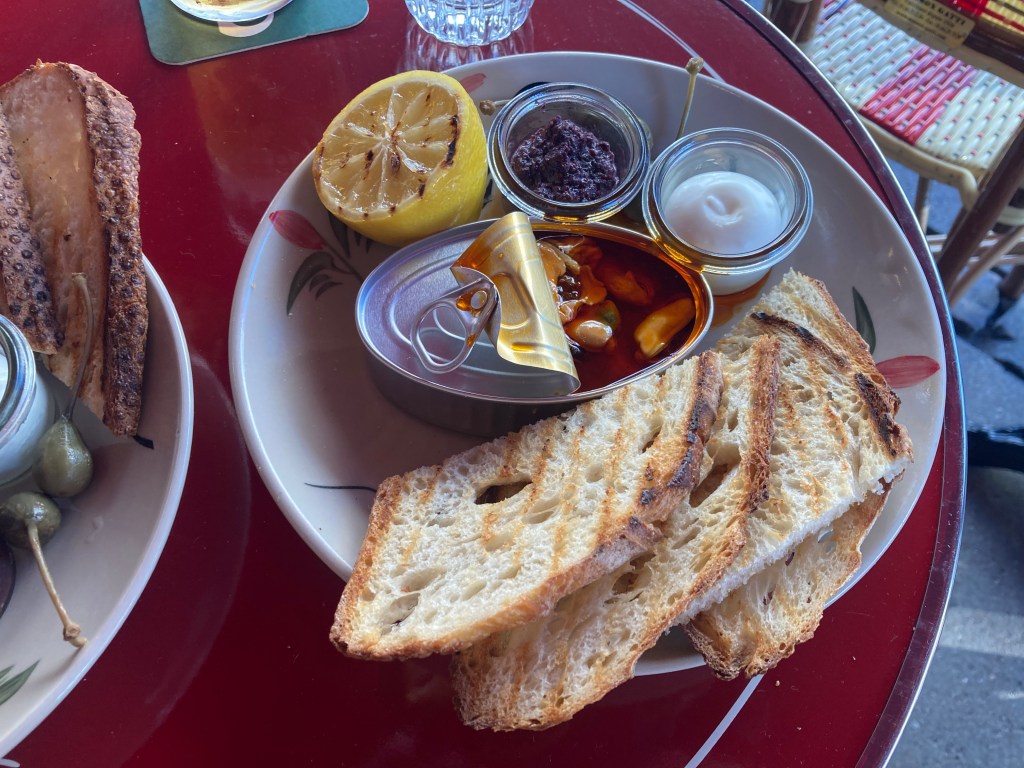
Each dish is prepared and cooked in its own can, sealed and heated to lock in flavour, almost like a rustic, modern take on tapas. When it’s ready, the chef opens the can just before serving, releasing a burst of aroma that feels far more gourmet than the humble container suggests. I ordered the mussels, and they were beautifully tender, infused with the broth they’d been cooked in. Simple, inventive, and genuinely delicious.
It’s the kind of quirky dining concept that makes travelling fun—unexpected, a little playful, and memorable enough that we both agreed we’d happily return.
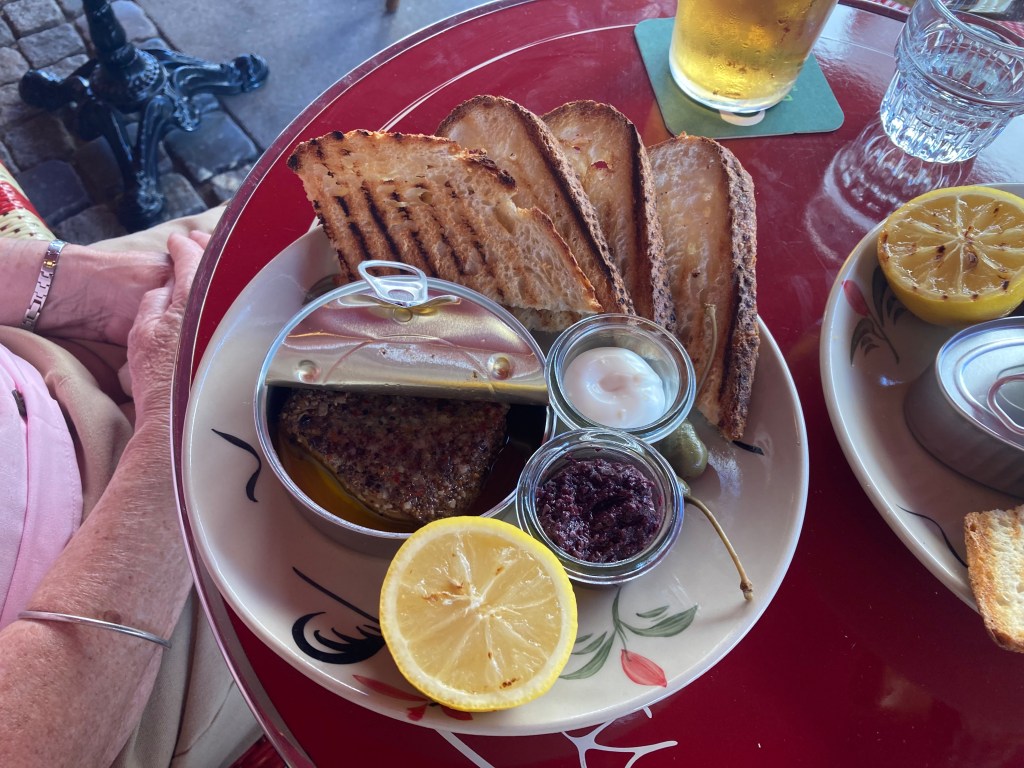
Maree ordered the peppered salmon, while I stuck with my mussels, and both dishes arrived with the same thoughtful accompaniments: thinly toasted bread, a generous scoop of olive tapenade, a small serving of mayonnaise, and half a lemon lightly grilled to bring out its sweetness. It was exactly the kind of simple, flavour‑forward meal we’d been hoping for after a long day of walking. The beers were excellent too—cold, crisp, and the perfect match for the food.
The pub itself is Belma, a cosy, unpretentious spot tucked along Istedgade 50 in 1650 København, right in the heart of Vesterbro. The neighbourhood is known for its mix of old‑school bars, creative eateries, and a lively street atmosphere, and Belma fits right in with its relaxed charm and inventive menu. Highly recommended.
Well it is time to sign off for another day. We hope you are enjoying following our travels.
Monday 21 July 2025
Today we headed off to Nyhavn, Copenhagen’s iconic 17th‑century waterfront district. The name literally means “New Harbour,” though it has long since become one of the city’s most historic and atmospheric areas. Originally constructed between 1670 and 1673 under King Christian V, Nyhavn served as a busy commercial port where ships from around the world docked, sailors drank in the taverns, and merchants traded goods along the canal. The colourful townhouses that line the water today were once the homes of traders, ship captains, and craftsmen.
Nyhavn also has a strong literary connection. The famous Danish author Hans Christian Andersen lived here for many years, moving between several addresses along the canal. It was in these very buildings that he wrote some of his most beloved fairy tales, including The Princess and the Pea and The Tinderbox. His presence is still felt in the area, with plaques marking the houses where he lived and cafés proudly referencing his legacy.
Today, Nyhavn is a lively mix of restaurants, bars, and cafés, with its brightly painted facades reflected in the canal and historic wooden ships moored along the quay. Despite its popularity with tourists, it still manages to feel charming and full of character—a place where history, culture, and everyday life blend effortlessly.
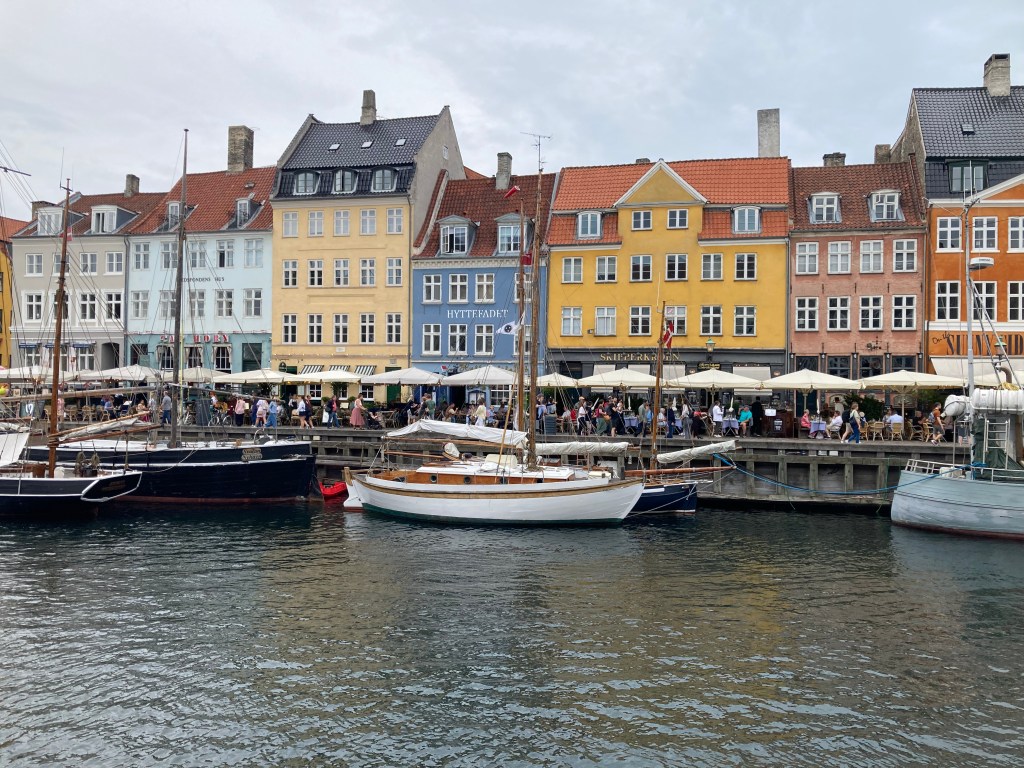
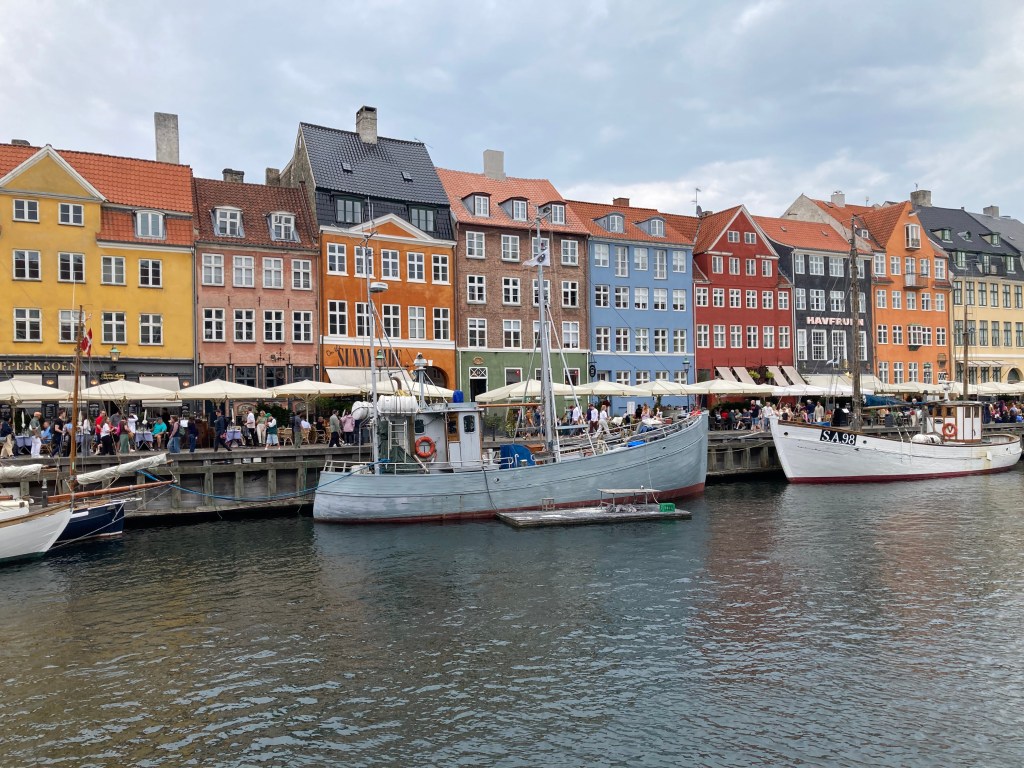
The house pictured is one of the former residences of Hans Christian Andersen in Nyhavn. A plaque on the façade marks his time living here, noting that he stayed in this building while writing some of his early fairy tales in the 1830s. Andersen lived at several different addresses along Nyhavn over the years, and these colourful canal‑side homes played a significant role in his life during one of his most creative periods.
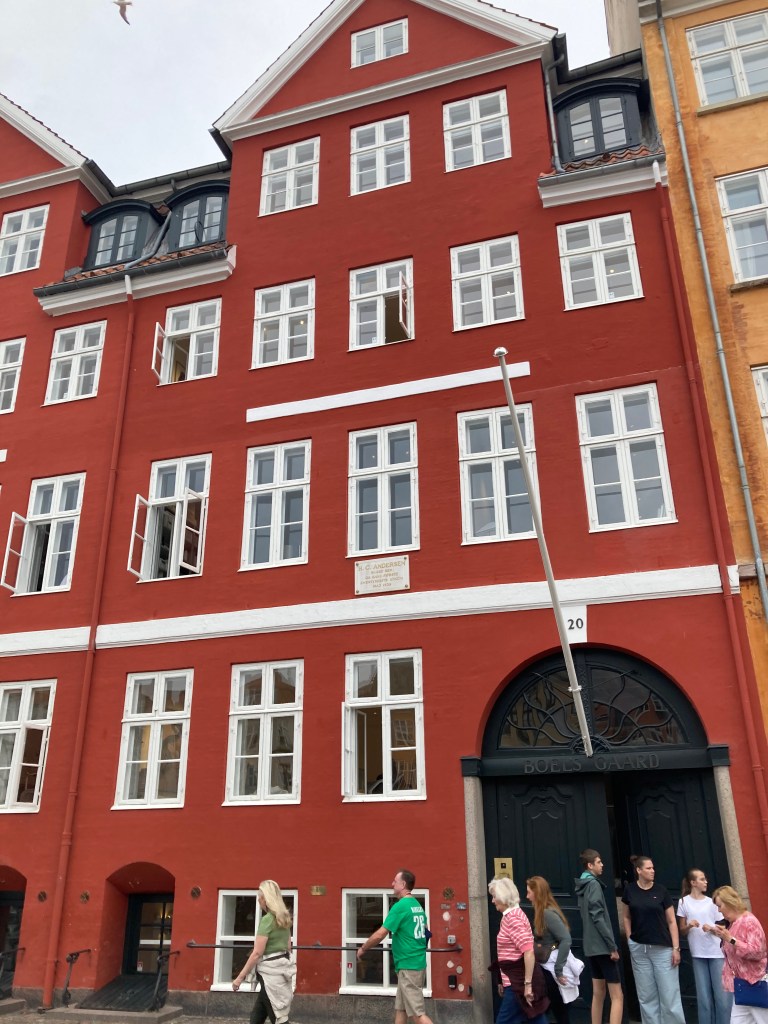
Hans Christian Andersen (2 April 1805 – 4 August 1875) was a remarkably versatile Danish writer whose work spanned plays, travelogues, novels, and poetry. Yet it is his literary fairy tales that secured his place in cultural history. Across nine volumes, Andersen wrote 156 stories, and these have since been translated into more than 125 languages, making him one of the most widely read authors in the world.
His tales operate on multiple levels: enchanting and accessible for children, yet layered with themes of virtue, resilience, longing, and human frailty that resonate deeply with adult readers. Many of his most famous works—The Emperor’s New Clothes, The Little Mermaid, The Nightingale, The Steadfast Tin Soldier, The Red Shoes, The Princess and the Pea, The Snow Queen, The Ugly Duckling, The Little Match Girl, and Thumbelina—have become woven into Western cultural memory.
Andersen’s influence extends far beyond the printed page. His stories have inspired ballets, operas, stage plays, and countless film adaptations, both animated and live‑action. More than a century after his death, his imaginative worlds and moral insights continue to shape storytelling across the globe.
After wandering the streets and admiring the historic houses, we joined a canal cruise that took us through the waterways of Nyhavn. It was a relaxing way to see the district from a different angle, gliding past colourful façades, old wooden ships, and the lively quayside cafés that give the harbour its charm. The photos that follow were taken during this cruise.
Because the tide was higher than usual, many of the bridges we passed under were remarkably low—low enough that everyone instinctively ducked, even when we technically didn’t need to. It added a bit of fun (and a few nervous laughs) to an otherwise peaceful ride through one of Copenhagen’s most iconic areas.
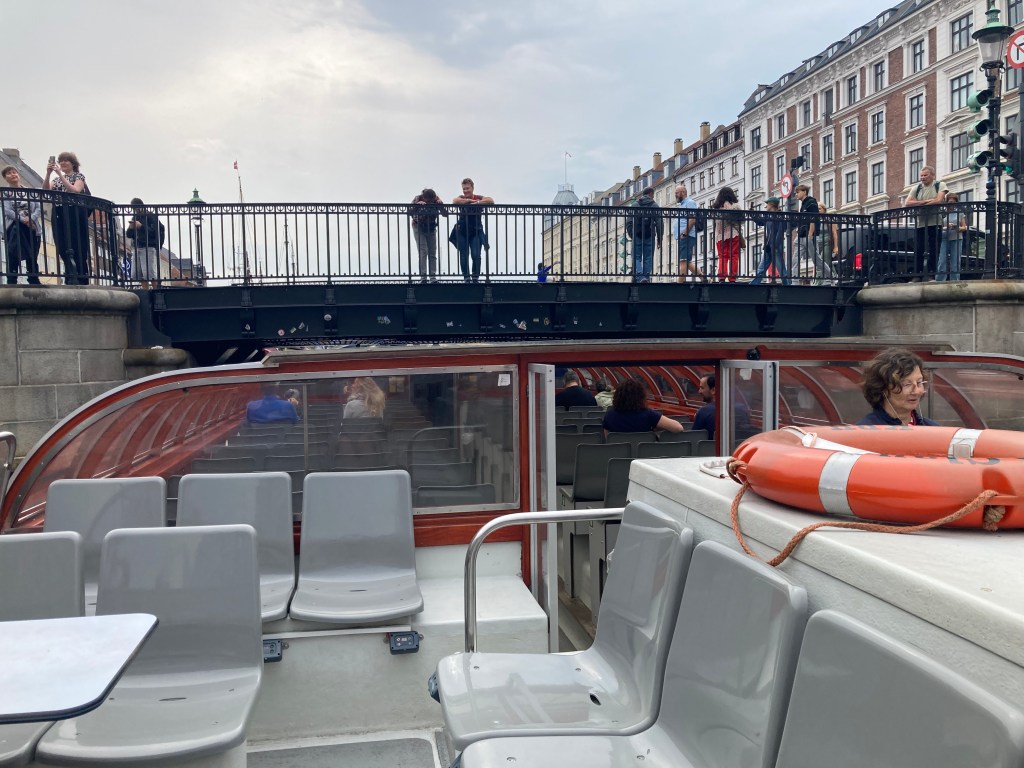
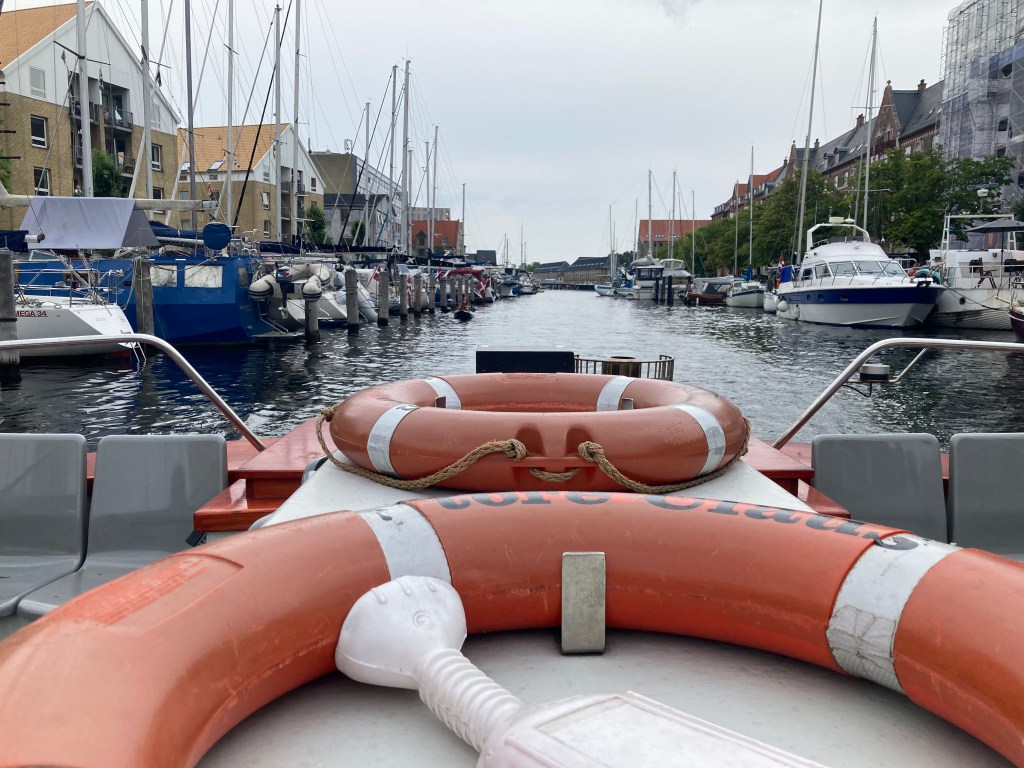
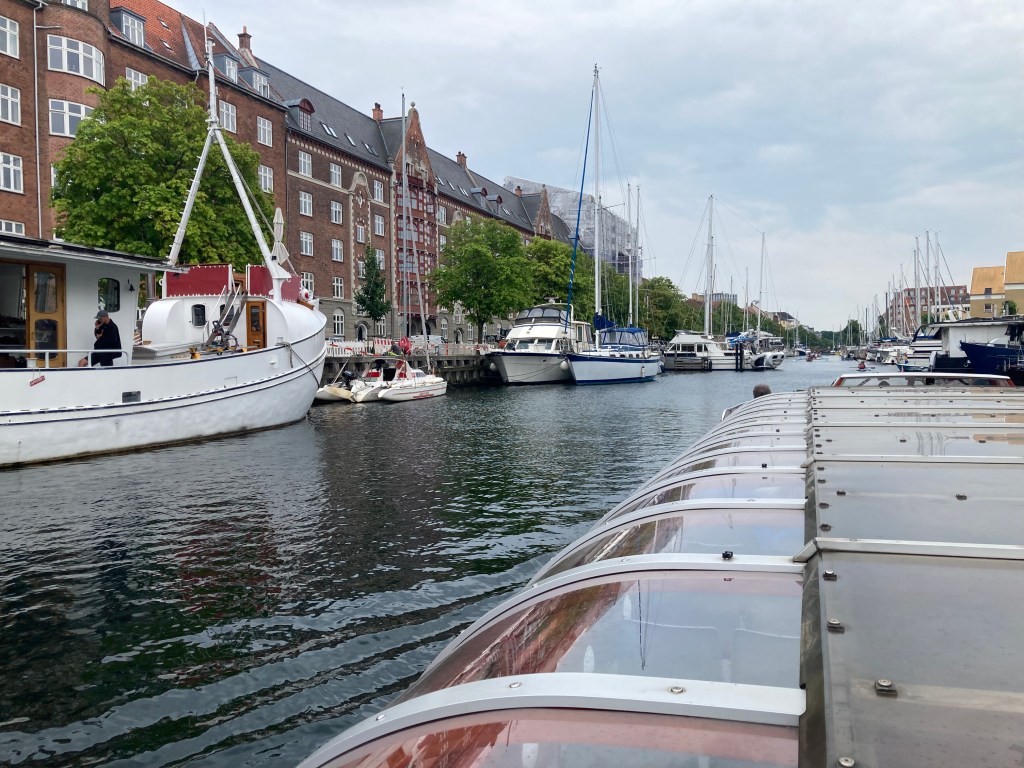
Nyhavn’s canals are wonderfully picturesque, and the cruise offered a fascinating way to appreciate the area from the water.
Tonight we had pizza at a local restaurant called DEJ, a cosy neighbourhood spot known for its creative sourdough bases and relaxed street‑side seating. The tables spill out onto a narrow footpath, which means everyone walking past slows down—sometimes subtly, sometimes not—to sneak a look at what diners are eating. It makes for great people‑watching, something Maree always enjoys.
Our waitress happened to be from Iceland, which gave us a lovely chance to chat and reminisce about our own trip there back in 2017. It added a personal touch to an already enjoyable evening.
Sitting outside DEJ on that narrow footpath, watching the world drift by, turned out to be the perfect way to end the night.
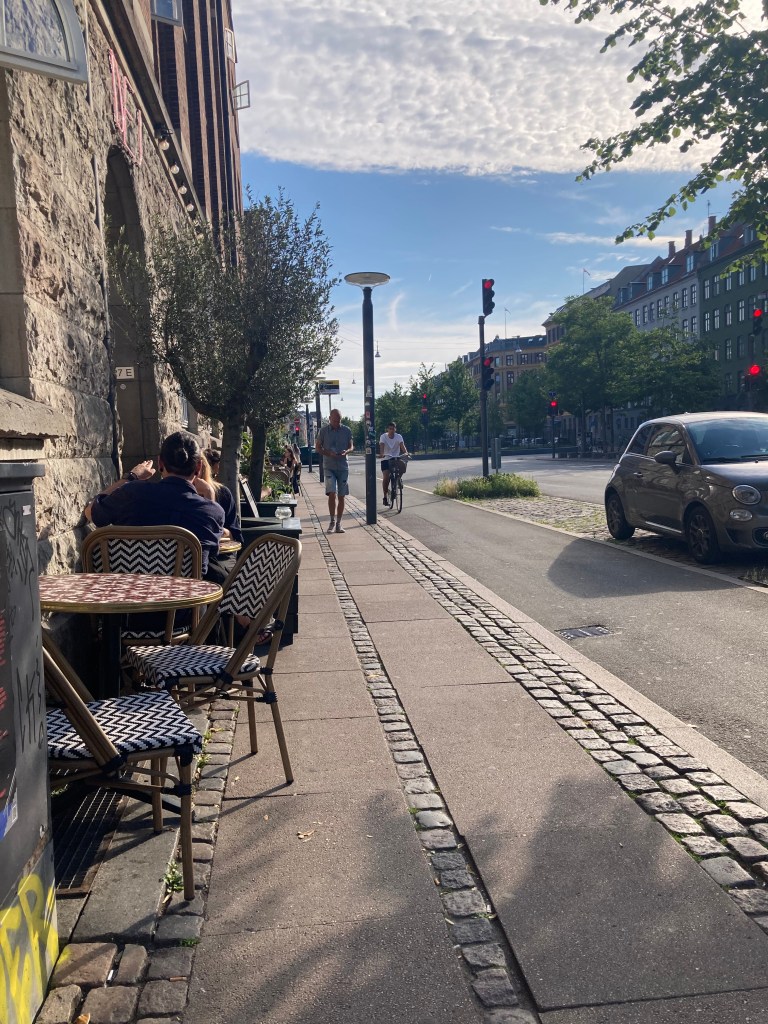
This photo shows only the last third of our large bruschetta entrée—because, once again, we forgot to take a picture before diving in. Sorry, Alex… clearly we’re still not in your league when it comes to food photography. The pizza was enormous as well, and yes, we managed to forget that photo too.
Some habits die hard, especially when the food is this good.
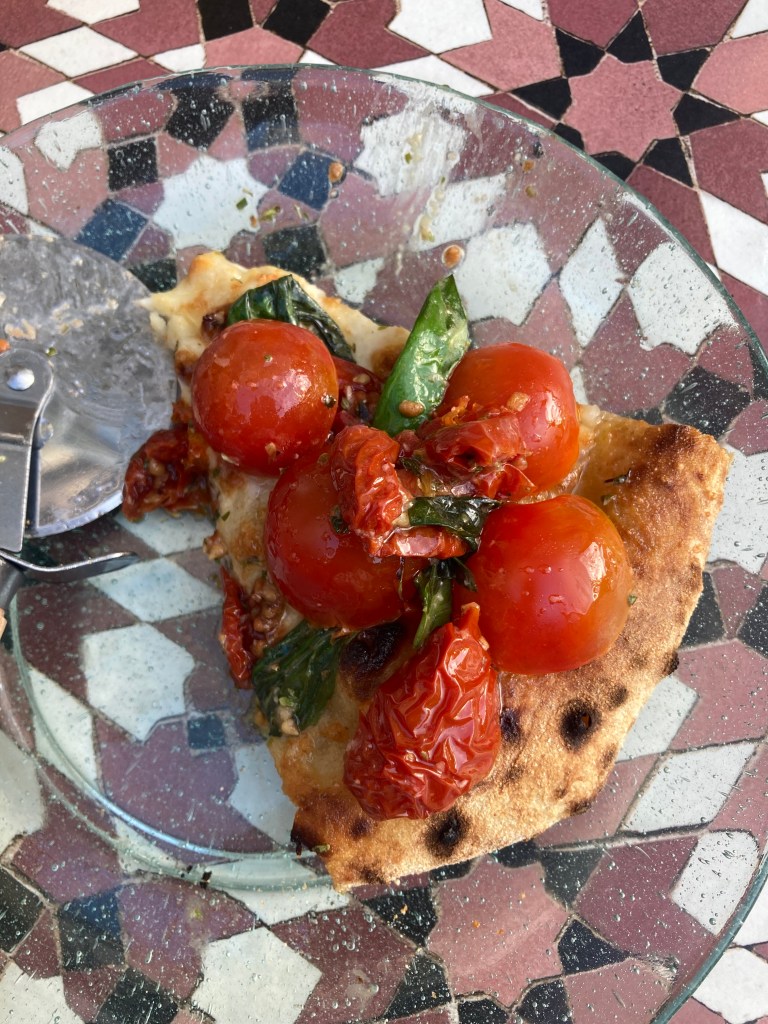
Maree is looking toward me for the camera, though she’s clearly keeping one eye on the steady stream of people passing by. Still, it turned out to be a lovely photo of her.
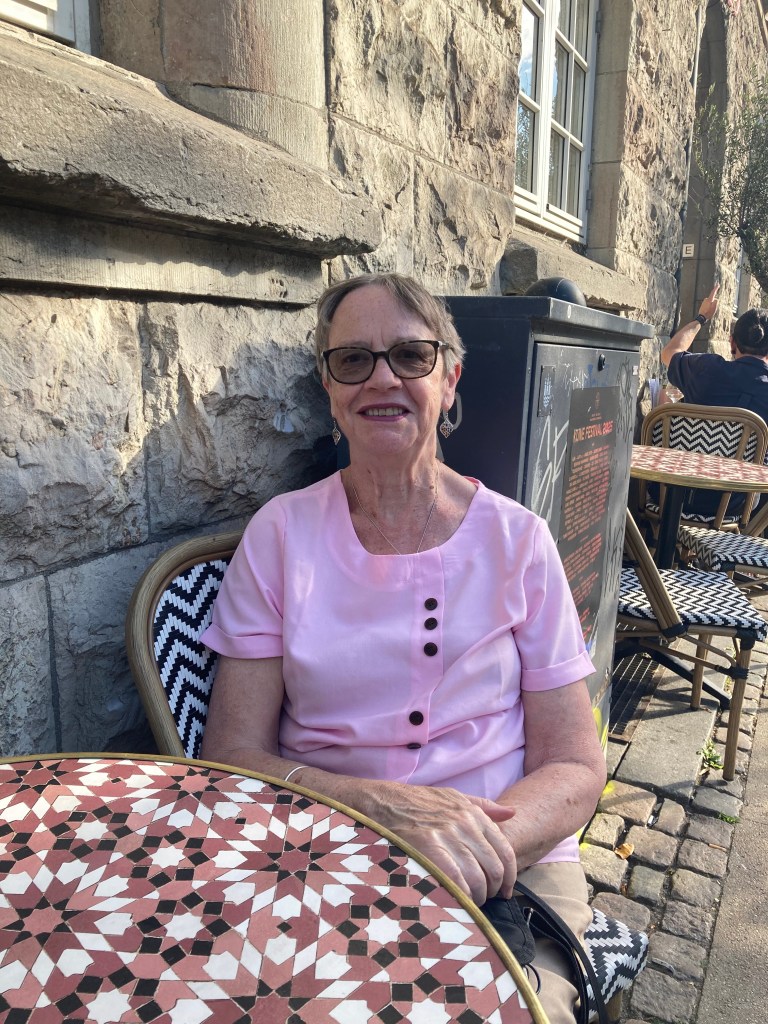
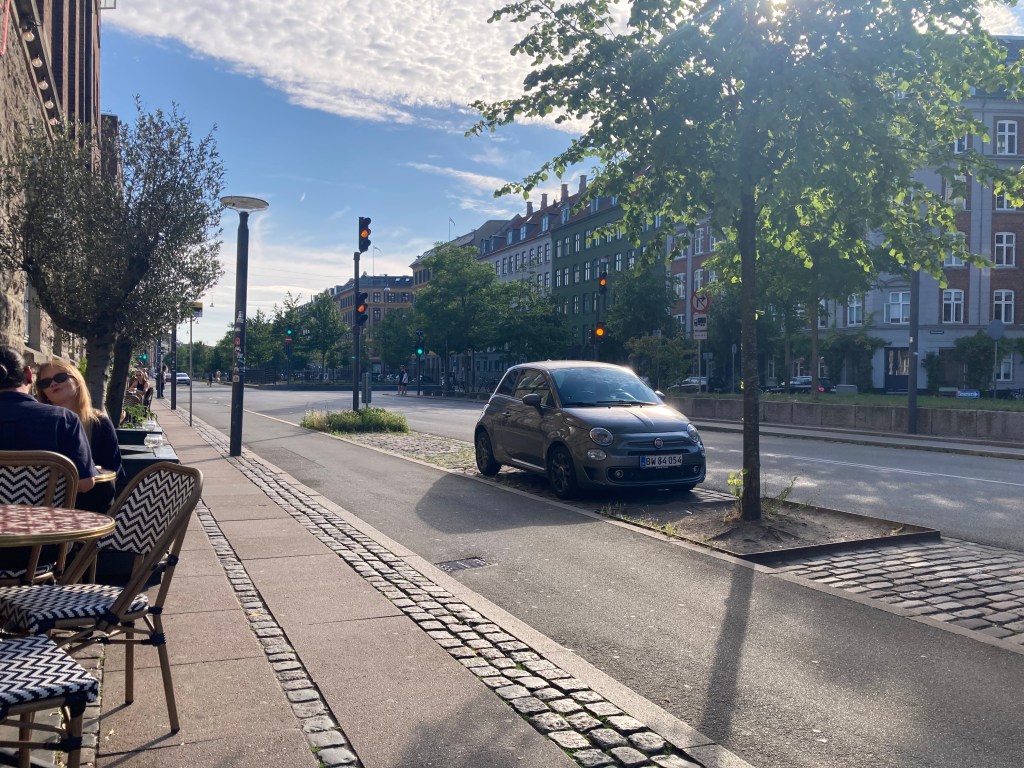
After dinner, we took a leisurely walk back to the hotel, enjoying the calm of our final evening in Denmark. Tonight marks our last night here, as tomorrow we board the high‑speed train bound for Berlin, travelling via Hamburg. It will be a new chapter in the trip, and we’re looking forward to spending the next three nights exploring Germany’s capital.
Tuesday 22 July 2025
This morning we left Copenhagen and began our journey to Berlin. Fortunately, the Danish rail network had finished the track work on the tunnel between Nyborg and Slagelse—a welcome relief after our previous experience, when we had to transfer to a bus at Nyborg to reach Slagelse before continuing on to Copenhagen. That chaotic transfer is not something we were eager to repeat.
The route from Copenhagen to Berlin runs via Hamburg, with the first leg taking about five hours. There’s no bistro car on this train, so we came prepared and bought food yesterday to enjoy onboard. The train departed at 10:00 and rolled into Hamburg right on time at 15:00.
Our carriage had the old‑style six‑seat compartments—three seats facing three. On this trip there were only four of us, joined by two fellow travellers: one from Switzerland and the other from England. It made for a pleasant journey, with easy conversation carrying us most of the way to Hamburg.
At Hamburg we had a 30‑minute wait before boarding our ICE service to Berlin. This particular train had started its long journey in Kiel and would eventually continue all the way to Munich. When we travelled up to Copenhagen earlier in the trip, we crossed the Kiel Canal on an impressive iron bridge; that crossing isn’t far from the town of Kiel itself, which sits further downstream.
Because this ICE service runs for nearly nine hours, it includes a full restaurant car offering everything from snacks to proper meals. We settled in for the two‑and‑a‑half‑hour ride to Berlin—after first picking up two 250 ml bottles of German Pinot Grigio from the restaurant car. With the wine in hand and the countryside flashing past at 230 kph, it was an easy and enjoyable trip into the German capital.
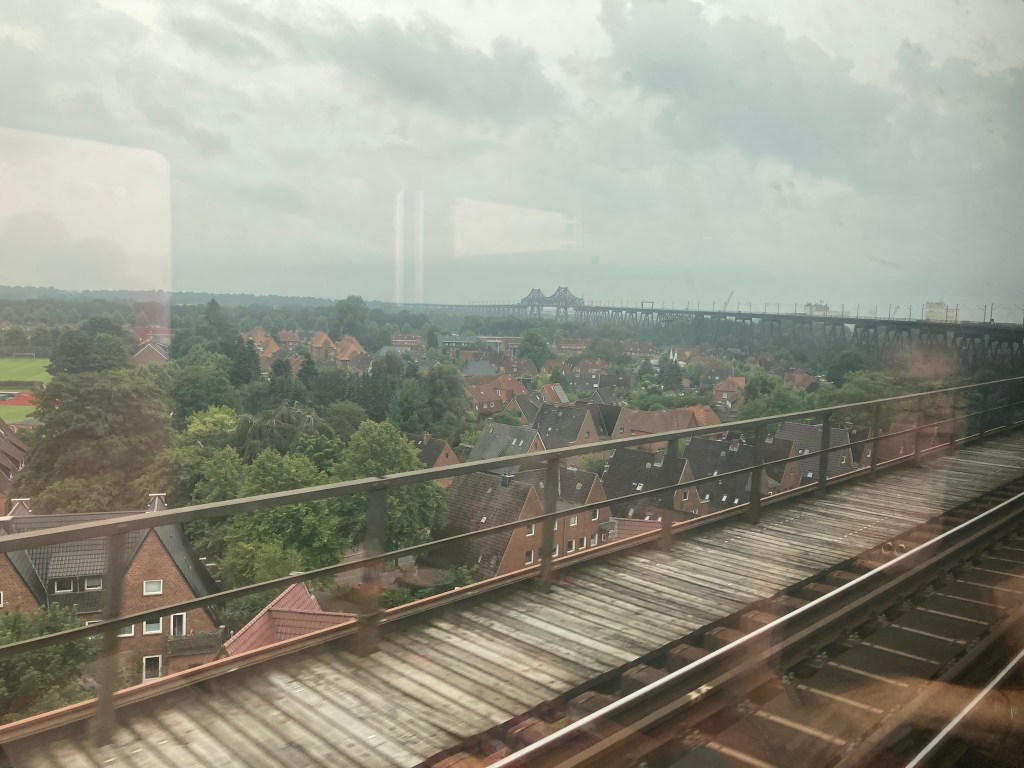
After an easy, uneventful trip, we checked into the ibis Berlin Hauptbahnhof, a modern, no‑nonsense hotel just a few minutes’ walk from the central station. It’s the kind of place that does exactly what you need after a travel day—clean rooms, quiet corridors, and a location that makes exploring Berlin almost effortless.
We barely made it to the front door on our way out for dinner when the skies opened and a heavy downpour chased us back under the awning. With no hope of staying dry, we dashed next door to Peter Pane, the burger restaurant conveniently attached to the hotel. It’s part of a well‑known German chain that prides itself on gourmet‑style burgers, creative sides, and a surprisingly polished atmosphere for something so ubiquitous.
Dinner turned out to be an unexpectedly great choice: the burgers were genuinely delicious, the service warm, and the Pinot Grigio we ordered was exactly what we needed to wash it all down. A cosy, rain‑soaked evening made better by good food and the luck of having it right next door.
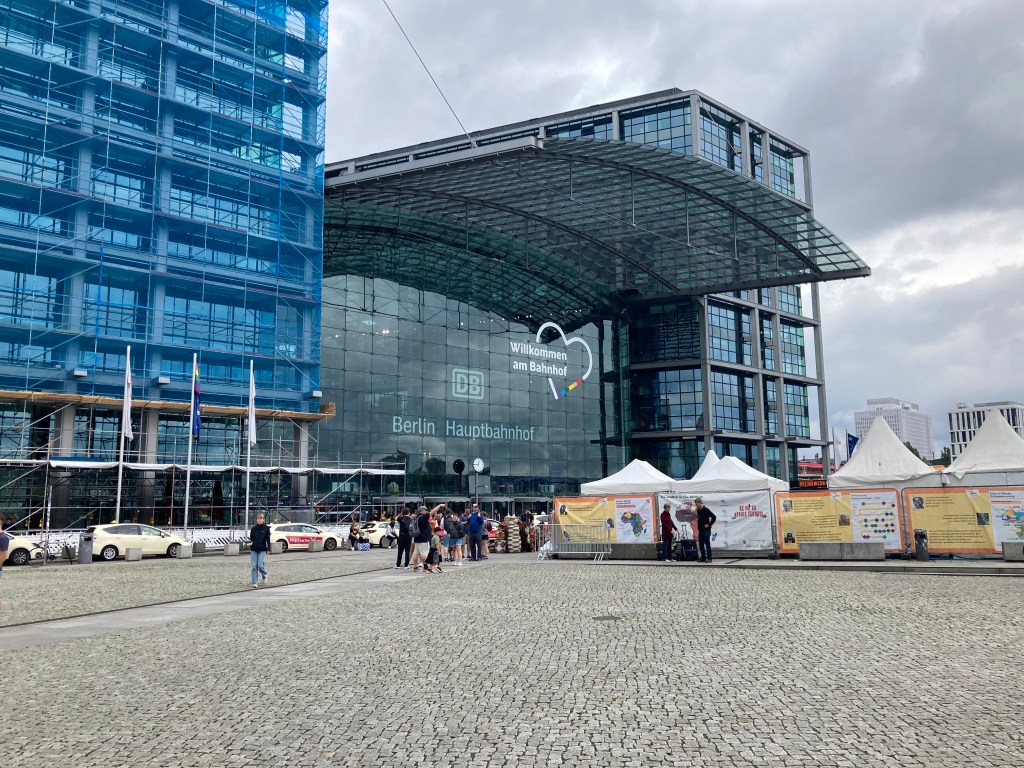
Wednesday 23 July 2025
Today we spent the day exploring the Berlin Wall Memorial, walking through the preserved sections, open grounds, and historical displays that trace the story of the divided city.
Berlin Wall memorial Background obtained from the site.
In the heart of Germany’s capital, the Berlin Wall Memorial stands as the central site commemorating the decades of division that shaped the city and its people. Set along Bernauer Strasse, a street loaded with history, the memorial stretches for 1.4 kilometres across what was once part of the fortified border strip. When the Wall went up in 1961, everyday life on this street was violently interrupted—families, neighbours, and friends were separated overnight, and the scars of that moment are still visible today.
This is the only location in Berlin where a section of the Wall has been preserved in its full depth, allowing visitors to see the layered structure of the border as it appeared in the late 1980s: the outer wall, the death strip, the patrol road, the inner wall, and the watchtowers that once loomed over it all.
The sealing of the border on 13 August 1961 transformed Bernauer Strasse into one of the most dramatic frontlines of the divided city. Residents suddenly found themselves living on the edge of two political systems. Some attempted desperate escapes by jumping from the windows of buildings that opened directly into West Berlin—acts that were filmed and broadcast around the world. A few succeeded; many paid with their lives. Through no choice of their own, the people of this street became unwilling participants in a defining chapter of post‑war German history.
Today, the memorial spans both sides of Bernauer Strasse. On the former East Berlin side lies the outdoor exhibition, tracing the story of division through the lens of this neighbourhood. The site also includes the memorial to the victims of communist tyranny and the Window of Remembrance, honouring those who died trying to cross the border. Nearby, the exposed foundations of a former apartment block reveal how the building’s façade once formed part of the Wall itself until its demolition in the early 1980s.
Across the street, in what was West Berlin, stand the Visitor Centre and the Documentation Centre, complete with a viewing platform overlooking the preserved border strip. We also visited the exhibition Border Stations and Ghost Stations along Transit Lines in Divided Berlin at Nordbahnhof S‑Bahn station, which explains how the Wall disrupted the city’s transport network—turning once‑busy stations into sealed, silent “ghost stations” for nearly three decades.
Following are the photos we took as we walked through the site. Some of the images include historical panels; you may need to expand them to read the inscriptions clearly.
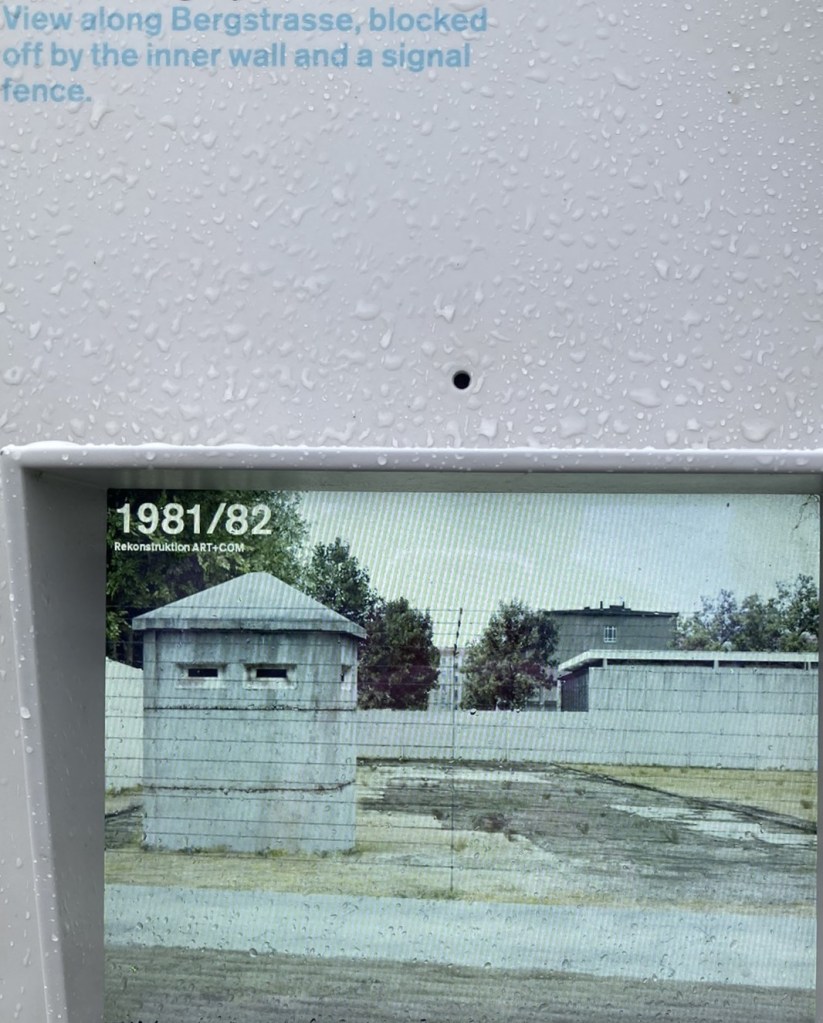
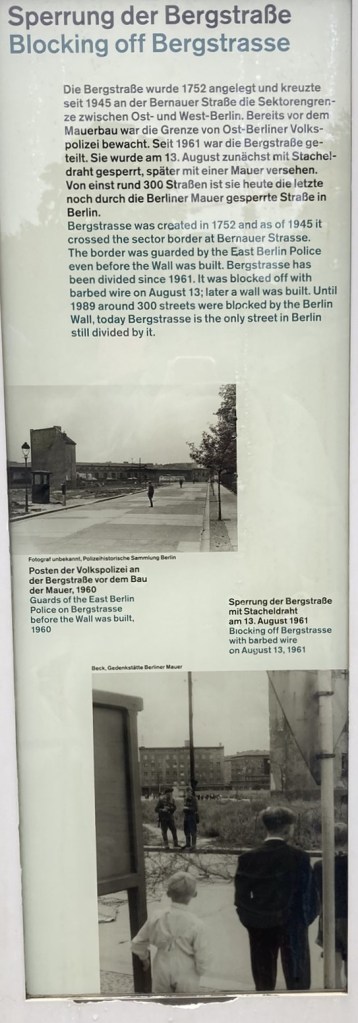
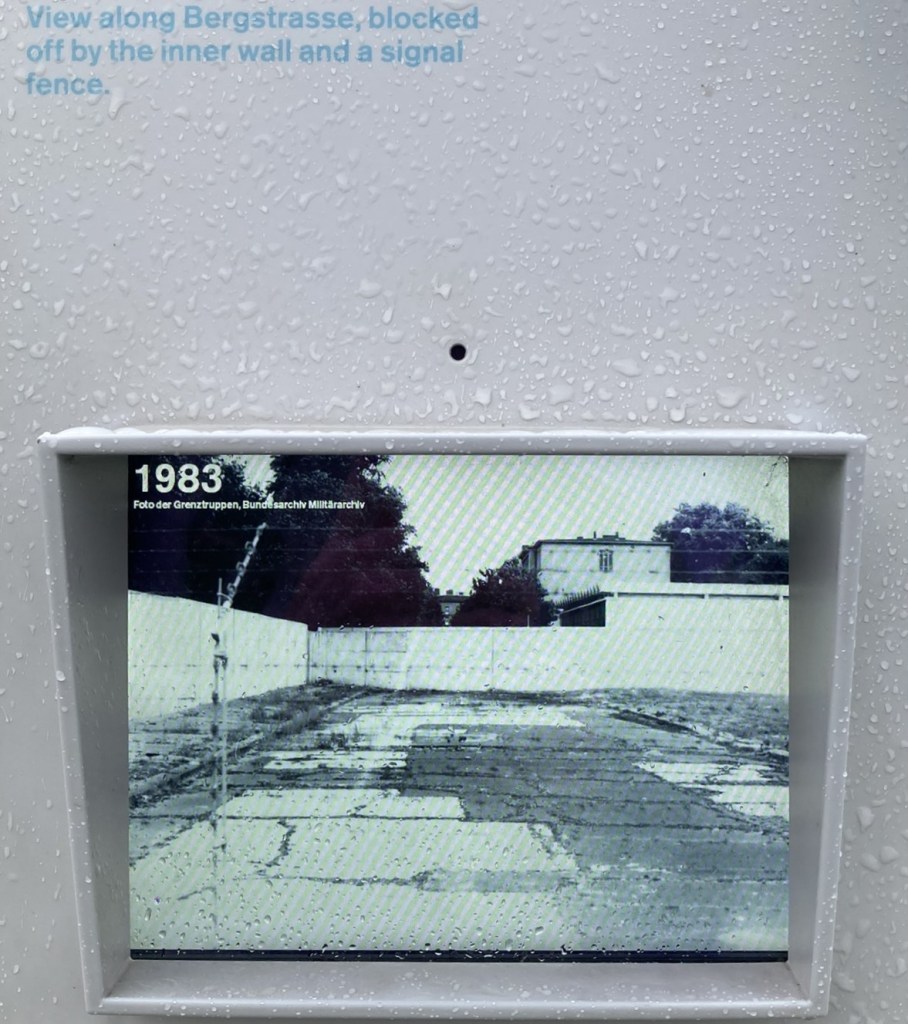
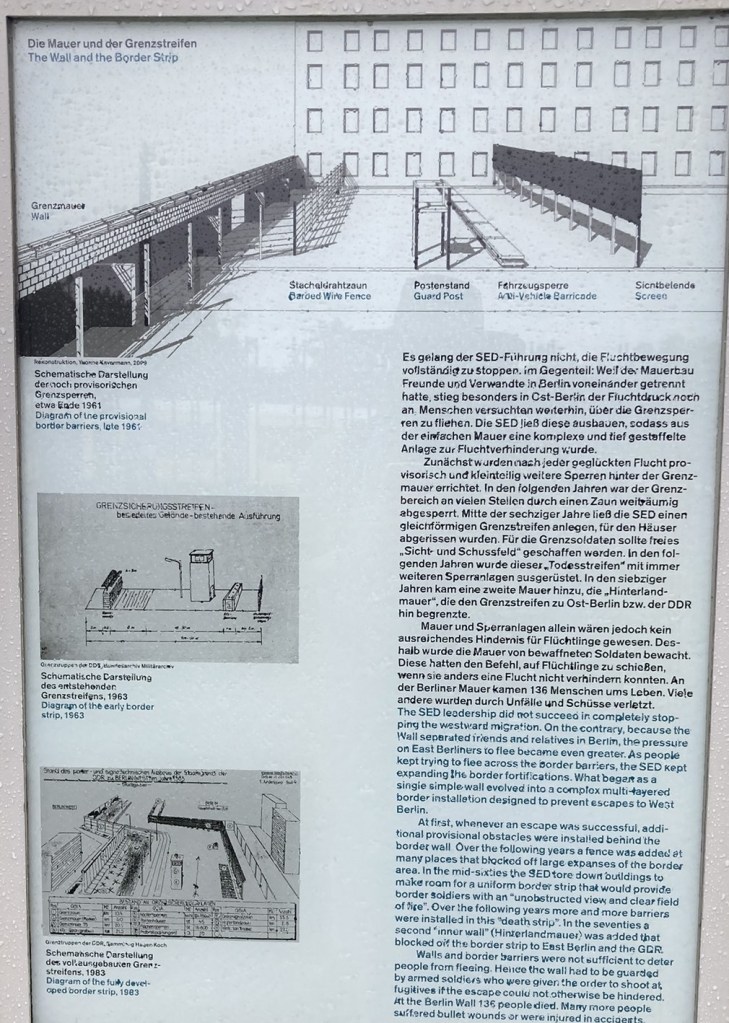
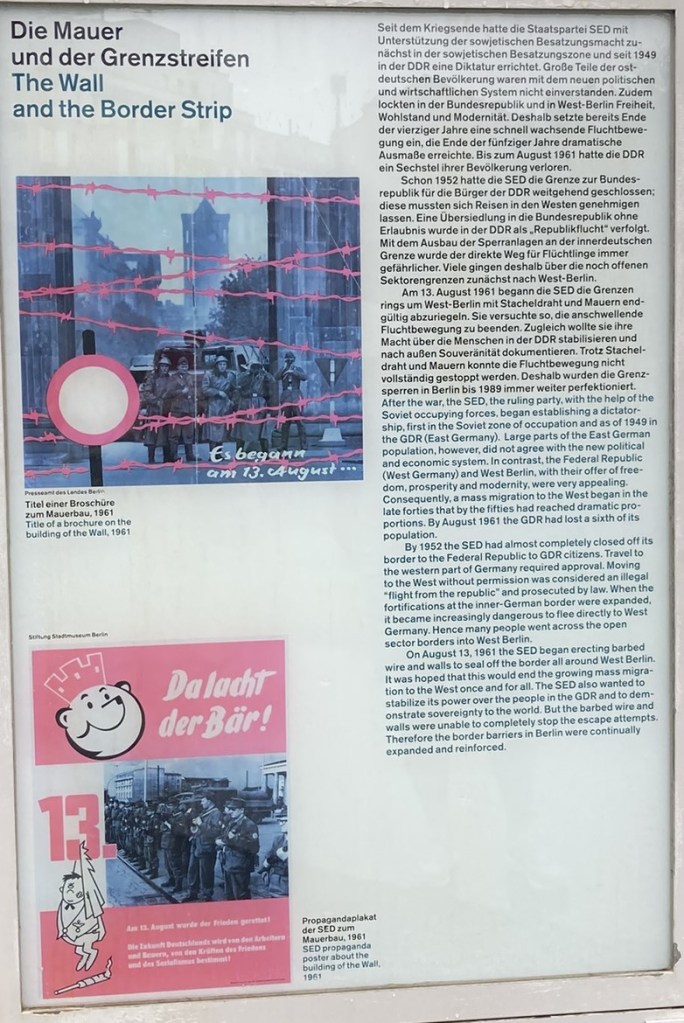
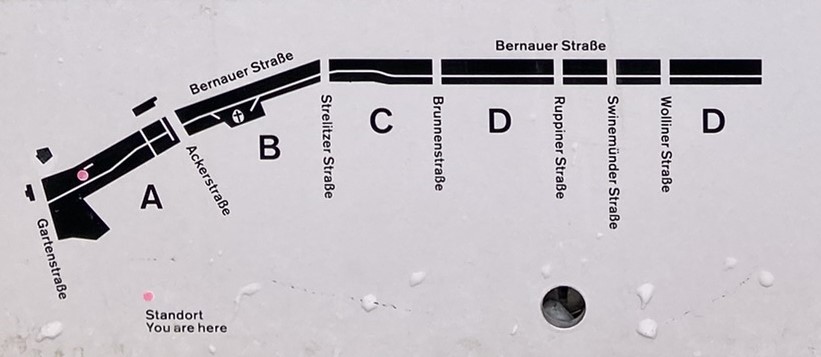
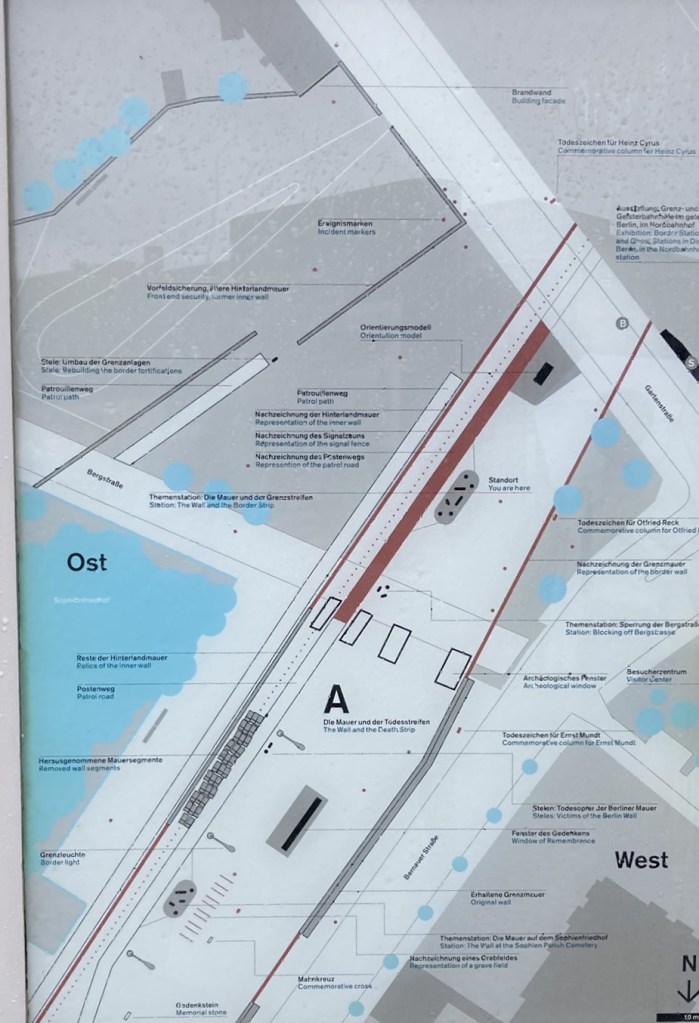
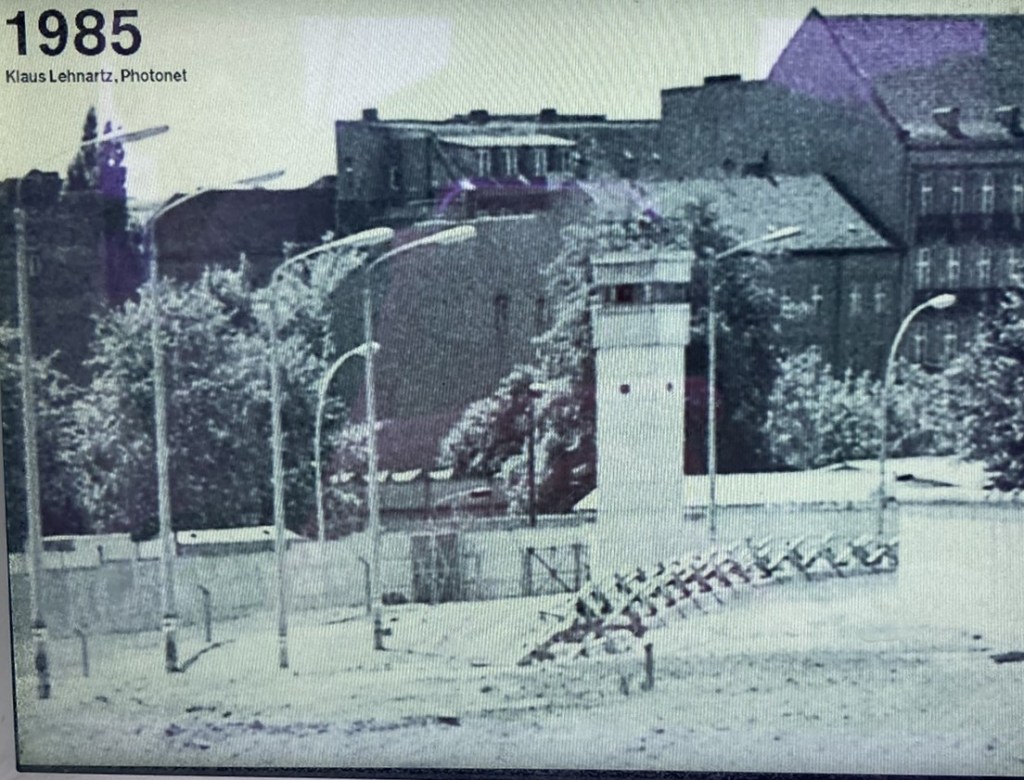
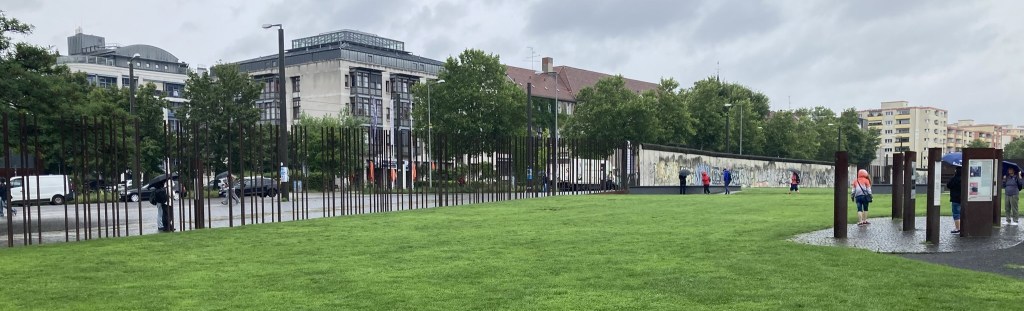
The Window of Rememberance.
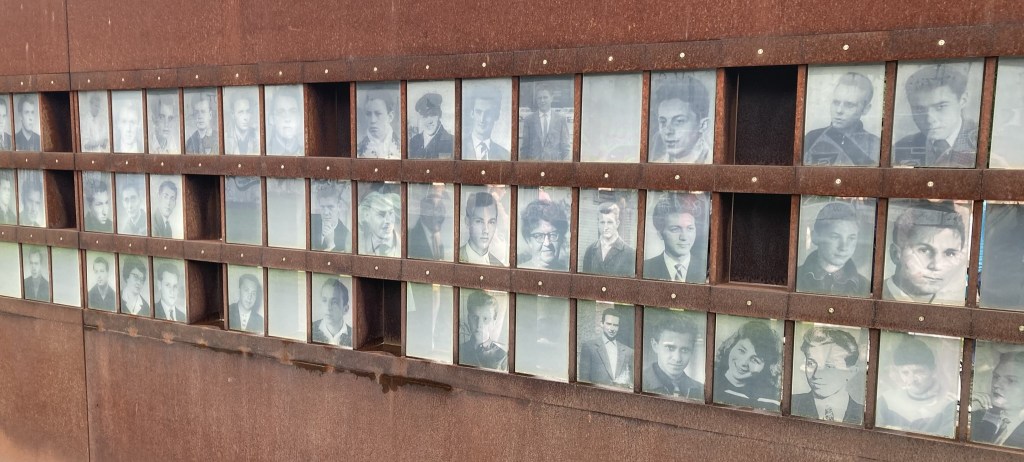
The Window of Remembrance honours the 140 people known to have lost their lives as a result of the Berlin Wall and the East German border regime between 1961 and 1989. Some were shot or killed while attempting to flee; others died through accidents or misjudgment in a system designed to treat every movement near the border as a threat. The memorial presents their photographs year by year, creating a quiet but powerful timeline of human loss. Where no photograph exists, the niche remains white. A few spaces have been deliberately left empty, acknowledging that additional victims may still be identified.
Of the 140, a majority — 101 people — died while trying to escape to West Berlin. The remaining 31 had no intention of fleeing. Many were mistaken for escapees or became unintended casualties of the border’s harsh restrictions. Among the most heartbreaking stories are the five children from West Berlin’s Kreuzberg district who drowned in the Spree. They had been playing on the western bank when they fell into the border waters; because the river formed part of the controlled zone, rescue attempts from the East were forbidden. Their deaths became emblematic of the cruelty and rigidity of the border system.
The Window of Remembrance gathers all of these lives into one place, ensuring that the human cost of division is neither abstract nor forgotten.
Thursday 24 July 2025
Today we visited the Brandenburg Gate and the national memorial honouring the European Sinti and Roma who were murdered after being persecuted as so‑called ‘gypsies’.
Brandenburg Gate
The Brandenburg Gate stands as one of Berlin’s most iconic monuments, a landmark layered with more than two centuries of history. Once a stark symbol of division—isolated in the restricted zone after the Berlin Wall went up—it was inaccessible to both East and West Germans. With the fall of the Wall in 1989, the gate transformed almost overnight into a powerful emblem of German unity and reconciliation.
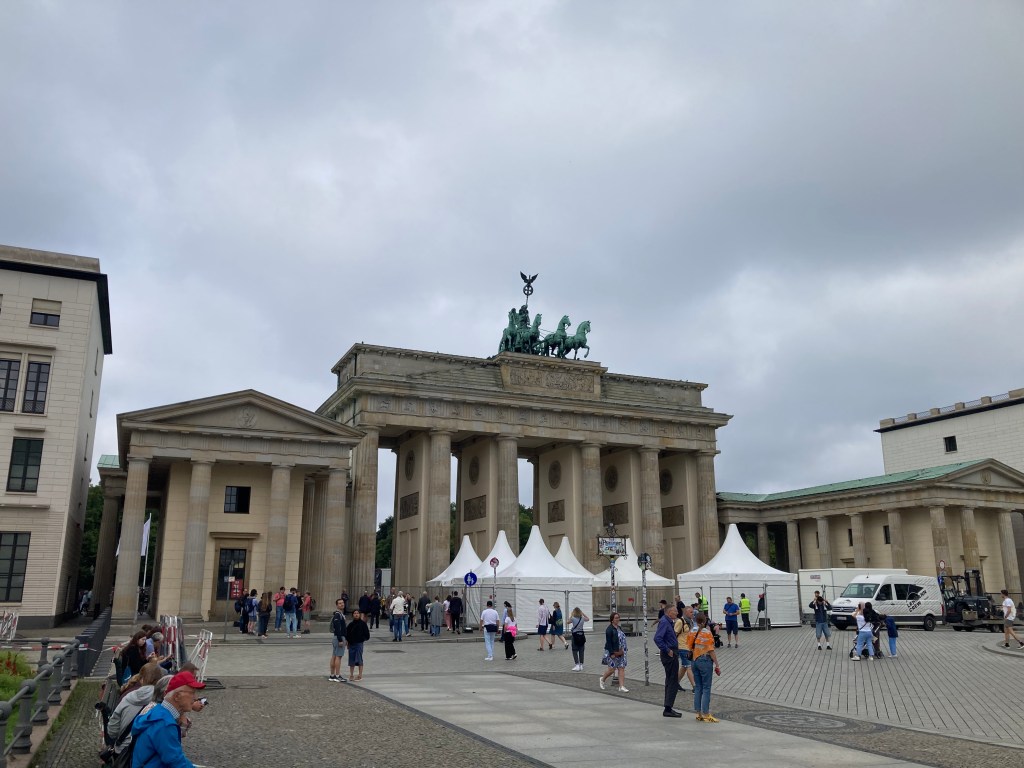
Berlin owes this neoclassical masterpiece to King Frederick William II, who commissioned a grand sandstone gate to mark the ceremonial end of Unter den Linden, the city’s most prestigious boulevard. Built between 1788 and 1791, the structure was designed by Carl Gotthard Langhans the Elder, whose inspiration came directly from the Propylaea of the Athenian Acropolis. Its harmonious proportions and restrained elegance have long earned it a reputation as one of the finest achievements of classicism.
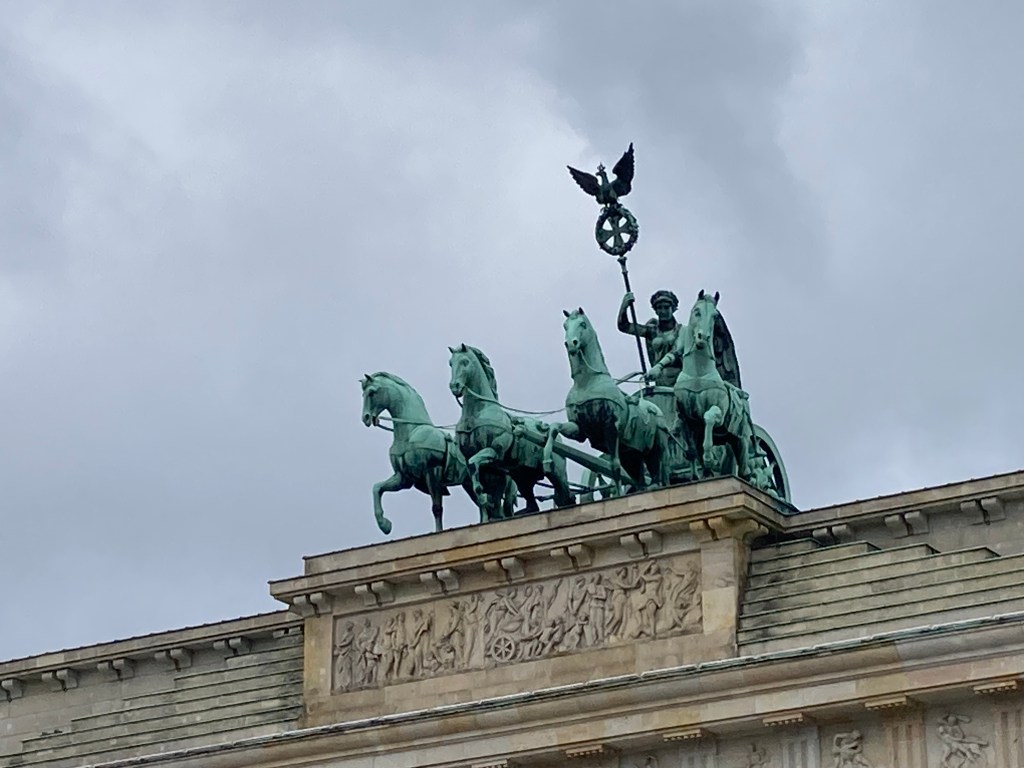
In 1793, just two years after the gate was completed, the Quadriga—a striking sculpture of a four‑horse chariot—was installed atop the Brandenburg Gate. Designed by Johann Gottfried Schadow, it originally depicted the goddess of peace guiding the city toward prosperity. Over time, the sculpture’s fate became inseparable from Berlin’s own turbulent history.
After Prussia’s defeat in 1806, Napoleon seized the Quadriga and had it transported to Paris as a trophy of war. Only with the Allied victory eight years later was it triumphantly returned to Berlin and restored to its place above the gate. The Second World War brought further devastation: both the Brandenburg Gate and the Quadriga suffered heavy damage from bombing. During the postwar reconstruction in 1956, the surviving fragments of the sculpture were deemed beyond repair and removed, and a faithful replica was created to take its place.
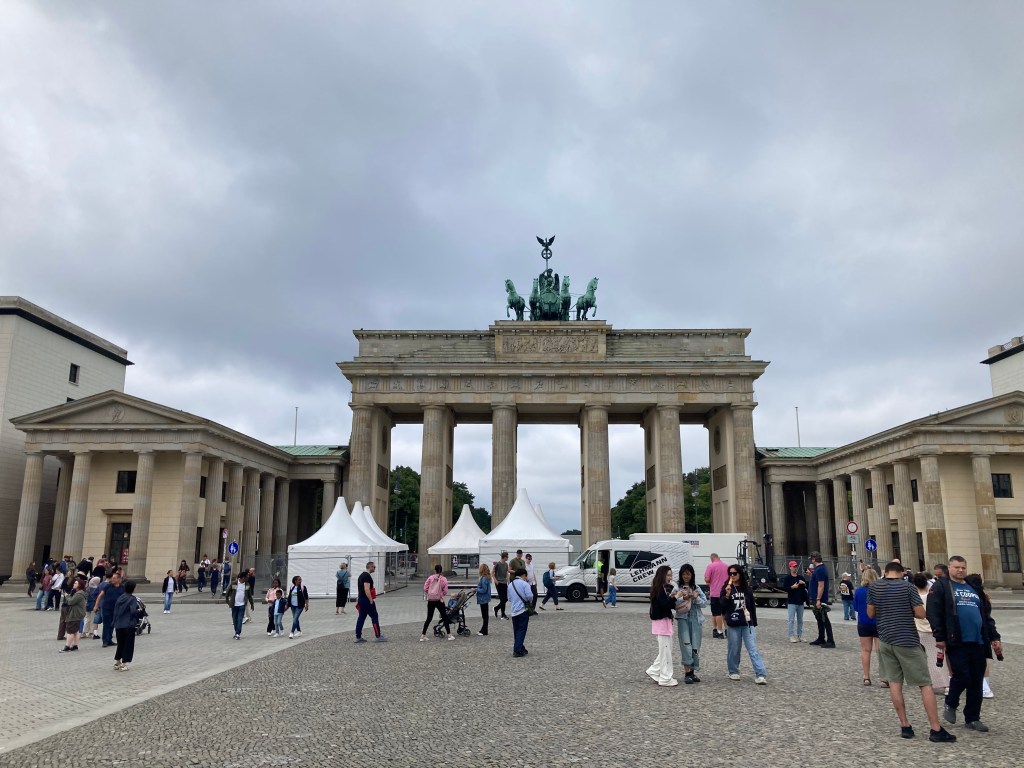
As mentioned earlier, the Brandenburg Gate took on profound symbolic meaning during the decades when Berlin was divided. After the construction of the Berlin Wall in August 1961, the monument found itself stranded in the heavily guarded border zone—visible, but unreachable, a silent witness to the separation of the city. Neither East nor West Berliners could approach it. When the Wall fell in 1989, the gate instantly became a powerful emblem of reunification. On 22 December that year, more than 100,000 people gathered to cheer as the gate was officially reopened.
Today, 24 July 2025, the Brandenburg Gate will once again serve as a canvas for collective memory. To mark the 80th anniversary of the end of the Second World War in Europe, the landmark will be illuminated from sunset until midnight with the opening line of the German Basic Law: “Human dignity shall be inviolable.” The display is intended both to commemorate the anniversary and to highlight the foundational value at the heart of modern German democracy. And because today is also Europe Day, the gate will be lit in the colours of the European Union as part of the celebrations.
We’ve decided not to return tonight for the commemorations, mindful of the large crowds expected to gather—very much in keeping with Smart Traveller advice.
Berlin is home to two major Holocaust memorials: the Denkmal für die ermordeten Juden Europas (Memorial to the Murdered Jews of Europe) and the Denkmal für die im Nationalsozialismus ermordeten Sinti und Roma Europas (Memorial to the Sinti and Roma of Europe Murdered under National Socialism). The first—often referred to simply as the Holocaust-Mahnmal—is a vast field of concrete stelae near the Brandenburg Gate, serving as the central memorial to the six million Jewish victims of the Holocaust. The second, located in the Tiergarten, commemorates the Sinti and Roma who were persecuted and murdered by the Nazis, a genocide known as the Porajmos.
National monument in memory of the murder of the European Sinti and Roma persecuted as “gypsies”.
Under National Socialism, between 1933 and 1945, hundreds of thousands of people across Germany and occupied Europe were persecuted under the racist label of “gypsies.” Most of those targeted identified themselves as Sinti, Roma, Lalleri, Lowara or Manusch, depending on their community and cultural lineage, with the Sinti and Roma forming the largest groups in Europe.
The Nazi regime’s racial ideology aimed at the complete destruction of this minority. Children, women and men were abducted, deported, and murdered—whether in their hometowns, in ghettos, or in concentration and extermination camps. Members of the Jeni community and other travelling groups were also subjected to systematic persecution.
In 1992, the German Federal Government resolved to create a national memorial honouring the Sinti and Roma of Europe who were murdered under National Socialism. The memorial commemorates the estimated 220,000 to 500,000 victims of this genocide, known as the Porajmos. At its centre is a circular fountain with a stone that lowers into the water, upon which a fresh flower is placed each day. Surrounding panels provide detailed information about the exclusion, persecution and mass murder inflicted on this minority during the Nazi era.
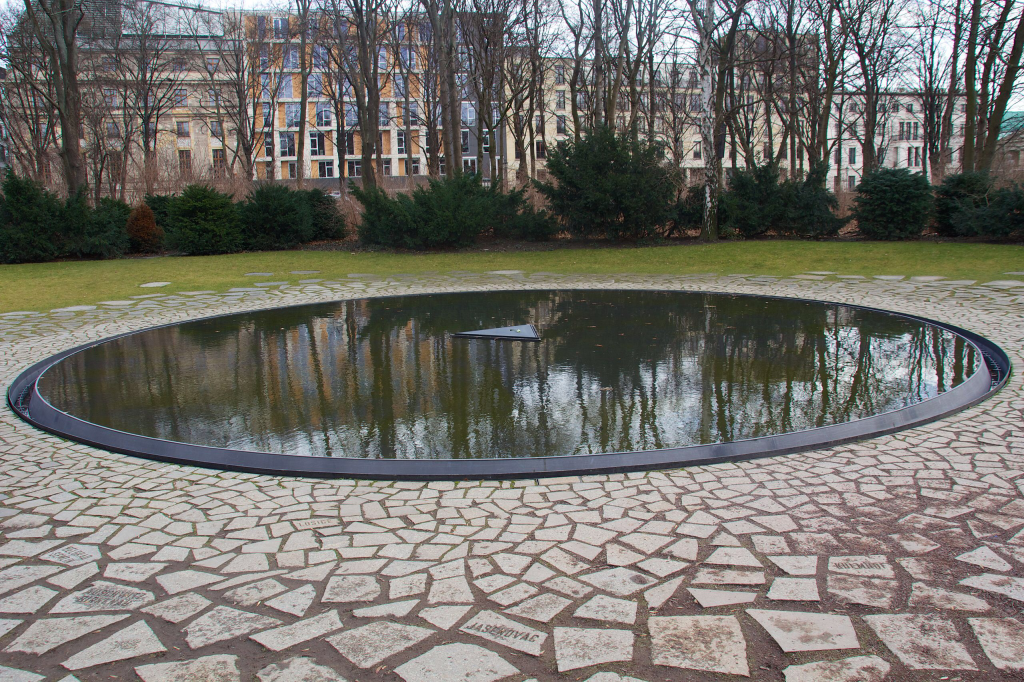
After spending the afternoon exploring, we headed back to the hotel for a well‑earned break—feet up, a moment to reset, and a chance to recharge before dinner. Later, feeling human again, we wandered over to L’Osteria Berlin Humboldthafen, a lively Italian restaurant overlooking the water. The place is known for its generous portions, wood‑fired pizzas the size of satellite dishes, and classic pasta dishes done with real Italian comfort in mind.
The food was excellent—fresh, hearty and full of flavour—and the Italian wine didn’t disappoint either. Naturally, we chose a Pinot Grigio, crisp and reliable, the perfect match for a relaxed evening meal.
Friday 25 July 2025
This morning we left Berlin and began our journey to Prague, Czechia—a trip of just over four hours by train. As you can see from the photo, our first‑class seats are wonderfully comfortable. We each have a single seat on the left side of the carriage, with Maree sitting just behind me, both of us settled in for a relaxed ride through the countryside.
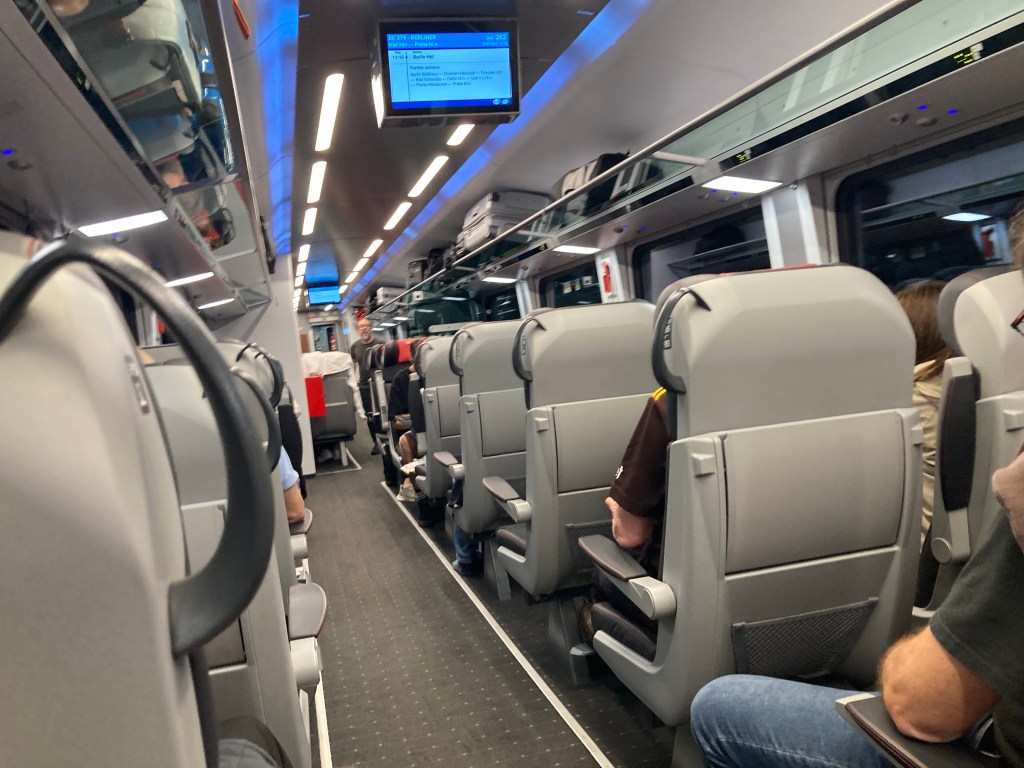
The journey was wonderfully relaxing, and we enjoyed some beautiful scenery as we left Germany and crossed into Czechia. From Dresden onward, the route follows the Elbe River almost the entire way to Prague, winding past cliffs, forests and small riverside towns. The photos below give you a sense of what the landscape was like—just keep in mind they were taken from our carriage while the train was moving at 160 kph.
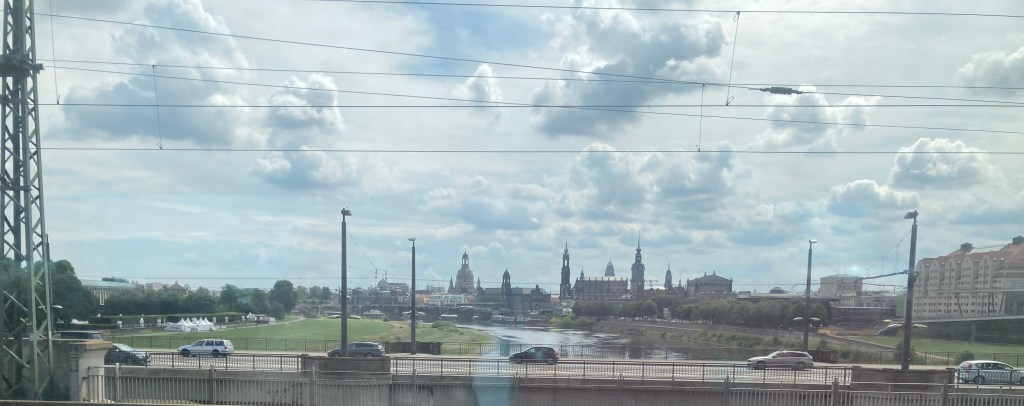
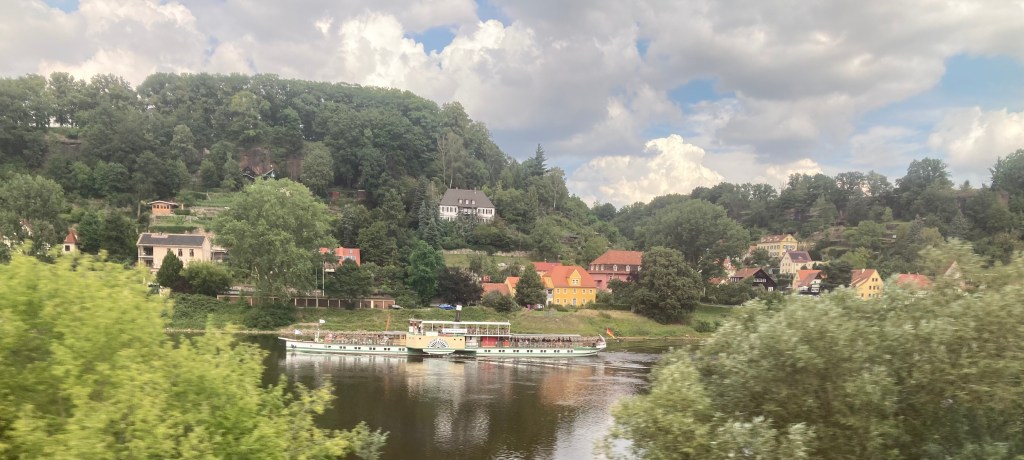
The Elbe has a long and proud tradition of paddle‑steamer travel, especially around Dresden, which is home to the world’s oldest and largest fleet of historic paddle steamers. The story began in 1836 with the founding of the Elbe Steamship Company, which introduced regular passenger and cargo services despite early scepticism from the authorities. The fleet grew steadily and reached its peak in 1915 with 34 steamers operating along the river.
Today, nine beautifully preserved historic paddle steamers—along with two modern saloon ships—still cruise the Elbe. Their broad decks, rhythmic paddles and elegant 19th‑century silhouettes offer a wonderfully nostalgic way to experience the river, passing vineyards, castles and the dramatic sandstone cliffs of Saxon Switzerland. These vessels aren’t just tourist boats; they’re living pieces of river history, still very much at home on the waters they’ve travelled for nearly two centuries.
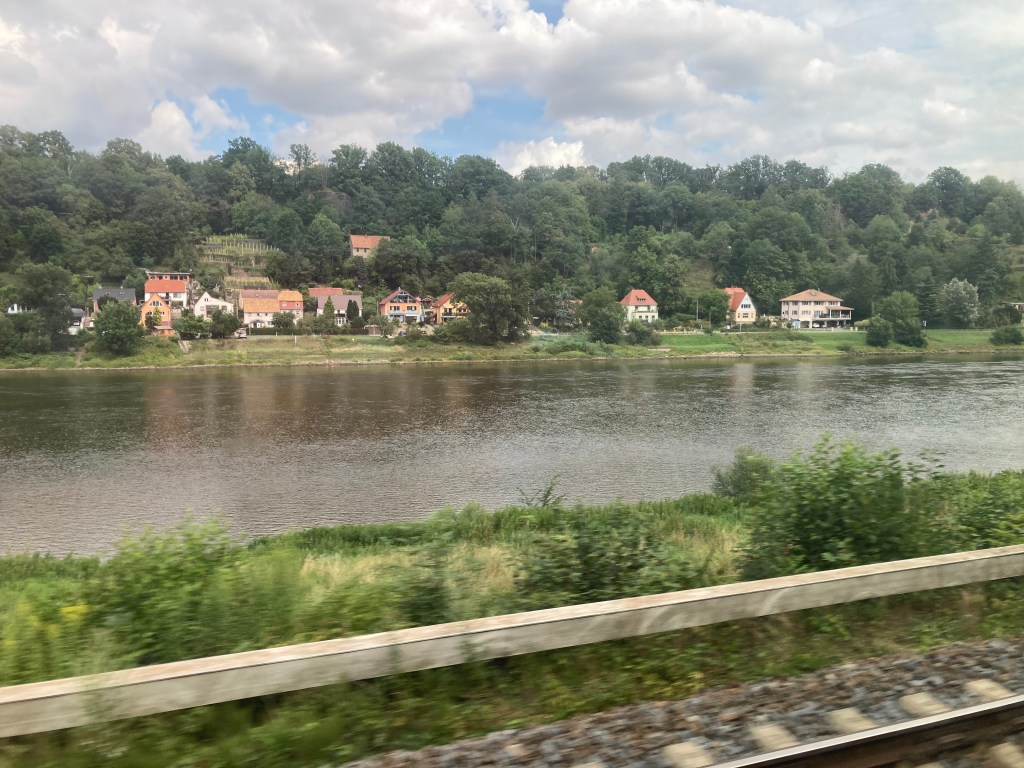
Many of the homes that line this part of the river are traditional Central European houses—often modest, steep‑roofed structures designed to withstand cold winters and occasional river flooding. Their colours and styles vary from simple rural cottages to slightly grander 19th‑century villas, reflecting the layered history of the small towns and villages scattered along the Elbe. Seen from the train, they create a peaceful riverside tableau, tucked between the water and the rising hills beyond.
Reaching 305 metres above sea level, these jagged sandstone pillars were shaped over millions of years by water erosion, creating one of the most striking natural landscapes in the region. Located near the village of Rathen, southeast of Dresden, the Bastei is the signature landmark of Saxon Switzerland National Park, an area famed for its deep gorges, sheer cliffs and sweeping river views.
The Bastei has drawn visitors for more than 200 years. As early as the early 19th century, travellers were making their way up to admire the panoramic views. In 1824, a wooden bridge was built to link several of the towering rock formations, allowing visitors to walk among them. This was replaced in 1851 by the now‑iconic Bastei Bridge, constructed from local sandstone and blending seamlessly into the surrounding cliffs. Today, the bridge is one of the most photographed sights in Germany.
The nearby spa town of Rathen serves as the main gateway to the Bastei. Visitors can reach it from Dresden by paddle steamer along the Elbe—a wonderfully scenic approach that echoes the 19th‑century tradition of river travel. From Rathen, well‑marked trails lead up through forests and rocky outcrops to the viewpoints, where the landscape opens into a breathtaking panorama of the river valley and the sandstone mountains beyond.
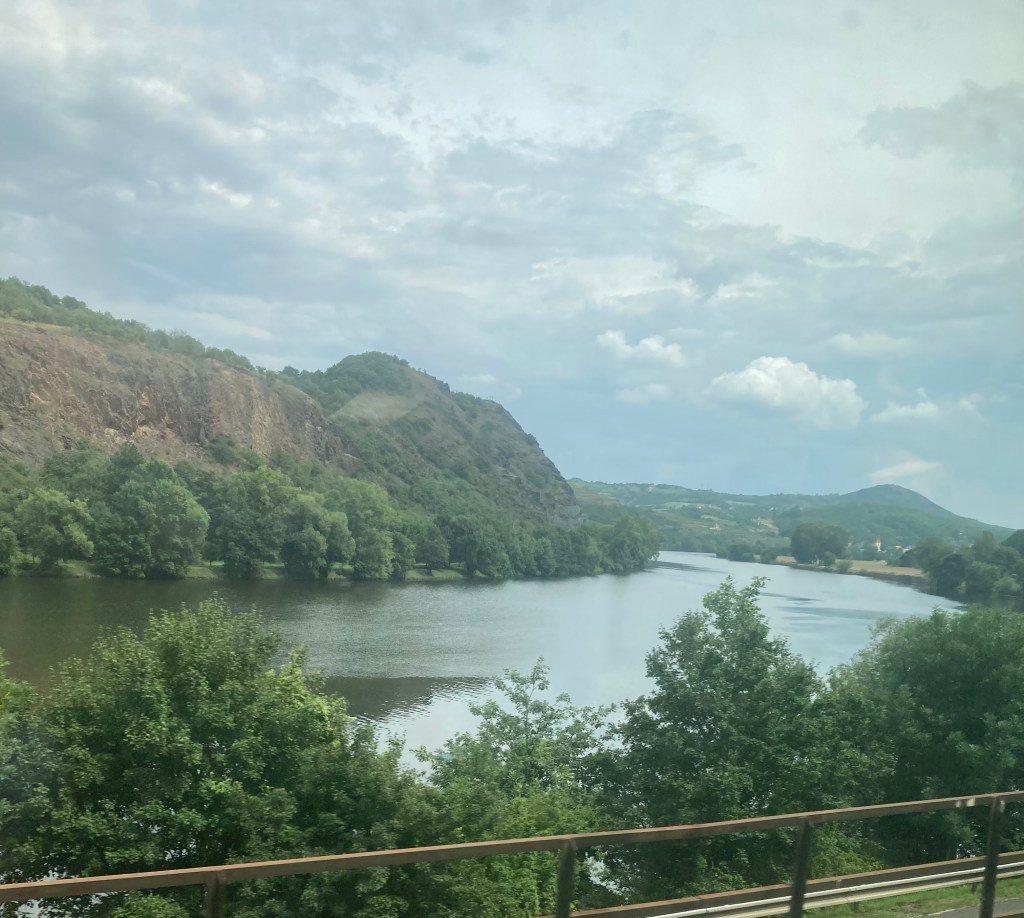
We arrived in Prague and headed straight to our accommodation on Kaprova Street, right in the heart of the Old Town. After settling in and unpacking, we set off for an evening stroll to get our bearings and find somewhere for dinner. We eventually chose a cosy Italian restaurant, and the mild evening meant we could sit outside and enjoy the atmosphere. The food was excellent, and so was the local beer—Dobre Pivo, a small Prague spot known for showcasing quality Czech brews. True to its name, it specialises in “good beer,” offering a rotating selection from independent breweries, which made it the perfect introduction to Prague’s beer culture.
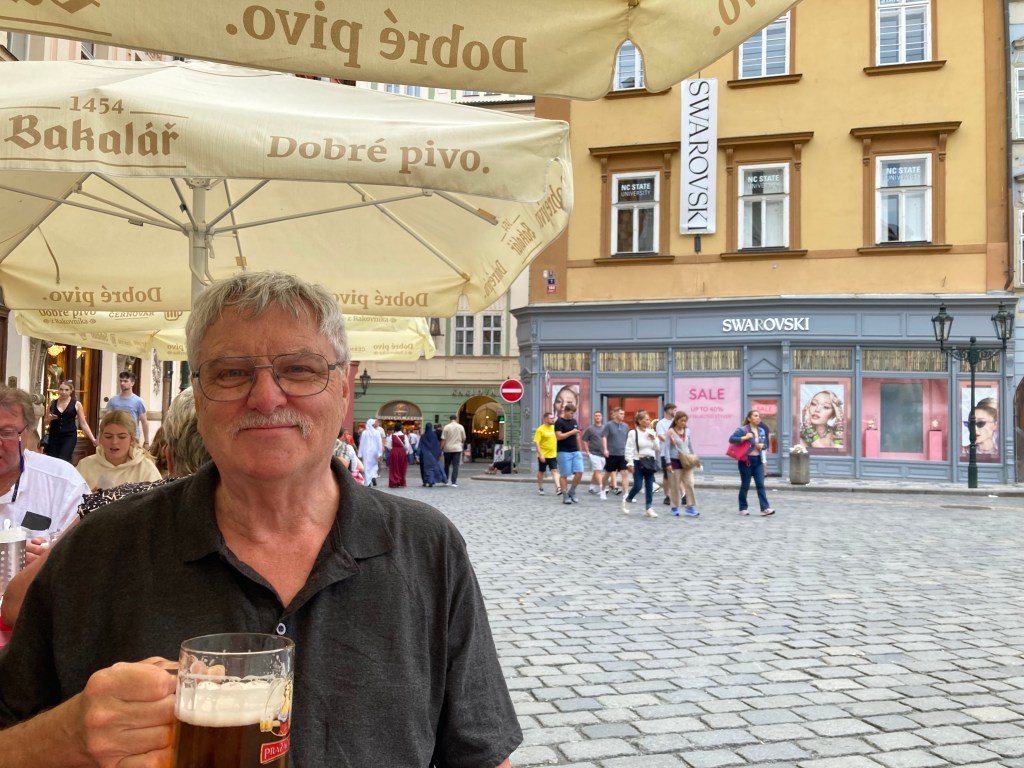
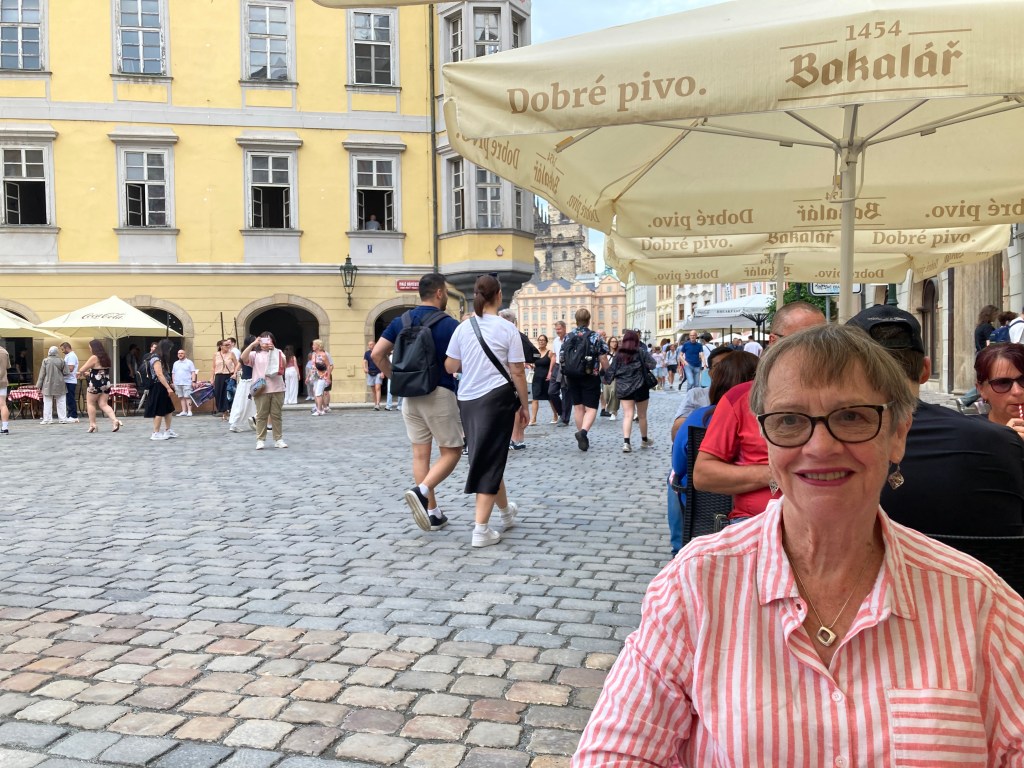
With the sun not setting until around 21:00 at this time of year, the Old Town stays lively well into the evening. The streets are full of people wandering, talking, and soaking up the warm light—tourists, locals, families, and groups of friends all adding to the busy, cheerful atmosphere.
26 July 2025
Today is Maree’s birthday, so the whole day is dedicated to her. Whatever we do, wherever we go, it’s all about celebrating Maree and making sure she feels thoroughly spoiled.
We began the morning with breakfast at a delightful little café just around the corner—Coffee & Waffles on Valentinská. It’s a cosy spot known for its sweet and savoury waffles, good coffee, and relaxed atmosphere, perfect for easing into the day. Maree, being the birthday girl, went straight for the waffles, while I chose the eggs Benedict with salmon. Both dishes were excellent, and neither of us had the slightest regret about our choices. It was a lovely way to start a day that’s all about Maree.
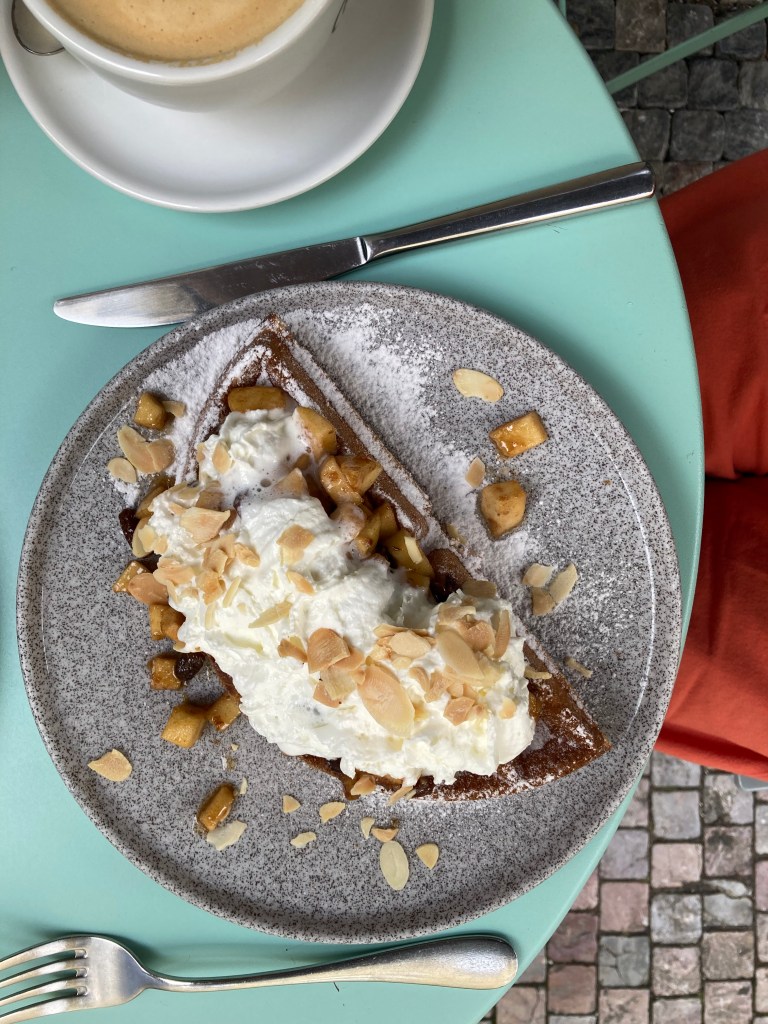
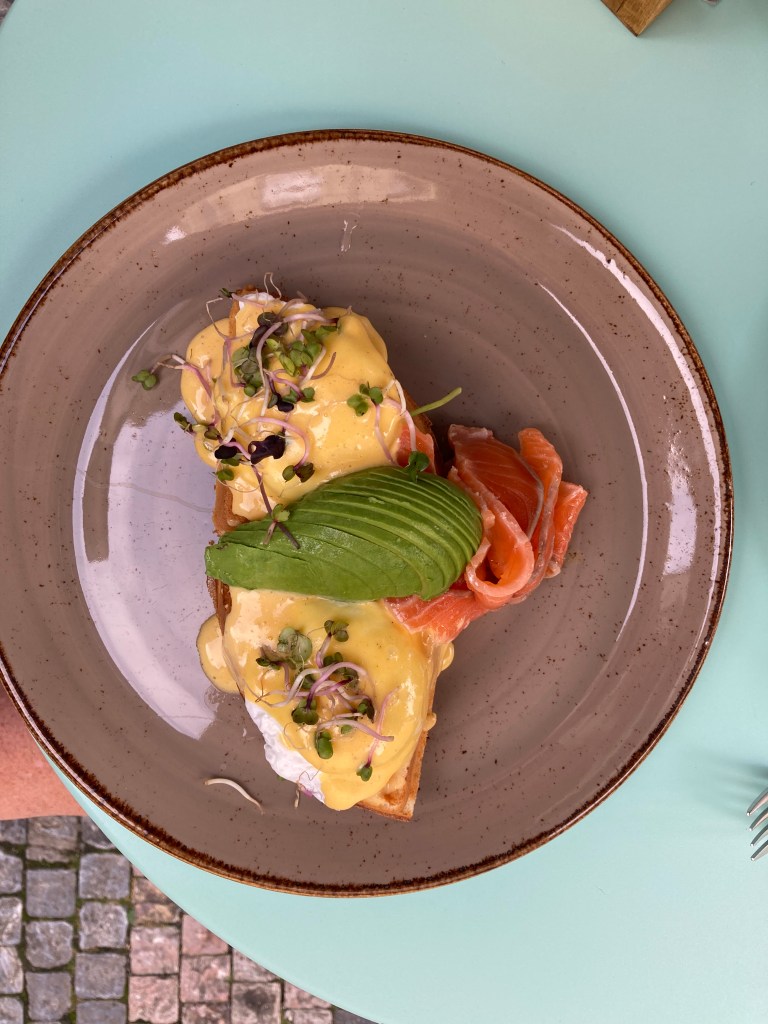
From here, we spent the rest of the day wandering through Prague’s Old Town. This part of the city is a maze of medieval lanes, grand squares, Gothic spires and pastel‑coloured buildings—busy, atmospheric, and full of life at every turn. Following are a few photos capturing some of the Old Town’s charm.
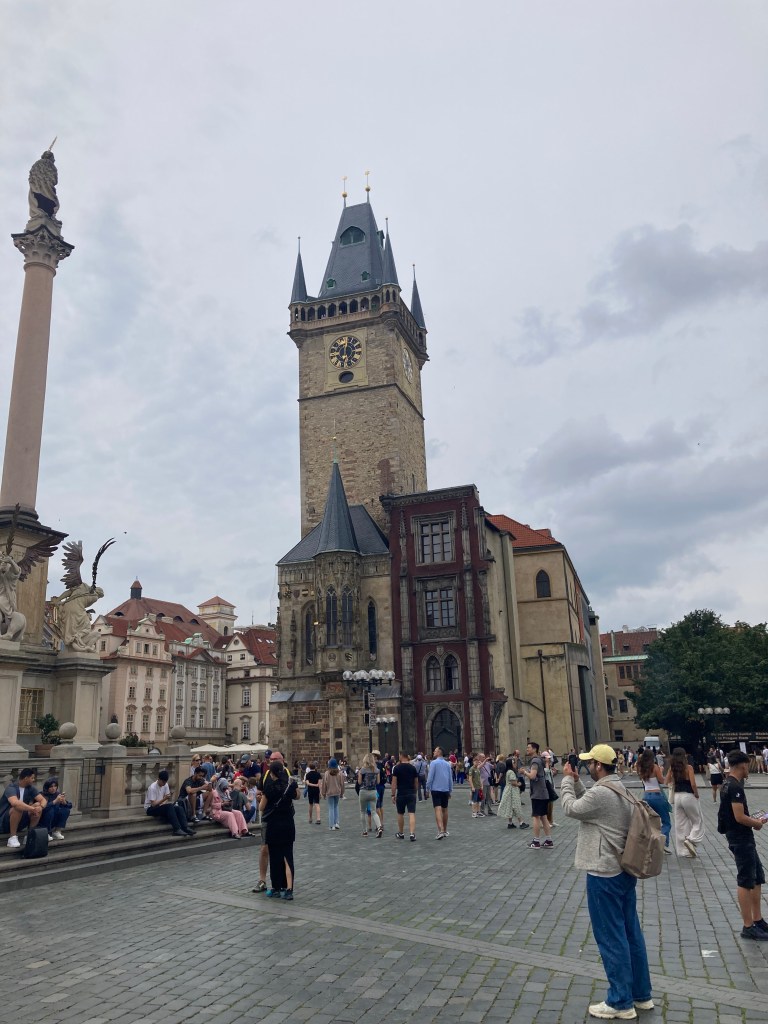
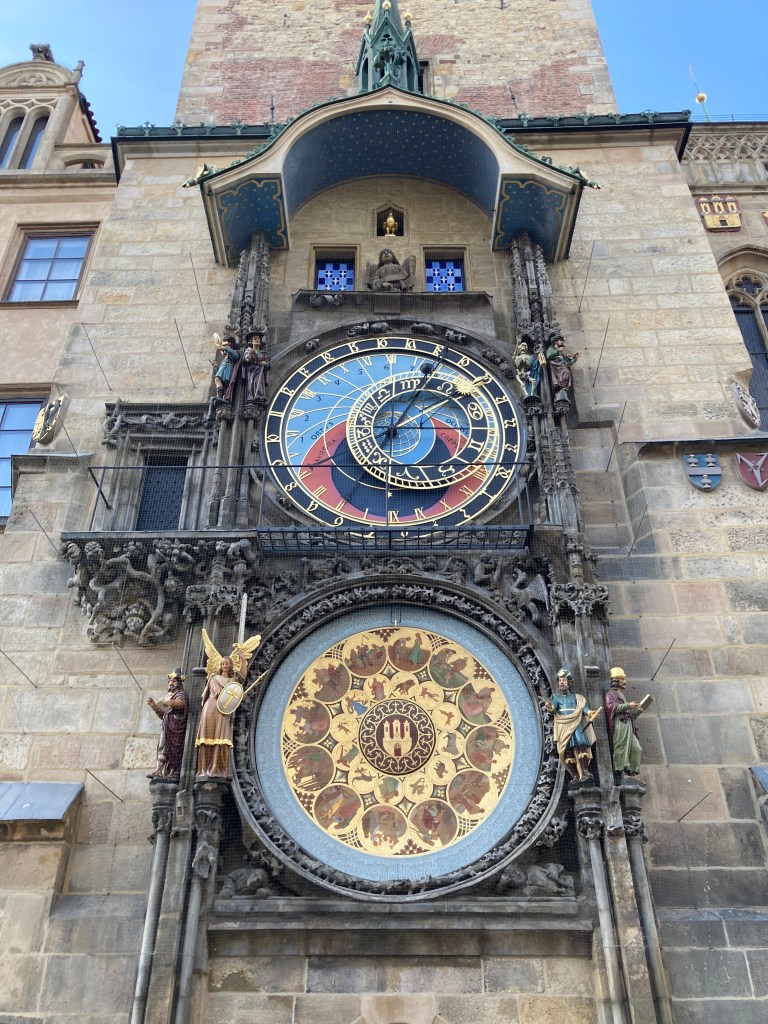
This remarkable medieval clock is one of the city’s most iconic landmarks, and its mechanism is made up of three main parts. The astronomical dial shows the position of the Sun and Moon in the sky and displays a range of celestial details. Flanking the clock are carved figures of Catholic saints, while above them, “The Walk of the Apostles” takes place every hour—twelve wooden Apostles appearing in procession, accompanied by other moving sculptures, including the famous skeleton representing Death, who strikes the time. Below, the calendar dial features painted medallions symbolising the months of the year.
Local legend adds a touch of mystery to the clock’s long history. It is said that Prague will suffer if the Orloj is ever neglected or allowed to fall into disrepair. A ghost perched on the clock was believed to nod in warning should its workings be threatened, and according to the tale, only a boy born on New Year’s night could save the city from misfortune.
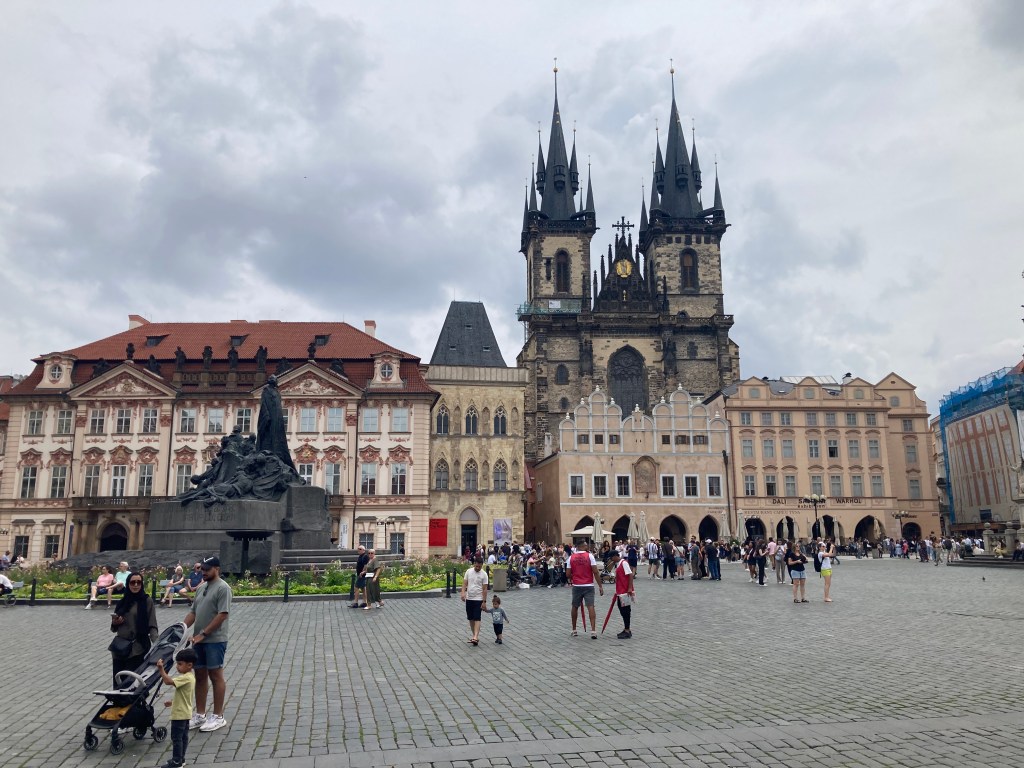
Inside, the church serves as a remarkable gallery of Gothic, Renaissance and early Baroque art. Among its most notable treasures are altar paintings by the renowned Czech artist Karel Škréta, as well as the tomb of the famous astronomer Tycho Brahe, who served at the court of Emperor Rudolf II. The church also houses Prague’s oldest organ, dating from 1673, which is still in use today.
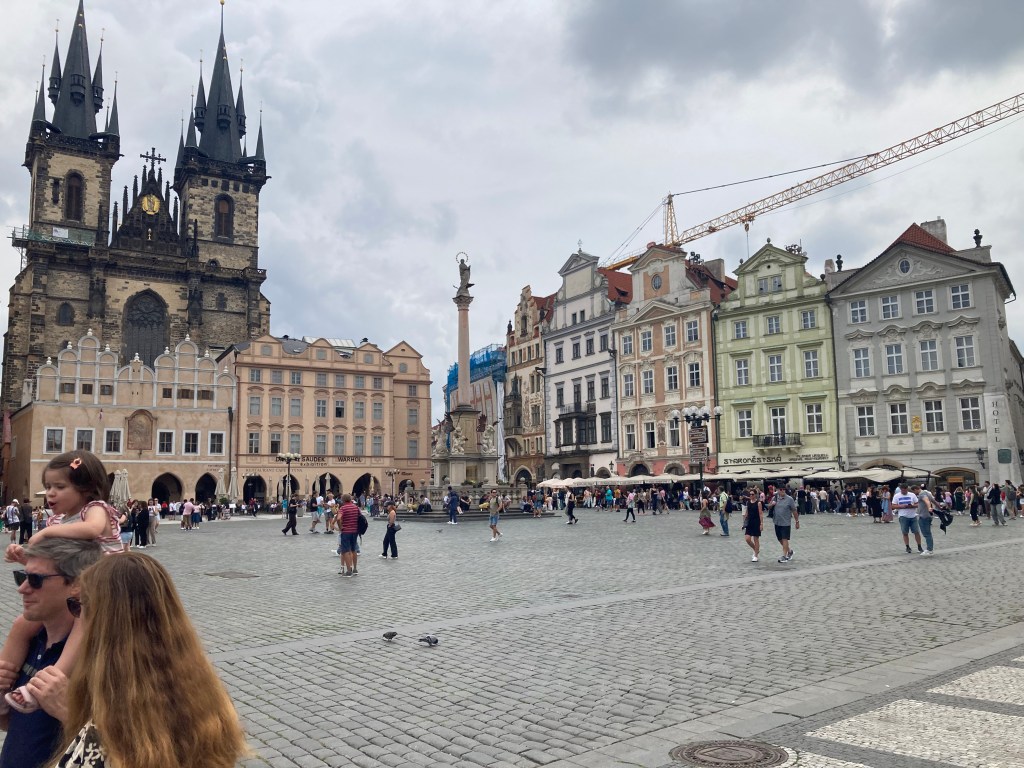
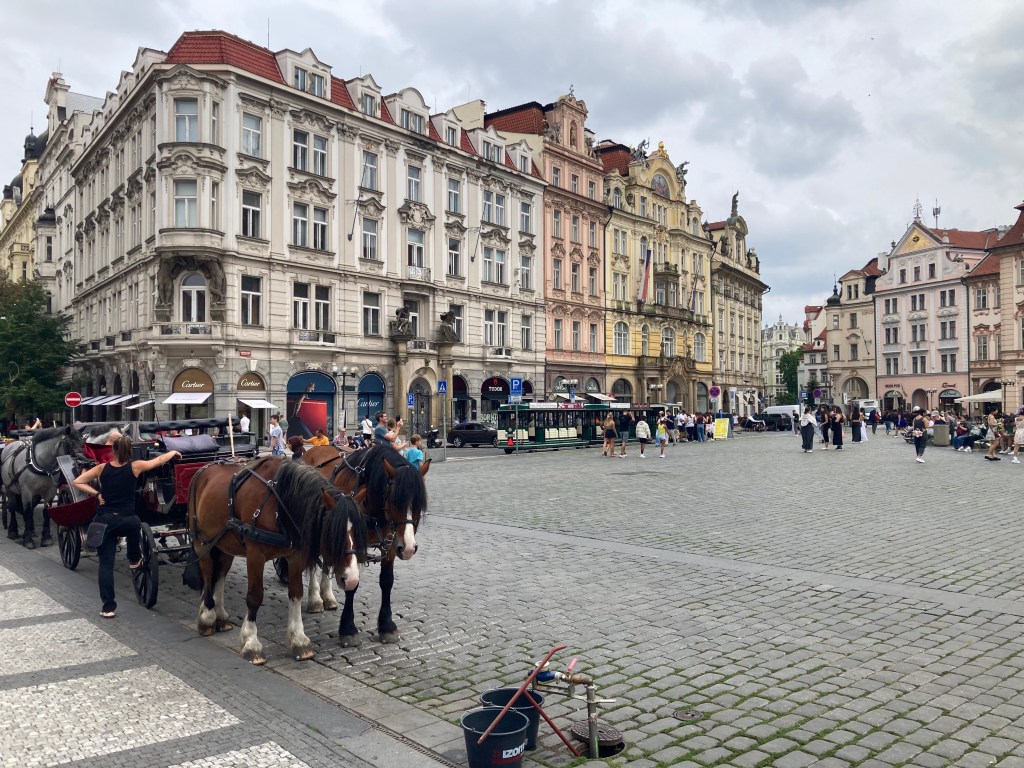
For Maree’s birthday, I had booked a dinner cruise on the Vltava River—one of the loveliest ways to see Prague in the evening. The boats glide past the city’s illuminated landmarks, including Charles Bridge, Prague Castle and the National Theatre, all reflected in the water as the sun sets. It’s a relaxed, scenic way to experience the city, with live music on board and a steady stream of views you simply don’t get from the streets.
This was the birthday treat I’d arranged for Maree, a chance to unwind, enjoy a good meal, and take in Prague from the river that runs through its heart.
We arrived at the dock at 18:30 for the 19:00 departure of our three‑hour dinner cruise. The vessel was beautifully prepared for what promised to be a fine‑dining experience—tables set with crisp linens, soft lighting, and a welcoming atmosphere that set the tone for a special evening on the Vltava.
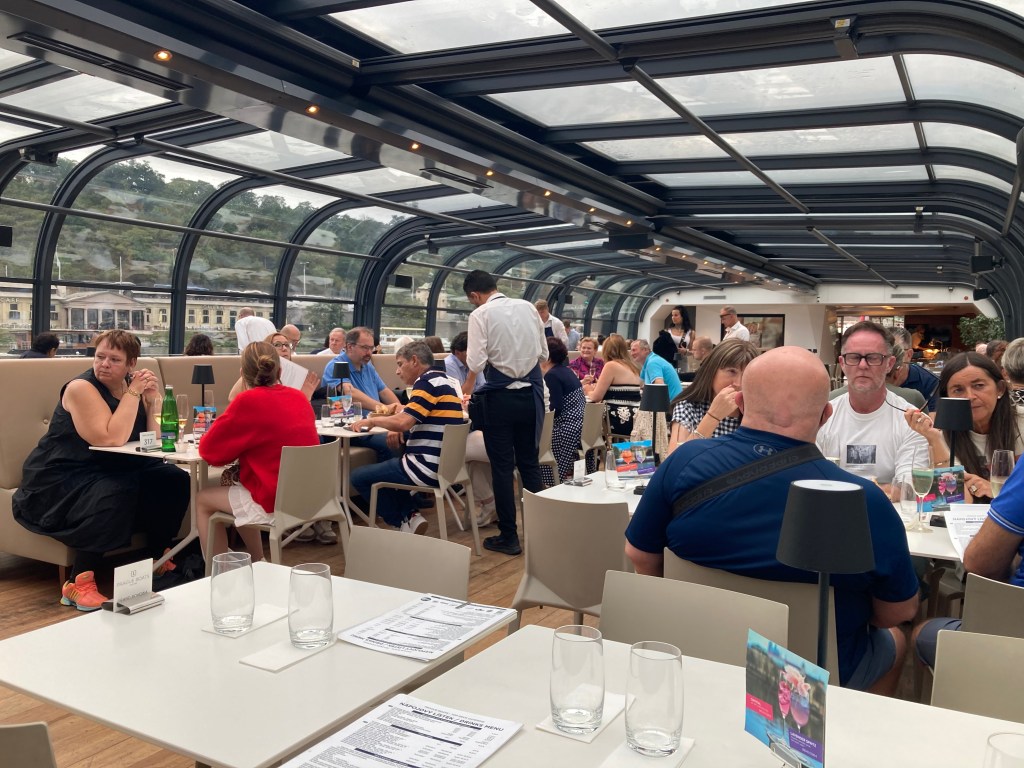
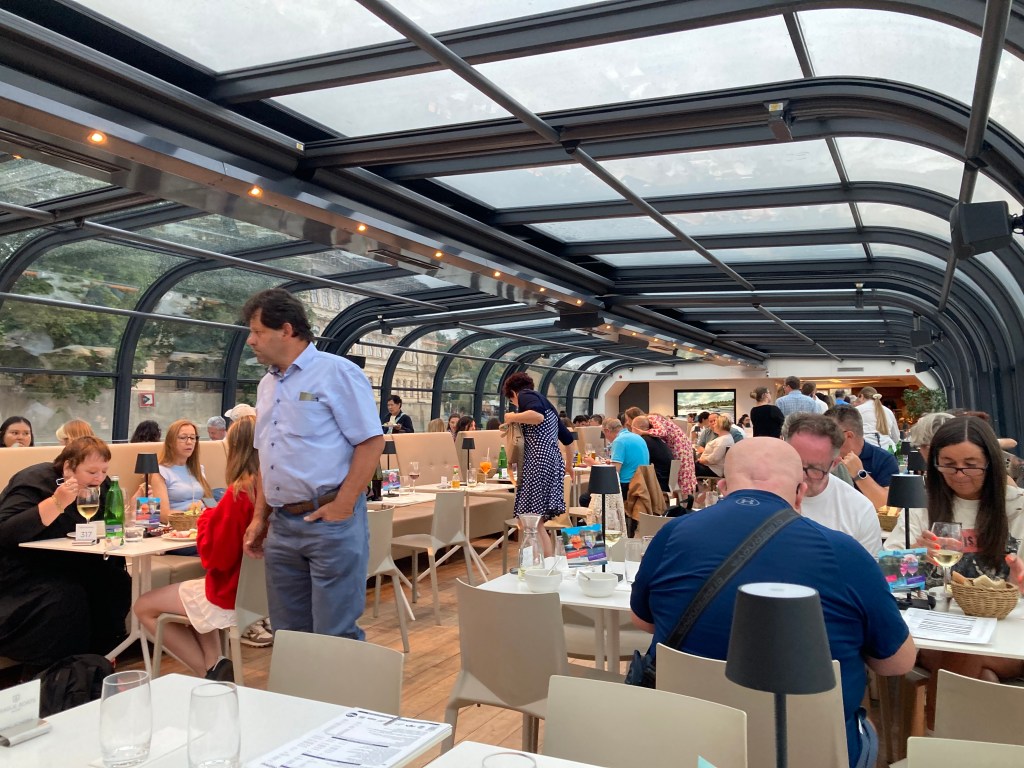
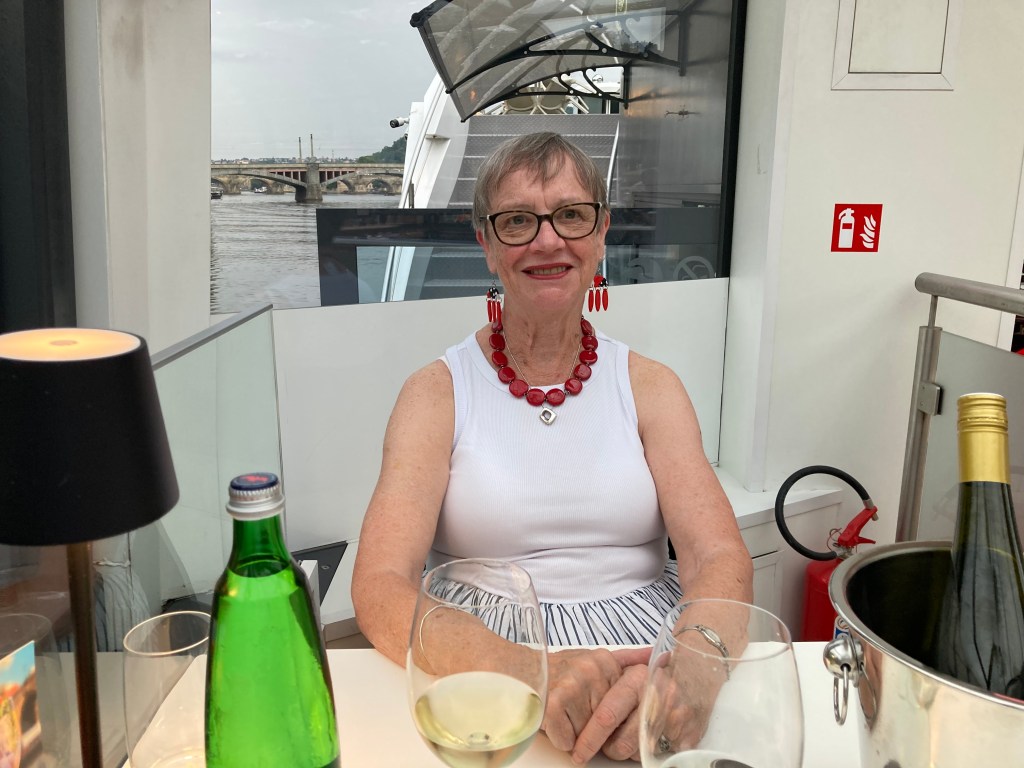
I’d booked a private table for two—paying extra to secure one of the prime window spots for her birthday. You can’t choose the exact location, though, and as it turned out, we did get the views… just slightly tucked away in a corner. Still, it made for a cosy little spot for the two of us as the cruise got underway.
Unfortunately, being tucked away in that corner turned out to be more than just a minor inconvenience. Our table was constantly overlooked by the waitstaff, and we were virtually ignored for most of the evening. Any time we wanted to order something, we had to work to catch someone’s attention—it genuinely felt as though we were invisible. What should have been a special birthday dinner for Maree became memorable for all the wrong reasons, and it was a disappointing outcome for something I’d planned with such care.
Things only got worse when it came time to settle the bill for the wine and water we’d ordered. The waiter pointed to the receipt and said, “Price does not include tip, so just add your tip here.” I replied, “Sorry, but no tip tonight—the service was terrible.” His attitude changed immediately; he became rude and dismissive, snatched the payment, and stormed off. When he returned later to clear the table, he wouldn’t even acknowledge us. It was a poor reflection on him personally, especially since almost everyone we’ve met in Czechia—particularly in restaurants—has been friendly, warm and incredibly helpful.
So after the cruise, we walked back to our accommodation feeling disappointed with how the evening had unfolded. Not the birthday experience I’d hoped to give Maree.
Sunday 27 July 2025
We started the day by getting our laundry done at Bloomest on 9 Dušní Street, then wandered a few doors down to a cosy little bistro at 11 Dušní for breakfast. It was the perfect setup—enjoying a relaxed meal while the machines quietly took care of the clothes next door.
Once the laundry was underway, I headed next door to join Maree for breakfast. She ordered the pancakes, while I went for the potato rösti topped with salmon and avocado—an interesting combination and surprisingly tasty. It was a relaxed, easy start to the morning, with breakfast sorted and the washing taking care of itself
With breakfast finished and the laundry washed and dried, we headed back to our accommodation to drop everything off and freshen up. Then we set out for Prague Castle, which sits high on the hill overlooking the city on the west bank of the Vltava. It’s an impressive complex—part fortress, part palace, part cathedral—and dominates the skyline from almost anywhere in Prague.
Prague Castle is a vast castle complex that today serves as the official residence and workplace of the President of the Czech Republic. Its history stretches back to the 9th century, and for more than a thousand years it has been the seat of power for Bohemian kings, Holy Roman emperors, and later the presidents of Czechoslovakia. Because of this, the term “Prague Castle”—or simply “the Castle” or “the Hrad”—is often used as shorthand for the president and his circle of advisors.
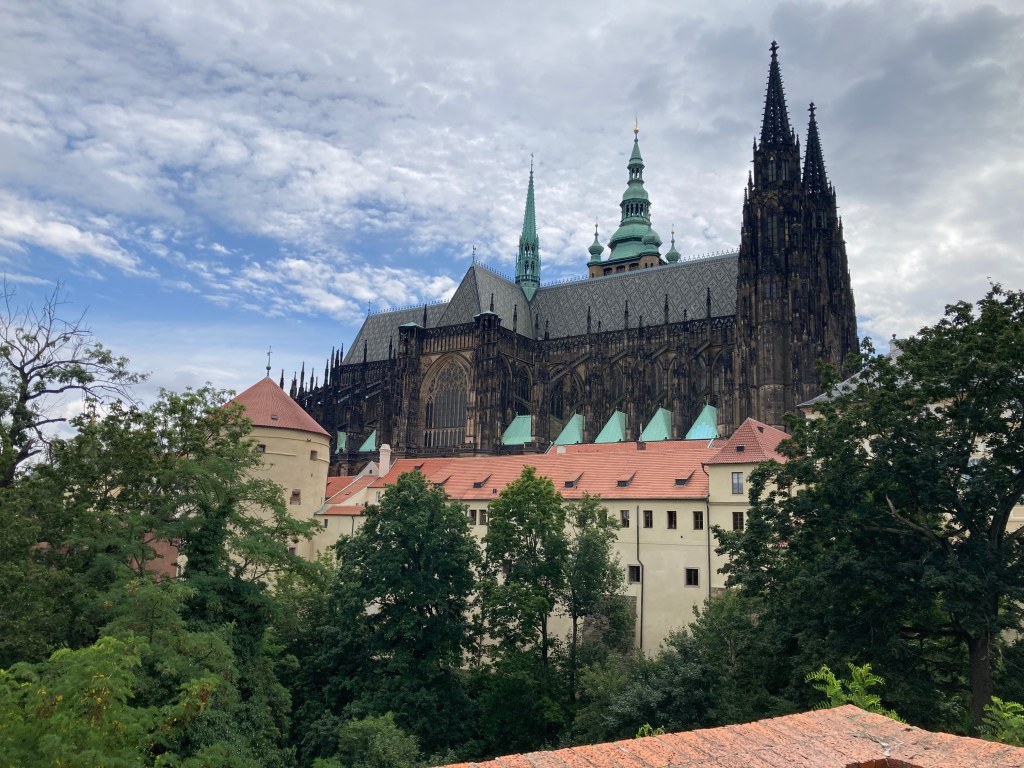
According to the Guinness World Records, Prague Castle is the largest ancient castle in the world, covering nearly 70,000 square metres. It stretches roughly 570 metres in length and about 130 metres in width, forming a sprawling complex of palaces, courtyards, churches and historic halls. Hidden within its walls is a secure chamber where the Bohemian Crown Jewels are kept, accessible only through a unique system of multiple keys held by different officials.
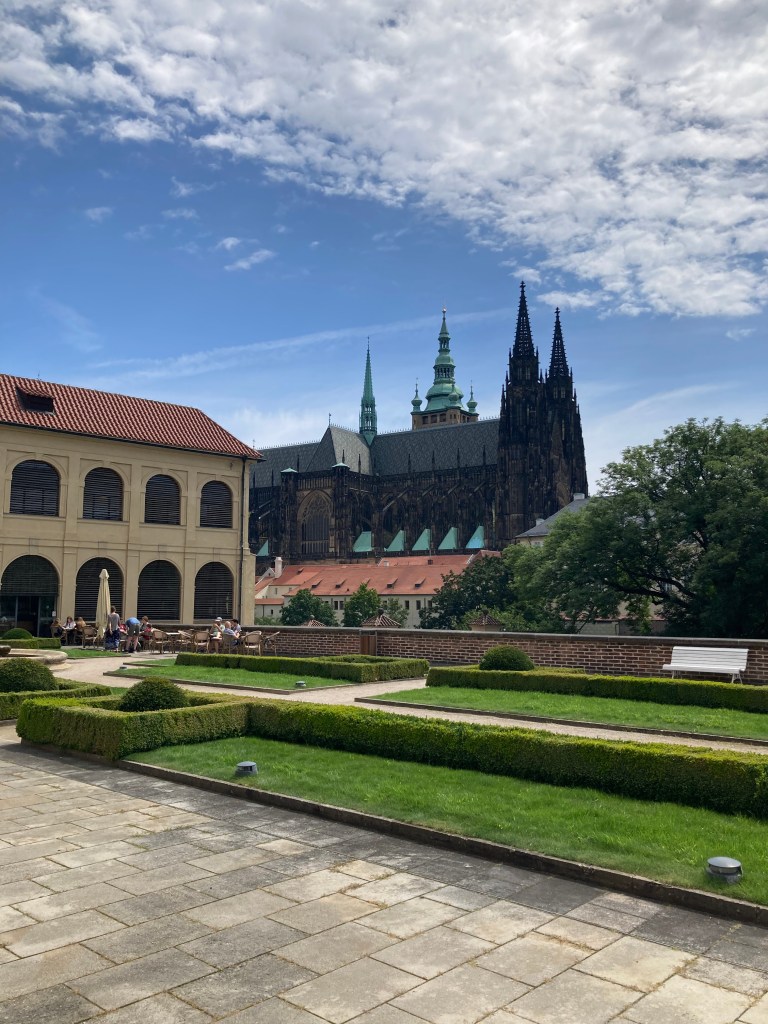
The castle’s story began around 870, when the first walled structure—the Church of the Virgin Mary—was built. In the early 10th century, under Duke Vratislaus I and his son Wenceslaus I, the Basilica of St. George and the original Church of St. Vitus were founded. The first convent in Bohemia was also established here, beside St. George’s Basilica. A Romanesque palace rose in the 12th century, and archaeological finds, including 13th‑century Venetian coins, reveal the castle’s long‑standing connections to trade and power across Europe.
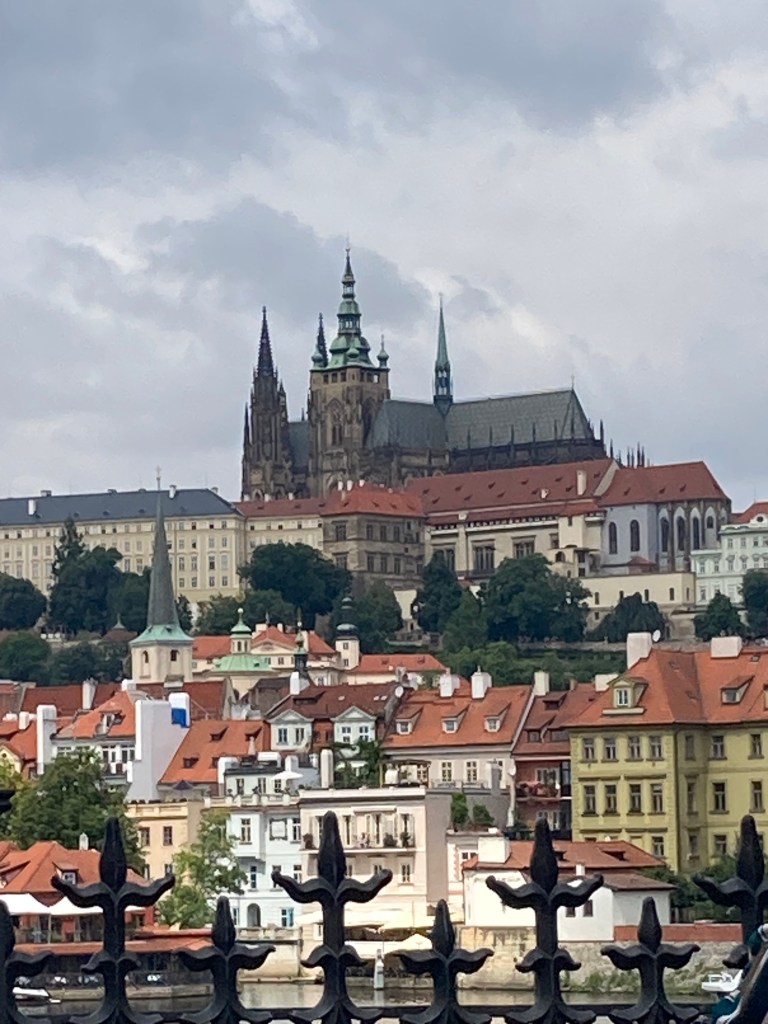
We wandered through the castle grounds, taking our time to admire the beautifully kept gardens. One of the highlights is the Royal Garden, an Italian Renaissance‑style garden created in 1534 under Emperor Ferdinand I of Habsburg. The site had originally been a vineyard, which Ferdinand purchased specifically to establish a grand garden for the royal court. The Royal Garden was developed at the same time as Queen Anne’s Summer Palace, completed in 1560, and together they formed one of the most elegant corners of the entire castle complex. Even today, the garden’s long avenues, manicured lawns and historic pavilions offer a peaceful contrast to the bustle of the city below.
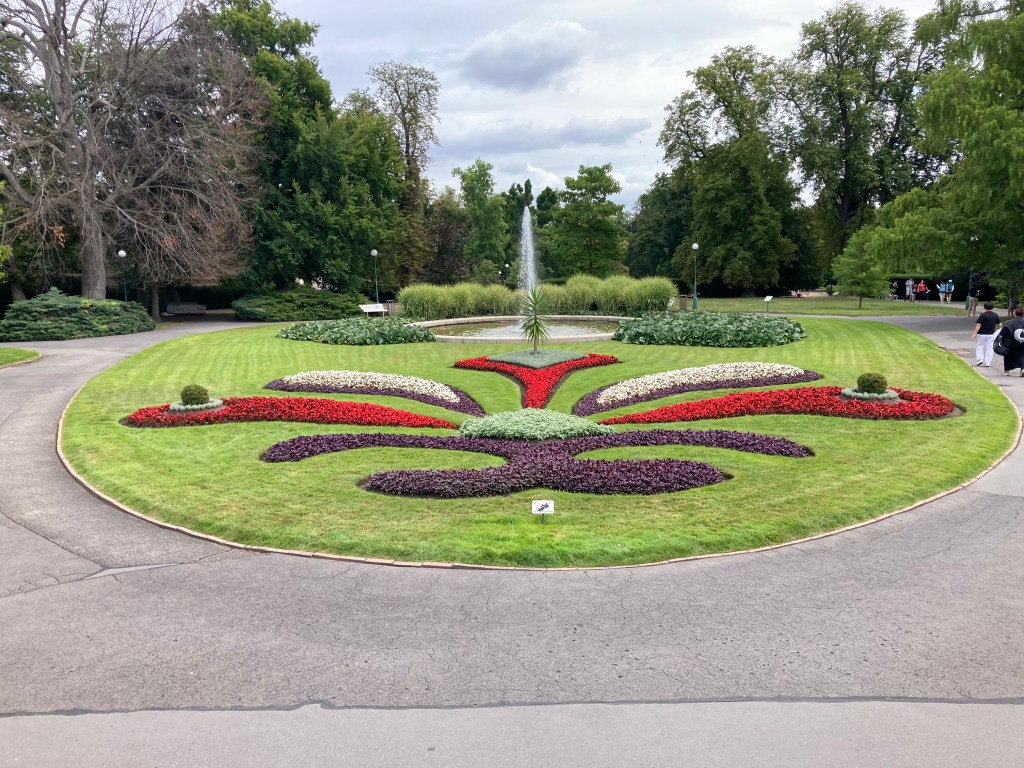
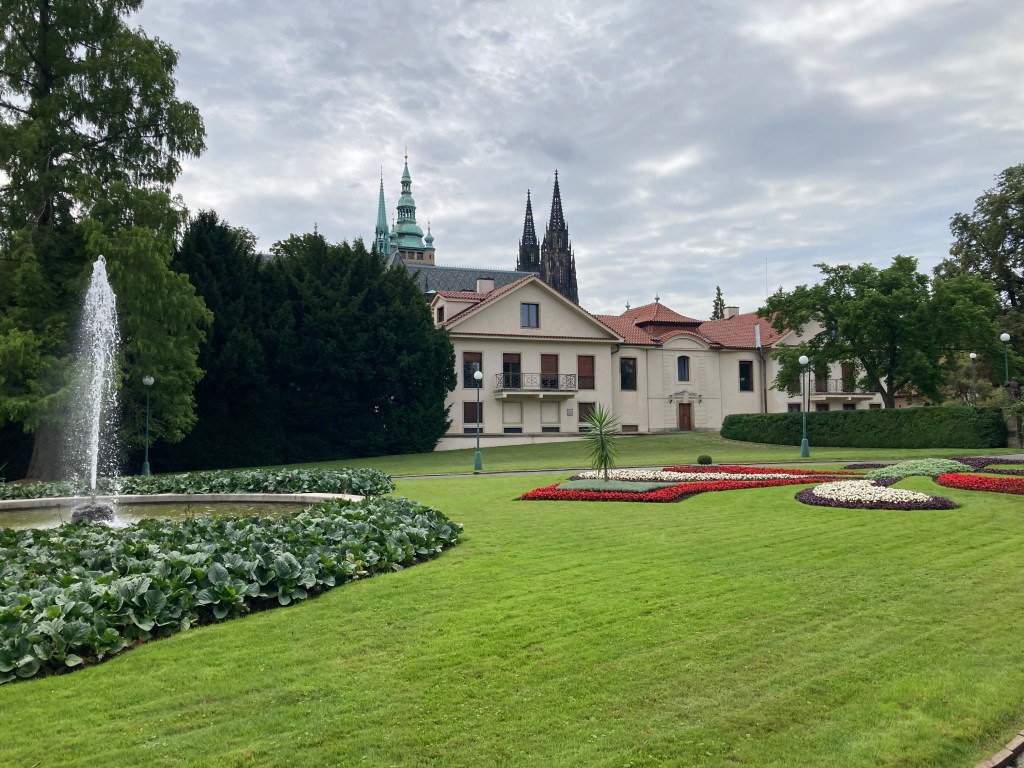
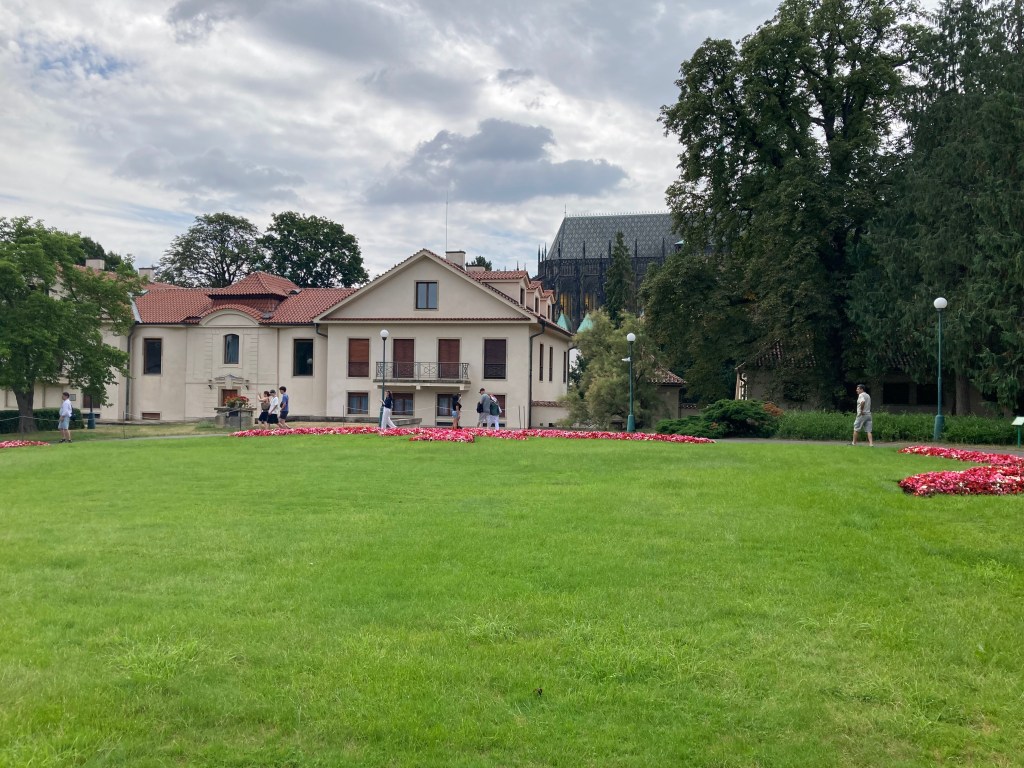
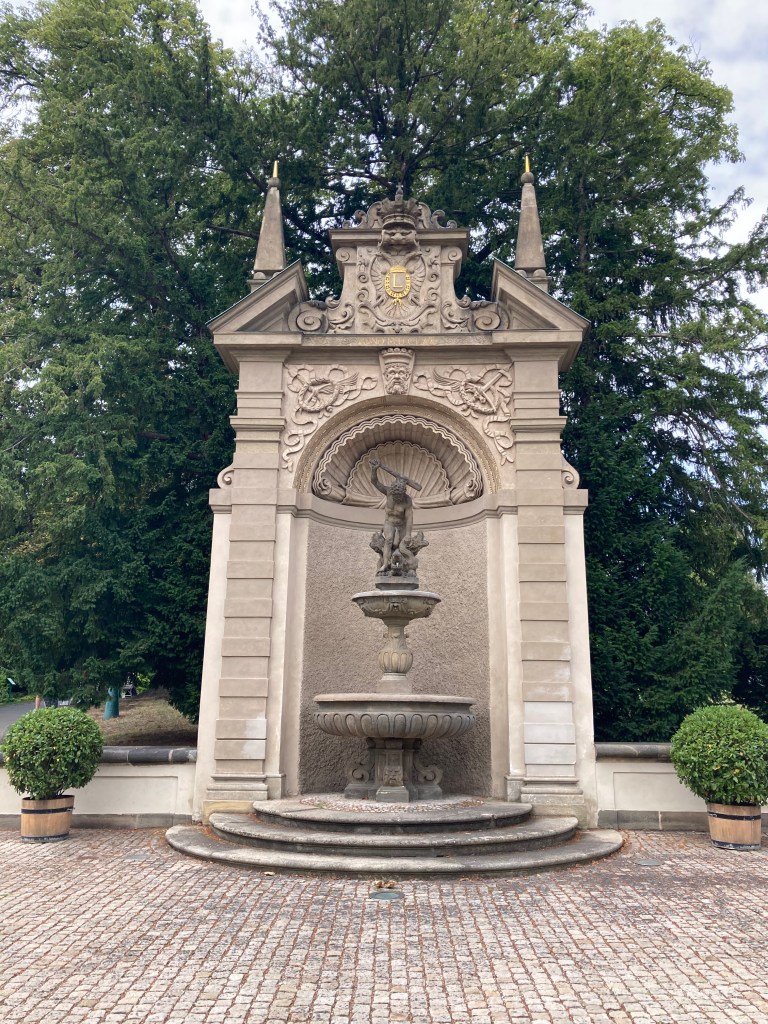
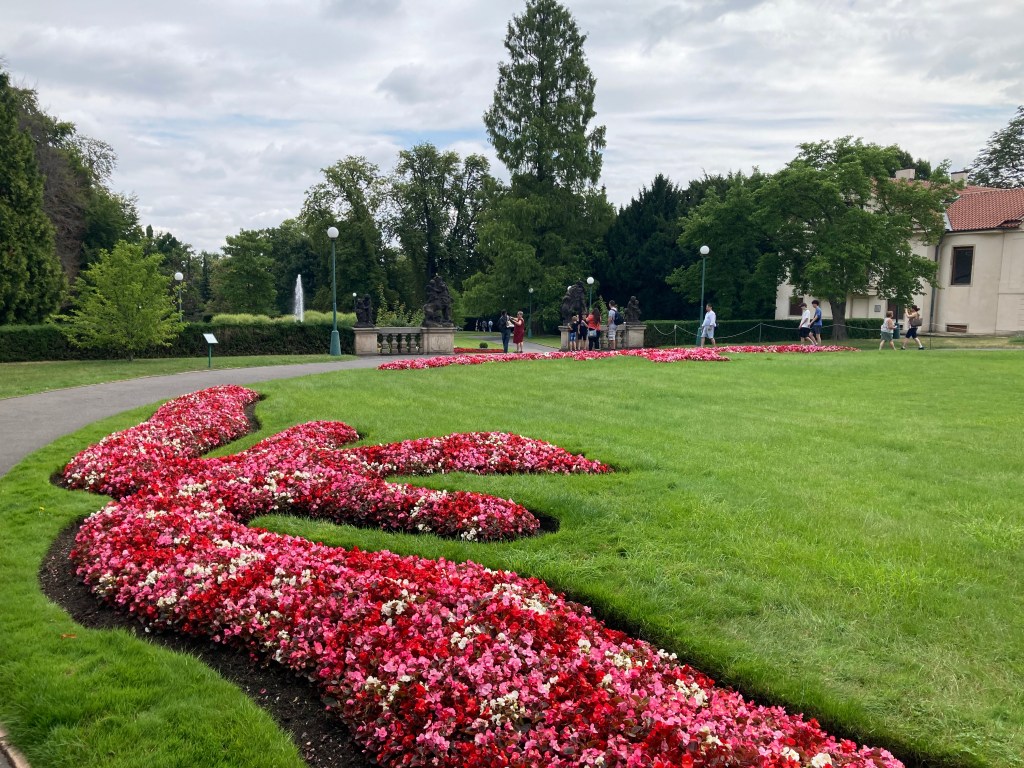
Monday 28 July 2025
We had a late start today, deciding to take it easy and wander through parts of the Old Town we hadn’t explored yesterday. Drifting down different lanes and side streets eventually brought us to the Charles Bridge, one of Prague’s most iconic landmarks.
Charles Bridge is a medieval stone arch bridge spanning the Vltava River. Construction began in 1357 under King Charles IV—famously at 5:31 a.m. on 9 July, a moment chosen for its numerically symmetrical sequence (1357 9/7 5:31), believed to bring strength and longevity to the structure. The bridge was completed in the early 15th century, replacing the older Judith Bridge (1158–1172), which had been heavily damaged in the devastating flood of 1342. Originally known simply as the Stone Bridge, it wasn’t officially called Charles Bridge until 1870.
For centuries, it was the only way to cross the Vltava, making it the vital link between Prague Castle on the west bank and the Old Town on the east. This single crossing helped establish Prague as a major trade route between Eastern and Western Europe, shaping the city’s economic and political importance.
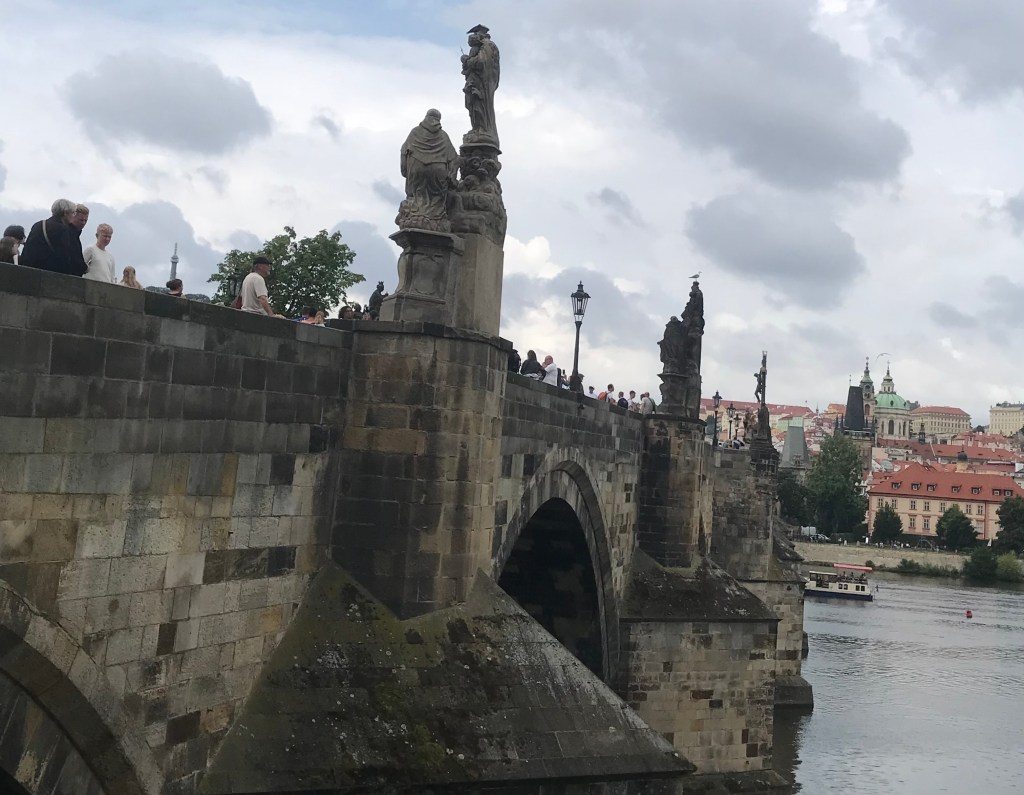
Today, the bridge is lined with 30 Baroque statues, added between the late 17th and early 18th centuries, each with its own story and symbolism. Street musicians, artists and vendors add to the atmosphere, making the bridge feel like a living stage set against the backdrop of the river and the city’s skyline.
The one below is called Calvary.
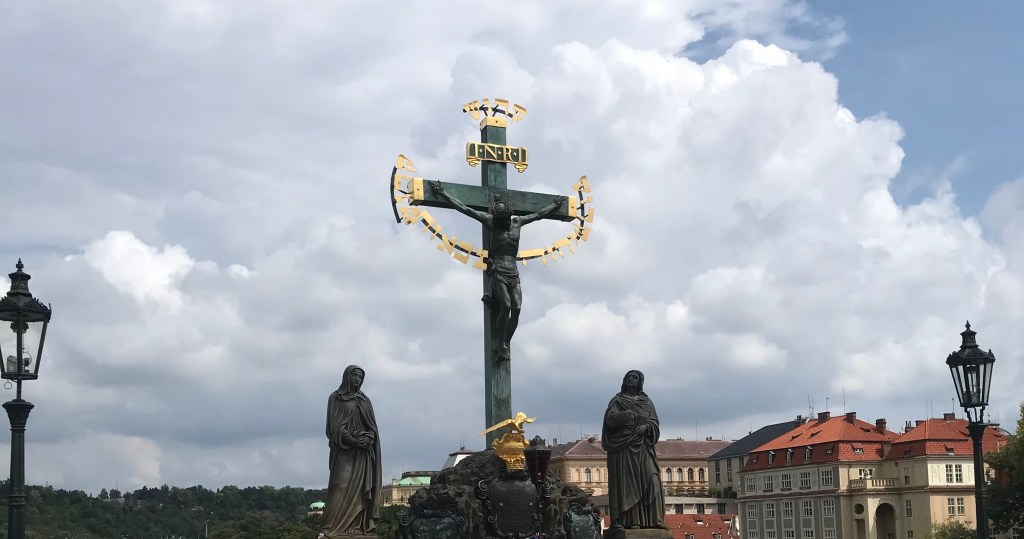
The Calvary stands on the third pillar of the north side of Charles Bridge and is one of the bridge’s most striking—and historically complex—sculptural groups. A cross has stood at this spot since the 14th century, as recorded in chronicles from the reign of Emperor Charles IV. The current bronze figure of Christ on the Cross was added in 1657, replacing earlier versions damaged by time and weather.
What makes this Calvary particularly distinctive is the large gilded Hebrew inscription encircling the crucifix. The words read: קדוש קדוש קדוש יהוה צבאות—“Holy, Holy, Holy is Jehovah of Hosts”—a line from Isaiah 6:3. The inscription was added in 1696 under troubling circumstances: a Jewish communal leader, Elias Backoffen, was forced to pay for it as part of a punishment after being accused of blasphemy. The episode remains a reminder of the difficult and often unequal relations between Prague’s Christian authorities and its Jewish community in earlier centuries.
Over time, the Calvary has become one of the most photographed and discussed sculptures on the bridge—not only for its dramatic visual presence but also for the layered history it represents. Today, interpretive plaques help visitors understand both its artistic value and the complex story behind its creation.
You can feel the city open up from the Charles Bridge—those sweeping views of the Old Town’s rooftops, church spires and winding streets on one side, and the silhouette of Prague Castle rising above the river on the other. It’s one of those spots where the whole character of Prague seems to unfold in front of you, layer by layer, with every step across the span.
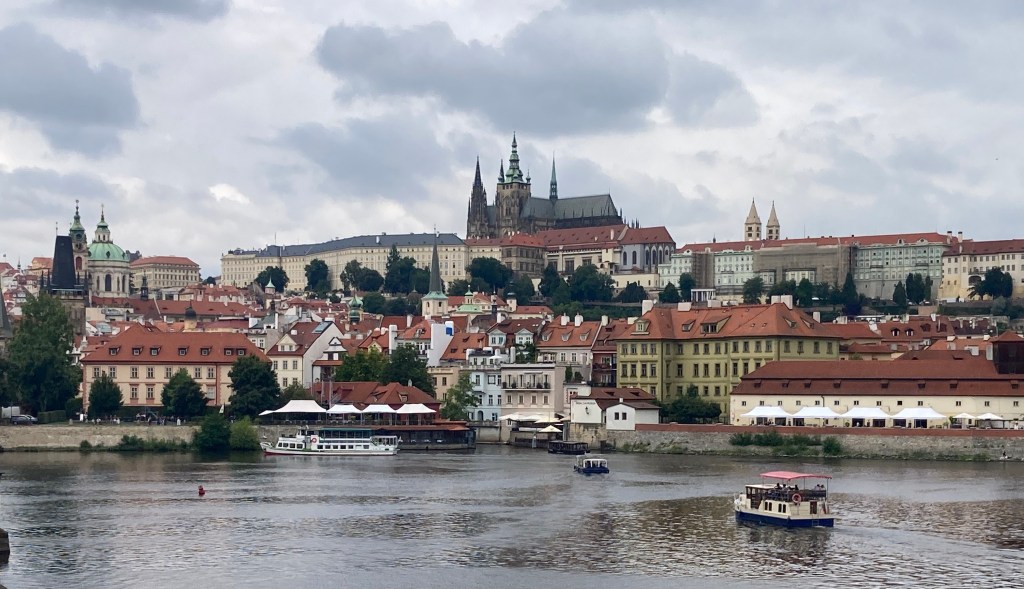
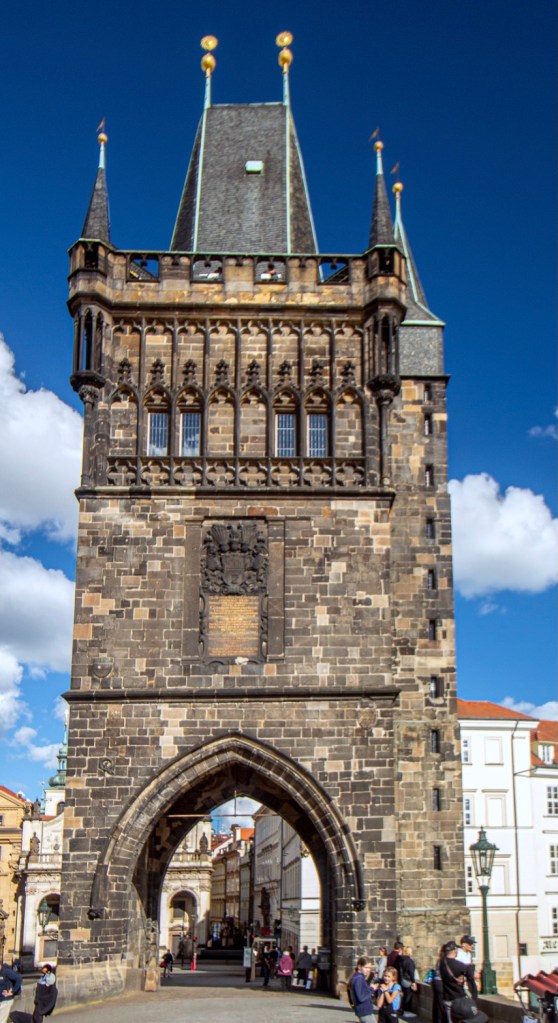
Its façade is richly decorated with statues of Charles IV, Wenceslaus IV, and the patron saints of Bohemia, along with intricate stonework that once served as a symbolic statement of royal power. From the bridge, the tower rises like a dark, elegant sentinel, framing the view toward the Lesser Town and the castle beyond.
Today, it remains one of the most photographed landmarks in Prague—a dramatic Gothic gateway that signals the start of one of Europe’s most storied bridges.
Tonight we had dinner at Restaurant Golem, a Jewish‑Czech restaurant whose menu blends the flavours and traditions of both cultures. The food was excellent—comforting, generous and full of character—and we enjoyed it so much that we’ve already decided to return tomorrow for our final evening in Prague. The staff were wonderfully friendly and welcoming, which added to the whole experience.
Inside the restaurant stands an unusual statue that immediately caught our attention. When I asked our young waitress about it, she explained that it represents the Golem, the legendary figure from Jewish folklore. She told the story with real affection, saying her grandmother used to share these tales with her when she was growing up. It was clear the legend is part of her own family’s heritage, not just something she learned for work.
The restaurant sits in the heart of Prague’s Jewish Quarter, making the presence of the Golem especially fitting. Between the warm service, the rich cultural history and the excellent food, it’s a place we can genuinely recommend.
GOLEM
The most famous version of the Golem legend centres on Rabbi Judah Loew ben Bezalel, the revered 16th‑century rabbi of Prague known as the Maharal. According to tradition, he fashioned a Golem from clay taken from the banks of the Vltava River, bringing it to life through sacred rituals and Hebrew incantations. The creature’s purpose was to defend the Jewish community of Prague from antisemitic violence and the threat of expulsion under Emperor Rudolf II.
The Golem was called Josef, or Yossele, and stories describe him as possessing extraordinary abilities—he could become invisible, summon spirits and carry out tasks with superhuman strength. To control him, Rabbi Loew placed a shem—a small tablet or scroll inscribed with a holy name—into the Golem’s mouth. This shem animated the creature and allowed it to obey its creator’s commands. Each Friday evening, before the Sabbath began, the rabbi would remove the shem to let the Golem rest.
One tale says that Rabbi Loew once forgot to remove the shem and feared the Golem might inadvertently violate the Sabbath. Another version tells of a Golem who fell in love and, when rejected, became violent. In many retellings, the creature eventually spirals out of control, forcing the rabbi to remove the shem and deactivate him. The Golem collapsed into lifeless clay, and his remains were said to be stored in the attic of the Old New Synagogue, ready to be revived if the community ever needed protection again.
For those curious to explore the legend further, more information is available through Prague City Tourism’s page on the Golem.
Tuesday 29 July 2025
Today was our last day in Prague, and with the rain setting in—and having already seen everything we’d planned—we decided to spend the day touring the city the way locals do: by tram. We’ve done this in other cities, and it’s always a fascinating way to see how real life unfolds beyond the tourist areas.
We spent around four hours riding different routes, hopping from tram to tram to cover as much of Prague as we could. Route 22 took us all the way to the end of the line, and the further we travelled, the more the scenery shifted. The neighbourhoods became noticeably poorer, with rows of ageing apartment blocks reminiscent of government housing back home in Australia, and a fair amount of graffiti and neglect.
In complete contrast, the end of Route 2 carried us into the northwest of the city, where the atmosphere changed entirely. This area felt far more affluent—well‑kept buildings, tidy streets, and a general sense of prosperity. It was striking to move from one extreme to the other within the same city, simply by following the tram tracks.
Other routes offered a mix of everything in between, giving us a broader sense of Prague beyond the postcard views. It’s an eye‑opening way to understand a place—seeing the everyday rhythms, the lived‑in suburbs, and the contrasts that don’t appear in guidebooks.
And one unexpected bonus: public transport is free for our age group in Prague, making the whole adventure not only interesting but wonderfully easy.
Wednesday 30 July 2025
Today we travelled from Prague to Kraków, Poland. We’re only staying in Kraków for two nights, as this part of the trip is focused on visiting the Wieliczka Salt Mine and Auschwitz‑Birkenau, the largest of the German Nazi concentration camps.
Once again, our train configuration was changed, and we found ourselves in one of the old‑style six‑seat compartments. Fortunately, we shared the space with two couples travelling together, which made the five‑and‑a‑half‑hour journey pass quickly. Having people to chat with always makes these longer trips feel lighter.
On arrival in Kraków, we headed straight to the Hotel Mercure Kraków Stare Miasto, checked in, and decided to keep things simple by having dinner in the hotel restaurant. The trip down from Prague had been surprisingly tiring, so it was a quiet meal and then straight to bed.
Tomorrow will be a long and emotional day—we depart the hotel at 06:15 for a full‑day tour and won’t return until around 19:00—so that’s all for today.
Thursday 31 July 2025
Today it was only Maree who visited the Wieliczka Salt Mine and Auschwitz‑Birkenau. I didn’t sleep well last night and woke up coughing, sneezing and with a pounding headache, so I thought it best to stay in bed and rest—both for my own sake and so I didn’t alarm anyone by looking contagious. At the same time, I didn’t want Maree to miss out on these important visits, and of course she was keen to go, so she got up early and joined the tour group for the full day.
I’ve never been to the salt mines myself, but I have visited Auschwitz‑Birkenau before, during a work trip to Warsaw in the early ’90s. I had a free weekend and took the opportunity to travel to Kraków and see the site, so I know how significant and confronting the experience can be.
So today’s photos and notes are all from Maree. I’ve simply typed everything up for the blog, and I hope you enjoy following along with her day’s adventure.
The first stop for Maree was the Wieliczka Salt Mine.
The Wieliczka Salt Mine
This mine is in the town of Wieliczka, near Kraków in southern Poland.
From Neolithic times, people in this region produced table salt from naturally rising brine, but the Wieliczka Salt Mine as we know it began to take shape in the 13th century. Remarkably, it continued producing salt without interruption until 1996, making it one of the oldest continuously operating salt mines in the world. For most of its history, the mine was run by the Kraków Salt Mines company, but falling salt prices and increasing problems with flooding eventually brought commercial mining to an end.
The mine itself is extraordinary in scale. It reaches a depth of 327 metres and stretches through more than 287 kilometres of tunnels, chambers and passageways. The rock salt is naturally grey—more like rough granite than the white crystals most people imagine—giving the underground world a surprisingly rugged, stone‑like appearance.
Along the visitor route, which covers about 3.5 kilometres, there are chapels, sculptures and reliefs carved entirely from salt by miners over the centuries. The mine also contains an underground lake and a series of exhibits that trace the long history of salt production in the region. It’s a place where geology, labour, artistry and legend all meet far beneath the surface.
With all that history in mind, Maree began her descent into the mine—hundreds of steps down into a world carved entirely from salt. From here on, the experience becomes hers, and the details, photos and impressions that follow are all through her eyes.
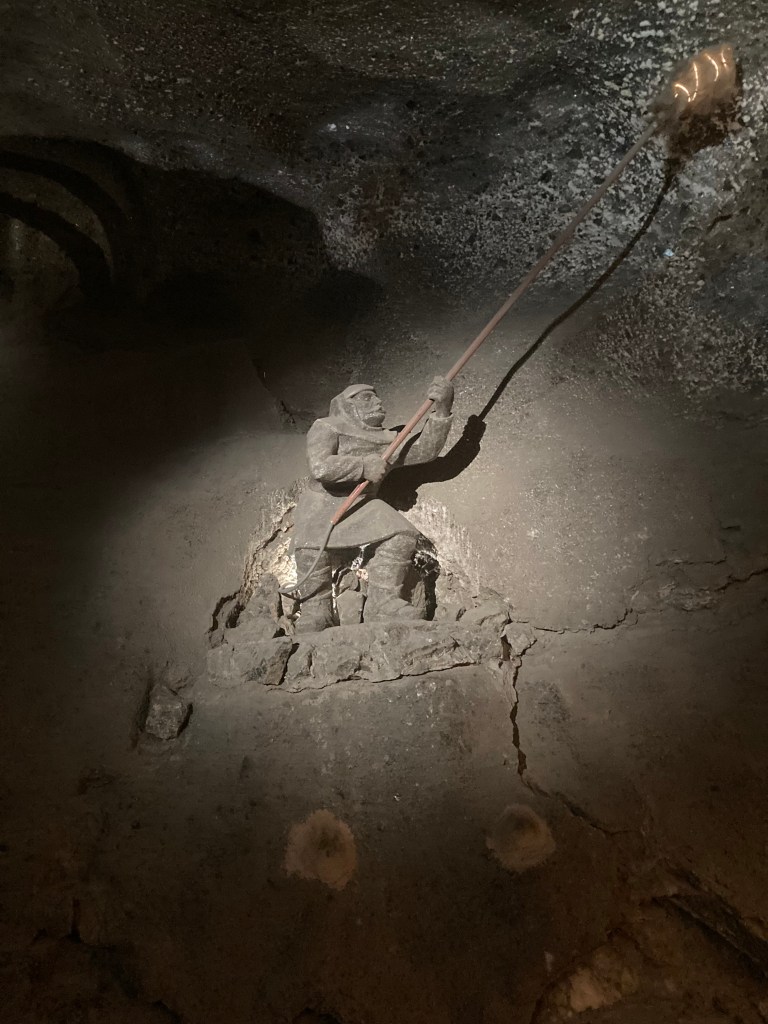
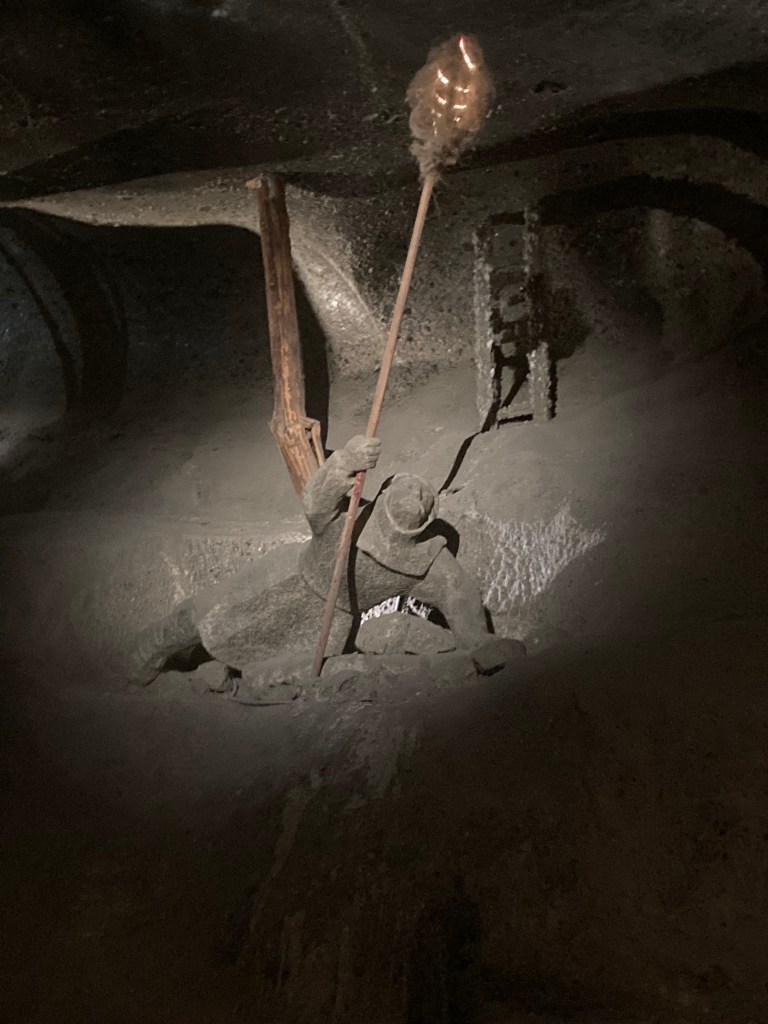
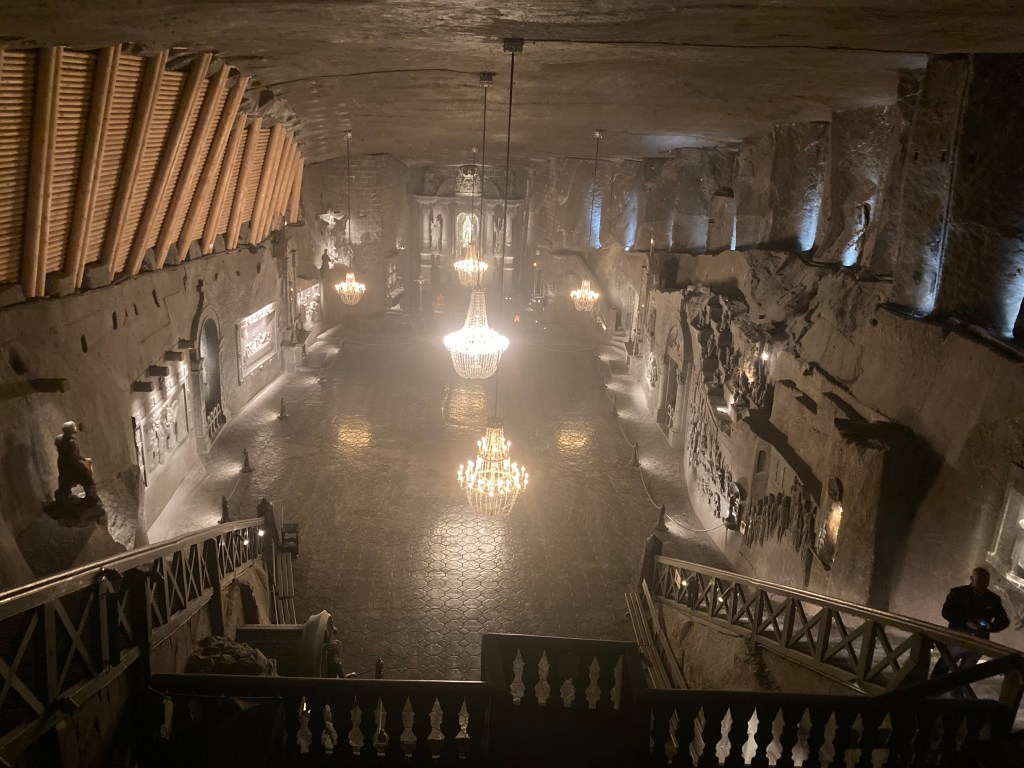
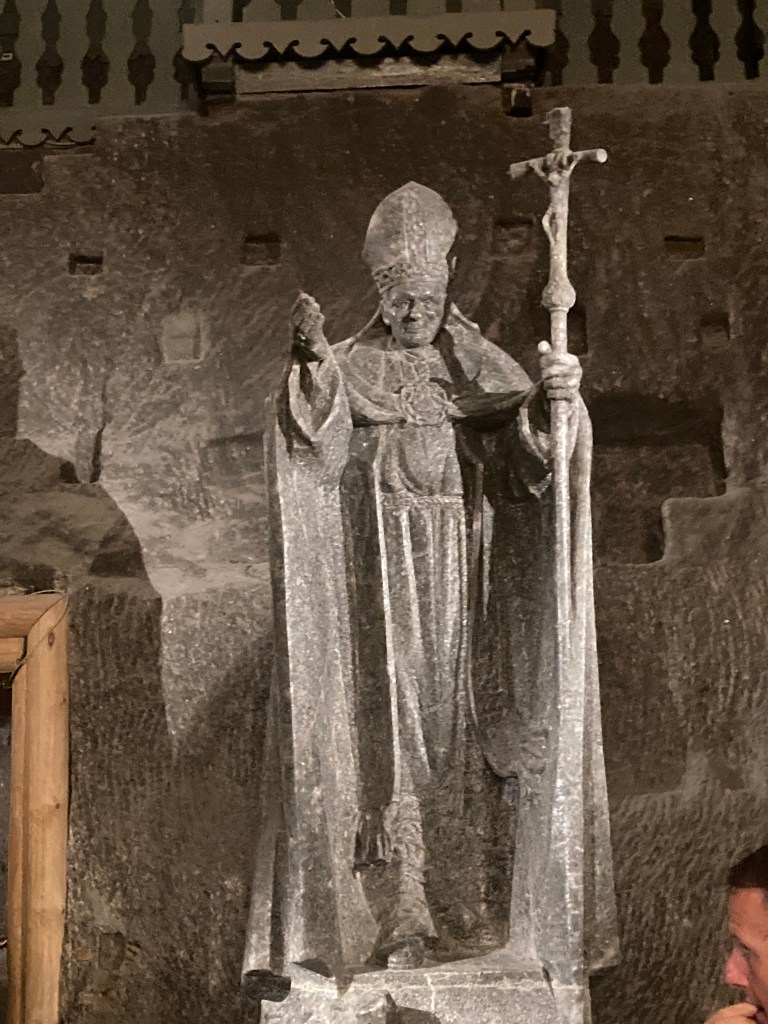
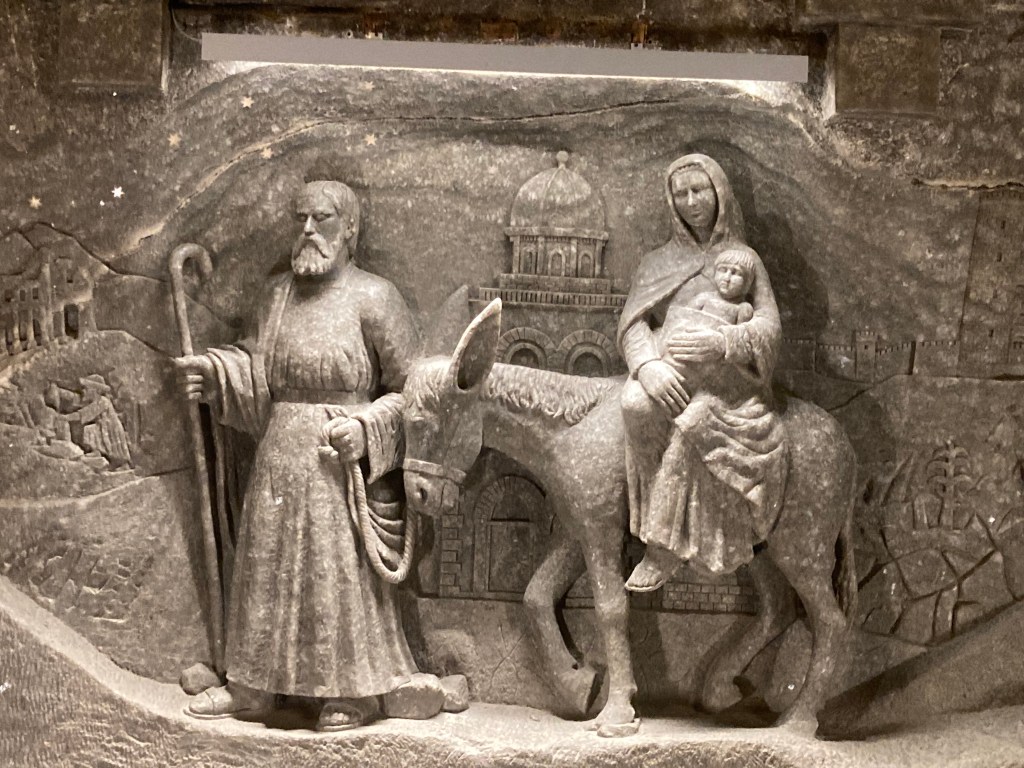
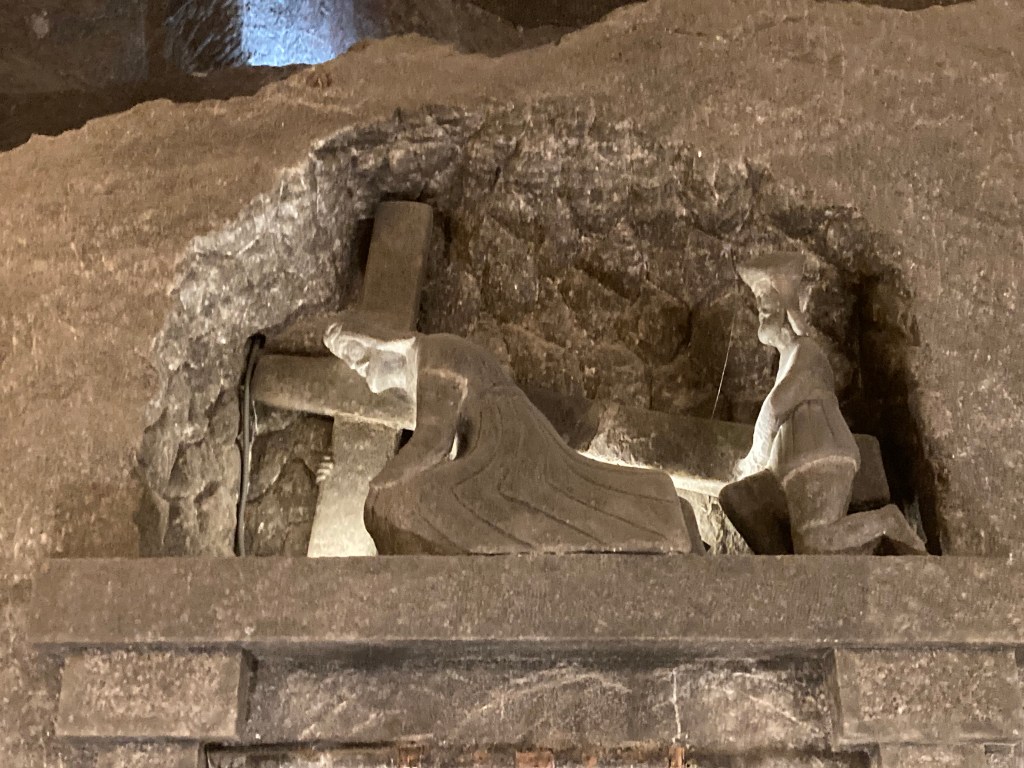
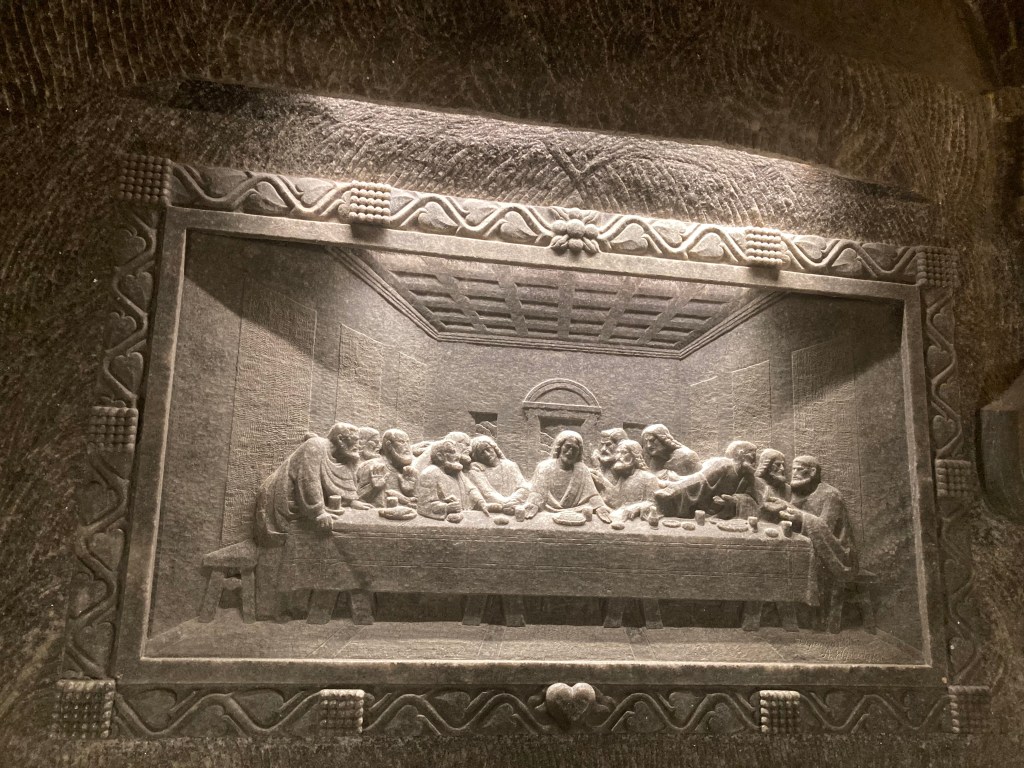
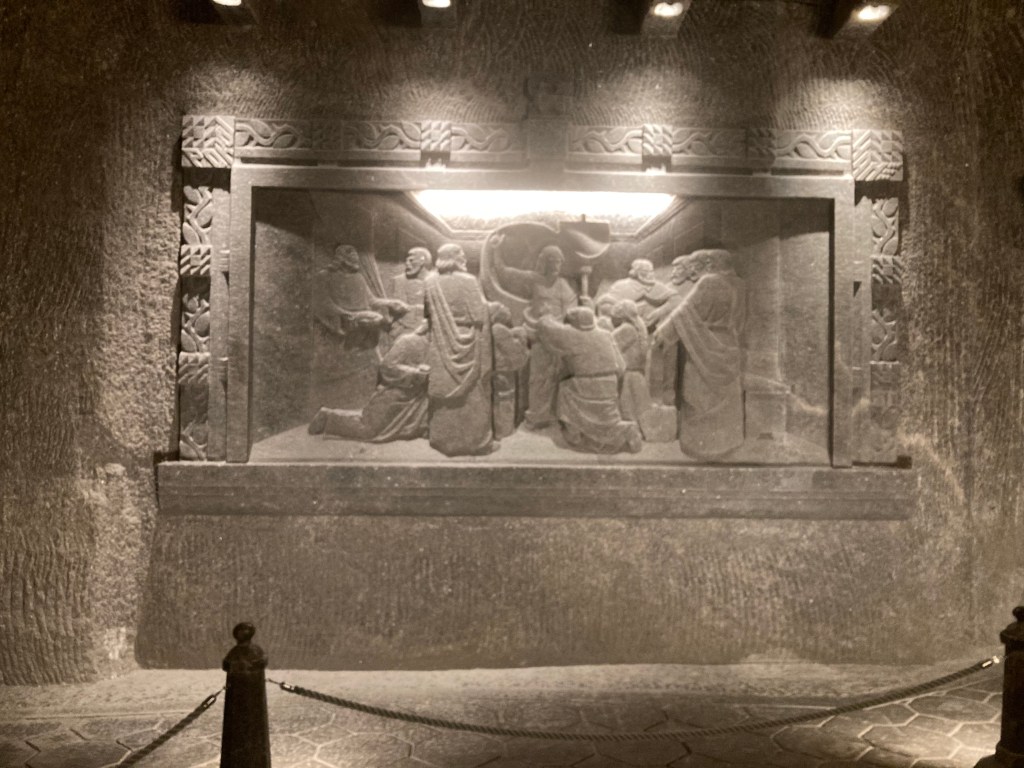
As I made my way through the Wieliczka Salt Mine, I learned just how deep its history runs. Salt has been part of life here since Neolithic times, when people collected brine that naturally welled up to the surface. By the 13th century, miners had begun digging the first shafts to extract solid rock salt, and not long after, the Saltworks Castle was built to oversee the growing industry. Today, that legacy lives on in the Kraków Saltworks Museum, right here in Wieliczka.
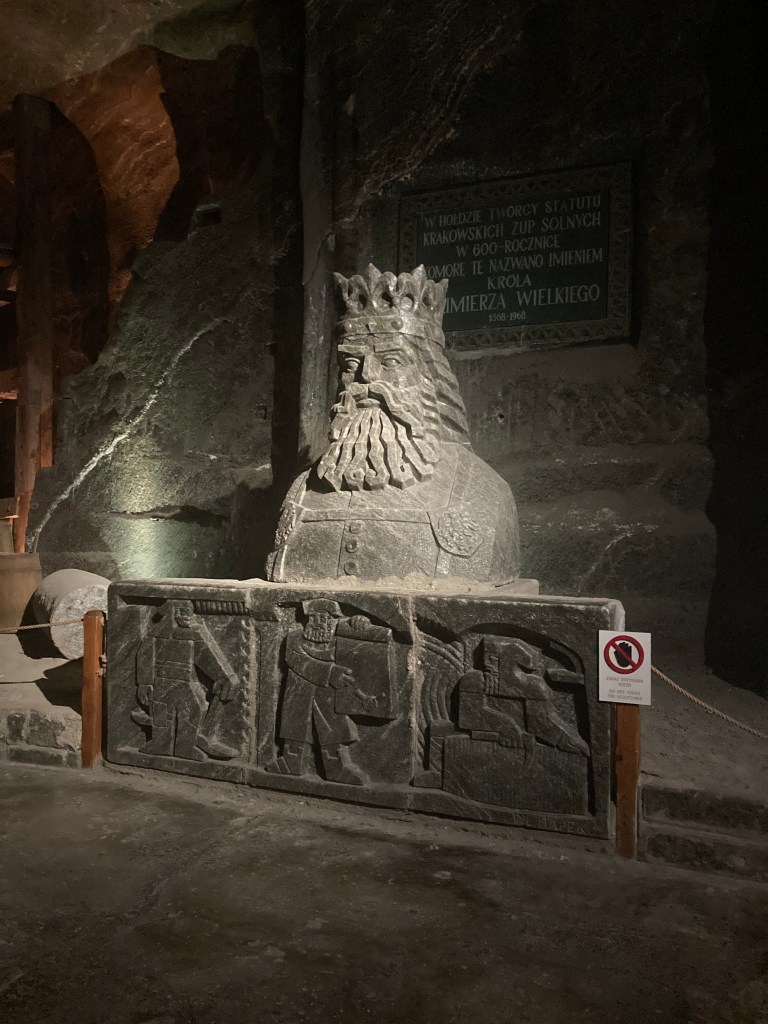
Much of the mine’s early development is credited to King Casimir III the Great, who granted the mine special privileges and placed the miners under his protection. In 1363, he even founded a hospital near the site. They say he “turned a Poland of wood into a Poland of stone,” because so much timber from nearby forests was used to support the mine’s expanding tunnels.
By 1871, Wieliczka was considered one of the most productive salt mines in the world. Scientific American at the time described three distinct types of salt found here:
Green salt, opaque and mixed with clay
Spiza salt, sandy and crystalline
Szybik salt, the purest and clearest of all
Walking through the chambers, I could see how the mine evolved over the centuries. Early on, miners relied on ingenious devices like the Hungarian horse treadmill and the Saxon treadmill to haul salt to the surface. By the late 19th century, machine drills and blasting had taken over, carving out the vast spaces that now form the visitor route.
The mine also carries a darker history. During World War II, the occupying German forces attempted to convert parts of the mine into an underground armaments factory. Between August and October 1944, Jewish prisoners from the Plaszow and Mielec camps were forced into hard labour here. The factory never became operational, as the Soviet advance halted the project, but the suffering endured underground remains part of the mine’s story.
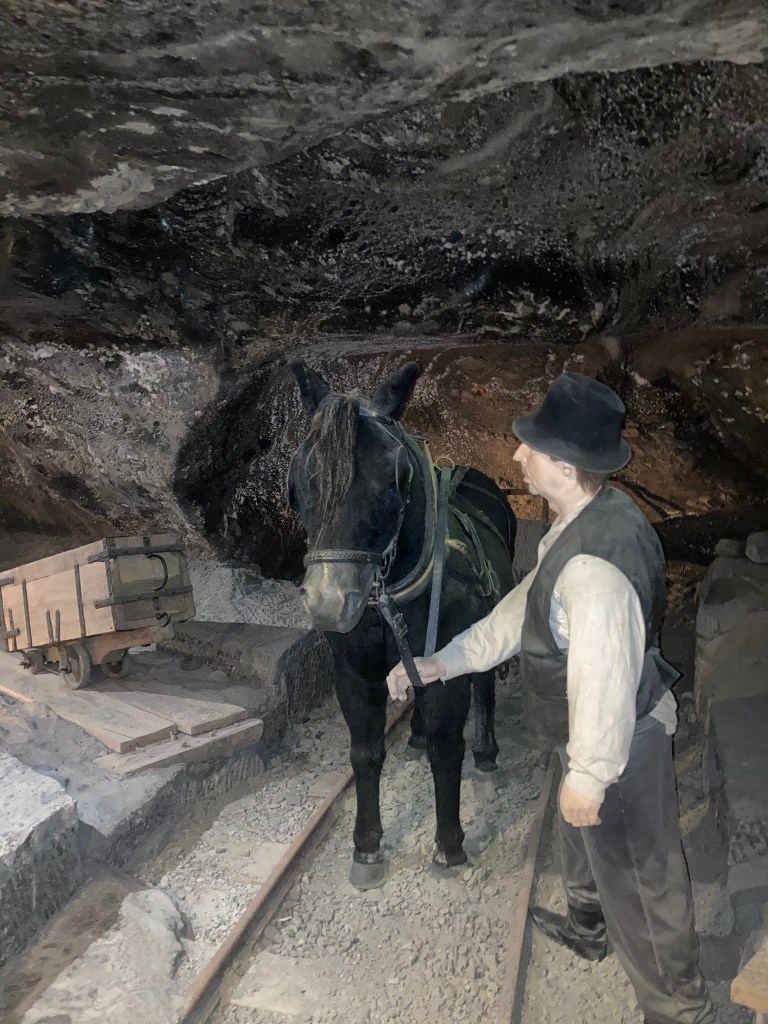
Today, Wieliczka is recognised as one of Poland’s official National Historic Monuments. In 2010, it was linked with the nearby Bochnia Salt Mine—Poland’s oldest—and together they now appear on the UNESCO World Heritage List as the Wieliczka and Bochnia Royal Salt Mines.
As photos do not really show the enormity of this salt mine, I strongly recommend you watch the video link below that was created by a Ben Robson in 2024 and is titled: Inside The WIELICZKA SALT MINE | Day trip from Krakow to see why this mine is definitely worth a visit. The video is well worth viewing.
After finishing the tour of the salt mine, I took a short break—much needed after all the walking. I’d already clocked almost 6,000 steps just inside the mine, and my legs were definitely feeling it. Once everyone had regrouped, we boarded the bus again for the 1.5‑hour drive to the town of Oświęcim, the site of Auschwitz‑Birkenau.
What follows is some of the history of this place, along with the photos I took during my visit.
As we arrived in Oświęcim, I was reminded that this quiet town holds one of the most devastating chapters in human history. Auschwitz was not a single camp but a vast network of more than 40 concentration and extermination camps created and operated by Nazi Germany in occupied Poland during World War II. The complex included:
- Auschwitz I, the original camp, built in former Polish army barracks
- Auschwitz II–Birkenau, the largest camp, designed for mass extermination
- Auschwitz III–Monowitz, a forced‑labour camp serving the IG Farben chemical works
- Dozens of smaller subcamps scattered across the region
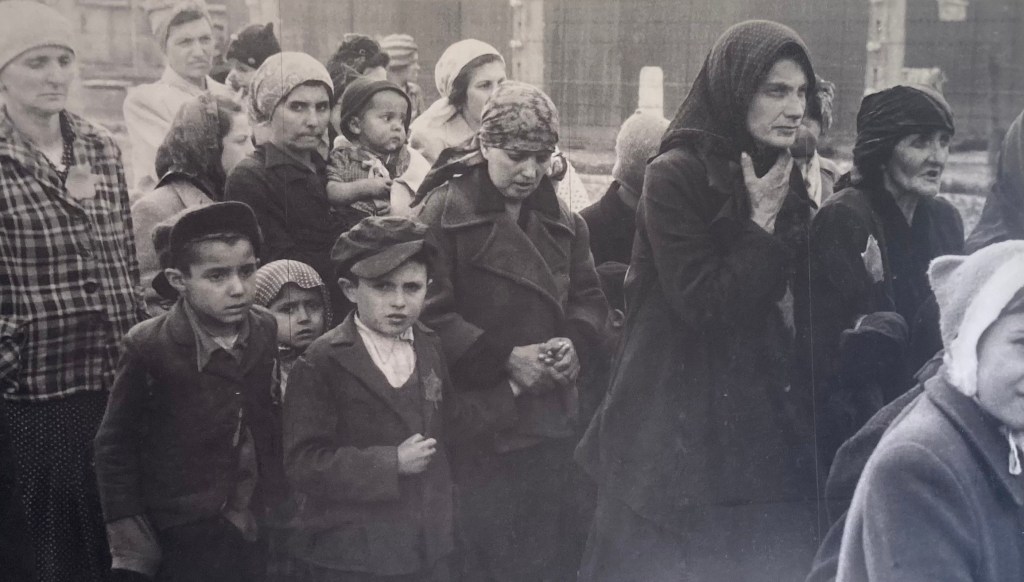
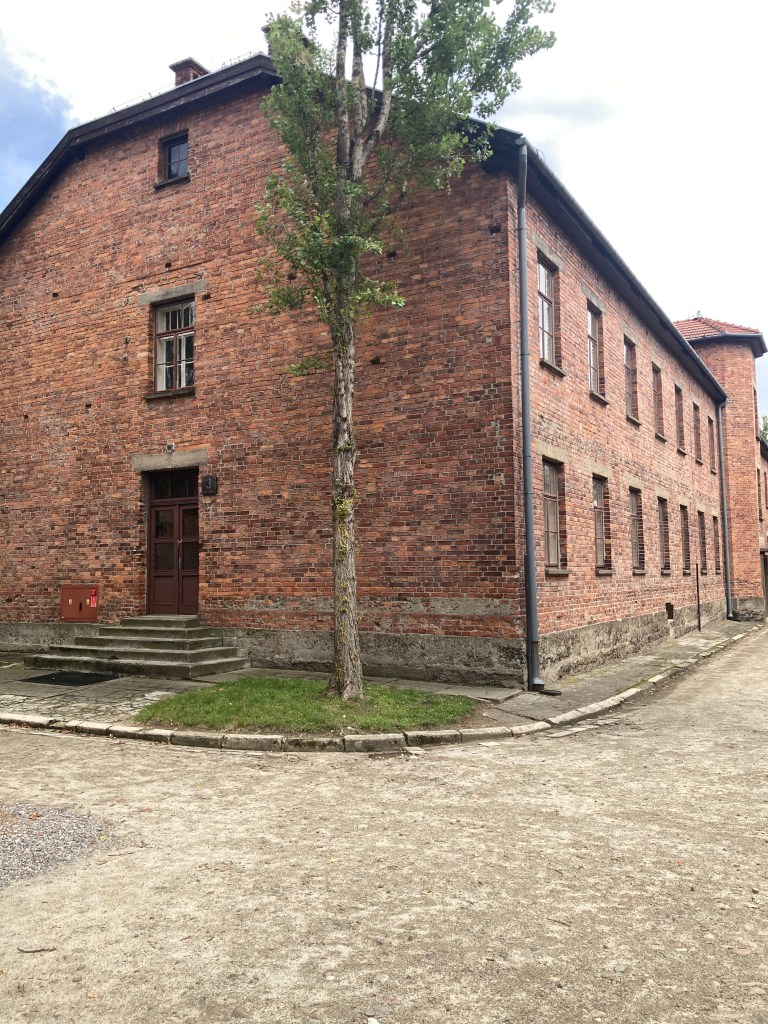
After Germany invaded Poland in 1939, the SS converted Auschwitz I into a prison for political detainees—mostly Poles, who made up the majority of prisoners in the early years. In 1940, German criminal prisoners brought in as overseers quickly established a regime of brutality. Beatings, torture and executions became routine, often for the smallest infractions.
The first gassings took place in 1941 in Block 11 of Auschwitz I, targeting Soviet and Polish prisoners. Construction of Birkenau began soon after, and from 1942 to late 1944, trains arrived daily carrying Jews from across German‑occupied Europe. Of the 1.3 million people deported to Auschwitz, 1.1 million were murdered. The victims included:
- 960,000 Jews
- 74,000 non‑Jewish Poles
- 21,000 Romani people
- 15,000 Soviet prisoners of war
- Up to 15,000 others
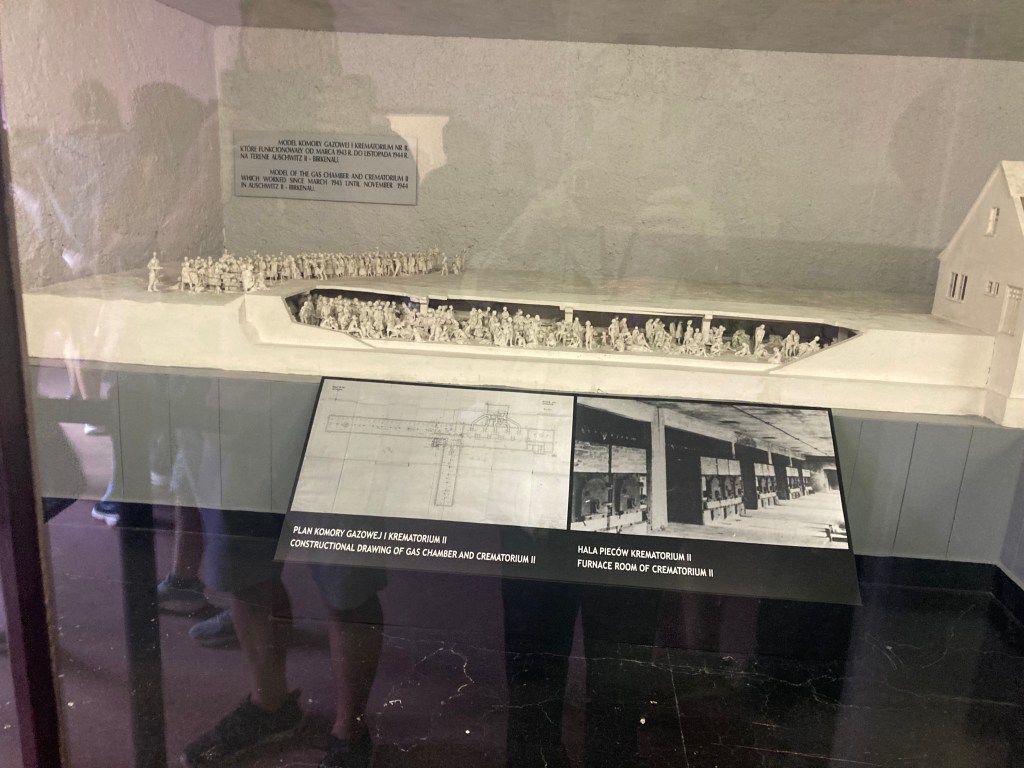
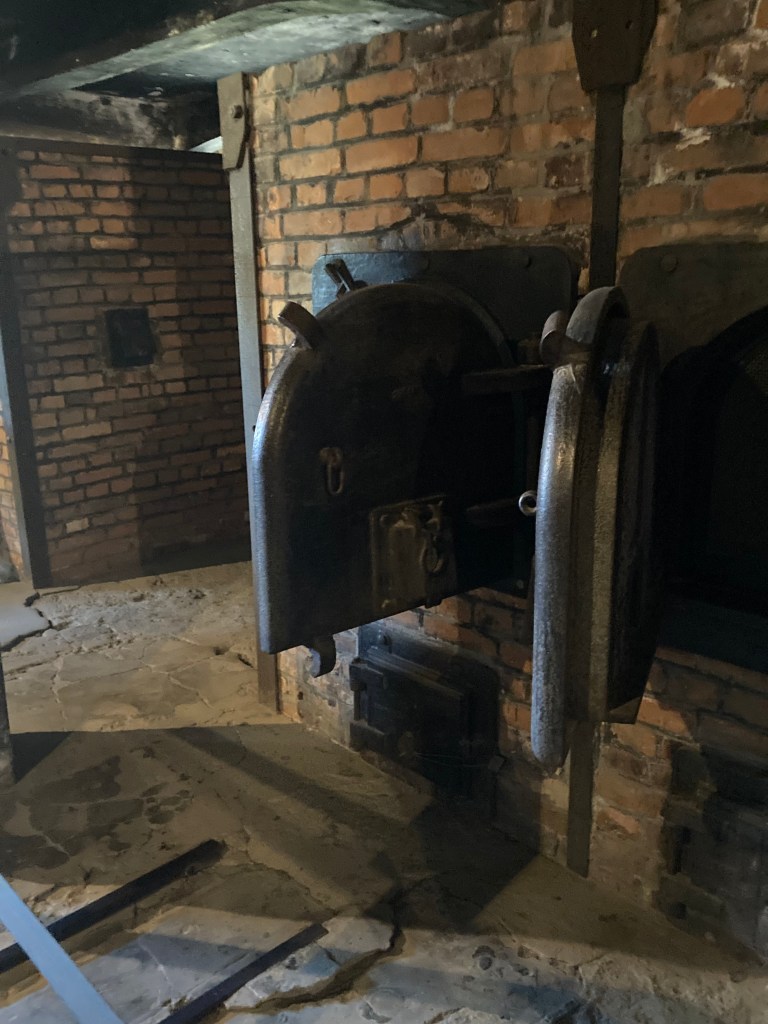
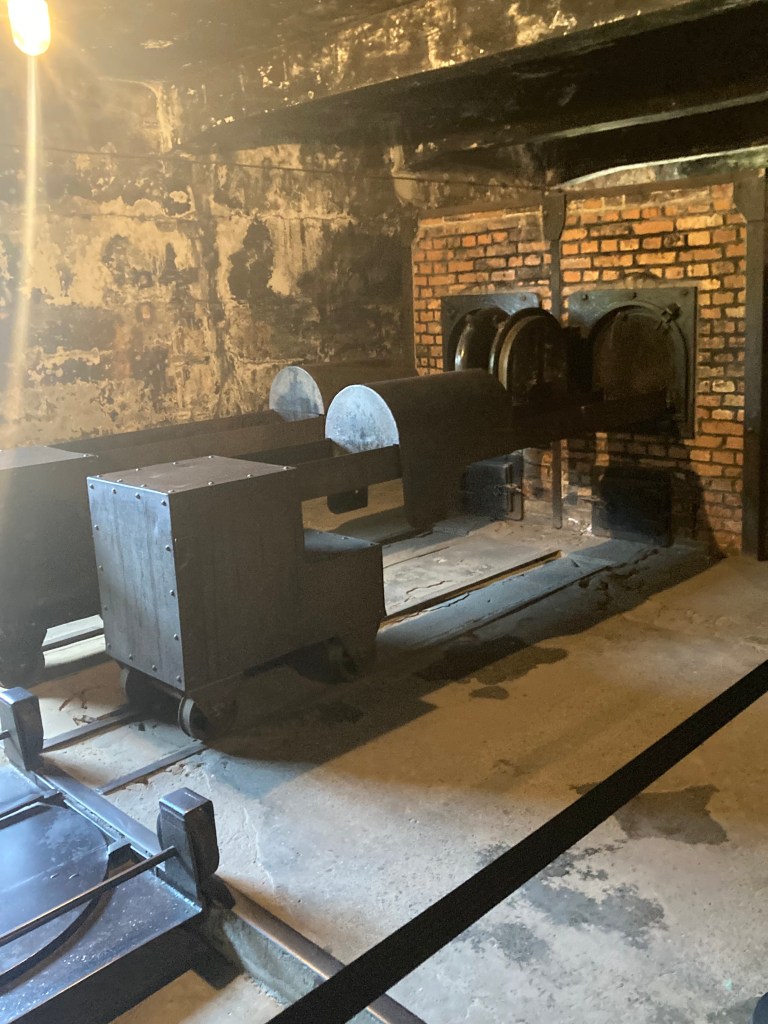
Those not killed immediately in the gas chambers faced starvation, disease, forced labour, medical experiments or execution. A few attempted escape—802 prisoners, with 144 succeeding. In October 1944, members of the Sonderkommando staged an uprising, but it was ultimately crushed.
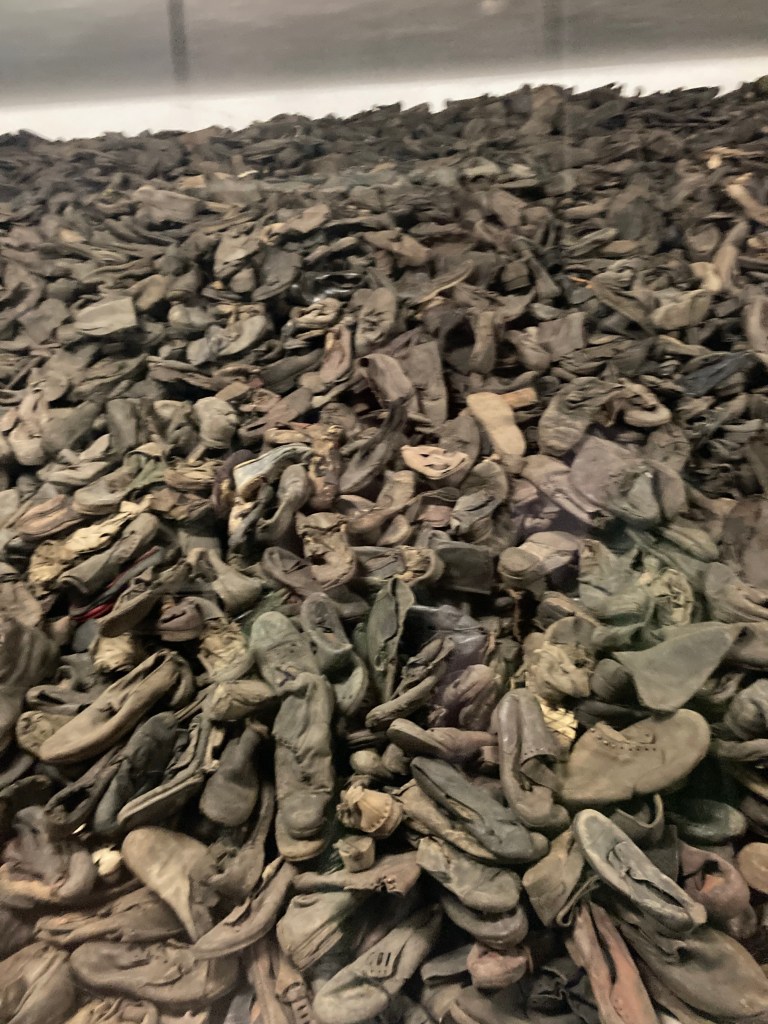
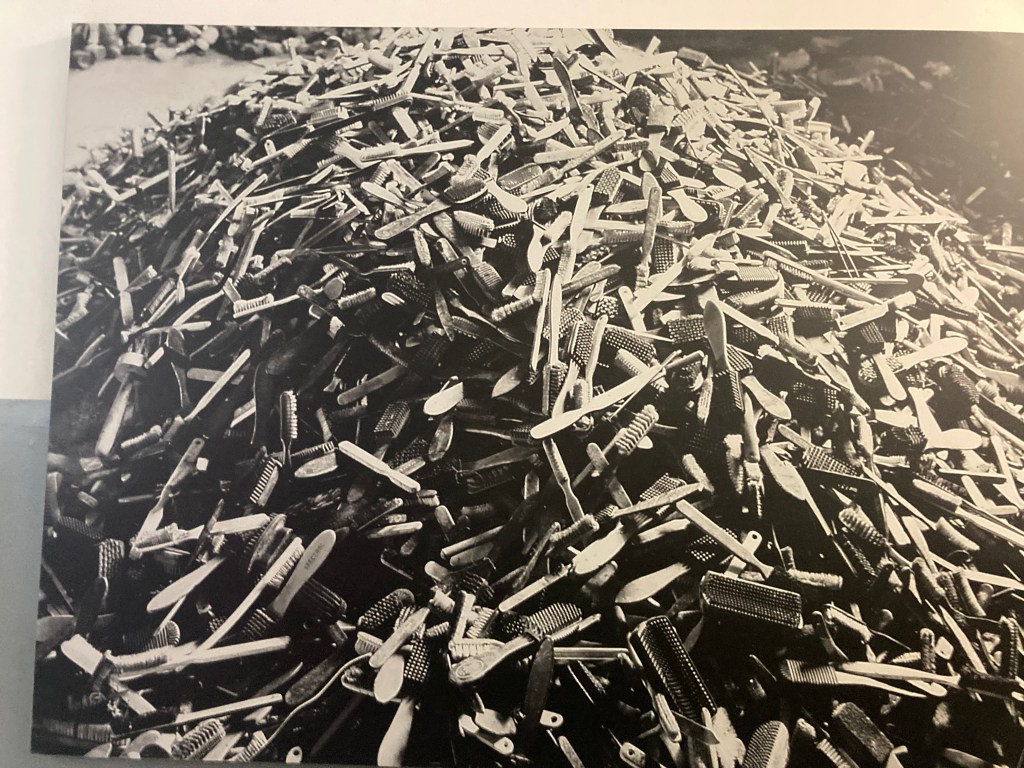
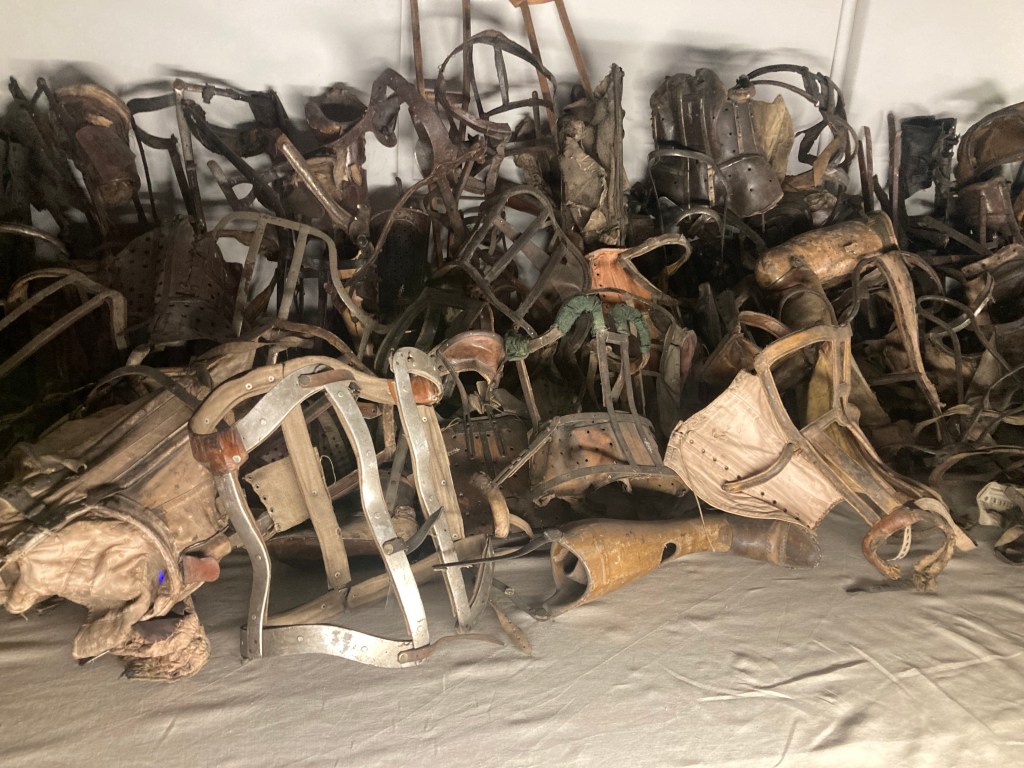
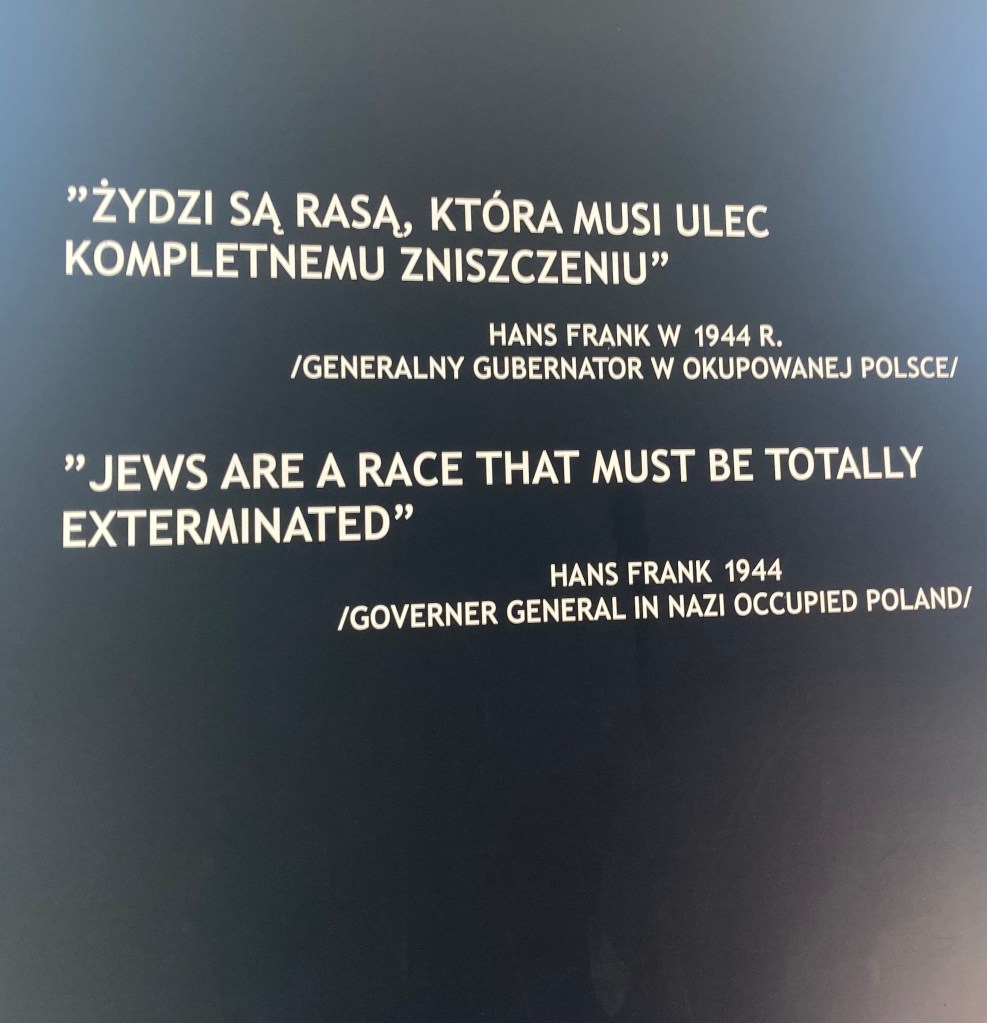
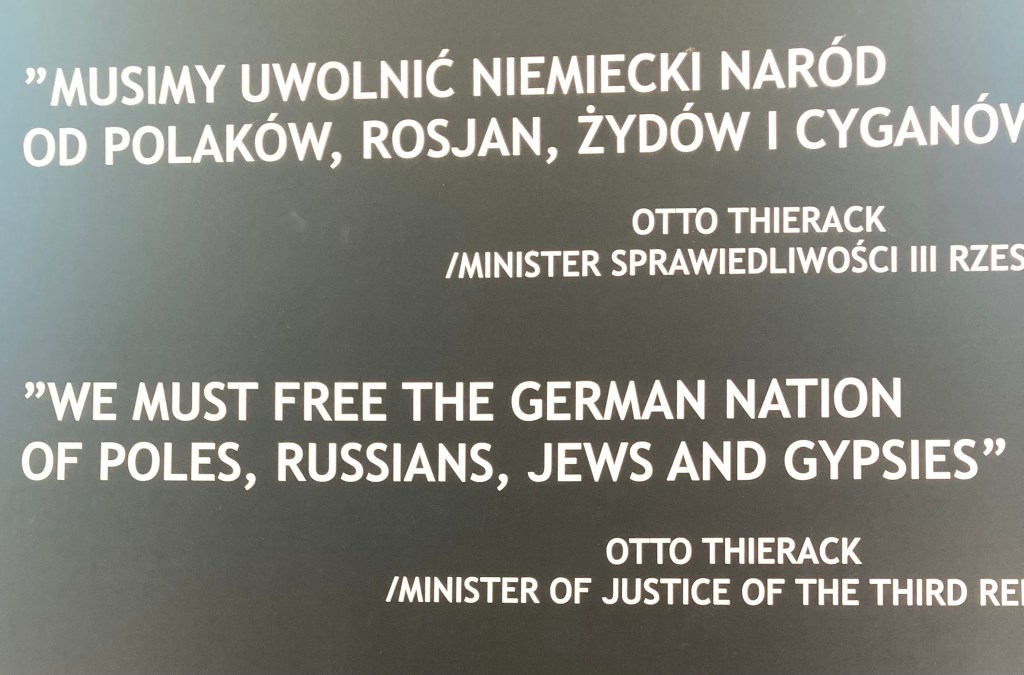
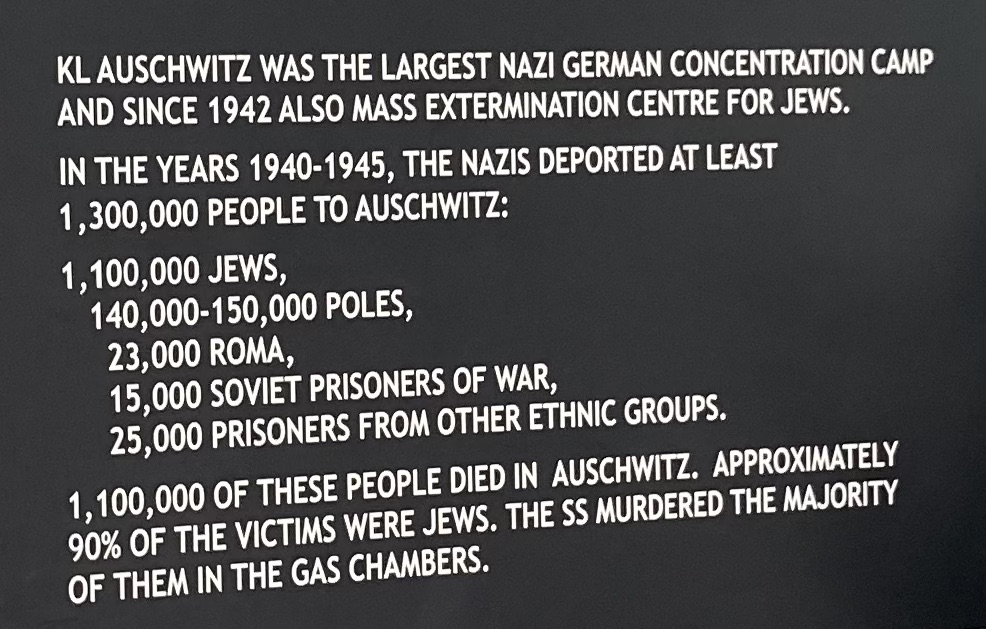
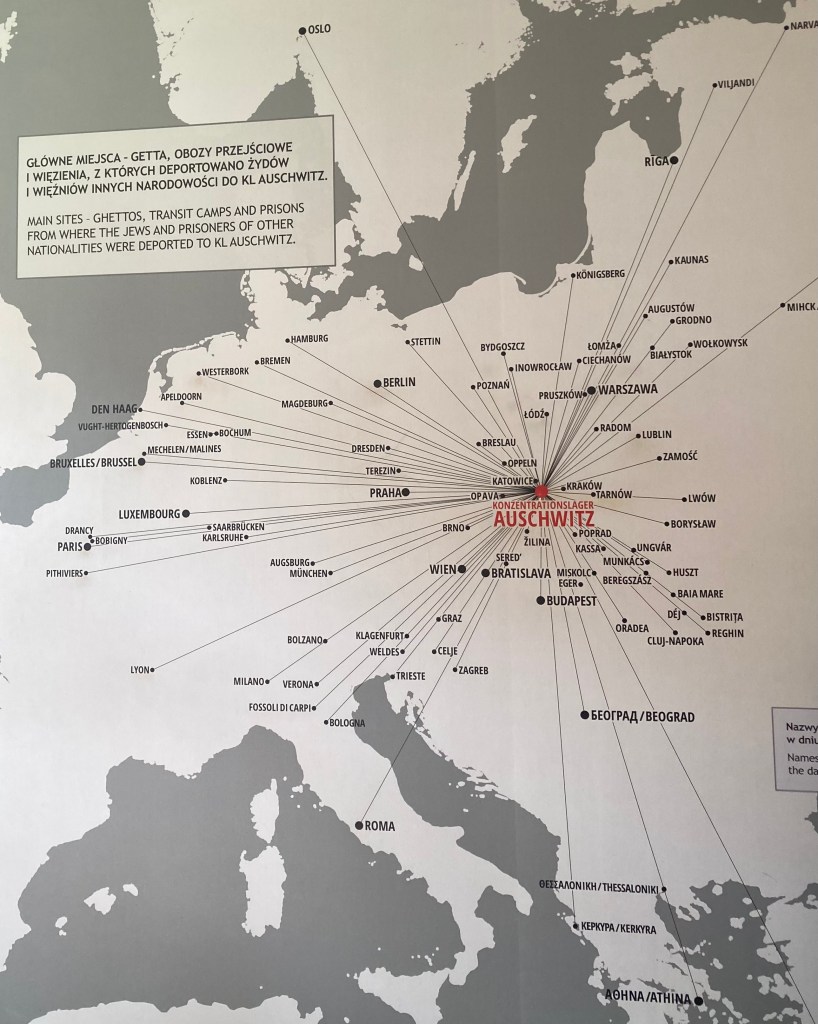
As the Soviet Red Army approached in January 1945, the SS forced most prisoners on death marches toward camps deeper inside Germany. Soviet troops liberated Auschwitz on 27 January 1945, a date now marked worldwide as International Holocaust Remembrance Day.
In the decades that followed, survivors such as Primo Levi, Viktor Frankl, Elie Wiesel and Edith Eger shared their testimonies, ensuring the world would not forget. In 1947, Poland established the Auschwitz‑Birkenau State Museum, and in 1979, the site was designated a UNESCO World Heritage Site. Today, Auschwitz remains the largest site of mass murder in a single location in human history—a stark reminder of the consequences of hatred and unchecked power.
I hope you find meaning in today’s reflections. Tomorrow brings another early start as we board the train for the seven‑hour journey to Budapest, Hungary.
Friday 1 August 2025
Today we left Kraków for Budapest on the 06:27 train. It rolled out only a minute behind schedule, but that tiny delay slowly grew—by the time we reached Břeclav, we were running 40 minutes late. Břeclav itself is a small Czech border town and a major railway junction, the kind of place where trains from Poland, Austria, Slovakia and Hungary all seem to cross paths. Unfortunately, our path didn’t quite line up: we missed our 10:55 connection to Budapest by a frustrating margin.
The next train wasn’t until 12:55, so we settled in for the wait. When it finally arrived, we boarded with relief—only for that train to also run late. Instead of pulling into Budapest at 16:28 as scheduled, we finally arrived at 17:30.
Thankfully, our hotel—T62 Hotel—was directly across from the Budapest Nyugati (Western) Railway Station, so it was only a short five‑minute walk to Reception. The staff were warm, friendly and incredibly helpful. As we checked in, the receptionist recommended a local Hungarian restaurant, Matula Bistro, saying her friends loved it even though she hadn’t tried it herself.
After a short rest, we headed out to find it. Matula Bistro turned out to be a cosy, welcoming spot with a relaxed neighbourhood feel. We ordered two beers and a main course each. Maree chose an arugula salad with chicken, while I went for a traditional Hungarian dish—paprika chicken with pasta. It wasn’t the most photogenic plate, but it was full of flavour and very satisfying.
A long travel day, but a good meal and a friendly welcome in Budapest made for a pleasant ending.
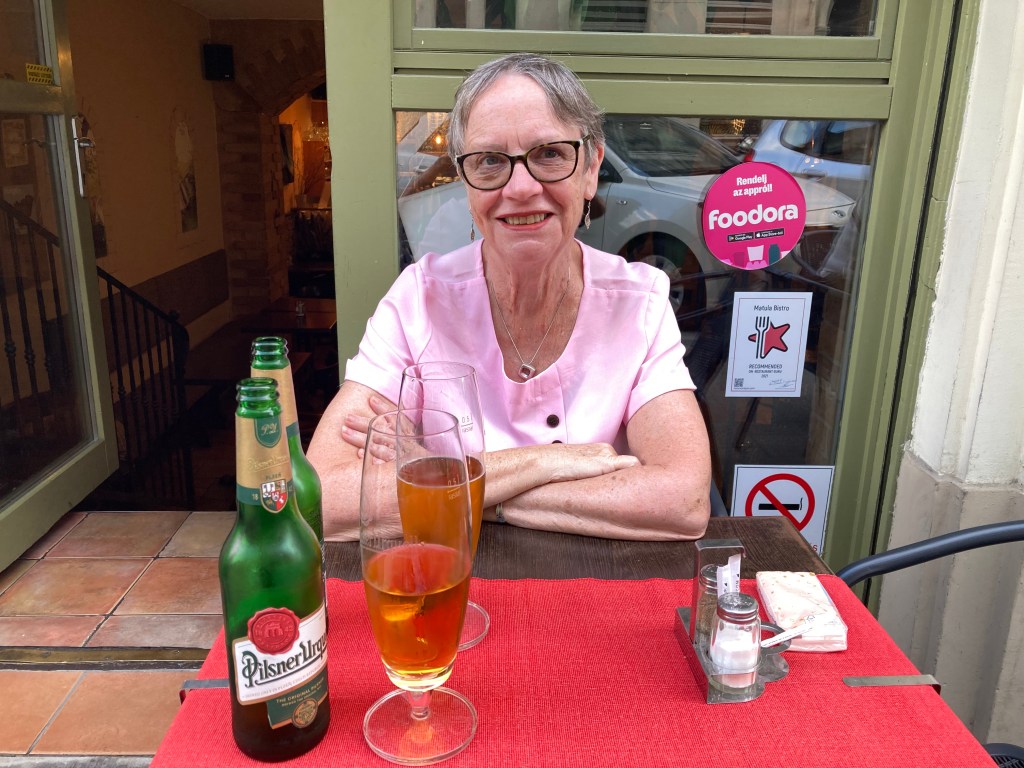
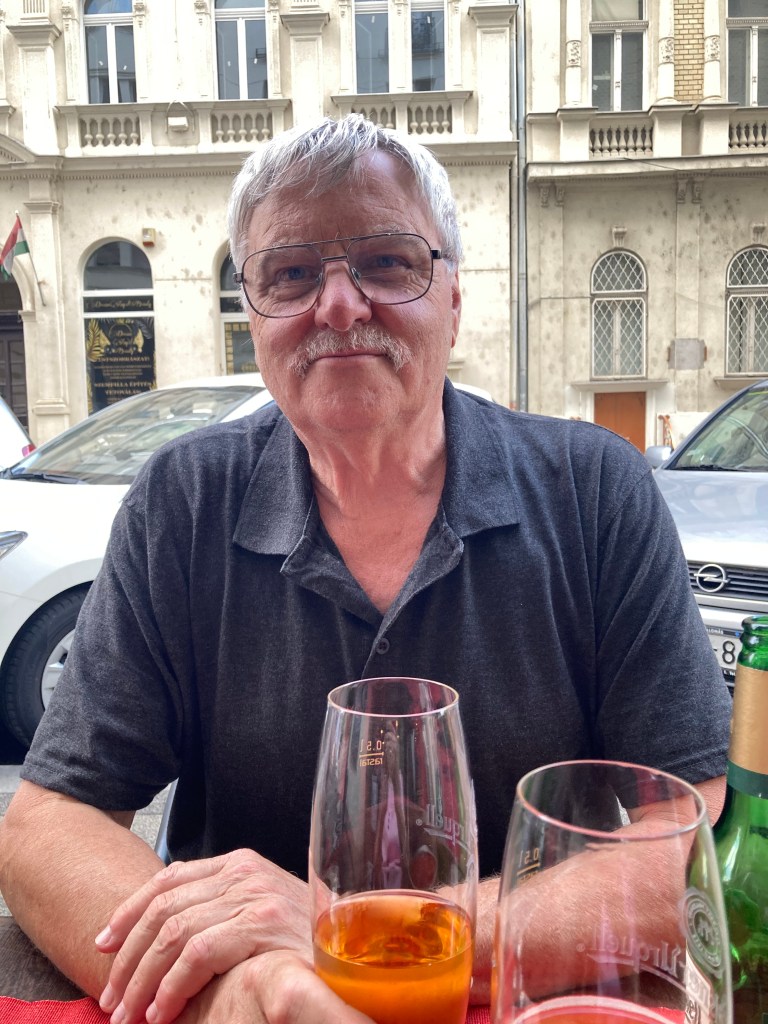
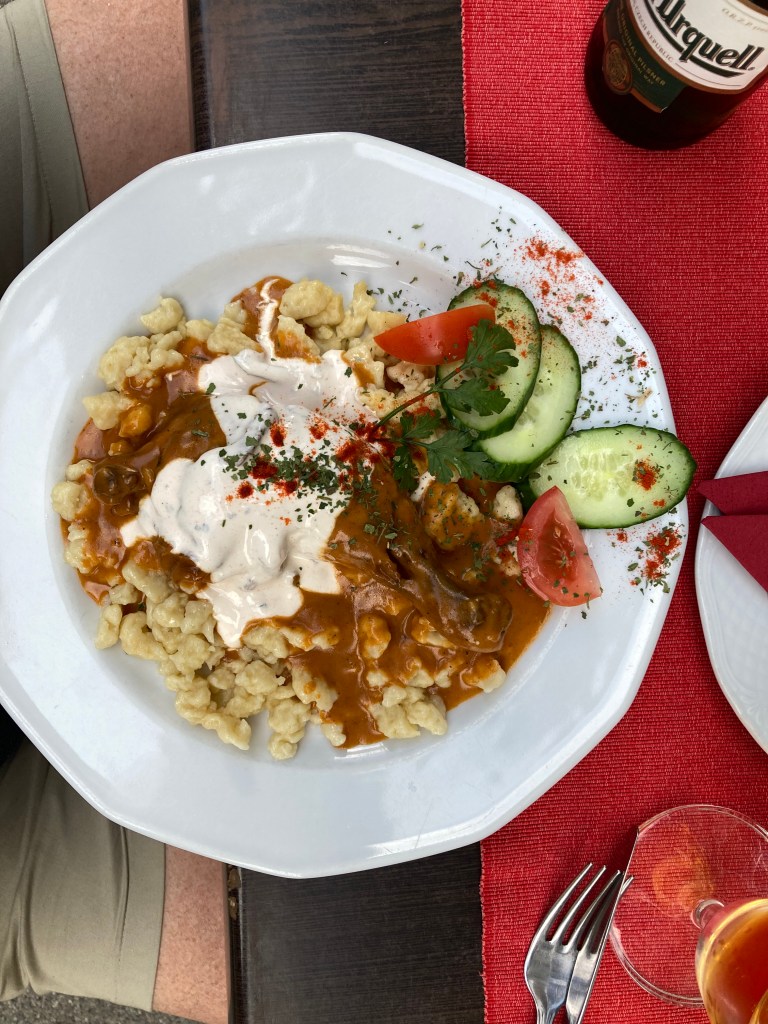
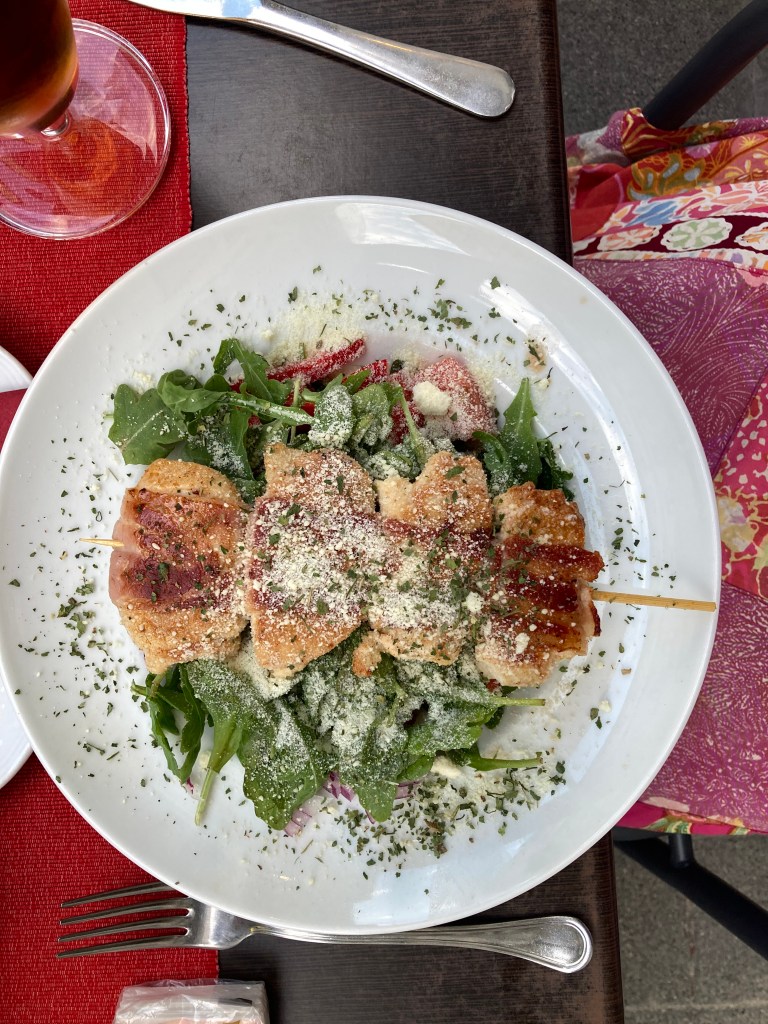
After such a long and tiring day—having been up since 05:00—we simply headed straight back to the hotel after dinner and called it a night. Getting our bearings in Budapest can wait until tomorrow, when we’ll be far more rested and ready to explore.
Saturday 2 August 2025
Today we set out on foot to explore Budapest, beginning with a walk through the city and a visit to the magnificent Hungarian Parliament Buildings, followed by a stroll along the banks of the Danube.
For anyone unfamiliar with the city’s origins, Budapest is actually the union of two historic towns—Buda and Pest—which were officially combined in 1873. Buda, on the western bank of the Danube, is the hilly, older and more residential side, crowned by the castle district. Pest, on the eastern bank, is the lively, flat and bustling heart of the city, filled with grand boulevards, cafés, markets and government buildings. Before unification, the area was sometimes referred to as Pest‑Buda, though the modern name flows much better.
Our walk took us down to the Hungarian Parliament, one of Europe’s most striking legislative buildings. Sitting proudly in Kossuth Square on the Pest side of the river, it dominates the eastern bank of the Danube with its neo‑Gothic spires, sweeping façade and enormous central dome. It’s not only the seat of Hungary’s National Assembly but also one of the city’s most iconic landmarks—instantly recognisable and endlessly photographed.
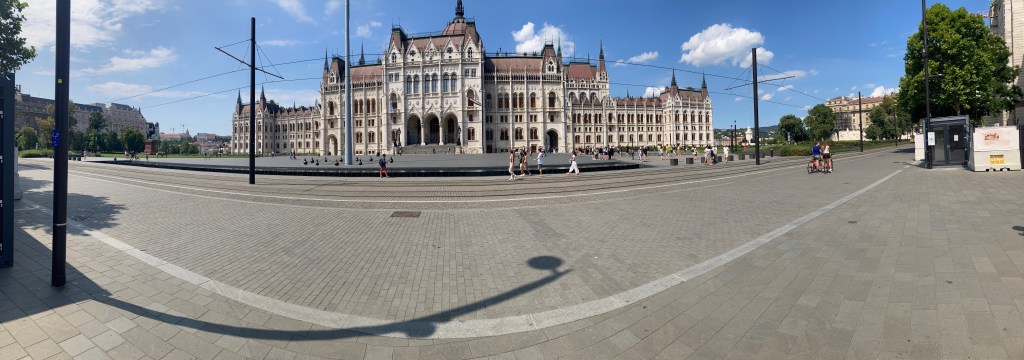
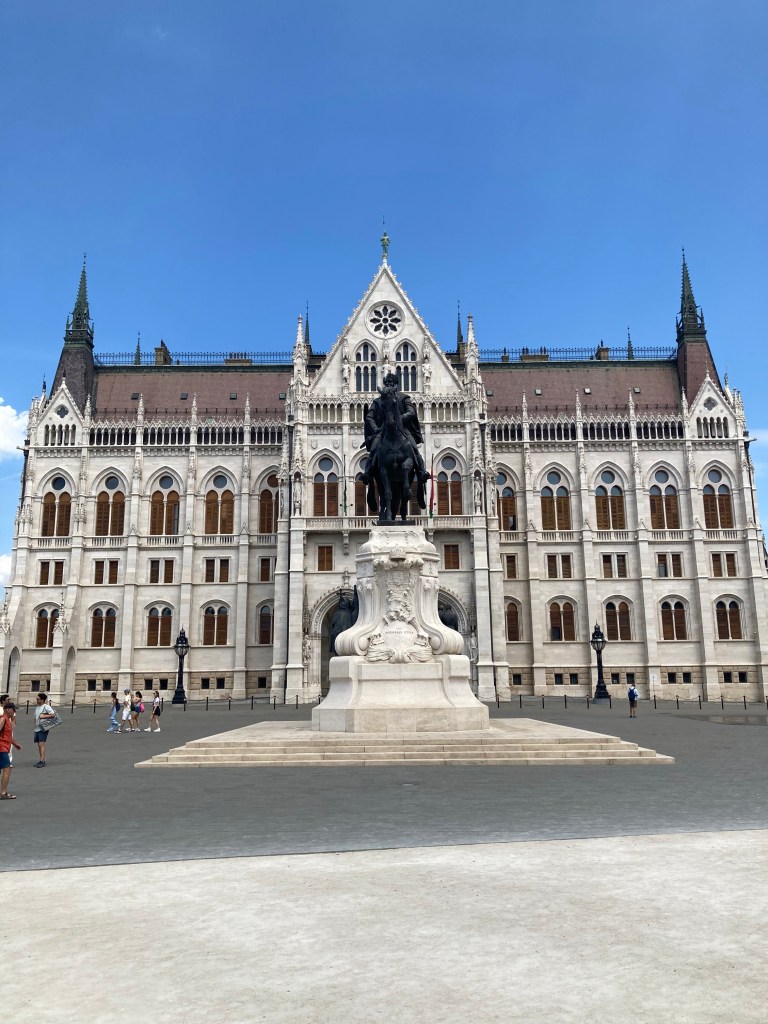
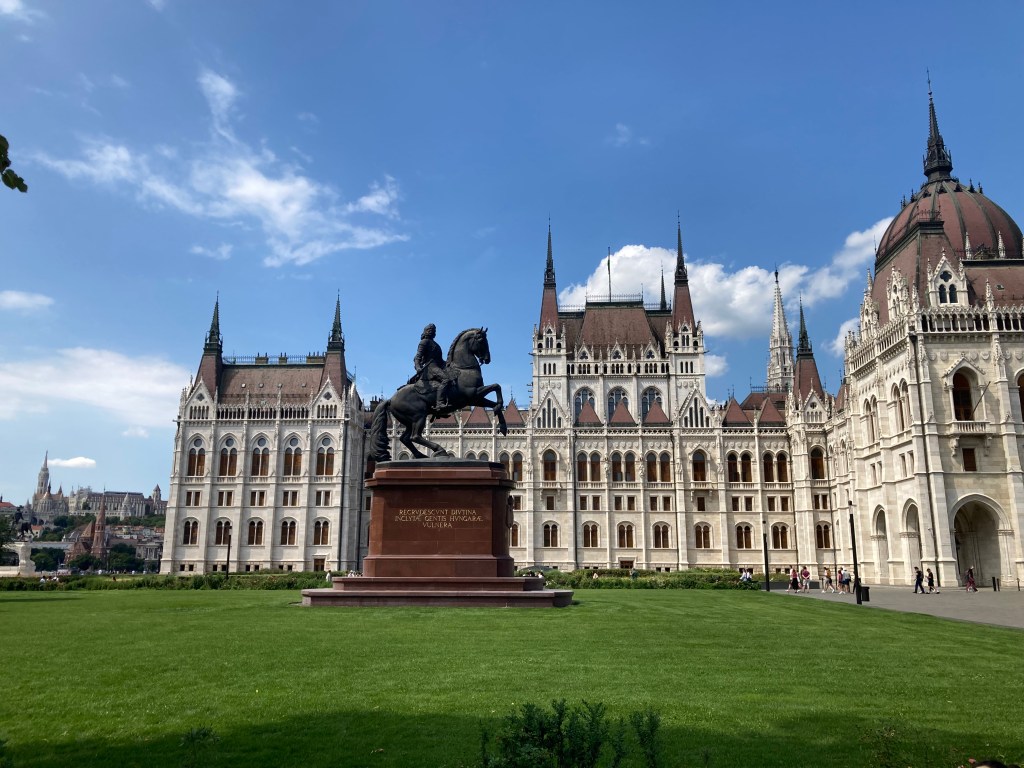
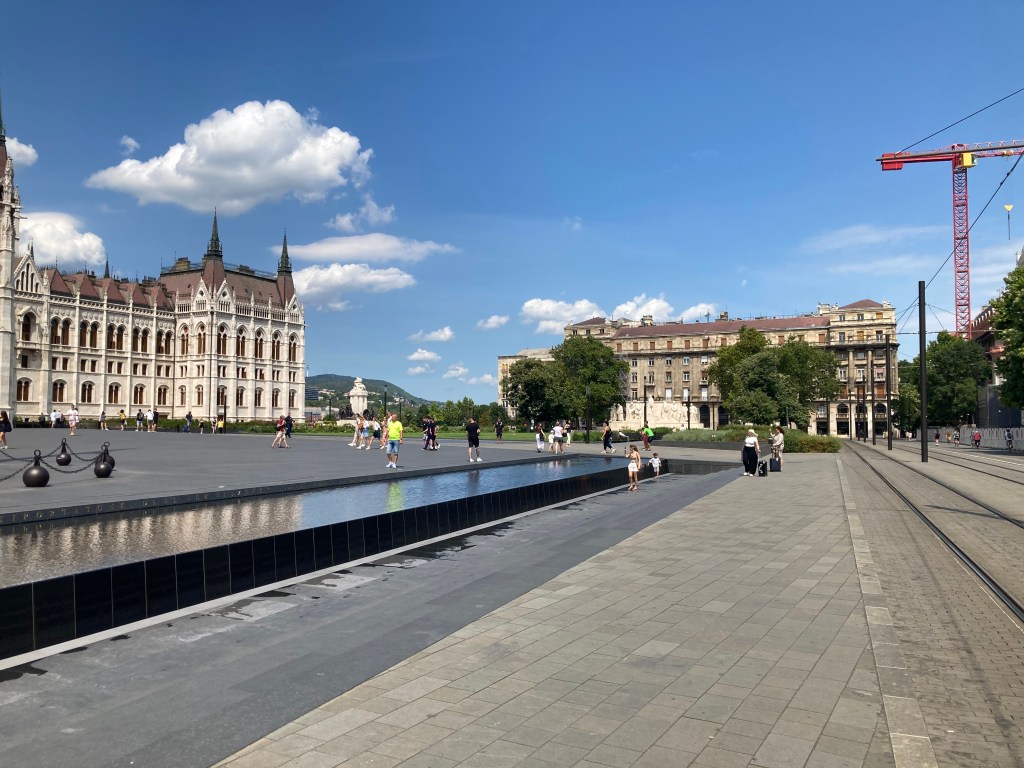
From there, we continued along the Danube promenade, watching the river stretch out between the two halves of the city. The views across to Buda—its hills rising gently behind the old rooftops—were beautiful, and the Parliament building looked even more striking from the water’s edge. The Danube has shaped Budapest for centuries, serving as a vital trade route and once marking the northern boundary of the Roman Empire. Today its riverbanks form one of the city’s most impressive UNESCO World Heritage sites, lined with architectural landmarks such as Buda Castle and the Chain Bridge.
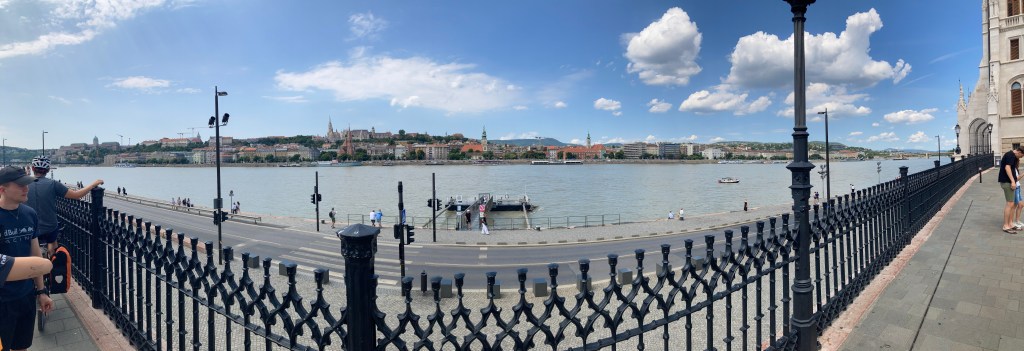
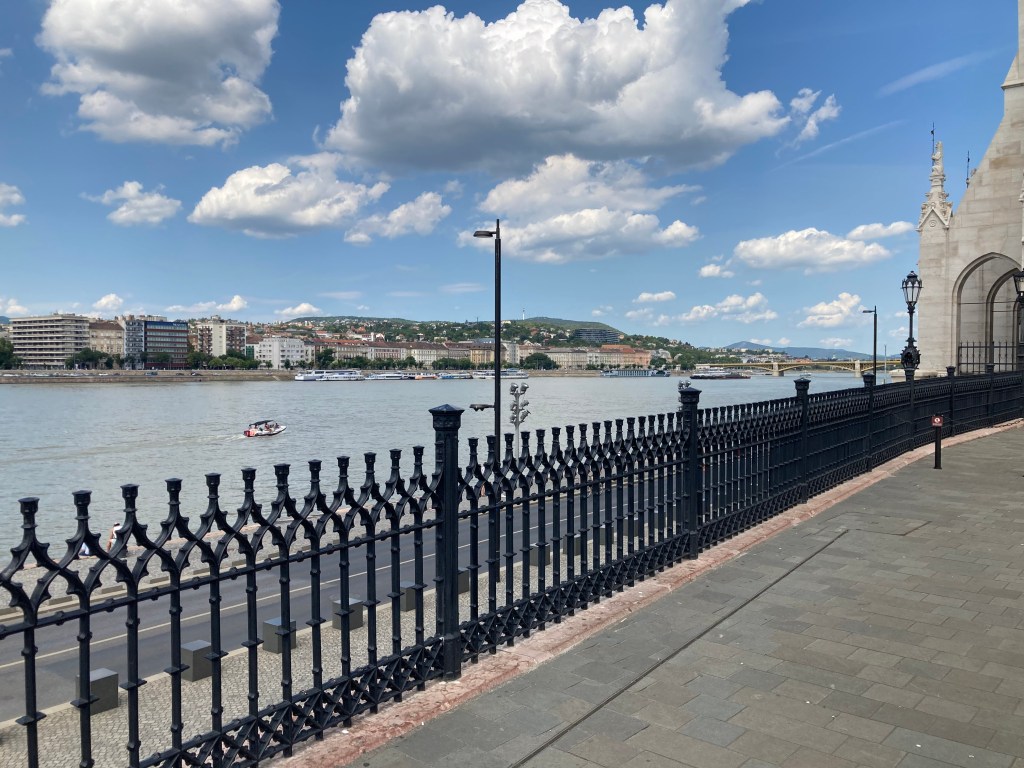
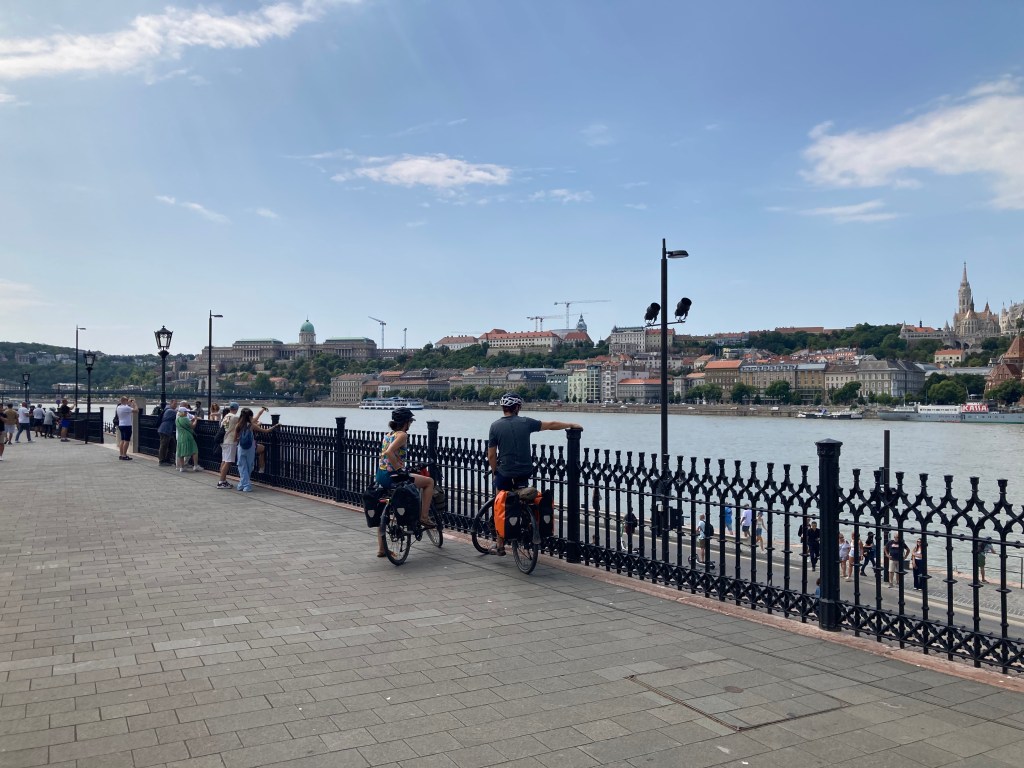
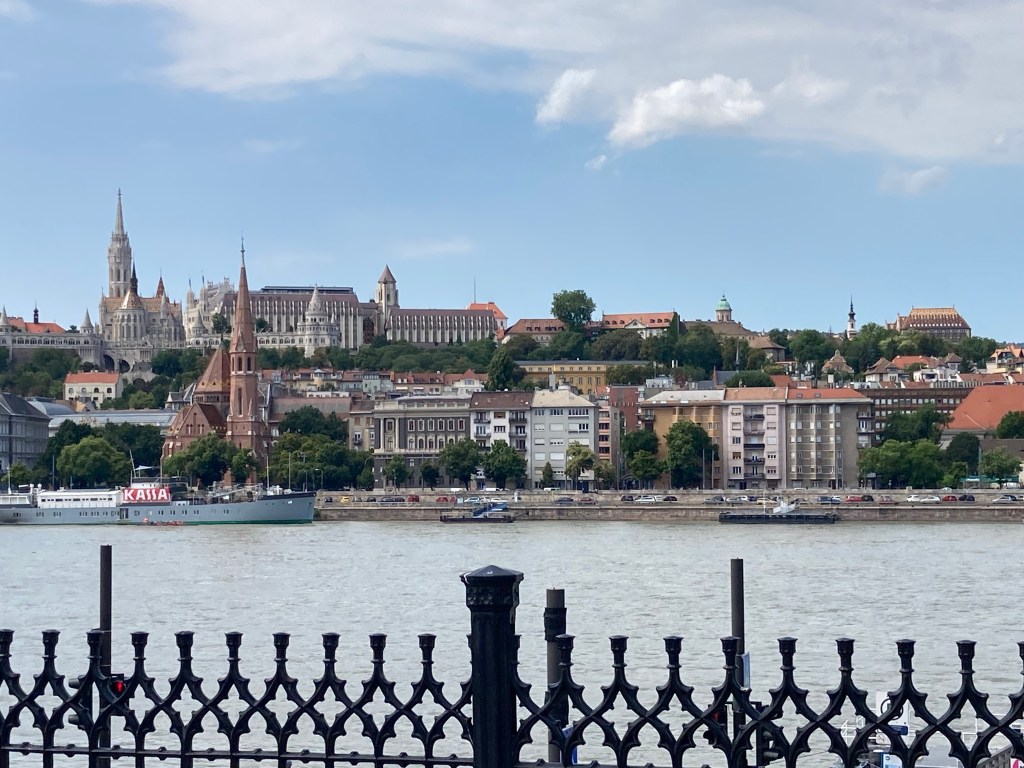
From there, we went off in search of some lunch. Maree wasn’t particularly hungry, so she settled for a drink while I decided to try one of the local flatbread dishes. It turned out to be a delicious Hungarian specialty: a fried flatbread topped with salmon, dill, yoghurt and cucumber. Despite being fried, it was surprisingly light and not oily at all—really tasty.
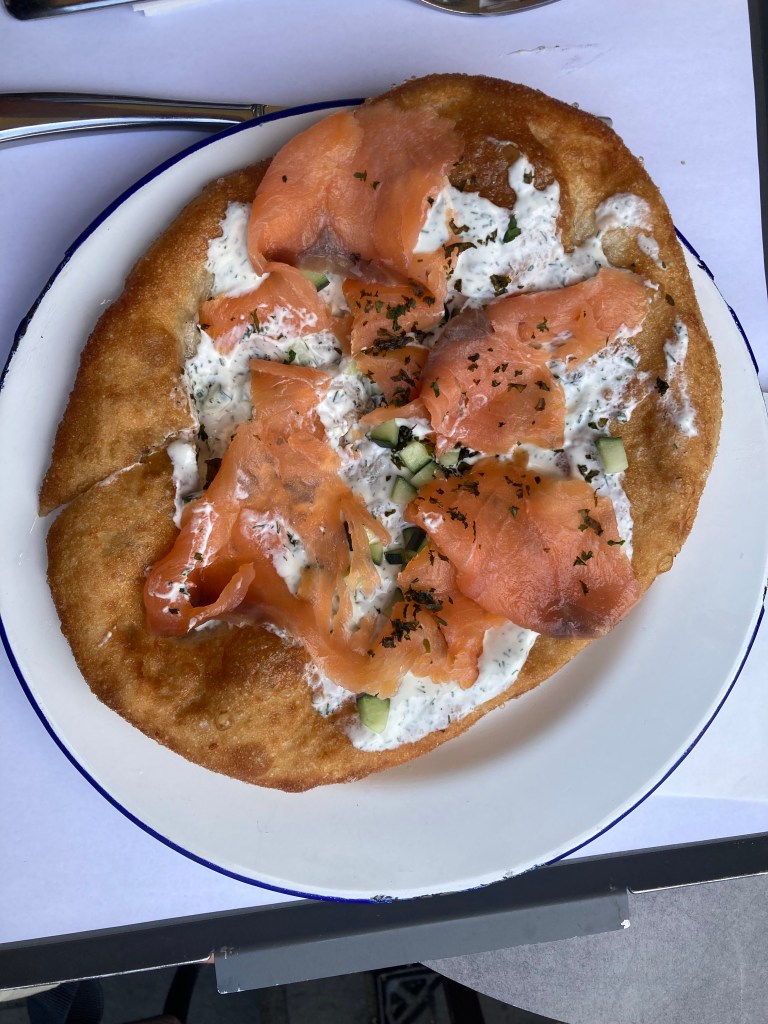
As we ate, a small string trio set up nearby with a bass, cello and violin. They played a mix of light classical pieces and familiar melodies. They weren’t bad at all, and it added a pleasant atmosphere to the meal, though it felt more like casual busking than a formal performance.
A simple but enjoyable lunch break before continuing our wander through Budapest.
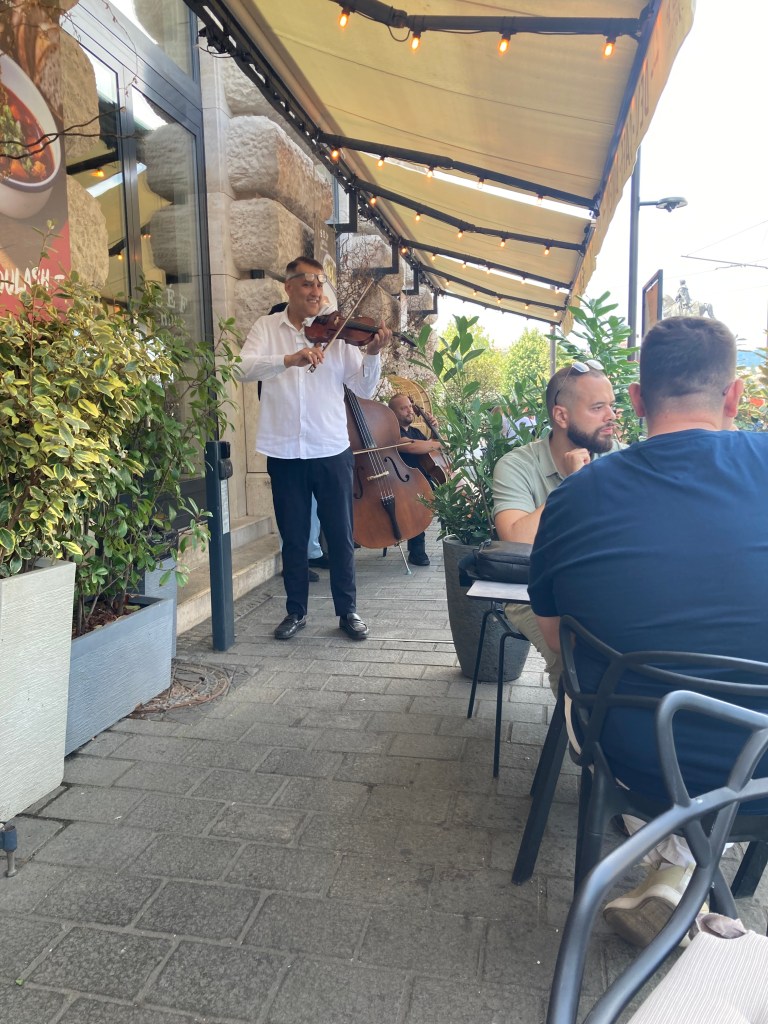
As we walked toward the tram, we suddenly heard the sound of water spraying and discovered a large tiled square with fine jets of water shooting up in shifting patterns. It turned out to be an interactive cooling area—designed so people could walk through the mist and spray to escape the summer heat. Tourists were happily darting in and out of the jets, using it as a refreshing break from the warm afternoon.
Then it was back to the tram. The ride followed the Danube for a while, offering some lovely river views before crossing over into Buda. Once on the other side, there wasn’t much of interest along that particular route, so we hopped off, wandered around for a bit, and then switched to another tram to make our way back to the hotel. With public transport being free for anyone over 65, it’s an ideal way for us to explore the city—far cheaper and far more flexible than the “Hop On Hop Off” buses.
After a couple of hours’ rest at the hotel, we headed out again for dinner. Tonight was Maree’s choice: Melissa Greek Taverna, a cosy little spot not far from where we were staying.
The menu featured all the classic Greek favourites, so we settled on tzatziki with pita, a serve of dolmades, and a Greek salad. The food was excellent. The dolmades were some of the most tender I’ve ever had, and the salad was the proper Greek version—no lettuce sneaking in, unlike the Australian interpretation. And the tzatziki… absolutely perfect. Sitting there, enjoying those flavours, felt a little like being transported to a taverna in the Plaka in Athens. They couldn’t have done it better.
My turn to choose dinner tomorrow night, and I’m already tempted to casually suggest, “How about we go back to the Greek place?” I’ll try to pretend I’m being spontaneous… but we both know where this is heading.
Sunday 3 August 2025
After breakfast we decided to spend the day visiting Buda Castle, perched high on Castle Hill on the Buda side of the Danube. We walked for about twenty minutes through the streets of Pest before hopping on the number 16 bus, which carried us straight up to the castle gates.
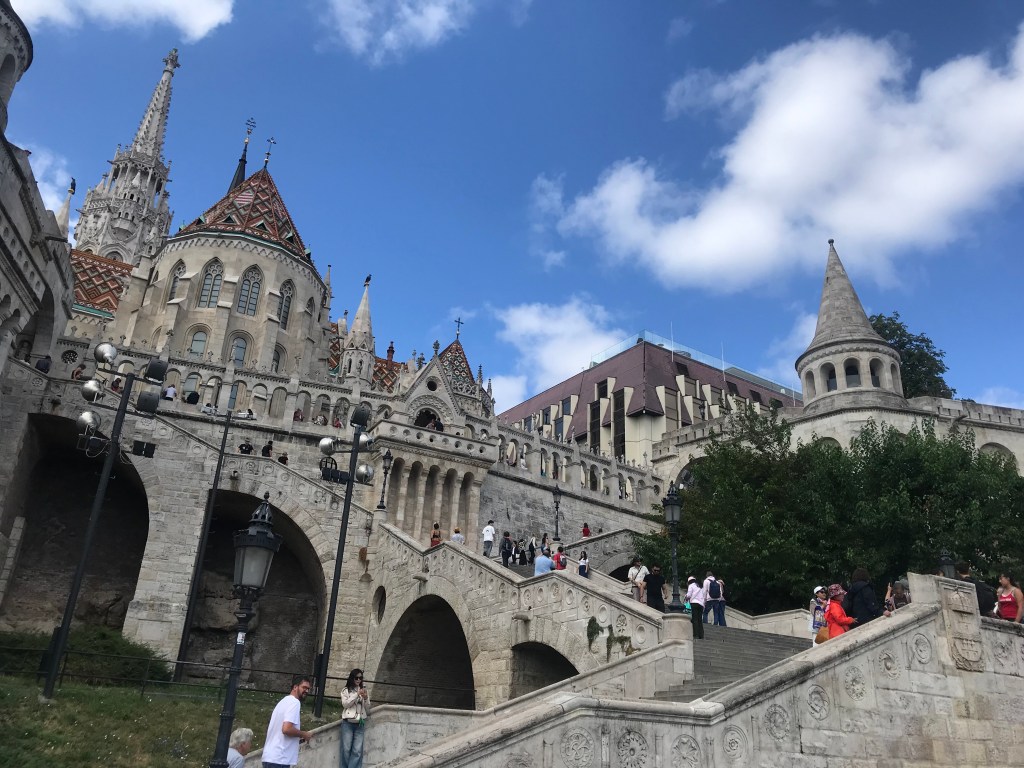
Buda Castle, once known as the Royal Palace, is the historic castle and palace complex of Hungary’s kings. The first fortified structure on this hilltop was completed in 1265, though the grand Baroque palace that dominates the site today was built much later, between 1749 and 1769. It suffered heavy damage during the Siege of Budapest in World War II and was later rebuilt in a simplified Baroque style during the communist era.
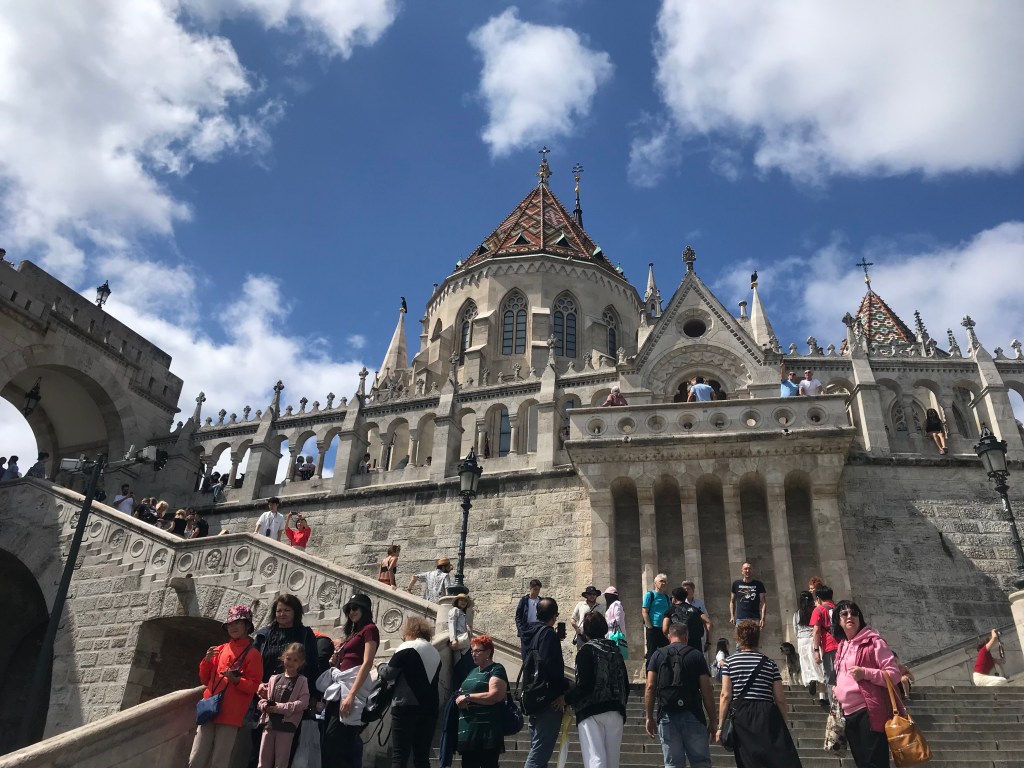
Today, the palace houses three major cultural institutions: the Hungarian National Gallery, the Budapest Historical Museum, and the National Széchényi Library. The entire complex sits on the southern end of Castle Hill, with its defensive walls stretching around the Castle Quarter to the north, a neighbourhood known for its beautifully preserved medieval, Baroque and neoclassical buildings. Several important government buildings, including Sándor Palace and the former Carmelite Monastery, also stand within this district.
Locally, both the palace and the surrounding neighbourhood are simply called a Vár, “the Castle”, a name that reflects just how central this hilltop has been to Budapest’s history and identity.
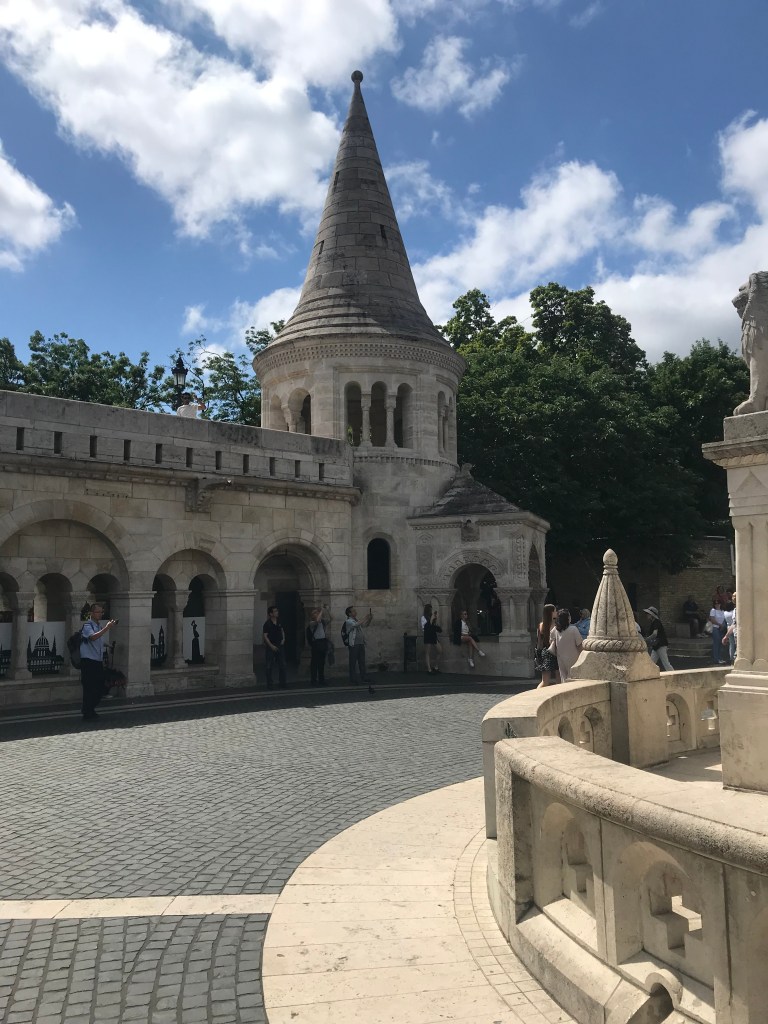
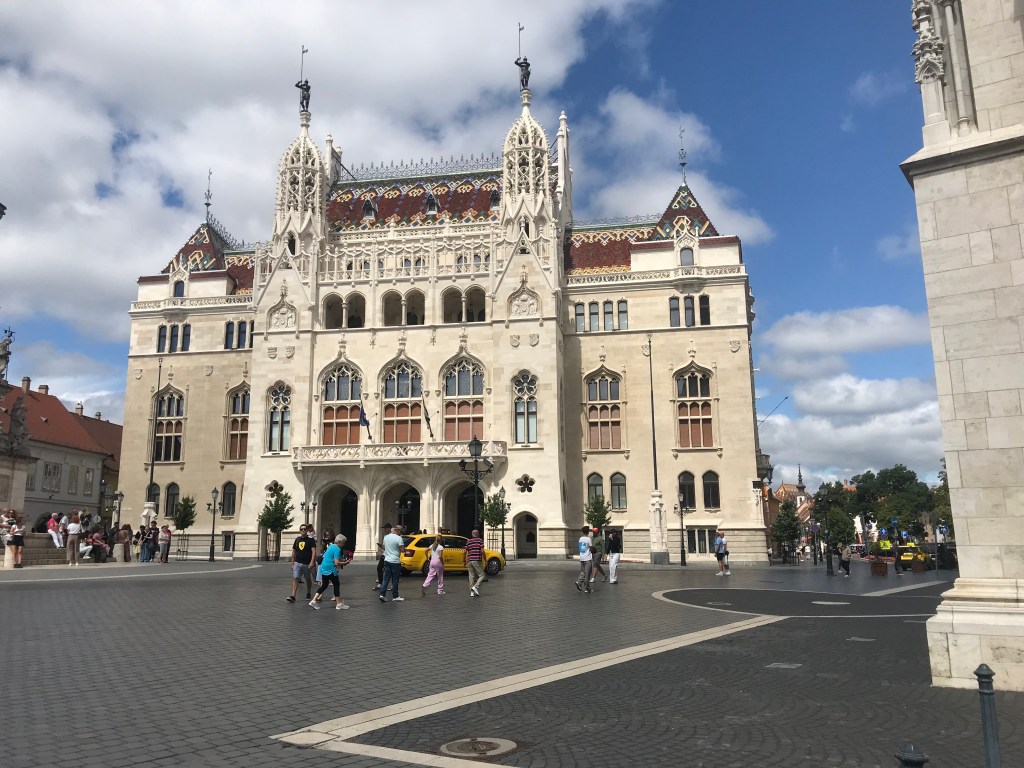
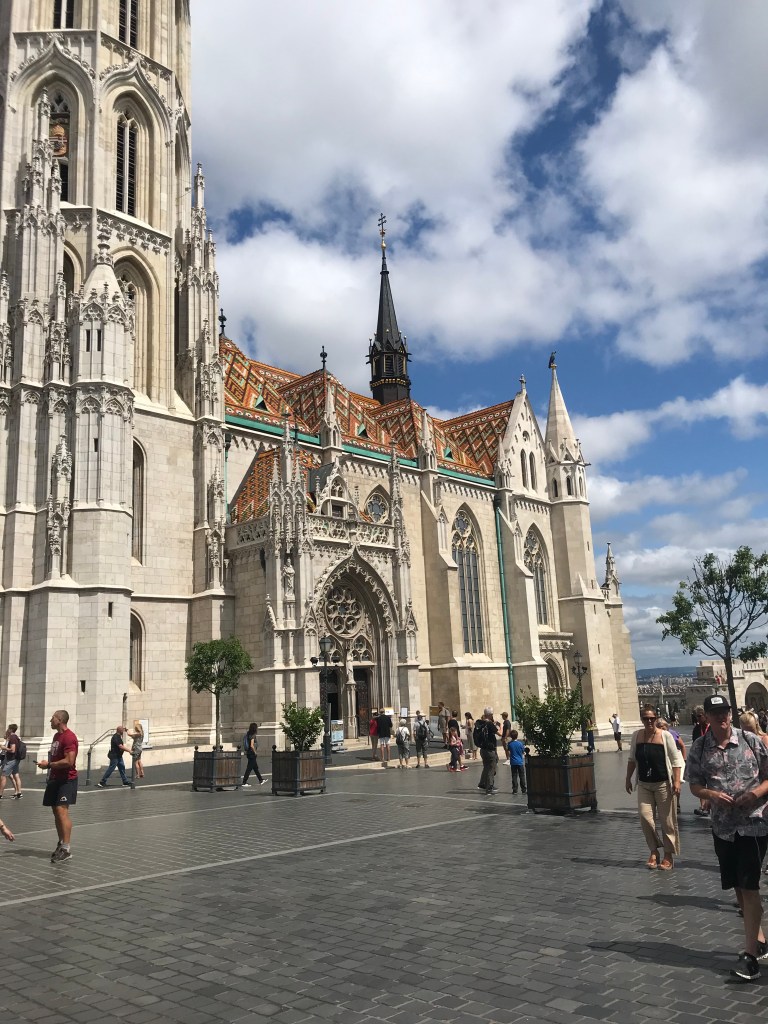
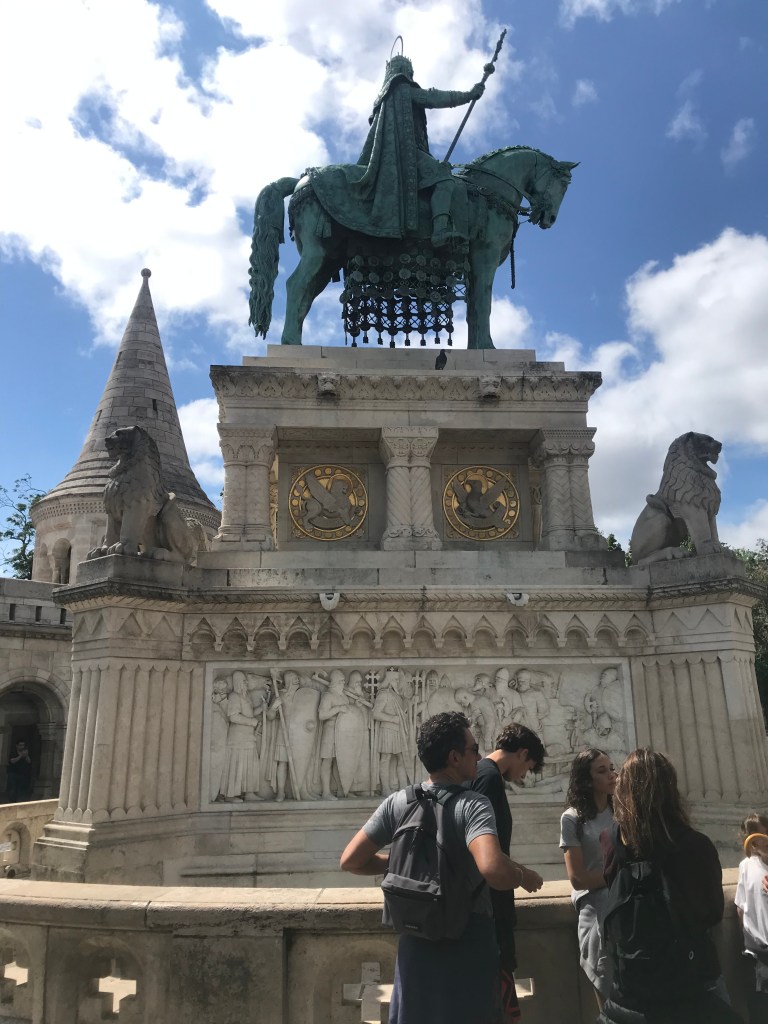
We took plenty of photos around the castle grounds, and Maree climbed up to the highest viewpoint accessible to visitors to capture the sweeping panorama from the top. There’s even a small fee to reach this lookout, but the views make it worthwhile, stretching across the rooftops of Pest and taking in the curve of the Danube below.
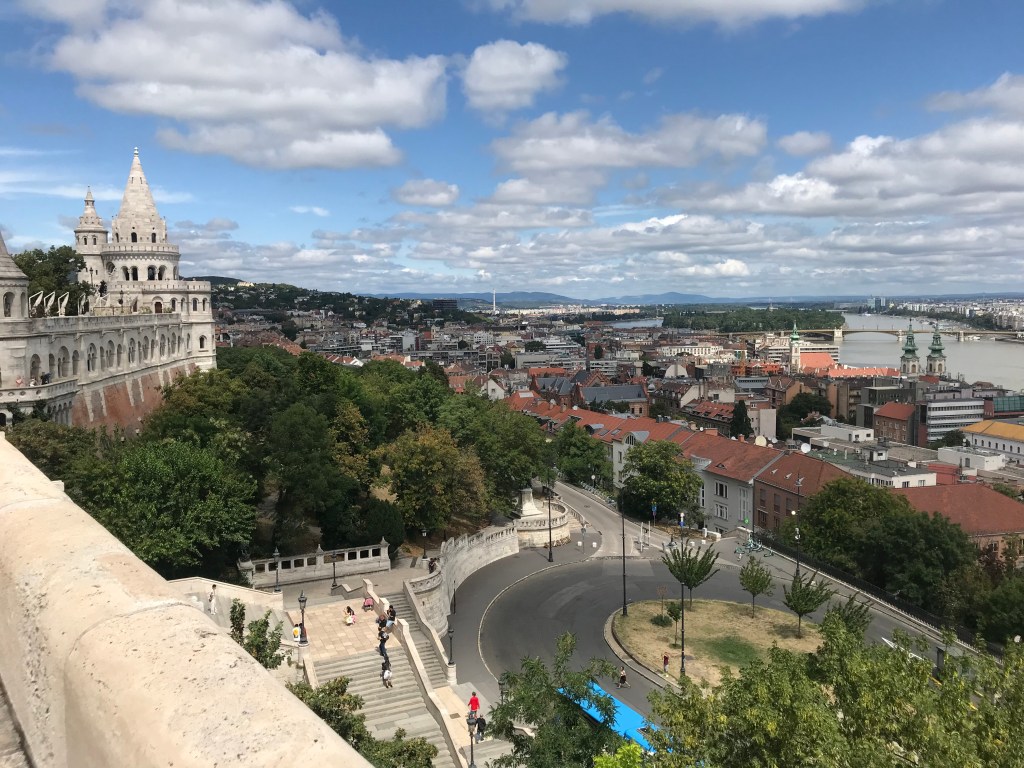
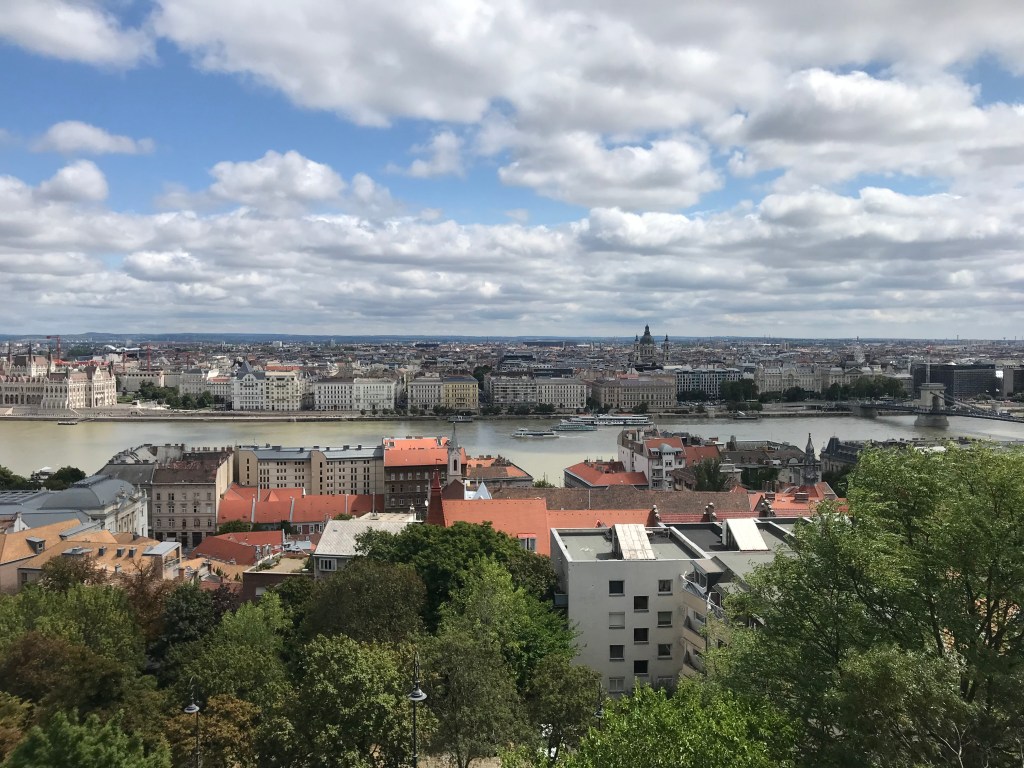
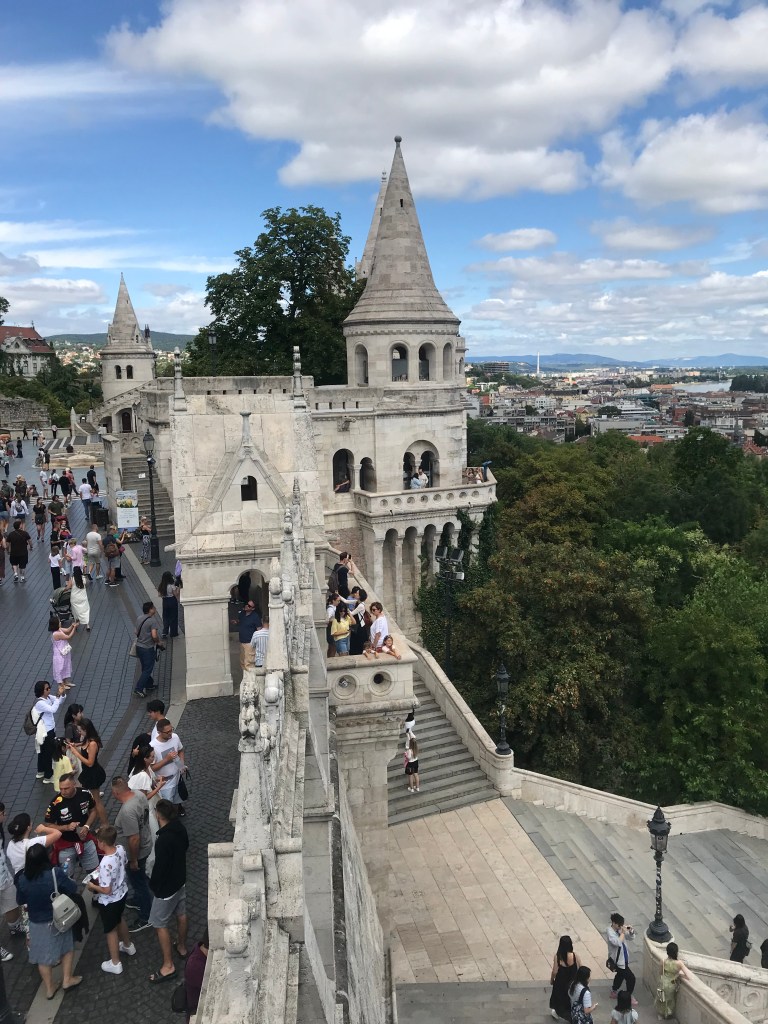
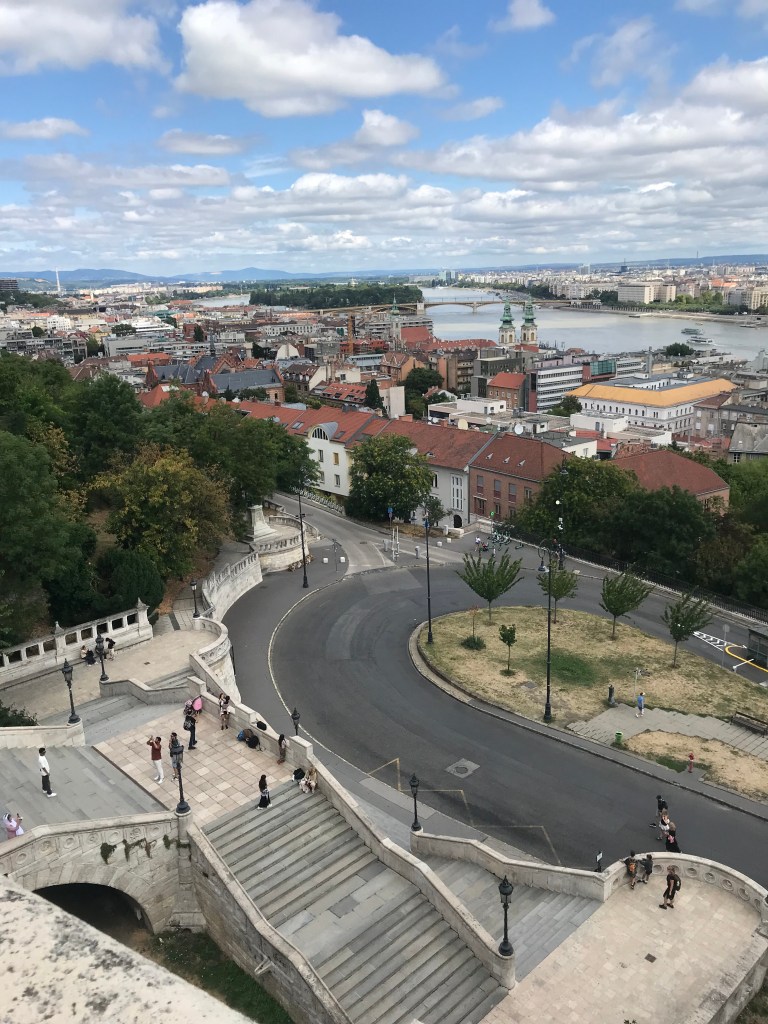
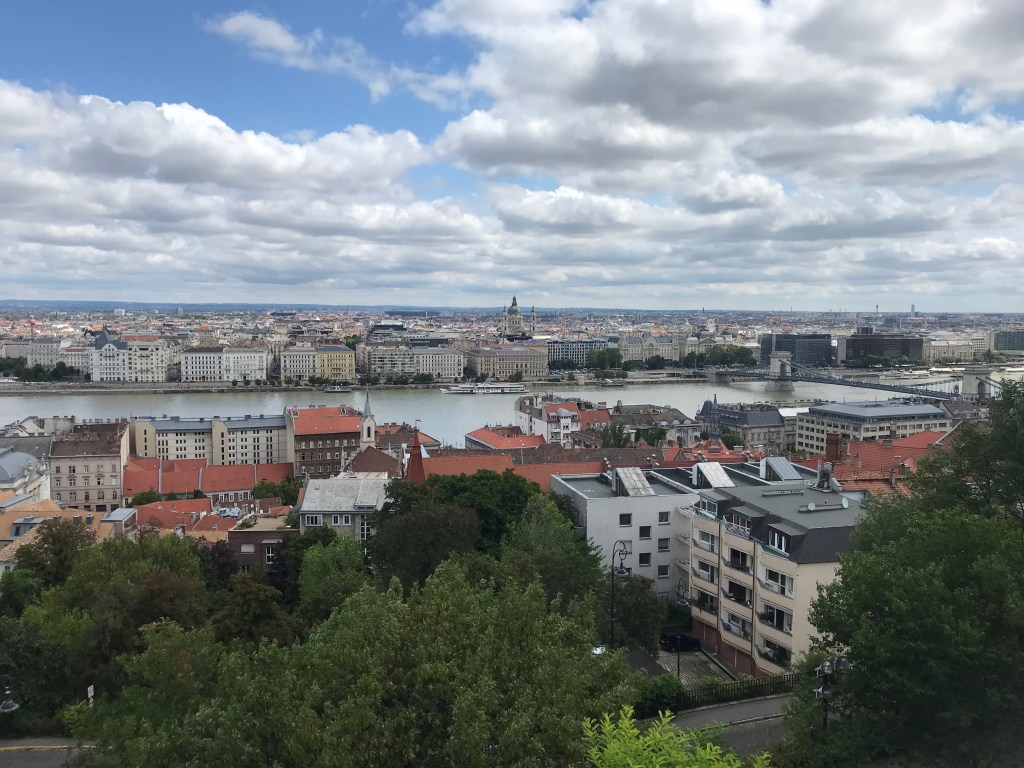
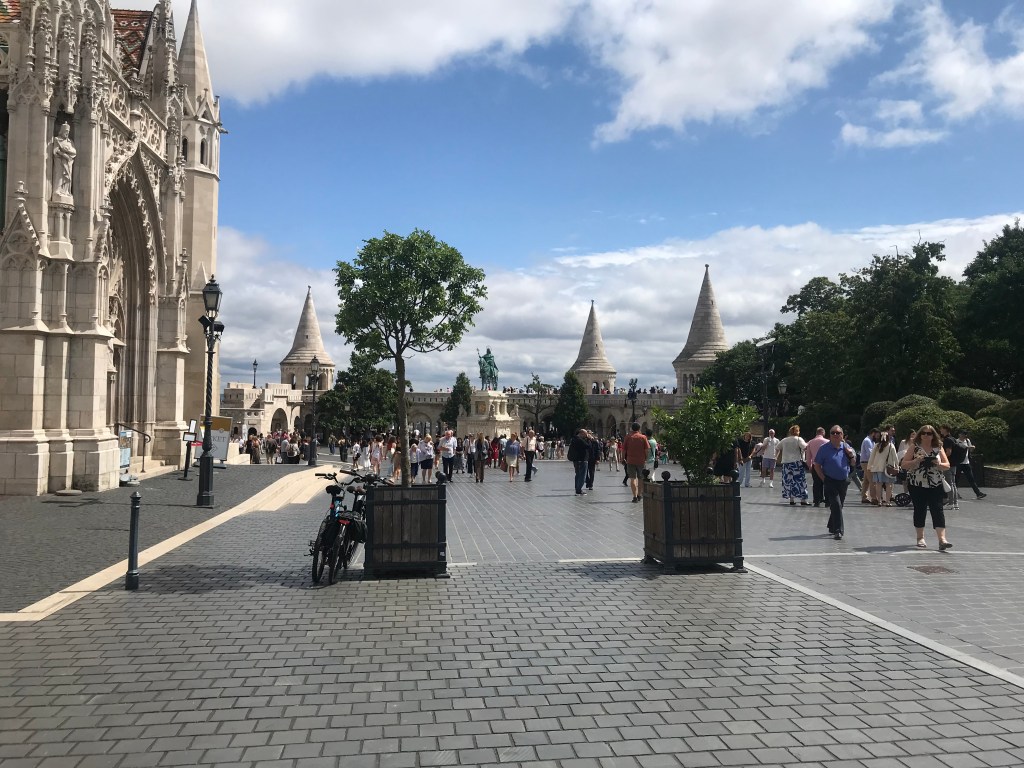
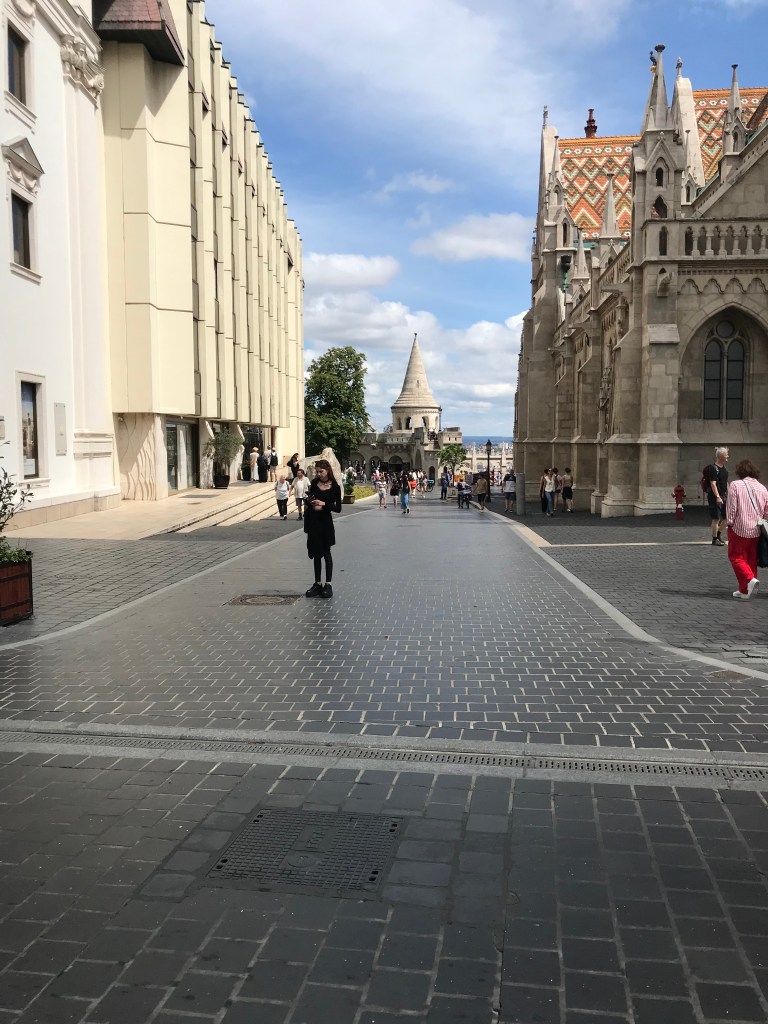
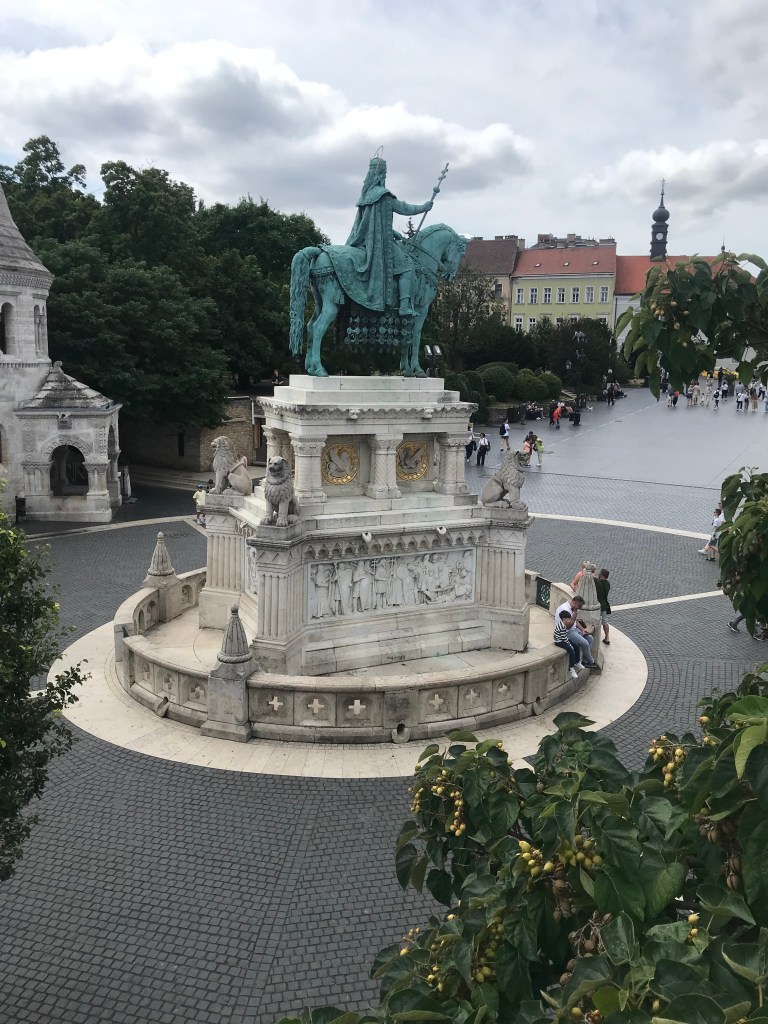
Positioned between Fisherman’s Bastion and Matthias Church, the statue stands in one of the most scenic spots in the Castle District, offering sweeping views over the city and the Danube. It remains a proud tribute to Hungary’s early statehood and enduring cultural heritage.
As we wandered around Castle Hill, we stumbled upon a souvenir shop with a rather curious figure standing guard out front. It looked like someone dressed in full sheep-like costume—complete with a horned mask—creating quite a sight. Naturally, we had to stop and take a photo.
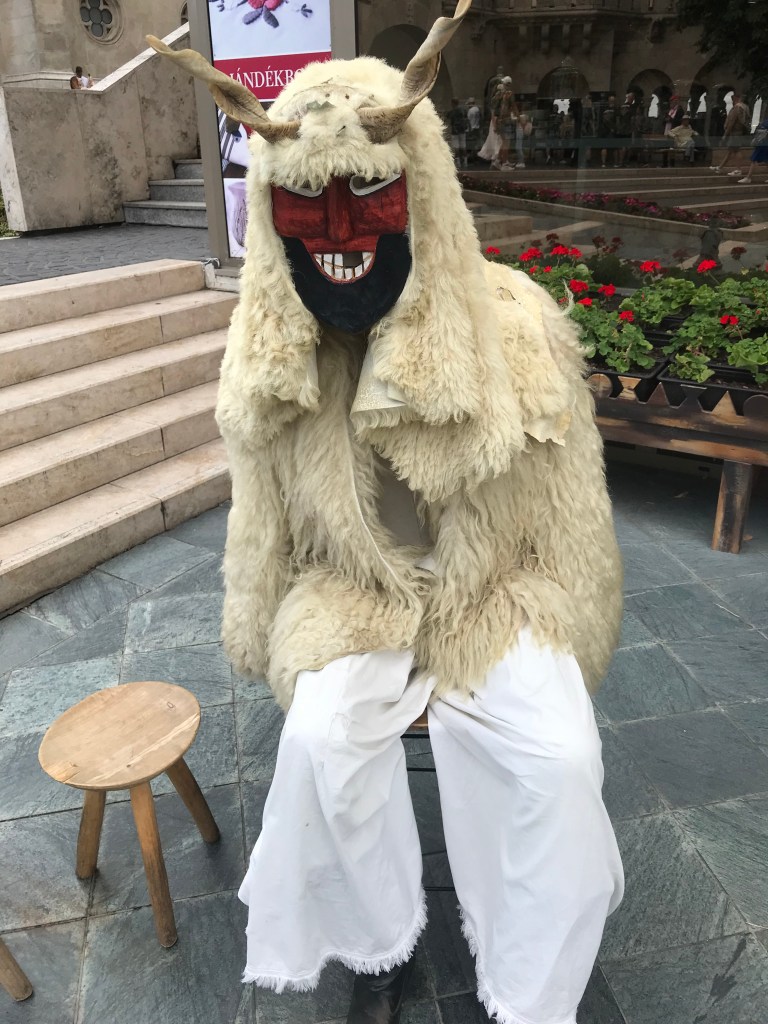
We stepped inside, and Maree asked the cashier about the strange creature outside and the masks covering the walls. The cashier was more than happy to explain, giving us a bit of background on the figure’s meaning in Hungary and its connection to the Busójárás tradition.
THE MASKED MEN OF MOHÁCS, HUNGARY—BUSÓJÁRÁS
There is a Hungarian festival called Busójárás, a tradition that goes back more than 150 years. The name translates roughly to “the Busó walking around,” referring to the masked, fur‑clad figures who parade noisily through the streets. Although no one knows the exact origin of the custom, two main legends are commonly told to explain how it began.
One story dates back to the period when the Ottoman Turks occupied Hungary for around 150 years, nearly five centuries ago. In this version, the Turks are the classic villains of folklore. The tale goes that the local people devised a plan to frighten them away by carving grotesque, animal‑like masks with horns, painting them with pig’s blood, and arming themselves with loud wooden clackers. Under the cover of night, they emerged from the marshes in these terrifying disguises, making such a racket that the Turks supposedly fled in fear.
A similar legend comes from the Šokci, a South Slavic ethnic group from the Mohács region. According to their version, they had fled the Ottomans and later returned with a plan: they would reclaim their town by scaring the occupying soldiers with monstrous masks, rattles, and thunderous noise. Whether either tale is historically accurate is impossible to say, but both have become part of the festival’s mythology.
Traditionally, Busó costumes were valuable and often passed down through generations. A typical outfit included a carefully carved wooden mask with horns, a heavy sheepskin cloak, and white leggings—sometimes padded with straw if the wearer’s legs were a bit on the skinny side. The overall effect was meant to be wild, chaotic, and intimidating.
Today, the meaning of Busójárás has shifted. Rather than scaring away invaders, the Busó figures now symbolically chase away winter. During the festival—held each February in the town of Mohács—participants don the same fearsome masks and sheepskin cloaks, parade through the streets, bang drums and clappers, and create a lively, noisy spectacle to welcome the coming of spring. The event is so culturally significant that it has been recognised by UNESCO as part of Hungary’s Intangible Cultural Heritage.
What began as folklore and legend has become one of Hungary’s most distinctive and colourful traditions.
After spending the day exploring Castle Hill, we caught the bus back down and then took a slow wander through the side streets of Pest, gradually making our way toward the hotel. It was a gentle end to a full day of sightseeing.
Maree agreed we should go back to the Greek restaurant for dinner, though I suspect she only “agreed” because she knew I was going to suggest it anyway. Some decisions are just too easy.
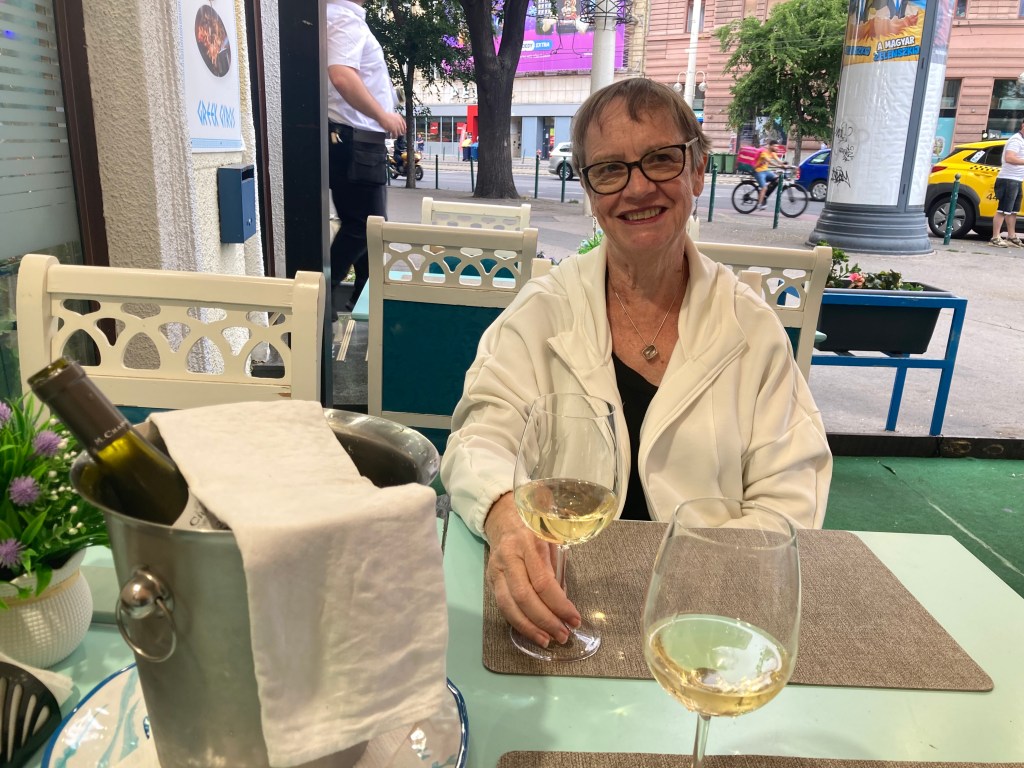
The food and wine were every bit as good as the night before, the service even better, and the whole experience felt like we’d become honorary regulars in just 24 hours.
Monday 4 August 2025
Today we spent the day wandering through the streets of Pest, exploring its lively boulevards, cafés and neighbourhoods at an easy pace. As evening settled over the city, we made our way to the river for a Danube cruise, drifting past the illuminated landmarks that line the waterfront. Seeing Budapest from the water at night—Parliament glowing on one bank, Castle Hill rising on the other—was a beautiful way to end the day.
The next two photos are ones Maree took at the Roma Holocaust Memorial in Budapest. The site—formally known as the Memorial for the Roma Victims of the Holocaust—stands within a small but powerful memorial park dedicated to honouring the Sinti and Roma people persecuted and murdered under National Socialism.
A particularly solemn date connected to this history is August 2nd, now observed as Roma Holocaust Memorial Day. It marks the night in 1944 when 2,897 Roma men, women, and children imprisoned in the so‑called “Gypsy Family Camp” at Auschwitz‑Birkenau were murdered in a single, brutal act of liquidation.
Standing in this quiet corner of Budapest, the memorial offers a space not only to remember those lives lost but also to acknowledge a chapter of Holocaust history that for decades received far too little recognition. Maree’s photos capture that stillness and gravity beautifully.
The next two photos are from our Danube River cruise. The light proved tricky for most of the shots I attempted—between the movement of the boat and the shifting reflections, many didn’t quite work out. In the end, only two photos were really worth keeping, but it still captures a little of the atmosphere from the evening.
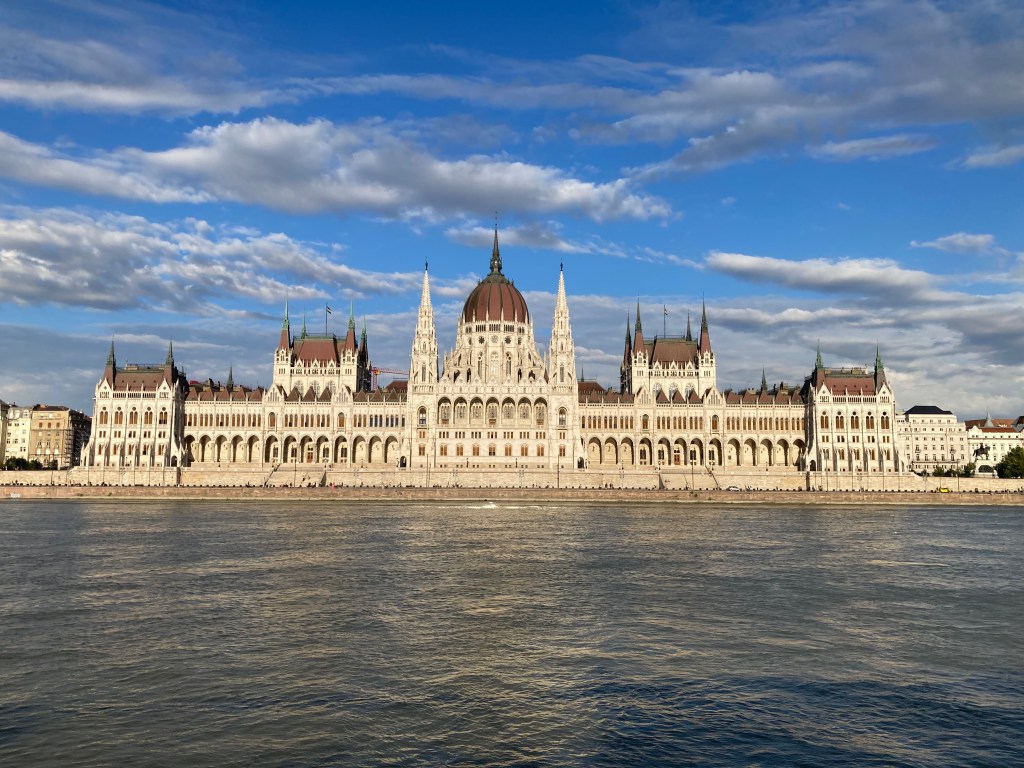
The structure stretches nearly 270 metres along the riverbank, making it one of the largest parliamentary buildings in the world. Its riverside façade was intentionally designed to be the most impressive, meant to be admired from the water—something that becomes especially clear on an evening cruise, when every arch and tower is lit in warm gold.
Inside, the building houses the Hungarian Crown Jewels, including the Holy Crown of St. Stephen, a national symbol dating back over a thousand years. From the outside, though, especially when viewed from Buda across the Danube, the Parliament feels almost like a glowing palace—an architectural statement of national pride and one of the most photographed sights in the city.
Seeing it from the river at night was a highlight of the cruise, and Maree’s photo captures that sense of grandeur beautifully..
It’s a slightly startling sight at first, but this design is essential for navigating Budapest’s central stretch of the Danube, allowing the vessel to slip under several of the low lying bridges.
Tuesday 5 August 2925
Today we left Budapest and travelled on to Vienna, where we’ll be spending the next four days exploring the city. Most of the day disappeared into the practicalities of travel, getting from one hotel to the next, settling in, and catching up on laundry; so there isn’t much to report in terms of sightseeing just yet.
Vienna itself, though, promises plenty. Often called the City of Music, it was home to Mozart, Beethoven, Haydn, Schubert, Brahms, and Mahler, and its concert halls still carry that legacy. It’s also known for its grand imperial architecture, a reminder of when Vienna was the glittering capital of the Habsburg Empire. Even its coffeehouse culture is UNESCO‑listed, recognised as an intangible cultural heritage for the way these cafés shaped intellectual and artistic life.
Tomorrow we’ll start discovering it properly, but for today, the journey, and the laundry, were enough.
Wednesday 6 August 2025
Today was a quiet one for us. We decided to take a rest day and save our energy for exploring Vienna’s Old Town tomorrow. My cousin and her friend, who are holidaying in Austria, will be joining us, so it should be a full day of wandering and catching up.
Vienna’s historic centre—the Innere Stadt—is a UNESCO World Heritage site, and tomorrow we’re expecting to see many of its highlights: the elegant Graben and Kohlmarkt shopping streets, the soaring St. Stephen’s Cathedral, and the winding medieval lanes that still hint at the city’s early past. The Old Town is also home to grand Habsburg landmarks like the Hofburg Palace, once the seat of imperial power, and countless cafés that helped shape Vienna’s famous coffeehouse culture.
With so much history, architecture, and atmosphere packed into such a compact area, it should be a fascinating day of exploring—and a lively one with family along for the adventure.
Thursday 7 August 2025
Our first task this morning was to head over to the Hauptbahnhof to meet my cousin and her friend. It was a late start to the day, but we didn’t mind in the slightest—slow mornings are a luxury when travelling.
Once they arrived, the four of us hopped on a tram and made our way into the Old Town. Naturally, the very first order of business was coffee and cake. They’d arrived around 10:00, and by then all of us were more than ready for a little Viennese indulgence. We found a charming café just around the corner from St. Stephen’s Cathedral, the perfect spot to settle in and catch up.
After a long, easy chat and plenty of laughter, we wandered over to the Cathedral itself, rising proudly in the centre of Vienna’s historic heart. It was the ideal place to begin our day of exploring together.
St. Stephen’s Cathedral is the mother church of the Archdiocese of Vienna and the seat of the Archbishop, standing at the very heart of the city on Stephansplatz. The cathedral’s striking Romanesque and Gothic form—much of it shaped under Duke Rudolf IV in the mid‑14th century—rises on the foundations of two earlier churches, the first of which was consecrated in 1147. With its patterned, multi‑coloured tile roof and soaring south tower, it has become one of Vienna’s most recognisable symbols and its most important religious building. For those feeling energetic, the cathedral’s tower contains 256 steps from top to bottom.
By the 12th century, Vienna had grown into a significant centre of German culture, and its handful of existing churches could no longer meet the needs of the expanding population. In 1137, the Treaty of Mautern—signed by Bishop Reginmar of Passau and Margrave Leopold IV—referred to Vienna as a civitas for the first time and set aside land for a new parish church. This site would eventually become St. Stephen’s.
Although long believed to have been built outside the medieval city walls, modern excavations tell a more intriguing story. Work carried out in 2000 uncovered graves 2.5 metres below the surface, carbon‑dated to the 4th century, suggesting that an even older religious structure once stood here—possibly predating St. Rupert’s Church, traditionally considered Vienna’s oldest. This discovery hints at an unbroken thread of worship on this site stretching back to Roman times.
Today, St. Stephen’s Cathedral stands not only as a masterpiece of medieval architecture but also as a witness to centuries of Habsburg and Austrian history—coronations, funerals, wartime damage, and countless civic events. It remains the spiritual and cultural heart of Vienna.
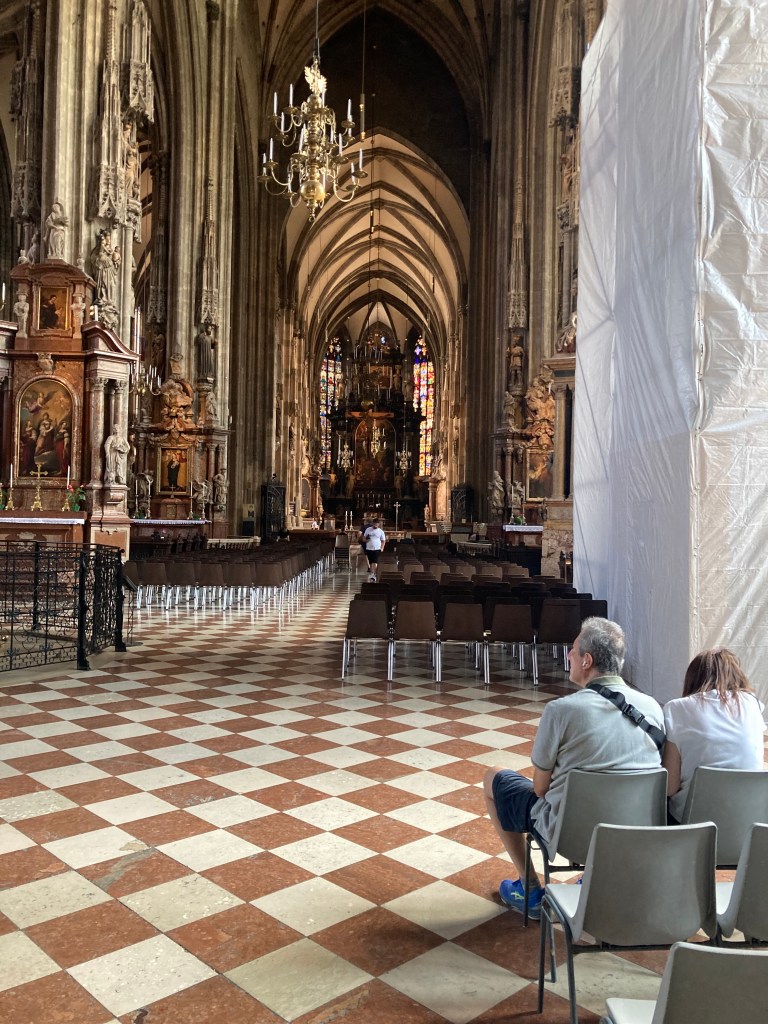
From here we continued on to Stadtpark, Vienna’s beloved city park. Opened in 1862, it was the first public park created after the old city walls were demolished and the Ringstrasse boulevard began to take shape. Stretching from the Innere Stadt into the Landstraße district, the park covers around 65,000 square metres and is divided in two by the Vienna River, giving it a mix of open lawns, winding paths, and elegant landscaped gardens.
Stadtpark is famous for its collection of monuments dedicated to Vienna’s great cultural figures—artists, writers, and especially composers. As we wandered through, we passed statues and busts of Franz Schubert, Anton Bruckner, Hans Canon, Emil Jakob Schindler, and many others who helped shape the city’s artistic identity.
But the most striking of all is the monument to Johann Strauss II, the “Waltz King.” Unveiled in 1921, the gilded statue shows Strauss mid‑performance, violin in hand, capturing the energy and elegance of the music that made him world‑famous. His compositions—most famously The Blue Danube—became symbols of Vienna itself, and the monument has become one of the most photographed spots in the entire city.
Standing beneath the shimmering gold figure, surrounded by trees and the gentle hum of the park, it’s easy to feel why this place holds such a special place in Vienna’s cultural memory.
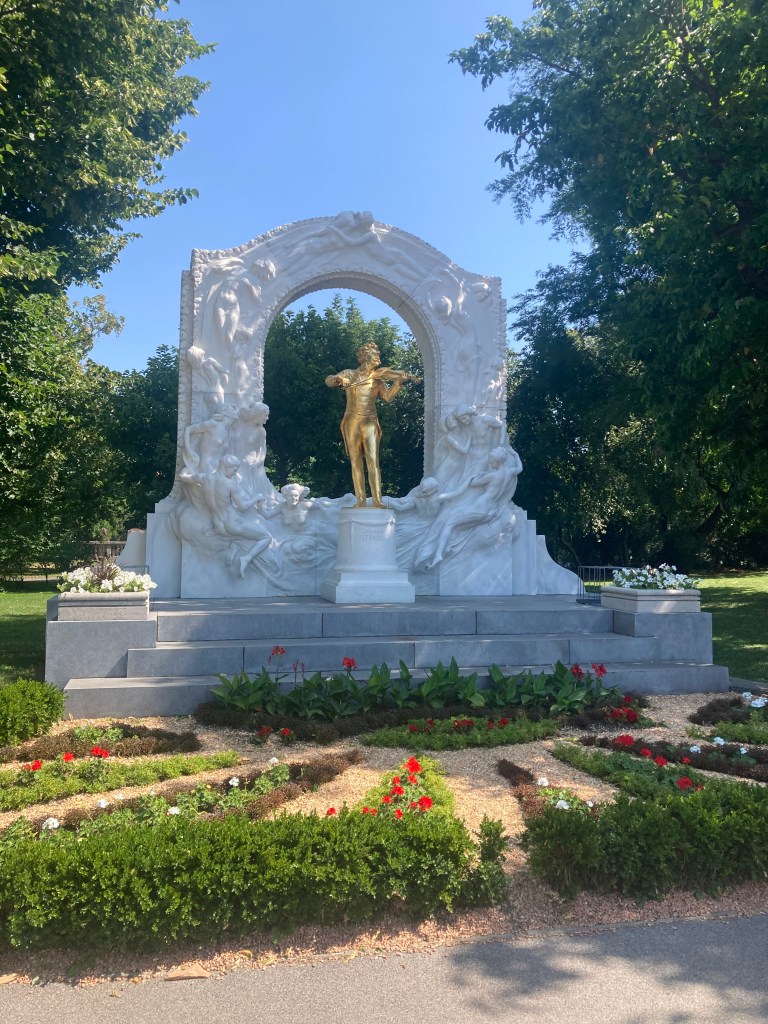
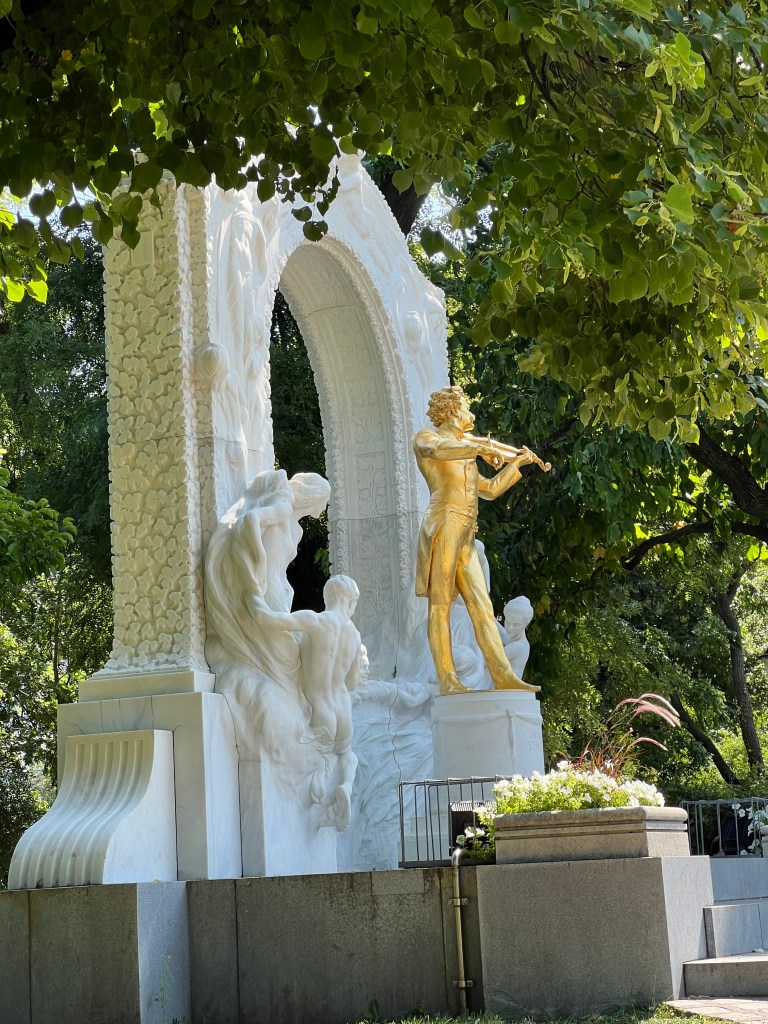
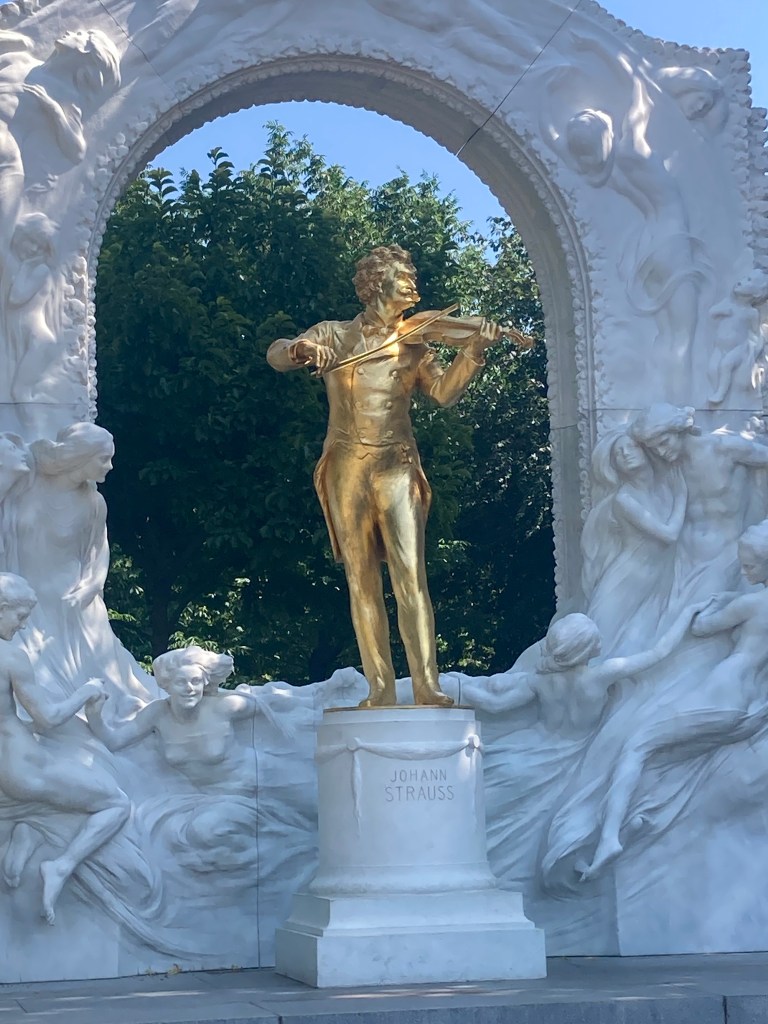
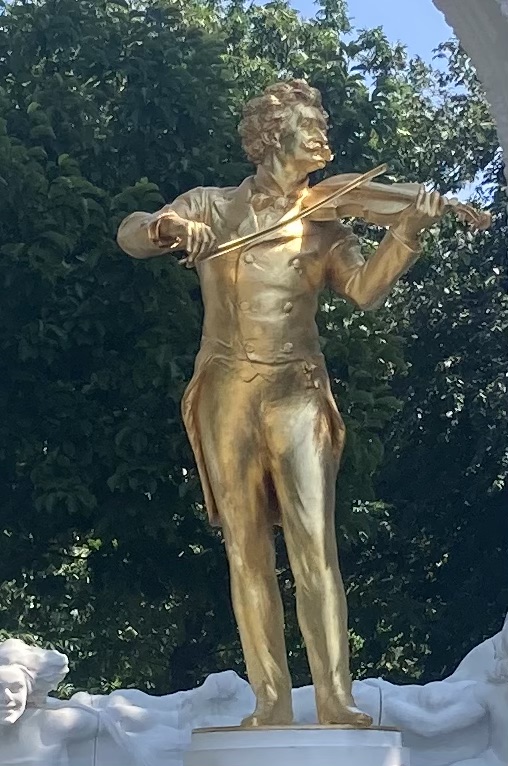
We wandered through the park admiring the many composer sculptures, and then it was time for family photos — Sheelagh, Maggie and Maree in Stadtpark, Vienna.
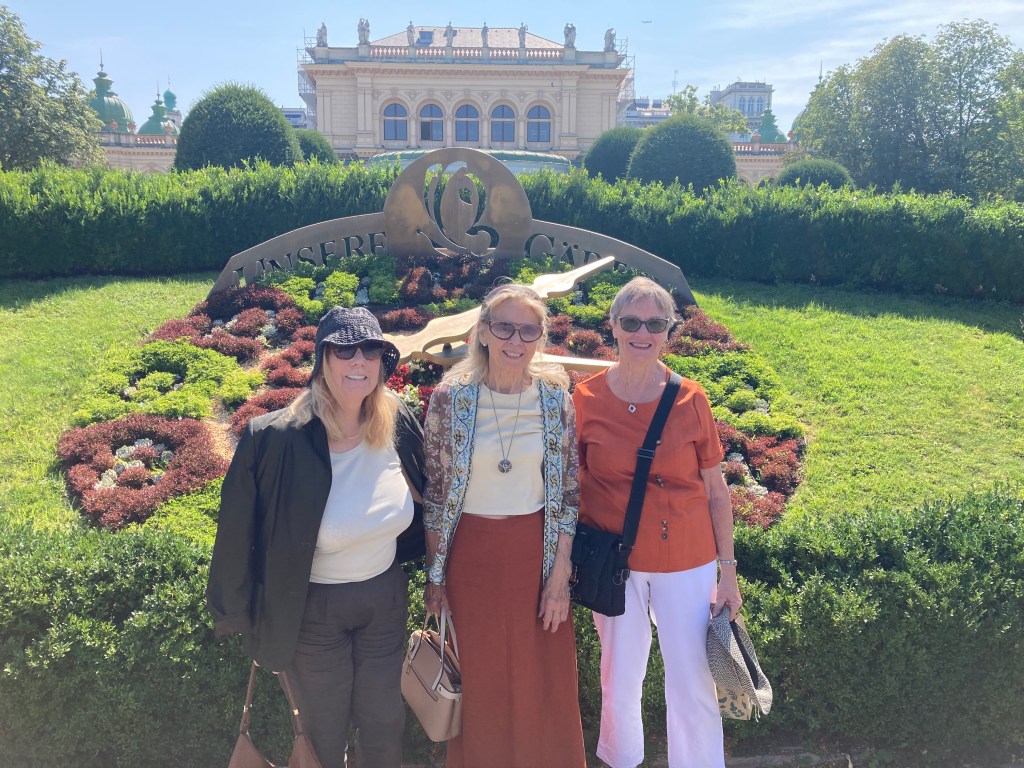
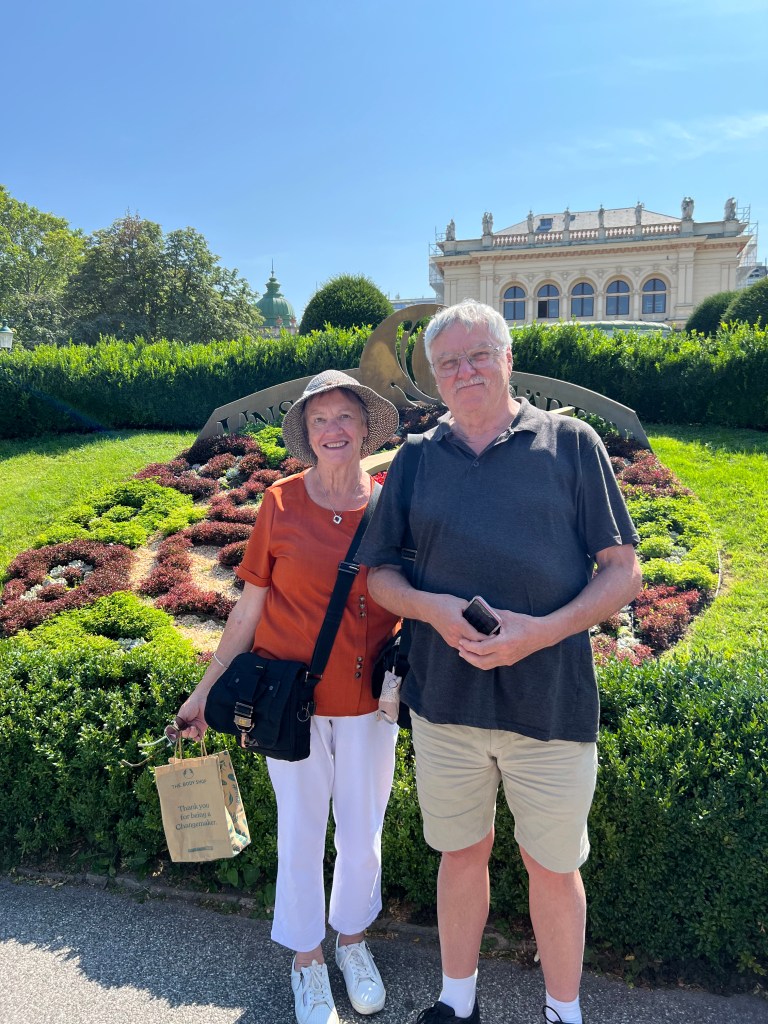
The two main visits today—St. Stephen’s Cathedral and Stadtpark—ended up filling most of our time, and before we knew it, it was time to think about dinner. We found a lovely Italian restaurant tucked away in the Old Town. There really does seem to be an Italian place on every corner here, but we weren’t complaining. A good meal, a nice bottle of wine, and the chance to rest our feet were exactly what we needed.
After dinner we took a slow stroll to the tram stop and made our way back to the Hauptbahnhof, where our visitors were catching their train back to Graz. Graz is Austria’s second‑largest city and the capital of Styria—famous for its beautifully preserved medieval centre, the hilltop Schlossberg, and its reputation as a vibrant university town. They’re spending their holiday exploring that region, so Vienna was just a day trip for them.
Once we’d seen them off, Maree and I headed back to our hotel and called it a night. We were both tired and ready to simply sit and switch off. We’re averaging at least 10,000 steps a day on this trip, so despite all the wonderful food we’re enjoying, we’re certainly keeping ourselves fit.
Tomorrow we’re off on a day trip by train to Salzburg, and we’re looking forward to it.
Friday 8 August 2025
This morning we caught the 7:30 train to Salzburg. The journey takes only about two and a half hours, making it an easy and very popular day trip from Vienna.
Not long after leaving the city—barely ten minutes into the ride—we entered the Wiener Tunnel, one of the major rail tunnels that helps high‑speed trains slip efficiently through the outskirts of Vienna before opening out into the countryside.
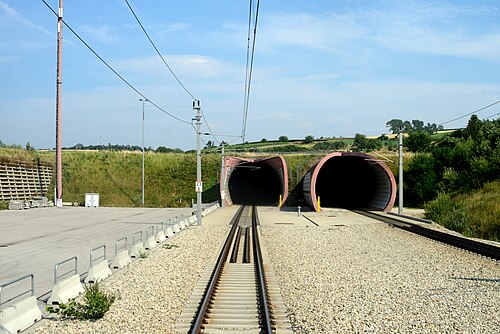
This photo shows the two parallel single‑track bores that link directly with neighbouring tunnels along the high‑speed corridor.
The Wienerwald Tunnel is one of the major engineering features of Austria’s Western Railway, and we passed through it only a short while after leaving Vienna. Built as part of a major upgrade to the country’s most important rail corridor, the tunnel was designed to reduce gradients, support high‑speed travel, and improve access to the newly constructed Wien Hauptbahnhof.
Stretching 13.3 kilometres beneath the northern edge of the Wienerwald (Vienna Woods), it forms part of the 250 kph high‑speed section between Vienna and St. Pölten. The tunnel is actually made up of two different configurations: one long single bore carrying two tracks, and two parallel single‑track bores that connect with neighbouring tunnels, including the Lainzer Tunnel. Construction began in 2004, breakthrough was achieved in 2010, and the tunnel officially opened for service in December 2012.
As we travelled through it, I kept an eye on the digital speed display inside the carriage. The train accelerated smoothly to 250 kph and held that speed for the entire length of the tunnel. There was no sway, no vibration—just an incredibly smooth glide through the darkness. It was easily the most seamless part of the journey.
By 10:00, we rolled into Salzburg, ready to start the day. So, while we sit here enjoying an iced latte and yet another apple strudel, here’s a little introduction to Salzburg to set the scene for what comes next.
Salzburg is Austria’s fourth‑largest city, set along the Salzach River near the German border and framed beautifully by the foothills of the Alps. The city stands on the site of the ancient Roman settlement of Iuvavum, and its long history as an ecclesiastical centre began early—founded as a bishopric in 696 and elevated to an archbishopric in 798. For centuries, Salzburg’s prosperity came from salt mining, trade routes through the Alps, and even gold extraction in the surrounding mountains.
Towering above the Old Town is the Hohensalzburg Fortress, one of the largest and best‑preserved medieval fortresses in Europe, dating back to the 11th century. Much of Salzburg’s elegant Baroque character emerged in the 17th century, when the prince‑archbishops embraced the ideals of the Counter‑Reformation and filled the city with churches, monasteries, and grand squares. And of course, Salzburg is forever linked with its most famous son, Wolfgang Amadeus Mozart, whose birthplace and family home remain major landmarks. Today the city is also a lively university hub, with a large student population adding energy to its historic streets.
With our refreshments finished, it was time to start the walk toward the Old City. It’s only about 1.5 kilometres from the Hauptbahnhof, a pleasant stroll through town and across the Salzach River—at least, it would have been more pleasant if it hadn’t already reached 32 degrees this morning. To make matters worse, I managed to leave my Akubra on the train from Budapest to Vienna last Tuesday, so walking in the heat without a hat wasn’t ideal. I suppose I could always buy a Tyrolean hat and blend in with the locals.

A Tyrolean hat is a traditional Alpine hat that originated in the Tyrol region of Austria (and parts of northern Italy and Bavaria). It’s one of those instantly recognisable pieces of Alpine culture — stylish, practical, and full of character.
Views from the bridge crossing the Salzach River — a perfect vantage point to take in Salzburg’s Old Town, with its Baroque skyline, church towers, and the Hohensalzburg Fortress watching over the city from above.
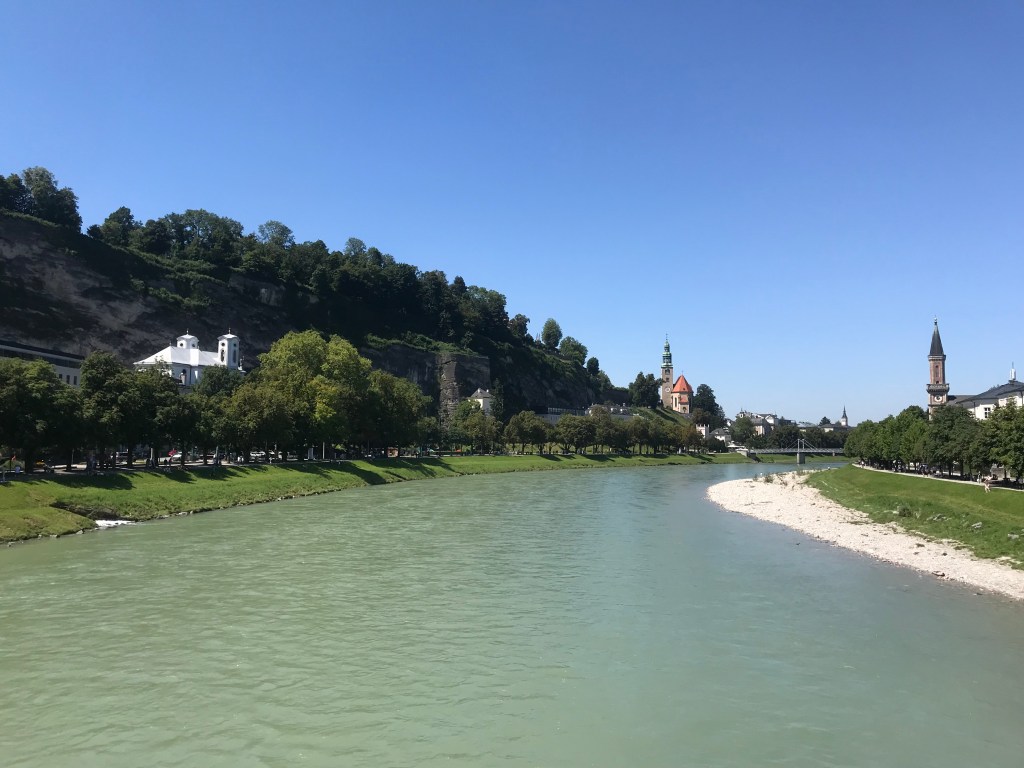
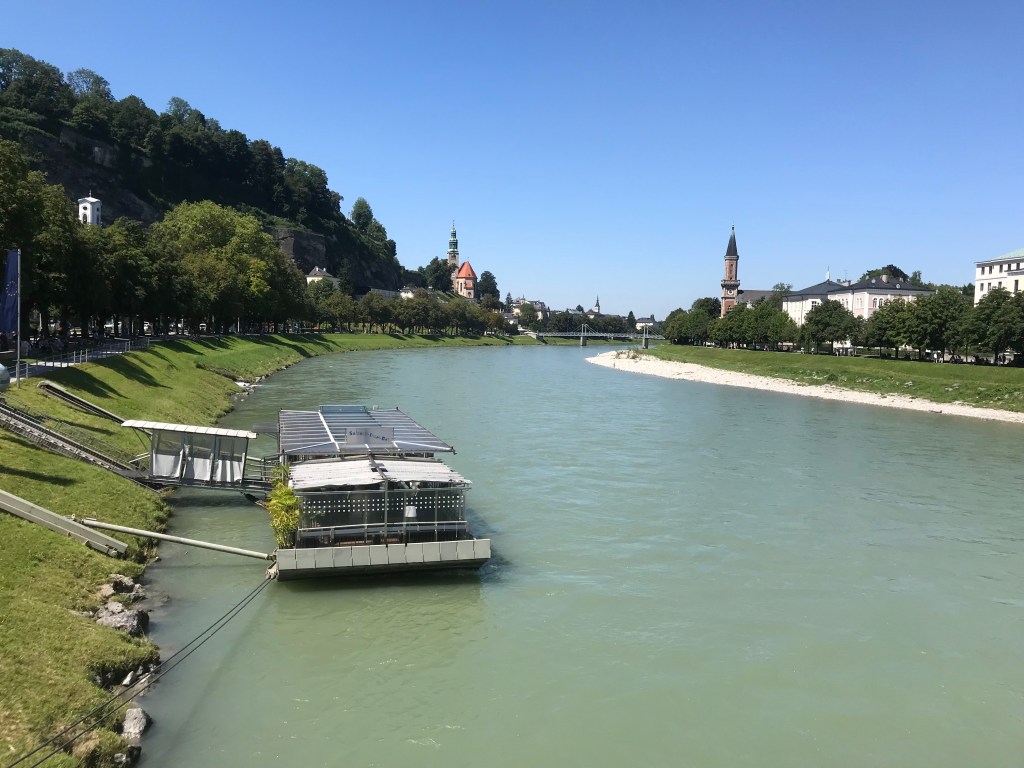
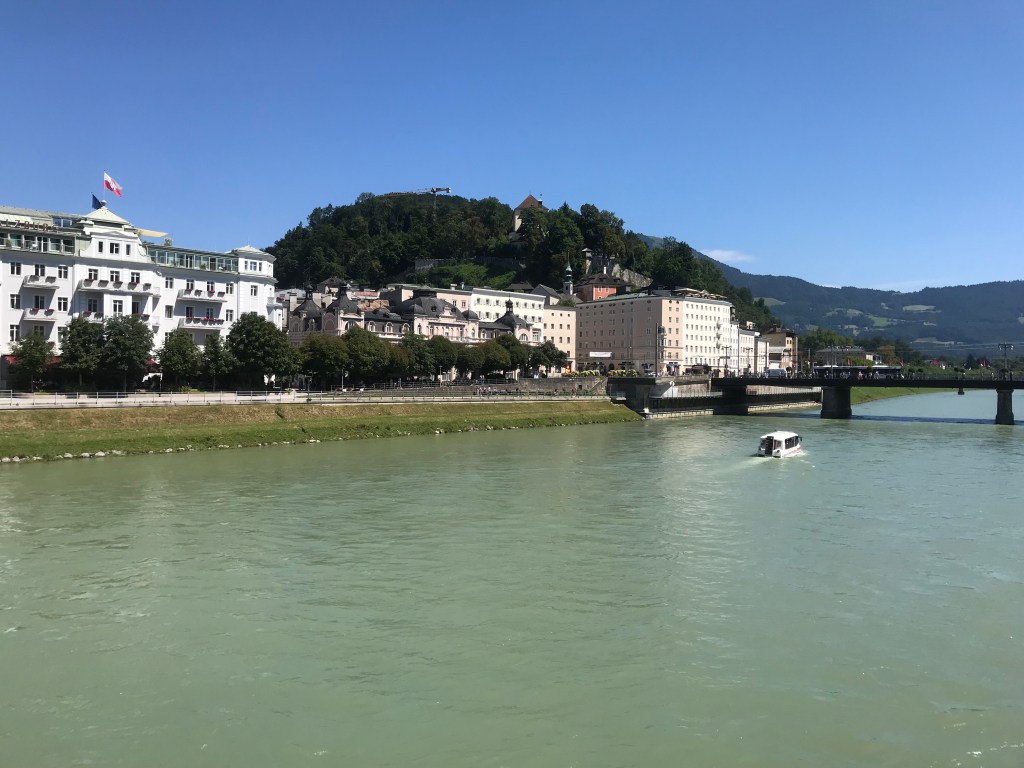
From here we continued toward the Old City, and the first thing we encountered was a remarkable sculpture exhibition in Residenzplatz. Our timing couldn’t have been better, the works are only on display until 28 August 2025, so we were fortunate to see them.
After the photographs, you’ll find more about the Secret Garden exhibition, which adds even greater depth to what we experienced in Residenzplatz.
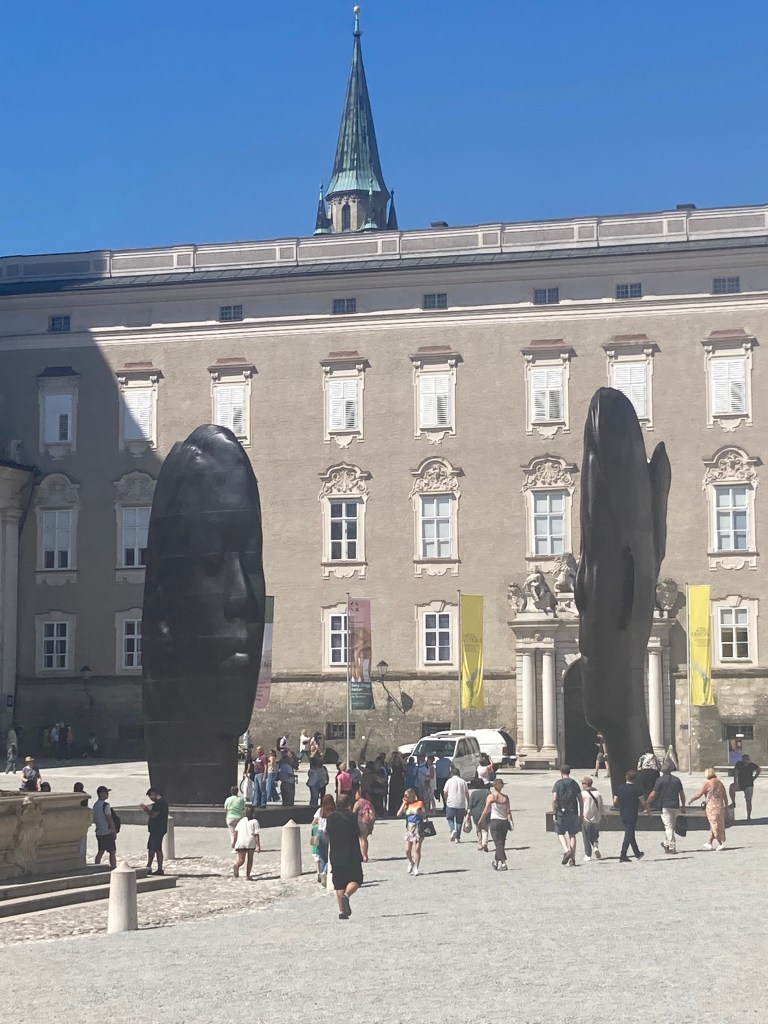
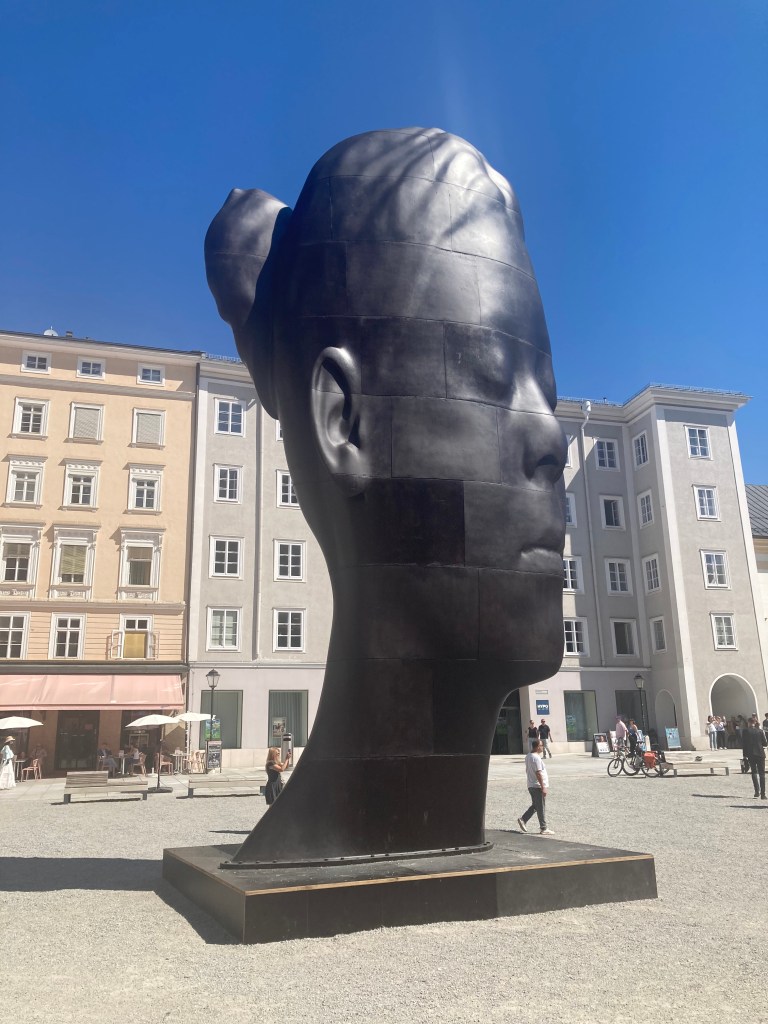
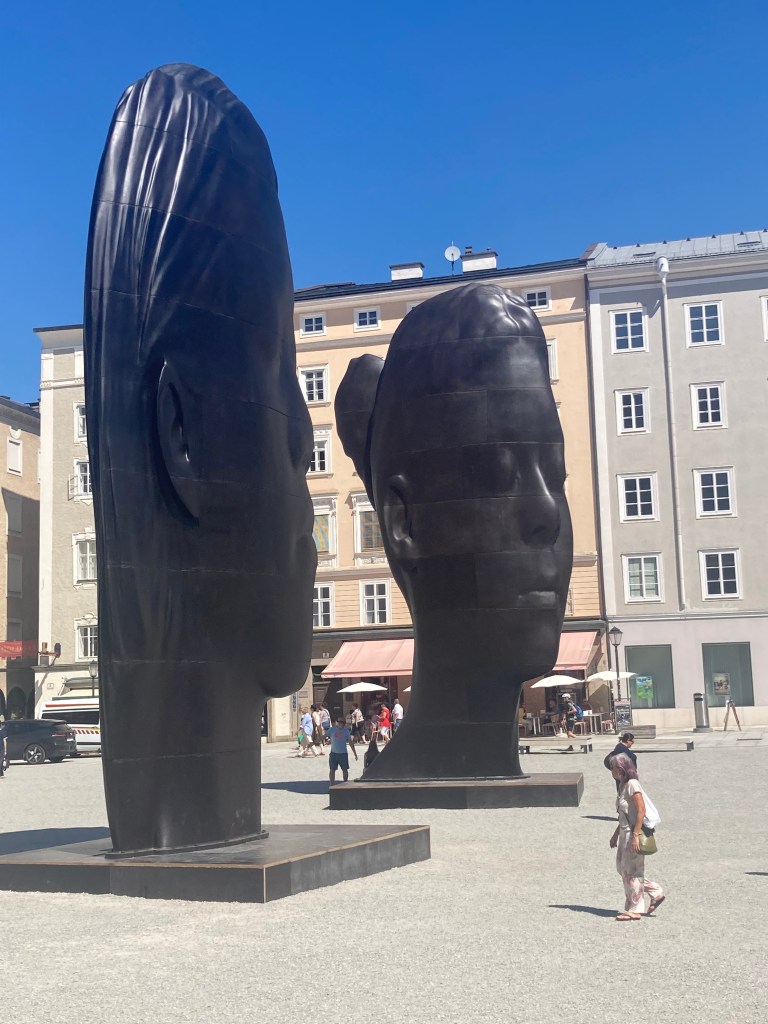
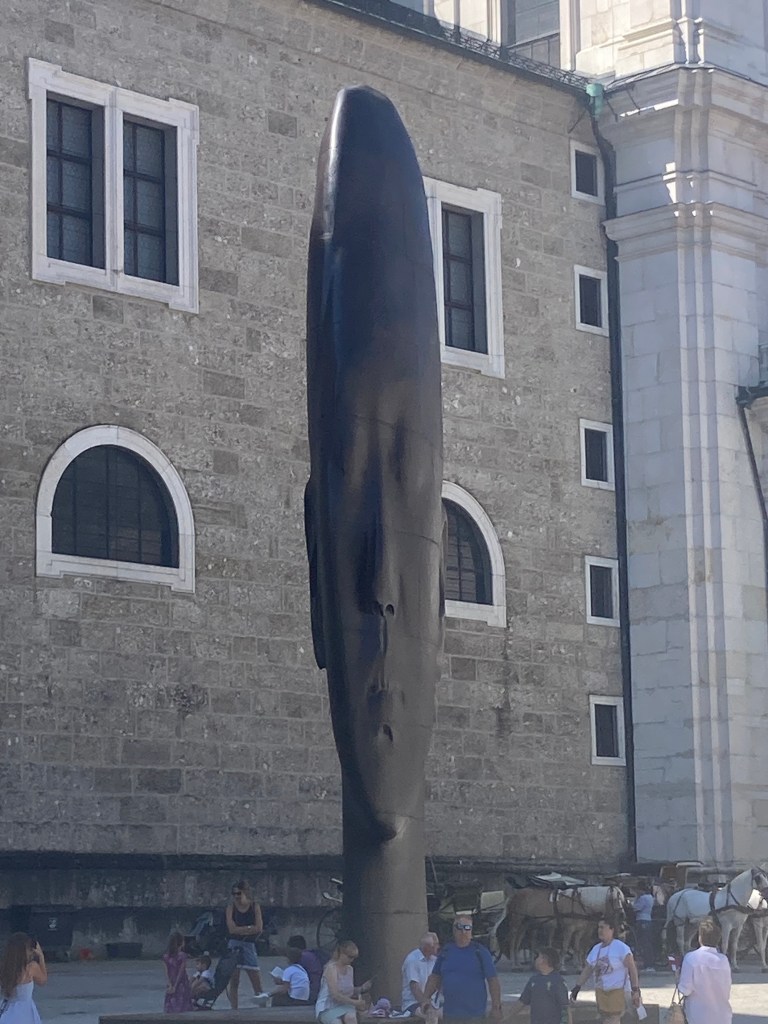
The exhibition, titled Secret Garden, features five monumental female heads by the internationally renowned Spanish sculptor Jaume Plensa. The sculptures are extraordinary in person: serene, elongated faces cast in iron, each radiating a quiet, contemplative presence. Plensa’s intention is to portray timeless, universal women — figures who cannot be placed into any single cultural, ethnic, or geographic category. They feel both familiar and otherworldly, inviting viewers to pause and reflect.
At the heart of Plensa’s work is the theme of love, expressed through forms that embody hope, beauty, and human connection. In Secret Garden, the five heads are arranged around the Residenzbrunnen in the formation of the Pythagorean Star, echoing the five points of the Vitruvian Man, a symbol of harmony, proportion, and ideal beauty. The placement suggests a gathering of figures from across the world — perhaps even from five continents — meeting in silent dialogue at the centre of Salzburg.
The sculptures are more than aesthetic objects; they are an invitation to empathy. Plensa’s art encourages openness, kindness, and attentiveness to others. Secret Garden celebrates diversity within a liberal society and creates a space for conversation, reflection, and shared humanity. Standing among these towering faces, you feel both grounded and uplifted — a reminder of how art can quietly reshape a public square.
It was a fascinating exhibition, and I’m genuinely glad we were able to experience it.
From Residenzplatz we continued through the Old City toward Mozart’s birthplace. The area in front of the building was absolutely packed, walking tour groups, day‑trippers, and a general crush of people. We didn’t manage to go inside, and even getting a decent photo of the façade proved difficult. Still, it was worth seeing, even briefly, given Mozart’s deep connection to the city.
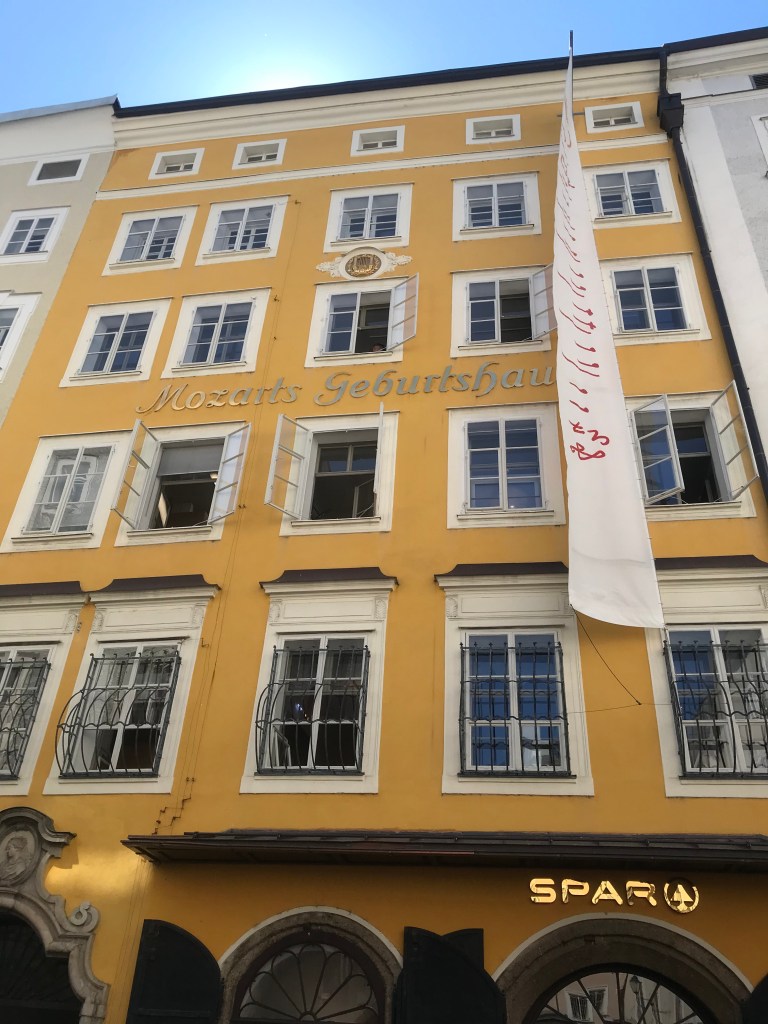
From here it was time to find a spot for a late lunch. We eventually settled on a small Indian restaurant that turned out to be an excellent choice, flavourful dishes, friendly service, and exactly what we needed after walking around in the heat. Given the temperature, we treated ourselves to two small draft beers with lunch, which went down very well.
After eating, we made our way back to the Hauptbahnhof, where we had about an hour to wait before our train. The service back to Vienna was supposed to be the Railjet originating from Zurich, but something was clearly amiss. Instead of arriving on the scheduled platform, ÖBB substituted a different train configuration on a completely different track. Still, the electronic signage matched our details, carriage 26, seats 22 and 24, train RJ165, so we boarded. In fact, we were allowed on a full 30 minutes before departure, which is unusual.
This particular service was actually two trains joined together, to be separated upon arrival in Vienna: one portion continuing to the airport, the other heading onward to Budapest. We were in the Budapest section, so it was important to double‑check the train number, carriage, and seats. Everything looked correct, so we settled in for the two‑and‑a‑half‑hour journey.
Well… that lasted until about ten minutes before departure.
I happened to glance at the compartment display and noticed it had suddenly changed. Our carriage was now labelled RJ565, carriage 36. At that exact moment, crowds of people began sprinting down the platform toward our train. For reasons known only to ÖBB, the rail company had decided to switch the identities of the two trains electronically. With a few keystrokes, the train we were sitting on became RJ565, and RJ165 was now seven carriages away, on the other side of the locomotive that joined the two services.
Because seats and carriages are reserved, we had no choice but to grab our things, jump off, and run down the platform to find the actual RJ165, carriage 26, before departure. And of course, first class was at the very end of the entire formation, or, thanks to the direction of travel, now at the very front. To reach it, we had to get past the mid‑train locomotive, which physically separated the two services, before we could even enter a carriage and walk through to our seats.
Suddenly the chaos made sense. Everyone was running because everyone had to change carriages. It was absolute bedlam.
Despite all this, the train departed only three minutes late, and the journey back to Vienna was uneventful, until about fifteen minutes before arrival.
You’re not going to believe this.
The conductor switched the train numbers back to their original configuration. RJ165 was once again the Budapest‑bound service, and RJ565 was once again the airport train. For us, it didn’t matter, we were getting off in Vienna anyway. But for everyone continuing to Budapest, it meant yet another mad dash across the platform in Vienna to reach the correct train on the other side of the locomotive. The scheduled stop was only five minutes, so it had to be extended to allow the chaos to unfold… again.
The sheer stupidity of the whole situation was unbelievable.
I hope you had a laugh reading all that. We certainly did afterwards, though I genuinely felt sorry for the older lady and the child sitting behind us, they had to sprint to the other train in Vienna, and it was stressful to watch.
After the exhausting return journey to Vienna, we didn’t even think twice — we headed straight to the little pizza place next door to our hotel and had dinner. Nothing fancy, just good food and a chance to finally stop moving. After that it was back to the hotel to unwind for the evening.
Despite the chaos with the trains, it really was a wonderful day in Salzburg and absolutely worth the trip. Just one piece of advice for anyone following in our footsteps: make sure you’re sitting in the right carriage on the right train… and keep a very close eye on that onboard signage.
Saturday 9 August 2025
oday was all about preparing for tomorrow’s departure to Milan, Italy — a full day of train travel, leaving at 06:24 and not arriving until 18:15. With such a marathon ahead of us, we kept things deliberately low‑key. More laundry was done (again), and Maree settled herself in the hotel’s recreation room with her book, perfectly content. I spent the afternoon fine‑tuning the remaining legs of our trip and doing a bit of contingency planning for tomorrow’s tight transfer at Venice Mestre, just in case the rail gods decide to test us again.
For our final evening in Vienna, we decided to head back into the Old Town for a farewell dinner — a small ritual of sorts before moving on to the next chapter. It felt like the right way to close out our time here: a relaxed meal, familiar streets, and that quiet sense of anticipation that comes the night before a long journey.
Tomorrow, Milan awaits.
Sunday 10 August 2025
As mentioned yesterday, today was our marathon travel day from Vienna to Milan — one long cross‑country journey with a single, crucial transfer at Venice Mestre. If everything ran on time, we’d have a comfortable 32‑minute connection before boarding our 14:34 train to Milan, arriving at 18:15. With not much else to report before departure, I thought I’d take you along for the ride.
We set the alarm for 05:00 and left the hotel at 05:50 for the short walk to the Hauptbahnhof. We found our platform easily and waited for our Railjet service, fast, smooth, and usually reliable. Our scheduled departure was 06:24.
The train rolled in at 06:33 and finally departed at 06:40, already 16 minutes late before we’d even left Vienna. That immediately cut our Mestre transfer time in half. Still manageable, but not ideal.
About an hour into the journey, an announcement came over the speakers: the locomotive was having technical issues and would need to be replaced at St. Veit/Glan, a full 2.5 hours away. Worse, the locomotive was running below normal speed, meaning our delay was growing. Time to start contingency planning.
I checked the onward connections from Mestre to Milan. Two high‑speed direct services were available: 14:47 and 16:00. By the time we reached St. Veit/Glan, we were 30 minutes behind schedule, meaning we’d miss our original 14:34 connection by two minutes. The 14:47 train became our new target, giving us a tight but doable 15‑minute transfer. I booked seat reservations through the Eurail app, AUD 50, not bad for peace of mind.
But the day wasn’t finished with us.
Forty minutes after leaving St. Veit/Glan, we reached Villach, and our delay had grown by another ten minutes due to track work. New estimated arrival at Mestre: 14:42. That left us with a five‑minute transfer, assuming we arrived on a platform anywhere near platform six, which was far from guaranteed. The onboard staff couldn’t confirm our arrival platform, as delays often reshuffle everything.
At this point, the sensible option was to secure seats on the 16:00 train as well. Another AUD 50, but at least we’d be guaranteed to reach Milan tonight. And before you ask why we didn’t just modify the first reservation, Italian high‑speed seat changes can be unpredictable, especially with Eurail passes. Sometimes it works, sometimes it doesn’t, and last‑minute changes are notoriously tricky. Easier to just book fresh seats and move on.
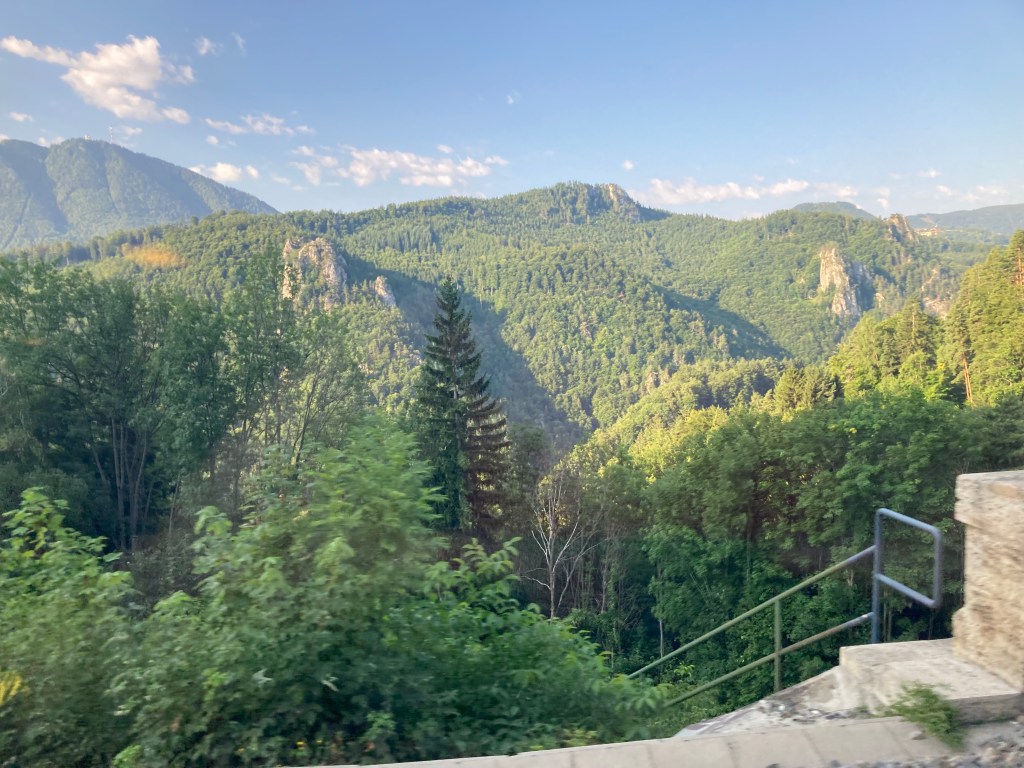
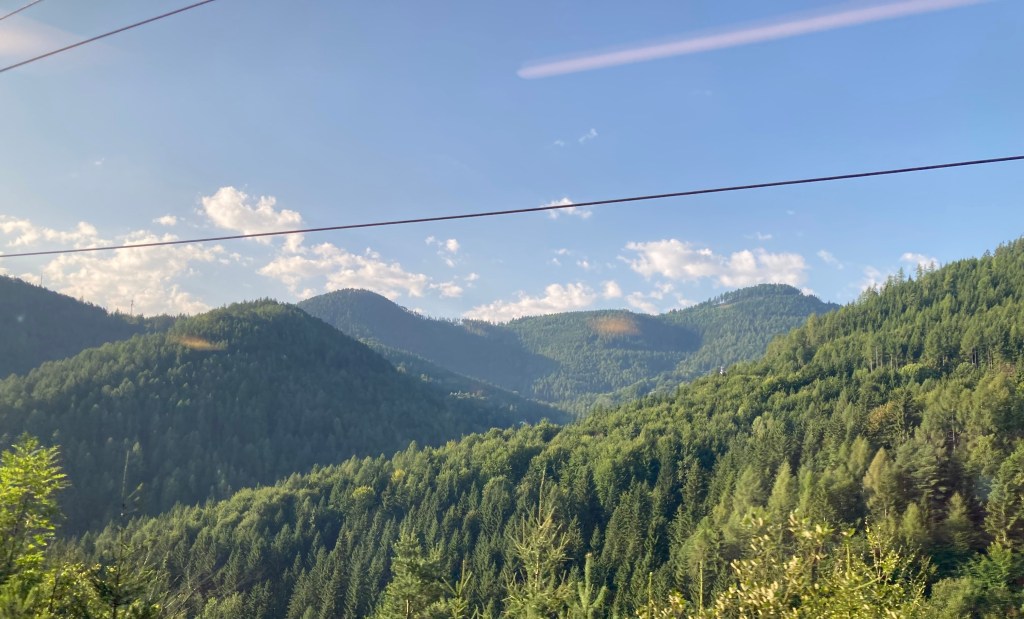
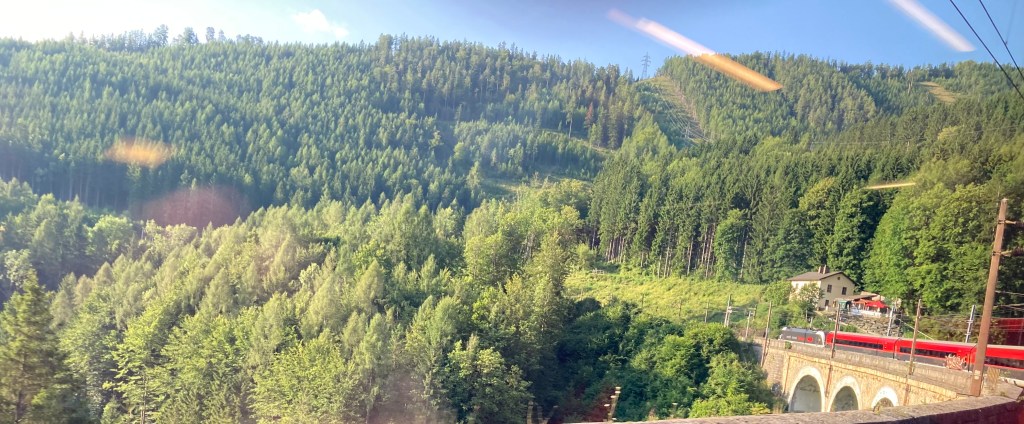
From Villach to Mestre was a three‑hour run. Surely nothing else could go wrong.
And then something strange happened.
At the first stop, we made up 10 minutes. At the next three stops, we gained another 20 minutes. By the time we left Treviso Centrale, we were running only two minutes late. Somehow, in three hours, we’d clawed back 40 minutes — something that shouldn’t be physically possible unless the train was secretly a rocket.
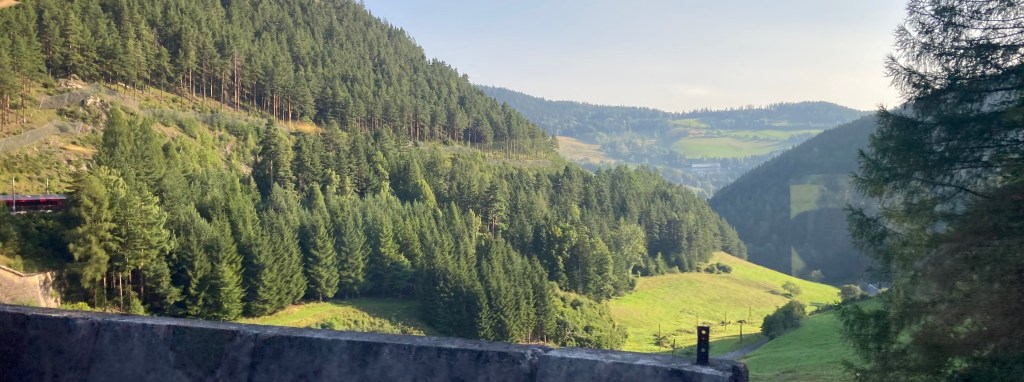
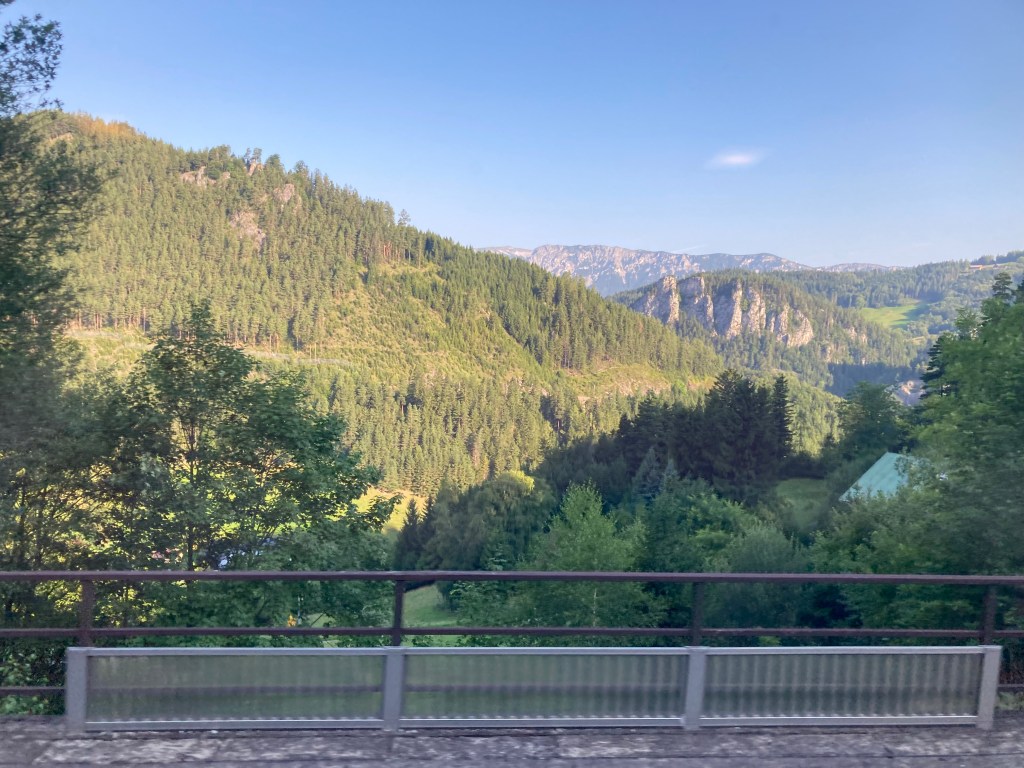
The only explanation I can come up with is that the rail company deliberately displays conservative travel times on the onboard screens when delays occur, assuming the locomotive will run slower than it actually does. Meanwhile, the train barrels along at normal speed, quietly making up time while the passengers panic‑plan their connections.
No announcements were made, just a polite message on the screen inviting dissatisfied passengers to lodge a complaint on the company website. Something was definitely amiss.
In the end, we arrived in Milan at the original scheduled time, despite the chaos, the locomotive swap, the phantom delays, and the mysterious time‑gains. We were only AUD 100 out of pocket for the extra seat reservations; and honestly, the three small bottles of wine we bought on the Mestre–Milan train did wonders for our stress levels.
By the time we rolled into Milan, Maree and I were perfectly relaxed.
A long day, a strange day, but a memorable one; and we made it.
Our hotel was only 300 metres from the station, which was a blessing after the day we’d had. A short walk, a quick check‑in, and then we shuffled across the road for an equally quick dinner — the kind where you’re too tired to care what you order as long as it arrives on a plate.
By the time we got back to the room, we were both ready to collapse. Whoever said train travel in Europe is relaxing has clearly never tried doing it the way we do.
Monday 11 August 2025
Today was officially shopping day for Maree. And really, where better than Milan — the global capital of fashion, style, and people who somehow look runway‑ready even when buying milk. Maree was on the hunt for something special, and I was quietly hoping she’d find it quickly so I wouldn’t have to carry too many bags.
But first: breakfast.
We found a small café not far from the station that looked promising. The moment we sat down, the waiter swooped in and started rattling off suggestions before we’d even opened the menu. I politely said I’d like to look first, so he immediately turned to Maree and repeated the entire performance. I told her to just ignore him and keep reading.
Eventually we ordered, an omelette for me, a croissant and latte for Maree. The food was fine, nothing memorable. When the bill arrived, the waiter insisted on cash. I told him I didn’t have any, so card it was. Then came the chorus: “Tip? Tip? Tip?” I said no tip today; the service didn’t exactly inspire generosity. He wasn’t thrilled, but that’s life.
From there we walked to Corso Buenos Aires, one of Milan’s major shopping streets — three kilometres of shops, heat, and more shops. We chose the shaded side first because it was already 32 degrees and absolutely still. After an hour of browsing and no purchases yet, we decided it was time for a break.
And that’s when we found Elisir Café, and what a discovery.
This place deserves a special mention. A charming little spot with genuinely warm service, beautifully presented pastries, and iced lattes served in cocktail glasses, which somehow made them taste even better. I ordered a tiramisu that was light, creamy, and perfectly balanced. Maree had a lemon tart that she loved. It was one of those unexpected travel finds that instantly becomes a favourite.
See the photos that follow — they do the place justice.
Refreshed and re‑energised, we continued our Milan adventure, grateful that at least one café today understood how hospitality is supposed to work.
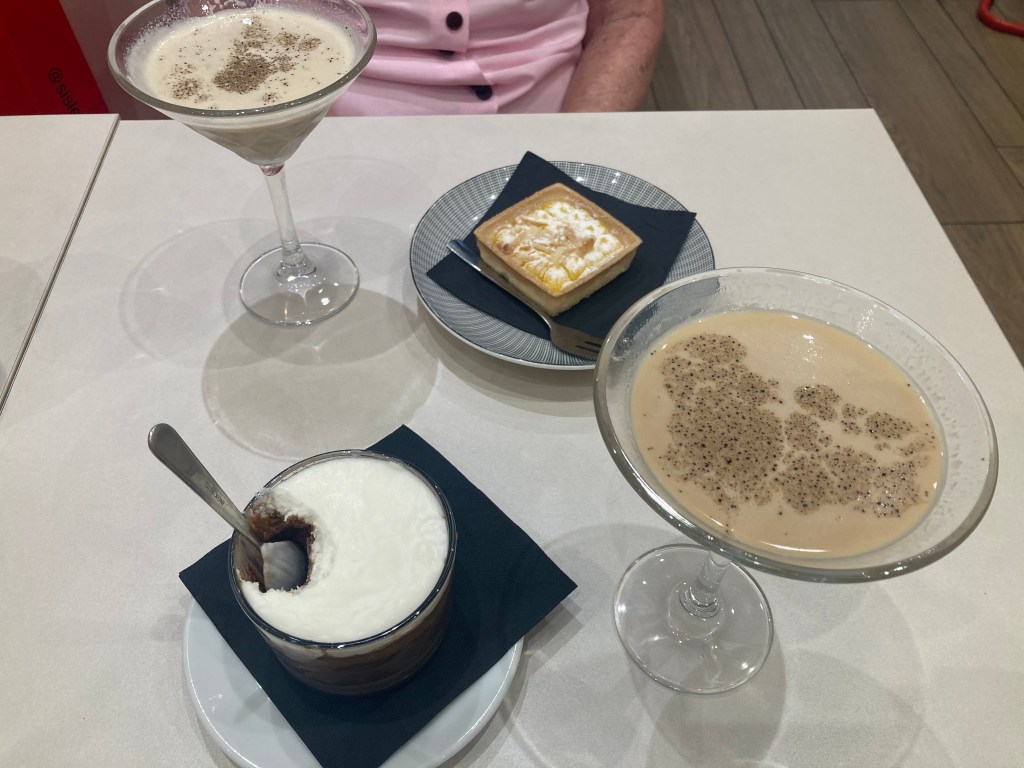
From here it was more shopping, and Maree finally struck gold, she found a Bennetton store and walked out with three lovely tops. Great colours, great prices, and like most of the fashion along Corso Buenos Aires at this time of year, everything was on special. A successful Milan shopping mission at last.
After wandering the streets in the heat, it felt like the perfect moment to retreat to the hotel, cool down, and gather ourselves. Once the evening softened, we strolled just a short distance from the Glam Hotel to Osteria Italiana, the cosy neighbourhood restaurant we’d chosen for dinner.
The place has that classic Italian warmth, mple, welcoming, and focused on good food rather than fuss. Its menu leans into traditional favourites: fresh pastas, rustic mains, and generous portions that feel like they’ve come straight from someone’s nonna rather than a commercial kitchen. The atmosphere is relaxed, the service unhurried, and the whole experience has that comforting, unpretentious charm that makes a meal feel restorative rather than demanding.
It turned out to be exactly what we needed: a calm, satisfying dinner just steps from “home” for the night.
Now it’s off to bed — tomorrow brings another long travel day, this time to Monte Carlo, a tidy seven hours of trains and scenery.
Tuesday 12 August 2025
Today was spent entirely on the rails, travelling from Milan to Monte Carlo via Ventimiglia. We left Milan at 09:50 and rolled into Ventimiglia at 14:59, where we had just under twenty minutes to transfer to the local train. That short hop to Monte Carlo, scheduled for 15:18 to 15:50, turned out to be the most memorable part of the journey.
By the time the train pulled out of Ventimiglia, the carriage was heaving with people, bags, bikes, scooters, anything that could be wedged into a doorway or aisle. There was barely room to breathe, let alone move. Most passengers were heading on to Nice, which meant our stop wasn’t too chaotic, but the platform at Monte Carlo was packed with people trying to squeeze on. Watching them attempt to board reminded me of the commuter crush in Japan, bodies pressed against windows and doors as the train lurched away even fuller than before.
Given the heat, neither of us felt inclined to walk the kilometre to the hotel. The station has a dedicated phone for taxis, so we used that, and were promptly reminded that Monaco plays by its own rules. The flag fall alone was 25 EUR, and thanks to traffic the short ride ended at 30 EUR. A steep introduction, but at least it delivered us straight to the cool refuge of our hotel room, where the air‑conditioning was quickly set to “civilised.”
After a much‑needed rest, thoughts turned to dinner. Wanting something close by, we asked reception for a recommendation and were pointed toward Maya Mia, the local Italian restaurant just a short walk away.
It turned out to be an excellent suggestion. Maya Mia has that polished‑yet‑casual charm Monaco does so well, warm lighting, attentive staff, and a menu that balances comfort with refinement. Maree chose gnocchi with clams, a beautifully delicate dish with fresh seafood and perfectly soft gnocchi. I went for a beef schnitzel with roast potatoes, and it was spot on. In Europe, schnitzels often come with lemon rather than a heavy sauce, and I’ve come to prefer it that way—the bright, sweet‑sour hit lifts the whole dish. I added a little Dijon mustard on the side, which gave it another layer entirely. And of course, a bottle of Pinot Grigio completed the evening.
A long travel day, a chaotic train crush, a pricey taxi, and then a genuinely lovely dinner quite a welcome to Monte Carlo.
Following are photos I took inside the restaurant and the food.
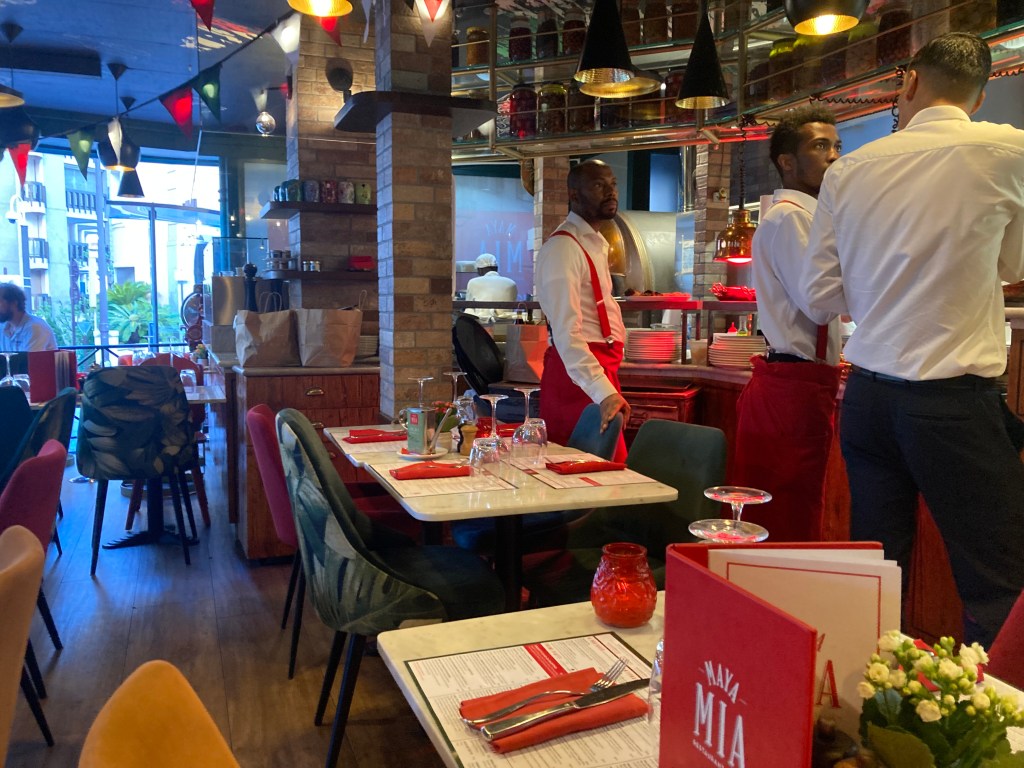
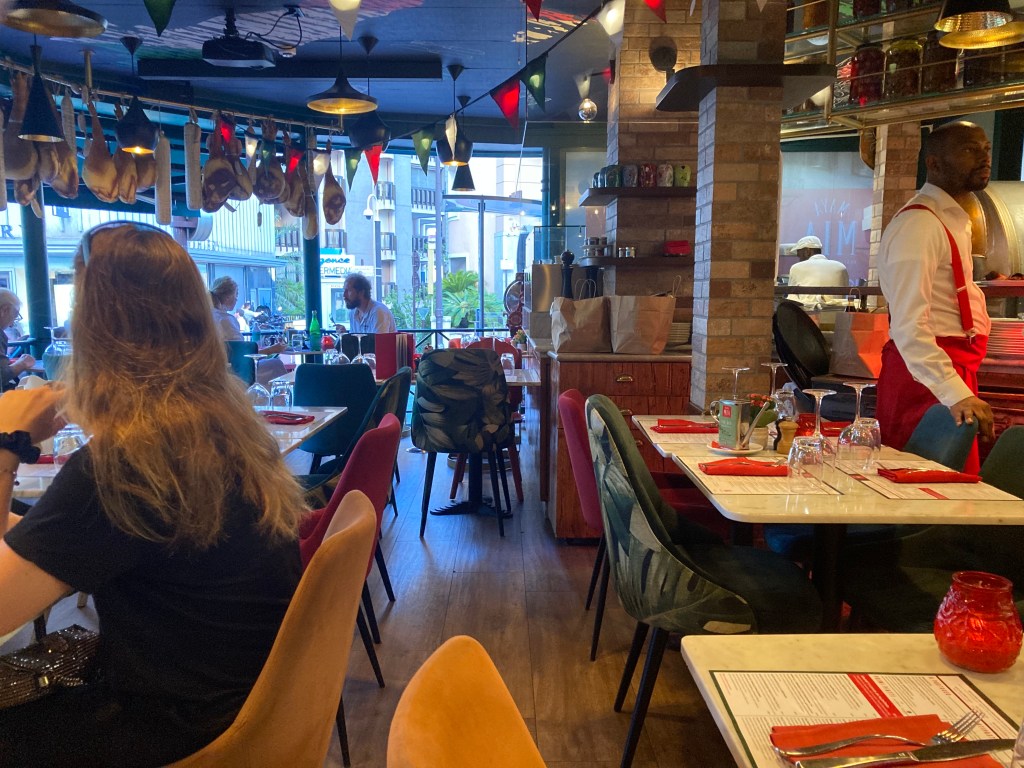
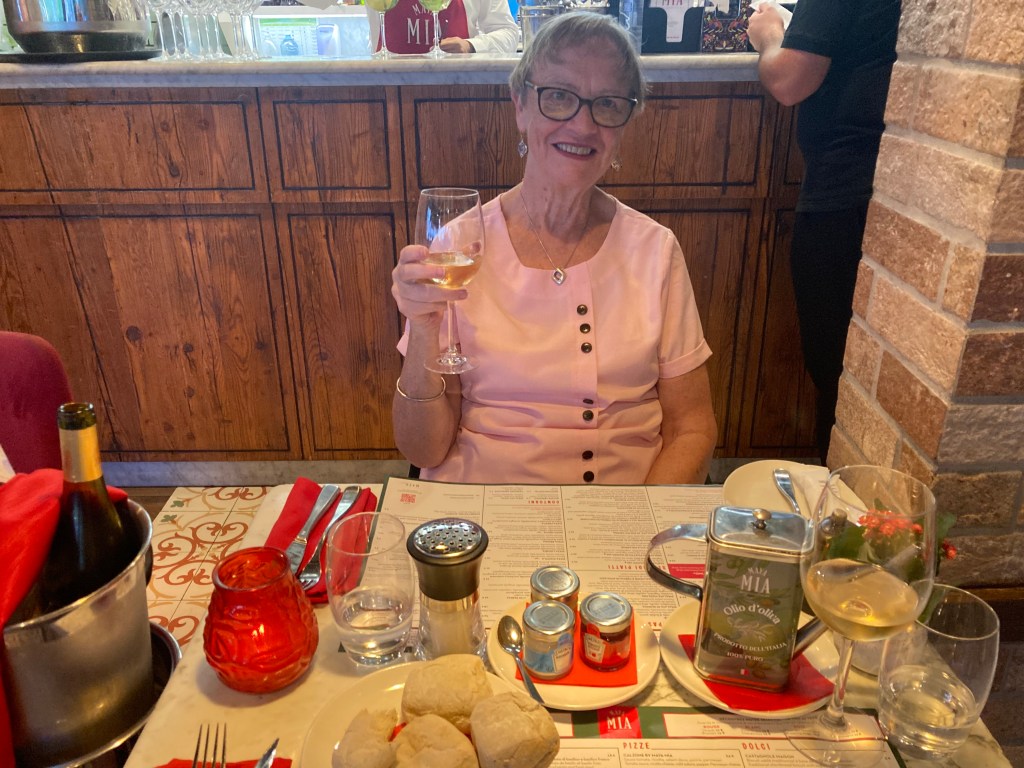
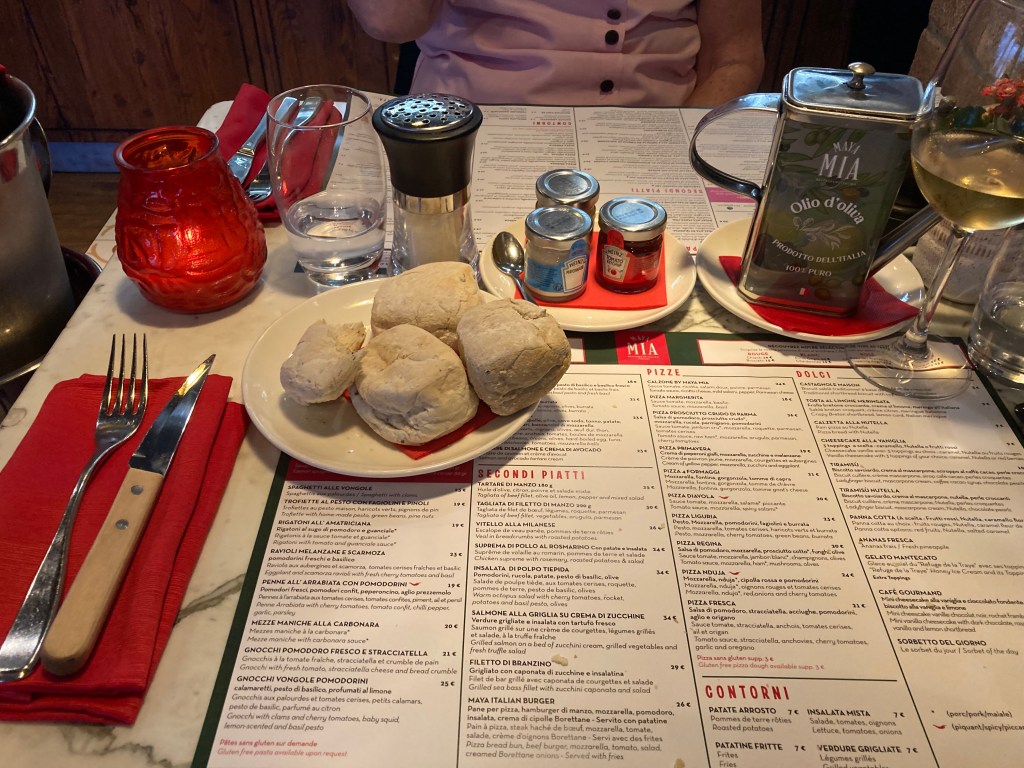
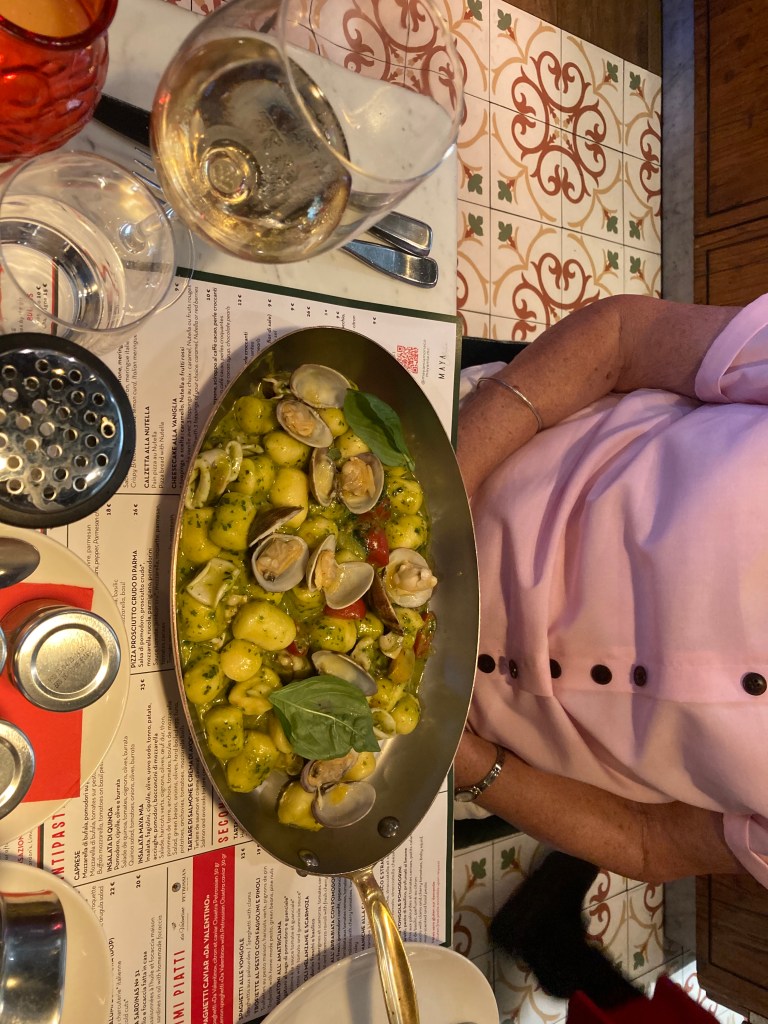
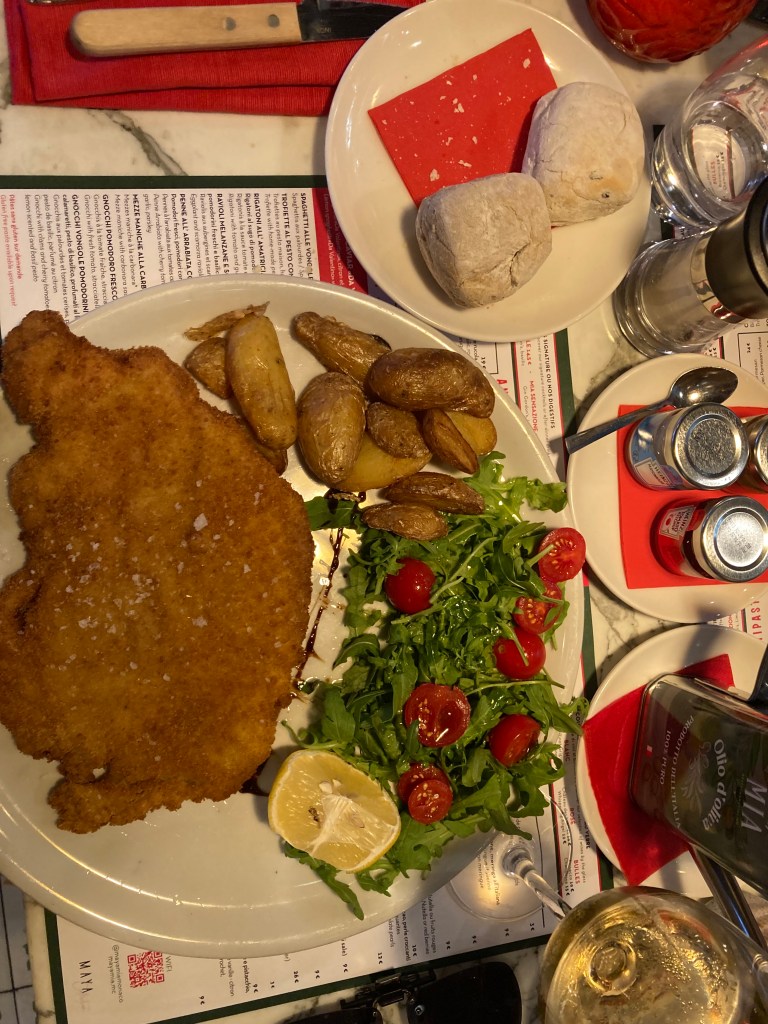
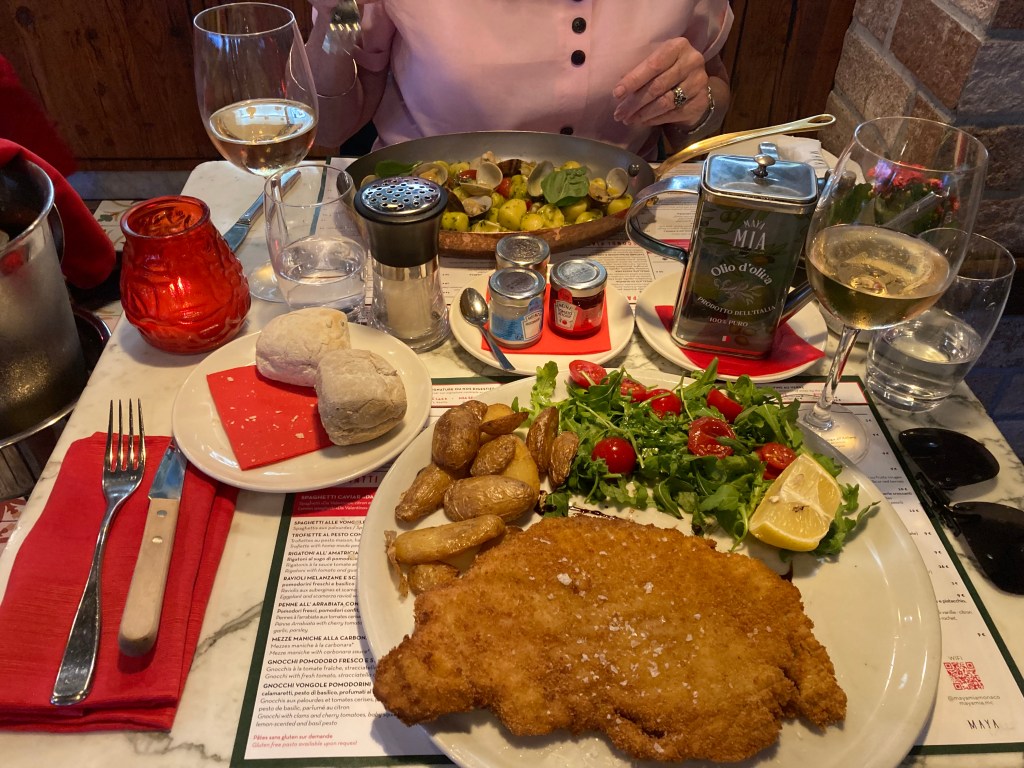
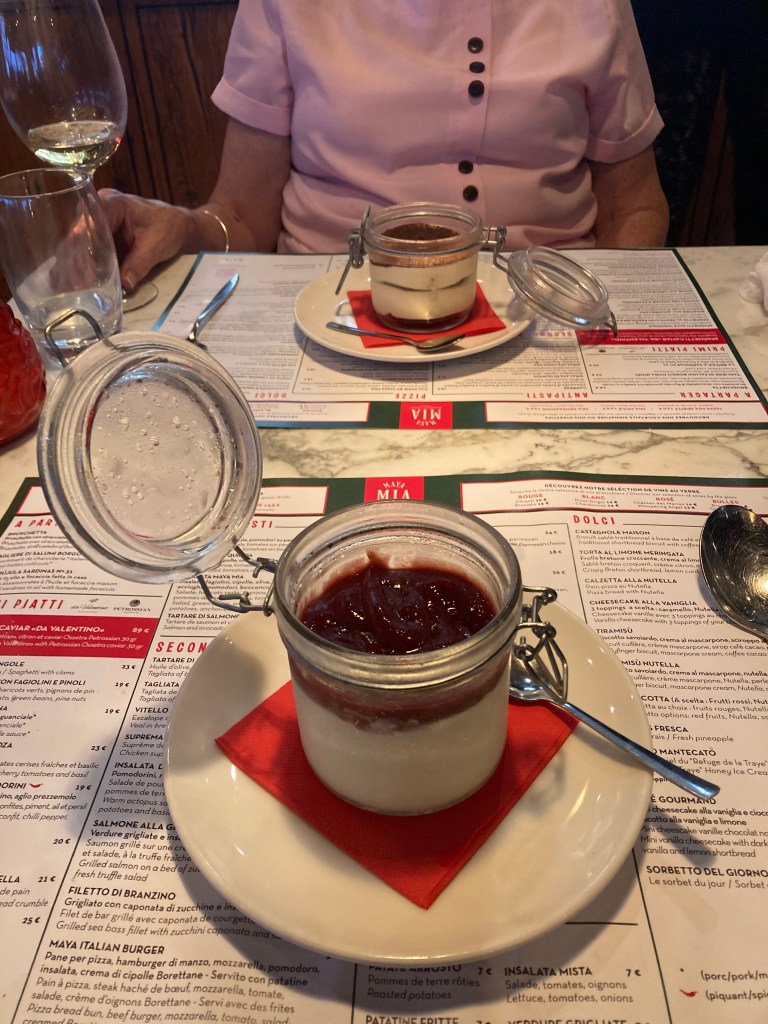
As mentioned, both the food and the service were excellent, and we’ve already decided to return tomorrow night—partly because the weather is scorching, and partly because having a genuinely good restaurant so close to the hotel feels like a gift in this heat.
Tonight’s bill came to 240 AUD, by the way. Monte Carlo doesn’t miss an opportunity to remind you that nothing here comes cheap.
Wednesday 13 August 2025
Today we took a walk around Monte Carlo, though we didn’t stay out for long—the heat at the moment is intense, and getting anywhere from our accommodation involves navigating a surprising number of stairs. The paths down to the waterfront are either steep staircases or winding footpaths that follow the roadside. The footpaths take longer, and in this kind of still, airless heat they’re hardly appealing. The stairs aren’t much better, of course, because whatever goes down must eventually come back up, and the climb is no small effort.
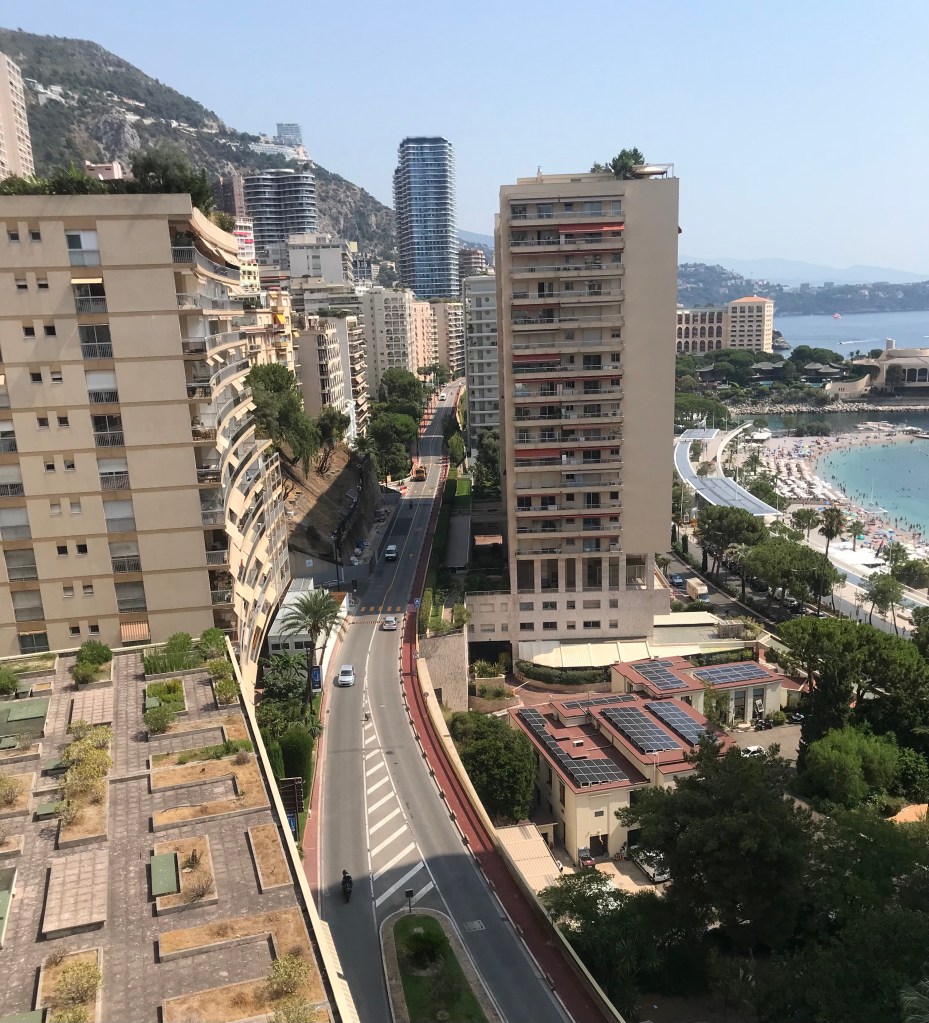
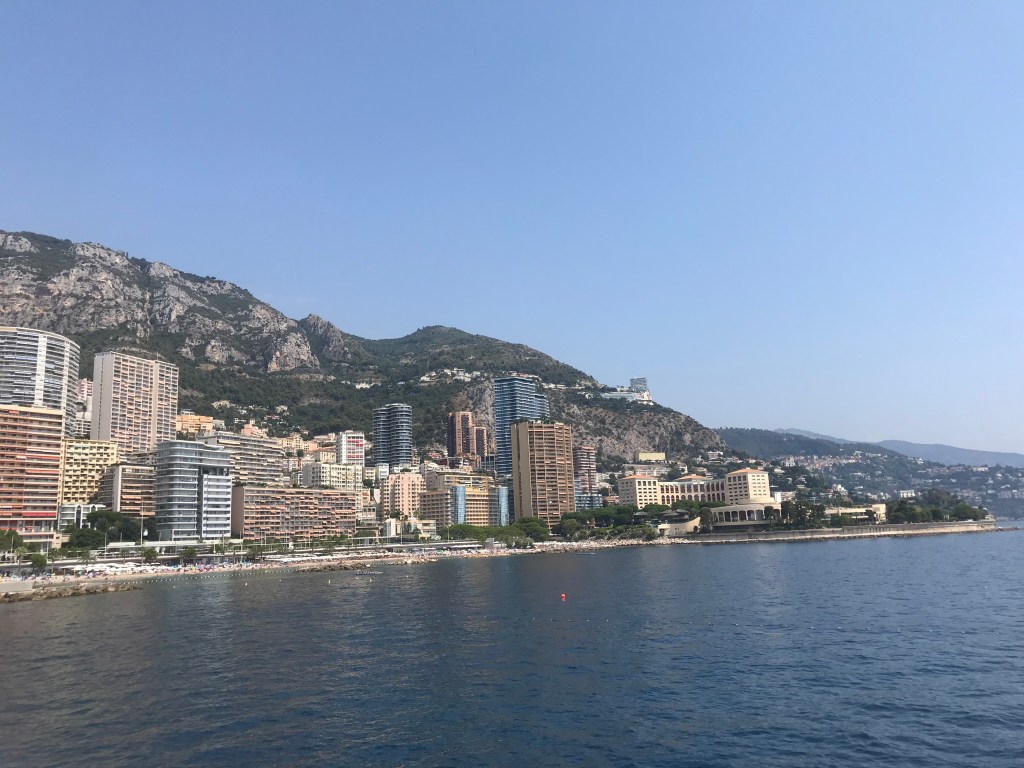
Monaco, the second‑smallest country in the world, has a history shaped by its strategic position on the Mediterranean and by the remarkable longevity of the Grimaldi family, who have ruled—on and off—since the 13th century. Long before the modern principality emerged, the area’s defining feature was the Rock of Monaco, a towering limestone promontory that served first as a natural refuge for ancient peoples and later as a fortress coveted by every regional power.
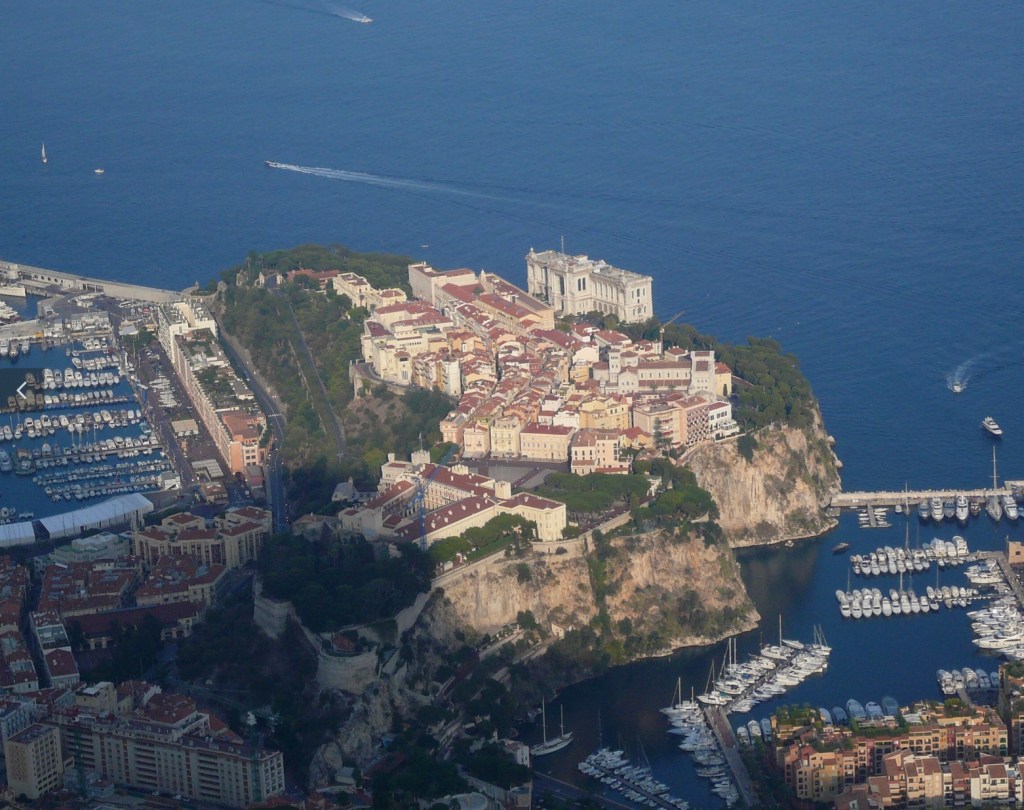
Monaco’s early political story begins with the Republic of Genoa. The Holy Roman Empire granted the territory to the Genoese, and it was the Genoese Grimaldi family who seized the Rock in 1297, establishing a dynasty that still reigns today. Over the centuries, Monaco’s independence ebbed and flowed under the influence of larger powers, including the Crown of Aragon, Spain, and France. After the French Revolution, Monaco was absorbed into France, only to regain limited autonomy in the 19th century as a protectorate of the Kingdom of Sardinia.
In 1848, the towns of Menton and Roquebrune broke away from Monaco and were later sold to France, reducing the principality to its current size. In return, France formally recognised Monaco’s sovereignty. From the 1860s onward, Monaco reinvented itself as a destination for tourism and leisure, an identity cemented by the opening of the Monte Carlo Casino and the development of luxury hotels and seaside promenades.
The 20th century brought further upheaval. Monaco was occupied by Axis forces during World War II, but after liberation it steadily strengthened its independence, culminating in full recognition by the United Nations in 1993. Today, Monaco is a sovereign state that uses the Euro but is not part of the European Union, maintaining its own distinct political and economic identity.
A tiny principality perched on a dramatic coastline, shaped by centuries of shifting alliances and the enduring presence of the Grimaldis, Monaco’s history is as layered and striking as the cliffs it stands upon.
The following photos were taken by Maree during her walk down toward the waterfront, a descent that offers not only sweeping views of Monte Carlo but also a chance to encounter some striking public art along the way. Among the most eye‑catching pieces are the statues of opera singers, including two sculptures from Manolo Valdés’s celebrated Reina Mariana series.
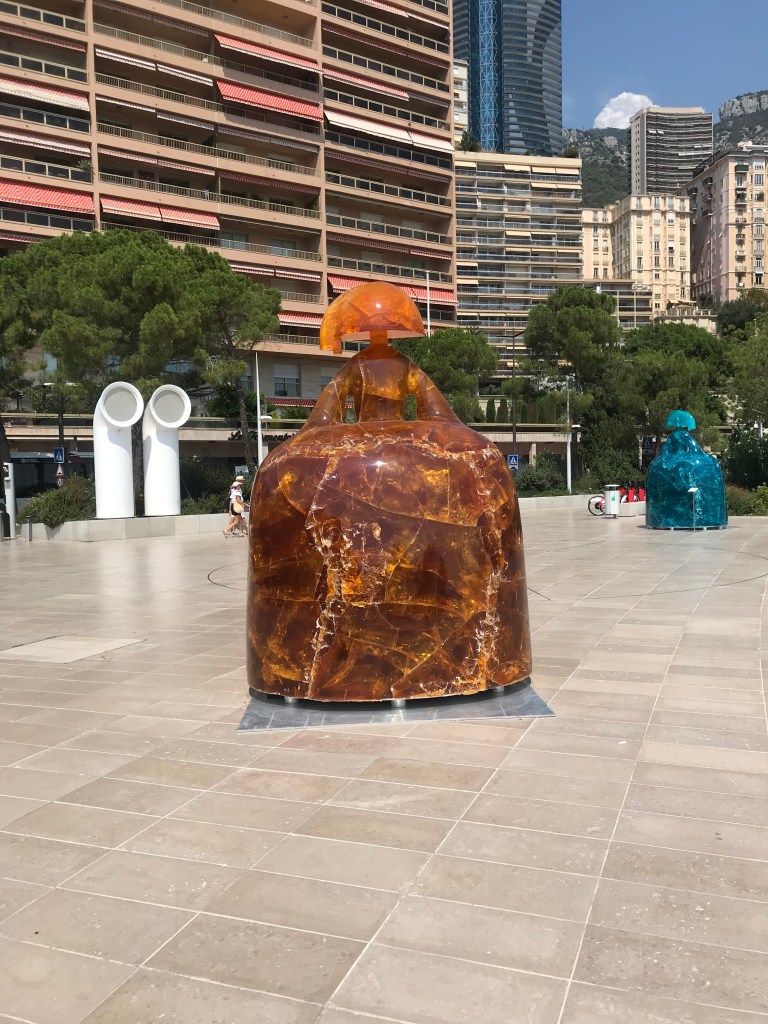
Seeing them on the walk down, set against the steep terrain, the glittering harbour, and the dense cluster of high‑rise buildings, creates a striking contrast between old and new, tradition and reinvention. It’s a reminder that Monaco’s visual identity isn’t just shaped by its history and geography, but also by the contemporary art woven into its public spaces.,
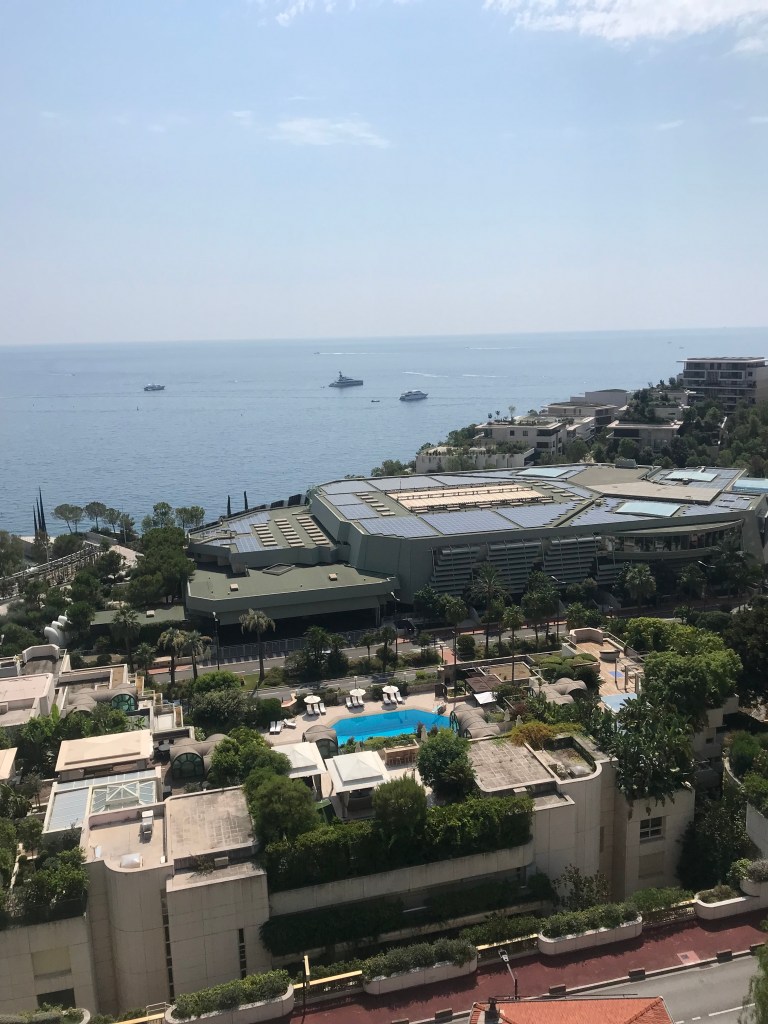
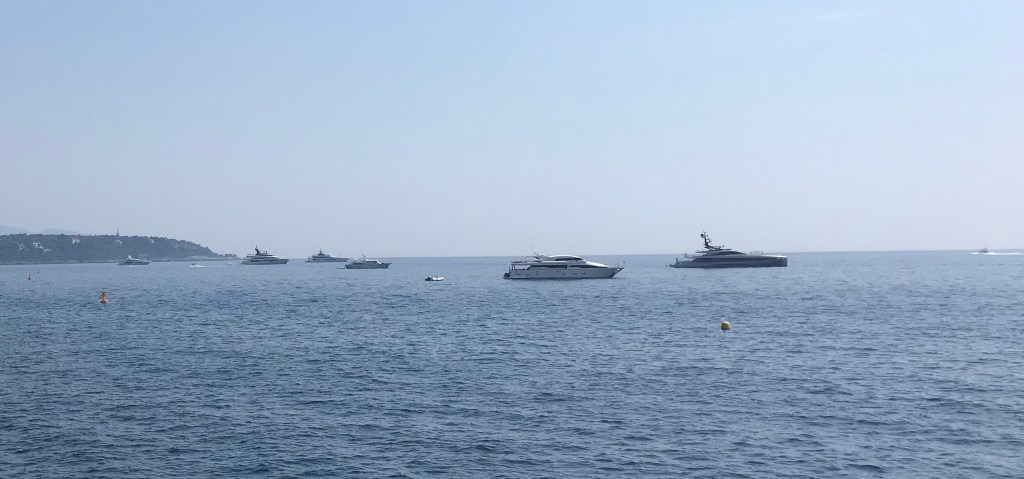
An evening photo of one of the many steep stairways that criss cross Monte Carlo. The city is built into sharply rising terrain, so getting up and down often means navigating long flights of steps like this—an everyday reminder of just how vertical the principality really is.
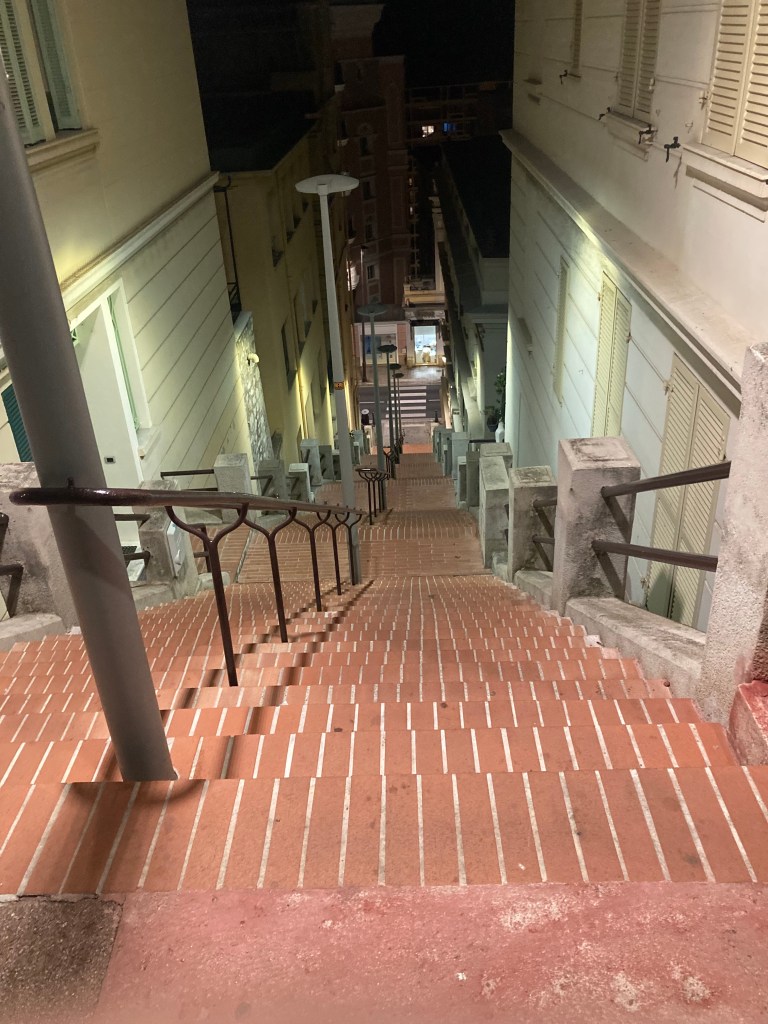
For dinner we headed back to Maya Mia, and the food and service were every bit as good as last night’ so much so that we’ve already booked ourselves in again for Friday evening. Maree chose the warm octopus salad and said it was beautifully done, full of flavour and perfectly tender. I stayed loyal to last night’s choice and ordered the same dish again, which tells you everything you need to know about how good it was.
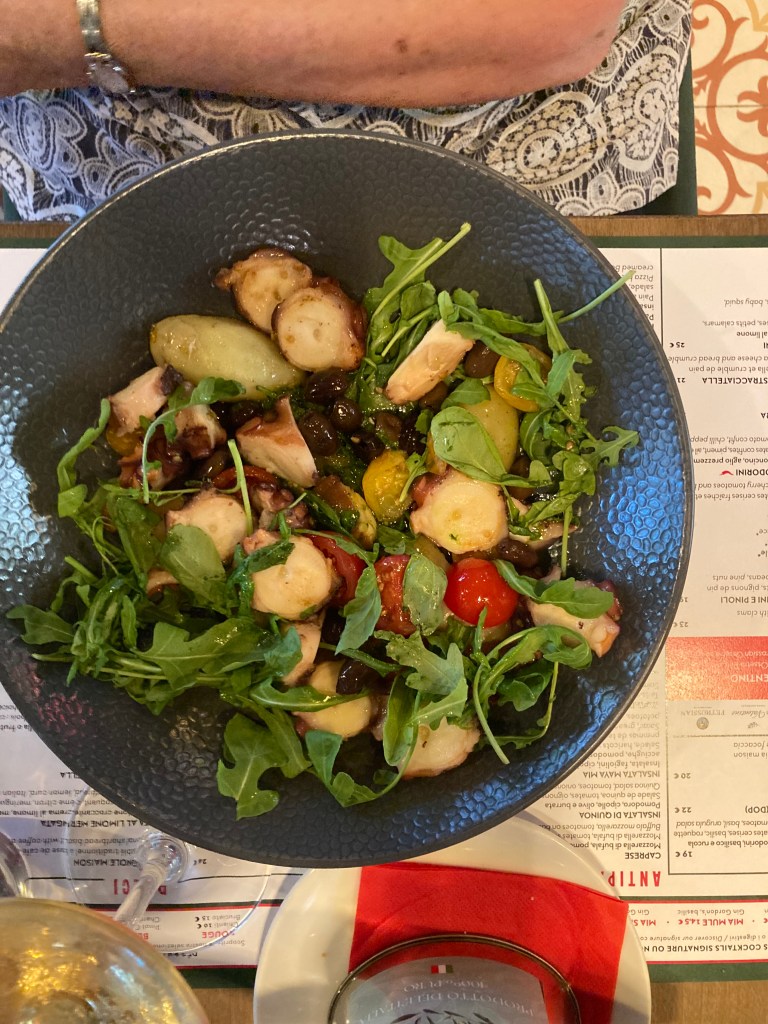
Tomorrow we’ll be celebrating Maree’s birthday once more, this time with a special dinner at Le Train Bleu inside the Monte Carlo Casino; a fittingly elegant setting for the occasion.
Thursday 14 August 2025
Today we took it easy and stayed indoors for most of the day. The heat makes walking outside a real challenge, especially with all the stairs you need to navigate just to move between levels in Monte Carlo. Venturing out simply wasn’t appealing.
But tonight we did make our way to the main casino and enjoyed a wonderful dinner at Le Train Bleu, the elegant restaurant tucked inside the building. It was a perfect way to end an otherwise quiet, heat‑laden day.
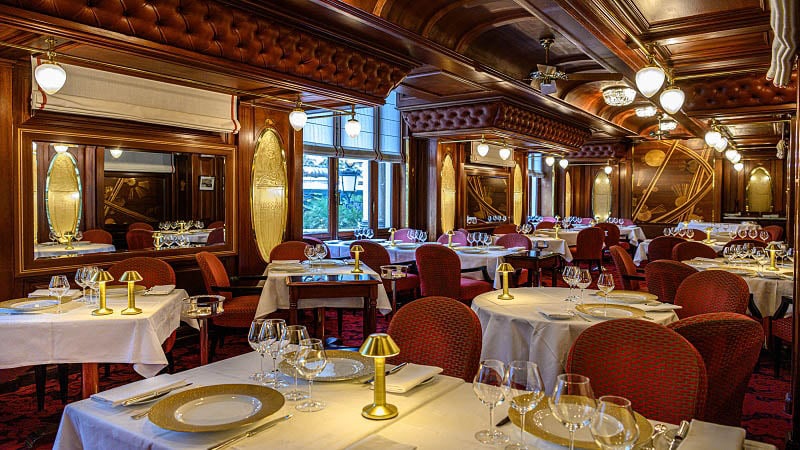
Tonight felt like a truly special occasion for Maree, and Le Train Bleu provided exactly the kind of setting that elevates a birthday celebration into something memorable. Tucked inside the Monte‑Carlo Casino, the restaurant blends the flavours of Italy with the elegance of the Belle Époque, creating an atmosphere that feels both intimate and grand.
The menu, crafted by Head Chef Richard Rubbini, draws on the richness of Mediterranean cuisine—wild fish, langoustines, lobster, seasonal vegetables like artichokes and porcini—each dish prepared with a sense of refinement and genuine passion. The sommeliers guide diners through an impressive wine selection, pairing each plate with something that enhances its character. Rubbini oversees the kitchens not only here but also at the Casino de Monte‑Carlo and the Salon Rose, bringing his talent and love of cooking to every corner of the Société des Bains de Mer.
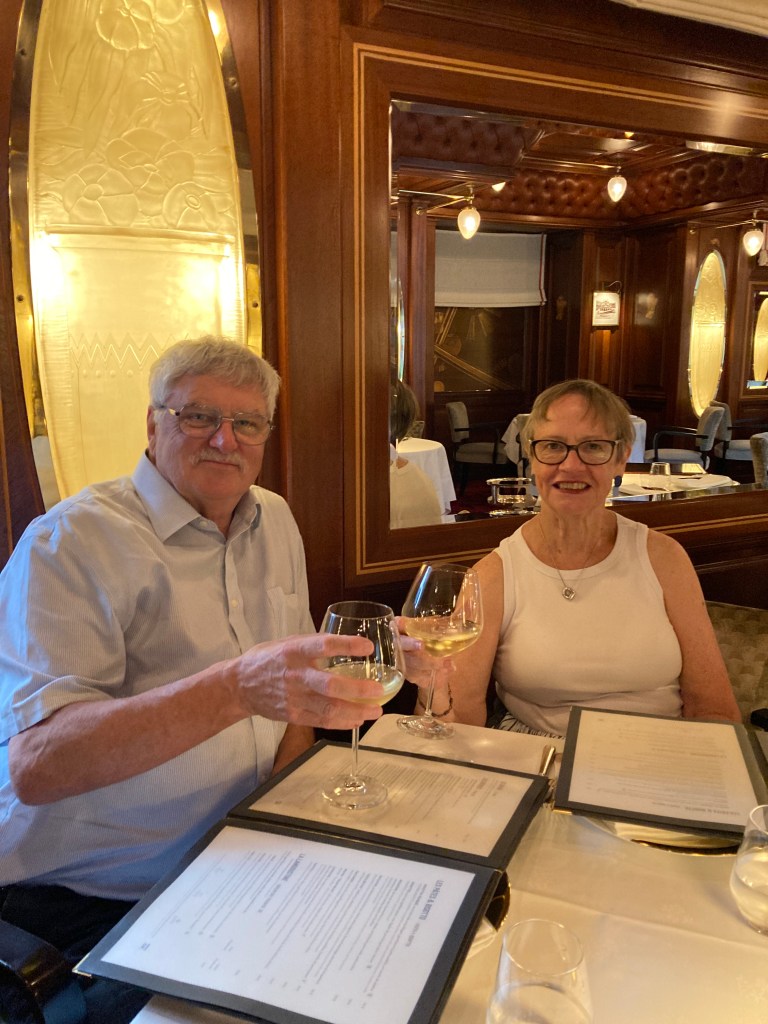
What makes Le Train Bleu even more enchanting is the story behind its name. In the early 20th century, the only way to reach Monaco was by train, and the restaurant pays homage to that golden age of travel. Designed as a faithful evocation of a luxurious dining car, it’s filled with rich woodwork, warm colours, and paintings that echo the splendour of the Belle Époque. Sitting there, you can almost imagine the rhythmic sway of a train gliding along the Riviera, carrying glamorous travellers toward the Principality.
Photography inside the casino is tightly controlled, allowed only within the restaurant and only with the maître d’s permission, and never of other guests. The gaming rooms remain strictly off‑limits for photos, though their architecture is undeniably beautiful. That sense of exclusivity adds to the atmosphere: a quiet reminder that you’re dining somewhere with history, prestige, and a touch of old‑world glamour.
All of it, the setting, the food, the service, the history made tonight feel like a fitting tribute to Maree’s birthday, a celebration wrapped in elegance and a little bit of Monte Carlo magic.
We were only able to take photos of two of the three courses tonight, as photography inside the casino is quite restricted. And, true to form, I completely forgot to capture Maree’s main of lamb and my veal fillet mignon. Some habits, especially when the food is good, are hard to break.
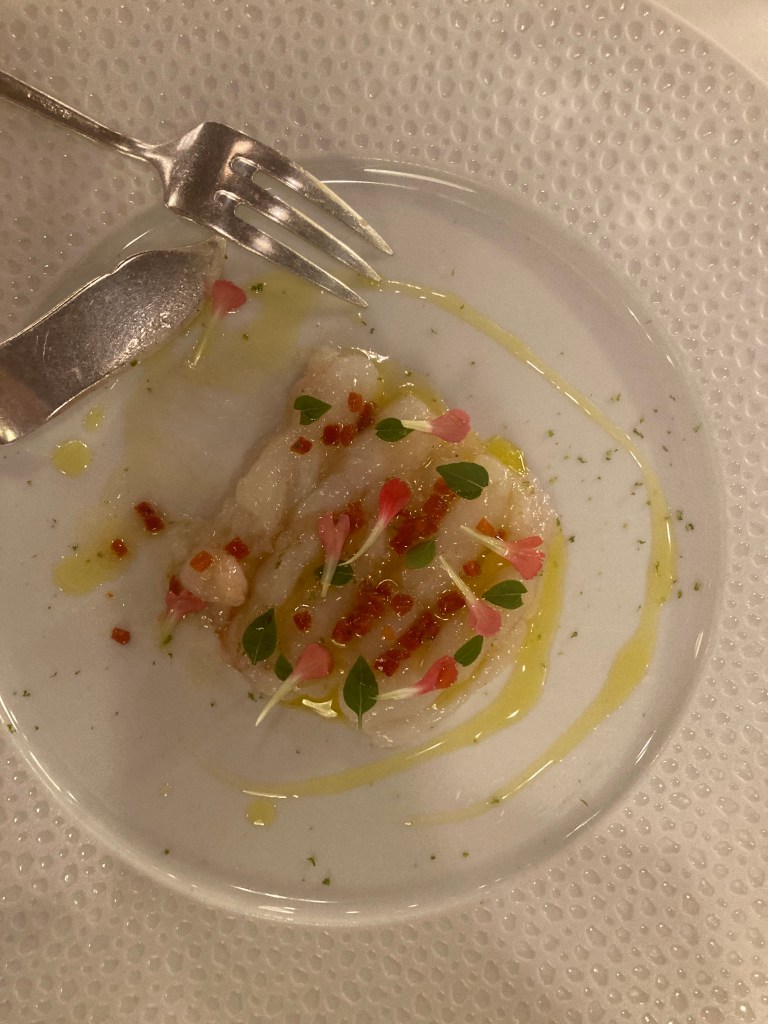
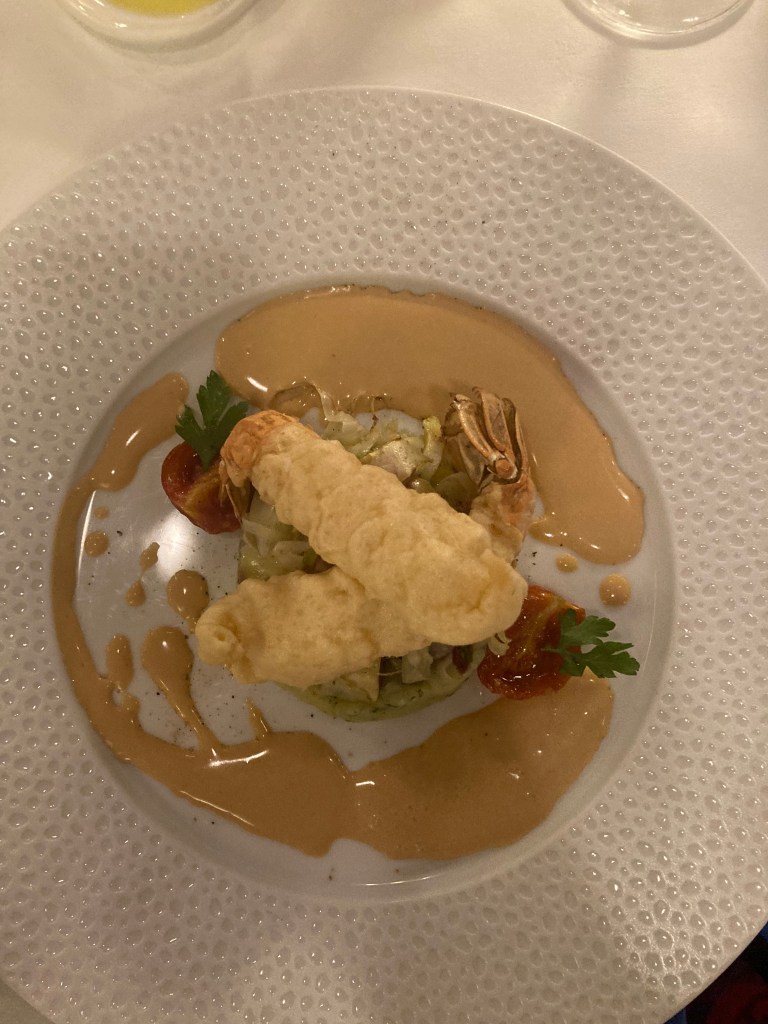
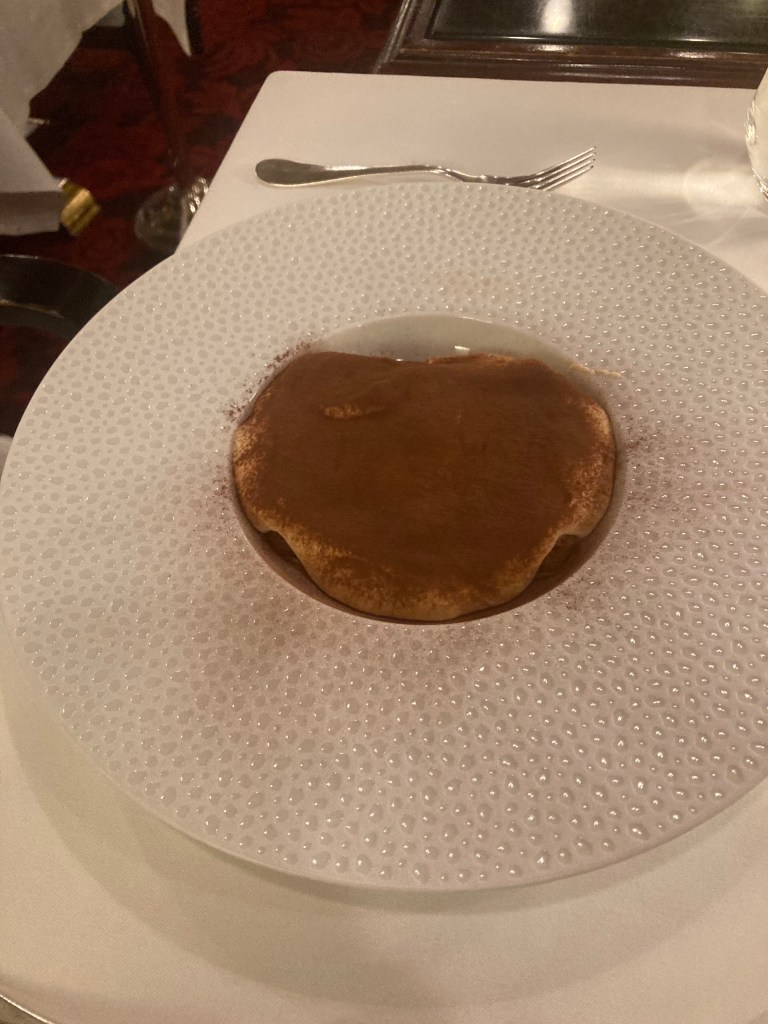
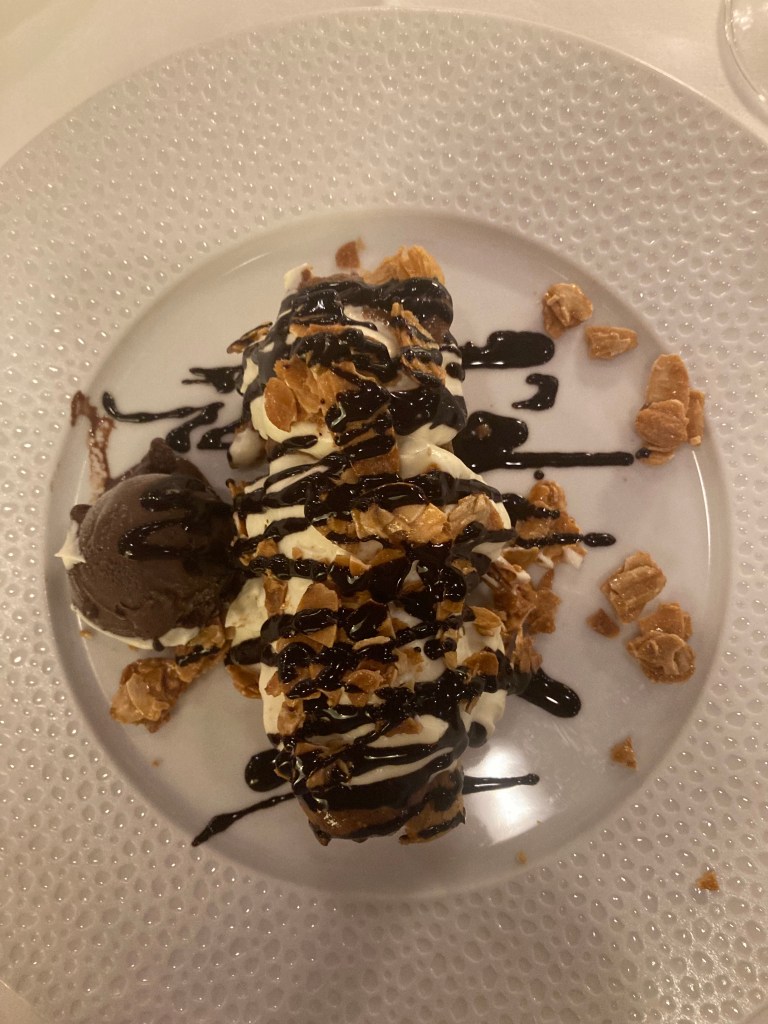
We had a wonderful meal and a really lovely evening at the casino, helped along by excellent service from start to finish. Then came the bill—417 EUR, which politely transformed itself into 747.91 AUD the moment it hit the account. Still, it was all worth it. I’d booked the night as a second celebration for Maree’s birthday, and if you can’t splurge a little for that, when can you?
Friday 15 August 2025
Today was another deliberate rest day, so we kept things simple with a gentle walk along the footpaths down to the waterfront—carefully avoiding any staircases that would require climbing back up in this heat. The plan was to stay cool, take it slow, and then finalise everything for tomorrow’s departure to Geneva, Switzerland.
Mid‑morning we received a text from SNCF letting us know that, due to the extreme heat, all services from Marseille to Toulouse on our travel day had been cancelled. A quick reassessment later, I decided the safest option was to choose a major, well‑used route less likely to be disrupted. So the Marseille–Geneva line gets the green light. But that’s tomorrow’s adventure.
For today, we walked all the way downhill from our accommodation in Beausoleil to La Grotte Bleue—a total of 1.8 kilometres. Technically, we could have cut the distance in half by taking a set of stairs. But one look at those sun‑baked handrails and I thought, absolutely not. I need to hold onto those rails, and I have no desire to sear my palms in the process. Sometimes the long way around is the only sensible choice.
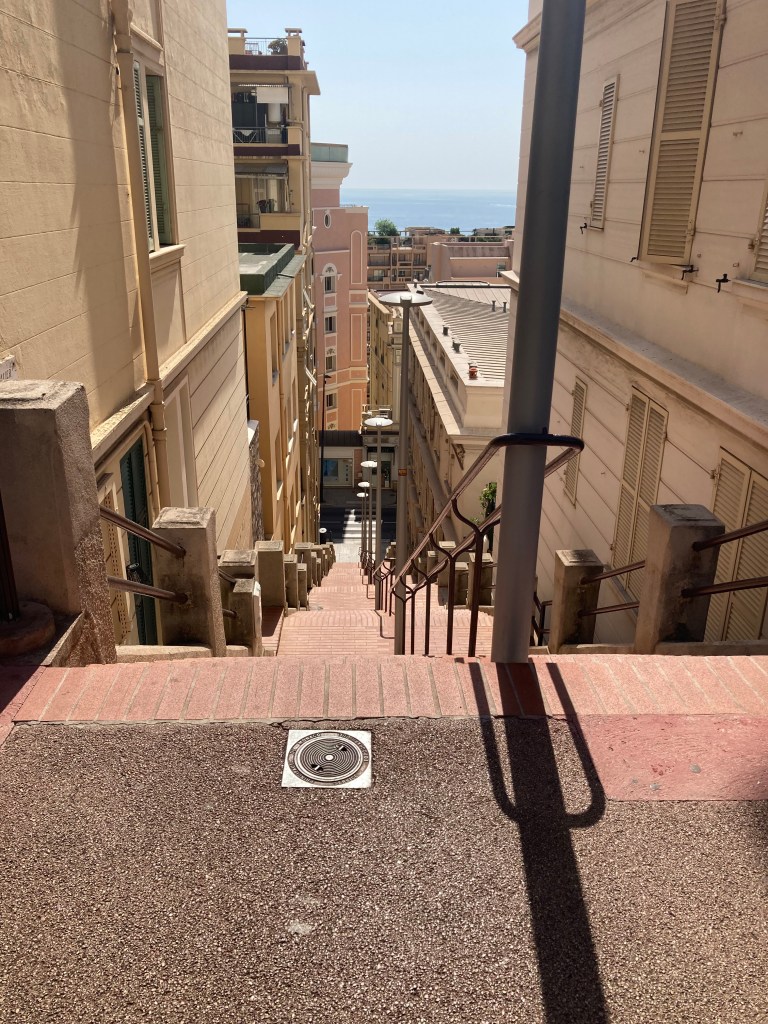
After a slow, steady walk—and a couple of strategic diversions for shade and a cold drink—we eventually made it down to the waterfront, about two kilometres all up. The temperature was sitting at 32 degrees with absolutely no breeze, and the white concrete everywhere was bouncing the light and heat straight back at us. It made the whole walk feel hotter than it already was, and more than a little uncomfortable.
Our first diversion was back to the casino where we’d dined last night—purely for the air‑conditioning, of course, not because we were already missing the place.
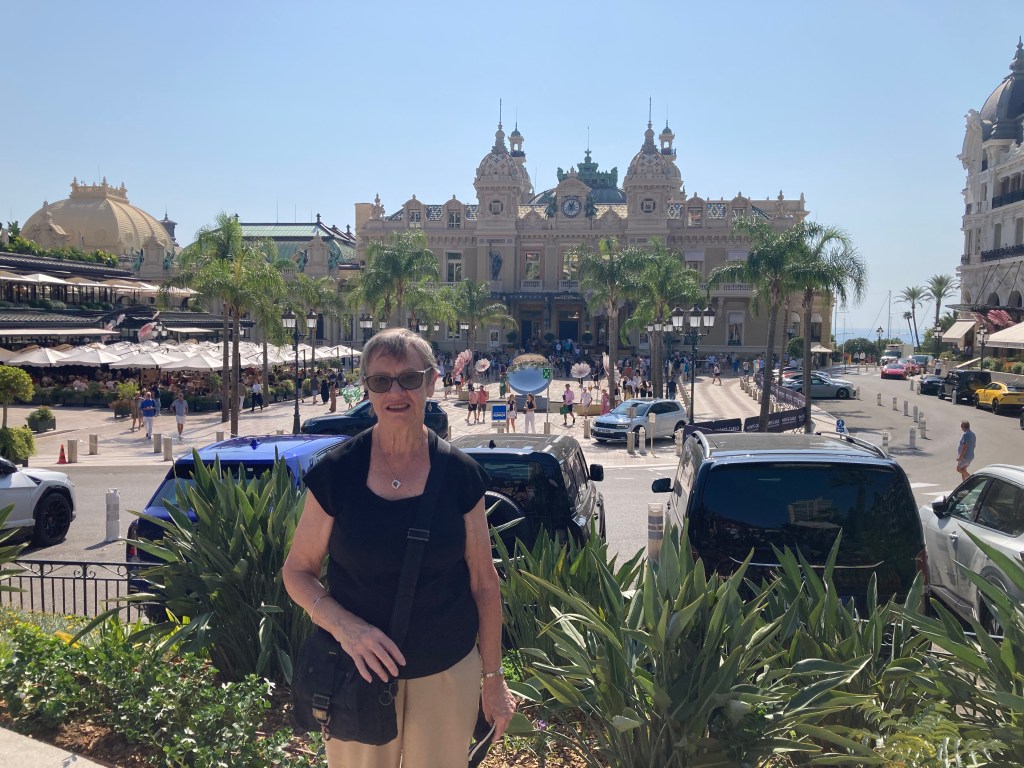
Then a walk to a cafe for a nice refreshing iced tea.
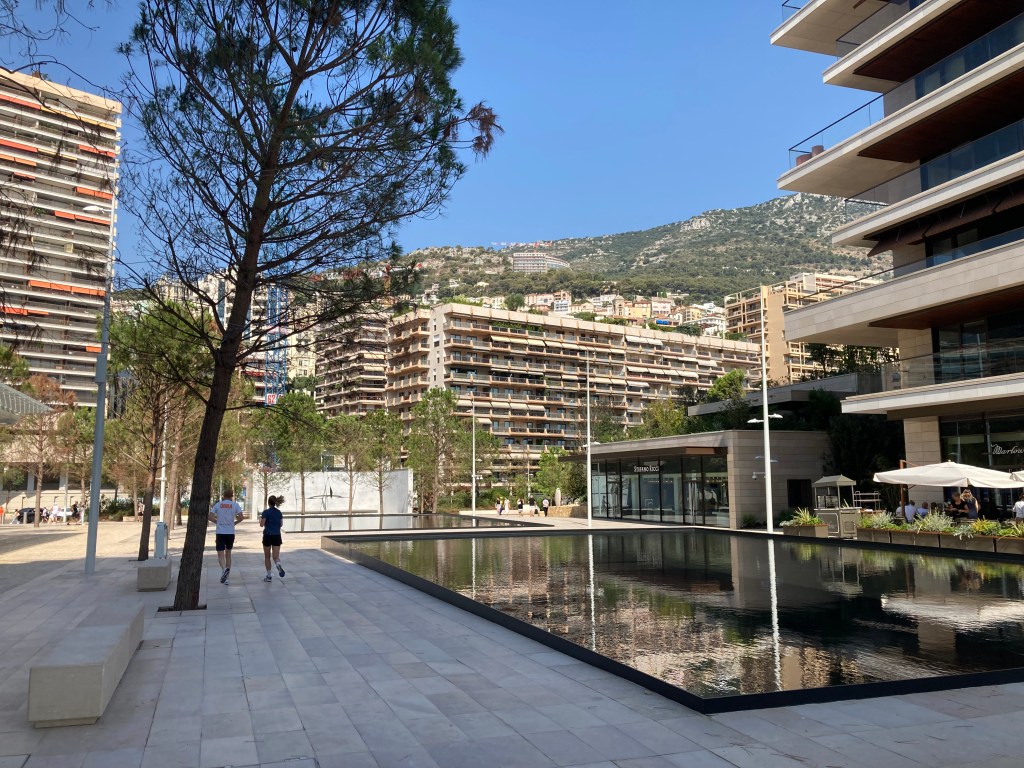
From here a few hundred metres to La Grotte Bleue. Great views from this point, but very hot and still no breeze.
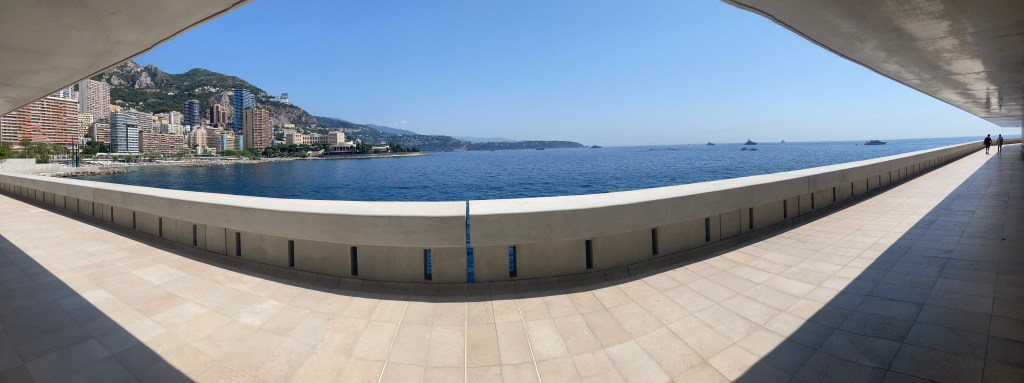
We also spotted the Windstar vessel Windsurf in port—the very same ship we sailed on during our 21‑day Mediterranean cruise. It was a nice little full‑circle moment, seeing her again here in Monaco. If you’re curious about that trip, you can find the full story in our earlier blog entries on this site.
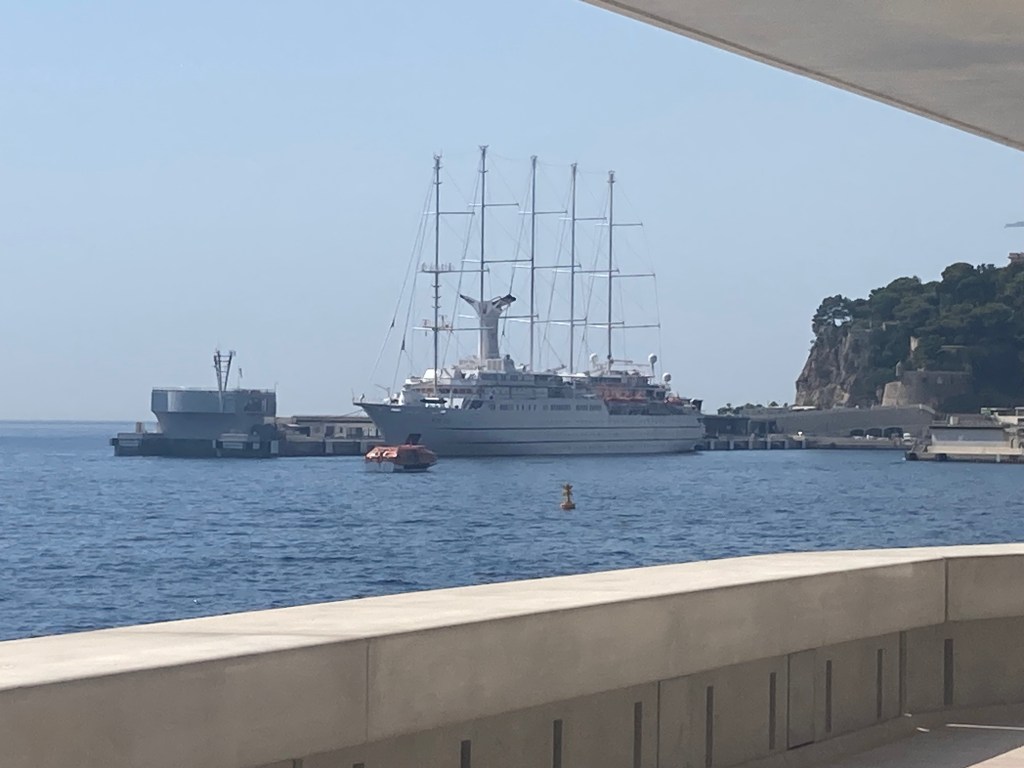
From there we made our way up to the main road, where a very kind attendant issuing tickets for a hotel car park happily called a taxi for us. The 25 EUR flag‑fall suddenly felt like a bargain—there was no way we were walking the remaining two kilometres uphill in this heat. Sometimes you just have to surrender gracefully to the taxi meter.
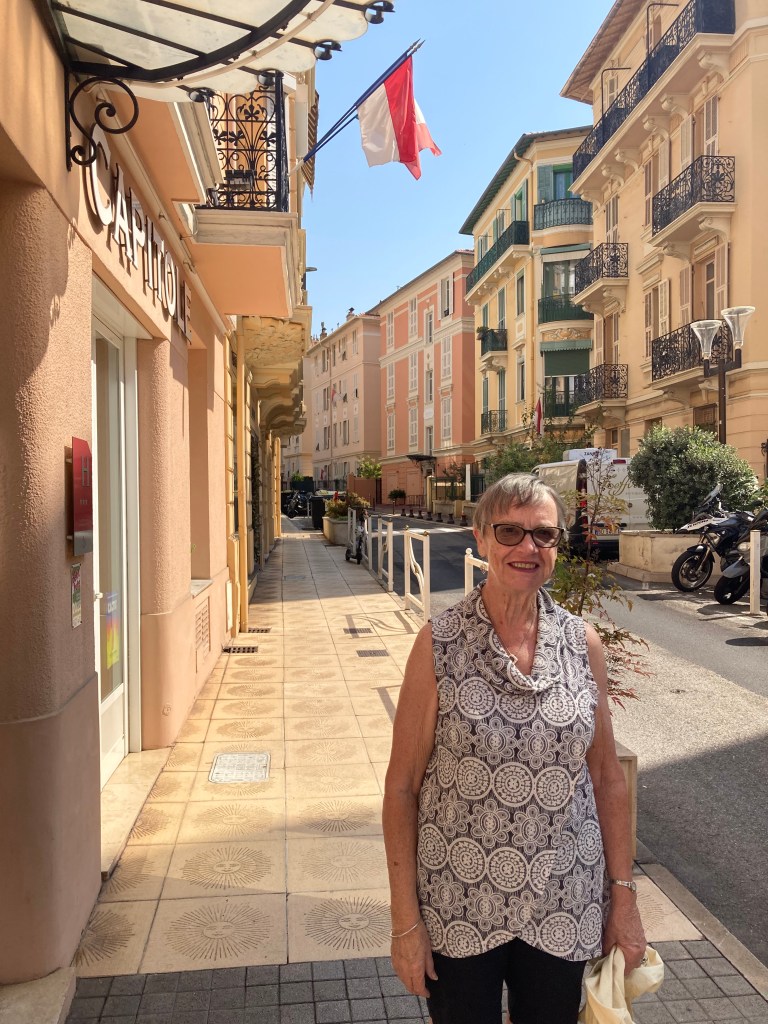
Tonight we returned to our favourite restaurant, Maya Mia, for one last meal in Monte Carlo. As always, everything was spot‑on, great food, lovely service, and a fitting way to wrap up our stay in the principality.
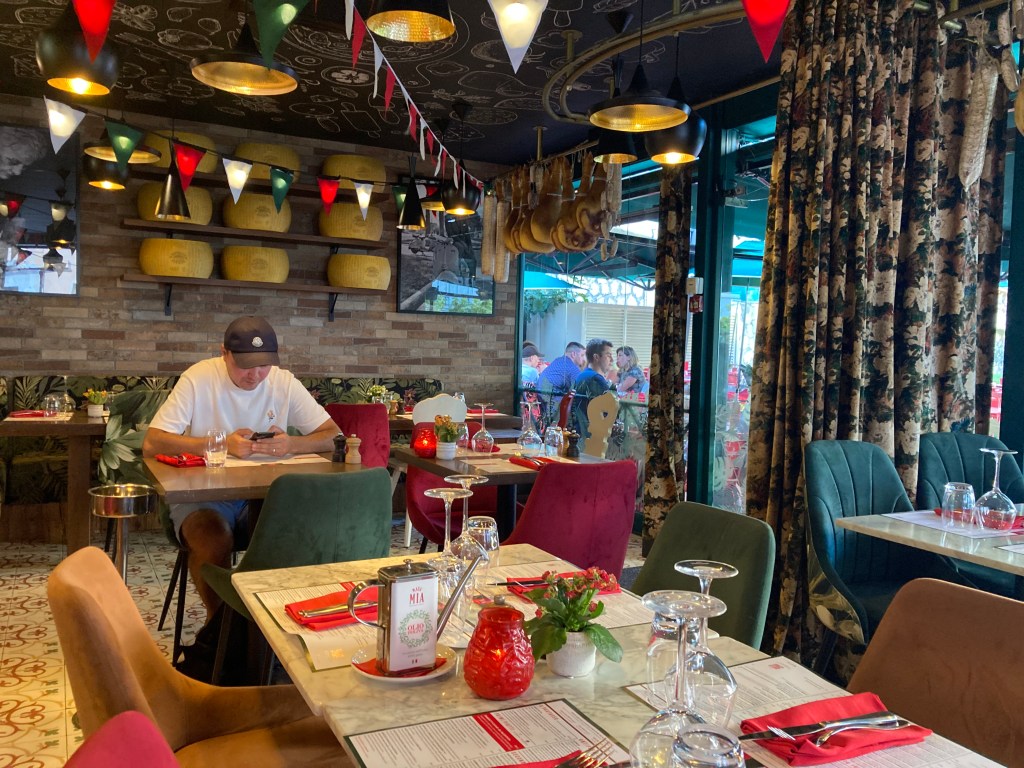
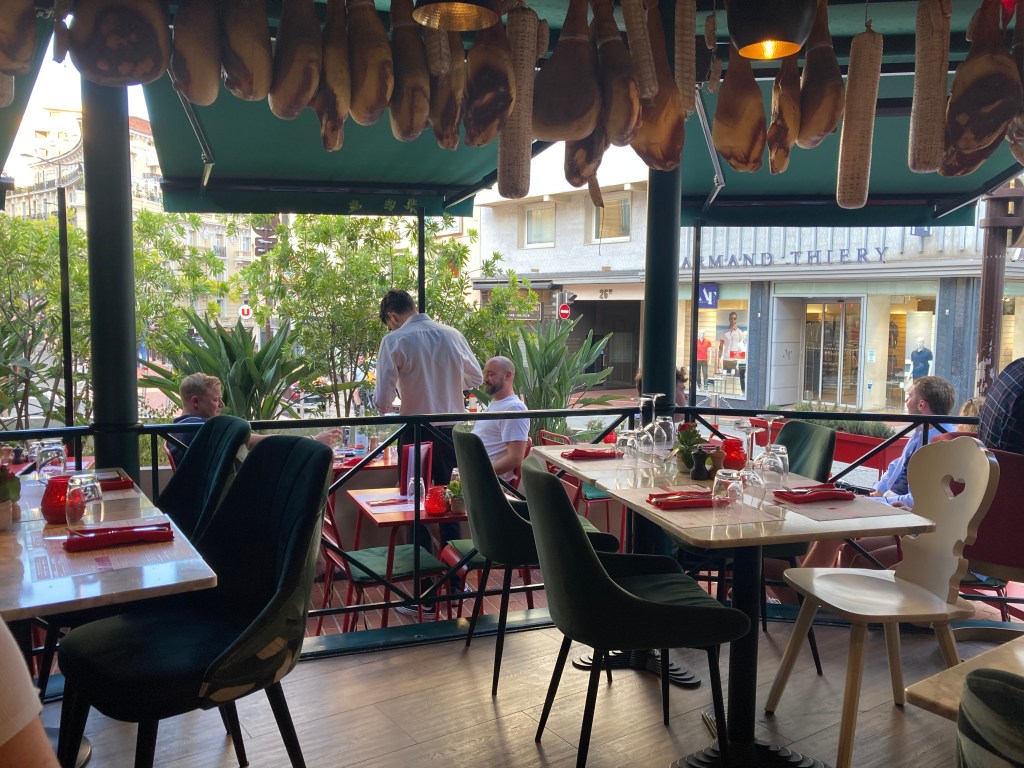
Saturday 16 August 2025
Today is a long travel day from Monte Carlo to Geneva. As I mentioned yesterday, we had to rethink our plans after significant rail cancellations between Marseille and Toulouse due to the extreme heat sweeping across southern Europe.
So Geneva it is. Our chauffeur, Blacklane as always for the longer road transfers, collected us at 06:45 and drove us from our accommodation in Monte Carlo to Nice‑Ville station for the first leg of the journey to Marseille.
Nice is always interesting to pass through, even briefly. It’s the unofficial capital of the French Riviera, a place where Italian influence meets French elegance, and where the Promenade des Anglais curves along a coastline that has lured artists, writers, and sun‑seekers for more than a century. Even at this early hour, the city had that unmistakable Riviera glow.
Our driver also mentioned that Marseille was expecting a top of 41 degrees today and not exactly ideal when you’re facing a three‑hour transfer there. The heatwave is certainly making its presence felt.
On the way from Nice to Marseille, the train carried us through Cannes. I managed to snap a few photos of the coastline as we travelled. They’re not the best, taken from a moving train with window reflections, but they still capture a little of that Côte d’Azur charm.
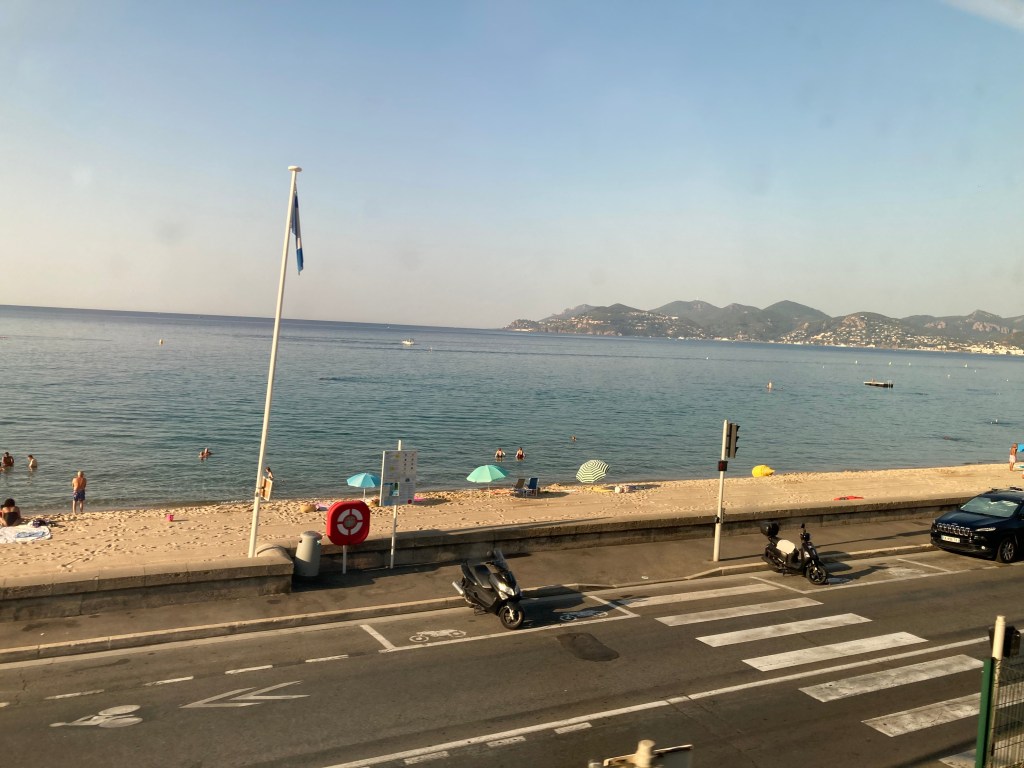
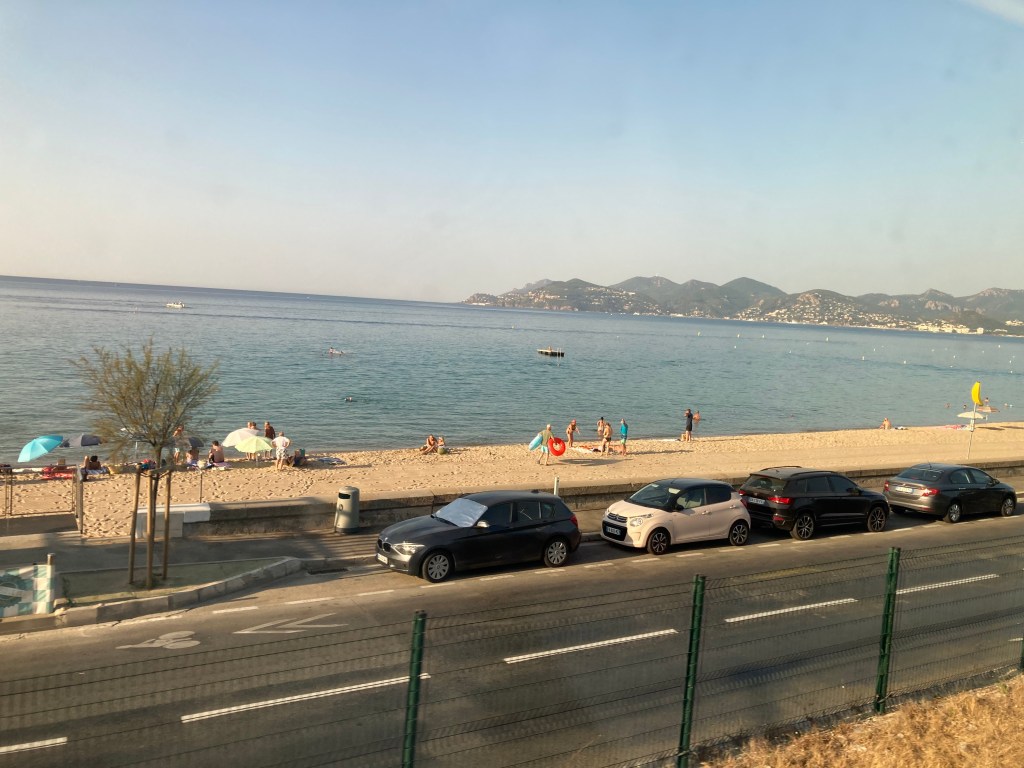
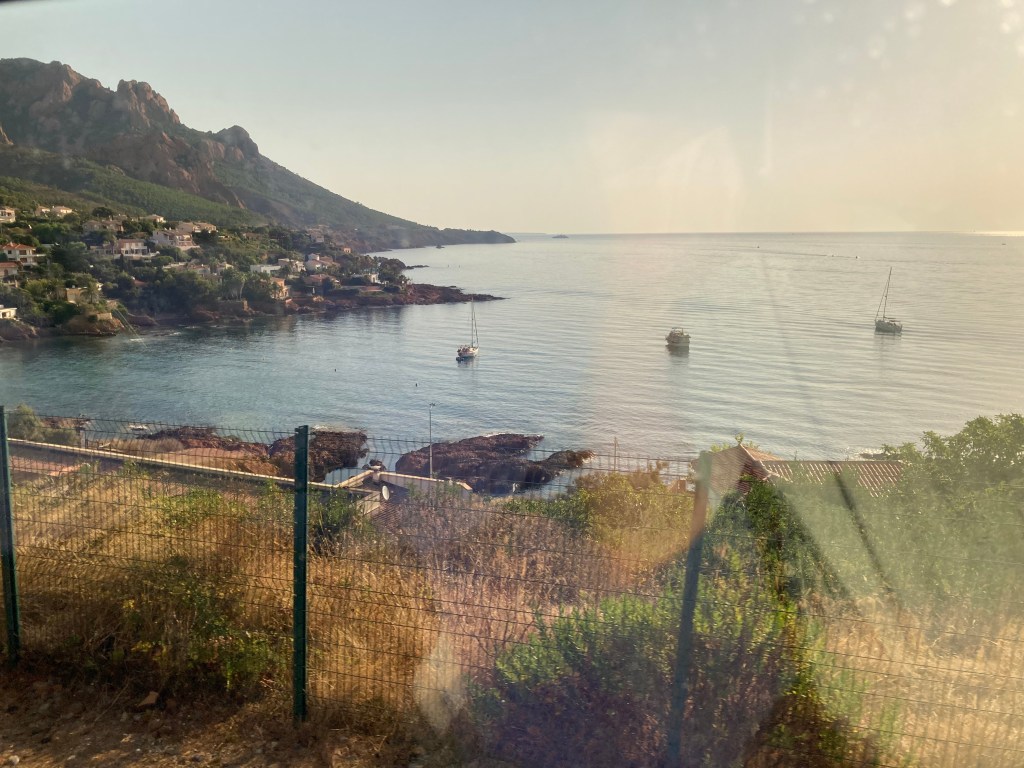
As the weather was scorching, the train’s air‑conditioning never quite kept up. It took the edge off, but the carriage was still uncomfortably warm, though certainly better than being outside in the full blast of the heatwave.
After a two‑and‑a‑half‑hour journey we finally rolled into Marseille. And yes, our chauffeur had been absolutely right: the moment we stepped off the train, the heat hit us like a wall. Because our first‑class carriage was at the very end of the train, we had to walk the entire length of the platform in the blazing sun, passing carriage after carriage before we reached the shade of the station’s iron‑and‑glass train shed.
Marseille‑Saint‑Charles is an interesting station in its own right, built in the 1840s, perched high above the city, and famous for its monumental staircase that once greeted travellers arriving from Paris and beyond. You can almost feel the history of the port city drifting through the heat haze.
It was under the welcome shelter of that old rail shed that I took a photo of Maree standing beneath the station sign, both of us grateful to be out of the sun for a moment.
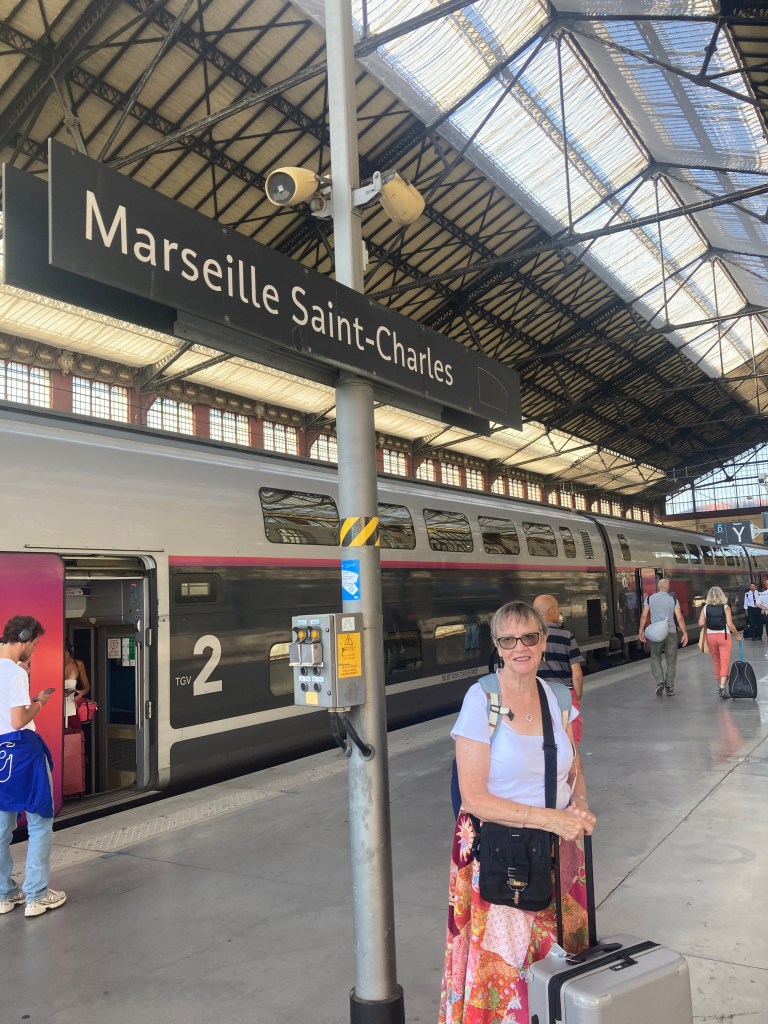
We eventually found a spot to sit in the un‑air‑conditioned terminal and settled in for the three‑hour wait before our next train to Geneva. Not exactly luxurious, but at least it was out of the sun. The next leg would be another five hours, so a little patience was required.
While we were waiting, I did manage to catch a distant photo of the famous Notre‑Dame de la Garde, perched high above the city. Even from afar, the basilica stands out—Marseille’s watchful guardian keeping an eye on everything below.
Notre‑Dame de la Garde—Our Lady of the Guard—is affectionately known to locals as la Bonne Mère, “the Good Mother,” and she’s easily Marseille’s most recognisable symbol.
Perched on the highest natural point in the city, a 149‑metre limestone outcrop overlooking the Old Port, the basilica has watched over sailors, fishermen, and the city itself for generations. It’s also the most visited site in Marseille and the destination of a major Assumption Day pilgrimage each year.
The basilica was built on the foundations of an old fort, with construction beginning in 1853 and continuing for more than 40 years. What started as an enlargement of a medieval chapel soon became an entirely new structure under the vision of Father Bernard and architect Henri‑Jacques Espérandieu. Even though it wasn’t finished, it was consecrated in 1864.
The complex is made up of two distinct churches: a Romanesque crypt carved directly into the rock, and an upper Neo‑Byzantine church decorated with shimmering mosaics that reflect the Mediterranean light. Rising above it all is a 41‑metre bell tower topped by a 12.5‑metre belfry, which supports an 11.2‑metre gilded copper statue of the Madonna and Child. The statue is visible from almost anywhere in the city and has long served as a navigational landmark for ships entering the port.
It’s no wonder Marseillais look up to her, quite literally, as their steadfast guardian.
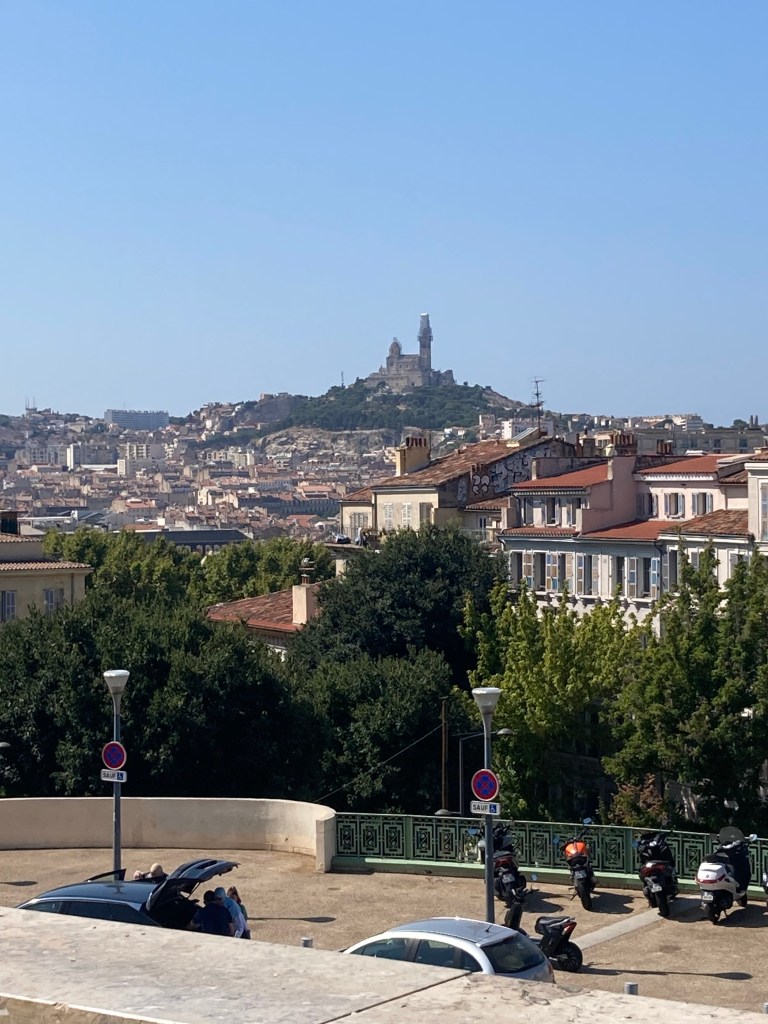
We eventually boarded our train to Geneva at 13:36. It pulled out right on time and, true to Swiss reputation, arrived exactly when it was supposed to. Always reassuring to see that Swiss punctuality hasn’t slipped.
After arriving, we checked into our hotel, the Novotel on Rue de Zurich, which turned out to be a very pleasant surprise. Modern, comfortable, and perfectly located for exploring the city, it gave us exactly the kind of calm landing we needed after a long day on the rails. A refreshing shower made us feel human again, and before long we wandered out to a nearby Indian restaurant for dinner.
Geneva itself has a very different energy from the Riviera, sleek, orderly, and framed by the Alps and Lake Geneva. Even just stepping out of the station, you can feel that blend of international diplomacy and lakeside serenity the city is known for.
It had been a long day, but the scenery along the Mediterranean and then inland toward Switzerland more than made up for it. A tiring journey, yes, but a beautiful one.
Sunday 17 August 2025
Today we started with breakfast at a local cafe. Then it was a short walk down to the shores of Lake Geneva.
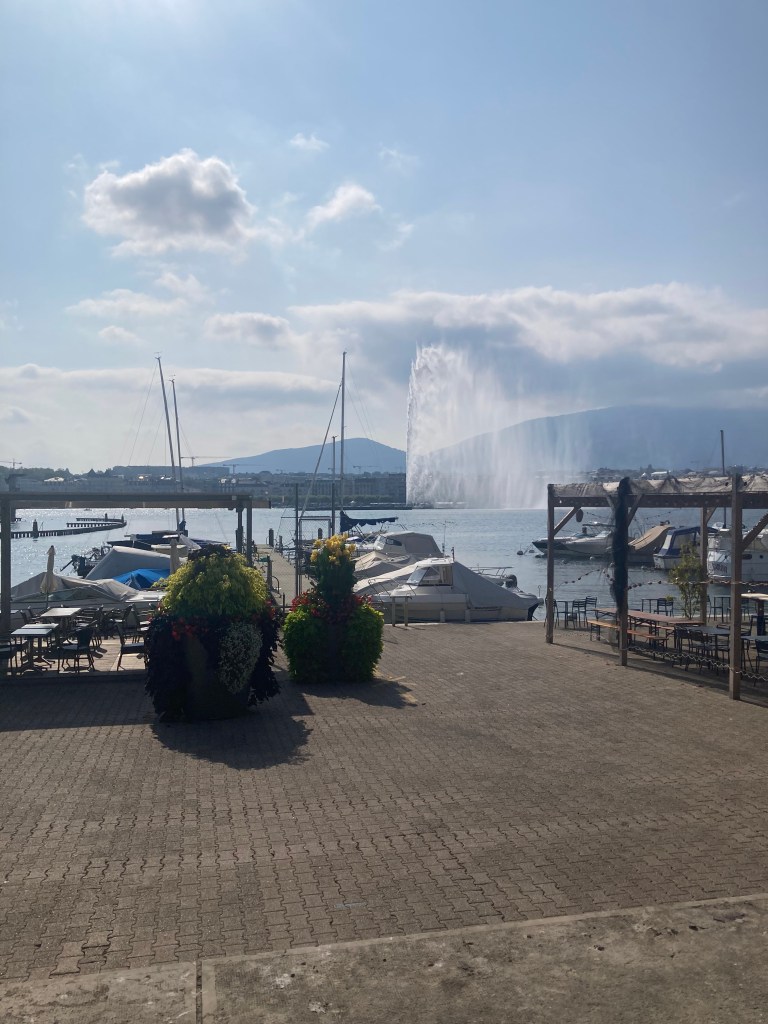
Lake Geneva is a deep, crescent‑shaped lake on the northern side of the Alps, shared between Switzerland and France. It’s one of the largest lakes in Western Europe and the biggest along the course of the River Rhône. Sixty percent of its waters, about 345 km², belong to Switzerland (the cantons of Vaud, Geneva, and Valais), while the remaining forty percent, around 235 km², lies within France’s Haute‑Savoie region.
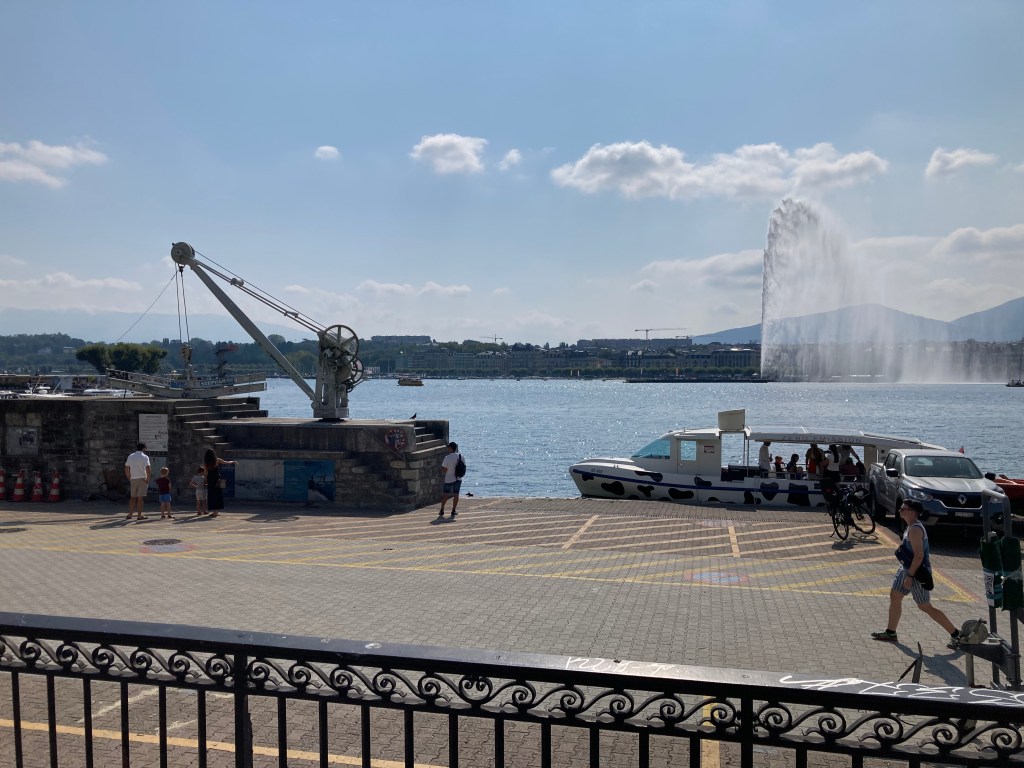
The lake has been celebrated for centuries for the beauty of its shores and the charm of the towns that line them. Writers, painters, and poets have all been drawn to its light and landscape. Interestingly, the scenery only takes on a truly Alpine character at the eastern end, between Vevey and Villeneuve, where the mountains rise more dramatically. On the southern side, the Savoy and Valais ranges are rugged and sombre, while the northern shore slopes more gently, vineyards tumbling down toward the water, dotted with villages and old castles.
It’s a place where history, geography, and culture meet in a single sweep of blue water. And on a day like today, with the heat still lingering from the journey, even the short walk to the lakeside feels like an expedition—but the view makes every step worthwhile.
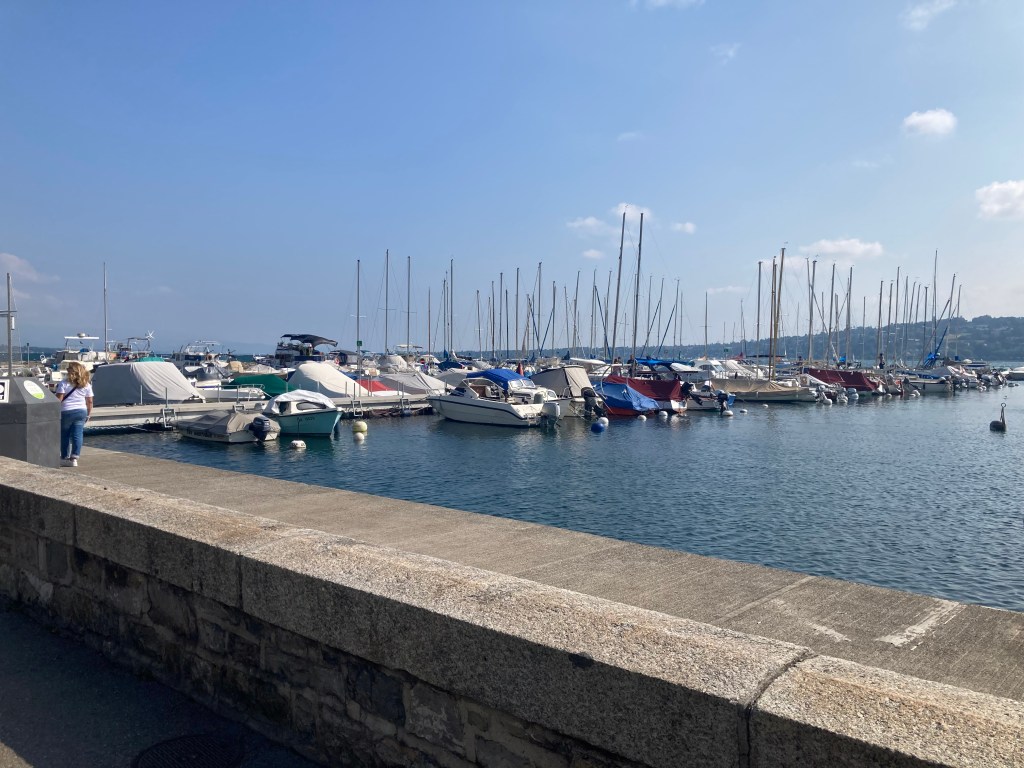
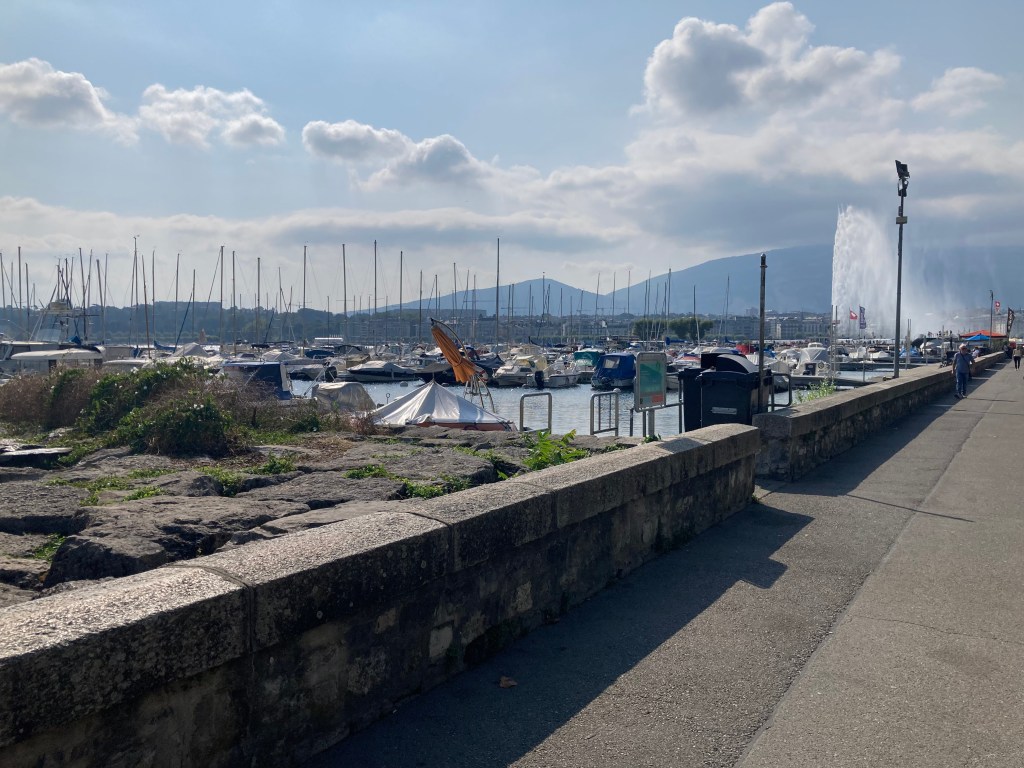
A little background on the fountain you can see in the photos above:
The Jet d’Eau, Geneva’s iconic water fountain, actually began life as a purely practical device. In 1886 it served as a safety valve for the city’s hydraulic power network at the Usine de la Coulouvrenière, the former hydro‑power plant and waterworks positioned right where the Rhône flows out of Lake Geneva toward Lyon. Built between 1883 and 1892, the plant harnessed the river’s flow to supply water pressure for Geneva’s drinking water system and its early hydraulic power network. Its weir also helped regulate the lake’s water level. Although the plant stopped producing power in 1963, it continued to house pumping equipment for the city’s water supply until 1988.
The original fountain was never meant to be decorative, but locals quickly grew fond of the dramatic plume of water shooting into the sky. By 1891, the Jet d’Eau had become so popular that it was moved from the power station to its current position on the lake to mark two major celebrations: the Federal Gymnastics Festival and the 600th anniversary of the Swiss Confederation.
In 1951, the fountain received a major upgrade with its own dedicated pumping station, allowing it to draw water directly from the lake and reach its now‑famous height of 140 metres. Today, the Jet d’Eau operates year‑round, weather permitting, and is often illuminated at night, becoming a luminous beacon visible across the city.
What began as a simple engineering solution has become one of Europe’s most recognisable landmarks and a proud symbol of Geneva.
Monday 18 August 2025
Today we just wandered around the Lake and the old city.
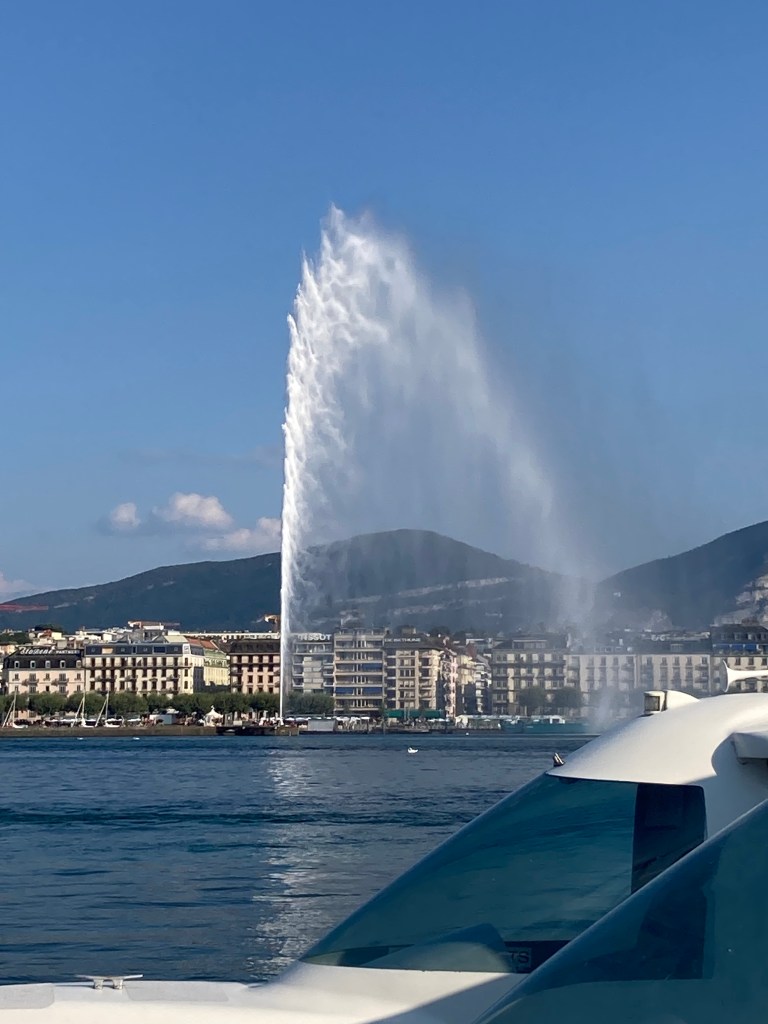
Replicating it wasn’t as simple as copying a sketch. The technical specifications for Geneva’s fountain were closely held, and it took high‑level diplomatic negotiations before the city of Geneva agreed to share the engineering details. Eventually, Geneva granted permission for the design to be used, allowing Canberra to create its own towering plume of water, one that can reach up to 147 metres under the right conditions.
So when you stand on the shores of Lake Geneva watching the Jet d’Eau arc into the sky, you’re also seeing the the fountain back home in Canberra. Two cities, two lakes, two spectacular jets, linked by a surprising bit of international cooperation and a shared love of dramatic water engineering.
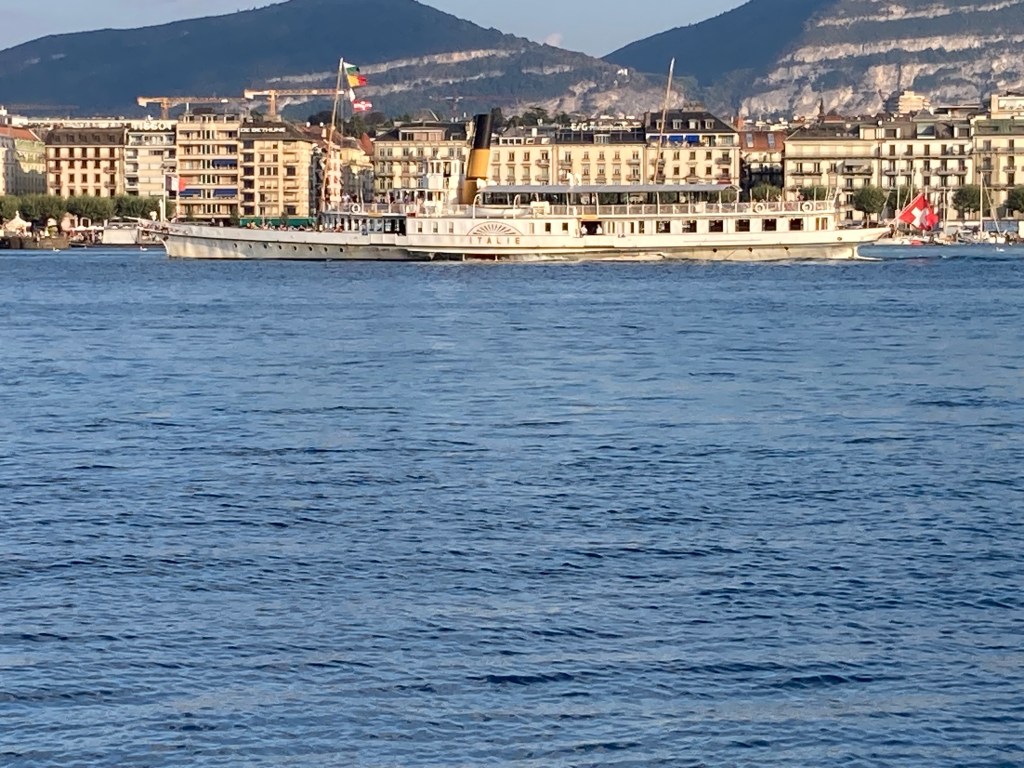
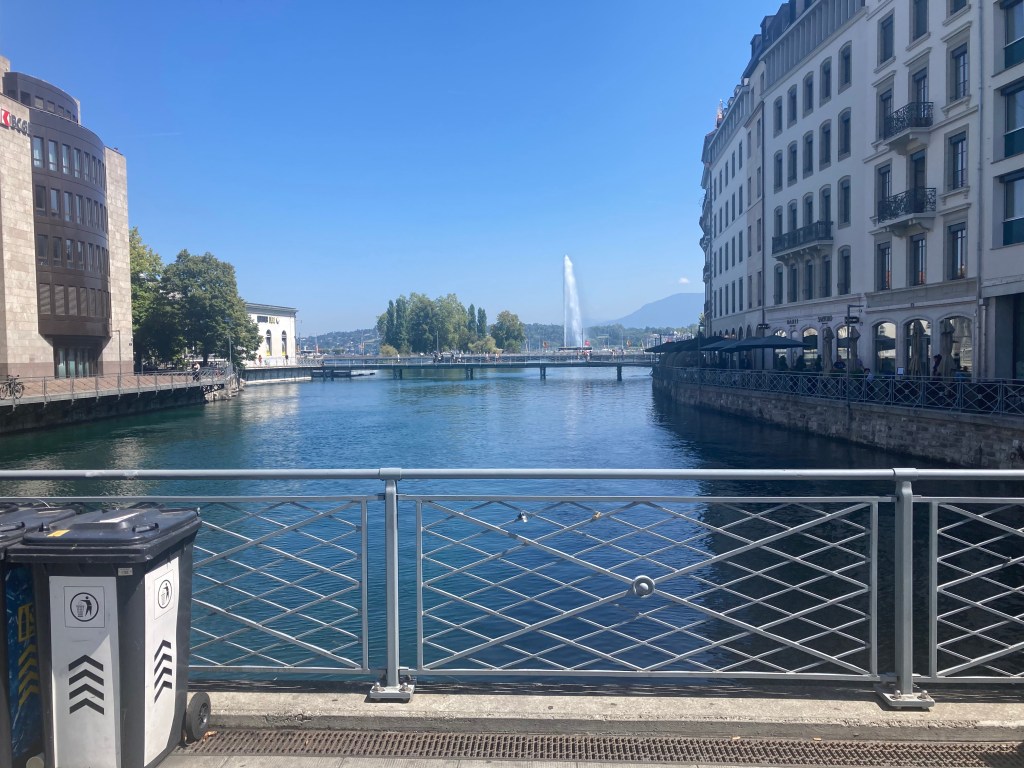
The River Rhône flows straight through the heart of Geneva, giving the city much of its character and shaping its history. It begins its journey high in the Swiss Alps at the Rhône Glacier, then empties into Lake Geneva before emerging again at the western end of the lake, right in the middle of the city. This outflow is strikingly visible: the Rhône’s clear, fast‑moving turquoise water contrasts sharply with the darker, slower‑moving Arve River that joins it a little further downstream, creating a famous two‑tone confluence.
In Geneva, the Rhône has long been a vital artery. It powered early industry, supplied water to the city, and served as a key transport route linking Switzerland to France and the Mediterranean. Even today, its presence shapes the city’s layout, with bridges, promenades, and riverside cafés lining its banks.
So when you see the Rhône flowing through Geneva, you’re watching a river that has carved valleys, fed vineyards, powered cities, and connected cultures from the Alps all the way to the sea.
Tuesday 19 August 2025
oday we left Geneva bound for Paris for lunch, before continuing on to Brussels for dinner. A three‑country day, always a satisfying line to add to the travel diary. We’ll be based in Brussels until Saturday.
The first leg was on the TGV Lyria double‑decker express to Paris Gare de Lyon, gliding through the French countryside and arriving right on schedule at 11:43. From there, it was a 20‑minute taxi ride across the streets of Paris to Gare du Nord, the departure point for Eurostar services.
Before boarding, we made time for lunch at a cosy trattoria nearby. The food was excellent, simple, fresh, and exactly what we needed, and the waiter looked after us beautifully. He seemed genuinely surprised when we left a tip, which made the moment even more charming.
Next stop: Brussels, and the final meal of the day in our third country.
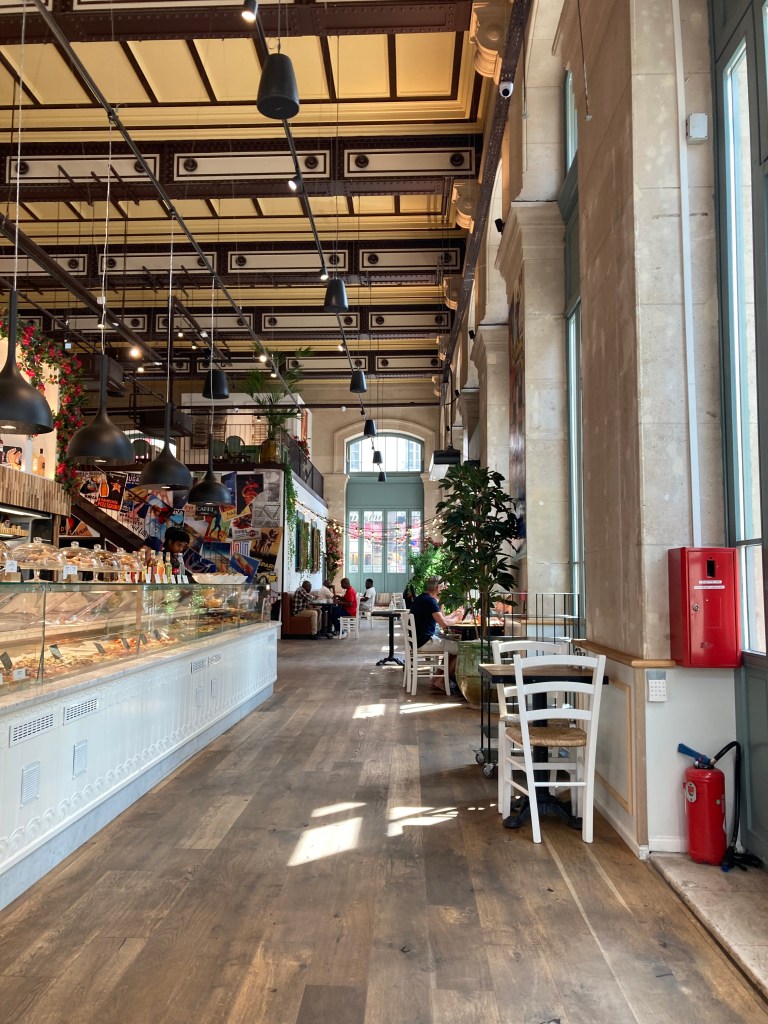
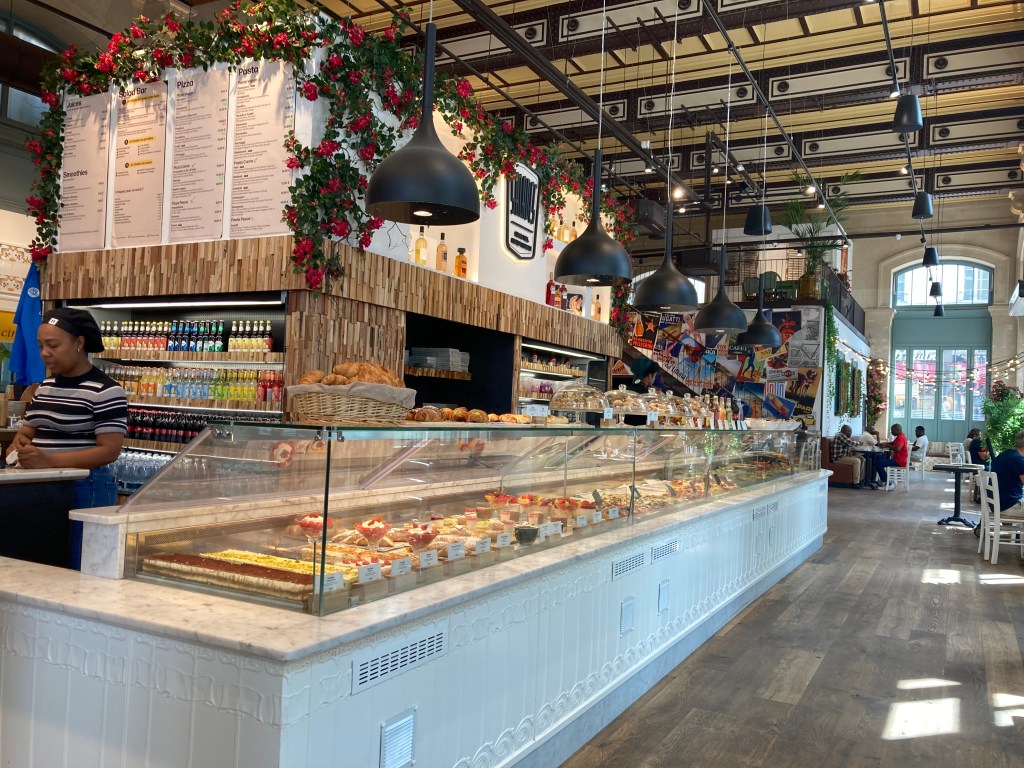
After lunch we still had about an hour before our train to Brussels, so the mission became simple: find somewhere, anywhere, to sit. Gare du Nord was packed, and after wandering around for a while we eventually discovered the only available seats in the entire station… at Starbucks. Not exactly glamorous, but at that point a chair was a chair.
When the train finally arrived, we boarded straight away, even though we still had 15 minutes before departure. At least we could settle into our comfortable seats and relax for a moment before the next leg of the journey.
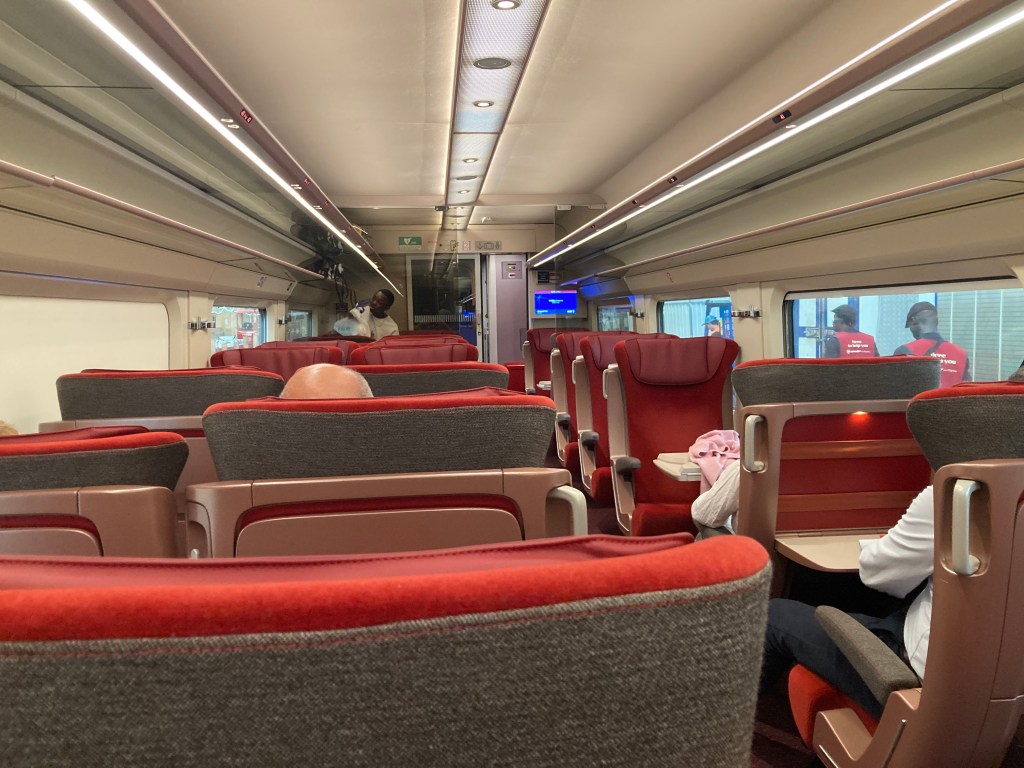
Once the train pulled out of Paris, it didn’t take long before we were racing through the French countryside at full speed. Within minutes the display screen inside the carriage was showing 300 kph, a reminder of just how effortlessly the Eurostar eats up the distance between cities.
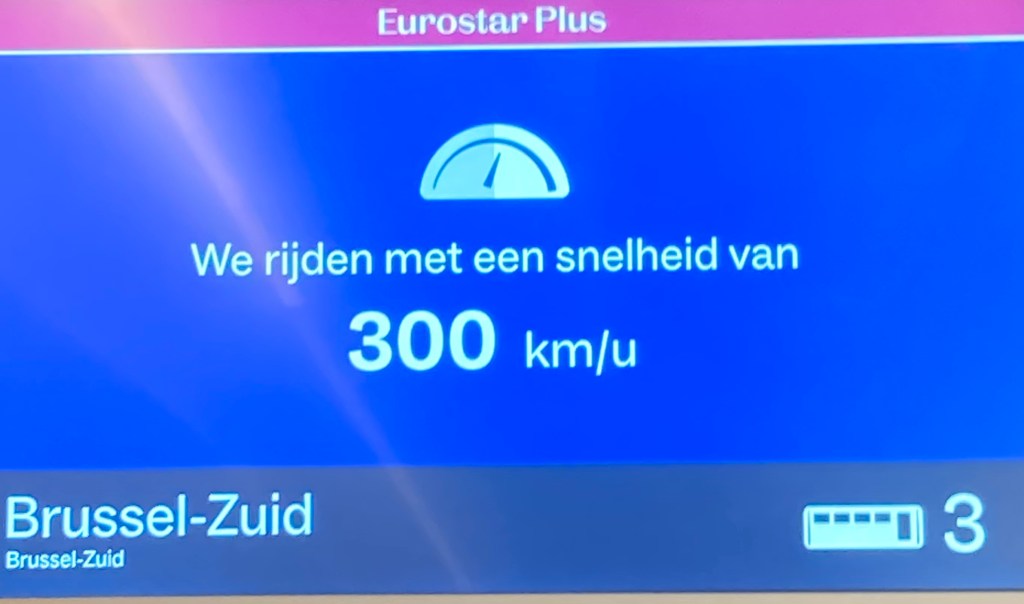
When we arrived in Brussels, we decided not to wrestle with public transport and simply took a taxi straight to our hotel—Résidence‑Hôtel Le Quinze Grand Place. It’s a lovely little hotel set right inside the Grand Place, which is the historic heart of Brussels and one of the most beautiful squares in Europe. Stepping out of the taxi and into that UNESCO‑listed square feels like walking into a living postcard—gilded guildhalls, ornate façades, and the Town Hall’s soaring spire all around you.
I’d been told earlier by the hotel that the taxi fare should be between 10 and 15 euros, so I kept an eye on our route using Google Maps. It didn’t take long to realise the driver was taking the scenic route—unnecessarily. The final fare was 20 euros.
When we checked in, Laurir at reception confirmed our suspicions immediately. “You were definitely taken advantage of,” he said, shaking his head. He added that even locals get targeted sometimes, though they at least know when a driver is trying to be creative with the route.
Still, once we were inside the hotel—with its warm welcome, comfortable rooms, and unbeatable view over the Grand Place—the annoyance faded quickly. There are worse places to end a travel day than in the golden glow of Brussels’ most iconic square.
So all checked in and time for some photos.
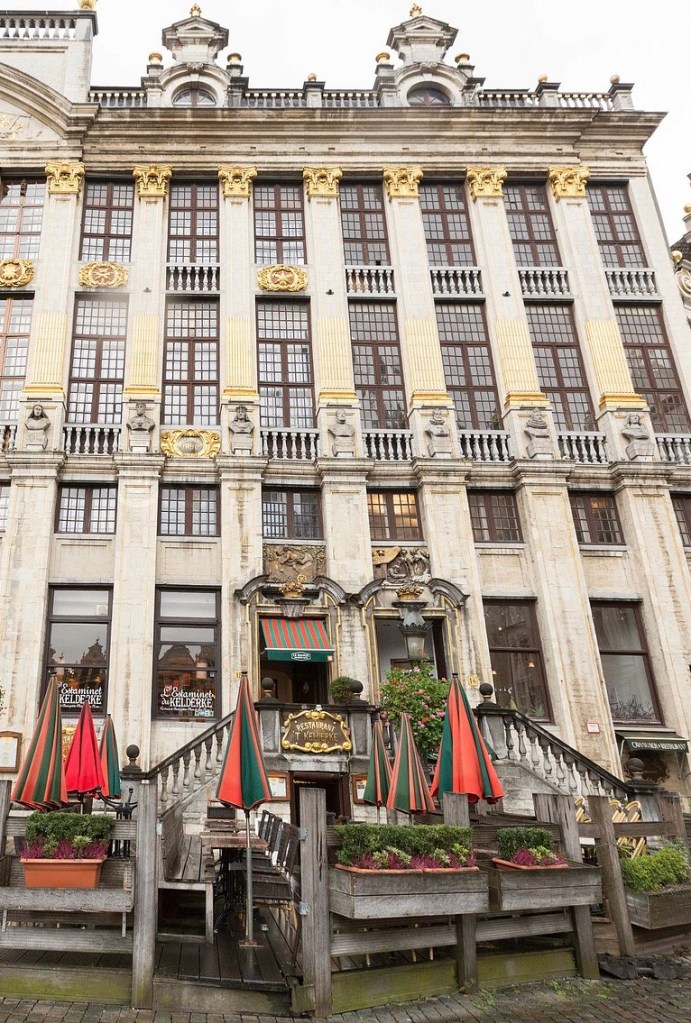
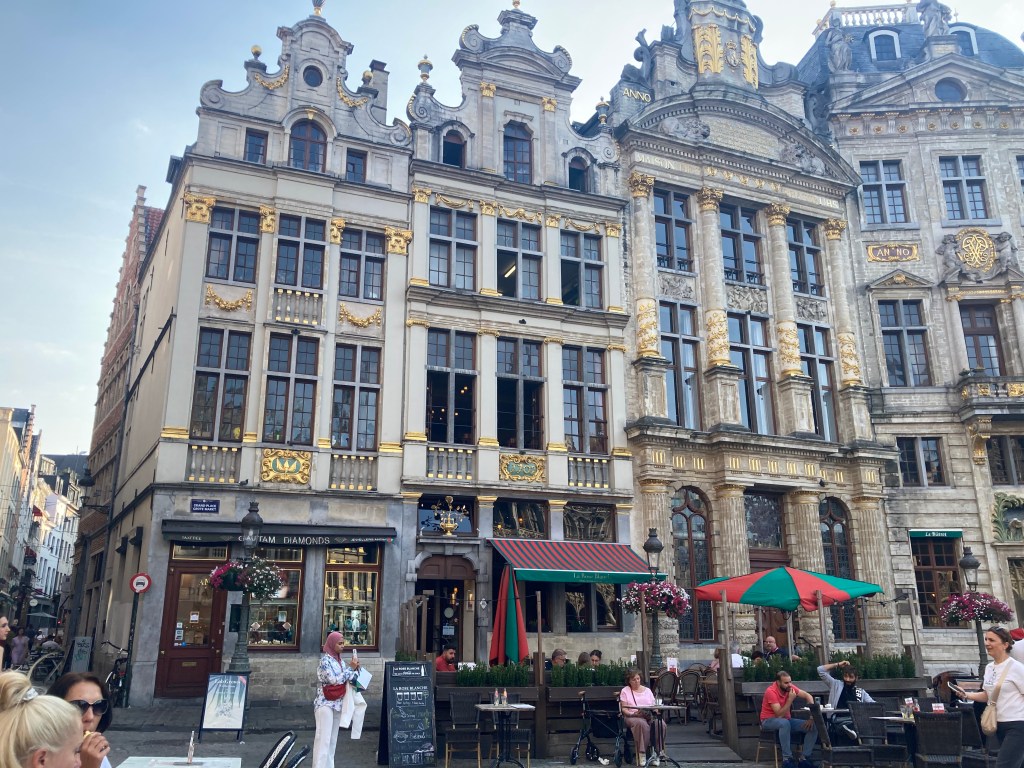
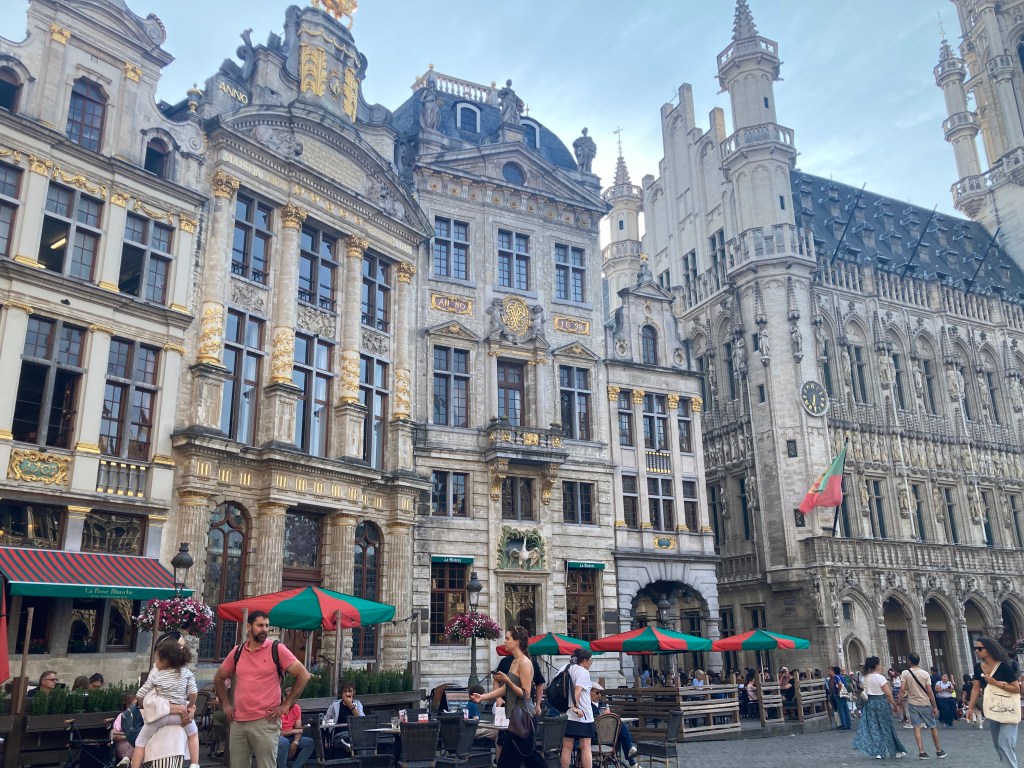
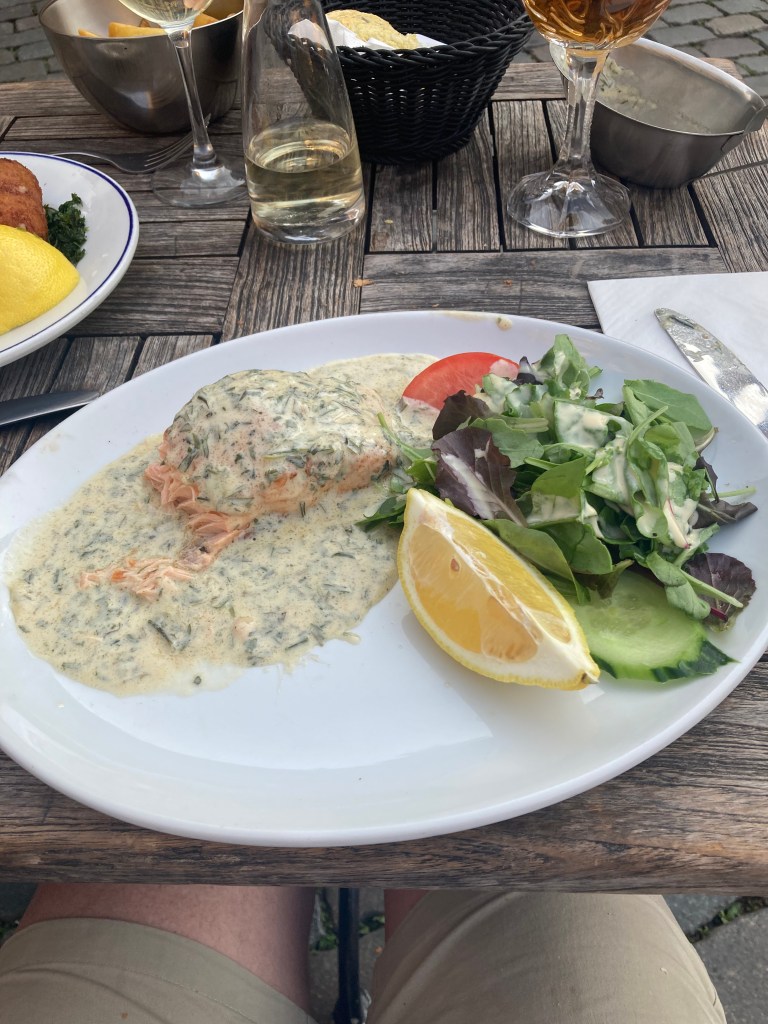
I couldn’t resist taking the next photo: a couple enjoying a meal and a drink, both of them wearing shared earpieces while he sported dark glasses. From where we were sitting, it looked like some kind of amateur covert operation. The sight of it gave us both a good laugh.
That is all for today.
Wednesday 20 August 2025
Today we spent the entire day wandering through the old town of Brussels, exploring its narrow lanes, grand squares, and centuries‑old façades. Below are some of the photos we took along the way, along with a few interesting facts about the two famous statues that draw visitors from all over the world.
Below is Manneken Pis—Dutch for “Little Pissing Man”—is a famous 55.5 cm bronze fountain sculpture in the centre of Brussels. It depicts a puer mingens, a small naked boy cheerfully urinating into the basin below. Despite its modest size, it has become one of the city’s most iconic symbols, beloved for its humour, history, and the countless costumes it wears throughout the year.
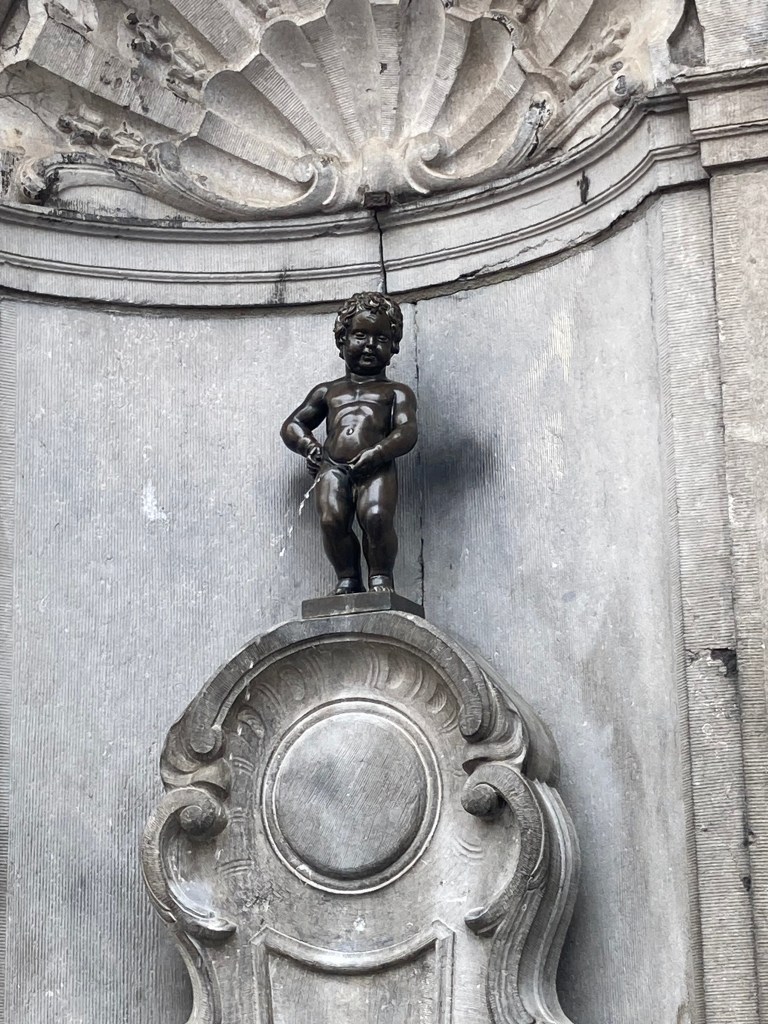
The earliest known reference to Manneken Pis appears in an administrative document from 1451–52 concerning the water lines that supplied Brussels’ fountains. From the very beginning, the little statue served a practical purpose: it stood on a column and poured water into a double rectangular stone basin, playing an essential role in the city’s distribution of drinking water. The only depictions of this original version appear, very schematically, on a map by cartographers Georg Braun and Frans Hogenberg, where the fountain seems to stand directly on the street rather than on a corner as it does today. The statue also appears in a 1616 painting by court artists Denis Van Alsloot and Antoon Sallaert, where it is whimsically dressed as a shepherd.
The first statue was eventually replaced in 1619, when the Brussels City Council commissioned a new bronze version. This is the 55.5‑centimetre figure we know today, positioned at the corner of Rue de l’Étuve and Rue des Grands Carmes. It was created by the Brabantine sculptor Jérôme Duquesnoy the Elder, father of architect and sculptor Jérôme Duquesnoy the Younger and the renowned Baroque sculptor François Duquesnoy. Despite its tiny size, this little bronze boy has become one of Brussels’ most recognisable and beloved symbols.
Below is Jeanneke Pis, the is the playful female counterpart to Brussels’ famous Manneken Pis. This small bronze fountain sculpture depicts a young girl in a squatting pose, cheerfully relieving herself into the basin below. Though far more modern, created in 1987, it has quickly become a beloved curiosity in its own right. Tucked away in a narrow alley near the Delirium beer bar, Jeanneke Pis attracts visitors with the same mix of humour, charm, and light‑hearted irreverence that defines Brussels’ most iconic statues.
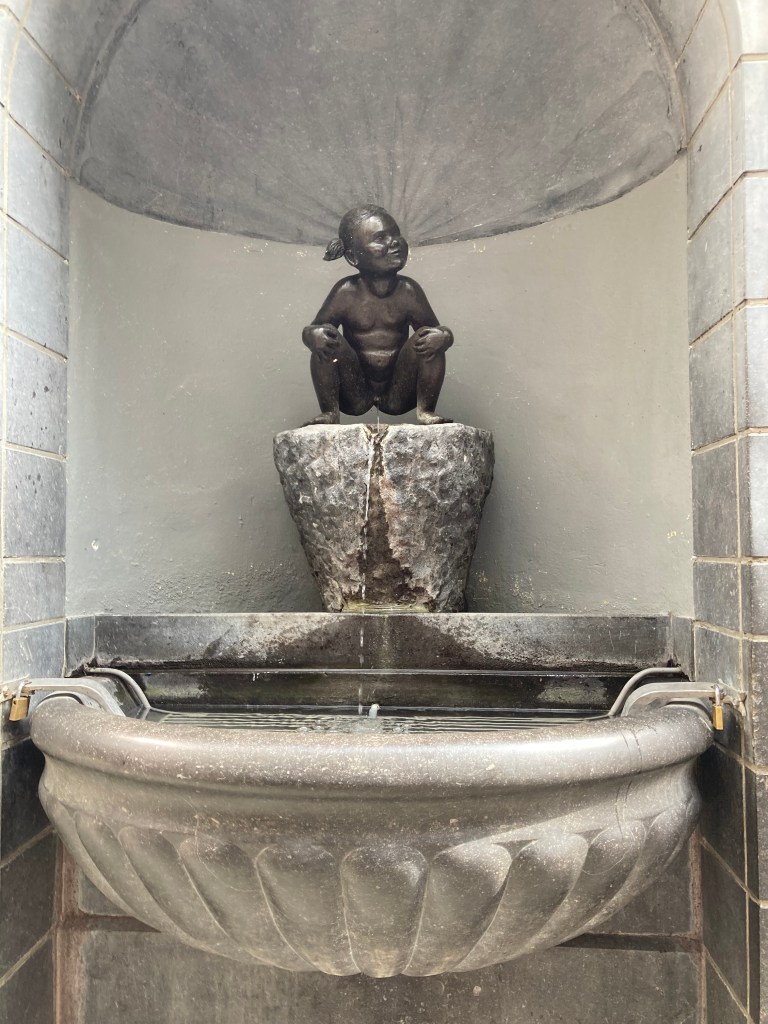
Jeanneke Pis—Dutch for “Little Pissing Joan”—is a modern addition to Brussels’ collection of quirky public sculptures. Commissioned by Denis‑Adrien Debouvrie in 1985 and unveiled in 1987, it was created as a deliberate counterpoint to the city’s much older Manneken Pis. The 50‑centimetre bronze figure shows a young girl with short pigtails, squatting playfully on a blue‑grey limestone base.
You’ll find Jeanneke Pis just north of the Grand Place, tucked along the Impasse de la Fidélité, a narrow cul‑de‑sac branching off the lively, restaurant‑filled Rue des Bouchers. Because of past vandalism, the statue is now protected behind iron bars, though visitors still flock to see her.
Debouvrie’s idea was twofold: to revive interest in the little alley where he owned several restaurants, and to symbolically “restore equality between men and women” by giving Brussels a feminine counterpart to its famous urinating boy. The result is a modern icon with its own charm, humour, and loyal following.
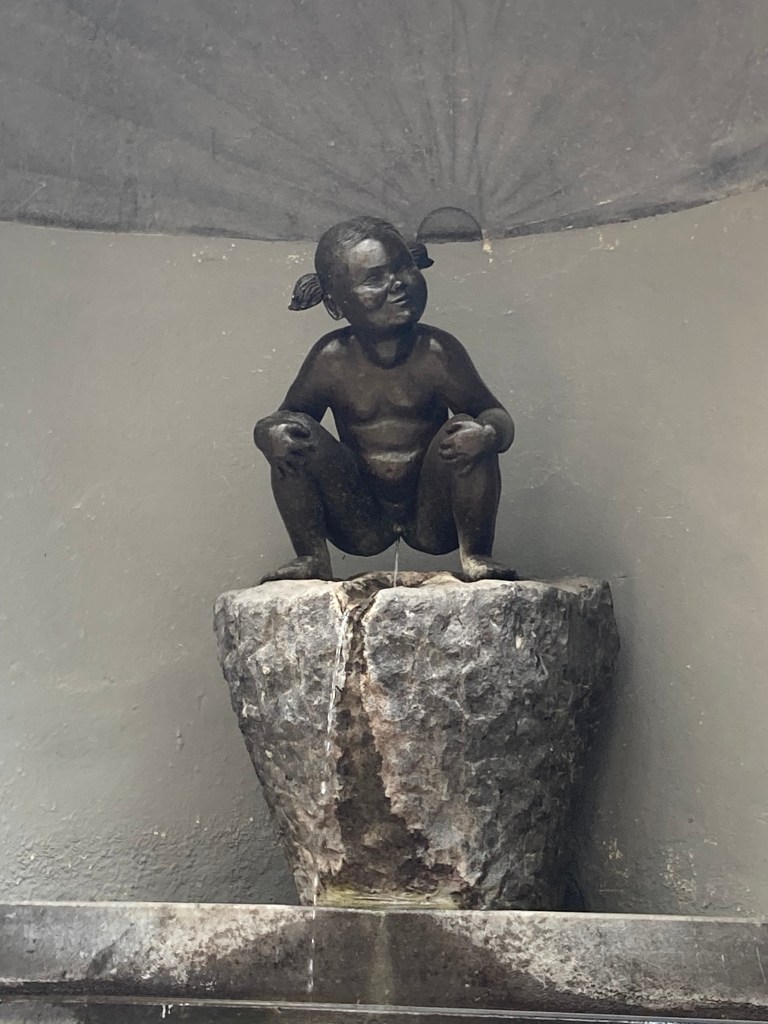
While we were viewing these statues the following horseless carriages came by.
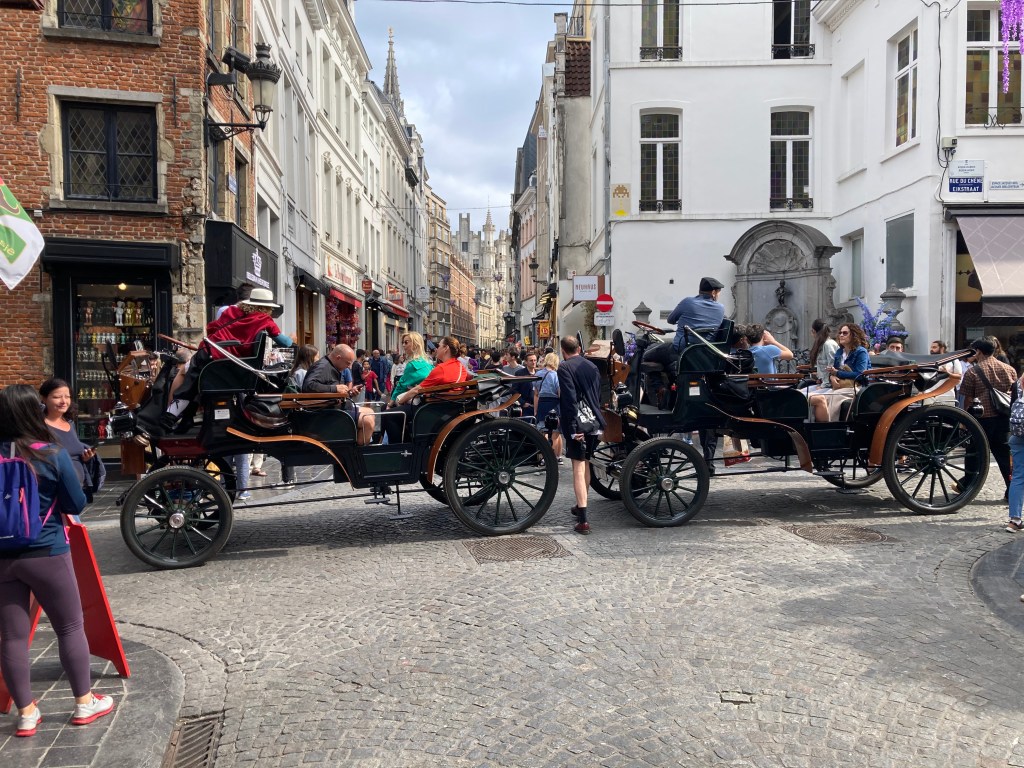
These electric carriages were designed to mimic the look and gentle pace of the old horse‑drawn versions, but with quiet motors, zero emissions, and smoother movement through the cobbled streets. They now offer visitors a comfortable, eco‑friendly way to explore the medieval lanes and grand boulevards—proof that tradition and innovation can sit side by side in a city as old as Brussels.
From here we wandered the streets taking photos.
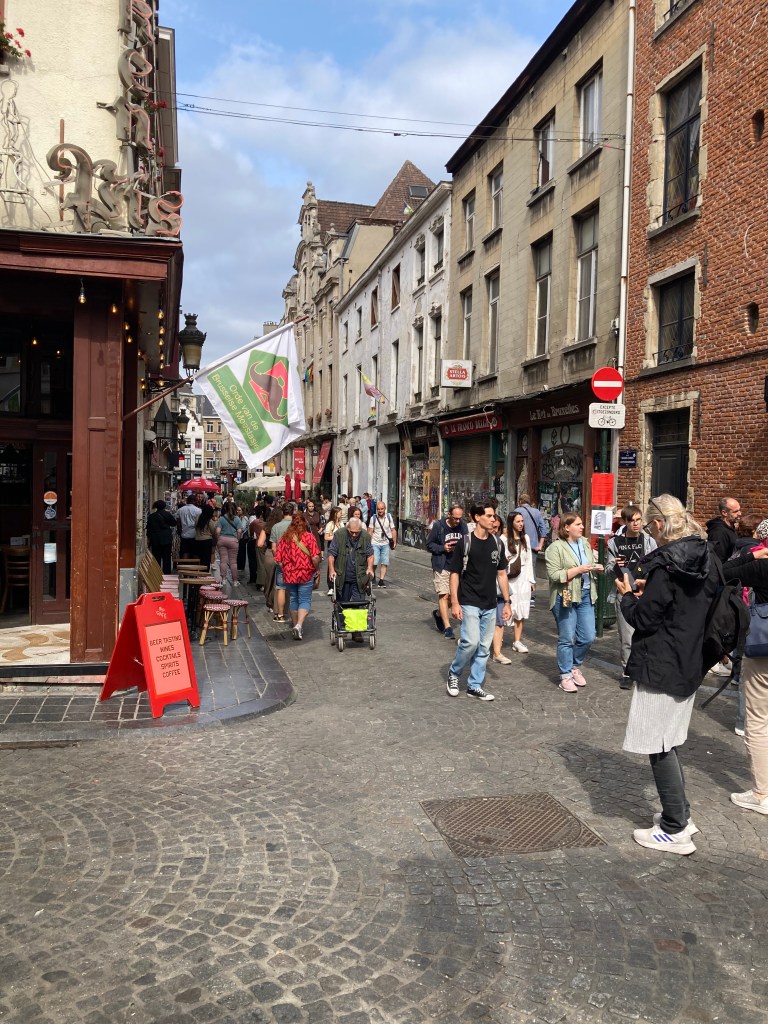
We then made our way to Rooftop 58, perched atop Brucity, the City of Brussels’ new administrative headquarters. The building was designed to bring together dozens of scattered municipal services under one roof, and the rooftop terrace was created as a public space, an open, elevated lookout where anyone can enjoy sweeping views of the city.
From the eighth floor, you get a full 360‑degree panorama of Brussels: the Grand Place rooftops, the spires, the modern skyline, and the patchwork of medieval streets stretching out in every direction. Unfortunately, the only way up is via a completely transparent circular glass tube of an elevator. Was I going up in that thing? Not a chance.
Maree, on the other hand, was far braver. She went up, loved the views, and took some fantastic photos while I spent thirty minutes pacing the pavement below. Given the heightened security presence around Belgium these days, I’m sure the local police were quietly wondering what on earth I was up to.
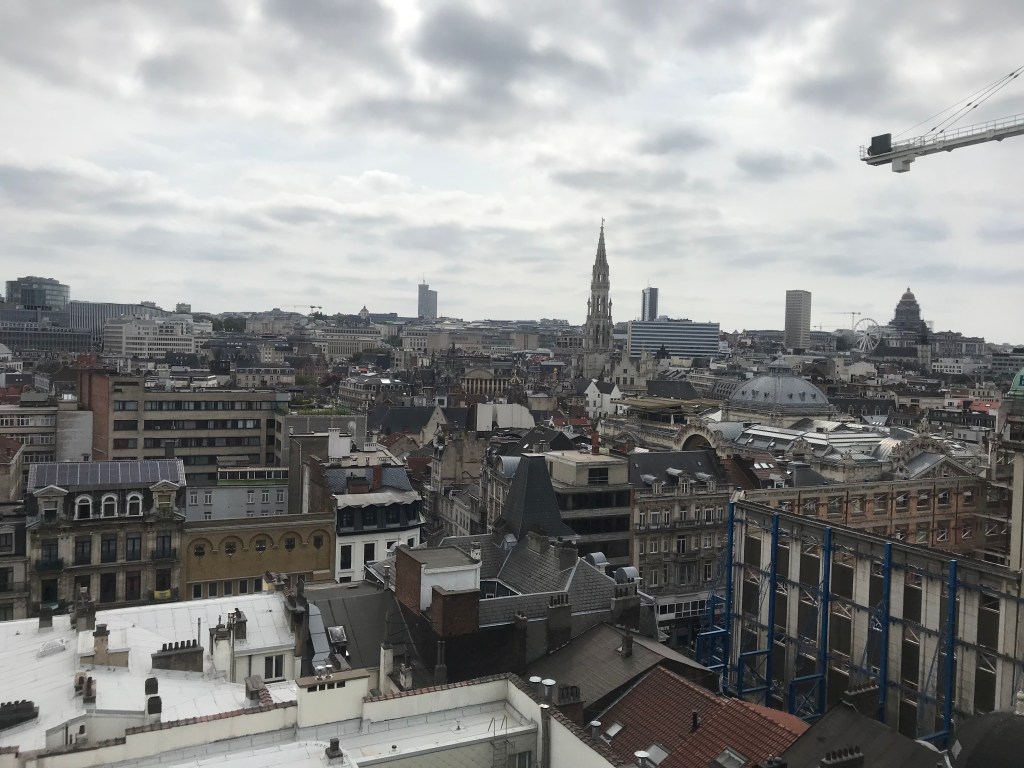
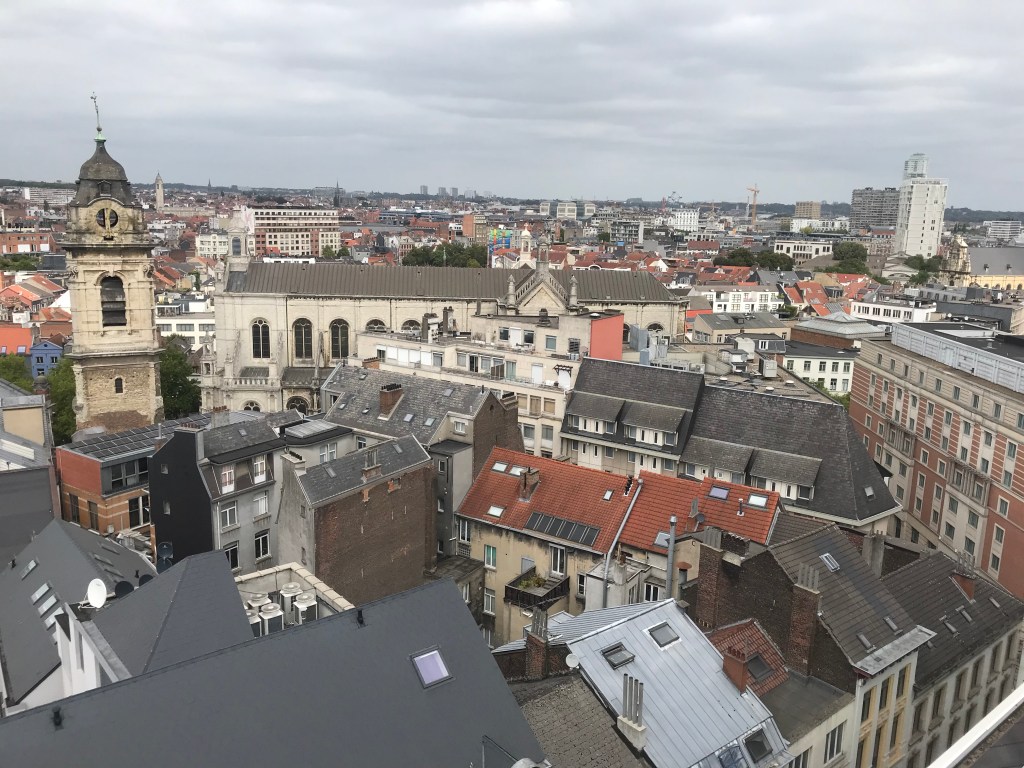
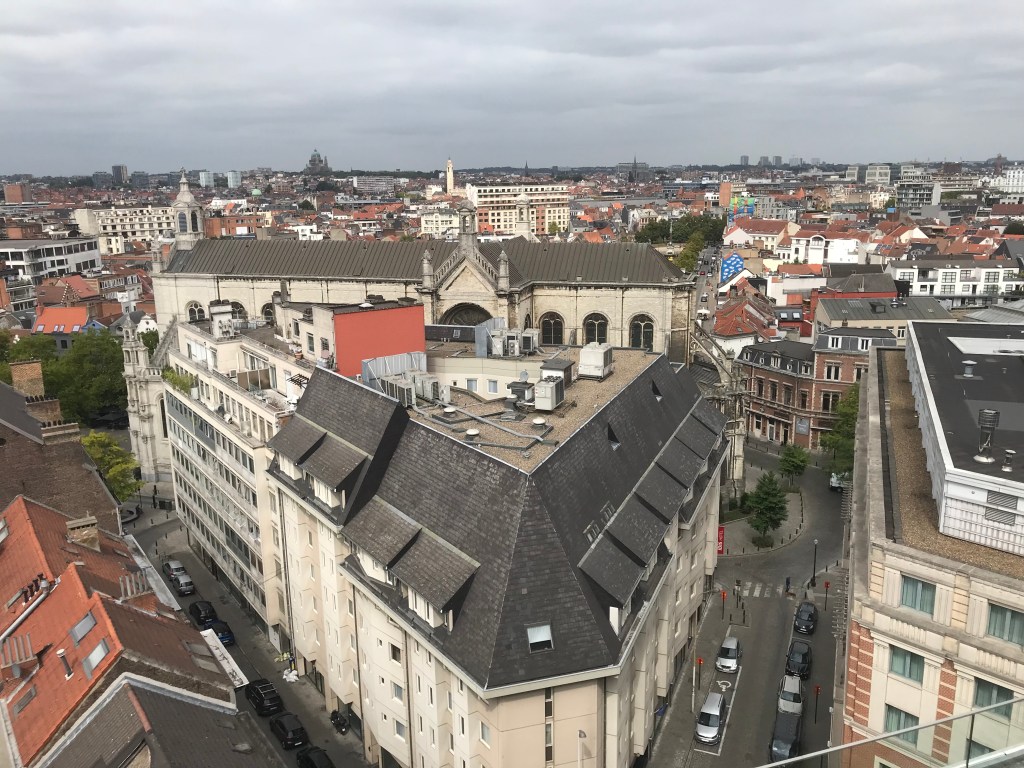
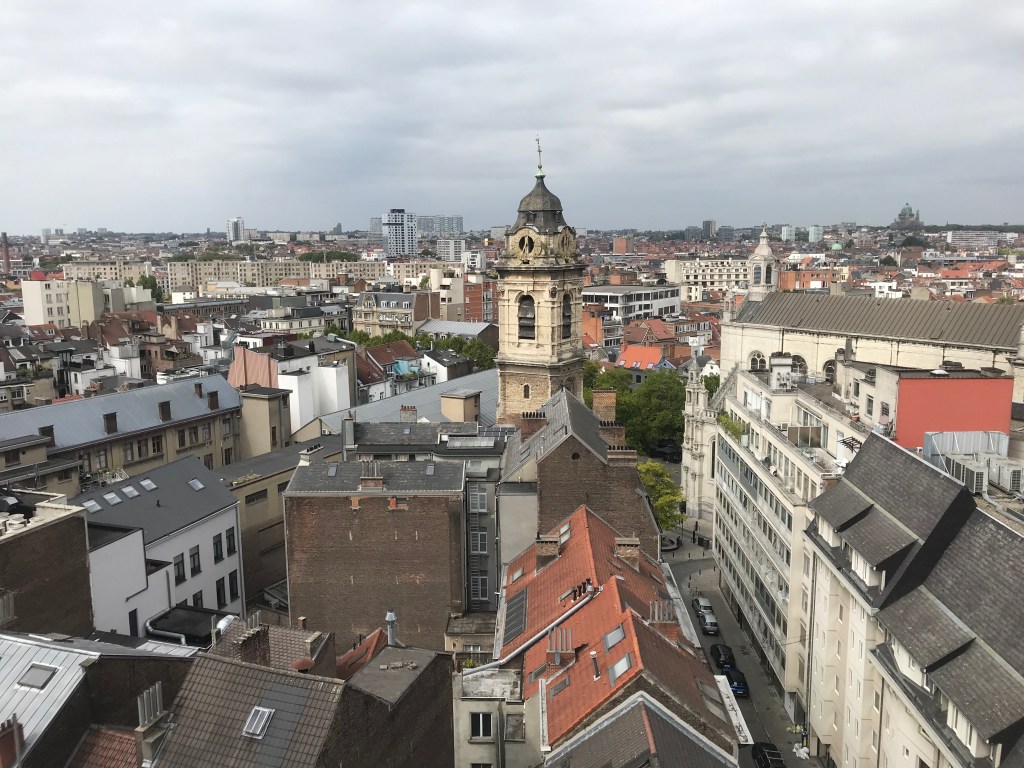
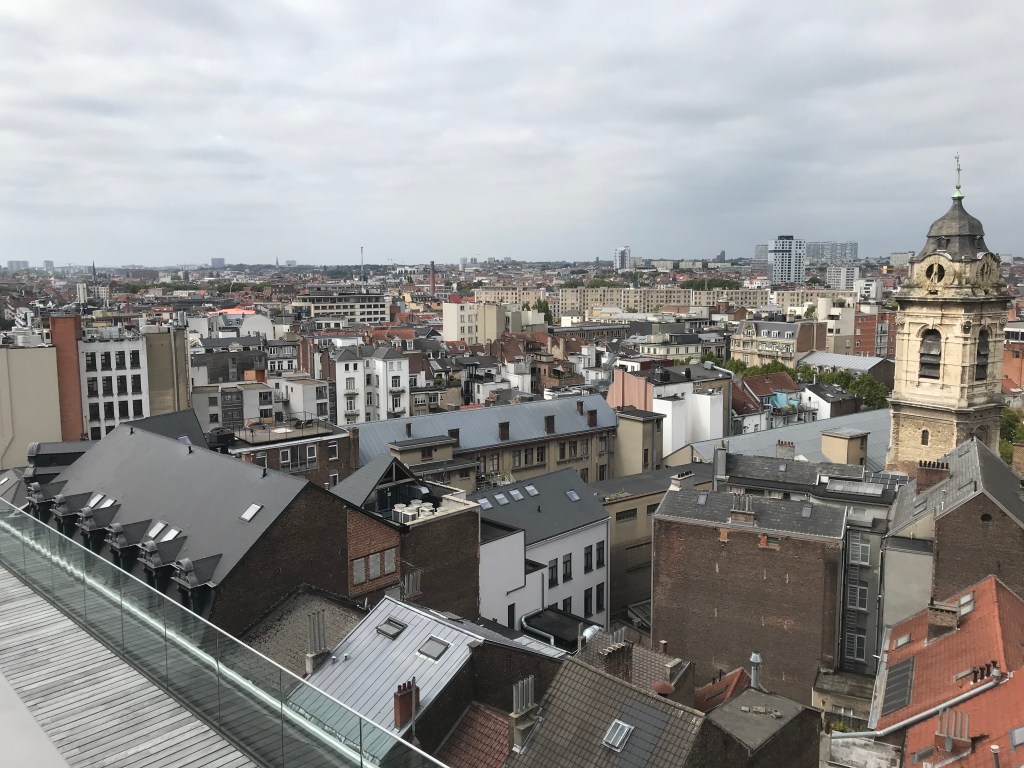
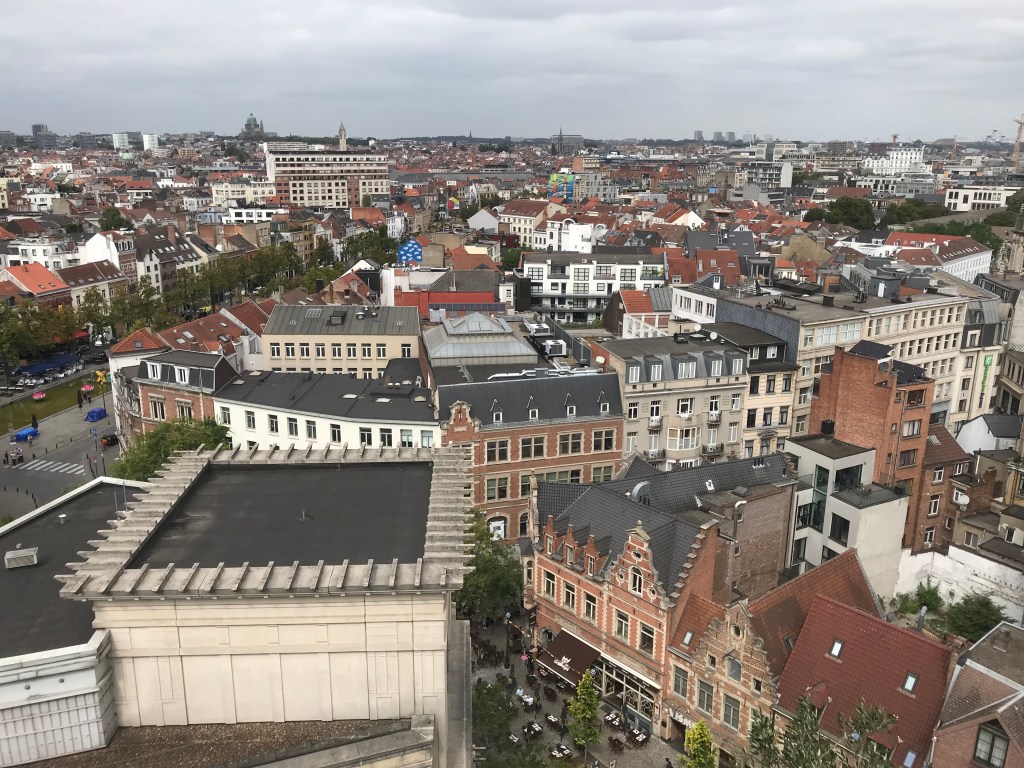
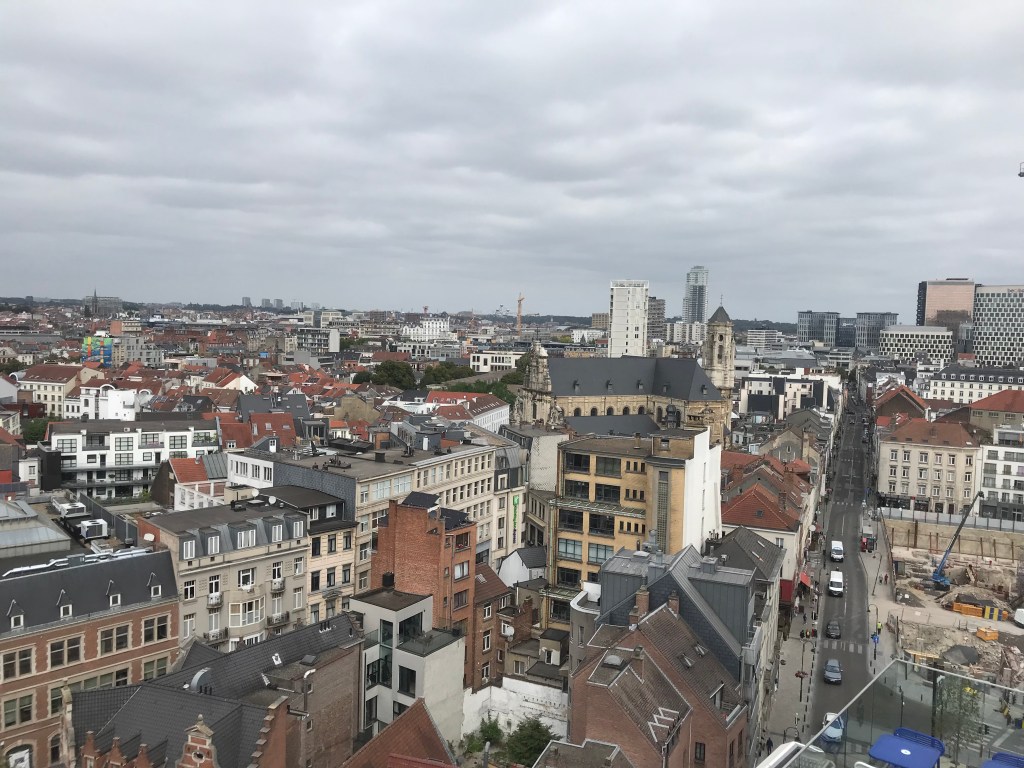
Well, that’s all from our wander through this lovely old town. A full day of cobblestones, history, and hidden corners; Brussels never disappoints.
Thursday 21 August 2025
Today we joined an organised walking tour to Brugge (Bruges) and then continued on to Gent, a full‑day excursion that began in Brussels at 08:30 and returned us to our starting point at 19:00.
You’ll notice both spellings, Brugge and Bruges, appearing throughout this blog. The difference is simply linguistic: Brugge is the Dutch/Flemish spelling used locally in the Flanders region, while Bruges is the English and French version of the same name. Both are correct, but “Brugge” is the form preferred by the people who call the city home.
So with that out of the way, let’s get on to the trip.
As we left Brussels for Brugge, our bus paused right beside the Cardo Brussels Hotel, whose entire 30‑storey façade is wrapped in a gigantic reproduction of René Magritte’s The Son of Man. It’s officially the largest Magritte artwork in the world. The iconic figure in the bowler hat, his face hidden behind a floating green apple, stretches across the building like a surreal billboard. The hotel plans to replace the façade every three years with a different Magritte masterpiece, turning the tower into a rotating tribute to Belgium’s most famous surrealist.
The Son of Man was painted in 1964 and is one of Magritte’s most recognisable works. Although it looks mysterious, it’s actually a self‑portrait. The painting shows a man in an overcoat and bowler hat standing before a low wall, with the sea and a cloudy sky behind him. A green apple hovers in front of his face, obscuring it, though his eyes peek just over the top. Magritte loved visual paradoxes, and even included a subtle twist: the man’s left arm bends in an anatomically impossible way.
The painting also had a memorable moment in pop culture. In the 1999 film The Thomas Crown Affair, it appears several times, most famously during the final heist sequence when dozens of men dressed in bowler hats and trench coats flood the museum, echoing Magritte’s imagery and confusing the security team.
Brugge (Bruges)
Brugge’s story is shaped by its medieval rise as a major trading centre. From the 12th to the 15th centuries, the city flourished thanks to the wool and cloth trade, attracting merchants from across Europe and helping spark the golden age of Flemish art. Its fortunes changed in the late 15th century when the waterways that connected Brugge to the sea, the Reie and the Zwin, gradually silted up. Trade declined, but the slowdown had an unexpected benefit: the city’s medieval streets, guild houses, and canals were preserved almost untouched.
The Reie was once a natural river flowing through the city, while the Zwin served as the vital estuary linking Brugge to the North Sea. As the Reie silted up, the Zwin became Brugge’s main harbour, until it too eventually closed off, leaving the city landlocked and economically isolated.
By the 19th century, Brugge’s perfectly preserved medieval core began attracting visitors, leading to a revival that ultimately earned it UNESCO World Heritage status. In the 20th century, the construction of the artificial port of Zeebrugge, along with a modern canal, reconnected Brugge to the sea and restored its role in maritime trade, blending its ancient charm with renewed purpose.
Refer to https://en.wikipedia.org/wiki/Bruges for a complete history of this lovely old city.
Following are some photos we took as we walked around this very old city.
The park was officially opened to the public in 1979 and has since become a favourite spot for both locals and visitors, who come to enjoy its calm pathways, graceful bridges, and the soft reflections of the lake.
At the southern edge of Brugge, this little building marks the spot where several streams once converged to form the River Reie, the waterway that carried Brugge’s trade all the way to the sea. To manage the city’s water levels, a system of locks was built here in the 12th and 13th centuries. The current Lock Keeper’s House, dating from the 16th century, replaced those early structures and served as the control point for regulating Brugge’s canals right up until the 1970s.
Although the locks are no longer in use, you can still see the old reservoir openings where the water once surged through—quiet reminders of the engineering that kept medieval Brugge afloat.
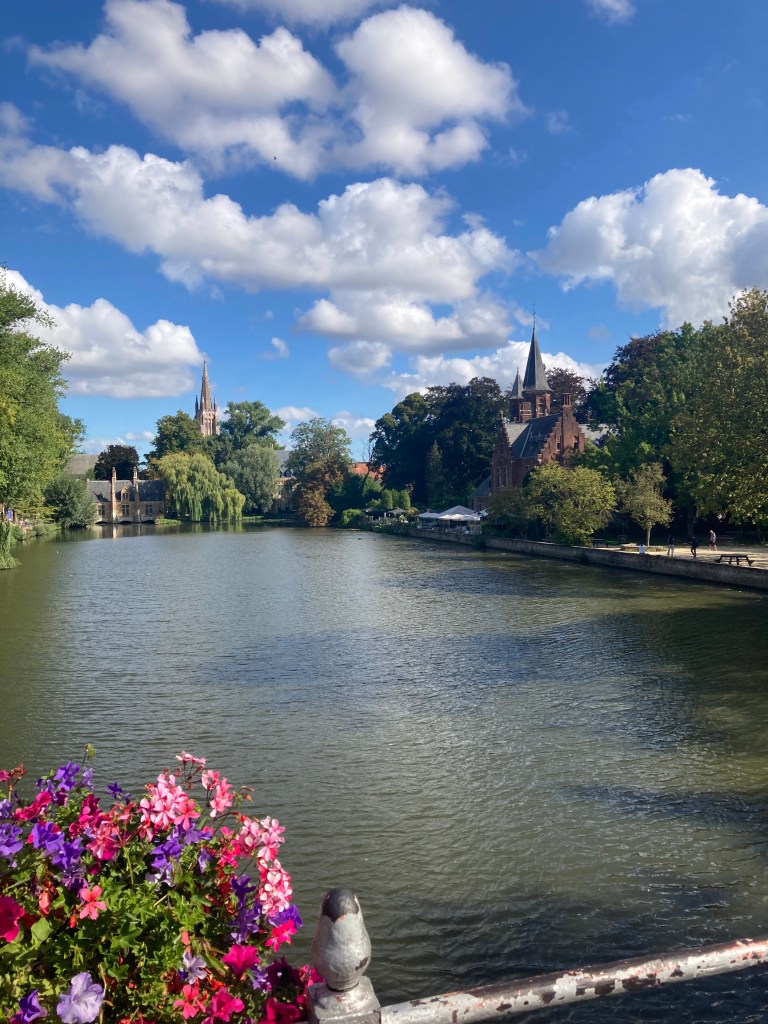
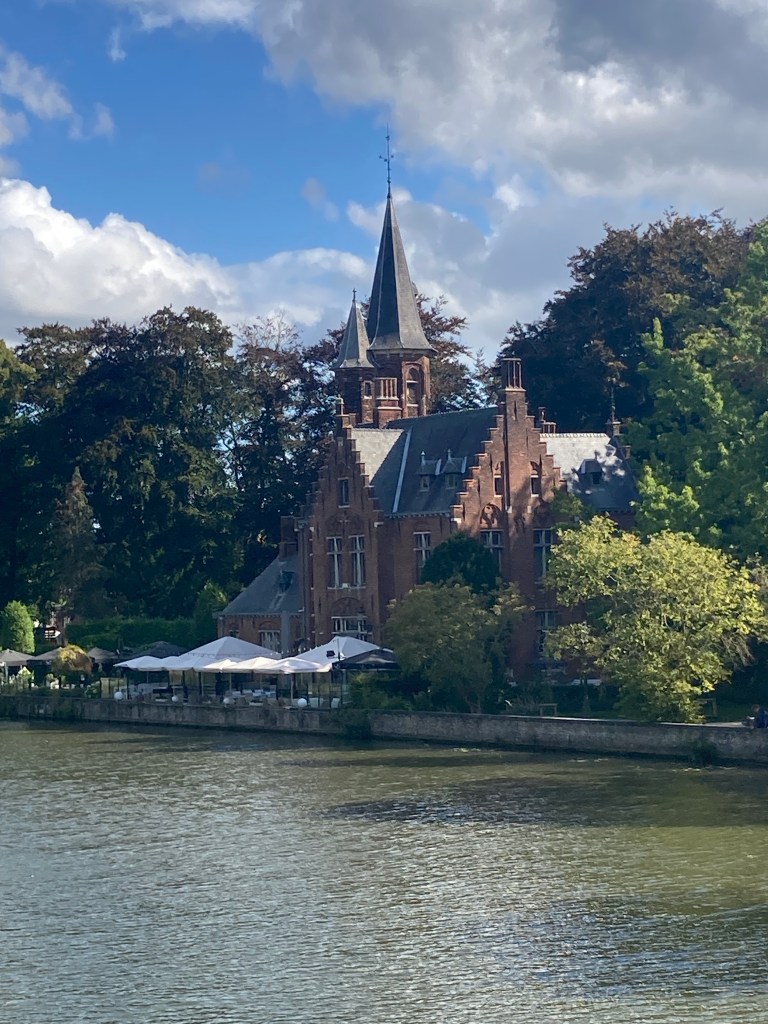
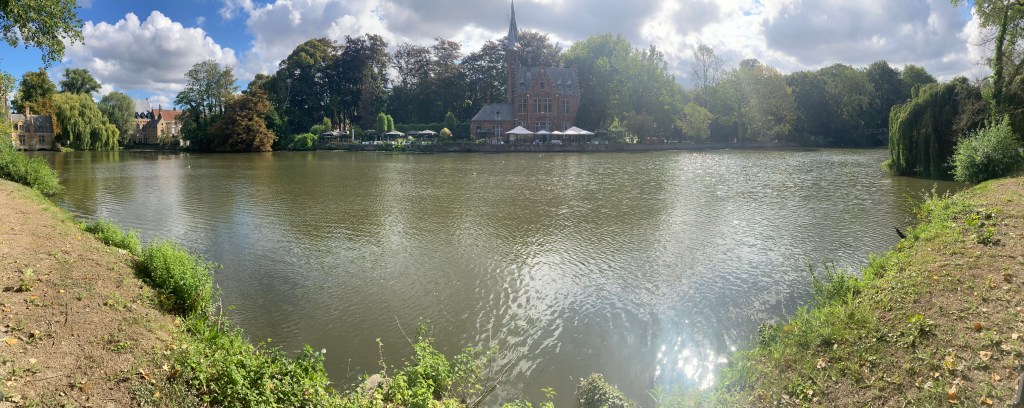
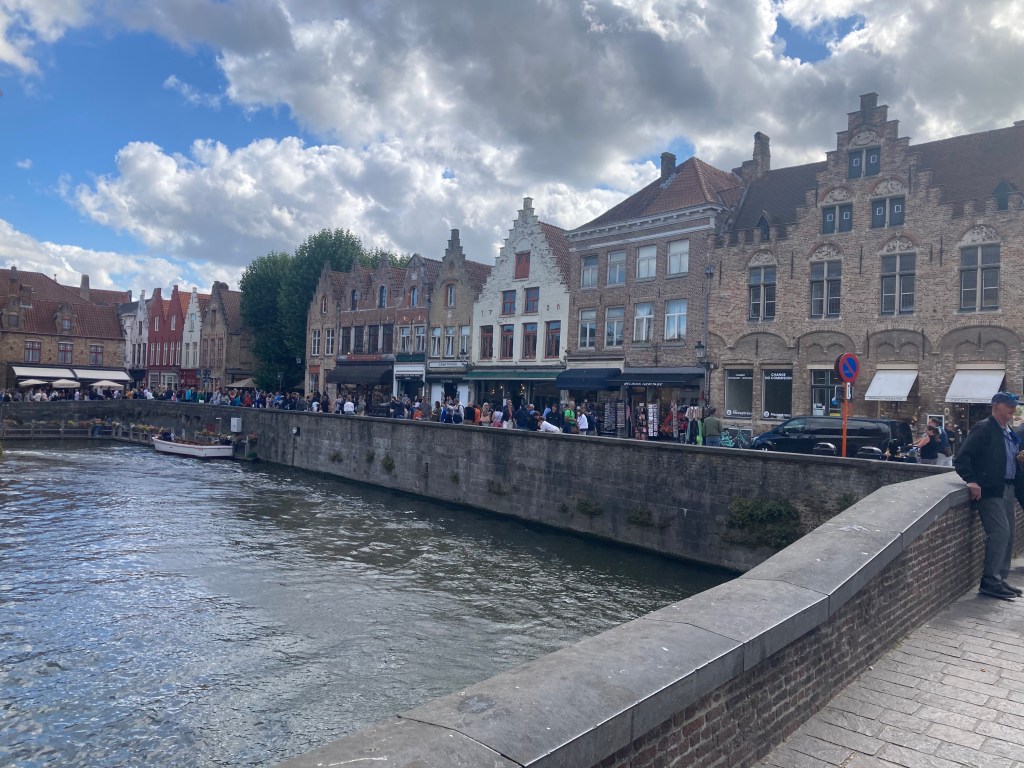
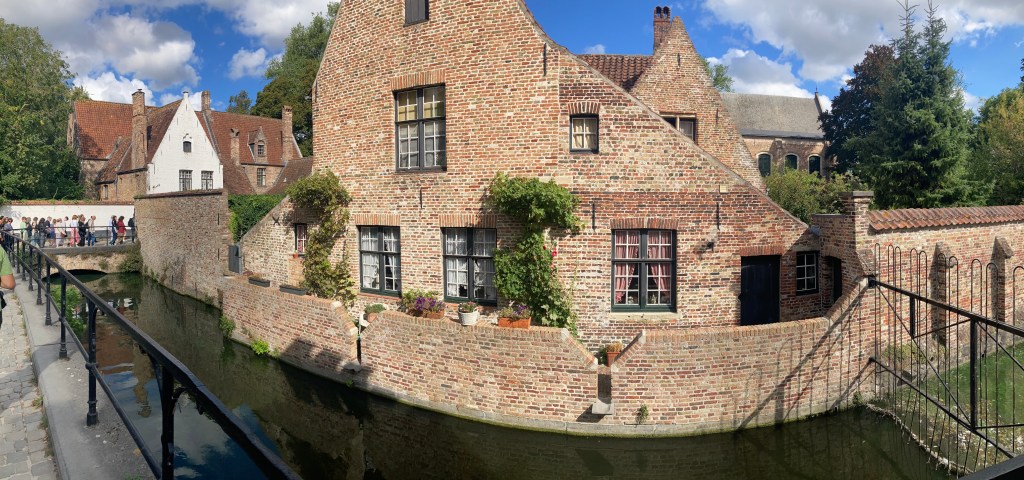
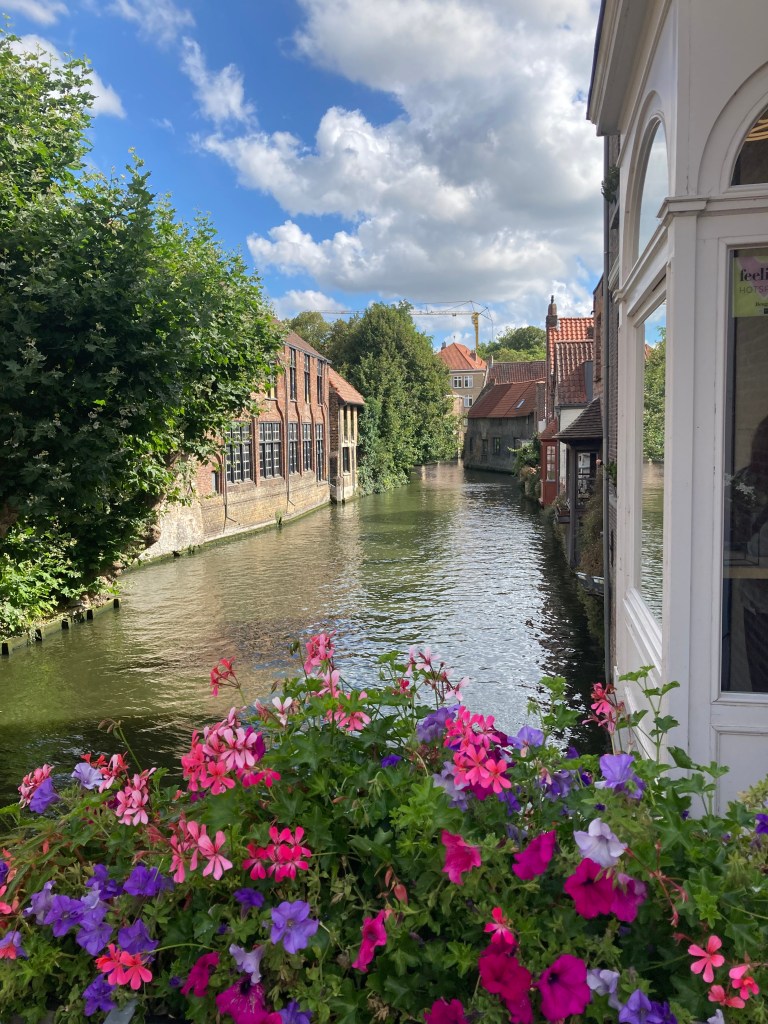
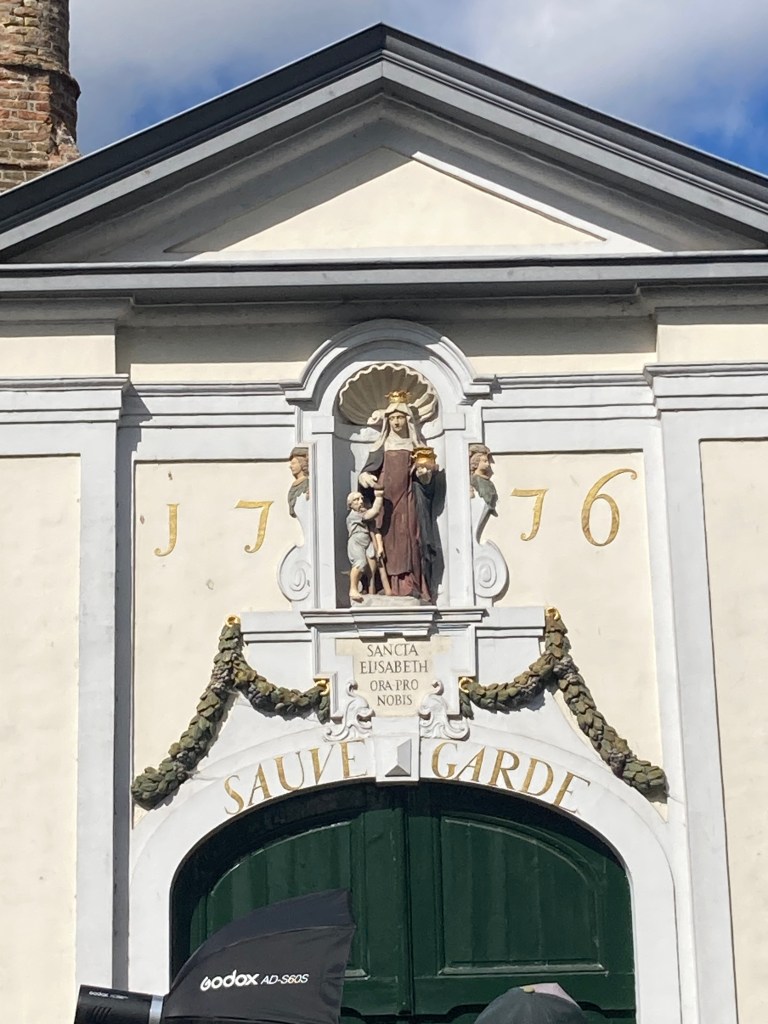
Beguines devoted themselves to prayer, charity, and simple communal living, but unlike nuns, they did not take permanent vows or withdraw entirely from the world. These semi‑independent communities flourished particularly in the Low Countries, modern‑day Belgium, the Netherlands, and parts of northern France, where they offered women social, spiritual, and economic stability at a time when few such options existed. Many Beguinages, including Brugge’s, are now recognised as UNESCO World Heritage Sites for their cultural and architectural significance.
Although beguines were sometimes accused of heresy, these tensions arose from their unusual independence and their refusal to fit neatly into established Church structures, not from any association with witchcraft or unorthodox beliefs. Their communities remain a remarkable example of medieval female autonomy and devotion.
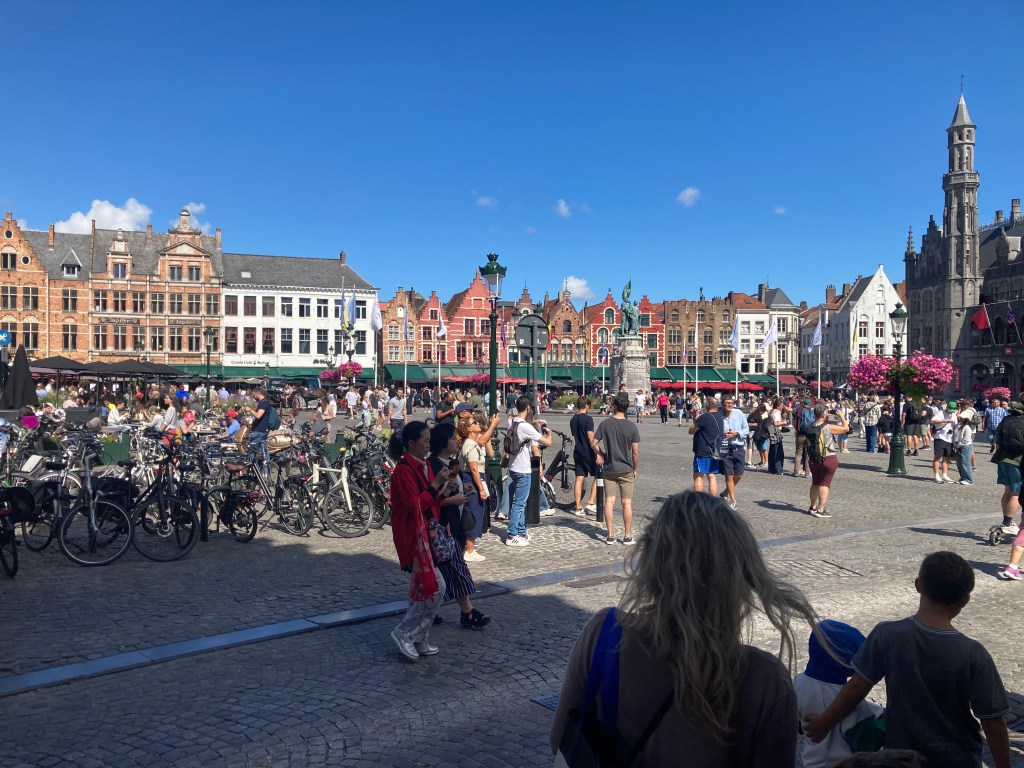
The bustling heart of Brugge, Markt Square has been the city’s main gathering place for nearly a thousand years. Surrounded by colourful guild houses, cafés, and historic façades, it has long served as the centre of trade, festivals, and public life. The iconic Belfry towers over the square, once home to the city’s treasury and medieval watchmen. Today, Markt remains the perfect starting point for exploring Brugge, alive with horse‑drawn carriages, market stalls, and the timeless rhythm of a city shaped by its medieval past.
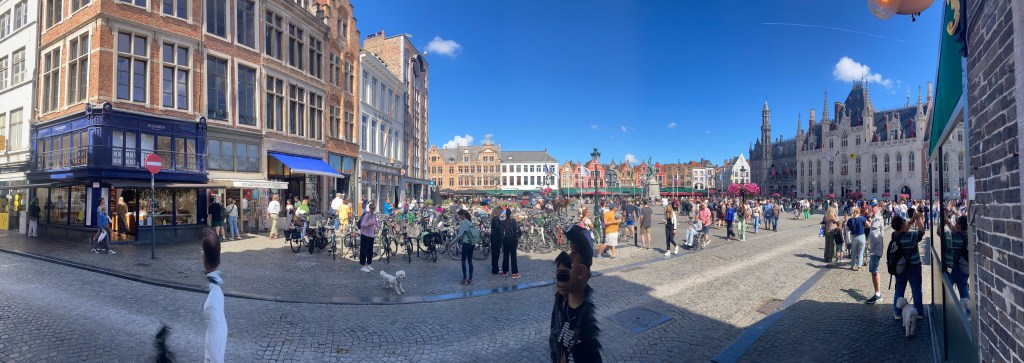
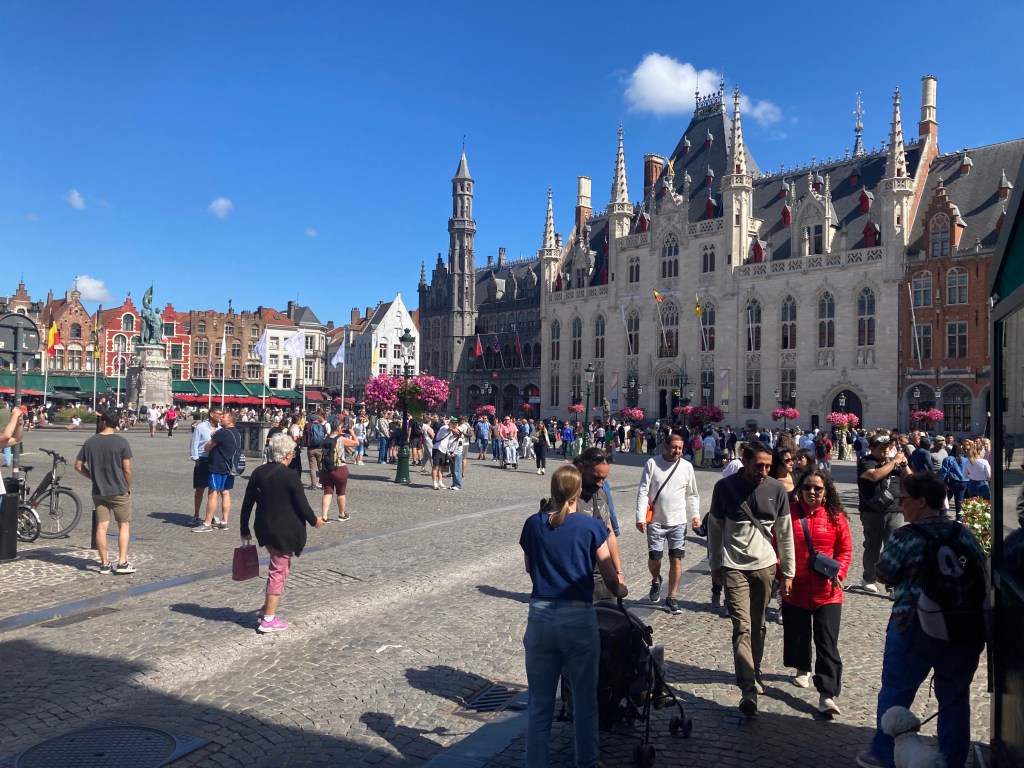
The Belfry of Brugge is one of the city’s most recognisable landmarks—a medieval bell tower rising above the centre of Brugge. Once the heart of civic life, it housed the city’s treasury and municipal archives and served as a vital watchtower for spotting fires and other dangers.
The first belfry was added to the Markt around 1240, when Brugge was a major hub of the Flemish cloth trade. After a devastating fire in 1280, the upper half of the tower had to be rebuilt, though the city archives were lost forever.
Between 1483 and 1487, the tower gained its distinctive octagonal upper stage, topped with a wooden spire crowned by Saint Michael—banner raised, dragon beneath his feet. That spire didn’t last long: lightning struck in 1493, destroying both the spire and the bells. A new wooden spire stood for the next two and a half centuries until another fire in 1741 brought it down. It was never replaced, reducing the tower’s height from 102 metres to its current 83 metres. In 1822, an openwork stone parapet in the Gothic Revival style was added, giving the belfry the silhouette we see today.
After stopping for lunch, we made our way back to the meeting point and boarded the bus for our next destination, the beautiful town of Gent.
Is it Ghent or Gent?
Much like Brugge and Bruges, both spellings, Ghent and Gent, are correct. Ghent is the English version, while Gent is the Dutch (Flemish) and German spelling. Locally, and on the city’s official tourism materials, you’ll see Gent, which is the form used throughout Flanders.
Gent’s history stretches back to 630, when St Amandus founded an abbey at the meeting point of the Lys and Scheldt rivers. Nearly fourteen centuries later, that early settlement has grown into a city where the past is still very much alive, complete with a medieval castle, a cathedral, a belfry, and three beguinages (you may recall my earlier explanation of these remarkable communities in the Brugge post).
From around 1000 to 1550, Gent was one of Europe’s most important cities. It was larger than London and second only to Paris. Its 14th‑century population of 60,000 fiercely defended their rights and freedoms; earls and princes quickly learned that the people of Gent were not easily subdued. Until the Battle of the Golden Spurs in 1302, the city was dominated by wealthy merchant families known as the Leliaerts, named after the French lily on their chosen king’s coat of arms. As the guilds and trades gained influence in the 14th century, Gent gradually developed a more democratic form of governance.
The city’s reputation for stubborn independence endured for centuries—sometimes to its detriment. Gent’s political defiance eventually weakened its power, and it wasn’t until the late 18th century that the city experienced a new economic upswing. Under Dutch rule, Gent gained its own university in 1816, commemorated by a statue of King William I on the Scheldt. A decade later, the Gent–Terneuzen Canal reopened the city to the sea, restoring its maritime connection.
Because Gent escaped major bomb damage during both world wars, its historic centre remains remarkably intact today, a rare gift for a city of its age and importance.
We enjoyed a lovely walk through Gent, though after our long (and very enjoyable) tour of Brugge earlier in the day, we were admittedly a little weary. As a result, we didn’t take many photos; but the city left a strong impression all the same.
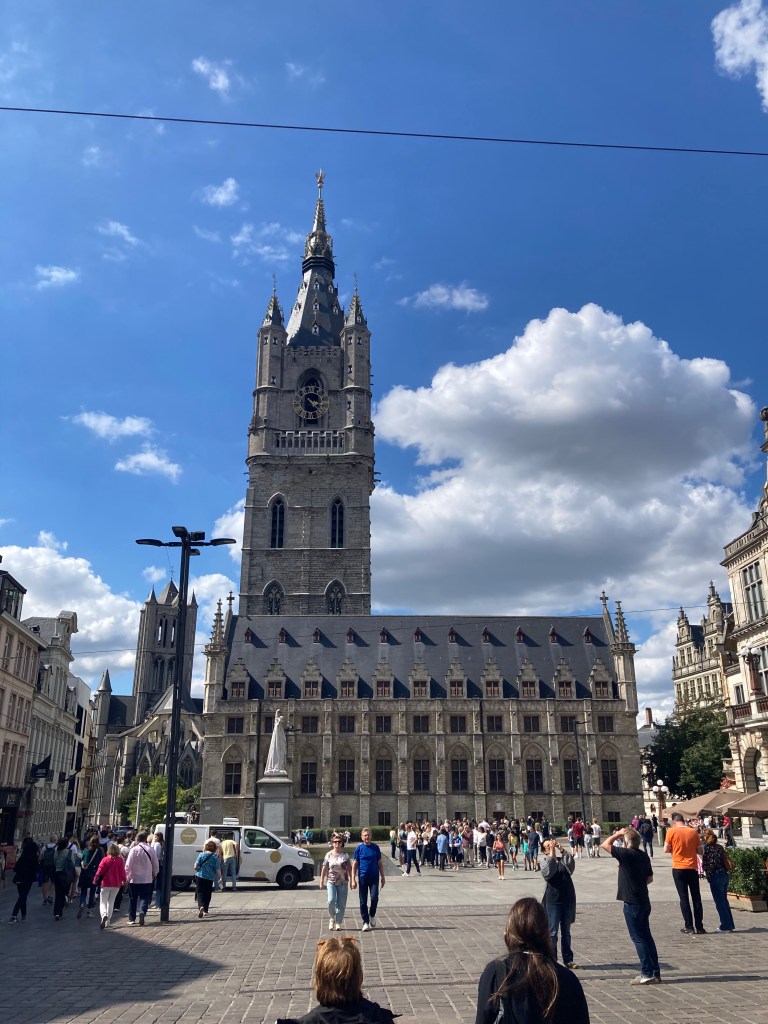
Attached to the Cloth Hall is the well‑known Mammelokker annex, added in 1741. Originally functioning as a guardhouse and the entrance to the former city jail, it is best recognised for the relief sculpture above its doorway. The artwork depicts the Roman legend of Pero and Cimon, in which the daughter secretly breastfeeds her imprisoned, starving father to keep him alive. This striking scene gives the annex its unusual name—“Mammelokker,” meaning “breast sucker”—and remains one of Gent’s most memorable historical curiosities.
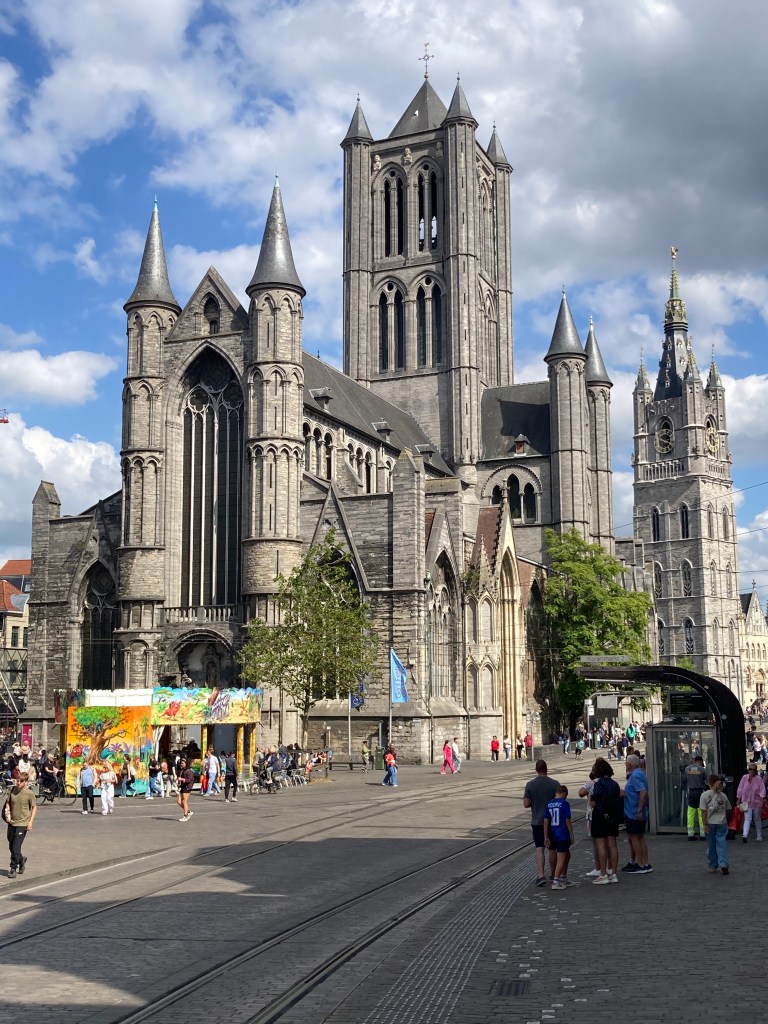
Situated in the heart of Gent’s medieval trade district beside the Korenmarkt (Wheat Market), the church was closely tied to the city’s powerful guilds. Many guilds maintained their own chapels, added along the sides of the church during the 14th and 15th centuries, reflecting both their wealth and their influence.
The central tower, partly funded by the city, served not only as an architectural focal point but also as an observation post, housing the town bells until the neighbouring Belfry of Gent was constructed. Together with St. Bavo’s Cathedral, these three towers still define the iconic skyline of the city centre.
Among the church’s notable treasures is its historic organ, an important piece of Gent’s musical heritage.
After wandering through the town, we found a quiet spot, ordered a beer each, and let our legs rest while we waited for the bus back to Brussels. The guided tour of both cities had been genuinely fascinating, full of history, stories, and beautiful streets, and we’d really enjoyed the long walks that stitched the day together.
Once we were back in Brussels, we grabbed a quick bite to eat, more out of practicality than ceremony, and then made our way to the hotel for a well‑earned, quiet evening. A full day, a good day, and one that left us pleasantly tired in the best possible way.
Friday 22 August 2025
Today is another gentle rest day, and it feels well earned. We’ve done a short wander through the streets, but at this point we’ve covered everything we hoped to see during our time here. Now we’re simply soaking up the atmosphere of the Grand Place, which has been an absolute highlight of our stay. Being based right in the square has made our days in Brussels feel especially memorable, waking up to that architecture, stepping straight into the heart of the city, and watching the square shift from quiet mornings to its golden, glowing evenings. Highly recommended to anyone visiting.
Tomorrow we pack up and say goodbye to Brussels as we make our way to London.
Saturday 23 August 2025
Today was a travel day as we made our way from Brussels to London. The Eurostar journey was smooth and uneventful, though we did arrive about twenty minutes behind schedule due to track work along the route, which kept the train from reaching its usual high speeds. Still, it was a comfortable ride and a pleasant way to transition between cities.
Once we checked into our hotel, The Howard Winchester, we took a little time to rest and settle in. It’s a simple, well‑located place, nothing fancy, but perfectly positioned for exploring the city and ideal for a short stay.
Later in the evening we wandered over to a nearby pub, The Lucas Arms, for dinner. We wanted a classic English pub experience, and it delivered exactly that: warm atmosphere, friendly service, and hearty comfort food. I went straight for the traditional fish and chips, while Maree chose the steak and ale pie, both excellent choices and very satisfying after a day of travel. Naturally, we paired our meals with a crisp Pinot Grigio, which rounded things off nicely.
A gentle, easy start to our time in London, and a lovely way to end the day.
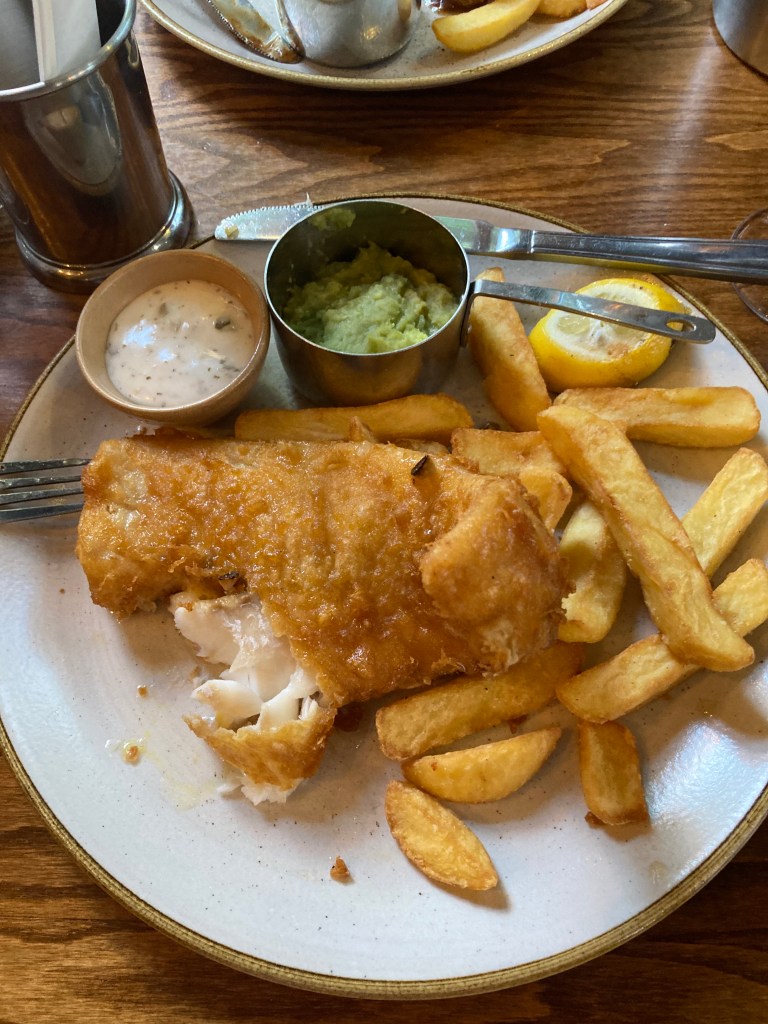
Sunday 24 August 2025
This morning we left London for Beeston (Nottingham). We stayed in London overnight to break the journey from Brussels. As we were departing from St Pancras International Station, I thought I would take the opportunity to take a photo of this lovely old building a do a little research on its history.
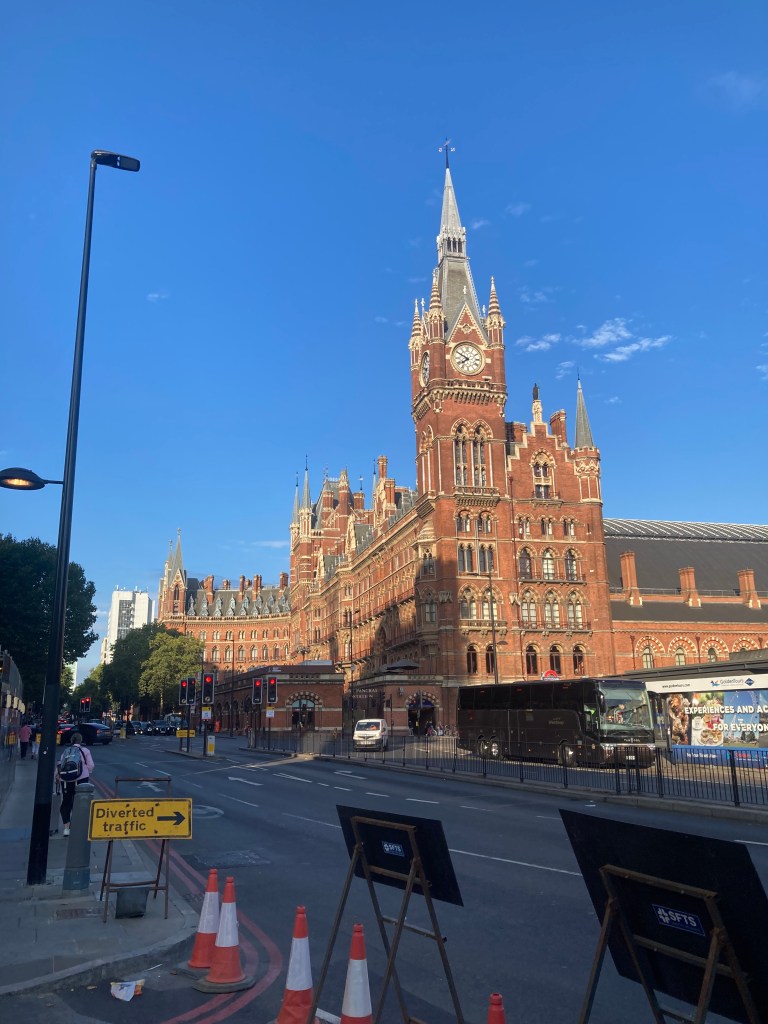
This morning we left London for Beeston (Nottingham), having stayed overnight in the city to break the journey from Brussels. As we were departing from St Pancras International Station, I took the chance to photograph the magnificent façade and dig a little deeper into its history.
St Pancras was built by the Midland Railway to link its extensive network across the Midlands and northern England to a dedicated London terminus. After severe congestion during the 1862 International Exhibition, the company decided to construct its own line from Bedford to London, complete with a grand new station. Designed by William Henry Barlow, the station featured a revolutionary single‑span wrought‑iron roof supported by slender pillars. Measuring 210 metres long, 73.2 metres wide, and 30.5 metres high, it was the largest enclosed space in the world when it opened on 1 October 1868.
Soon after, the Midland Railway commissioned a hotel for the station’s frontage. The result was the spectacular Midland Grand Hotel, designed by George Gilbert Scott in an ornate red‑brick Gothic Revival style. Today, both the station and the hotel are celebrated architectural landmarks and hold Grade I listed status.
St Pancras faced serious threats during the 20th century. It suffered bomb damage in both World Wars, and in the late 1960s there were plans to demolish it entirely and divert services to King’s Cross and Euston. A passionate campaign led by the Victorian Society and Poet Laureate John Betjeman saved the building, its Grade I listing was granted just ten days before demolition was due to begin.
In the early 21st century, St Pancras underwent an £800 million transformation to become the London terminal for the Channel Tunnel Rail Link / High Speed 1 (HS1), part of a major regeneration project across East London. The refurbished station was officially opened by Queen Elizabeth II in November 2007. Today it includes a secure Eurostar terminal, platforms for domestic services, a shopping arcade, and a coach facility. It is owned by HS1 Ltd and managed by Network Rail (High Speed).
With a couple of hours to spare before our train to Beeston, I wandered across the road to King’s Cross Station to see the famous Platform 9¾; a fun little nod to the Harry Potter stories and a popular stop for fans visiting the station.
After arriving in Beeston, a suburban town just outside Nottingham with a friendly, lived‑in feel, we made our way to our accommodation at the Linden Leaf Hotel. It’s not the most luxurious place we’ve stayed, but its location is undeniably convenient, close to the station, easy to reach, and perfectly adequate for a short visit.
Once we’d checked in and freshened up, we headed out to meet my cousin, her husband, and a close family friend for a lovely evening meal. It turned into a really enjoyable night of chatting, catching up, and sharing stories, one of those relaxed family evenings that feels both familiar and restorative.
Now, back at our accommodation, it’s finally time to call it a night and get some well‑earned sleep.
Monday 25 August 2025
The reason we visited Sandiacre today was to watch my cousin in a belly dancing group providing a display of their talents for the general public. Click on this link https://youtu.be/sQdEsMMIjzA to view the video.
Sandiacre lies seven miles west of Nottingham and nine miles east of Derby, forming part of the Greater Nottingham urban area. It sits just across the River Erewash from Stapleford, with Long Eaton to the south and Risley to the west.
The Erewash Canal runs through the heart of Sandiacre, and the small basin immediately above Sandiacre Lock once marked the terminal junction with the Derby Canal. Built between 1777 and 1779, the Erewash Canal became a vital industrial route, carrying coal and goods through the Midlands.
Sandiacre Lock is one of the canal’s original late‑18th‑century structures, complete with its brick-lined chamber and traditional wooden gates. Alongside it stands the Grade II listed Lock Keeper’s Cottage, now preserved as a small museum that reflects the working life of the canal and its keepers.
Although the Derby Canal closed long ago, the Erewash Canal remains active. In 1968, the Erewash Canal Preservation and Development Association was formed to protect and promote the waterway. Today, the towpath forms part of the Erewash Valley Trail, and narrowboats still moor at nearby Padmore Moorings—quiet reminders that this historic canal continues to be part of local life.
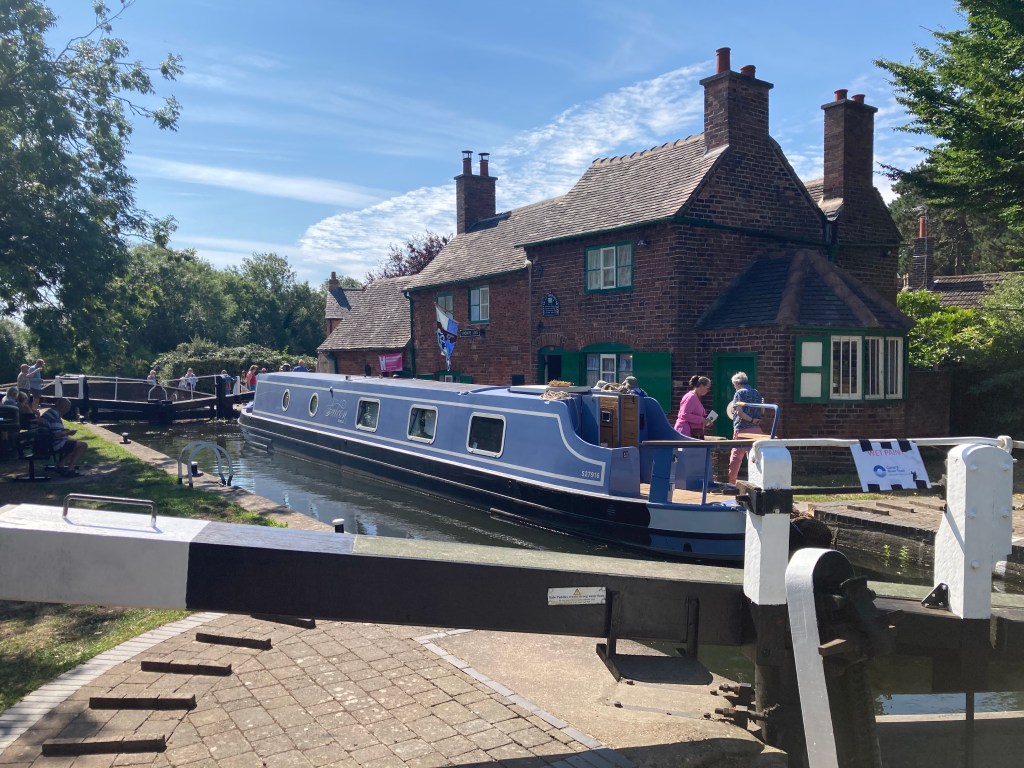
Tuesday 26 August 2025
Today we headed into Nottingham to wander around the city, sort out my locked UK bank account, and visit Nottingham Castle. We left the hotel around 10:30 and caught the local tram from Beeston into the city. The service itself is efficient, but I have to say the tram we were on felt like it was riding on square wheels. After the beautifully smooth trams we’d been spoiled with across Europe, this one was a bit of a jolt back to reality. Still, it got us where we needed to go, and we rolled into Market Square around 11:30.
First task of the day was the bank account, which—thankfully—we managed to resolve quite quickly with the help of the branch staff. With that sorted, we rewarded ourselves with a coffee and something to eat at Starbucks before taking a short walk up to Nottingham Castle.
Nottingham Castle
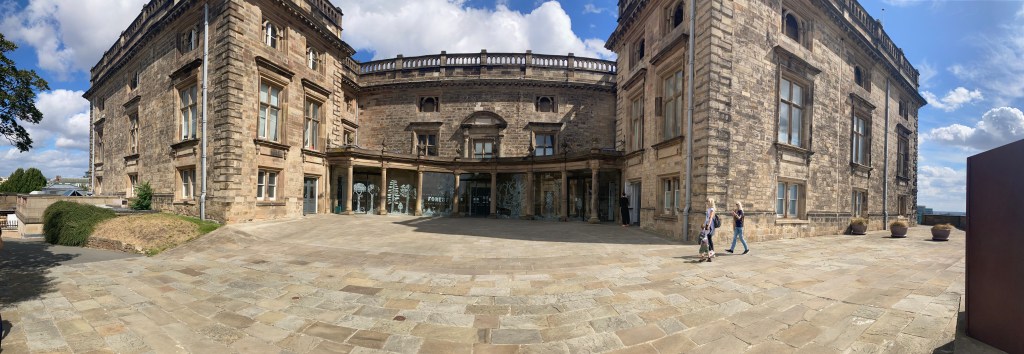
The first Norman castle on Castle Rock was a wooden structure of a motte-and-bailey design, begun in 1068, two years after the Battle of Hastings, on the orders of William the Conqueror. This wooden structure was replaced by a far more defensible stone castle during the reign of King Henry II, of an imposing and complex architectural design, which eventually comprised an upper bailey at the highest point of the castle rock, a middle bailey to the north containing the main royal apartments, and a large outer bailey to the east.
The first Norman stronghold on Castle Rock was a simple wooden motte‑and‑bailey fort, begun in 1068, just two years after the Battle of Hastings—on the orders of William the Conqueror. Its position was no accident: Castle Rock offered a natural defensive outcrop overlooking a key crossing of the River Trent.
During the reign of Henry II, the original timber fortification was replaced with a far more formidable stone castle. Over time it developed into an extensive complex, with an upper bailey crowning the highest point of the rock, a middle bailey housing the royal apartments, and a large outer bailey stretching eastward. For centuries, Nottingham Castle stood among the most important royal fortresses in England, valued not only for its strategic location but also for its proximity to royal hunting grounds in the Peak District, Barnsdale, and Sherwood. The castle even had its own deer park—an area still known today as The Park.
The castle also played a role in the political drama of the late 12th century. While King Richard the Lionheart was away on the Third Crusade, supporters of Prince John, including the Sheriff of Nottingham, took control of the fortress. This episode helped cement the castle’s place in the Robin Hood legends. In March 1194, shortly after Richard’s return to England, he besieged the castle using siege engines reminiscent of those he had seen on crusade. With the support of powerful allies, the fortress surrendered after only a few days.
Another dramatic moment unfolded here in 1330. Shortly before his eighteenth birthday, Edward III orchestrated a daring coup against his mother, Isabella of France, and her ally and lover, Roger Mortimer, who had been ruling as Regents during his minority. Guided by William Eland, the castle’s constable, Edward’s supporters entered the fortress through a secret tunnel and seized Mortimer in a nighttime raid. Mortimer was later executed, Isabella forced into retirement, and Edward’s personal reign began. The story was so striking that it inspired a later medieval chronicle, which imagined the caves beneath the castle as the work of Lancelot, carved to hide Guinevere from King Arthur—an early literary reference to their famous affair.
After absorbing all this history, we wandered the castle grounds, taking in the imposing exterior as we circled the site. When we finally stepped inside, we expected at least some of the traditional castle interior one usually finds in historic British fortresses. Although we knew it now functioned as a museum, we were still a little disappointed to discover that the interior has been fully modernised, with very little of the original structure visible. Even so, the historical information, especially the stories tied to the site, was genuinely fascinating.
From here we made our way around to Ye Olde Trip to Jerusalem pub. The inn famously claims to have been established in 1189, athough there’s no surviving documentation to prove the date, but it certainly looks the part. The building is set directly against Castle Rock, the same sandstone cliff that supports Nottingham Castle, and several of its rooms extend back into caves carved out of the soft rock. The result is a pub that feels partly built, partly excavated, and entirely steeped in centuries of local lore.
Ye Olde Trip to Jerusalem is one of several English pubs that lay claim to being the oldest in the country. Its famous founding date, 1189 AD, the year Richard the Lionheart ascended the throne and Pope Gregory VIII called for the Third Crusade, makes for a compelling story, but there is no surviving documentation to confirm that the pub itself existed at that time.
What is better supported is the long history of the caves behind it. Carved into the soft sandstone of Castle Rock, these chambers are believed to have been used as a brewhouse for Nottingham Castle and may date back to the castle’s earliest years, around 1067. Their cool, stable temperatures made them ideal for storing ale, and they form an integral part of the pub’s character today, rooms that feel more excavated than built.
The above-ground structure has a more traceable timeline. The oldest parts of the current building likely date from between 1650 and 1660, although an earlier building appears on John Speed’s 1610 map of Nottingham. By 1751, the premises were operating as an inn under the name The Pilgrim, a nod to the era’s fascination with travel, exploration, and perhaps the Crusader legends associated with the site.
Over the centuries, the pub has accumulated layers of folklore, tales of cursed objects, ghostly encounters, and soldiers drinking before departing for distant wars. Whether or not these stories hold any truth, they contribute to the atmosphere of a place that feels deeply rooted in Nottingham’s past. Today, Ye Olde Trip to Jerusalem remains a curious blend of myth, history, and sandstone caverns, offering visitors a pint with a side of centuries-old intrigue.
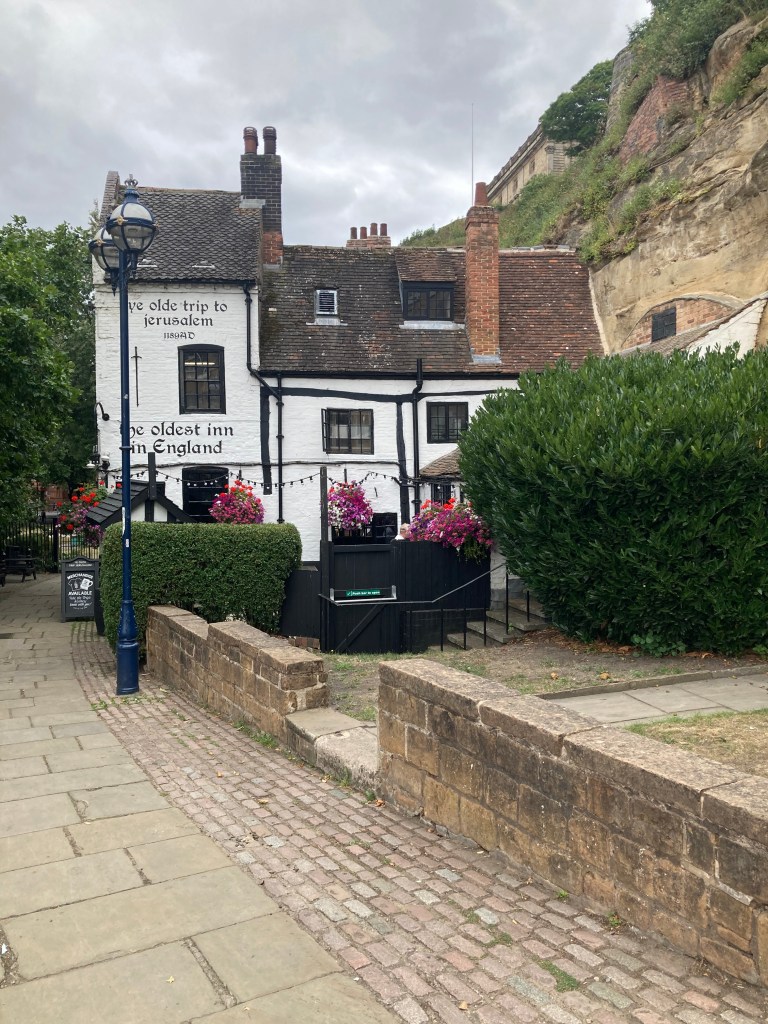
Maree and I stopped here for a local brew and took the following photos.
From here we made our way back to the city to catch the tram back to Beeston.
Tonight we’re meeting up with family for dinner at The Plough in Normanton‑on‑the‑Wolds.
The pub sits at the heart of this small, picturesque hamlet in South Nottinghamshire, a place surrounded by gently rolling countryside, farmland, and quiet lanes that still feel distinctly rural despite being only a short drive from the city.
Normanton‑on‑the‑Wolds itself is one of the county’s traditional agricultural settlements, with a history stretching back to the Domesday Book. Today it remains a peaceful village of stone cottages, leafy verges, and open fields, offering the kind of calm that feels a world away from Nottingham’s bustle.
The Plough has long been a focal point of village life. Known for its warm, traditional atmosphere, the pub blends the charm of an old country inn with a reputation for good food and friendly service. Its setting tucked among mature trees and surrounded by green space, adds to the sense that you’ve stepped into a classic English countryside scene. It’s the sort of place where locals gather, walkers stop in for a pint, and families come together for a relaxed meal.
All in all, a lovely spot for a family dinner in one of Nottinghamshire’s prettiest rural corners.
Following are some family photos taken during the evening.
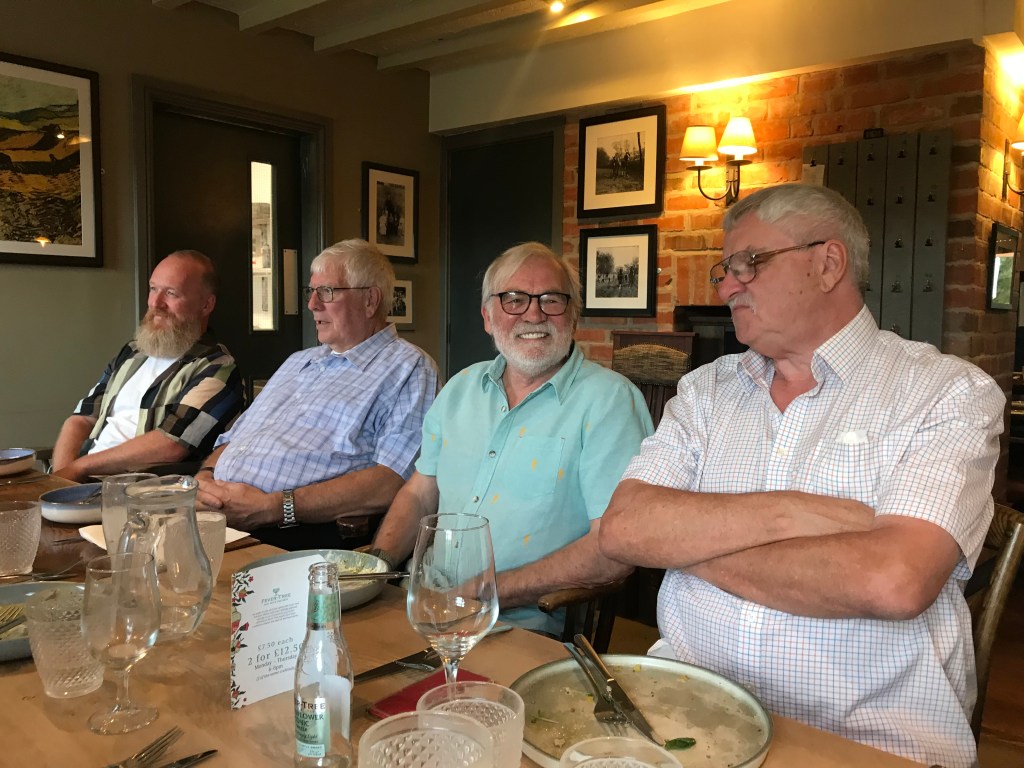
Wednesday 27 August 2025
Today we travelled from Beeston to Leicester for the day to visit the King Richard III Visitor Centre.
The King Richard III Visitor Centre in Leicester tells the remarkable story of King Richard III’s life, death, and the extraordinary rediscovery of his remains more than five centuries after his burial. For generations, the exact location of Richard’s grave had been uncertain, though local tradition suggested it lay somewhere beneath a Leicester car park. That unlikely rumour proved true in 2012, when archaeologists uncovered a skeleton beneath the tarmac, on the very first day of excavation. DNA testing, radiocarbon dating, and forensic analysis later confirmed the remains as those of the last Plantagenet king.
The Visitor Centre opened on 26 July 2014 on the site of the medieval Greyfriars friary, where Richard was hastily buried in 1485 after his death at the Battle of Bosworth Field. The centre occupies the former Alderman Newton’s School, a Victorian building standing beside the old Social Services car park where the king’s grave was found. Leicester City Council transformed the school into a museum in response to worldwide interest in the discovery, creating a purpose-built space that includes a glass-covered viewing area over the original grave site and a preserved section of the friary’s choir floor.
The story told inside the centre is inseparable from the dramatic events of the Battle of Bosworth, fought on 22 August 1485. This clash marked the final major battle of the Wars of the Roses, the long-running civil war between the houses of York and Lancaster. Richard III, leading the Yorkist cause, faced Henry Tudor, a Lancastrian claimant whose forces had landed in Wales earlier that month. Although Richard’s army outnumbered Henry’s, shifting loyalties on the battlefield proved decisive. The Stanley brothers, who had arrived with their own troops, held back until the crucial moment, then sided with Henry. Richard, seeing an opportunity to end the conflict by killing Henry directly, led a bold cavalry charge across the field. Cut off from his men, he was surrounded and killed, becoming the last English monarch to die in battle. Henry Tudor was crowned on the field, becoming Henry VII and founding the Tudor dynasty. Historians view Bosworth as the end of the Plantagenet line and one of the defining turning points in English history.
Richard’s reign had begun only two years earlier, in 1483. Across the Channel, Henry Tudor, whose Lancastrian claim was tenuous but politically useful, saw an opportunity. His first attempt to invade England failed in a storm, but his second, in 1485, succeeded. As Henry marched inland, support grew, while Richard struggled to consolidate loyalty among his nobles. When the two armies met near Ambion Hill in Leicestershire, the fate of the crown hung on the decisions of a few powerful men.
One of the most intriguing details we learned at the Visitor Centre was Henry VII’s clever legal manoeuvre after the battle. He backdated the start of his reign to 21 August 148, the day before Bosworth, so that anyone who had fought for Richard could be declared a traitor. This allowed Henry to seize lands and titles, strengthening his new regime and rewarding his supporters.
The Visitor Centre brings all of this together: the medieval politics, the battlefield drama, the centuries of uncertainty, and the astonishing archaeological detective work that finally brought Richard III back into the light. It’s a rare place where history, science, and storytelling meet in a way that feels both grounded and genuinely captivating.
Photos taken at the museum.
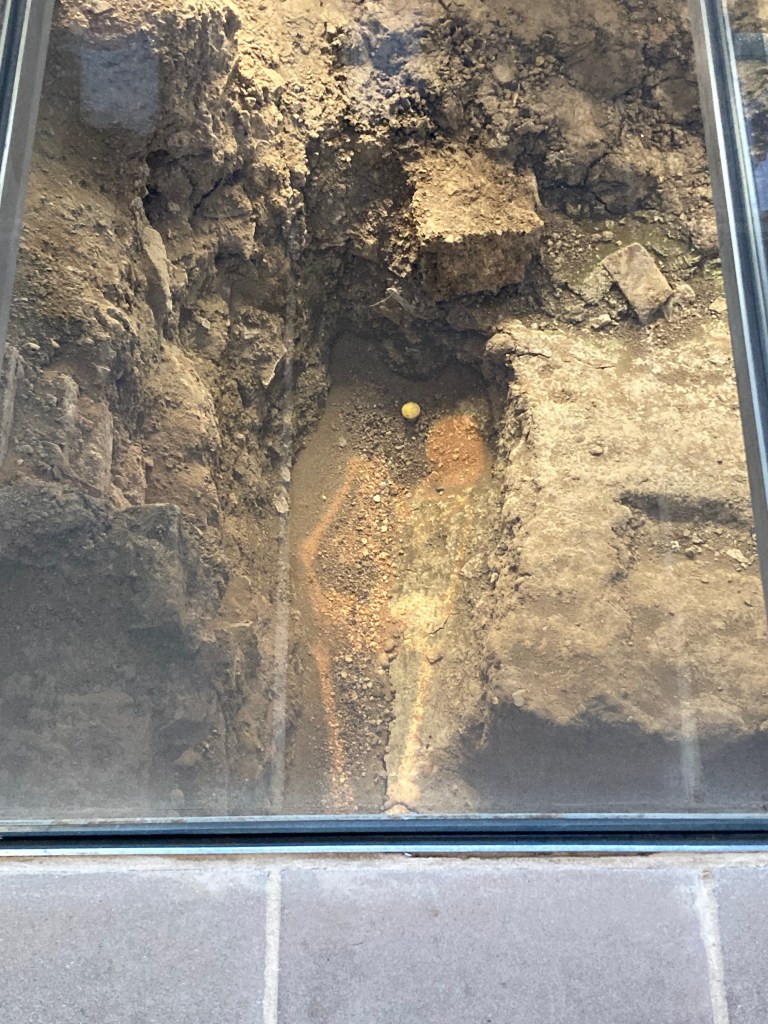
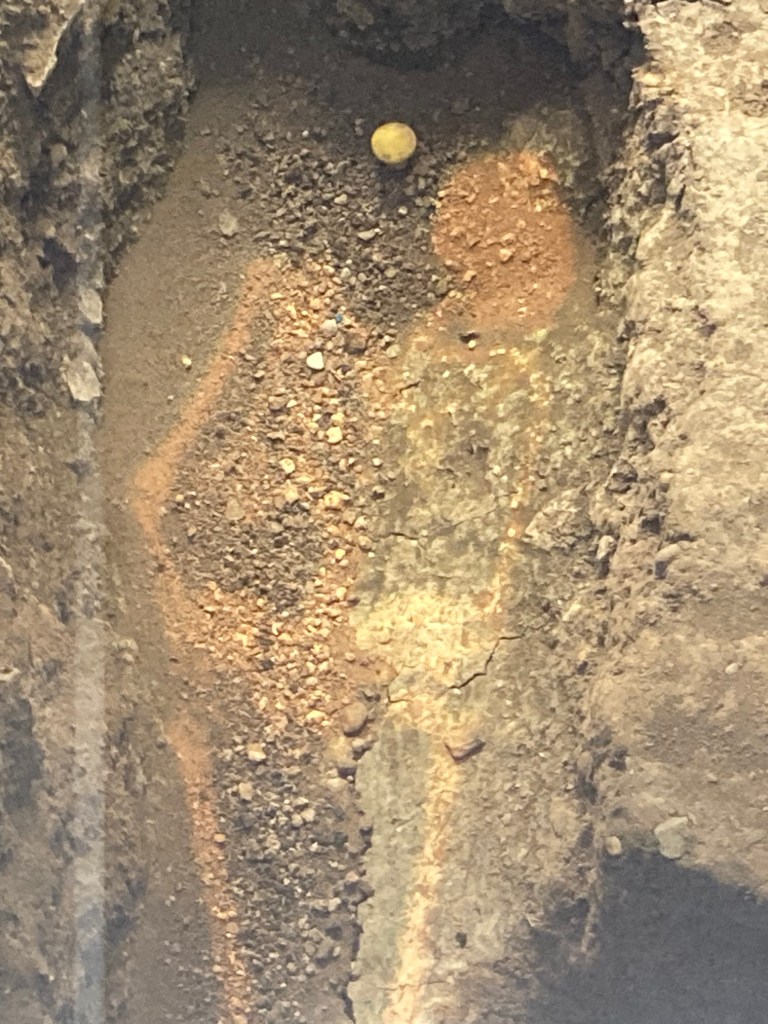
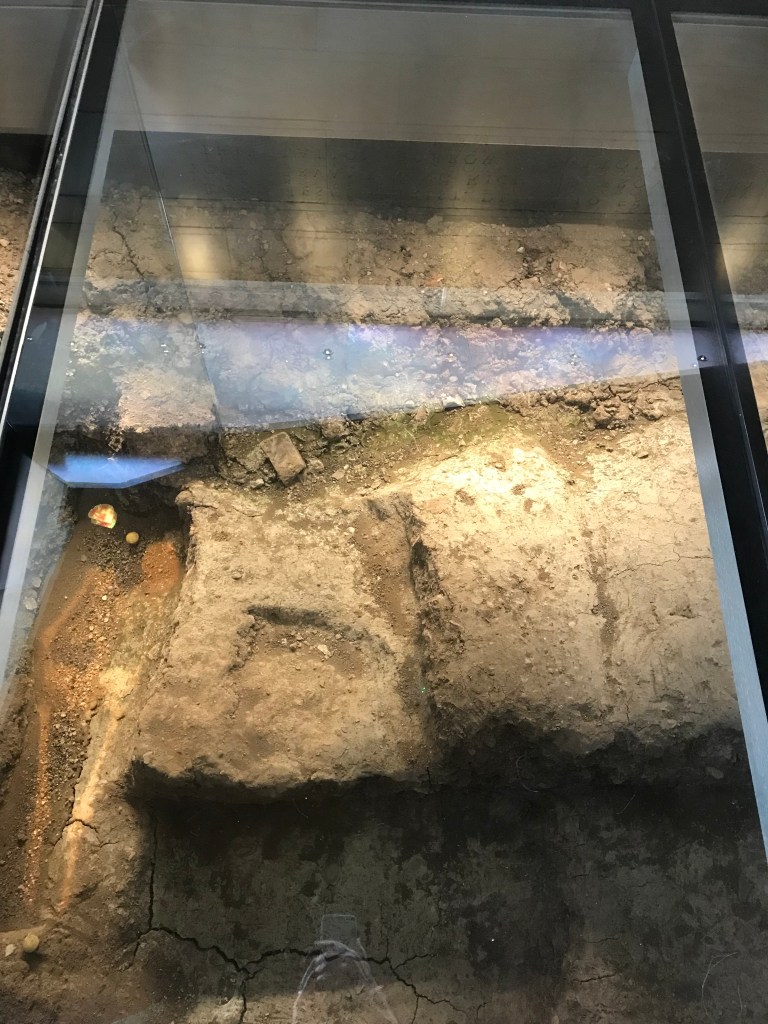
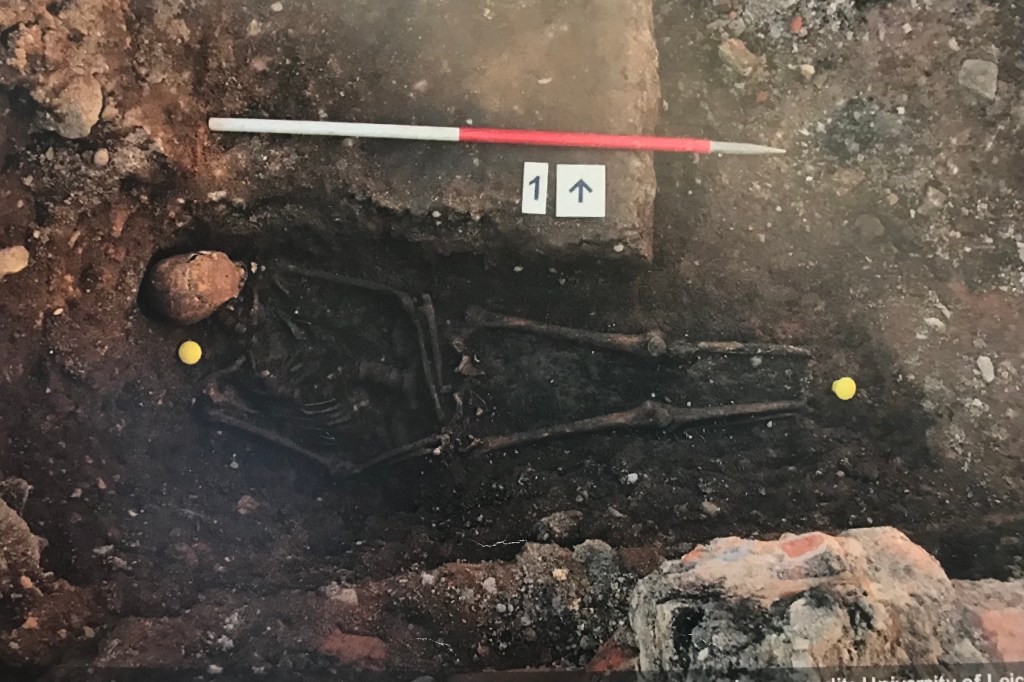
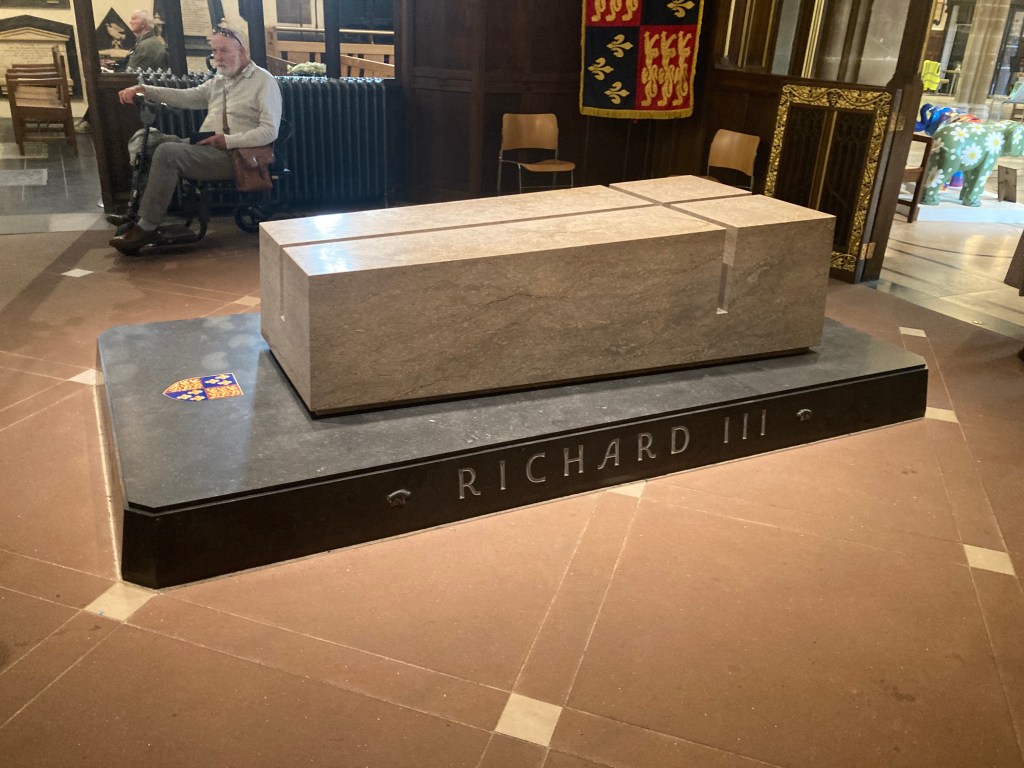
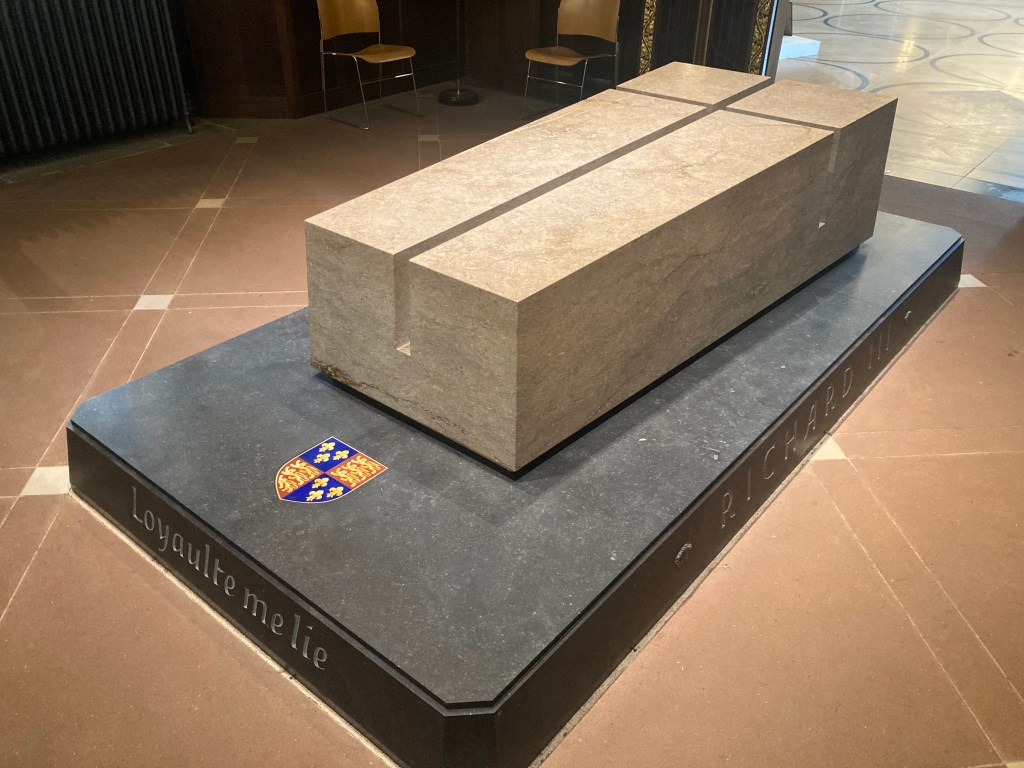
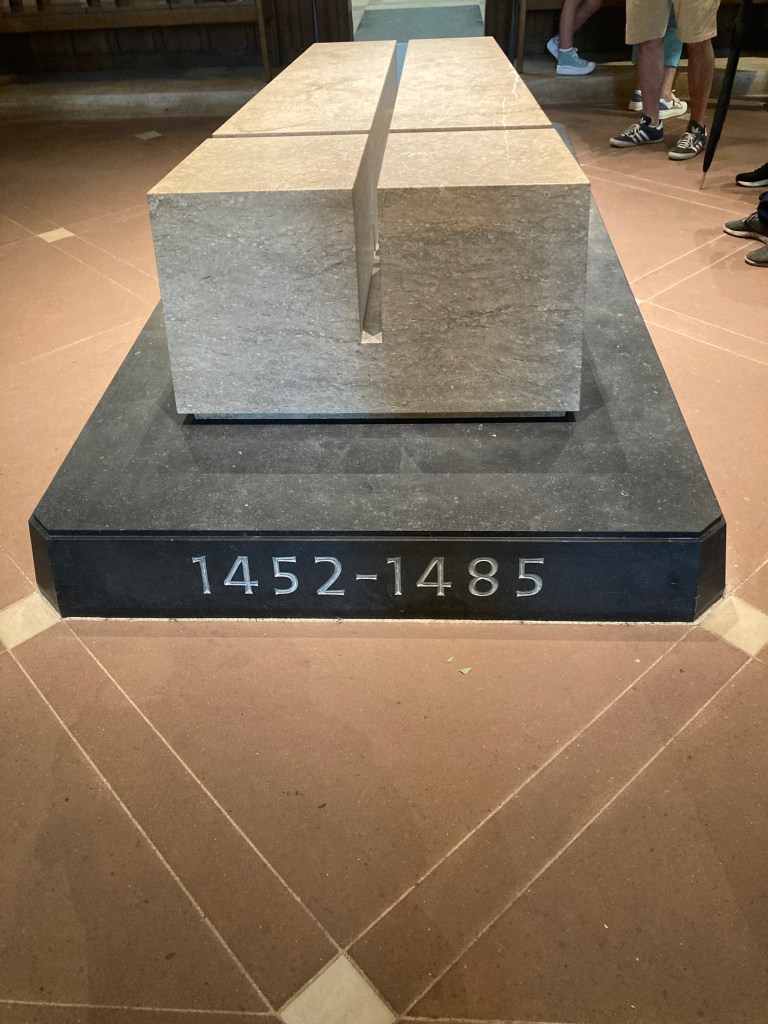
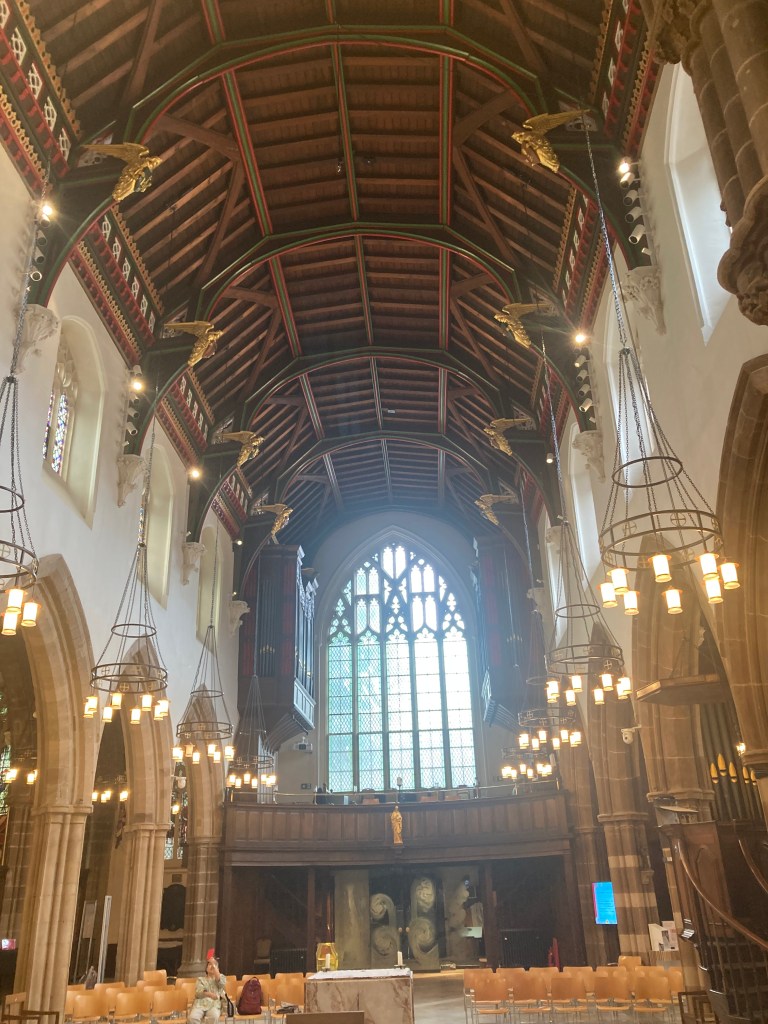
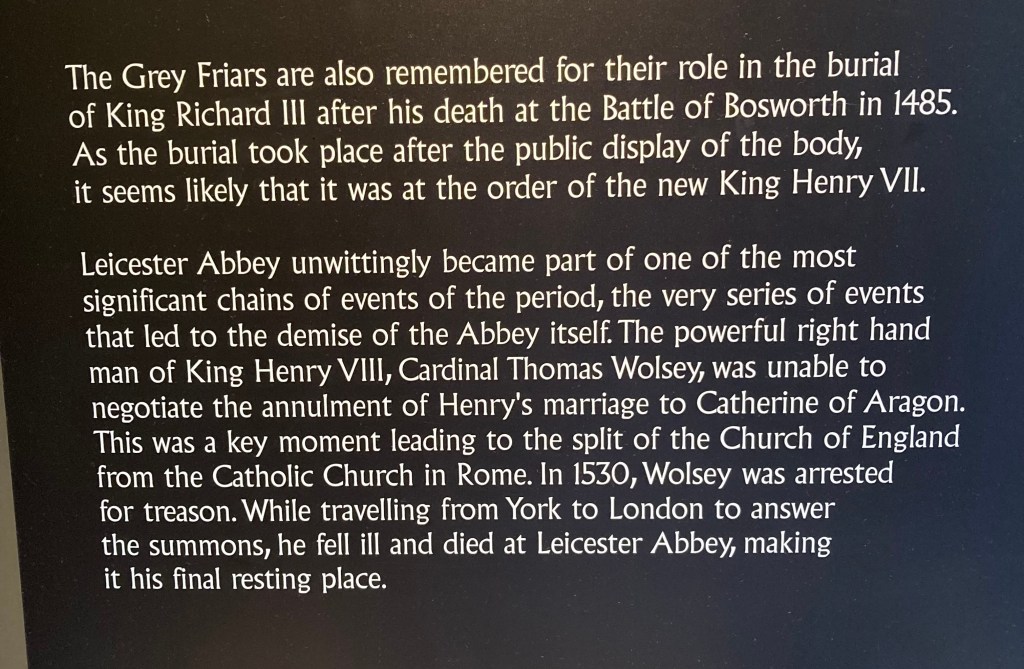
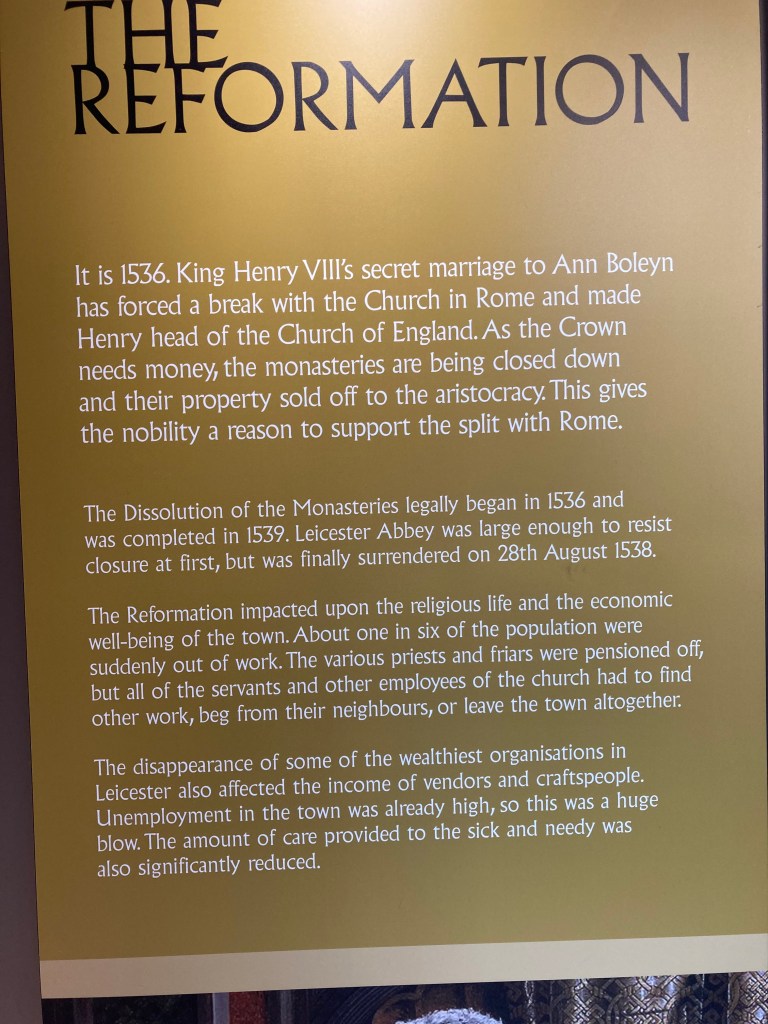
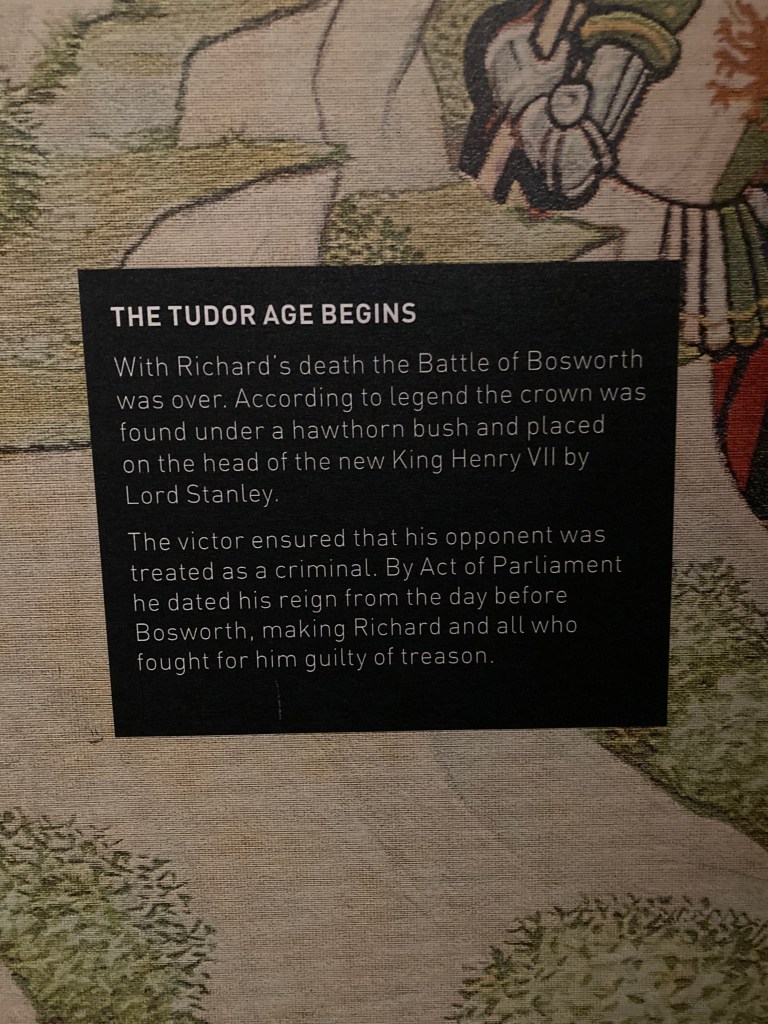
Thursday 28 August 2025
Today was a much‑needed rest day. Maree and I spent the day with family, taking things slowly and enjoying the chance to unwind. No schedules, no rushing—just good company, easy conversation, and a welcome pause in the middle of our travels.
Friday 29 August 2025
Today we visited my cousin Brian, who had kindly arranged an outing for us to Newstead Abbey, joined by his wife Liz and my other cousin Maureen. The trip took us through the northern reaches of Nottinghamshire, an area known for its mix of quiet villages, wooded estates, and stretches of open countryside. Newstead sits just outside Ravenshead, a leafy, well‑kept community surrounded by parkland and historic estates that once formed part of the old Sherwood Forest landscape. The drive itself offered a glimpse of this rural character, tree‑lined roads, pockets of farmland, and the gentle rise and fall of the Nottinghamshire countryside, setting the scene nicely for our visit together.
Newstead Abbey, in Nottinghamshire, began life as an Augustinian priory before the Dissolution of the Monasteries transformed it into a private estate. Today it is best known as the ancestral home of the poet Lord Byron, whose association with the house has shaped much of its romantic reputation.
Byron first arrived at Newstead at the age of ten, inheriting both the title and the estate unexpectedly. The grandeur of the property made a deep impression on him, feeding his sense of drama and personal destiny. Yet the reality was far less glamorous: the estate’s income had dwindled to around £800 a year, and the buildings were in serious disrepair. Byron and his mother soon moved to nearby Southwell, and although he returned to Newstead at intervals, he never lived there permanently for long. The decaying abbey became, in his imagination, a symbol of his family’s decline, an image that would echo through his poetry and personal mythology.
One of the most poignant stories connected with Newstead is that of Boatswain, Byron’s beloved Newfoundland dog. When Boatswain died of rabies in 1808, Byron commissioned an elaborate monument for him on the grounds, larger than the poet’s own eventual memorial. The inscription, taken from Byron’s Epitaph to a Dog, remains one of his most famous works. Byron even wished to be buried beside Boatswain, though he was ultimately interred in the family vault at St Mary Magdalene’s Church in Hucknall.
The poem Epitaph to a Dog as inscribed on Boatswain’s monument
Financial troubles plagued Byron throughout his early adulthood. He hoped to raise a mortgage on Newstead to keep it, but his adviser John Hanson urged him to sell. The estate became a constant source of anxiety, especially after Byron left for his Mediterranean travels in 1809. When he returned to England in 1811, he stayed in London rather than at Newstead, and his mother, who had been living at the abbey, died before he saw her again, a loss that weighed heavily on him.
Byron made repeated attempts to sell the estate. An auction in 1812 failed to reach a suitable price, though a private buyer later offered £140,000. The sale collapsed when the buyer, Thomas Claughton, failed to pay the agreed deposit in full. Byron, already in debt and having spent money in anticipation of the sale, was left in an even more precarious position. By 1814, the deal had fallen apart entirely, and Claughton forfeited the small amount he had paid.
Later in life, Byron’s path took him far from Nottinghamshire. He joined the Greek War of Independence, becoming a national hero for his support of the Greek cause. He died in 1824 at the age of 36, succumbing to fever during the sieges of Missolonghi. His early death only deepened the aura of romantic tragedy that surrounds both the poet and Newstead Abbey.
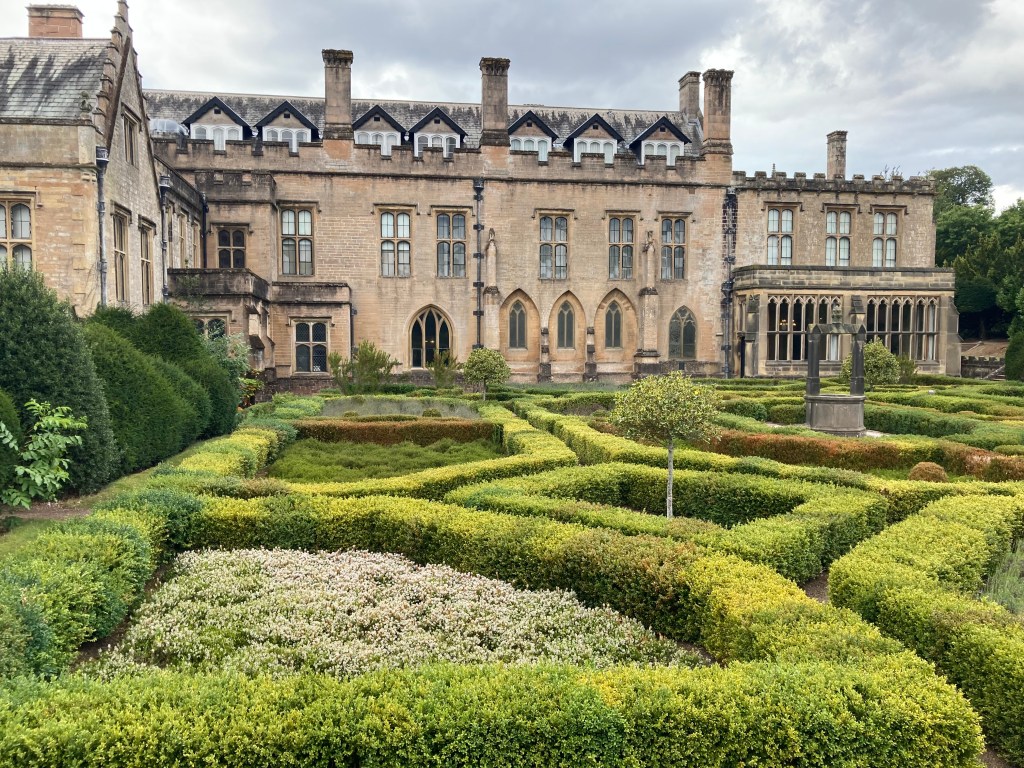
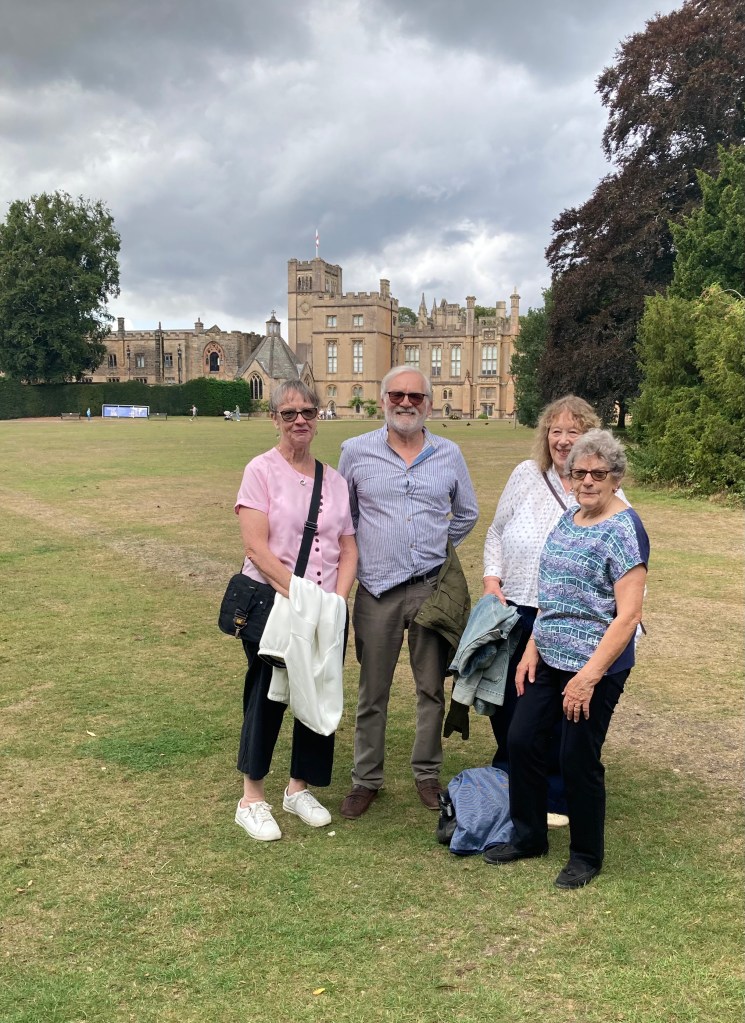
Today, the estate stands as a place where layers of history, monastic, aristocratic, literary, and personal, intertwine, offering a vivid glimpse into the world that shaped one of England’s most iconic poets.
Tomorrow we leave Nottingham for Murthly, Scotland.
Saturday 30 August 2025
We left Beeston early this morning, pulling out around 07:00 for the long drive to Murthly in Scotland. The route up the M6 covers about 565 kilometres, roughly the distance from Canberra to Hay, plus another 60 kilometres for good measure, so it’s a solid day on the road. Much of the journey runs through built‑up areas at either end, but once you settle into the M6 proper, the landscape gradually opens out and the scenery becomes far more enjoyable.
We broke the trip halfway at Tebay Services, a stop that has become something of a legend among regular travellers on the M6. Unlike the usual motorway service stations, Tebay is independently run and sits in the middle of the Cumbrian hills, surrounded by farmland and sweeping views. It’s known for its farm shop, local produce, proper food, and the feeling that you’ve stepped into a countryside retreat rather than a motorway pit stop. Most people heading north or south make a point of stopping there, it’s almost a rite of passage on the drive to Scotland. After stretching our legs and enjoying some refreshments, we were ready for the final leg.
From there, the journey continued smoothly, and by mid‑afternoon we arrived at our home for the next eight days. We’re staying with my cousin for this last stretch of our European holiday, a chance to slow down, spend time with family, and enjoy a gentler pace after weeks of travel.
My cousin’s apartment is lovely, with views that make you pause for a moment before you even take your shoes off. My favourite room is the kitchen; she’s clearly put a lot of thought into the design, and the layout is so practical and versatile that I found myself quietly taking mental notes. The lounge and the snug are equally inviting, warm, comfortable spaces that make you feel instantly at home. Honestly, I could live here very happily. Sell up in Canberra and retire to a place like this in Scotland… it’s a tempting thought.
Sunday 31 August to 7 September 2025
As we are spending time with family in Scotland, I’ll only update the blog if we travel around the local area of Perthshire and the information will be of interest to you all. After we leave Murthly on 8 September, we will be starting our travel home, arriving in Canberra on 15 September.
A little background on the village of Murthly.
Murthly: A Quiet Corner of Highland Perthshire
Murthly is a small village in Highland Perthshire, tucked between the River Tay and the rolling farmland that stretches north toward Dunkeld. It’s the kind of place many travellers pass without realising what they’re missing: a peaceful rural community with deep historical roots and a landscape that feels unmistakably Scottish.
Although modest in size, Murthly has been settled for centuries. The surrounding area is dotted with archaeological traces of early habitation, and the village itself grew around farming estates and the old coaching routes that once linked Perth to the Highlands. Today, it sits just off the A9, offering easy access to both Perth and the Cairngorms, yet it retains a sense of quiet seclusion.
One of the most striking features of the village is its setting. Murthly is surrounded by woodlands, open fields, and gentle hills that shift in colour with the seasons — bright green in spring, golden in summer, and rich with autumn reds and browns. The River Tay flows nearby, bringing with it salmon, otters, and the occasional heron gliding low over the water. Walkers and cyclists often use the local paths to explore the countryside, where you can wander for hours and meet little more than a few sheep and the occasional dog walker.
The village also has a long association with the Murthly Estate, whose lands have shaped the area for generations. While the estate itself is private, its influence is visible in the old stone buildings, tree‑lined lanes, and the sense of order and history that still lingers in the landscape.
Despite its rural calm, Murthly has a friendly, lived‑in feel. Locals know each other by name, and the pace of life is unhurried. It’s the sort of place where you can hear birdsong more clearly than traffic, and where the sky seems just a little bigger than it does elsewhere.
For visitors, Murthly offers a gentle pause — a chance to slow down, breathe in the Highland air, and enjoy the quieter side of Scotland. Whether you’re staying with family, exploring the countryside, or simply passing through, the village has a way of making you feel welcome without ever demanding your attention. It’s understated, authentic, and quietly beautiful.
A small place, yes — but one with a big sense of peace.
Monday 1 September 2025
Today we travelled down to the small town of Falkirk, set in Scotland’s Central Lowlands between Edinburgh and Glasgow. Falkirk has long been a crossroads of Scottish history, from Roman frontier defences to industrial‑era engineering, and today it’s equally known for its bold modern landmarks, including the Kelpies and the Falkirk Wheel.
Our first stop was the Falkirk Wheel, and it’s hard not to be impressed as you approach it. Rising out of the landscape like a piece of futuristic sculpture, the Wheel is the world’s only rotating boat lift, a feat of engineering that manages to look both elegant and improbable at the same time. Its sweeping, curved arms have been compared to Celtic double‑headed axes, a giant propeller, or even the ribs of a mythical creature. Whatever image comes to mind, it’s unmistakably striking.
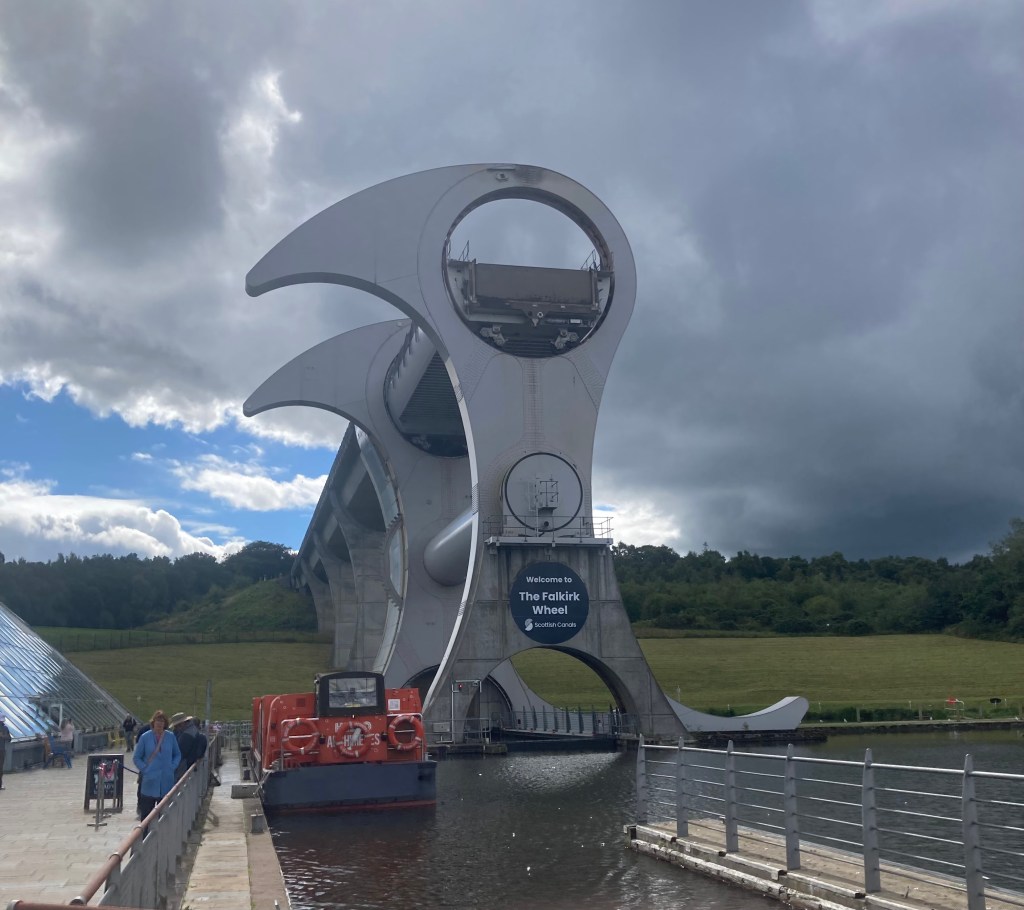
The Wheel was built as part of the Millennium Link project, an ambitious effort to reconnect Scotland’s historic canal network after decades of decline. Before the Wheel existed, boats had to navigate a laborious flight of 11 locks to travel between the lower Forth & Clyde Canal and the higher Union Canal. That journey took almost a full day. The Falkirk Wheel now completes the same 24‑metre elevation change in just a few minutes, using remarkably little energy, roughly the equivalent of boiling eight kettles, thanks to its perfectly balanced design.
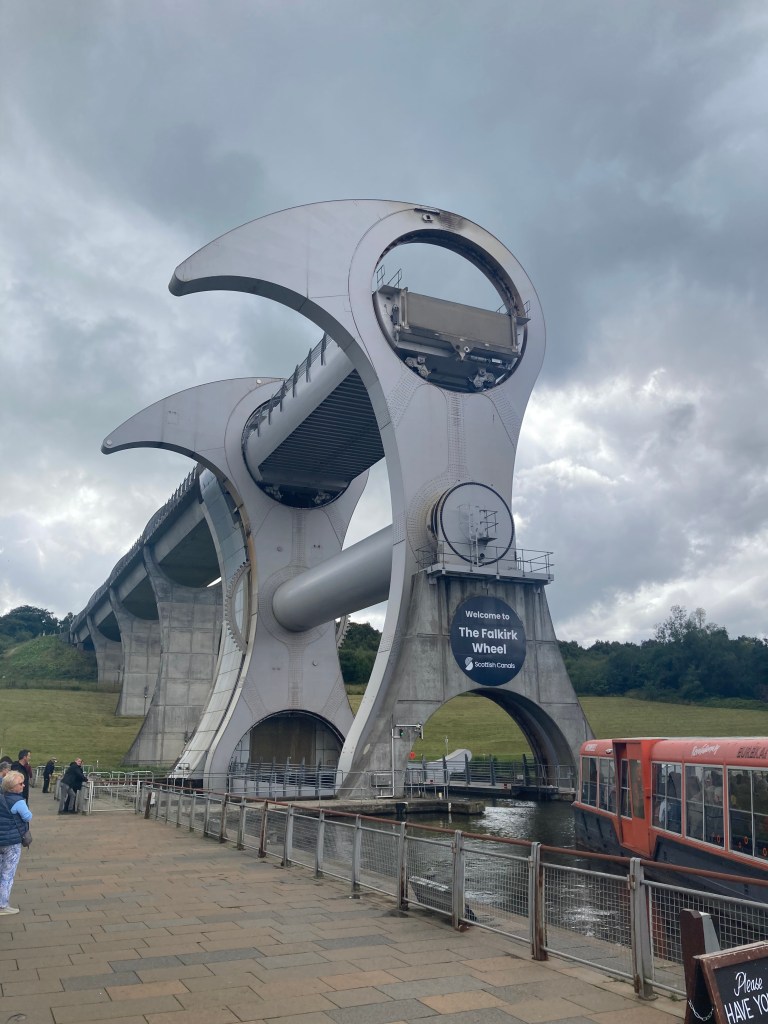
Scottish Canals, who own and maintain the structure, run boat trips that allow visitors to experience the Wheel in motion. Maree, Maggie, and Brian joined the one‑hour tour, gliding from the lower basin into the Wheel’s gondola before being lifted smoothly to the upper aqueduct. From there, the boat made a short journey along the Union Canal before returning via the Wheel to the basin below. I stayed behind to focus on photography, and honestly, watching the Wheel rotate from the outside is just as captivating as riding it.
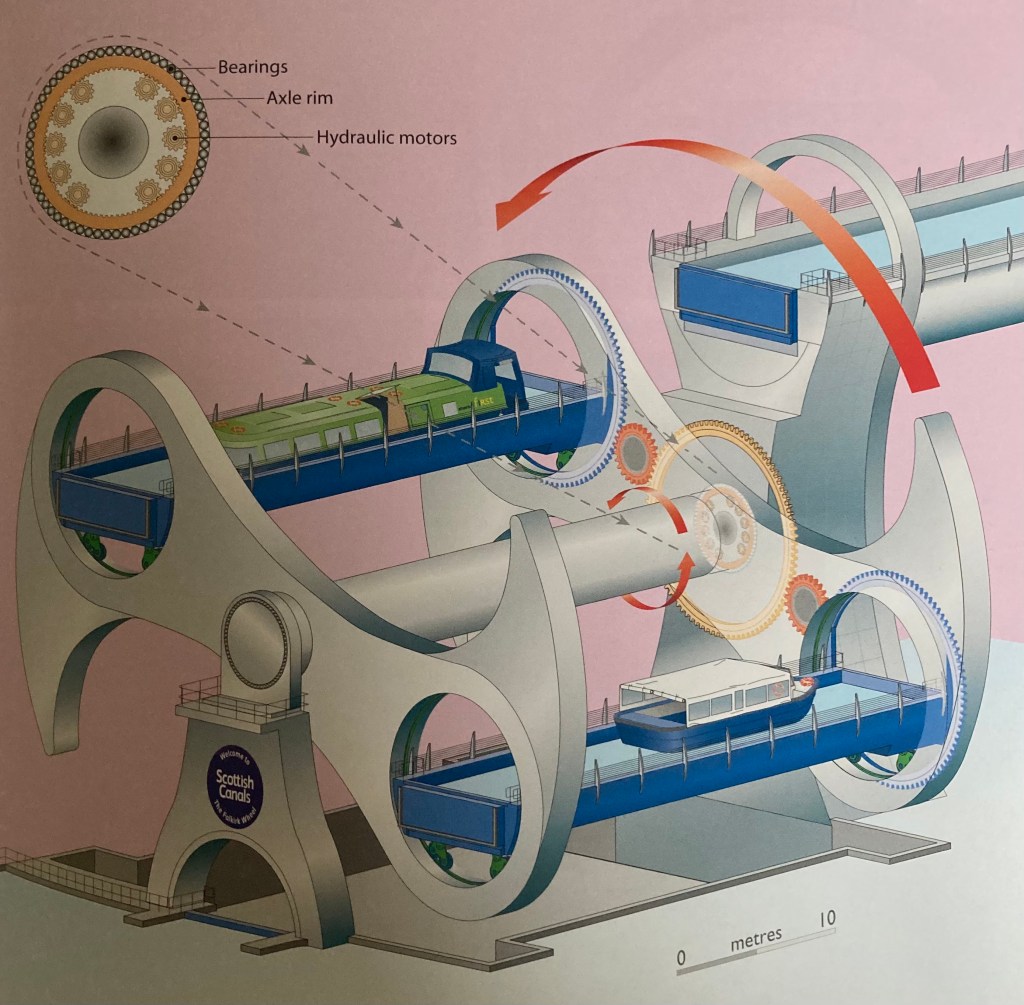
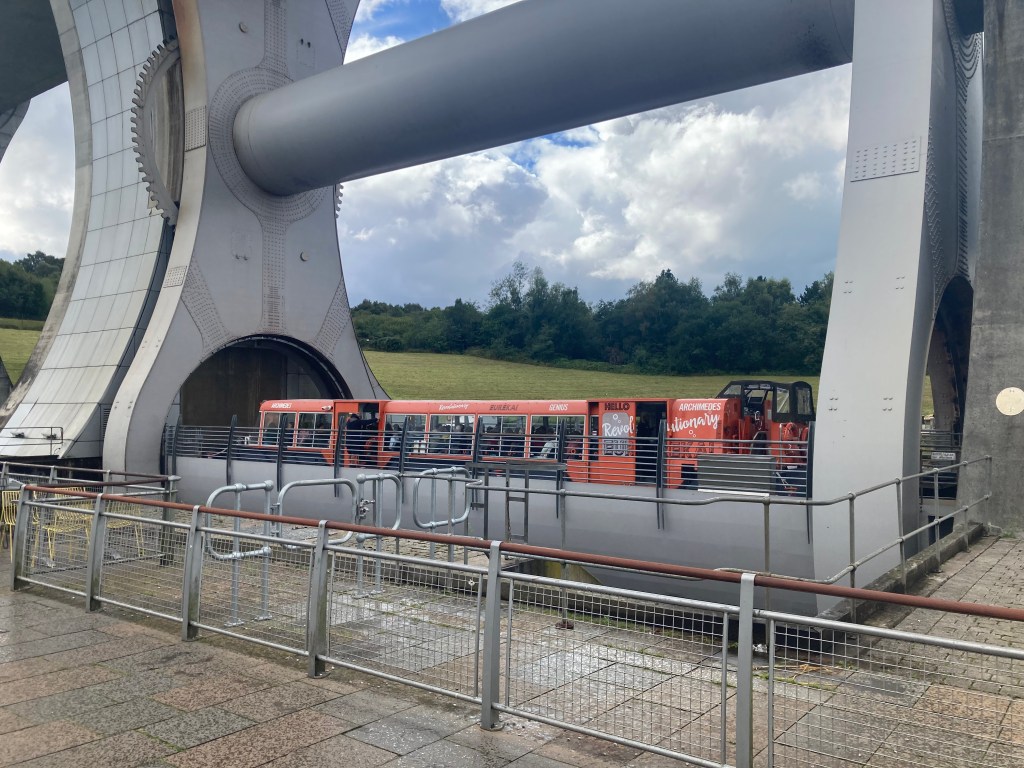
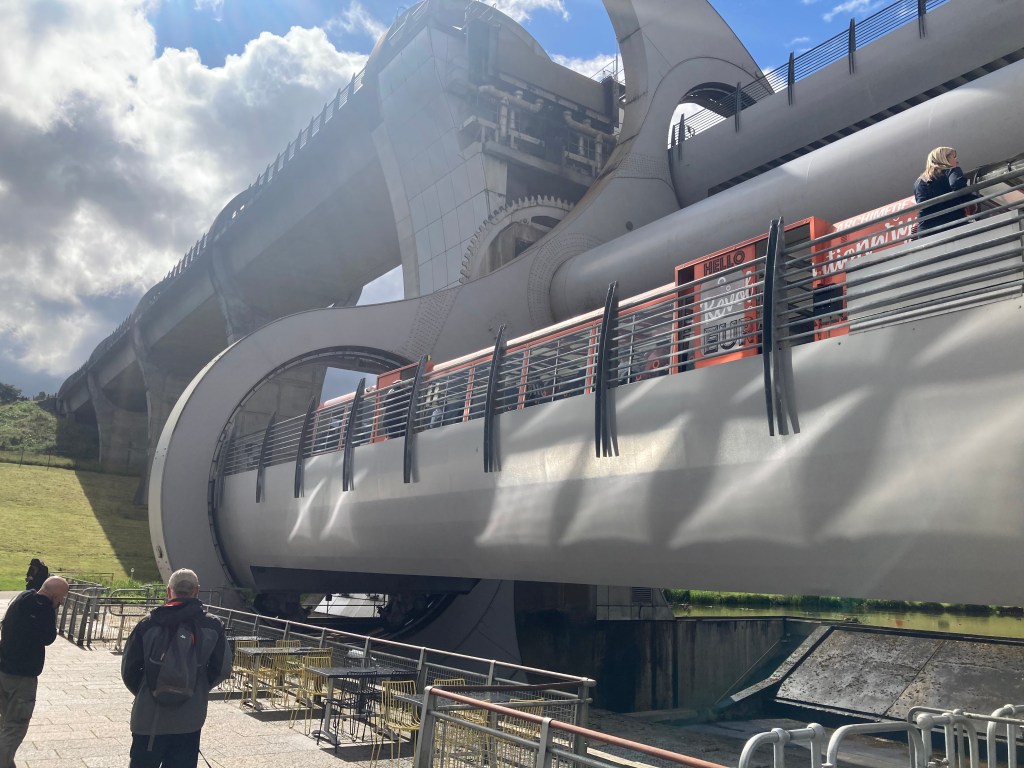
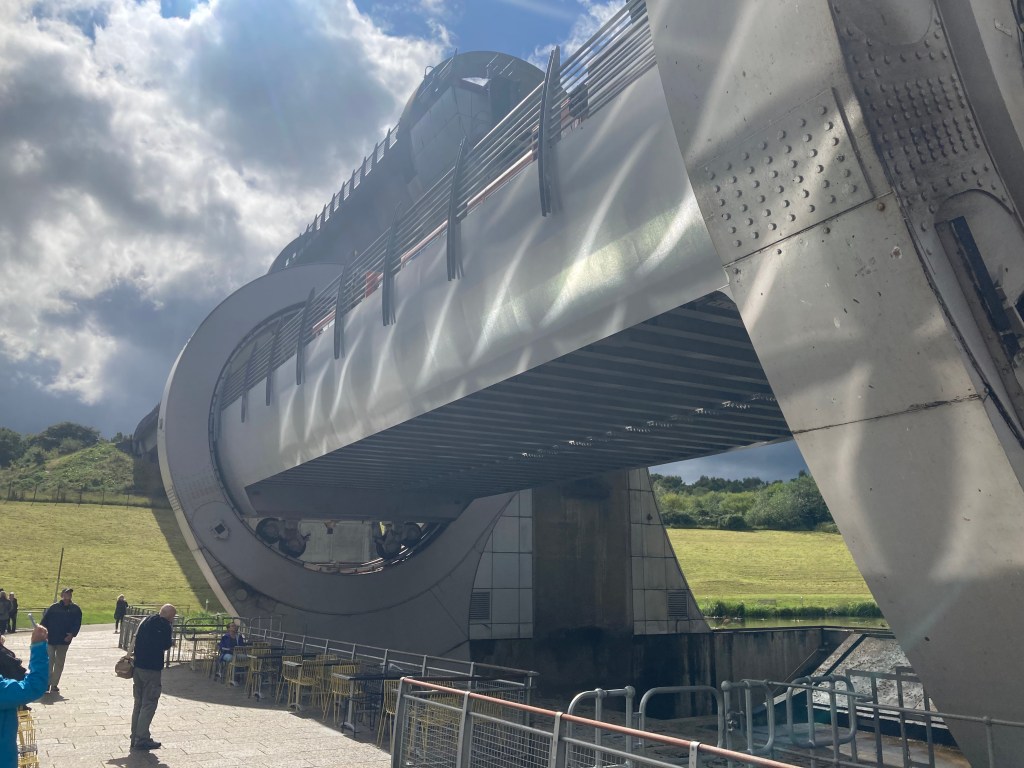
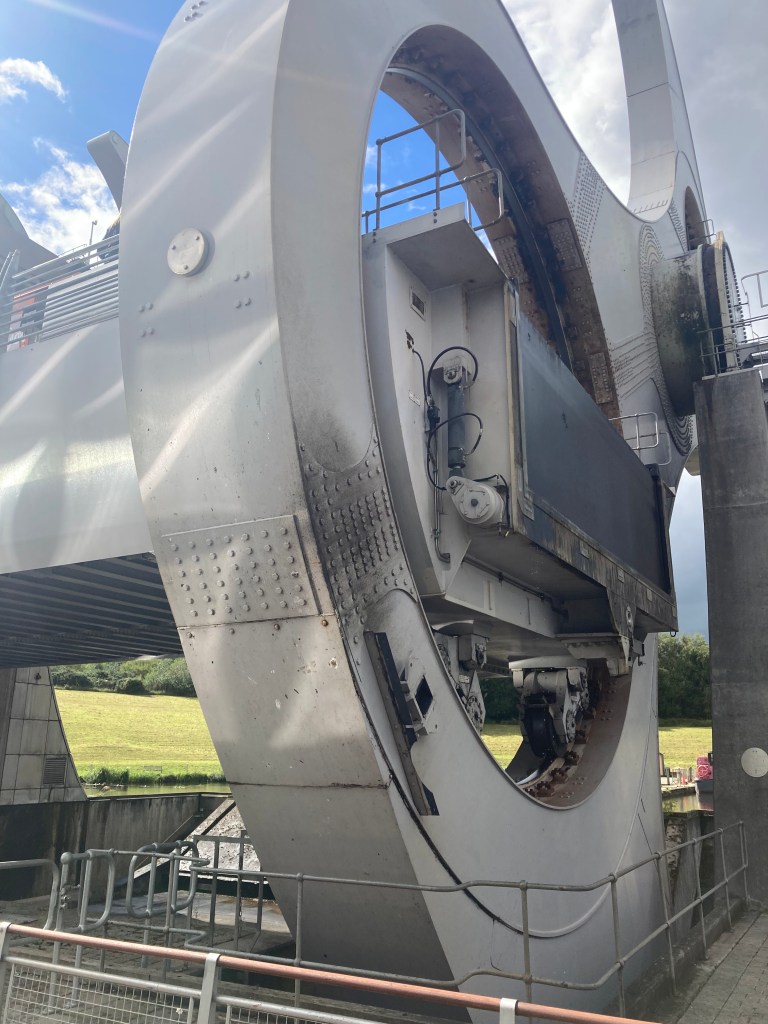
Following are three short videos of the Falkirk Wheel.
Falkirk itself has plenty more to offer, including the nearby Kelpies, the largest equine sculptures in the world, and remnants of the Antonine Wall, the northernmost frontier of the Roman Empire. But the Wheel remains one of Scotland’s most imaginative modern achievements, blending art, engineering, and a touch of theatricality into something that feels both practical and magical.
A memorable stop on our journey, and a reminder that Scotland’s innovation didn’t end with castles and clans, it continues to turn, quite literally, into the present day.
After spending time with the Falkirk Wheel, we headed to the next destination, The Kelpies.
The Kelpies, as these towering sculptures are known, stand as guardians of the canal, inspired by the mythical Celtic water horses said to haunt Scotland’s lochs and rivers. Rising 30 metres into the air, these vast, shimmering horse heads have become one of the most recognisable modern landmarks in the country.
Set beside the Forth & Clyde Canal on the edge of Falkirk, the Kelpies form the centrepiece of The Helix, an ambitious urban parkland project designed to connect local communities with the surrounding landscape. Created by sculptor Andy Scott and completed in 2013, the Kelpies were conceived not only as tributes to folklore but also as a celebration of Scotland’s industrial heritage. Their gleaming steel forms echo the strength and endurance of the heavy horses that once powered the nation, hauling barges along the canals, ploughing fields, and working in foundries and factories.
Each sculpture is made from a lattice of 500 individually shaped steel plates, giving the surface a semi‑translucent quality that catches and reflects the shifting Scottish light. Up close, the scale is astonishing: the hollow interiors soar above you like cathedrals of metal, and the horses’ expressions, one calm, one dynamic, seem almost alive.
Standing on either side of a modern lock, the Kelpies mark the eastern gateway to Scotland’s canal network, a dramatic, almost theatrical welcome for those travelling by water or exploring the park on foot. Whether viewed from a distance or admired up close, they command attention, capturing the imagination just as the old stories of water horses once did.
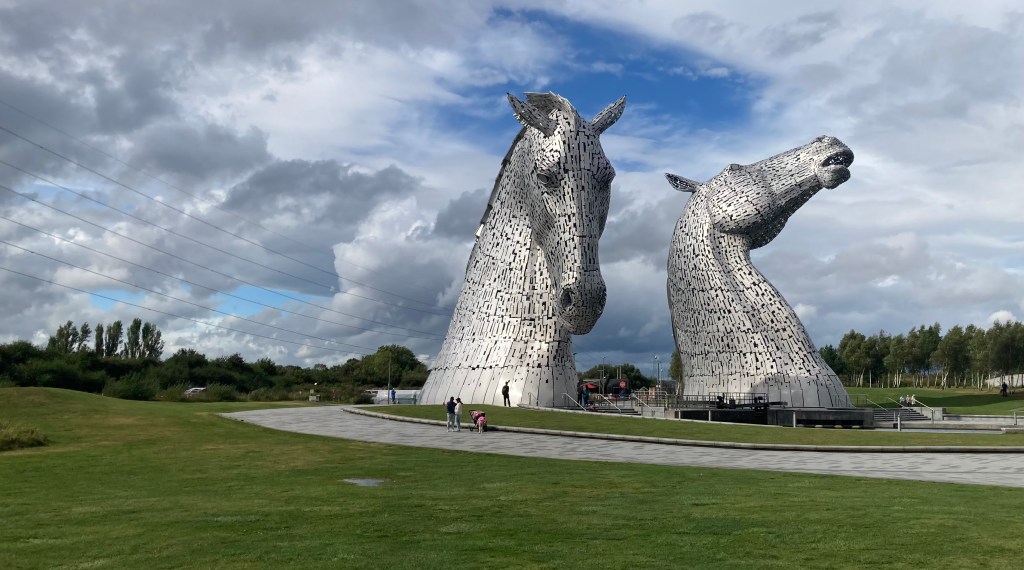
Although inspired by mythical kelpies, these sculptures also serve as a reminder of the real working horses that shaped the canal era. Before mechanisation, towpath horses were the engines of Scotland’s waterways, pulling heavy barges for miles at a steady, dependable pace. Scott’s design blends this history with legend, creating a pair of monuments that feel both ancient and futuristic.
A striking fusion of art, engineering, mythology, and memory, the Kelpies have quickly become a symbol of modern Scotland, bold, creative, and deeply rooted in its past.
Tuesday 2 September 2025
Today we headed to the small town of Dunkeld for lunch, a place that feels like a gateway between two very different Scotlands.
Dunkeld sits in Perth and Kinross on the north bank of the River Tay, directly opposite Birnam. Its position is no accident: the town lies almost exactly on the Highland Boundary Fault, the great geological line that separates the rolling Lowlands from the rugged Highlands. Because of this, Dunkeld is often described as the “Gateway to the Highlands,” a title it earns not only through geography but also through the dramatic shift in landscape that begins here. Travelling north, the gentle farmland gives way to steeper hills, deep glens, and the wilder scenery that defines the Highlands.
The Highland Boundary Fault itself is a major geological feature stretching from Arran and Helensburgh on the west coast all the way to Stonehaven in the east. It marks the meeting point of two ancient landmasses, and the contrast is visible even to the untrained eye: softer, lower terrain to the south; rugged, uplifted ground to the north. Where rivers cross the fault, they often carve out gorges and waterfalls, natural obstacles that once hindered salmon migration and shaped the ecology of the region. The fault’s dramatic uplift is thought to have occurred during the Acadian orogeny, the same geological forces that helped form the Grampian Mountains.
Dunkeld itself is one of Scotland’s most complete 18th‑century towns. After being heavily damaged during the Battle of Dunkeld in 1689, the town was rebuilt, and many of its rough‑cast vernacular buildings have since been carefully restored by the National Trust for Scotland. The layout of the old town forms a distinctive Y‑shaped pattern: High Street slopes down toward The Cross, the traditional market place. Where the original mercat cross once stood, you’ll now find the Atholl Memorial Fountain, a neo‑Gothic structure built in 1866 to honour George Murray, the 6th Duke of Atholl. The fountain is rich in heraldic and Masonic symbolism, fitting, given that the Duke served as Grand Master of the Grand Lodge of Scotland for over two decades.
Dunkeld’s influence stretches far beyond Scotland. The Victorian‑era town of Dunkeld in Australia was named by early Scottish settlers after this very place. Even the Australian “Grampians” borrowed their name from the Scottish range, though the region is now more commonly known by its Aboriginal name, Gariwerd. Still, the Scottish connection remains strong in local identity and heritage.
After exploring the town, we found a wonderful café on the main street — Palmerstons Coffee. It ticked every box: excellent food, great coffee, warm service, and music that set just the right mood. The place was buzzing with locals and visitors drifting in and out throughout the long lunch period, and it’s easy to see why. Highly recommended if you ever find yourself in Dunkeld.
A simple lunch stop, but in a town layered with history, geology, and charm.
Friday 5 September 2025
I thought I’d pause for a moment and show you the travel route we’ve covered so far on this trip. The digital Eurail Pass includes a map that tracks each of our rail journeys, and I thought you might enjoy seeing our route laid out visually.
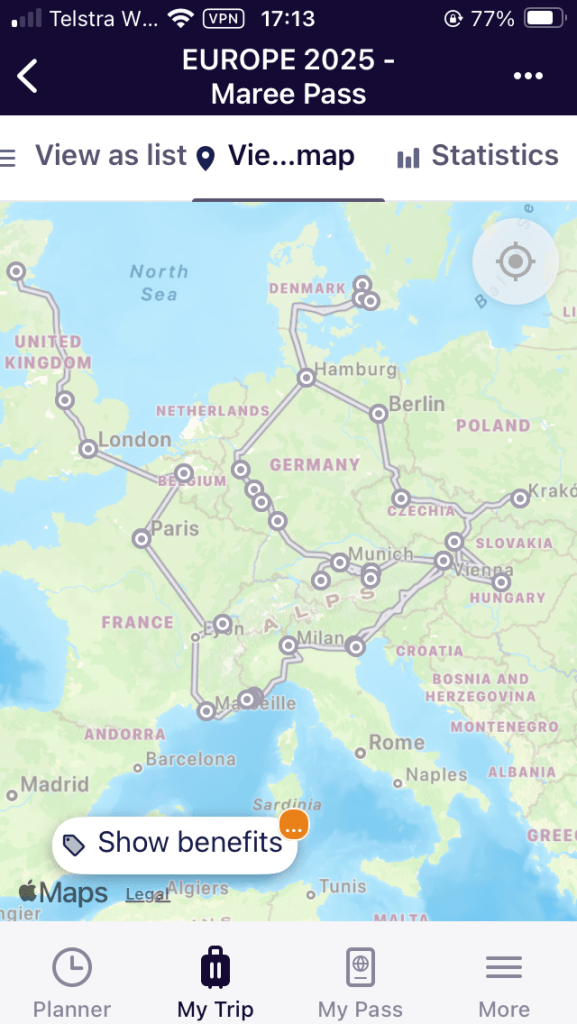
The pass gave us unlimited flexibility: no need to buy individual tickets, no stress about fluctuating prices, and the freedom to hop on trains across multiple countries without worrying about the cost each time. When you’re covering long distances or moving frequently from city to city, those savings add up quickly.
For us, Eurail wasn’t just convenient — it was a clear winner.
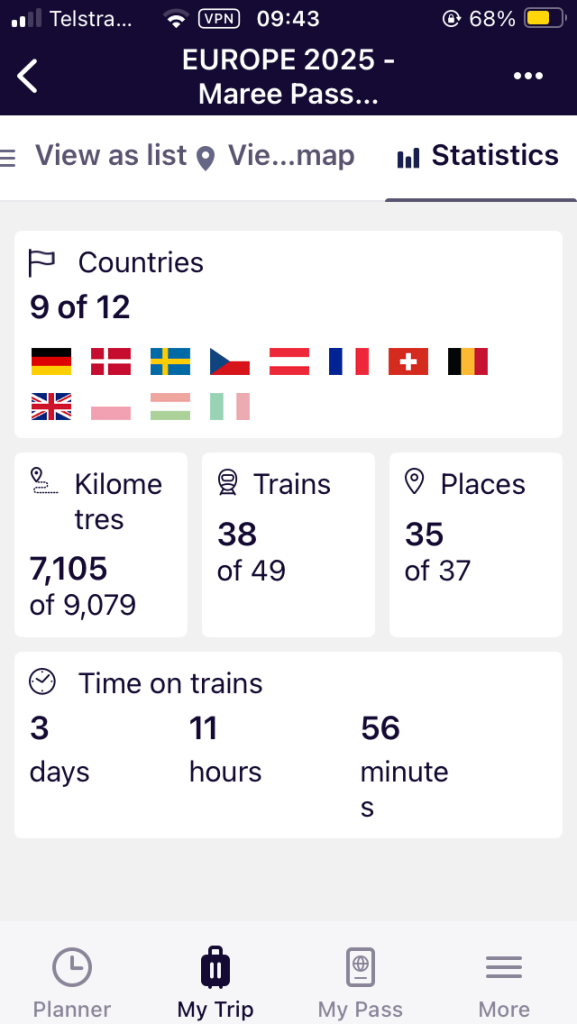
For some reason, the last three country flags aren’t highlighted, even though we did stop and visit those places — so I’m not entirely sure why the app didn’t register them.
Sunday 7 September 2025
We’ve had a wonderful time here in Scotland with my cousin, and today marks our final day before we begin the journey homeward. We’re finishing this chapter with a relaxed lunch at the local golf club, a fitting way to wrap up our stay.
Tomorrow, a Blacklane chauffeur will collect us and drive us to Edinburgh Airport, where we’ll board a direct flight to Munich for a two‑night stopover. We don’t plan to do much sightseeing this time, as we spent the first week of our trip exploring Munich thoroughly.
From there, we continue on our Etihad flight to Singapore via Abu Dhabi, with three nights in Singapore to unwind before the long haul home. The following Sunday, we depart Singapore for Sydney and then Canberra, bringing our two‑and‑a‑half‑month journey to a close.
It’s been a long, memorable adventure, and now the home stretch begins.
Monday 8 September 2025
Today we travelled from Edinburgh to Munich, marking the beginning of our journey home after a wonderful two‑and‑a‑half months exploring Europe.
Our flight left Edinburgh right on schedule, and the trip down to Munich was smooth and uneventful, exactly what you hope for at this stage of a long holiday. The service was operated by AirBaltic on behalf of Lufthansa, and they were excellent: friendly crew, good food, and a relaxed atmosphere that made the short flight surprisingly pleasant.
Once we landed in Munich, we cleared immigration quickly and headed straight to our hotel, the Hilton at the airport. It’s a beautifully presented property, and our room was spacious and comfortable with everything we needed. I’d requested a ground‑floor room because the hotel’s lifts are built with glass on all four sides, not ideal for someone like me who prefers solid walls when heights are involved.
After settling in, we wandered down to the bar for a drink. We weren’t hungry, having already enjoyed the business lounge in Edinburgh and a nice meal on the flight, so a quiet drink felt just right. We chose a local wine similar in style to a Pinot Grigio, and it didn’t disappoint. One glass turned into two as we unwound from the day, and Maree spotted apple strudel on the menu, a temptation she happily gave in to. She was very pleased with that decision.
By the time we finished, the combination of travel, relaxation, and doing very little had caught up with us. It’s funny how a day of “not much at all” can still leave you ready for bed. So we called it a night and headed back to our room, content and ready for the next step of the journey.
Tuesday 9 September 2025
After a wonderfully deep sleep, the kind where you wake up, look at the clock, and realise it’s 11:30, we decided there was absolutely no reason to rush anywhere. The weather outside helped make the decision for us: grey skies, steady drizzle, and that unmistakable Munich winter dampness that encourages you to stay indoors and take it slow. Besides, we’d already spent a full week exploring Munich at the start of our trip, so there was nothing pressing left on the sightseeing list.
Instead, we wandered through the shops in both Terminal 1 and Terminal 2, doing a bit of browsing and people‑watching before stopping for a late brunch. Afterwards, we took a moment to locate tomorrow’s check‑in area for our flight to Abu Dhabi, a small but satisfying piece of travel organisation that always makes the next day feel smoother.
With that done, we retreated to our room for a quiet afternoon of doing very little, which felt like exactly what we needed. Later, we headed down to the Hilton restaurant for dinner, enjoying the calm atmosphere and the luxury of not having a timetable to keep.
Tomorrow’s flight isn’t an early one, so there’s no need for alarms or frantic packing. Just one more relaxed evening before the next stage of the journey begins.
Wednesday 10 September 2025
This morning we walked across to the terminal to catch our flight to Abu Dhabi. With an 11:20 departure, it was one of those rare travel mornings where nothing felt rushed. Check‑in was effortless, and the fast‑track lane for Business Class passengers made security a breeze, always a welcome start to a long travel day.
Etihad doesn’t operate its own lounge in Munich, so we made use of the World Lounge. It was spacious, comfortable, and perfectly adequate for the time of day, with enough food options to tide us over until boarding.
Our aircraft for the flight was one of Etihad’s new Boeing 787‑9s fitted with their latest Business Class suites. The layout is impressive: each passenger has a fully enclosed suite with a sliding door, giving a real sense of privacy and calm. The design feels modern and thoughtfully arranged, with plenty of storage, a wide seat that converts into a fully flat bed, and a large entertainment screen. The cabin is arranged in a staggered 1‑2‑1 configuration, so everyone has direct aisle access, a small detail that makes a big difference on longer flights.
The flight itself was smooth and uneventful, just the way you want it. Service was excellent, warm without being intrusive, and the food was genuinely good. Maree chose the salmon for lunch and said it was delicious, while I opted for the rib‑eye beef, which was surprisingly tender for an inflight meal.
All in all, a very comfortable journey, and a great showcase of Etihad’s new Business Class design.
Short video of Business Class cabin Etihad B787-9 https://youtube.com/shorts/xDvhdg8EjLs
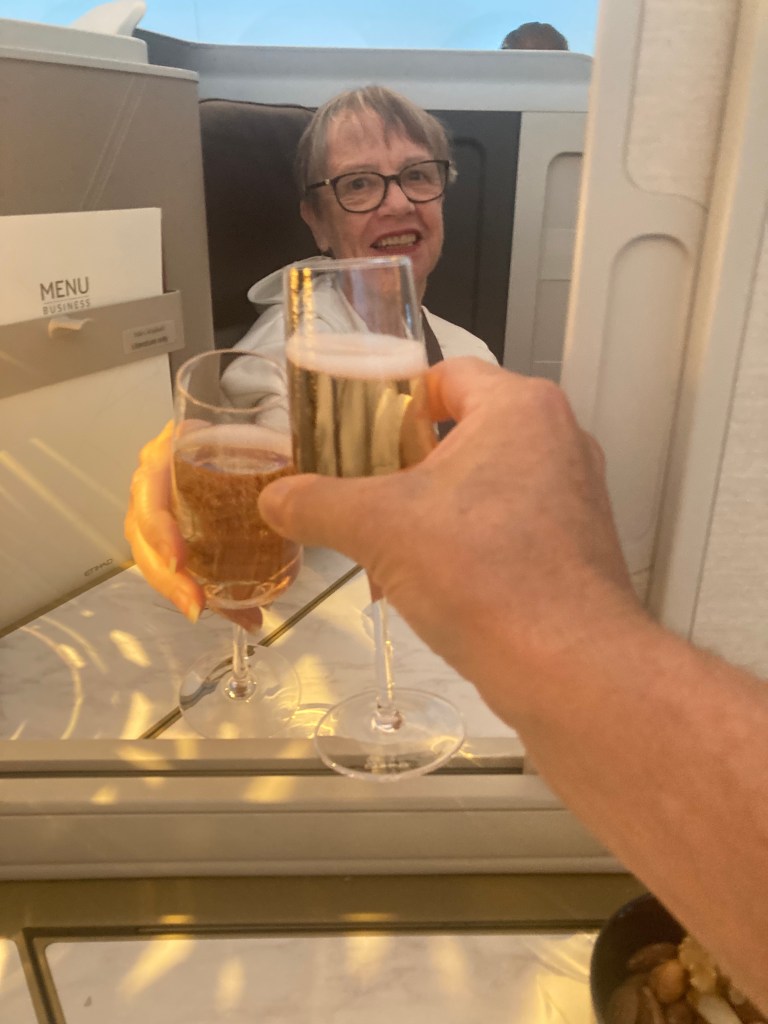
Our flight arrived ahead of schedule, giving us plenty of time before our connection to Singapore. With a three‑hour wait ahead, we made our way straight to the Business Lounge to settle in and relax before the next leg of the journey.
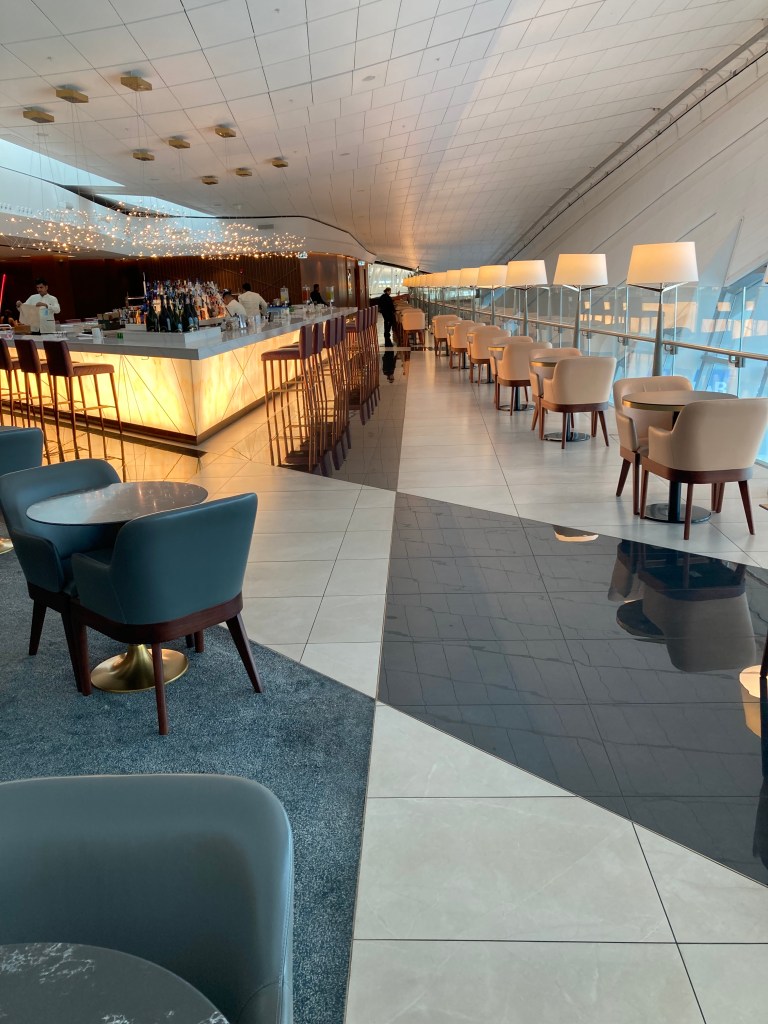
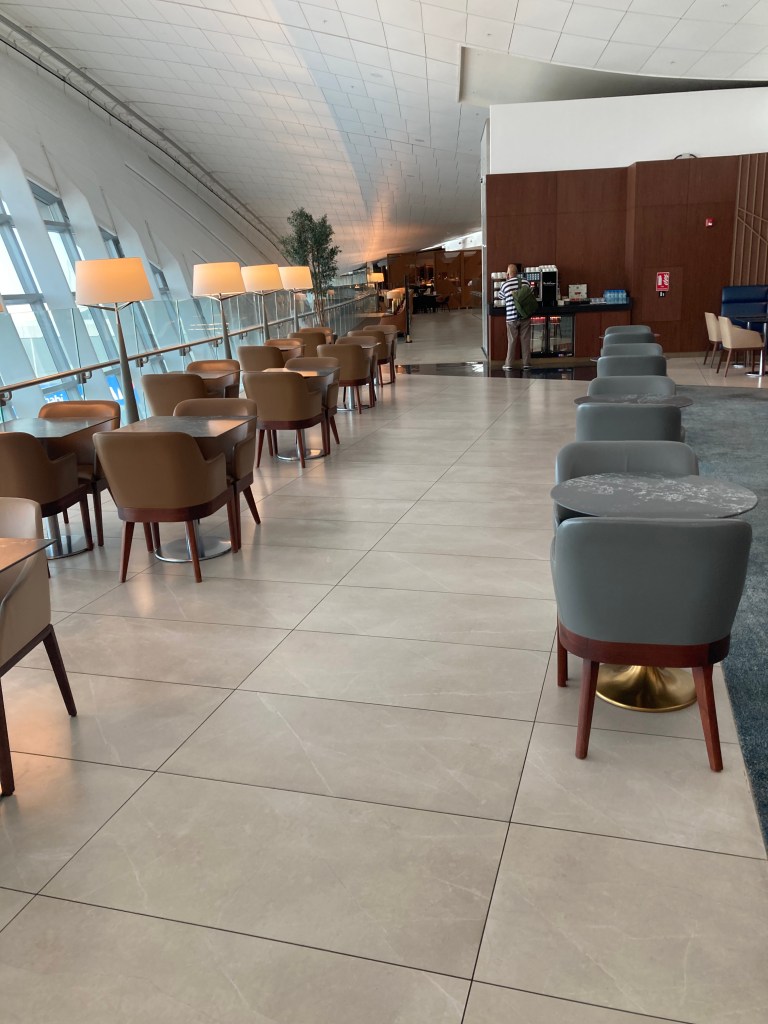
On arrival at the Lounge we were greeted with news we were not anticipating. Our A388 flight to Singapore was delayed. Scheduled departure was 22:30 but it was delayed until 06:00 in the morning. We were given options so we took the option of the hotel accommodation with transfers between the airport and hotel and return. All paid for by Etihad.
So with our hotel booking we started the process of leaving the airport and getting to the hotel. Now this is not as easy as it sounds.
Steps to Exit the Airport and Reach the Hotel
- Leave the lounge and head to the escalator or elevator from Level 3 up to Level 5.
(This is the only way to reach the elevator that goes down to Immigration.) - From Level 5, take the elevator all the way down to Level 0 – Immigration.
- Join the Immigration queue, as we couldn’t use the e‑Gates — these passports hadn’t been used to enter the UAE before.
- Passport check, photo, and fingerprint scans completed.
- Clear Immigration and Customs, finally stepping outside into the arrivals area.
- (But we weren’t done yet.)
- Take another elevator from outside back up to Level 3 to reach the Etihad Service Desk.
- Collect the transport voucher for the taxi from the service desk.
- Take yet another elevator from Level 3 back down to Level 0 to reach the taxi rank.
Only then were we finally on our way to the hotel. The whole process was more exhausting than it sounds, especially because the first two steps are the only route from airside to landside. The escalators are long and exposed, which is not ideal for someone with a height phobia, so elevators were our only option. Thankfully, the elevators have solid metal walls (only the door is glass), but getting to them involved narrow walkways suspended in very open spaces. And with the airport roof soaring 52 metres above, it certainly made my skin crawl. Fortunately, several staff members were kind and understanding, helping me navigate the more challenging sections.
Arrival at the Hotel
The taxi ride to the Rose Hotel in Abu Dhabi took just 20 minutes and was very pleasant. The staff greeted us warmly and mentioned that flight delays, especially for the Singapore service, were common, and many guests that night were in the same situation.
We headed up to Room 1317, dropped our backpacks (our checked luggage was still with the airline), and then made our way down to the bar/restaurant for a much‑needed drink. We chose a bottle of Italian Pinot Grigio. A single 150ml glass was AED 115 (AUD 47), while the full 750ml bottle was AED 195 (AUD 80). The bottle was clearly the better option.
By 21:40, it was time for bed. We’ll be collected at 03:00 for our rescheduled 06:20 departure.
Until tomorrow.
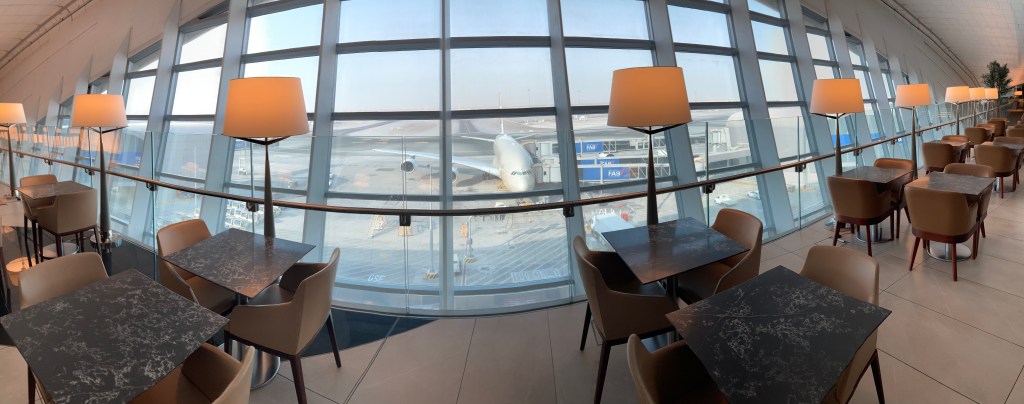
Thursday 11 September 2025
This morning we were collected from our hotel in Abu Dhabi at 03:00 by one of Etihad’s chauffeur vehicles and driven to the international airport for our planned 06:20 departure. At that hour the city is quiet, and the drive was smooth and uneventful — the kind of calm start you hope for before a long travel day.
Once at the airport, we headed straight to Immigration. There was no need to check in, as we’d already been issued our boarding passes the day before, and our luggage was still with the airline from the Munich flight. We cleared Immigration quickly using the eGates and made our way directly to the Etihad Business Lounge. Because the chauffeur dropped us at the departures level (Level 3), we didn’t have to navigate any elevators or escalators to reach the lounge — a small but welcome mercy at 3-something in the morning.
Inside, we went up to the rooftop level on Level 6, found a quiet spot, and settled in for breakfast and coffee while we waited for boarding. Business Class passengers board directly from Level 5 of the lounge, so as boarding time approached, we moved down a level and joined the small group of passengers waiting for the call.
Then 06:00 came… and went.
Passengers began asking questions, and the first update arrived: a “technical issue” with the A380. Staff expected more information at 07:00.
At 07:00, the update was simply that another update would come at 07:30.
At 07:30, the same message — no details, just “technical issue” and “please wait.”
This pattern continued until 09:00, when the announcement finally came: the aircraft was not going anywhere. The flight was cancelled.
For many passengers, this caused immediate panic — a large number were connecting through Singapore later that same day. We, on the other hand, were ending our journey in Singapore and not flying onward until Sunday the 14th, so we had a little more breathing room. When we asked about our options, staff explained that Etihad was allocating another A380 to operate the flight later that night at 21:15. They would provide hotel vouchers, transfers, and meals — at the same hotel we’d stayed in the previous night.
Given the circumstances, returning to the hotel was the most sensible option.
And so, the saga continues.
With our vouchers in hand, we began the process of exiting the terminal once again.
- Leave Level 5 of the lounge and take the elevator down to Level 3.
- Walk for five minutes across the Departures area on Level 3 to reach the only elevator that goes up to Level 5.
- Reminder: You must go up to Level 5 first, because that is where the only elevator to Level 0 (Immigration) is located.
- Take the elevator up to Level 5.
- Follow the zig‑zag walkway through several doors on Level 5 to reach the correct elevator.
- Take that elevator all the way down to Level 0 – Immigration.
- At Level 0, head to the Immigration arrival eGates.
- Receive the inevitable message directing us to the manual processing desk, which I suspected would happen since we hadn’t actually departed on a flight before re‑entering the country.
Essentially, the system can’t automatically process a passenger who clears Immigration to depart (moving from landside to airside) and then later clears Immigration to arrive (moving from airside back to landside) without ever having left the country on a flight. In the system’s eyes, you’re still “on” the original flight until you’ve been officially off‑loaded from it.
Because of that, the automated e‑Gates won’t work — the system needs a manual override to confirm that you didn’t actually depart and that you’re legally re‑entering the country. It’s not a difficult process, but in Abu Dhabi it involves a lengthy manual procedure, which is why it took some time.
So once again we continue:
- From Level 3, we returned to the same elevator that takes you up to Level 5.
- On Level 5, we went straight to the Etihad Service Desk to collect our “off‑load paper,” which confirms that we were officially removed from the cancelled flight.
- With that document in hand, we walked back to the same Level 5 elevator — the only one that goes down to Level 0 for Immigration.
- Once on Level 0, we headed toward Immigration, only to be stopped by an officer at the manual‑processing line.
- We were instructed to go to the Immigration Office on Level 0 to obtain a second document.
This paper verifies the need for the first paper, essentially confirming that we were off‑loaded and that our re‑entry into the UAE needed to be manually authorised.
There was an Immigration Officer speaking to about twenty other passengers, all from our cancelled flight, explaining the situation. He told us the manual processing would take time and that he would handle everyone in batches. The whole procedure was expected to take around two hours. Considering we had been awake since 02:00 and it was now 10:00, we were completely worn out. I turned to Maree and suggested that instead of going through this long process just to leave the airport, we should simply stay put and wait for tonight’s rescheduled flight in the lounge. Maree agreed immediately.
So off we went again — back to our now‑familiar elevator from Level 0 up to Level 5. From there, we cleared security on that level, then walked to the other elevator that takes you down from Level 5 to Level 3, where the Departures area and the Etihad Business Lounge are located.
By 10:20, we were back in the lounge. Only eleven hours to go before our flight to Singapore. I spoke to the Etihad staff member who had originally issued our hotel voucher and thanked her for her help, explaining that we were simply too tired to go through the lengthy exit process and would rather wait in the lounge. She understood completely and asked us to wait a moment while she checked something.
What we didn’t know was that the Etihad lounge has what they call a “relaxation centre” — two large rooms, each containing four private sleeping suites for Business Class passengers to use during long delays. She had gone to see if any were available.
She returned with good news: two rooms would be free from 13:00, and we could use them until our flight departed. We happily accepted. We went upstairs to the rooftop lounge to relax until then, but only a short time later the staff member who manages the relaxation centre came to find us. The passengers who had booked the rooms hadn’t shown up, so we could use them immediately.
It was 11:00 — perfect timing. We thanked her and headed straight there. The rooms were simple but exactly what we needed: a bed, a blanket, a pillow, a small light, charging points, and permanent low lighting. Most importantly, they were wonderfully quiet. After the morning we’d had, it felt like a sanctuary. We knew instantly we’d made the right decision by staying in the airport.
We both slept for four hours and woke up feeling refreshed. Although we had the rooms until 20:00, we felt rested enough to leave early so others could use them.
Feeling human again, we had something to eat, enjoyed a glass of wine, and relaxed in the lounge until our flight was finally called for boarding.
It’s now 21:39 and we’ve just taken off for Singapore. We’re due to arrive at 09:30 tomorrow morning, Friday, where a chauffeur will meet us and take us to the hotel. I booked a car through Blacklane — the company we always use — because after the last 24 hours, the last thing we want is the hassle of finding a taxi. Being met and looked after at the other end will be a welcome comfort.
Saturday 13 September 2025
We arrived in Singapore right on time and were met immediately by our Blacklane driver, who was excellent — friendly, efficient, and exactly the kind of calm presence you want after a long overnight flight. The whole process from touchdown to hotel was seamless. Before we knew it, we were pulling up to the Royal Plaza on Scotts, the same hotel we stayed in at the very start of this journey. It felt almost like closing a loop — familiar, comfortable, and just as welcoming as we remembered. It really is a great hotel and one we’d happily recommend.
After the last 24 hours, today was all about taking it easy. Other than heading out for lunch, we did absolutely nothing — and it was perfect. Having visited Singapore many times before, there was no pressure to rush around or tick off sights. Rest was the priority, and we plan to do exactly the same tomorrow.
Sometimes the best travel days are the quiet ones.
Monday 15 September 2025
Last night we left Singapore for the overnight journey home, choosing to use our frequent‑flyer points for this final leg. That meant flying economy — something we thought would be fine for one last hop. The flight was operated by Qantas but on a Finnair A330 that QF has dry‑leased. (For interest: a wet lease includes aircraft, crew, maintenance, and insurance; a dry lease is just the aircraft, with Qantas providing the crew and operations.) A few of the Finnair crew mentioned they weren’t thrilled with the arrangement, though they didn’t go into detail.
We picked this particular flight because of the 2‑4‑2 seating layout. I’d booked the A and C seats on the left side so we wouldn’t have anyone beside us. The seats themselves were comfortable enough, but the girl in front of Maree reclined her seat fully and stayed that way for the entire flight, leaving Maree with very little space. Most people are considerate in economy — this one wasn’t. That sealed it for us: long‑haul economy is officially off the list for future international travel. Unfortunately, I’ve already booked economy for our December Japan trip, but as we’re travelling with my son and his girlfriend, we’ll just make the best of it.
Now we’re home, and the familiar post‑holiday routine begins — unpacking, sorting, and getting the house back in order after two and a half months away. Alex did a great job looking after everything, but the garden definitely needs some attention after being left to its own devices.
We hope you’ve enjoyed following our travels and sharing the highs, the hiccups, and the unexpected adventures along the way. Our next journey is already on the horizon: Japan, departing 7 December 2025. Another chapter to look forward to.
TRIP EXPENSES



Leave a Reply